



Robinski
-
Posts
4690 -
Joined
-
Last visited
Content Type
Profiles
News
Forums
Blogs
Gallery
Events
Everything posted by Robinski
-
 Apologies that it has taken me so long to get to your submission. I hope that these comments are helpful in some way. Seashell Creatures What a beautiful poem. My eyes misted up as I read it, and there is a serious lump in my throat. My mother is 95, has both vascular dementia and Alzheimer's and now lives in a care home (since March). This resonates with me. Even more so, as my mother is an artist, and watched her (albeit from a distance) lose her ability to paint, then draw, then even form the simplest shapes. I was helping her write a birthday card for my daughter, and I suggest she draw a smiling sun in it, and she could not imagine how to do that. Very, very sad. So, your open resonated strongly in me. If I had a 'critical' observation, it is on the last stanza. Through the poem, it seems to me that the child is distant from the grandmother, as indicated (I think) by the line about the child not knowing the grandmother was anything more than a strange creature lying around. (This actually echoes my relationship with my own grandmother, who I never really new as a person, as she was so old, and almost bedridden when I was young). In the last stanza, the line about the child not being ready seemed a little out of context for that reason. Not that it wouldn't be the case of course, I'm just not sure how clearly we saw the transition from the child being distant to the child 'not being ready' for the grandmother to die. Then, the last two lines. I wasn't particular reading the poem as being about death, but the loss of identity. So, the last line in particular, seemed to me not to be about the main thread of the poem. I was expecting the end to be about the grandmother being 'lost', irrevocably, echoing Line 17, which does talk about death, but also about the loss of self. That loss of self, I think, is the aspect that is arguably not present at the end of the poem, but maybe should be? I don't know. Poetry is a very personal thing. In fact, I think maybe you've inspired me to submit a poem or two of my own. Thank you for submitting this. I really enjoyed reading and thinking about your poem Blue and Orange Do you know what? Placeholder or not, this title is intriguing, refreshing. There are so many possibilities to it, before the reader starts reading. Okay, if it were a book, the cover blurb, and the cover itself would convey exactly what kind of story the reader was going to get (or should do), but here, maybe as a prologue title, it's ripe with possibility, which I love. (page 1) - Wow. Absolutely nailed the first line, and the first paragraph, for me anyway. I'm completely engaged in finding out what's at the top of the mountain, and who Z is. Nicely done. The prose is very smooth, flows and weaves. Im very hopeful for the rest now. - "wind current" - I feel that wind is an air current, so, wind current--to me-sounds like tautology. - "watching the ground get closer and closer" - Nothing 'wrong' with this line, but it sounds to me like the first part of falling, when the ground is very distant. This line could be freighted with my tension, like 'the ground rushing up to meet her', for example. Something that conveys more the energy of falling, the terror of impending death. - "As she let her feet rest on the mountaintop" - (a) This happens quite suddenly. It seems we go from the fear (and therefore the possibility) of failure, to suddenly being their (and safe, to some degree). (b) This phrasing is very passive, BUT, I guess coming in to land is about controlling decent, speed, angle, etc, and I suppose letting the feet touch down. I guess on closer analysis maybe it's natural, but it still reads as passive, I think, compared to how likely it would feel in practice. - "Even as chief" - repetition of 'even' clanged slightly with me as I read this. Whole first page, lovely prose. I'd very happily read this and not critique it, but that's not my remit at this point! (page 2) - "that were so cruel a reflection of the warm peaks from their once-home" - (a) grammar here tripped me up. I don't think the meaning is quite clear in this phrasing. I had to read it three times to get the sense of it. I think 'that were such a cruel reflection of', or something like that, would be much clearer. (b) I feel 'of their once home'. 'from' sounds like the peaks of home move around. 'Here are the peaks from our once home'. Sounds odd to me. - Who is the master? Is it Z? I'm not completely clear on that. - "the continued refusal of..." - The phrase starting here, it's quite complicated and not all that clear, I feel, particularly at the end. - "they had barely enough of the ancient wood" - I think this phrase could be stronger, ramp up the stakes. It's the last chance to return to the glory days, once gone, they'll be cast down in darkness for eternity, etc. (I dunno). I just want the stakes (excuse the pun. You know, wood, stakes...I'll see myself out) to be higher here, at the end of the prologue. - "if the spirits of their ancestors" this, I think, is part of the reason for my confusion before about the punishment and entreaties, because I didn't understand who they were entreating, and who was doing the punishment. - "The ancient logs arranged in a wreath..." - (a) Starting with the noun (the logs), is pretty passive. In this case, I think it makes it hard to parse the meaning from the first part of the sentence. Primacy and Recency is theory (rule?) that says the reader better remember, and gets more impact from, the beginning and end of a sentence or paragraph, and therefore that is where the more important words and sentences should go. Ergo, here, I think starting with the verb would have more impact, as in 'Arranging the logs in a wreath, Z lit...' (b) Logs are big, chunky things, a wreath is a small thing I hang on my door at Christmas, or maybe gets laid on a coffin. These two things don't go together for me. The wreath must be HUGE. - "The logs finally caught the spark" - I think this deserves to be a new paragraph. This is the moment of impact, the ceremony instigated, the moment of truth, and I think it would have the impact it deserves if it were a new paragraph. - It's a good ending, leaving the reader hanging on the outcome. I like that. I feel the tension in her, and the weight of history. It's good. BUT, I do have an issue here. Her thought process is all about whether the other council members will back her, is it not? And yet, there is no vote, no decision process. She does not even have any interaction with them. That is really the only thing about this prologue that leaves me confused. However, it seems to me that it's the central aspect of the whole thing, and it feels like the only inconsistency. I think that needs to be addressed, for clarity. Overall reaction I enjoyed this a good deal. I think it does what a prologue should do: sets up my expectations, engages me in the style, and the possibilities of the story. Even though details are very sparse, I feel I have very much been given promises about lost power regained, the impact of that power on the (unsuspecting?) world, and things like that. I don't for a minute think that Z will appear in the story proper. I'd be kind of surprised if she did, in any major way. I love your prose. I feel it is very high quality, generally uncluttered; easy and pleasurable to read. It does have a poetic flavour, I think, that speaks of epic fantasy, which is very much what I'm expecting now. Good job. Might we see some more of this?
 -
Hah! I was right! Still, I don't think anyone would get upset if you used Arial or Georgia or something. The whole font rule is there (I would assume) to prevent people from submitting with fancy cursive, unreadable fonts they feel fits their character or story. Well, there you go. I feel this is a bit outdated, BUT, some publishers are still very strict about what fonts they will accept. Others are more flexible, and specify a 'plain' font, or specific one or two different options. Anyway, I stand corrected about the guidelines. Also, it appears I haven't been following them for the last 2 years
-
Yeah, please do read the guidelines. Used to be some folks could not handle .docx. I think it's more accepted now. I don't think the guidelines say Time New Roman (Do they? Goodness knows the last time I read them.) The best practice, IMO, would be to treat it like your were submitted to a publisher. Read the guidelines, and/or research proper publishing format, which is something you should be doing anyway. Don't wait until your first submission to a market before you learn who to format. This is a good starting point: https://www.shunn.net/format/
-
Okay, second instalment of comments.Interested indeed to see where this is now, given how I felt about the prologue. Chapter 1 (new version) (page 1) - Double use of 'blade' in the first sentence is really awkward. - "sharp on both sides" - Kind of simplistic. If you are going to write sword fights, you need to convince the reader that you know something about it, unless the character has no skill. There was an excellent example in the WE podcast recently, where Cory Doctorow was talking about how to sound like a gun expert when you don't know that field. His 'trick' was to refer to a 'modified' Walther PPK (for example), which he said would send all the gun-nuts wild trying to figure how it was modified, and that they would forgive anything that the normal gun should not be able to do. Okay, this will not work in all scenarios, and not at all for swords, IMO. For swords, IMO, you need to know enough to be convincing, and you get that by reading sword forums (probably on Reddit, for example), and doing to research, and just reading stories by other writers who have done this already. So, here, I would at least say that the sword has two edges, or is 'double-edged' (Hah! Wouldn't you know, that is a saying for a reason). - "He gave a grin to the other two people" - This is really cluttered, and I noticed you used this in the previous version. He just grins at them, IMO. You don't give people a grin, or give a spit. Extra words hamper flow and cause confusion. - "exchanging dumbstruck looks with one another before looking back at" - Every word on the page should be doing work, and you don't need words that are doing work that's already been done by other words. Okay , maybe this is polish. I cut from my work too, but if it's there, I'm going to comment on it. - "dragonfly" - Huh? I don't understand. - "like it was made by Or.” Or gave her a small scowl, which she gave a grin at" - The odd one of two of these would be okay, I think and I think this one sounds less awkward than the earlier one, but if we're going to get two or three a page, I think it's going to stick out a mile as a style 'tick'. I mean, she can totally just grin at it, rather then giving a grin. Also, new paragraph after the first instance of Or, IMO. - "hardly true.” He protested" - Not a new sentence. 'he protested' is the dialogue tag that belongs at the end of the previous sentence. I'm kind of surprised to have to comment on this kind of stuff, to be honest. - "why Father is letting me leave with" - Is this just his dad? Should not be capitalised. Every time you capitalise a word, it weakens the emphasis on every other word you have capitalised. The fewer the better. - "goes to the capitol" - capital. (page 2) - "truly worthy" - one word, trustworthy. -"Time to go tell Father, he thought, making his way towards his home" - (a) as above. This reads like he's the holy father of the world, supreme being, benign deity; (b) We're in V's POV, so everything is something he thought, therefore, don't need to say this at all; (c) Primary and Recency: this 'rule' says that the things that have the biggest impact with the reader are those at the start and the end of the sentence/paragraph. Therefore, end on something with a bit of momentum, i.e. going to tell father, which pushes the reader into the next section. - "and pulled F from behind his belt" - So, we didn't see the blade tell him his name. This I think is the first instance of the blade being named, so I personally would like it called out that he knows the name, and therefore is withholding that information from his friends. Is that right? - inconsistency in the spelling of sheath/sheathe. (page 3) - "slid the blade back into the sheath, cutting off the Blade’s low hum" - This is repetitive of him experiencing the hum at the top of the previous page. It reads like he's experiencing it for the first time, in the book, but it happened a page ago. Suggest deleting this. - "he began to hear voices" - he heard voices: the time between him beginning to hear it and hearing it I nothing. - "red haired woman" - red-haired woman. It's a compound adjective. 'red haired woman' reads like 'red, haired woman'. - In my opinion, there are too many new names in the one chapter to keep any kind of meaningful track of. The three youngsters talking, fine. The dad's name, fine, and the sword, but there is as cavalcade of new names on Page 3 here, and I've stopped trying to remember them after the first two, because it's just going to confuse me. General note: I like how you are conveying background, setting and probably some plot through dialogue; that's a good idea. I just think it's a bit clunky in places, and does not sound quite as natural as it could. First draft card gets played though. I think a lot of this will refine out quite nicely. And hey, it works fine for Aaron Sorkin, walking and talking. - "from the Guild City " - Why is this capitalised? I'm getting really frustrated with all the capitalisation. It's so unnecessary, like shouting, or capital letters in texts. I mean, look at this sentence: "He had heard of T L before, a F K who had been a bloody mercenary commander from the G C of M whose terrible exploits had been told of even across the entirety of S N" - Nine capitalised words, out of a total of 37, that's 25% of the words in this sentence capitalised. I would seriously rein back on that. - General point: I love the fact that V's dad is some renowned figure of history. That is completely awesome. It's a really strong trope, very satisfying. Surprising and intriguing. (page 4) - "Wasn’t even his son?" - I'm not convinced about the paragraphing. I think this should be in a new paragraph. If nothing else to give it the big emphasis it deserves as being a big old surprising reveal, but also for the fact that it's in his head, whereas the dialogue he's hearing is from her. - "heard the sound of someone spitting" - Will you stop doing that, please? - "trying to get it drawn. He got the blade drawn clumsily" - Really awkward, stuttering action: he tried, and he drew it. (page 5) - "He spat at her feet" - Right, look, you're going to have to explain this to me. What are you trying to achieve with all this spitting? (page 6) - "striking twice with those two wicked blades" - So, is that four strikes or two, total? - "I am sorry I did not get to her" - I think I mentioned this in my comments on the last submission but, because the characters all speak in quite correction language, they all sound the same. There's a major opportunity to create differing characters, or rather to show those differing characters, but treating each person's dialogue differently. Even slightly different 'rules' and patterns of speech between characters can go a long way in this regard. (page 7) - "pack he always kept packed " - awkward word repetition. It's always easy enough to pick a different word: rucksack he kept packed; pack he kept ready. It doesn't need to sound awkward. - "sat waiting by the window" - she told him to go to the hill. I can forgive him for forgetting though. - "The horse is out front" - Which one, there are two? (page 8) - The ending is awkward. For one thing, I don't think he feels enough emotion about his death 'father'. I does not seem that badly affected by it after the first few moments. I mean, one minute he's pissed himself, even though the redhead specifically said she was there to take him away (not to kill him). Then he (a) sees a man killed that he thinks is his father, but (b) has just learned that he's not (maybe); before (c) seeing his attacker and his father's murderer killed by anotherperson he doesn't know. It's so much, and he thinks he's going to die, but recovers almost instantly, and enough to start asking cogent questions? The emotional impact and reaction is way off, for me. Not believable in this form, I think. And then, less than a page later, he's already disobeying the fearsome murderer, having completed regained his courage. I'm not convinced. Overall I'm not a fan of the prologue, but, I like Chapter One better in the sense that it goes straight to the intrigue, and yet...and yet, it's lost the atmosphere of the tavern. Where does the three's conversation take place? I don't have any sense of place. The form of the dialogue and what it conveys is good, but I can't help feeling there's no substance around it, no framework of background and story to give it relevance. I guess the prologue is aimed at doing that, but the prologue feels flimsy to me, and kind of contrived, as not above. There are a lot of good emotional beats in Chp.1 one, but then a whole load more arrive and I can't help feeling it so overloaded with events, and people popping up out of nowhere that's it's difficult to swallow the last bit. I must stress, go tense, conflicting story events and twists, but I don't have time to take them in, they happen so fast, one after another. There's is still an underpinning of good writing, IMO, in terms of the prose, but this feels way more like a first draft that doesn't have the greater degree of polish that the first sub did, IMO. Thanks again sharing
-
I should have added, @sniperfrog, that I continue to enjoy your prose.
-
What the....? Did the world just end? Is this the Twilight Zone?
-
Hey, @sniperfrog, glad to reading this week's submission on time(-ish) Prologue (page 1) - If he's trapped under the horse, how can his breastplate be heaving? Okay, I know his legs can be trapped, but he's gasping for air, which implies to me that he can't take an effective breath, i.e. his chest is constrained. - "dead thing off of his broken body" - You won't see this form in a mainstream published work (in narrative). I never have. The 'of' serves no function grammatically, and clutters up the flow the language. Your choice, of course, but look out for it when you're reading I'll be surprised if you find it any where. - I'm completely lost. Who is talking? Who is J? - "matter of factly" - hyphenated, matter-of-factly. - "could not see the speaker from his place on the ground" - I know you've described a battlefield, but I would like a stronger sense of the environment. Is it warm/cold, sounds/smells? I feel rather remote from what is happening. - "not all powerful" - This need a hyphen too. It's a compound adjective. 'we are not all powerful' means not all of us are powerful, as opposed to 'we are not all-powerful', which I think is what is intended. (You'll have gathered I'm a grammar 'evangelist'. I apologise to nitpicking over this stuff, but I don't feel it's nitpicking. Still, this is a draft, and you're looking for broader comments, I know. I'm trying to learn to overlook this stuff at early stages, so I'll try not to mention any more line edit things.) - "The words made A gasp" - It's the wound in his side that should be making him gasp. I know you get a degree of licence with wounds in fantasy, but an arrow there easily might have punctured a lung. A seems largely unaffected by the wound, and its the horse on top of him that seems his only real impediment. - "weeze" > wheeze. - Huh. I though The J was their god, an omnipresent spiritual being. Slightly thrown that he's tramping around a battlefield. And... The Man of T? I snorted at first, but I'll give you this, it's original, It just................it just seems too meta to me. All I can think of is that the person who does the twisting (in a plot sense) is the author. (page 2) - I don't understand the context of the conversation between The J and the Man of T (Oh, does that mean he's Mr. T?). It sounds all very weighting and portentous, but... - "sit in your hole all this time" - Oh, so is Mr. T the devil? - This dialogue is not convincing to me. For one thing, if one person is speaking to another, they would not use the other's name so often if at all, because they are only speaking between the two of them. The end result is that this all sounds very maid-and-butler. Honestly, I preferred the storyteller in the inn. While that was rather a cliche, it was well done, and a scenario like to happen. This, to me, feels contrived. - "A Bargain.” The T Man said" - Punctuation. I can't go past these things. 'The T man said' is not a complete sentence. Why is bargain capitalised? The more things you capitalise for emphasis, the less emphasis they get. - "There was the sound of spit" - What is it about this book and spitting? Everyone in this book spits! I've never read the like of this before. I don't know what to say. (page 3) - "He looked around wildly" - I mean, we don't actually know that it's a battle. Is it still going on? Is there an army in the field? The landscape feels kind of empty. - Wait, who is S? I'm really quite confused. - "the broken arrow clattering to the ground" - This is a battlefield, presumably churned mud. The arrow is not going to clatter on the ground. - "smooth as a baby’s bottom" - rampant cliche. And he's a decades old man: even in normal conditions his skin will not be a smooth as baby's bottom. (page 4) - "S looked down at the book" - So, who is S? I mean it seems to be Ar, but it's unclear to me what transition happened, and why A accepts being renamed and doesn't question it in any way. Overall I'm posting this up because I'm going to read the new Chapter One tomorrow. I know I had a lot to gripe about in the previous Chp.1, but I still thought it all made sense. I thought you might trim it down, inject some more character, make different choices in some of the more 'familiar' bits. This prologue, it really does nothing for me. I'm confused, and I'm not convinced. For me, the but that I did enjoy was at the end when Ar receives the book and has a chat with the devil. All the stuff before that, I don't think you need it. It sounds forced to me. If I was reading this in a shop, I would not walk out with it. I'm looking forward to reading Chapter One, because I have way more faith that it will give me characters that matter, and hopefully I can invest in as characters I will follow through a novel, instead of ones that I'm confident I'm not going to see again, and don't really grab my attention, because it seems clear that they don't matter as characters. High hopes for Chapter One.
-
The Unicorn King has a nice alteration to it, IMO.
-
Hmm, that's one for the moderators of Creator's Corner, I think. @Silk knows more about these things than I do.
-
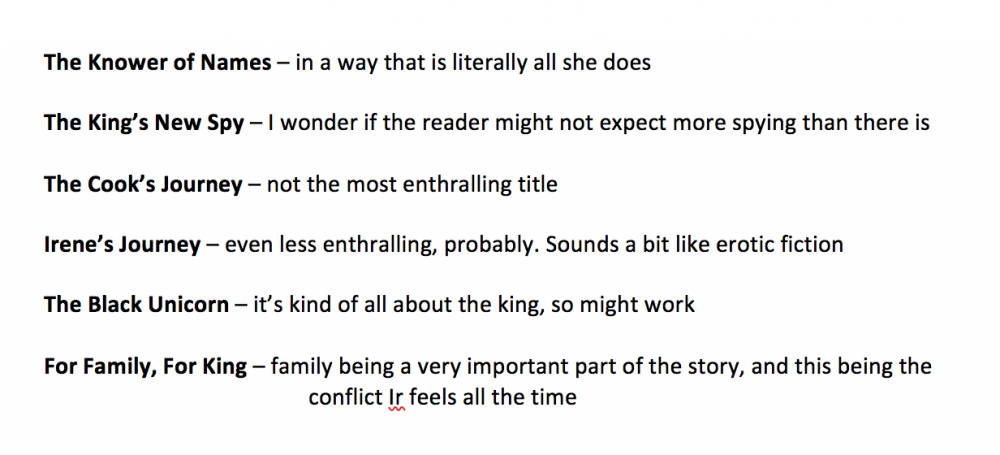
I mean, your title kind of encapsulates a whole strand of the story, but the NotK itself doesn't play a pivotal role in that first book, does it? I don't remember that being the case. I love playing around with titles, but I think maybe I've forgotten too much about the pivotal moments in the story to workshop any titles here. Having said that... And from what we were talking about wrt the search-ability of stuff, images might actually be the most secure way to do this in public forum. It's really easy on my Mac, but might be a footer (hassle) with other systems. Or not. There are a whole host of possibilities, of course, using the names that features in the stories.
-
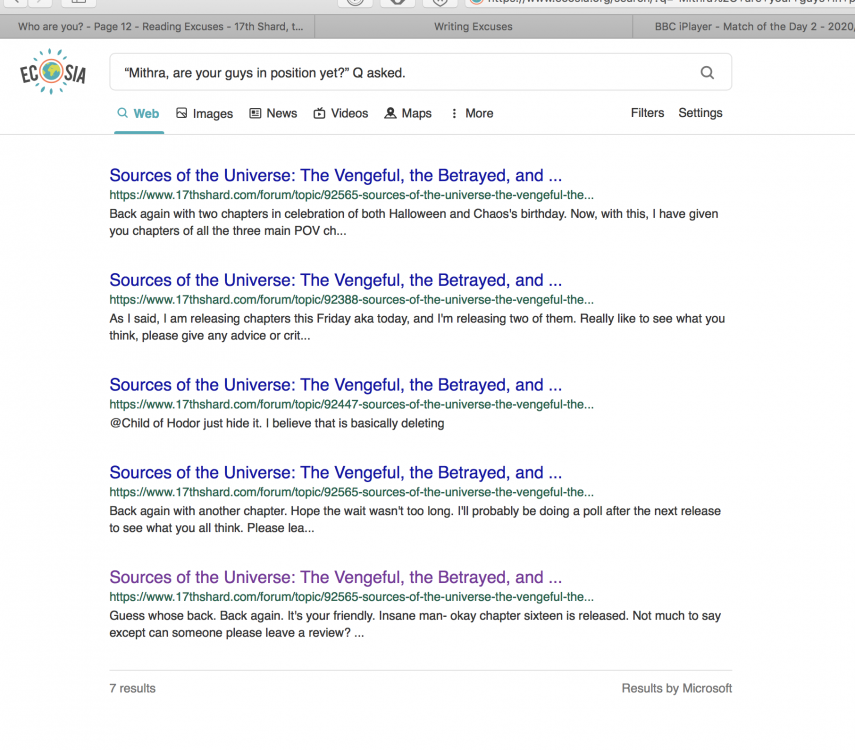
Oh, and I tested to see whether hiding the text of the chapter works, and it doesn't:
-
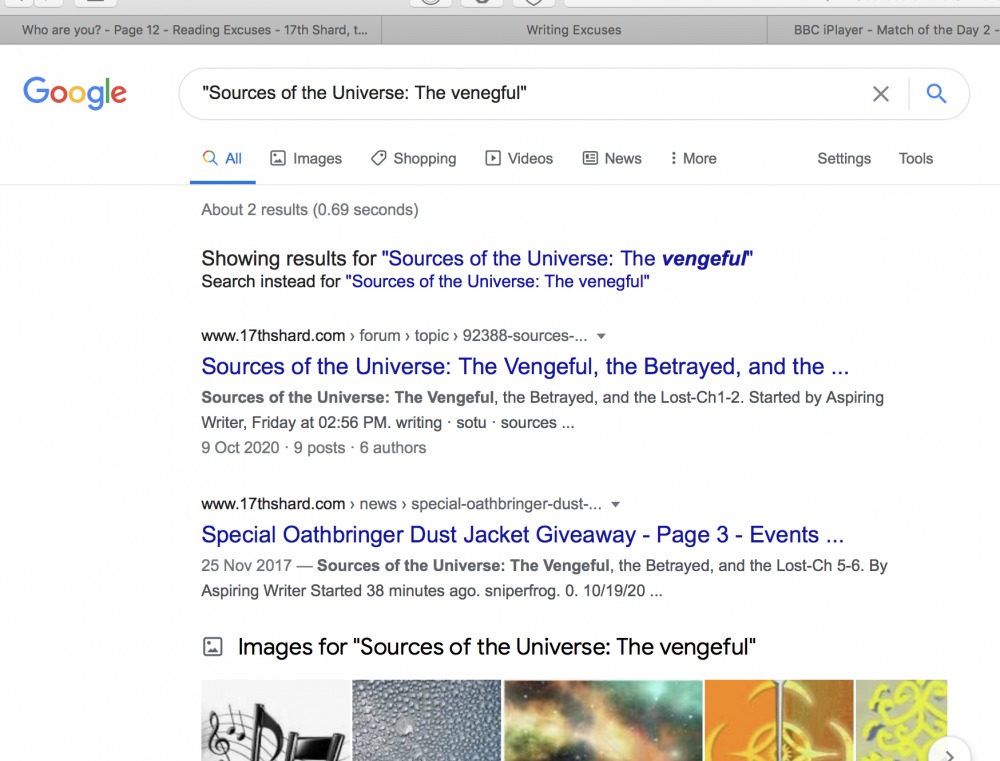
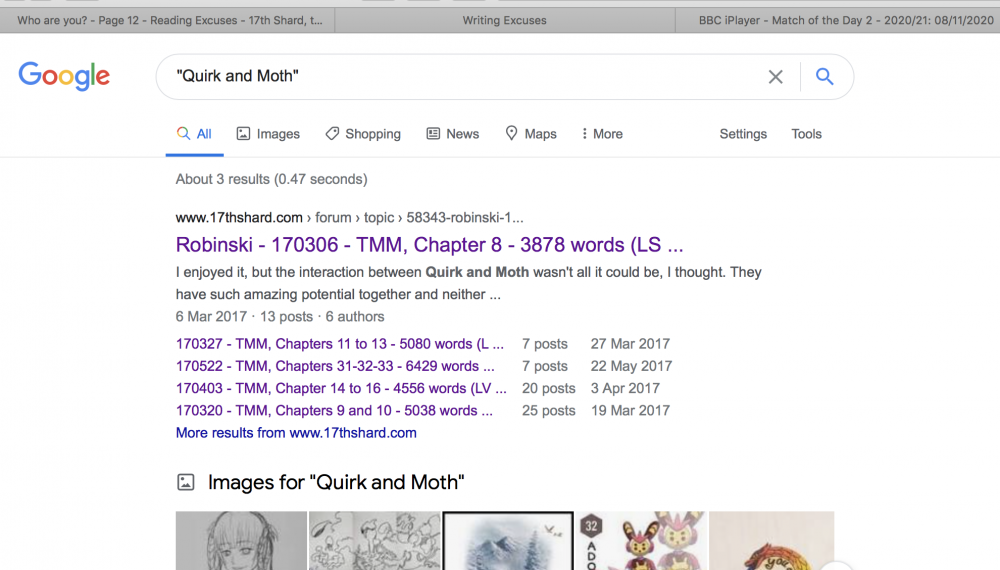
I guess, maybe? The issue on this page is just the sheer volume of exchanges. And with Creator's Corner, I guess people would need actively to request it? That might cut down the number of comments. Just FYI, so I popped over there then searched for a bit of your title, and it did come up, of course, because, search engines. I don't mean to beat you over the head with this, it's just an interesting topic of discussion. We have a page for that of course, and sorry to clutter up the Who Am I? thread with it, but @Silk will move the posts over if she deems it necessary. And here's mine: smaller than it used to be, there used to be dozens, but I went through and abbreviate them all, or so I thought.
-
Yes, this. Here's a example. An agent receives your book called The Cucumber Catastrophe. The first thing the agent does is [generic search engine] your name, and the title of the book. Maybe they find whole chapters of the book posted up on some forum, OR, maybe they find threads on this page, titled with the books name, and a whole bunch of comment from people tearing earlier drafts to pieces. Reaction? This is why we abbreviate all unique names for character, places, etc. in our comments. I abbreviate my book names here too. I subbed a book through called 'TCC' - no, it's not called The Cucumber Catastrophe, although, maybe it should be It still rankles a bit with me that when I [generic search engine] the names if my two main characters, who are a duo, basically, there are 5 or 6 link think still come up when I goggle it. I am going to have to eradicate those (with @Silk's help).
-
Like @ginger_reckoning said, I think popular usage has dropped the sexual connotation, but that is very much part of the actual definition. The key is that the masochist enjoys the pain. It's all about the gratification. So my friend George says, anyway
-
-
Welcome to the group, @Aspiring Writer. It is the place to be Couple of suggestions: (1) - Stop subbing your chapters on Creator's Corner forthwith, (and consider deleting what you have put up there already). Many publishers will look upon putting material out there in such a public way as being a form of publication, which will debar you from publishing with them. There is a grey area about a forum like this, however at least the writing is not accessible by Joe or Joanne public, and has to be obtained through private email list. Even then, certain authors on here have had Silk delete all their critique threads for a project when it went on sub to an agent (publisher?). (2) - If you write you are a writer, not an aspiring writer. I don't mean to take a potshot at your handle, but it sounds very much to me like you have gone way beyond aspiring. Aspiring writers sit in coffee shops browsing the web and wishing they could write something. You've done it; you're a writer. Writers write. You've done that: you're a writer, with an aspiration to be published. Additional information: I'm in a bad mood. I've spent the last 5 days solid writing four reports and was about to issue them to the planning authority and the architect emails me at 4:55pm and says, 'Have you issued the reports yet? Oh, by the way, better take out the bit where you propose an additional pedestrian crossing, not sure we like that. But you did issue the reports that you sent us drafts of TWO DAYS AGO, to comment on, yeah?' Further additional information: I'm a grumpy sod at the best of times. Ask anyone Glad to have you in the group. Silk or I will get your email added so you get subs on Monday coming.
-
10/19/20 - SniperFrog - The Trials -Chapter One (L,S)
Robinski replied to sniperfrog's topic in Reading Excuses
Hard agree. I think the dad is a good strong, silent did type, but most of the characters do feel the same. They can't all be upright, well-spoken reliable types. Agree, but I did not make that assumption. It felt to me like she was pigeon-holed (ooh, is that a Freudian slip?). Well put. I had the same issue. I see a lot of comments about sentence length and choppiness. For what it's worth, I had no problems in that area, <shrugs>. -
10/19/20 - SniperFrog - The Trials -Chapter One (L,S)
Robinski replied to sniperfrog's topic in Reading Excuses
Hi, @sniperfrog. I'm so sorry it's taken me so long to read this, and I hope my comments are still useful. I'm sure you've got much valuable advice from the others, but maybe, just maybe, I might pick something different. Anyway, I was always going to read it, as it's always exciting sampling new voices on the forum. (I am excited, honest! Just been so busy.) So, off I go The grey font: is there a medical reason for that? I know some people have issues with black-on-white. Or is it just my Mac reading it wrong somehow? I don't see how it can be since it's a PDF. If there is no necessity for it, can you please submit standard black on site text. And do not ever send something like this to a publisher, it won't get past the slush pile. (page 1) - "The practice field was empty today" - Soooooo many stories start with some kind or practice/training set up, an apprentice of some kind. It's such a 'familiar trope' / cliché (delete as applicable). The way around this problem of course is to do it brilliantly, like JK Rowling, or Patrick Rothfus (in his case, that word goes in air quotes, since I really like the education/training parts of Name of the Wind, but so much about the book annoys the [REDACTED] out of me). In short, this phrase fills me with trepidation, but I retain on open mind. My fear is that I'm going to read ten pages of people practice fighting with each other. - "He was Focus" - I mean, grammatically, this sounds off, but is 'F' a position? Like 'he was mayor'? Because it can be a verb, it's awkward to get the sense of, I think. - Your prose flows nicely. I'm enjoying that aspect so far. I'm getting a sense of character too, which is so important early on (and everywhere else, of course). - I don't think a wooden sword 'hisses' through the air. My opinion. I feel like it's a deeper sound. If I had a piece of wood to hand I would test this theory. - "People never get what they want, not the way they want" - This doesn't seem right to me: plenty of people get what they want, the way the want it. Especially people who dedicated themselves to getting it. - "V was not the tallest of men, but he was not short either" - There's a school of thought that would pillory you for using 13 words instead of saying 'V was medium height'. I don't subscribe to that: I like the lyricism of this phrasing. I think it's well done. I'm not good enough at describing my characters, and I lament this--especially when reading Jim Butcher, who goes into this kind of interesting detail. There's a lot of character coming through in this. Okay, that character is a bit typical man-of-action hero, but it is well done. (page 2) - I don't see that it's an "impromptu dance", he decided to do this very deliberately, IMO. - tense slip "that come from" (page 4) - Or--i - Lol, are you a Liverpool fan? - "him with his long legs up" - There 's no way of knowing who 'he' is here, since two people are mentioned at the start of the sentence and we don't know either of them. - "He spit to the side" - The monk did this too: repetitive. - "She gave a spit of her own" - Grammar. IMO you don't 'give' a spit, you spit, that's it. Also, why is everyone spitting? It is no officially annoying. - "add to her brothers" - Or is her brother? In that case, it's possessive, to should be brother's. - "as a part of her charm" - Lechery is not charming. And, "enjoying the company of a pretty girl" - this is not what lechery is. For me, this undermines my sense of the M/C's judgement of people. - "on either side" - either side of what? Nice description of the common room though. I get a nice (mostly) clear image, and can imagine smells, sights and sounds, even though you don't describe them. - "all focused on a man at their center" - I bet he's a storyteller. (page 6) - "He was telling another of his histories again" - Yup: cliché. (I don't mean to be harsh, but I've read about 1,200/1,300 submissions on RE (not counting offline alpha/beta reads), and my tolerances are pretty low these days. I expect this will be used as a means to convey world-building. - And he does, which is fine. It's allowed, and it's well written, I think. I just want to be surprised and intrigued at the start of a story. I don't want to be able to predicted each step before it comes, not this easily. BUT, I'm still willing to read because of the quality of the prose. (p.s inconsistent capitalisation of 'stars/Stars'.) - "Carried... lifetimes" - Great line, great paragraph actually. (page 7) - This story, the longer it goes on, sounds less like a story and more like a big info-dump. After the first few paragraphs, it starts to lose its impact. Now, it's sounding like maid-and-butler dialogue. most of the people here must know these things already, about the wars, etc., so very much it sounds now like spoon-feeding the reader. - "Third Meal" - I get why you change this from, say lunch or dinner, to something different, but it sounds really awkward. People tend to shorten long phrases in dialogue. Also, breakfast, lunch and dinner are single, distinct terms that are instantly recognisable to the brain, there is no need to that tiny, tiny time to calculate how many meals one has had that day. I mean, I'm still not really sure if this is lunch or dinner. - "The storm had died down to a light drizzle" that's way too fast for me. he was only speaking for about two minutes after the storm broke, and now it's done? Not believable, IMO. (page 8) - "like his stories," He said, Moving towards" - there are various issues with punctuation. Here is probably the most prominent example to date. Maybe it's an edit remnant, but should be 'like his stories," he said, moving towards...' - "before the ceremony" - what ceremony? Bit vague. Not sure I've got that straight yet. - "gave a spit" - There is way, way, way too much spitting, and it serves no purpose. I'd recommend cutting it completely. - "small coin flashed through the air" - And this is not annoyingly repetitive. it happens too much too close together, and therefore loses its impact, or any amusement when it happened the first time. (page 9) - "make him look like he had to rust" - POV issue. How does he know that? he can't see himself. (page 10) - "My boy, going to train under" - after saying how unlikely it is, Mew seems to then assume it's going to happen, which seem inconsistent with his initial viewpoint. - ...after the ceremony then?" He asked, his proud... - Ok, I had spotted a couple if these, and assumed they were typos, but this should be 'he', I'm sure you know that. Maybe it's auto-corrected? The rest of the prose is so tidy that I'm drawn to these punctuation issues. - "are going to come along" - it just feels so like The Name of the Wind, in places. That low-hanging fruit again. (page 11) - "I figure she is a recruiter for some guild or another" - The voices tend to sound the same. It's less of an issue with the friends, but I think you could have the story feeling more varied and interesting if there was more difference in the speech patterns of the characters. It's a key technique for bringing out character too: you can have background reasons why they speak in certain ways. Low-hanging fruit alert! The most obvious manifestation of this would be a lower class character speaking in a less refined way, but I'd look to go past that. I mean, the class thing is almost a requirement, but I use this as an example of going past the most obvious assumption. E.g. maybe someone caught a fishhook in their mouth at a young age and has a (slight) speech impediment . (I actually knew someone to whom that happened.) - "made me inclined to agree with him" - As I've come to expect in reading this submission, very well written, but I think this neat grammar makes V sound old than he is. - "They continued the rest of their meal" - minor logic quibble, but they haven't started 'the rest of' their meal yet, so they can't continue it. (page 12) - What is a half-covered (hyphenated) pile? Covered with what? - What decision did he make? Confused. - "Calling to him" - I've got misgivings about this. It feels a bit...lame, I think. Mysterious voice calling to him in a dream. And I really don't get why he drops everything. There's no debate, no internal agonising over it, just gets up and goes, not thought about it at all, hardly. - How does he know where to go? - I mean, there is good atmosphere to his leaving the house at night, but I don't really understand his motivation. (page 13) - Wait, what? This black wood place, it seems to be right there on the street. There's no sense of time passing before he walks away from his door and he's in the wood. - "He slowly approached..." - Sometimes a split infinitive is okay, but here it's proper 'to boldly go' awkward, IMO. - Okay, word repetition: (a) He pulled on the other end of the chain there was definitely something attached to the other end of it; (b) He quickly stuck a hand back under the roots and was quickly rewarded for his efforts. There are several more instances in this chapter that I didn't pick up at the time, because I'm trying not to LBL at the moment (Line by line comment), but, this is one of the very few what I would consider slips in the prose. Using the same word twice in one sentence is really awkward to read unless it's done for some kind of dramatic purpose, and I don't get that sense here, I just find myself tripping over the same word(s). (page 14) - fun do rf: my brain just goes to fun-size, or fun-day, or something like that. It feels comedic to me. - "He would be dead before nightfall" - hang on, it's the middle of the night already, surely? - Good last line. I still think there was too much coin tossing, or at least it happened too close together, but this is a good payoff, I'll give you that. Overall Prose: It's neat, tidy, flows well. There are some edits and slips I noticed, but nothing dramatic. Very clean for an early draft, presuming it is an early draft? That aspect alone will get you some browny points with early readers, and encourage people to read further, I think. Low-hanging fruit: I mentioned the plot. The events in this chapter are unsurprising, they did not grip me. The prose works well enough to set up the tension at the end, but it's so unsurprising that he finds a sword, that I just don't get the 'wow' I wanted. I feel I have read pretty much this exact same arc at least a handful of times in Reading Excuses alone over the years. Howard Tayler talks well about low-hanging fruit in the Writing Excuses podcast. I have written about it too many time on here to spool out all the text again. I need to clip it and keep it in a file. The bottom line it, don't settle for the first idea you have, it'll probably be the least original, throw it away and think go something else, maybe throw that away too. Writing needs to have some degree of freshness and interest. Stories need engage the reader with the promise of some kind of originality. I don't get that here. it feels very standard hero's journey. Unengaged 1: I thought his finding the sword was way too easy. He has a dream, goes to the woods, shoves his hand in the improbably soft ground and plucks out a sword. No peril, no try-fail. I think I would have been just as excited for him to find it in a cupboard. Unengaged 2: The other aspect of him finding the sword that I think is rather weak is that I have no real sense of V as a person, as a character. I don't know if I want to root for him. He doesn't seem to have anything much about him character-wise. He's good with a sword...so what? He seems loyal to those around him...good. But what is his motivation in life, what makes him engaging as a character I would want to follow for 400 / 600 pages of epic fantasy? I really need to know that on the first page, in the first line, but it's not there, IMO. E.g. V's a bit of a lad, a bit of a cad. He takes a girl (or a boy) in the forest for a bit of carousing. They up against the tree and his hand goes down into the ground and he finds the sword. Cue conflict with his paramour, and he seems a bit morally ambiguous so we don't know whether he'll do good things or bad. I him to be more ingesting, and I need it fast from the start. I really did enjoy reading your writing, and I think you would write a good, enjoyable novel, but I need the characters to be stronger, most especially the MC, and I'd like the plot and the choices to be more surprising, or for people to react differently, to have more conflict about the place, more tension, more intrigue. I need more to engage me. - Theory 1: I suspect his dad went to see the redhead. I suspect his dad knows who she is, and there is some history there. - Theory 2: Oh, the redhead, the orange(red) sword: coincidence, I don't think so. Thanks for submitting. Sorry for the late comments. I hope that this lot is still of some use. -
10.19.20- SarahB-PlagueShip-2,000words-Chapter1again
Robinski replied to Sarah B's topic in Reading Excuses
Apart from anything else, it's a spelling mistake. I meant 'nous', dang it https://en.wiktionary.org/wiki/nous -
#iagreewithmandamon Yes, definitely: guaranteed. Good point. I still have this feeling too. Comes back to what I said about stakes/motivation. What do these people want? I think we need a little something to show us what is important to each of them, and maybe what they're afraid of. Not a big treatise on each one, exactly the opposite, hints in how they react to thing. I think we get some of that in Chapter 1, but less so in Chp 2. I agree. Totally agree with all @kais's comments and, as usual, I certainly learning something from them
-
Chapter 1 Okay, so--heh--I'm still way behind, but I am determined to get caught up. I'm starting at the bottom of the unposed thread list, and I've read a previous version of this, so, head start. Fair warning, I'm in a bad mood because I have a huge amount of work to do, which is why I ain't been around much. Buckle up, this could be 'direct' - The word 'great' conveys very little. If this is the opening line of the whole book, it needs to be way more engaging than 'great'. Why is it 'great'? What does 'great' look like to this character, who I've never met before? And why do I care? - If it's dark, how can he see the dust? And if there was no dust, he wouldn't be able to see anything anyway, because it's dark. Oh, there's a fire, okay. - 'Small' is another rather rubbish adjective. General purpose adjectives Don't convey enough about the image. Are the flames narrow, or low, or thin? Why are they this way? Every line in a story needs to do double duty. Squeeze every ounce of impact out of every description. - In the space of six lines, I get introduced to five different characters (ace, finger, Am, woman and Ho), and there are three characters contained in two lines (ace, Am, finger). For me, it's too much, I feel like I'm bouncing off one name to the next, thinking who? which? huh? - I'm on page 2 and we're talking about the unit. It feels a bit clunky to me, like I can see the wires the lead back to the author's finger. They are only talking about this so that I can get to hear it, and they don't sound that comfortable or convincing doing it. In other words, this sounds maid-and-butler to me. - "supposed to be finding the bandits" - Third one's a charm, I won't mention this again, but finding is another word that doesn't convey much emotion or tension, but provides the opportunity to do so much more. While I'm on this, 'supposed' is pretty vague. So what are they doing, since this implies they are not doing what they are supposed to? Sorry, back to finding. I'm on the second page or a book and I desperately want to be swept up in the emotion, the tension, the motivations of the character, but I am not really feeling any of that. 'Their job was to coral bandits, track them, capture them, or kill them in the attempt. That was the plan, but it wasn't going that way.' I hate rewriting, I'm sorry, it's terrible critiquing form, and I apologise, but I'm trying to illustrate why I'm not going to read any more of this chapter. As a reader, two pages in, there's very little that I care about. BUT, there are definite plusses here. The m/c has a sense of humour, that can be good, and there is the suggestion of some good byplay between the characters. There is something of the start of a feeling of a tight group (not enough, IMO, on page 1, but I can see it's coming). What he doesn't have I think, is an especially compelling voice. I need to be grabbed by the throat, or maybe the wrist, at the start of a book and dragged into it like putting it down is NOT AN OPTION. The first page needs to smack me around the face and say forget your plans, your next thirty minutes belongs to me, mofo. You are reading this chapter. Okay, that's quite violent imagery, but I mean it figuratively, and I'm trying to get across that the I need more. Chapter 2 - I like going onto new ground. That's good. But...I'm in the desert again, and I'm tracking again, and there is someone crouching behind a rock...again. I feels awfully like the first chapter. - "sun pounded down, merciless" - cliché, IMO. "killing all shade" - Yes! This is good. So much better, IMO, than the first description. I feel like the sun is described twice, but the second one is much more vivid and engaging. - Why would he not have his traditional garb? - "widely interspersed stones" - dispersed, I think? - "like boulders that looked like ducks" also, "no extra limbs, thanks" - S's voice sounds the same as the other POV, to me. I think if you're going to have multiple POVs you want the voices to be distinctly different. - "flip-flop" - This is bothering me. It sounds like a modern term, sounds like the gambling term, makes me feel like we are just off the highway in Nevada, just down the road from Vegas. - "no way a Gif could just live a normal life" - This is where I start to feel some interest. All the stuff with the bird doesn't, stalking etc. is kind of slow, not particularly engaging, IMO, at the point of meeting a new character. - The use of magic is kind of interesting, but it's very random, accidental, and I'm not clear on what's going on. It works 'for some reason'; he 'almost thought' he saw something (he thinks it or he doesn't, you don't almost think something); now the energy wants to be a crack? (we go from him wanting the thing, to the energy wanting it). Telekinesis physically moves things, in this case the hand. Surely the energy that goes into the rock is pure physical energy, the point at which the telekinetic energy in the hand is converted into 'real' physical energy. "It missed the bird by a good six feet" - Eh?! That's kind of ridiculous. The whole point is to use magic to guarantee the outcome. He might as well have thrown the rock himself. Also, why on earth is he bothering throwing rock? Not good through process. Just generate a hand a throttle the bird. OR, more sensible still, why generate a hand at all? Throwing 'manually' involves this degree of hit-and-miss. Why not just move the stone directly? It's the action of throwing that introduces human error. Put energy directly into the stone and aim it at the head. This must be much more accurate. - "telekinesis was still just an imprecise art to him" - disagree, it's not the telekinesis that's imprecise, it's the way he's using it. "If you got the angle or the power wrong by just a little bit, disaster followed" - What disaster? He missed. You wouldn't call missing the target a disaster if you just picked up a stone a threw it. - "that would ruin the whole point" - What is the point? Do we know why he's hunting the 'k'? Maybe I missed that. - "It was DK, his girlfriend" - This is the point at which I stopped. I was already frustrated by S's actions, and various other points I've noted already, but this is just...it's so telling, simplistic; I just feel there's no depth. There's a term 'low-hanging fruit', which may or may not have been coined by Howard Tayler of Writing Excuses. To summarise (and forgive me if you know this already): don't pick the first thing that comes into your head, discard it, because the next thing will be more original, more thoughtful, more inventive. Train your mind to seek out the less obvious and more surprising (and therefore probably more satisfying for the reader) thing. Maybe discard the next one too. Keep going till you wind things that are novel and engaging. I feel that maybe this is what is turning me off this story: I don't get much as of sense of depth, of character, of motivation. I found the prologue promising: people were doing interesting things for interesting reasons. There were machinations afoot, tension, intrigue. After that, we've just been tramping around the desert, and I'm not really sure why. This chapter feels to me like an excuse to show the magic. I don't really see any point to S hunting the creature. There's no real tension, because it doesn't feel like he needs to do it. I would recommend starting at the beginning of the Writing Excuses podcast and listening to a whole bunch of episodes, OR, track down Brandon Sanderson's lecture series on YouTube, which would be a more compressed 'crash course' in a lot of the things that I think would benefit this story in terms of how it's emerging. Sorry not to be more positive . I can see there are ideas here, and some good underlying style, but I think the whole thing needs to have more purpose, to grip the reader, even if it is only mundane things that are happening. If it's a slow opening, I think the characters; internal narrative needs to be more powerful, engaging, surprising, intriguing, if it is not the pot events doing that job at the start. I wish you the best of luck with this. Although, luck has nothing to do with it, of course: it's all about the hard work
-
10.19.20- SarahB-PlagueShip-2,000words-Chapter1again
Robinski replied to Sarah B's topic in Reading Excuses
I hope for your sake there are no 'mechanics' listening Yes, this. #iagreewithmandamon. I thought their attitude was spot on. I think with the technical stuff, you either go full-on, no-holds-barred technobabble with a side-order of handwavium, or you do what Mandamon said, and keep it real general, like 'The pipework was shot, close to useless. It took all of A's massive engineering skill and, unparalleled mechanical nouse to save the entire space-station from destruction, again!' -
Subject to time available, of course Good advice. I'd say it varies from person to person (Ooh, no kidding, Robinski, how amazingly insightful!) For example, if I wait too long to edit, I'll lose the sense of what was happening and the context of the original comments (often). I don't like to leave it longer than a month or two, for an alpha read. For a weekly project going through here, I'll sub a chapter then edit the previous one. Me too. I mean, there's David Farland's tips feed. I've been storing up those nuggets for years, but haven't managed to maintain momentum at going through them. Also, Death of 1,000 Cuts podcast, although I find Tim Clare's advice has become much more about the psychology / mindset of writing over the years.
-
LOL, yes. I tend to think that the next part is always the hardest part. I think editing is like anything else, but the you need to gather the comment, plan your approach, then again--just like writing--give yourself a daily target. That's my approach anyway.
-
That's good. It always helped me that I am suuuuuper competitive in basically everyithing, especially with myself. Yeah. I mean, similar approach could be used. One of those years, I re-wrote the novel I wrote in a previous year. Ach, most of the time now we are streaming, but at the weekend our local internet gets slow/crashy and we wheel out the DVDs. Presently, we are streaming BBC's Spooks (10 seasons, available on iPlayer), and topping off the evening by re-watching Frasier on DVD, interspersed with a rewatch of Magnum: PI (also DVD). (Sorry, @Silk, I know this is Lounge fodder. My bad .)


