



Returned
-
Posts
1019 -
Joined
-
Last visited
Content Type
Profiles
News
Forums
Blogs
Gallery
Events
Everything posted by Returned
-
Sure, and he certainly does like theatrics. I'd argue that using Allomancy radically increases the risk for him, especially in that situation (only skaa around, an obligator who would know about emotional Allomancy, and a nobleman who might be an Allomancer himself). Do we ever see Kelsier play with other nobles that way? I don't recall. I think it's a nice touch that we generally can't know if emotional Allomancy is at work or not, much like a character in the setting can't know (absent an aluminum hat). Breeze even comments on that early on. If your read on the scene is that Kelsier was Rioting Tresting, who is anyone (save Brandon) to tell you otherwise? But as the post asks if others think so, I do not. It's not necessary to produce the effect we see and there isn't anything in particular to suggest that it is happening. We might as well conclude that Kelsier is constantly Soothing and Rioting nearly everyone he ever sees, just because he can and it would heighten the theatrics for him. And maybe he is!
-
I never thought of the possibility that he had. Why would he have used Allomancy that way in this situation? He was trying to stir up skaa to join the rebellion, and an upset Tresting seems a lot more likely to pay closer attention to the skaa and to treat them more harshly. He hadn't even intended to kill Tresting until a heat-of-the-moment event. Whatever else he may be, Kelsier is usually deliberate and careful, with the exception of extreme emotional situations. Frightening Tresting seems contrary to what Kelsier wanted and without any upside.
-
Interesting. My immediate read of sentence was that it's a continuation of the hint that Vasher is Returned. He could immediately have the 5th Heightening if he wanted to (hint part 1), and he couldn't use the the Divine Breath to Awaken things (hint part 2), though that wouldn't clarify if it's impossible to use the Divine Breath that way or just a very final decision to do so. But looking at it again I see a possibility that if the Divine Breath is not suppressed it cannot be used to Awaken, with the implication that if it were suppressed it could be. The only real example we have of a Divine Breath leaving a Returned is Lightsong, and it killed him even though he (presumably) had other Breaths to live off of. But Returned themselves are sort of Awakened, not unlike a super-high-quality Lifeless, and Divine Breaths seem categorically different from regular ones. Maybe an Awakening of an object like Nightblood, but using a Divine Breath instead of a lot of regular Breaths, has a similar effect that produces a categorically different result. Like a Returned compared to an ordinary Nalthian. Though I maintain my belief that Nightblood is the way that he is because the metal used to make the blade is atium or an atium alloy, and not just a product of the Command used or Investing lots of Breath into material that never lived.
-
rhythm of war spoilers adolin kholin
Returned replied to Blue-phoenix186's topic in Stormlight Archive
My prediction is that Adolin's rehabilitation is, in large part, fixing a problem in the Cognitive Realm by way of a Shard other than any of those on Roshar (my guess is Devotion). I don't think that that will grant Adolin any powers, at least on Roshar, as Surgebinding seems to have been pretty neatly locked away by Honor. I expect that Maya will be healed more or less fully. I do think that the implications of that process will be really important to addressing events on Sel, but we may not see that unfold for quite a while and Adolin might not be directly involved. -
Gemstones are commodities on Earth, and so have as much value as people are willing to pay for them in situations where they want to make that trade. I doubt your local grocery store would take a colorful gem-looking fragment inside a glass sphere in exchange for food, but a jeweler might buy or barter for one from you. On Roshar, spheres are currency (a universally accepted medium of exchange among human settlements) but also have intrinsic value due to how they can be used-- they hold Stormlight, so they can light darkness, fuel Soulcasters, and power Surgebinding abilities. A Rosharan would only want an American paper dollar (or any other dollar) if they were going to spend it on Earth, unless a Rosharan collecter wanted one as a weird object to collect or something. "How much is a broam-sized, well-cut emerald worth in dollars of some particular country" is a different question from what I interpreted the question to be asking. The question (as I interpreted it) is more about currency exchange, like U.S. dollars to British pounds or Japanese Yen, and answering that means looking at how much you can buy with one versus the other in either economy. That's what I'm not sure we can sensibly do, because what can be purchased (and how it's valued by people) is so radically different between Earth and Roshar.
-
Hoid definitely already had access to at least one magic, and possibly several, that could be called Lightweaving (among other things), and has used it (or them) in several of the different Cosmere series. But it's a different magic from what Roshar has even though it can produce similar results:
-
It's an intriguing idea, but I think that the biggest obstacle would be the lack of a spren. It would be noticed immediately by actual Stoneward members, and seems like it would be hard to fake given how small spren communities seem to be. If Nazh were especially capable of stealing the Honorblade, it might make a nice price/gift/bribe for someone else, though. Maybe, if Nazh did take it, it's being used to test and experiment with Surges/Investiture on Roshar?
-
I wasn't aware of those WoBs, but thinking about it it makes sense. We know that Vin was able to burn trace concentrations of Allomantic metals in Luthadel's water, and perceive the reserves she gained that way. But we never hear about a Mistborn having a ton of different reserves, or being careful of which they burn, even though they'd certainly be getting similar amounts of trace metals of various kinds. And when Zane's deception with the atium-coated lead ball was revealed Vin only noticed the atium vanishing and didn't seem aware of a different metal inside of her when the lead was all that was left. Lying about fatal, non-Allomantic metals strikes me as a pretty good deception on the Lord Ruler's part. If you're as powerful and rare as a Mistborn you've got a lot to look forward to. Trying to burn some random metal would have to be the lamest possible way to die and lose out on all that. Some Allomantic metals, even really impressive ones like bendalloy, are so toxic that it almost doesn't seem worth the cost as it is. That could be, but from Vin's experiments with aluminum alloys I think it's not likely. A severely mis-proportioned, but valid, alloy probably isn't going to be worse than a totally wrong alloy. And Vin survived quite a few of those.
-
Shoot, I was so sure it was the first feast that when I thought about checking, I figured "nah, you can skip looking this one up". Thanks for the correction, and keeping me honest
-
Welcome! I'm glad to have you and your art here. I'm excited to see more of what you draw and hear more of what you think! Who is your favorite Stormlight character, and which Surges would you most like access to yourself?
-
We don't really know. I'll disagree with what you're describing as the "savant effect" of being a lerasium savant. Usually when people say "savant" with Allomancy they mean you're extra good at using a metal and get extra power out of it compared to a regular Allomancer, like Spook getting vastly better senses from his tin. What's happening with lerasium (as I understand it) is that burning lerasium the "normal" way increases your Connection to Preservation, which grants/enhances Allomantic ability. Burning enough lerasium to become a savant is just burning all the lerasium there could be and achieving a complete Connection to Preservation's power. You're not a savant any more than Sazed was just for taking up the Preservation Shard in the first place; holding all the power is holding all the power, for any Shard, regardless of Allomancy. Even then, Ascending to a Shard is a big deal and is more than just grabbing its power. We may get more information in the future that clarifies things and proves you right, of course. But there are a lot of pieces we don't know, and I think that the ideas that lerasium (or any godmetal) has the same rules and features of proper Allomantic metals, and that Ascension would be a result of savantism with it, are assumptions that go a bit far with what we currently know. That's what I thought, and the first piece of my post above was an attempt to address it that way. Pewter almost certainly shows up as pewter, regardless of the exact mixture of the alloy. Otherwise the following passage, in which Kelsier tells Vin to burn metals to test them, wouldn't be necessary:
-
They probably do still show up, though whether or not an Allomancer can tell if the purity is off without burning them isn't clear. I think that the non-alloy related impurity wouldn't show up differently (so, iron and rusty iron will just be iron to an Allomancer), and alloys are probably discernable by the components but not their proportions (so, pewter is pewter regardless of the proportions of metals in it, whether or not the mixture is ideal for Metallic Arts). Any metal must be perceivable within the Allomancer or else they wouldn't be able to burn it, and we see Vin do just this when she's trying to find new metals in Well of Ascension. We also see Kelsier test some flakes of gold in Final Empire by swallowing them, and while I presume he burned them to test them I don't know for sure that he did. A skilled Tineye might be able to tell more. No idea, as we've never seen it. If the metal has any Allomantic properties, duralumin should release them all in one burst, just like it normally would, even if that burst is less impressive than one from the ideal mixture. If a metal is non-viable it won't actually work like a proper metal would (you'll burn it, but it won't act as a catalyst to draw Investiture from the spiritual realm), so it's not clear if the duralumin would affect it at all or not. Anyways, a totally non-viable metal is fatal if burned, so I don't know that duralumin would be capable of enhancing that or not. Also unclear, but if I had to guess I'd say no. The dividing line, as Kelsier described it, is whether or not a metal is Allomantically useful. A mediocrely constituted alloy will work, but not as well as the right one, and won't make you sick. An alloy containing an Allomantic metal but the wrong other component will make you sick, like with Vin's experiments towards duralumin. A metal or alloy with no Allomantic properties at all is the killer. I'm not quite sure what you're describing as a lerasium/shard alloy or a savant ascending, so I can't weigh in in much detail. I think you mean an alloy of two godmetals, one of the being lerasium? Regardless, becoming a lerasium savant would require so much of the metal that you're essentially taking up all of Presevation's power, which is more or less the same as just taking the Shard. Taking all of the power of two Shards would then, by extension, be more or less the same as taking up the two Shards just as Sazed did. Being a savant would be irrelevant, as the amount of metal you'd need to burn to become one would mean Ascension, which probably supersedes any savantism. A Vessel might conceivably take up another Shard, but I doubt that they'd need to go through the mechanism of burning the Shard's godmetal. But we haven't seen anything like it, and the rules for Shards seem intricate and mysterious. The Shards themselves might interfere given their natures and Intents. I doubt that Leras or Ati could take up Ruin or Preservation during Hero of Ages, for example: the Vessels are so influenced by the Shards that they might not be able to take another which is so opposed to them. But we don't really know much about this. I've been holding off on reading samples of Lost Metal too, so I'm hoping to get more details in just over two weeks! Also, I think that the description of a "higher Shard" may be a bit misleading, unless I'm missing your meaning. The way I'm interpreting it suggests some hierarchy that I'm not certain exists.
-
It was one of the feasts in the warcamps. Wit is insulting people, and asks Renarin if he can speak yet say nothing ridiculous. Renarin responds by saying "nothing ridiculous", which seems to surprise and impress Wit.
-
The Cosmere timeline is a bit fuzzy, but it's very likely that Hoid's Fortune-related ability to be where he needs to be predates Feruchemy altogether. It's always possible that there is more we don't know (there's always another secret!). But Hoid existed before Ruin and Preservation created Scadrial and the people on it, and Feruchemy is uniquely a result of their creation, so he can't be a natural Feruchemist. Next, we don't know of any other way to become a Feruchemist outside of Hemalurgy or Southern Scadrian medallion technology. The downsides of Hemalurgy seem severe enough for Hoid to avoid it, and the medallion technology is much more recent than many of Hoid's interventions around the Cosmere (so his method of accessing Fortune almost certainly predates it). Finally, the balanced nature of Feruchemy would make it an awkward way for him to always be where he needed to be. The time he'd need to spend with reduced Fortune, leaving him unable to be where he needed to be and/or more prone to be where he needed to not be, would defeat the purpose. Hoid lives a dangerous life, and an unlucky Hoid's life might also be quite a bit shorter. He wouldn't have had the option of compounding until the events of Secret History, which again is too late into Hoid's timeline to explain his earlier activities.
-
That's probably the most reliable reason, even if it's not always totally satisfying on a given issue. It's hard to know what Ruin thinks, but we definitely know what it is.
-
As I said, they're just guesses based on a few things we've seen. I don't claim to have any real insight into Ruin's mind. But in the spirit of discussion of your provocative question: The koloss may actually have had a point. They provided a distraction for Vin and Elend, giving them errands to do while Ruin tried to determine where the atium was. And he certainly believed that the atium at least might have been stored in a heavily fortified area which would be defended by soldiers, in which case a large army gathered and brought by Vin and Elend would have been very handy. Who's to say how many is enough? But he could also just have been looking for a good time as events played out, and Koloss do seem like his idea of fun. I'm not sure Ruin was going to bother taking Inquisitors off-world, or cared to take any minions away from Scadrial at all. The epigraph in chapter 47 of Hero of Ages indicates that he wanted to just destroy all of Scadrial instantly: "but he [Ruin] was still too weak to destroy the world in the blink of an eye as he yearned to do. This weakness was caused by part of Ruin's power—his very body—having been taken and hidden from him." It doesn't matter how good the Inquisitors would be off-world if Ruin wasn't going to take them. But I imagine a Shard could keep a few people around through such an event if he felt like it, so that line isn't really a much of a counterpoint. We've also got a description in another epigraph (to chapter 64 of Hero of Ages) that states that Ruin believed he'd have tons of minions anywhere he went anyways: "One must realize that, in Ruin's mind, all men were his minions, particularly those whom he could manipulate directly. He didn't send an Inquisitor because they were busy doing other tasks. Instead, he sent someone who—in his mind—was exactly the same thing as an Inquisitor.". Ruin's got as many minions as there are people, anywhere he goes. Why bother to pack your shampoo if you know there is going to be a bottle of it waiting for you at your destination? As for the "why bother to give Marsh an F-atium spike", I found an (unsourced) WoB on the boards which I couldn't authenticate stating that he didn't-- Marsh got it from one of the other Inquisitors after Vin killed it. I saw that you had a thread touching on similar topics not long after that one so I doubt it's news to you. But even so the larger question still remains: why would Ruin grant such a spike to anyone? I don't think that Ruin would have had any trouble finding a Misting of any variety, including a duralumin gnat. Deific awareness and all that. But more concretely he knew that Vin was Mistborn and her sister a Seeker; similarly, the mists knew whom to snap. I'm not saying that Ruin's plan was awesome and flawless, and he did end up losing in large part through his own arrogant miscalculations. But it doesn't seem so wild to me that Ruin chose not to use the Keepers for his Inquisitors, even if we discount his general lust for ruination (which was almost certainly the Shard itself being expressed, not the thoughtful application of a Vessel, and perhaps irresistible to what was left of Ati at that point). That part of his schemes never failed, and that he could have had stronger Inquisitors than he did seems kind of unimportant.
-
Is Tien talking about color, or Color? Theory time
Returned replied to Honorspring's topic in Cosmere Discussion
Well, yeah. Though I might phrase it as "before era 1 ended" rather than "just for era 1". Before Sazed Ascended lerasium and the Well already existed, and so atium and the Pits probably did too, all likely as effects of the Shards' Investment into the planet. After Harmony's Ascension there isn't any new atium being created. But the atium that already existed before that still exists, exactly as it was. The atium Marsh still has, for example, still exists and allows him to compound youth in order to stay alive. Sure, but I'm not sure how relevant the black smoke is to Ruin's manifestation. It seems like that particular thing was more a product of being trapped in the prison Preservation made (we never see it anywhere else), but you're definitely right to point out that Ruin could have had other manifestations than just atium. I mentioned before that atium is all we know about to help constrain our speculation to things that we know about for sure, so that the discussion can be guesses based in known information rather than guesses based on guesses. Black smoke seems hard to work into a sword, but I wouldn't say it's impossible in the Cosmere. And the similarity between the darkness Nightblood constantly leaks and Ruin's black smoke is a good one to note. I don't think that Nightblood leaks Ruin's body, though. Especially because, when we see Nightblood in action on Roshar, Ruin isn't a distinct thing anymore. Making new Ruin-as-black-smoke shouldn't be more possible than making new Ruin-as-atium is. As for the Perpendicularity, it's true that it was located in the Pits. But that's why Ruin's physical manifestation (atium) coalesced there, not a separate physical manifestation. ETA: While looking for something unrelated I found a WoB stating that Ruin's power was entirely condensed into atium and not into other manifestations like the mists, so I think that my position that atium is the only way to get "Ruin's Investiture" into something like Nightblood is still a solid enough one: Also, for future reference, forum guidelines prefer that additional information be edited into a post rather than double-posting, even if responding to multiple points, posts, or posters. -
That's a great question that I hadn't thought of before! We can only guess at the reasons, I think. But I'll submit a few possibilities that occurred to me: More Hemalurgy is better for Ruin than less. More spikes = more ability to control the spiked being. To the extent that Ruin cared about optimizing his Inquisitors for anything he may well have preferred optimizing for spikes rather than power. Ruin didn't really need more or more powerful Inquisitor servants. The Inquisitors definitely would have won had Vin not drawn on the mists, and once she had no amount of power would have been enough to overwhelm her as she Ascended. Other than that time they always won handily. Destruction is Ruin's thing and efficiency isn't. Even if preserving the maximum possible amount of power would have mattered to events (which it didn't, really, as above), Ruin is both fundamentally opposed to that and actively works towards the opposite. Hemalurgy itself is about degrading powers as they're stolen, after all. Ruining a full Feruchemist's power set to get a slightly weaker single power seems like something he'd be up for. Compounding is a big deal, and using it with certain traits could potentially have disrupted Ruin's control or plans. Sazed already knew about it, at least in theory, and so it's not unreasonable to think that other Keepers might have as well. I could see Ruin thinking "why deal with that, in exchange for nothing?". Ruin was on the verge of destroying the entire planet and everyone and everything on it, and was certain he would succeed. How much point could there be in running up the score before that?
-
Is Tien talking about color, or Color? Theory time
Returned replied to Honorspring's topic in Cosmere Discussion
No idea! We don't know if Shashara knew about Scadrial and atium at all, though it's at least possible that she did. She could also have gotten the atium alloy from a different worldhopper and studied it herself, determining it to be suitable for her purposes. She was an immortal, highly respected scholar and knew enough about Awakening to be aware of the importance of lots of precise details. In trying to Awaken something that was never alive and could not take on a more human form the material might have been very, very important. We know a few things that let us wiggle around some of the unknown details. Multiple alloys of atium exist and are meaningful with regard to Cosmeric properties. What we call "atium" on Scadrial is also an alloy (very slightly) in the first place, with implications we don't yet have a good grasp of. The proportion of one element of an alloy can be very small and still important in the end result, so it's possible that a very small amount of atium would have been enough. We know that godmetals can be alloyed with other metals to produce all kinds of magically relevant things, especially those on Scadrial. These are things like new metals with new properties in all of the Metallic Arts. And we know that, unlike other highly Invested objects (especially metals, like a fully-charged metalmind or a godmetal like a spren's Shardblade), atium can be affected pretty easily by something as simple as a weak steelpush despite being (largely) a godmetal. And atium's properties in Hemalurgy may not be relevant to its properties in Awakening (unless the blade was already a Hemalurgically-charged spike, which I think is less likely than just being the metal itself). And, finally, "Ruin's Investiture" is a pretty vague phrase, but analogous ones suggest that atium is perhaps the only fit for it (at the time that Nightblood was created, at least). Preservation's Investiture manifested as lerasium, mists, and the pool at the Well of Ascension. Ruin's Investiture was only manifested as atium, as far as we know. -
Is Tien talking about color, or Color? Theory time
Returned replied to Honorspring's topic in Cosmere Discussion
I think it's impossible for us to say, if only because we don't know the visualization of the Command Shashara used. Better Commands with better visualizations substantially reduce the number of Breaths needed to Awaken something compared with less precise ones, so knowing that it took 1000 Breaths to Awaken Nightblood doesn't give us a lot of guidance. In any case I would presume it takes more Breaths, rather than fewer, to Awaken something that is otherwise Invested, so if Nightblood was a Hemalurgic spike (or something along those lines) then the 1000 Breath piece is even more impressive. That's just the trend we've seen with interacting magics. We don't know much of anything about Vivenna's sword, which is very frustrating to me! We don't know how many Breaths it took to Awaken, nor the Command used to do so. That it drains color, rather than Investiture, has to matter in a big way, but we don't even know much about the significance of color being what fuels Awakening! I think that it's probably safe to say that Vivenna's sword was created through a different method than Nightblood was, though where the methods differ is obviously all guesswork too. In any case, Vasher isn't/wouldn't be thrilled about Vivenna's sword (per WoB, and it's not yet decided if he's canonically aware of it at this point in the series). But I think that people are too focused on the magical side of creating Nightblood. We know that there are lots of other features that matter to Awakening, like the form of the object, its composition, the inclusion of things like ichor-alcohol, and so on. I don't think that Nightblood's most dramatic features (massive destruction all around, killing anything with just one nick, encouraging evil feelings and actions) are the only reasons Vasher is so opposed to making more. Making something along the lines of Nightblood, using Shashara's method, raises other concerns beyond wanton destruction even if it's no more generally destructive than Vivenna's sword. For what it's worth, I think that Nightblood's blade is made of an atium alloy. That's why it has the general Investiture that it does, why it "steals" Investiture, why it attacks the spirit rather than the body, why its high degree of Investiture wouldn't inhibit its Awakening, and why it's so uncontrollably destructive. -
Is Tien talking about color, or Color? Theory time
Returned replied to Honorspring's topic in Cosmere Discussion
Shashara was killed by Nightblood (wielded by Vasher), per an annotation in Warbreaker (I don't recall an in-text statement that this is the case): But this same annotation indicates that Nightblood had been used in the battle prior to Shashara's death, by Shashara herself, so she almost certainly can't be the first one killed with/by him. From what we've seen of Nightblood in action, and given Shashara's knowledge of him and commitment to the battle, whether or not others were killed with his blade or by his influence/Investiture is not clear and may not matter. But given how far-reaching and devastating the Manywar was it doesn't seem like a wild idea to think that Ruin's influence was involved. Even the war's ending left a broken set of nations, and Nightblood's creation was important to the destruction of the Five Scholars' organized cooperation and their research into Awakening, the development of Nalthis as a whole in its expansion of their own Shard's magics and nature. And at least some Nalthians had worldhopped (they were trying to imitate Shardblades with Nightblood, after all), so it's not unreasonable to think that someone picked up a Hemalurgic spike along the way, or learned of them and then tried to work on a sword whose blade was such a spike... But even so I'm not sold that this is the avenue Ruin's power would have taken to end up in Nightblood. It's a bit... direct for a being like Ati/Ruin, and would be a pretty serious move on Endowment's turf while Ruin had been both restrictively Invested elsewhere and imprisoned for some time (probably; the timeline is a bit fuzzy). An Invested object, like a Hemalurgic spike, is harder to affect with other Investiture and so would be a curious choice for an object to Awaken with an experimental process (though we don't know anything about Shashara and Vasher's research here, so maybe that's a useful, or even necessary, element!). I'd wager that, rather than being directly (or meaningfully) guided by Ruin or Ruin's/Ati's Intent, the way that Nightblood works in attacking someone's spiritweb uses or requires Ruin's power in the same way that making a Hemalurgic spike does to tear off a piece of someone's spiritweb. But who really knows? -
I'm reading The Stormlight Archive for the first time
Returned replied to Amira's topic in Stormlight Archive
There are lots of rules to it (it's not really a spoiler, but Adolin mentions down the line how formalized dueling is in Alethi culture). But the broader issue is that Alethi nobles, like many people ensconced in wealth, privilege, and social scheming, like things to be representative of how they think things should be. Adolin's house is in an odd spot, tarnished and nearly disgraced despite its remaining strength, so he almost kind of should lose just on principle. And if he does win somehow, that "somehow" should involve his fulfilling their expectations exactly and satisfying them fully. They don't want to be forced to acknowledge his victory without Adolin needing to kowtow to them along the way, and having to do so is offensive to them. This is a dueling arena, not a battlefield, after all! We, the readers, may feel that the reaction is ridiculous, but Adolin's victory and the manner in which he achieved it are (at the margins) difficult and unpleasant in the context of what the Alethi nobility view as the pageantry of their lives and the symbols of their social positions. There is also some subtext regarding the semi-sacred, central nature of Shardblades and Plate to Alethi culture and the way in which the princedoms were unified, as well as hints of certain Radiant ideals juxtaposed against Alethi society and the values they claim compared with those they actually live. It's a pretty rich sequence (one of my favorites, as that plotline unfolds) that gets developed further but gives a lot to think about along the way. I think it's one of the more subtly expressed conflicts in the book, but you're thinking about things in the right way to get at those elements. -
End of WoK (obviously, there are spoilers)
Returned replied to Immortal Platypus's topic in Stormlight Archive
It was his Honorblade. -
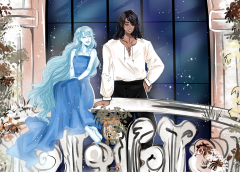 This is my favorite Kaladin and Syl picture to date. The composition and poses are really great, and get at a rare moment and interaction for the characters (especially Kal!).
 -
Could an Animal form a nahel bind and become a surgebinder?
Returned replied to SteelBagel's topic in Stormlight Archive
There is a WoB related to this: So, could an animal form a nahel bond? Yes. Would it be a Radiant-style nahel bond? Probably not, at least not in the sense of being a Windrunner and having access to everything that Windrunners can do. Plants... maybe? I don't see a lot of evidence that they've got what it takes, including souls to affect, nor do we have any examples I can think of offhand of plants on Roshar with bonds.
