



Returned
-
Posts
1018 -
Joined
-
Last visited
Content Type
Profiles
News
Forums
Blogs
Gallery
Events
Everything posted by Returned
-
I also think that this was it. His actual capabilities don't matter very much when he can compound-- with enough zinc he can intuit information in a flash without any real forethought. In a pinch, he'd be able to duplicate the results of the smartest people ever toiling for their entire lives over figuring out some issue or other. And even if he didn't bother and his plans failed, he was a deific, unstoppable killing machine. He almost certainly had the option of accessing unlimited Fortune, if he cared to, with the knowledge of physical science we know he gained during his brief ascension. At his leisure he could be both lucky and good. To the extent that he had an ongoing goal it was resisting Ruin, and he did so brilliantly: his preparations were vital in opposing him and preserving people through the final cataclysms. He deceived a god, one who had millenia of experience and far greater access to all of the powers that Rashek did, sufficiently to lead to that god's downfall even though Ruin was able to arrange his demise. His rule started by letting him express his rage unfettered at the same time his ability to impose his desires on the world expanded radically. By the end it seems like he was very apathetic, not caring much about anything at all (outside of resisting Ruin) and so not really bothering to do much. He didn't care about the quality or nature of his empire, save that he be in charge of it and be able to use it to oppose Ruin. He didn't care if the skaa rebelled, because the nobles and his armies could generally crush them (they always had before!). He didn't care if the nobles thinned themselves out with internecine conflict. He didn't care if life was easy or hard, pleasant or brutal, or anything else. I don't think he was a good ruler, by any definition of "good" I would use, but his empire was how he wanted it to be and accomplished the things he wanted it to accomplish.
-
This is the only way I can see a Bondsmith-comparable situation arising from the Unmade. Honor is about binding in the same way Cultivation is about growth/development, Preservation is about resisting change, Ruin is about destruction, and Odium is about conflict. More influence from Odium in a Nahel bond seems to me would broadly trend towards Odium's fundamental nature-- whether or not they can work with Adhesion in any capacity, that isn't going to be their main thing, and I wouldn't expect their powers to work along that channel (even if they can accomplish similar feats or results). I also think that their powers would be different from binding the Surges, as those seem to have been organized by Honor/Cultivation (and not exactly repeated on other Shardworlds), and it's hard to see greater Surge-based power being available than what Yelig-nar grants (access to all of the powers, or at least the nine that the Fused can make use of). The properties of the spren involved in the bond seem to be really significant, especially in terms of "greatness" (for lack of a more precise word). A lesser spren can bond with creatures, and grant power by doing so, but they don't grant Radiant-level abilities. See, for example, greatshells and Ryshadium. Greater spren can grant Radiant- or Fused-type abilities. But whether or not a Bondsmith spren is a level above even these isn't clear. There are unique, powerful spren which don't form bonds (that we know of), so we don't have a good test case. For that matter we don't even really know that the high status of the spren who have formed Bondsmiths has any effect on the types of powers they grant (would the Nightwatcher be more subject to Cultivation's nature than Honor's? We'll learn more when we see Navani explore her powers), or the degree of power (is Dalinar ultra-powerful because he's bound to an ultra-powerful spren, or is fiddling with Connection via Adhesion just amazing in itself?). Finally, we don't know very much about the nature of the Unmade. Are they effectively spren of Odium, as the spren involved in creating Regals are? Or were they something else, like spren derived from Honor and Cultivation, which were corrupted and may still retain some of their initial natures as far as granting powers? In any case they seem permeated with Odium's essence, which (as above) is associated with conflict like Honor is associated with bonds. Can that power grant a smooth bond, or would binding them involve constant conflict between spren and mortal? I personally think that the latter is the case, based on the description of binding Yelig-nar: try to control the one who comes after. In summary, I don't think that a bond such as the one suggested in this thread can produce a Bondsmith, or even a being with similar powers. Such a bond might produce a very powerful individual, possibly rivaling a Bondsmith, but they will be a thing apart and direct comparison is more likely to be a category error than anything else.
-
Agreed on Maya, and that we don't get more of other characters by having less of Adolin. The Maya piece is still in a "slow build, high tease" situation. I expect it to pay off, handsomely, much like some of the early Kaladin and Shallan sequences. But as Adolin isn't a main character (in the way that those two have been, with books dedicated to them), that's taking longer (more pages which aren't advancing this yet) to play out. Which is fine with me, but I can appreciate that they feel like filler to some people. I imagine it as feeling similar to if WoK ended without Kaladin swearing the second Oath or getting free of Sadeas: the buildup would still be there, and would be just as good and valuable, but the narrative would feel incomplete within that book. I increasingly have the impression that in Adolin we're getting a Kaladin- or Shallan-level plot from WoK or WoR (minus the flashbacks) but spread out over more volumes. I'm not sure I agree that the issue is getting more of other characters and less of Adolin vs. the opposite, but rather about narrative focus. Stormlight is huge, with tons of characters and events, and a constant risk with so much material is loss of focus and awkward pacing. When we have so much of Adolin, and it's nearly all setup and little payoff (so far) for so long, I feel that we're in danger of losing focus on the other characters and their immediately relevant stories. For people that want to see Szeth's story advance, RoW might have been very disappointing (though not due to anything about Adolin). But I can see how opening new story lines for Adolin might be frustrating, particularly for people that don't like him-- not only are they not getting Szeth (which they would never have gotten in RoW anyways), but they're also getting a lot more pages that aren't Szeth and dedicated instead to a character whom they also don't like. The books are getting longer with each release; if Sanderson isn't ready to advance already open stories (which is a legitimate choice, and I wouldn't challenge his vision!), that means that we're getting other stuff instead (and more of it) which isn't the same stuff that drew fans to the series in the first place. Again, I like Adolin and so don't mind this with him, but I can appreciate that some might be frustrated with what feels like a bridge novel to them in terms of what they care about: just another book to buy and read which is just passing time until the next one, which they might find more interesting. Prior to Oathbringer, no. Today, yes (sadly). Though I'll note that I don't think that Adolin's story is just fanservice. While we obviously can't get Szeth's story heading to Shinovar before the overarching plot is ready for it (with connections to events known and unknown to us), we could still get character development or even subplots about or involving him. He could be a player in events of RoW, even if not the central or decisive one. Instead he spends a non-trivial amount of in-world time doing next to nothing, an extra instead of a star or even supporting character. It's possible that the structure and plan for Stormlight is the best possible one, and that there just wasn't another way to do it other than how Sanderson did. But I'm not convinced that that necessarily is the case. Either way, after RoW and Lost Metal I'm less trusting and tolerant than I was before. I'm concerned that we're seeing longer and weaker books than might have been in service of books that don't yet exist, a tradeoff that might not need to happen. I don't lay that at the feet of any one character (and certainly not Adolin), but yes, I do think that we've reached a point where individual books are bloating a bit with fanservice (and other things) to fill out generally slower and more diffuse plot advancement.
-
I'm reading The Stormlight Archive for the first time
Returned replied to Amira's topic in Stormlight Archive
One other thing I especially liked about this scene is that Kaladin honestly confessed that he didn't do it before because he was afraid and apologized for it. I thought it was really introspective and honest, and courageous for him to express his feelings about that failure so openly. He didn't just do the right thing in the end, he also grew by confronting a fault in himself and his behavior. I'm right there with you! But the older I've gotten the more I appreciate being invested enough to suffer that anticipation at all. Some fiction is nothing but climactic events, and sometimes they're even good, but it's the setups and development of characters and events that tend to stick with me. -
If you were a fullborn, what would you use your powers for?
Returned replied to MangoBoi101's topic in Mistborn
Just constantly compounding gold is likely sufficient to overcome any physical damage that could be inflicted on a Fullborn. I'm not sure if we know an upper limit to what that can fix, but when Miles sets off dynamite in his own hand and is fine immediately afterwards we're at a point where physical damage simply isn't going to be enough to put a Fullborn down. Unless you can catch them unprepared and not compounding. But if that's a Fullborn's only meaningful vulnerability, and they know it, then that's unlikely to happen. If you can trap and confine a Fullborn and remove their access to metals you'll be able to cut off their access to more power, potentially forcing them to drain what they've stored until they're as mundane as anyone else (that's how Miles was executed). Anyone can be deceived or tricked, from the lowliest street urchin to Ruin itself. But a prison that could hold a Fullborn with lots of stored attributes seems hard to devise. A Fullborn, regardless of magical strength, is going to be able to compound attributes in ways that make pretty much any attack (or even direct opposition) ineffective as long as the Fullborn can conceive of it. And unlimited access to zinc and copper would tend to let the Fullborn outclass a non-magical person on those fronts, too. We still don't even know the extent of what compounding can do, or even some Feruchemy. If a Feruchemist constantly dumps Identity into aluminum, could they even be identified and located? Who knows? I doubt that there is going to be a generic way to stop a creature with such versatile power, and so much of it, without their adversary having access to magic too. -
If you were a fullborn, what would you use your powers for?
Returned replied to MangoBoi101's topic in Mistborn
I'd definitely go full secrecy, including a secret identity if I had to use my powers openly. As for what I'd use the powers for... "evil" is probably the most succinct description. (Not really, but I'm sure some would find some of my applications... questionable). As far as tasers go, I'd think that pewter would do a lot for you in terms of resisting them. Really, all of the things that the real world could bring to bear on a Fullborn have Metallic Arts solutions (or at least workarounds), provided that you've thought ahead and prepared. Being surprised is pretty dangerous for anyone. -
I'm reading The Stormlight Archive for the first time
Returned replied to Amira's topic in Stormlight Archive
I'm a bit late to it, but the stretch of WoR you're in now is my favorite across all of Stormlight. There's still plenty of awesomeness yet to come, but I still remember my own first readthrough of these chapters. Out of curiosity, do you think that Kaladin is in over his head as well as Shallan? She clearly is, but I'm interested in how you perceive Kaladin's storylines too in that regard. -
Would it be possible for there to be a tiny hole in the aluminum body of the gun, oriented such that it would only be visible to someone holding it (like at the back of the gun, under and behind the hammer)? That would allow for the Vindication-style safety, but wouldn't be very dangerous in a fight with a Coinshot or Lurcher. The vast majority of angles would render the safety invisiible/unpushable/unpullable, except for someone holding the gun. Whether or not that's something that is actually true of the gun, any possible workaround suggests that other workarounds are also possible. A master gunsmith and skilled Lurcher like Ranette is going to be more capable of finding a solution to issues like this than any of us, and so even if the solution isn't presented in-text that doesn't preclude one from existing. But regardless, I think that the above observation that the safety is just not that great of a feature is a good one-- thrown in in the first place as an example of another creative use and extension of Allomancy, but one which never really mattered. It might appeal to a rough-and-tumble gunfighter like Wax, but would be a no-brainer to trade away in favor of something more useful (like an aluminum gun body).
-
I don't, largely based on Vin's struggles with Ruin at the end of HoA. The Shards were so perfectly matched that each one could block the other's efforts to touch the world directly, and when Vin attacked the result was mutual annihilation. I feel comfortable drawing a pretty straight line from that to Sazed's contortions to hold both Shards. But I've also been thinking on this question recently: how potent are Shards, generally, in their ability to influence the realms in which the other characters exist? Actions like those taken by Rashek, Vin, and Sazed really don't happen onscreen elsewhere in the Cosmere books. We know from some things Odium has said that Shards have the raw power and reach to do all kinds of things, but are bound by (as yet) unspecified rules and risks of consequences. Odium felt that he couldn't harm Hoid in RoW, as an example of the former. And Odium was described by the Stormfather as being unwilling to do some things he (presumably) could do because they would leave him vulnerable to attack. I think that there are good reasons why a Shard may prefer such restrained and indirect action, some that we probably know a bit about now and some which we don't. But it is curious that most Shards we've seen are only a little bit more active, at most, in intervening than Harmony. Certainly they aren't running around smiting individuals or cities. They all seem to be playing the game the way that we might expect Autonomy and Endowment to prefer.
-
B1453A58-D96C-4B29-AED0-4362273B7166.png
Returned commented on Rocioplss's gallery image in Stormlight Archive Art
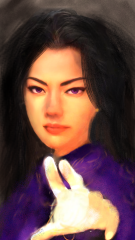 I think you captured the moment really well! Though it's a little bit disconcerting that my perspective is as one of the objects of the lesson...
 -
85542C94-7352-4A04-A1C7-0E4E079F4CA8.jpeg
Returned commented on Rocioplss's gallery image in Stormlight Archive Art
 I love the combination of the light dominating her chest and the depth from shading on her face. The motion in her hair is really nice in the composition too, expressing her windspren-similarity.
 -
I don't think that Connection is the attribute that would most let you do this, as storing it wouldn't make you less noticeable but might make people more suspicious or hostile towards you (we don't really know what Connection storage is like yet). If you wanted to be more of a Gray Man I think that Identity would be a more useful attribute to store here. You're still noticeable, but could people remember who you are? On the other hand, Identity in this sense may be more spiritual than social, so that may not have the desired effect either. Maybe a combination would work better? You blank your Identity and maintain some particular level of Connection, producing someone that no one can quite place as an individual but who definitely belongs where they are.
-
Interesting! I haven't come across too much anti-Adolin sentiment, though that probably has to do more with my timing of joining the forums and the people I happen to speak with in person about the books. At the beginning I liked Adolin because he gave a good angle on the story we weren't getting elsewhere, the "normal" Alethi view (Dalinar had his own stuff going on, Shallan is Veden and had her own stuff going on, and Kaladin and co. were enslaved). I also thought he was a nice foil for Kaladin-- talented, dedicated, and a decent person, but with all the advantages Alethi society can offer while Kaladin experienced all of the class-based injustices that society could mete out. I think that his stories have thinned out a bit since Oathbringer, mainly because we've already seen so much of what he's dedicated his life to (it would be hard to have a continued emphasis on dueling and battlefield domination indefinitely), and because events have diminished what made him unusual in war (Surgebinders flying and gliding everywhere, healing mortal wounds, and so on). His new plotlines have brought in additional details that round him out as a character more, but they're nevertheless not exactly about him as a character, nor his development. I think that we will get some stronger developments in those areas down the line but we're not there yet.
-
No worries, we were all new here once. Welcome! I'd be interested in hearing your views about Adolin, and why you think of him the way you do.
-
I hadn't really been thinking of Adolin sucking as a narrative character, as opposed to as a person, but this is a position I can get behind a bit more. Since I like Adolin I don't mind his POV sections, but there is definitely an opportunity cost to focusing on him instead of other characters when each book is only so long. If forced to choose, I'd rather read about Szeth than Adolin. Adolin may develop into a character who deserves more of the spotlight, and events might be better illuminated with his POV, but we're not there yet.
-
Yikes, is your non-Ookla name "Kaladin from WoK and the first half of WoR"? I like Adolin. He's entitled and spoiled, along with some ignorance about the world that comes along with those, but seems pretty decent to other people and is aware of his station and the incredible good fortune that has placed him in it. As a ridiculously wealthy Alethi nobleman who is adjacent to the throne and is also a full Shardbearer, a master swordsman, an excellent soldier, and is well-regarded by his soldiers, he's too big for the rules the Alethi pretend to care about. The non-fallout of the murder of Torol Sadeas is a good example of that. But even so, he tries to follow those nominal rules and spends a lot of time and effort trying to be a good person, often with good results. He also goes out of his way to prevent abuses of others and protest injustice. He cares enough to rehabilitate a deadeye, which people thought was impossible, and was willing to spend the rest of his life in an honorspren prison to spare Maya the distress of being harassed on the witness stand. He's not perfect by any means, and if you don't like him that's obviously a valid position. I might even agree that he's overrated (by whom, exactly?). But if he flatly sucks, then I think you'll have a hard time saying that anyone on Roshar, or even the broader Cosmere, doesn't. A complaint like "he wasn't punished for killing Sadeas" isn't really a thing about Adolin himself (he wouldn't suck if he'd been disinherited, but he wasn't, so he does?). And while he was a player for sure the details on that are a bit thin, and it's not like he hasn't been 100% faithful to Shallan since she came onto the scene.
-
Unpopular Brandon Sanderson Opinions
Returned replied to not an Evil Librarian's topic in General Brandon Discussion
My unpopular opinion (apologies if it's somewhere upthread, this topic is long!): Sanderson's prolific output is increasingly driven by writing formula and schedule, not inspiration or artistic drive, and it's showing more and more with each release. Quality is subjective, but the books are becoming more simplistic in plotting and structure, less immersive, and more similar to each other. I don't have any problem with more YA-focused books, like the Reckoners, but I'd rather not have that style in Stormlight or Mistborn. There is still a lot to like in everything he writes, and he's still a top writer in the genre. But the scope of the Cosmere isn't well served by more simplistic characters, more simplistic representations, more simplistic plots and scenarios, more lists of magic rules (in a tell-rather-than-show sense), or more catch phrases and fan service. My feeling is that the Cosmere books are tipping ever further in that direction with each release, and that that's largely a result of the packed and punishing schedule he's set for himself. I am concerned for future books, particularly past SA 5. I'd much rather have less frequent releases, even if that means fewer Cosmere releases each year, than get less polished works more often. -
I'm on board with this view, too. I do think that a major reason for the heavy-handed feeling is that Lost Metal is the last book in the sequence, so there wasn't any time or space for more setups, while it also would have been hard to work in appropriate setups in the earlier era 2 books. So for broader Cosmere stuff to be added in it really just had to be dumped in. There wasn't time for subtlety in the way that other Cosmere books have used. Other, non-era 2 books in the future will have more structural ability to incorporate these sorts of elements in ways that are less abrupt and more meaningful to the immediate plot. That said, I disagree with IndigoAjah about the goal being Cosmere-naive writing. I'm excited about the series interacting with each other, and with crossover magics and characters. But the plotting and writing comes first for me. Azure (and, better still, Vasher-as-Zahel) are my touchstone examples of this done well: they are meaningful parts of the stories in which they appear and their introduction, development, and actions are about those stories in which they're embedded. They also happen to be worldhoppers, with lots of implications and details that come along. There were subtle indications early on (Zahel's lifesense, sleeping in a dangerous spot during Highstorms, and others), and later on really obvious indications (Awakening sheets during a fight with Kaladin, Azure cutting sailcloth into roughly human shapes to make Awakening them easier). That's not how things played out in Lost Metal. TwinSoul and Shai (both of whom I like!) were just dropped in, had little to no connection to the setting or events of the book, and didn't do much beyond showing off their non-Scadrian powers. There wasn't any setup about why they were on Scadrial or why they'd joined the Ghostbloods-- they mainly showed up suddenly, inserted themselves into events, and used their powers to immediately solve problems that arbitrarily arose. To me, they came off as vehicles for Investiture-ex-machina more than anything else. I want the crossover stuff, but I want it to be interesting and important to the stories where that stuff happens and not just be there (obviously or subtly). Lost Metal gave me some real concern that we're going to get crossovers that are more artless than what Sanderson has given us so far just in service of the crossovers being present. Sanderson is a master at his craft, and given that I felt that Lost Metal had rougher edges than I expect from him.
-
Congratulations! Good luck on the third book. It's out there somewhere!
-
I think that the idea that Harmony is balance is an unfounded assumption. Sazed, post-ascension, holds two Shards which are balanced against each other due to their opposed natures-- it's holding Ruin and Preservation at once that forces balance. I don't think that that will change as long as those two Shards are held together without any other. Harmony is Sazed's Intent for those balanced forces: he wants them to to exist in tranquility. So Discord should also be constrained by balance because it has the same components which inherently require it, but the Intent won't be tranquil coexistence. What I think will be different about Discord is that instead of balance enforced largely by restraint or inaction (even when Sazed wants a specific outcome), the balance will be enforced by more activity which cancels itself out but which also heightens instability. I don't think that Sazed will have quite the same scope to prefer an outcome and position agents to pursue it but will instead maneuver people (who might, in the past, have been agents of Preservation, Ruin, or Harmony) with goals into positions where they will be forced to contend against each other. He'll end up promoting instability for its own sake, and the outcome will be determined by whoever is able to deal with that. Direct action will still be balanced, not by restraint and inaction, but by Preserving some groups and Ruining others so that there is always maximum friction between people and groups of consequence. I think that we're already seeing a lot of this, and that it's related. Harmony hasn't suddenly become Discord but has been sliding that way for a long time. We've gone from an idyllic people too content to progress (the Elendel Basin) to multiple political groups constantly at each others' throats and essentially refusing to work together (Elendel vs. the Roughs, all vs. Southern Scadrial), for example. I think we'll also see changes from certain "sides" getting help (Harmony sends Wax to save everyone, and sends nothing to the Set) to sending help to all sides (Wax is dispatched for side A and not-Wax is deployed for side B, both sent by Discord). The defining characteristic won't be capability, as Autonomy favors, or arbitrary conflict, as Odium favors, but will instead be fractiousness and disinterest (or inability) in working with others. Under Discord we'll see more factions bitterly opposed to other factions, more coups, more defectors and double-agents, and more of anything that opposes stability, cooperation, or peace.
-
I posted in the "problems with Lost Metal" thread, but I don't want my only posts on the forums to be criticisms of it! So I thought this thread would be a good complement, to talk about things we especially liked about the book that might not need a whole thread. I thought the character work was really good. I thought that everyone's motivations were consistent with previous books, Lost Metal gave great contexts for them to do and show what they needed, and their narrative arcs were very satisfying to me. Steris is a particular favorite of mine, and I really appreciated her rising to her challenges and finding acceptance through embracing her compulsions and responses to them. Her superlative abilities just needed to be in the right place to obviously show their worth, just like Wax needed to be in the Roughs for a while. I loved what we saw of Autonomy. Any time a Shard is on screen is significant, but seeing Autonomy in action sharpened a lot of previous thinking and suggested tons of new details. Especially exciting to me is that, just like Odium's nature means that it can't help but promote conflict even against itself, Autonomy can't help promoting self-determination even from Autonomy itself. And as her campaign of domination continues she's going to increasingly become the main force to oppose. Her greatest champion is also going to be her most dedicated opponent. Awesome. I cannot wait to read those stories as they develop. And her preference for avatars seems like more than just the Shard's nature (more self-determining instances of the power) but also a way to deal with conflict like that, which I find fascinating. The new details about the Cosmere were incredibly intriguing. The implications of a general Stamp are stunning, given how Forgery was previously shown as so limited to specific objects in specific places at specific times. Shai being able to Forge an Elantrian identity is similarly huge. It closes the loop on a lot of previous theorycrafting, and along with the reveal of raw Investiture to drive it we have a lot of new details to use when thinking about crossing magic systems. As there is more travel around the Cosmere and more power-mixing, Forgery is going to become easier to do, much more expansive in what it can do, and much more powerful. I'm also fascinated by the Aethers and their home system. I thought that the dual-conflict narrative was well done. Autonomy was going to invade and conquer, unless the Set conquered it in her name first. They had to save Scadrial, which required them to conquer Scadrial now, which meant blowing up a big part of it. It was a great motivation for a group with a doomsday device not just to have developed one in the first place, but also a compelling reason to actually try to use it. It was also a great way to separate out two antagonists at once, where they were on the same side but not quite the same side, and not really working together. The arc for Sazed, as Harmony, as increasingly unable to act (even indirectly) is moving to me, even if I haven't totally loved the pacing. He has virtually infinite divine power, strong moral beliefs, and worthy goals. But he can't bring all of those together. He must be tortured to be so helpless, even as a god, like reliving his struggle in Hero of Ages again but worse and on a larger scale. I don't know how becoming Discord will interact with that but I really want to see more. There was a lot more to like about the book but I'd rather hear what positive things especially stood out for other people.
-
I felt similarly. It's a good book but not a great one, and I can't shake the feeling that the final evaluation before publishing was essentially that it's good enough. There were issues that felt, to me, like they were balanced on the reservoir of goodwill from dedicated fans more than anything else. And I feel that many of those would have been hard to miss for Sanderson, editors, and advance readers altogether. Too much was teased in BoM which was totally dropped in LM. As I mentioned in another thread, the lack of any specificity at all in explanation for why Metallic Arts medallions are not more widespread or how they work and why they don't work in other ways felt almost insulting to me. Not a huge deal, but it's not like there's a need to keep details hidden for future books. I'm going to read them anyways! The political situation in the Basin was presented as balanced on a knife's edge in SoS and BoM, and remains pretty much the same six years later in LM. That makes protagonists' actions feel less meaningful and hurts my investment in the story and also makes the threats seem less significant. The villains were all back-benchers who were broadly ineffective. Telsin was a letdown compared to BoM, Autonomy was menacing but her army never arrived and she just left. Not-Wax and not-Wayne were interesting enough but their presence felt contrived to me (Autonomy apparently wants a person exactly like you for some reason, so I need to copy you in every possible way? OK, I guess). None of them stacked up to Bleeder or Miles for me in portrayal, motivations, or methods. There was more focus than I would have preferred on Sazed's difficulties holding Preservation and Ruin, given that his difficulty in acting has been a consistent theme for a long time. He's changing, sure, and that matters a lot, sure, but it was kind of a non-factor in this book. I felt like we heard more about Harmony's state in this book than any of the others but also learned less about it, so the focus was unsatisfying. There were too many connections to the broader Cosmere that were there just for the sake of being there. Someone in another thread scolded me (rudely) for not being sufficiently excited about some of those connections and mentioned the Identity safe, for example. The safe is really cool, but didn't interact with the story in any way. It was there just to be there and have its properties described. I might as well have been reading Coppermind about it, not a novel. TwinSoul (a character I really liked!) mattered to the story but mainly in solving an arbitrary problem as soon as it appeared in a way that just happened to showcase his non-Scadrian abilities. Contrast with the potential Skybreakers at the end: they were present, their nature was hinted at but not bluntly blurted out, and they didn't get more attention than their role in the story demands. We're starting to lose the "here's a cool, novel way to apply specific, rules-based magic you know about that makes it useful in addressing problems" approach to "here's an Investiture-ex-machina to resolve any particular problem". Dropped-in magic isn't the crossover magic I've been waiting for. Overall I felt the setup : payoff ratio was way too heavily weighted towards the former for a novel of this length and which caps off a distinct segment of the series. It's obviously incredibly subjective, but I felt this was the weakest Cosmere novel to date. Again, I liked the book, but there was some nontrivial drag.
-
Thank you for the extra detail! I wasn't aware of this kind of safety. The biggest issue I see with a safety like you describe in Vindication is that the angle of the gun relative to the center of mass of someone using seems variable in a way that the 1911 grip safety would not be. It seems to me that it would be difficult to work a grip-style safety if the angle is off even slightly (the force of the push would not just disengage the safety but would transfer through to the overall gun, ruining aim). That seems like a pretty detrimental feature during a gunfight. Maybe there could be some intervening mechanism that would prevent that, but that strikes me as extremely intricate and maybe even delicate (some cool gimbaling, springs, and/or shock-absorbers maybe?). I'm not a gunsmith, nor an Allomancer, so maybe my gut feelings are just off here. A second issue is that it is described as very, very hard for a Coinshot or Lurcher to mediate the force of a Push or Pull. It's generally full-force, with finer control being accomplished through "pulsing" the Push or Pull rather than maintaining it continuously at some lesser intensity. So in that sense a safety which requires continuous Pushing or Pulling seems disastrously difficult to me. The obvious counterargument to this one is that Wax is a fantastically skilled Coinshot and is observed to have exactly that sort of control. And since both Vindications were clearly made with him in mind, that might just be an additional layer of security: even if someone else takes the gun and knows about the safety, good luck using it effectively!
-
Interesting theory! I could see it being true; it's very straightforward and doesn't require a ton of speculation beyond what we know. My thinking on the godmetal(s) is a bit different, but I haven't spent much time considering your suggestion so I may need to revise. As to why Wax was able to produce lerasium, my best guess is that most of the people who were trying to split harmonium were much more strongly aligned with Ruin than Preservation, and not really with Harmony at all. The splitting of harmonium is itself inherently Ruinous (splitting Harmony's body into its constituent Shardic manifestations is destructive towards Harmony himself/itself). These two things combined make it unlikely that there is much Preservation-esque character to the splitting process in its nature or in the Intent of the people carrying it out-- it's all drawing on and manifesting Ruin. Wax, on the other hand, is more balanced in his relationship with Harmony. He's Ruinous for sure, especially when he embraces that aspect of himself (the stairwell scene in Lost Metal!), but I'd wager he's a lot more aligned with Preservation than the Set's weapons researchers.
-
I'm just not seeing the connection you're positing here. Hoid does not care about the survival of Roshar: yes, he says this directly (or, at least, he says that he would sacrifice Roshar to get what he needs). How does that suggest that he's stalling, rather than actively pursuing whatever it is that he needs? Or that Roshar's current war is so central to what he needs? Or that, even if I agree with what you're asserting, once the war ends and Hoid can leave Roshar that means that he's failed? I appreciate that this thread may not be the place to fully lay out all of these cases (and if you've described them elsewhere I haven't seen them, so I may be missing the details you're relying on), but all I see to support these specific ideas is your commitment to them. And they're very specific conclusions, which are then fed back into other speculations. That's not persuasive evidence. Why not? "I'd like some time off to try to start a business." "My brother is sick out in the Roughs town I'm from, I have to go be with my family for now. May I take some time off and return to your service later?" "Your last coachman was also named Hoid? What an odd coincidence! In Elendel, at least. Hoid is a really common name in parts of the Roughs. Parts you're not familiar with." "I know it seems odd to rehire me, but I'm the best horse-calmer and car-driver on Scadrial! If I'm available, you'll want me as your coachman." "Here is some magic you don't know anything about to cause you to rehire me without suspicion." Hoid is a master of misdirection and persuasion who has millennia of experience working people and has access to various arcane magics totally unknown to Wax (and us). He never (as far as we know) operated against Wax in any way, nor supported his opponents in any way, nor did anything at all that was contrary to things that Wax valued or wanted, and likely performed faithful service to Wax while working. It's a good observation that the time skip is a detail Hoid would need to work around, but the idea that he is 100% constrained only to continuous work in his disguise over that period is overdetermined. Your analysis could be correct, but given the setting and the character at issue it's not the only possible way things could have happened.
