



asmodeus
-
Posts
141 -
Joined
-
Last visited
-
Days Won
2
Content Type
Profiles
News
Forums
Blogs
Gallery
Events
Everything posted by asmodeus
-
This isn't special to Moash. Read Eshonai's prologue chapter, and look for what she thinks of Gavilar. Such mentions are also present in many of Dalinar's flashback chapters. Honestly, I don't think this is because of Singer ancestry at all. It's just a theme in the series, and is more a subtle showcase of certain principles of realmatics, and how the Cosmere itself operates.
-
Just adding to the conversation, but there is a bit of an-world debate on what Cognitive Shadows are, precisely. We don't actually know, for sure, if Cognitive Shadows are the same person, or a copy, and it might be that instead of all being one or the other, some are one while others are the other. Relevant WoBs: Basically, there is no Tanavast running around in the Cognitive Realm. The Stormfather was his own being way before Tanavast ever died, but after his death, he is also a weak shadow of Tanavast. How exactly this is possible isn't known, and even the exact specifics aren't known, but both these facts are true and known: that Tanavast is dead, and isn't hanging around in the Cognitive, and that the Stormfather is an heir and Shadow of Tanavast-Honor.
-
Yep, I'm all for this. A Discord user (goes by JennAiel, iirc) threw this around some time ago, and I've been a fan since. Another connection is the "sorrow" Glys keeps mentioning, which may have some connection to the "Keen" in Keenspren, and it also fits with the "Learned and Giving" attributes that Truthwatchers are supposed to have, if you count the "keen" to mean enthusiastic and intellectually sharp.
-
We recently theorised that Nergaoul might be responsible for some of the consistent warlike tendency that the East has displayed. On one hand, you have this quote, from the Sadees, the Sunmaker (WoK Chp 24): On the other, you have these, from Sadeas' PoV in WoR Chp 5: We have these, from Dalinar's flashbacks in OB: See the common elements at play in all of them? Odium reigns indeed.
-
Yes, it does. This is a world and magic of Honor. Honor, unlike Preservation or Ruin, isn't a state of the world independent of life and the living. Honor is about living a certain way. Honor is about being bound by rules you do not have to be bound by. Even the Honorblades, like the Shardblades, have been called "the mark of an Oath." It'd be pretty weird if there was no Oath involved when the original Honorblades were first created and given to the Heralds (probably the Oathpact itself). They are literally _Honor_ blades - why would there not be an Honor component to them? How can there _not_ be an Honor component to them? Then, if the spren copied the Honorblades in creating Surgebinding and the first Surgebinders, wouldn't the requirement of at least one initial Oath come with it? Here's another parallel - when the Heralds decided to break their Oathpact, they left their respective Honorblades behind. When the Radiants broke their Oaths, they left their Shardblades and Shardplates behind. Now, this isn't exactly bulletproof, and you can still argue for a scenario where Oaths were not a part of the first wave of Surgebinding. I just find it weird that any system where Honor plays an integral role wouldn't have an aspect of being bound by some sort of ruleset to get the power.
-

On Bondsmith-spren: A Potential Answer to Why the Sibling Slumbers
asmodeus replied to asmodeus's topic in Stormlight Archive
huh. I did not know this. -
On Bondsmith-spren: A Potential Answer to Why the Sibling Slumbers
asmodeus replied to asmodeus's topic in Stormlight Archive
-
No-one picked or created the Oaths. They are a natural outgrowth of the spren themselves: The Oaths should have been around for as long as there have been spren-bonding human Surgebinders on Roshar, regardless of what Ishar did.
-
Theories about Future Magic Implications
asmodeus replied to honorblades's topic in Cosmere Discussion
From here: -
Probably a case of something gestating in Brandon's mind. A lot of details about the greater Cosmere, including the current minutia of magic in Stormlight, was still being worked out when he was writing and finishing up Mistborn. This is why we have some inconsistencies, like being able to push and pull on Atium, that are just... built into the Cosmere now.
-
Relevant quote for the spren being able to appear and talk to people:
-
On Bondsmith-spren: A Potential Answer to Why the Sibling Slumbers
asmodeus replied to asmodeus's topic in Stormlight Archive
I very much disagree - this is not Mistborn. There, the inaccuracy of the magic charts make sense, as information is being actively suppressed in that world, and we were always going to get the magic explored (introduced and tidied up) several times over, so those charts evolving over time is fine. Stormlight is very different in that regard. The Charts and Religions of this world were deliberately created to carry information as succinctly and in as condensed a manner as possible. Moreover, we're 3/10ths through the story, and we have't gotten that charts updated, and the full narrative itself is going to be covering a period less than a century. While there is some avenue for evolution, it is more likely that the charts hold relevant information than not - particularly when, unlike Mistborn, we still haven't gotten the system and the charts explained to us. Them being wrong doesn't make much sense, because we don't even know what they mean, so there's no payoff. In contrast, we were taught and told exactly what the 10 metals chart was, and why people believed it to be true, before expanding on it and telling us why it was wrong. The 11th metal's very existence, from the beginning of the story, is a potential sign that what people understand is not quite complete, and this plays a crucial role in the whole narrative. Here, we still don't know exactly who made the charts, why they made it this way, and what they meant to convey through it. So then what's the point of having two charts, if they were never even going to be explained? Regarding the two WoBs you posted, I've read them both very differently from you. When Brandon says it's more straightforward than they think in-world, to me it seems the Orders clearly lean or cleanly stem from one shard or the other, and aren't just vaguely "more influenced by x." When Brandon says "Some lean one direction much more than the other," I read it as "Some lean one direction much more than the other direction, while others lean much more in the other direction" not "Some lean one direction much more than the other spren, who don't lean strongly in any direction." The Stormfather, in some form, predating the Shattering makes sense. The Highstorms were always around, and the mechanism by which spren naturally form on Roshar has also been around since then. As intelligent life existed and likely depended on the Highstorms exclusively for investiture and crucial portions of their life-cycle (Singers depend on the Highstorms to form-change, including switching between fertile and non-fertile versions of their gender), a personification of those storms, and as such a spren of the storms having formed is perfectly reasonable. What would have been personified to form the Nightwatcher? This doesn't mean she absolutely can't predate the Shattering - we don't know her well enough to say she doesn't play a crucial role in the ecosystem of Roshar, like the Stormfather does. But still. -
Each Shard's Future Sight Skills and How to Overcome Them.
asmodeus replied to Karger's topic in Cosmere Discussion
Ooh, very interesting ideas here. I really like your take on Ruin. One if the things that I'm more interested in is the orientation of the intent when it comes to self or others, and the impact of that on futuresight. So, Shards like Preservation are better at futuresight, because to best Preserve something, you need to see where and how external factors can break it. And that Preservation is long term - the whole point of keeping something as it is that you _don't_ want it to change, which gives Preservation such thorough futuresight capability. Autonomy is somewhat like Preservation - to keep something Autonomous, you need to see potential "blocking events" which constrict choice or freedom, so Autonomy, imho, should be _really_ good at Futuresight too. But then, how much is her intent also about freeing people from the oppression of others? Ruin isn't like that, to break something, you really don't need long term planning. You just need to look at what something is now, and figure out the cracks, and keep at them to break something. Dominion is in a similar boat to Ruin, for me. It is Conquest, and to defeat something and stand over it, you really just need to get through its defenses now, which is the exact same thing as Ruin, just with a different end-goal. It would be interesting to see what happens then. Establishing Dominion is one thing, but keeping something in control - I'm uncertain if that would require ling-term or short term futuresight. Endowment is a wildcard - we know so little about her. However, if you think about it, the way all the different Returned play into the narrative of Warbreaker, and are playing into the narrative of the Stormlight, points to a remarkable level of futuresight capability. Basically, how much does Endowment know, how far does Endowment see, before she chooses to Return someone? Did she Return Blushweaver having seen a future where Blushweaver would be murdered (without expending her divine breath) and that her murder would inspire _another_ of the Returned to give up their Divine Breath? Because if she did, then that's a pretty incredible domino futuresight. And this would have implications, when it comes to the The Five Scholars, who seem to have had a tremendous impact on the Cosmere. If she Returned them foreseeing their deaths, then you could argue that Shashara was Returned specifically to create Nightblood and then to die at Vasher's hands, and that the impact that had on Denth and Vasher and all the others was intentional and foreseen by Endowment. You could argue that she knew that Denth would die at Vasher's hands, and she really resurrected Denth not just because of what Denth could do himself, but because being who he was, how his life and eventual death would influence people around him was the actual purpose of his second life. If these were indeed intentional, then I would say that Endowment is so good because of her nature as this giver of potential, which naturally comes with the understanding of how this potential affects those endowed with it. So her futuresight is this intricate web of domino endowments, each event endowing others around it with a little bit of potential, and that going back and forth. That makes her scary. -
On Bondsmith-spren: A Potential Answer to Why the Sibling Slumbers
asmodeus replied to asmodeus's topic in Stormlight Archive
There's a difference. The Old Magic is not nearly the same as the Highstorms, it's more... it's like a one-off thing. It's not some passive feature of the world that just exists, and has become central to the ecology. It's more, people can choose to go to Cultivation and/or the Nightwatcher, and she will tweak them in a certain way, and then that tweak stays with them. It's not really a coherent system, it's more people explaining a service the Shard provides, for reasons the Shard has already given. The Stormfather is _not_ the source of Surgebinding. The Stormfather is the spren of Highstorms, and that has been a feature on Roshar that predates even the Shattering. The Highstorms shower the world with investiture, and the ecology of the world has evolved to both take into account the coming of such violent storms, the investiture they provide, and the spren that for some reason seem to form on Roshar. Surgebinding is certain spren copying something that Honor did with the Honorblades, and exactly how all of that works is still extremely uncertain. But because the Highstorms have always existed on Roshar, magic that stems from elements of the ecology and nature of that world also uses it's latent way to access investiture, and hence the Radiants are dependent on the Highstorms for access to Stormlight. The Nightwatcher has not had anything like this. [Spoilers for an excerpt from Rhythm of War] As for this: I don't think this works given what we already know of the Radiants and that whole era. I can tell you my reasoning for why it doesn't work if you want me to. You didn't have to tag me. hmm. This is another way of looking at things, and to be completely frank, I don't think this works as well. Adhesion, Gravitation, Cohesion and Tension are all about bonds, which should be Honor's purview, thematically. Similarly, Abrasion, Progression, Illumination, and Transformation are all based more around changing things, which should make them fall under Cultivation's purview, thematically. Division and Transportation are in the middle. Even Orders, by philosophy and themes, lean under the two Shards almost exactly along the Male-Female divide. The Windrunners and Skybreakers are extremely Honorable, and we can argue that the Willshapers and Stonewards should be too. Bondsmiths are weird. But Elsecallers, Lightweavers, Truthwatchers, Edgedancers, and Dustbringers should have a lot of Cultivation in their theming. I can't really explain it well, because to me this is more intuitive, and I can't really explain it without using my Order predictions, because I've held those in my head for significant periods of time at this point. -
On Bondsmith-spren: A Potential Answer to Why the Sibling Slumbers
asmodeus replied to asmodeus's topic in Stormlight Archive
This is fair criticism, and reading back, I didn't really put my motivation down thoroughly. It's been a tiny pet peeve of mine, ever since I've read OB, how important the Stormfather is to Surgebinding, or to all of Rosharan magic. Because all extensions of "natural" magic on Roshar (like Fabrials and Surgebinding) run and are completely dependent on Stormlight, which the Stormfather is intricately tied to. It makes sense then, that Dalinar, being bonded to the Stormfather, can overcharge people with Stormlight. Without him, none of that magic has any fuel to work. Because that's the Stormfather and the Highstorms' role on Roshar - to provide Stormlight. But it makes him uniquely and disproportionately more important in Surgebinding. In comparison, even before the death of Honor, the other two Bondsmith spren just don't have as clean roles associated with them. That's something that's been on the back of my mind for a while. Then, on one of the conversations on Discord, we had this discussion on the Stone that Szeth was given as a Truthless. And it makes sense for a piece of stone to metaphorically be associated with a promise, right? Stone is something naturally hard, and it endures. Another separate piece was about a discussion on the nature of Stonewards. What would they be like, as people? And there, we have this, from the in-world Words of Radiance: Given Taln, and their attribute of Dependable, it seemed (and I'm still cutting some context here because it's been sometime since this conversation) that the members of this order stick to what they say, like holding to an Oath, but above and beyond what other Radiants also generally do. Like Taln holding to the Oathpact beyond reason. And then there's this conversation in the community that I've seen about Oaths being of Honor and the progression of Oaths being of Cultivation. So when I saw the three connections of Bondsmiths, and I knew the Stormfather was associated with Stormlight and Winds, and I also had this background idea of Taln and the Stonewards being Oath-y, and this association of Stonewards and Oaths, I just put everything together to make one coherent idea. Stone can be metaphorically associated with Oaths, and the Sibling should also be associated with Stone, which establishes a connection between Oaths and the Sibling and then taking this: To mean that as Radiants lost faith in themselves as being worthy of the power they wielded, as they lost faith in their actions being the right course of action, and hence as they lost faith in their own Oaths (something which lead to the Recreance), the Sibling started going to sleep, and Urithiru started loosing it's Radiance. And at the recreance, as the Oaths are broken, that process is complete. The Sibling has been hurt enough, and completely goes to sleep. Urithiru goes completely dark. In the end, I just like that narrative thread. There is a big glaring whole in this theory - the Sibling should predate Surgebinding, so how did they get associated with Oaths so strongly? I don't know that. Mmhmm, I don't disagree with that per se. The Order associations I made was with Herald-gender though, and the Willshaper patron - Kalak - is male, while the Dustbringer patron - Chanarach - is female. Hence Willshapers being more Honor and Dustbringers being more Cultivation on that list. -
On Bondsmith-spren: A Potential Answer to Why the Sibling Slumbers
asmodeus replied to asmodeus's topic in Stormlight Archive
I noticed it. See the Water-Stone connecting line. You could argue that crem-water comes in Highstorms, so the Highstorms must also have a connection to Stone or Cultivation. That's not true, however. Although, do we have anything that connects crem to Cultivation? Because if iirc, that's exactly what Calderis' theory was about. -
On Bondsmith-spren: A Potential Answer to Why the Sibling Slumbers
asmodeus replied to asmodeus's topic in Stormlight Archive
There is more in here that's weird. Truthwatchers are the order whose symbol looks like grass. Renarin sees. His Order has the color green, associated with Emeralds, soulcasting essence Pulp and Body focus hair. Interesting then, that Cultivationspren (the spren that make Edgedancers) are green and have hair made of vines. In the Physical, Cultivationspren look like growing vines. SImilarly, Edgedancers are White (Diamonds), have the Soulcasting Essence Crystal and Body Focus of eyes. Yet, it's the Truthwatchers, whose spren manifests as a ray of light shining through glass and falling on a surface. Now, Edgedancerspren, in the physical, do have crystal in the vines of their spren, and for Truthwatcherspren, when they stop, the light slowly emates from them and amkes the shape of growing plants and leaves. Still, interesting, no? -
I just find it funny that people hate him. This is a world where the literal embodiment of God's own Hatred resides. What'd ya think you'd feel towards people influenced by his ideology?
-
Brandon answered this question here. The Prologue for the Oathbringer Preview appeared on Tor's website on August 22nd, for a November 12th release. So, expect it to start sometime in August for SA4 too.
-
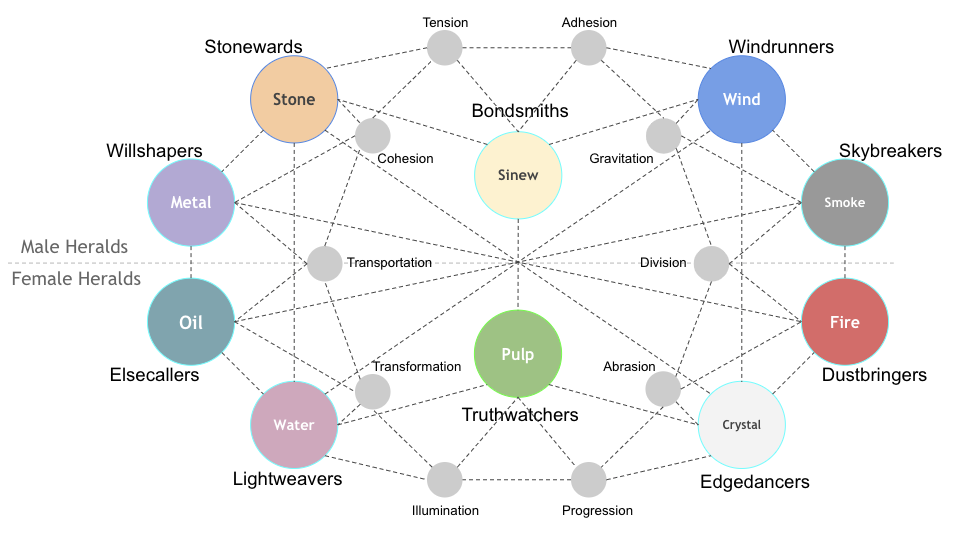
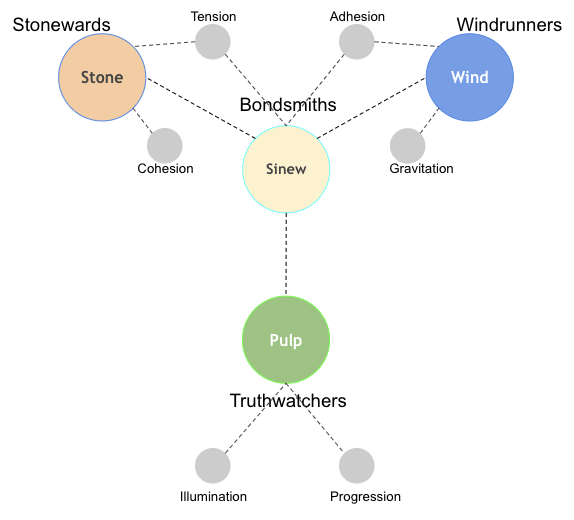
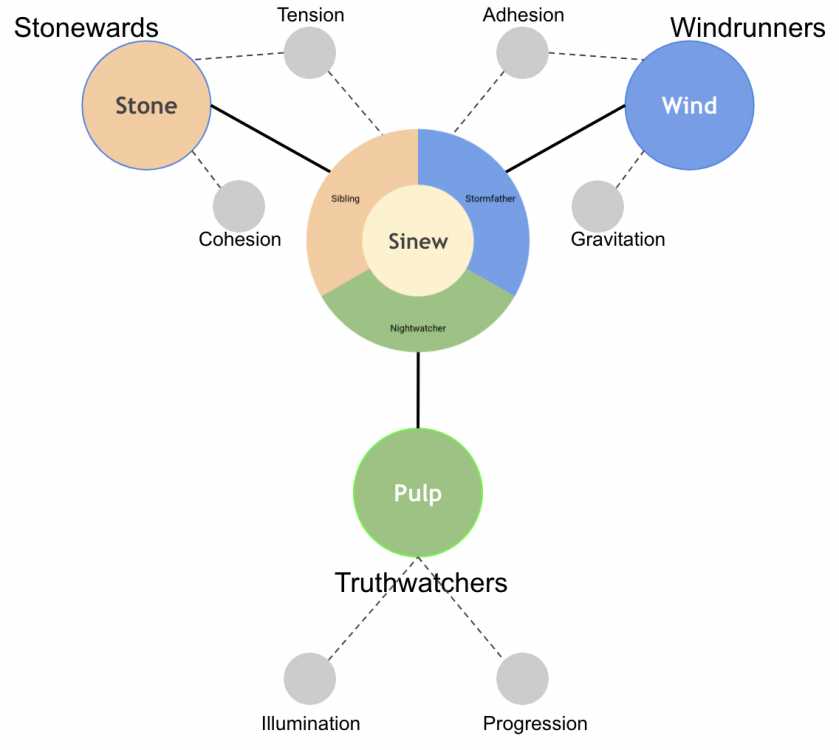
We've all taken jabs at trying to figure out what the Sibling may be about. The Community's Take General consensus is that there's three Shards on Roshar, and three Bondsmiths, so if the Stormfather, the Nightwatcher, and the Sibling are the three Bondsmith spren (which they are), then the Stormfather corresponds to Honor (which he does), the Nightwatcher to Cultivation (which "she" does), and the Sibling either corresponds to Odium, or is a mix in between Honor and Cultivation. For obvious reasons, it wouldn't make sense for the Sibling to be associated with Odium and still be a part of Surgebinding, so we tend to lean towards the "mix between Honor and Cultivation" more. Another general thing we tend to believe about the Sibling is that they are tied to Urithiru in some way, and may power even power the city. And the last well believed fact about the Sibling is that they are intricately tied to Stone. I know Calderis has a theory on why the Nightwatcher might be stone instead, but that's his to discuss. I'm gonna try and offer a different take on some of these points, and provide additional context to others. Whose magic is Surgebinding? The question asks it all. There's some fuzziness with what happened on Ashyn, but from what we know, the specific powerset of Radiant Surgebinding was first seen in the Honorblades. This implies that the exact specifics, at least, were first defined by Honor. If you look at the Heralds, we have 5 Male Heralds and 5 Female Heralds - a near perfect divide, with all the Male Heralds bunched up around what seems to be the Honor-half of the chart, whereas the Female Heralds bunched up around the Cultivation-half. Then we have spren copying Honorblades. This fact alone makes things very fuzzy. On one side, the spren are... essentially on a spectrum of Honor and Cultivation, with some spren having more Honor and others having more Cultivation. Yet others, like the Stormfather and Nightwatcher, are almost guaranteed to be nearly a 100% one or the other. But the pattern breaks a little if you try and match the spren to the Heralds. By association, a.) Windrunners, Skybreakers, Willshapers, Stonewards and Bondsmiths should be closer to Honor, whereas b.) Dustbringers, Edgedancers, Truthwatchers, Lightweavers and Elsecallers should lean towards Cultivation. And this works, until you look at the Bondsmiths. The Nightwatcher, who should practically be all Cultivation, is a Bondsmith spren, meaning that in Surgebinding, Cultivation is technically more present than Honor. This is despite Brandon telling us on atleast one occasion that the original Knights Radiants were focused more on Honor and his spren (which, depending on how you read it, could and couldn't conflict with Cultivation's presence in the magic). There's a third way of dividing the system too. You could theoretically say that Surgebinding is of both Shards because a.) All Radiants speak Oaths, which come from Honor, and b.) All Radiants have to grow over a total of five Oaths, which evokes the presence of Cultivation I'm going to put forth the idea that there is a third element here, but let's hold these two in mind, for now. When in doubt, stare at the Surgebinding Chart. When most people think of what the Surgebinding Chart tells us, they tend to think that all it tells us is that there are 10 orders, 10 Surges, and that each order gets 2 Surges, and that each Surge is shared between two orders, in a cyclic pattern. Usually, we tend to think that all the extra connections don't matter, and that they're there just for fluff. But, @Master_Moridinfound something interesting. The extra connections start making somewhat more sense once you pull in the Soulcasting Essences. Here's the full graph, and because not all of you are maniacs who have it by heart, I've gone forth and labeled it too: (it is definitely interesting that the whole thing looks like a gemstone) Smoke, for example, is connected to Fire, Wind, and Oil. Stone connects to metal, crystal (both come from the ground), water (crem), and flesh/meat/sinew (don't ask). They don't all immediately fall in place, because we think there's more weight to these connections in a metaphorical or philosophical sense, and there are also some thematic Order connections that we're wondering about. The Actual Theory However, an interesting thing happens when we zoom in on the Bondsmiths. Usually, when we think of the Bondsmiths, we think that they have two surges (Adhesion and Tension), and are adjacent to Windrunners (by Adhesion), and Stonewards (by Tension). Which is fine, except in the full chart, Bondsmiths don't have two, but three adjacent Orders: The Stormfather tells Dalinar that his is the power of Connection, so I can see why "Sinew" or "Flesh/Meat" could be associated with his order. But the interesting thing is the three (yep, three) essences they connect to - Wind, Stone, and Pulp/Wood/Plant Matter. I could sit here and establish a line of reasoning from the Essences to the three Bondsmith spren, but it's pretty simple from here on out. The Eila Stele mentions three Gods, of Wind, Spren and Stone. The Wind can pretty easily be attributed to the Stormfather, both because wind, and because his relation to Honorspren and the Windrunners. The Nightwatcher, by the virtue of color green, her home-base of the Valley and connection to Cultivation as "her heir", and indirectly through an excerpt from Rhythm of War, can associate with the Truthwatchers, the essence of Pulp/Wood/Plant Matter, and the "God of spren" from the Eila Stele. This leaves the Sibling, and Stone. So yes, I'm establishing a harder line of reasoning for why the Sibling should associate with Stone. But far more importantly, this establishes the Sibling and the Nightwatcher as being to the Stonewards and Truthwatchers what the Stormfather is to the Windrunners. And for more importantly, this can tell us a little bit more about the Sibling. Earlier, I established two components in Radiant Surgebinding: Oaths from Honor, and Growth from Cultivation. Which works, until you consider that Radiance actually has three elements - the third is that all Radiants are also completely dependent on Stormlight, which is responsible for the literal radiance in Radiance. And even before the death of Honor, the Stormfather is disproportionally more important than any other spren to Surgebinding, as he is the source of all Stormlight. So my theory: All three Bondsmith-spren are intricately tied to Radiance itself. a.) The Stormfather provides Stormlight, representing Honor's Power in Surgebinding b.) The Nightwatcher should be tied to Growth, representing Cultivation's association with Growth in Surgebinding c.) The Sibling should be the spren closely tied to Oaths themselves, representing Honor's association with Oaths in Surgebinding And this works on multiple levels. See, Stone being associated with the very concept of Oaths makes perfect sense - Stone is hard, and it weathers Storms but it doesn't break. An Oath, on a world where Honor resides, is this... abstract thing that must never be broken, and must weather all adversity. Perhaps this is also where the Oathstone of Truthless comes from culturally, and may have ties to Shin veneration of Stone. Another potential way this works is if you look at Stonewards and their attributes - Dependable and Resourceful. It also works if you look at Taln, who was the only one of the Heralds by Aharietam to have never bent his Oath and let the Singers pass. One thing that this implies is that out of the three Bondsmith, both the Stormfather and the Sibling are of Honor, and the Nightwatcher is of Cultivation. Another thing this implies is the reason why the Sibling may have gone to sleep, at least from a narrative perspective. We have two things we know about this: Oaths are about perception and belief - a Knight Radiant and their spren must believe in them and they mean what the KR and spren believe they should. From the Gem archive, we have at least one excerpt which says that the Knights Radiant may have been questioning their own worthiness (perhaps soon after Honor "raved" at them), and that this might be tied to something happening to the Sibling. The Stormfather mentions that "you" (which I read as the humans) "have hurt them enough" What I'm trying to get at, here, is that if the Sibling is... somehow intricately tied to the Oaths and the keeping of Oaths (Stone), then it makes complete sense that the mass breaking of Oaths at the Recreance was not pleasant for them. This means that as Radiants start speaking Oaths, the Sibling may start re-awakening. And if the Sibling is similarly tied to Urithiru, then the Sibling's re-awakening may be intricately tied to the re-awakening of Urithiru. This may be what the blob for RoW may be alluding to. In conclusion, here's the structure I'm implying: I want to dig into what I think this implies for the magic of Roshar in general here (including Voidbinding), but this is already too long, so for now this is it.
-
There is a certain... symmetry in the ending of OB, that might also be relevant. See, on one side, we have Dalinar having his big moment in rejecting Odium. Then, he goes to Nergaoul and captures it in the Honor's Drop, a perfect gem. The end result is that Dalinar's side now has a gem in which a powerful spren of Odium is trapped, and one which softly glows with Voidlight. Dalinar asks Navani to study it. On the other side, Moash hunts down Jezrein. He stabs him with a special knife given to him by the Singers, and this breaks Jezrein's cycle of rebirth by capturing his "soul" in a gem at the end of the knife. That gem gains a soft glow. The end result is that Odium's side gets a gem in which a powerful "spren" of Honor is trapped, and one which softly glows with Stormlight. We don't know what they're gonna do with it, but suffice it to say that the Fused probably have plans. It is also interesting that Odium and/or the Fused go after Jezrein's soul only after Nergaoul is captured by Dalinar.
-
Brandon recently did a livestream on Periscope with The Dusty Wheel, where he mentioned that the "focus" or "main" character (paraphrased) of this book is not Eshonai or Venli. This is a biok of their flashbacks, certainly, but the character we follow in present day is different.
-
Conversely, neither Shallan nor Lift have gotten immense bursts of Stormlight like Kaladin has. We actually do have WoB that Kaladin's bursts of power are present more because of the closeness of his Order to that of the Bondsmiths.
-
I... don't think there's a super in-depth reason for this, to be honest. It's about as many as Brandon can reasonably make work; 40 full Oaths, each having philosophical and emotional weight behind them is already a lot.
-
I personally don't subscribe to the subspren theory, it feels a little... off. My theory is that Shardplates are, in some way, related to a Radiant's own soul, as opposed to the spren, which makes the Shardblade. There are two parties in the Nahel Bond (the Radiant and the spren), and two kinds of Shard-equipment, so if one makes one, the other should, theoretically, make the other. A thematic "My Oaths are my armor" thing, where, as a Radiant swears further Oaths and gets more and more invested, they are able to manifest a part of their soul (an aspect or add-on to the soul which only grew after they began speaking the Oaths, and completed growing at the fourth Oath) to defend themselves, where as the spren makes them a weapon.
