



asmodeus
-
Posts
141 -
Joined
-
Last visited
-
Days Won
2
Content Type
Profiles
News
Forums
Blogs
Gallery
Events
Everything posted by asmodeus
-
I want to provide an interpretation of what Autonomy is about, and/or how Bavadin may be interpreting it. These are the events that are most associated with Autonomy - some more concretely than others. Bavadin-Autonomy had some light role to play in the story of White Sand - source Taldain entered into a long period of isolation because of Autonomy - sourced from the AU essay, where Khriss says "Autonomy’s policy of isolationism in recent times (in direct contrast to her interference with other planets, I might add) has prevented travel to and from Taldain for many, many years." Autonomy is potentially the one attacking Scadrial - speculated from source Patji is an avatar of Autonomy - source There are worshipped pantheons out there where every member is Autonomy. - source It's hard to come up with a coherent nature from these disparate elements. But I think we have enough to start making guesses. The Isolation of Taldain - Why? The easiest place to begin is point #2: Autonomy caused Taldain to enter into a millennia long period of isolation, during which the planet was cut off from the outside in almost every way. So we can ask this - Why would Autonomy have needed to do this? If indeed this was a decision made consciously, then what would've happened if Autonomy hadn't done this? What about Taldain required it to be isolated from the greater Cosmere, even as Autonomy was itself looking outward in seeking out places to seed Avatars? Was it done to keep someone/something in, or to keep someone/something out? The only thing we really know about Taldain is that it was technologically further ahead than any of the other planets in the cosmere, and that it was on track to become the first planet to get to space. source. Then, in this intervening period of isolation, Taldain got "frozen." And here we can speculate. Technological progress is exponential, so the farther ahead someone is, the faster they progress. A consequence of not isolating Taldain then, is that it gets unfettered access to space, including the capability to get to other planets with civilisation on them, like Sel, Ashyn, First of the Sun, and whatever the other Shards/Shardworlds/worlds are out there. And because of human nature, we can probably guess how well this would've gone for any of those other civilisations. Imagine what happens when a space age civilization - unopposed in any way - manages to land on First of the Sun a thousand years before the events of Sixth of the Dusk. Before Patji the Avatar was there, and when the natives were even less advanced. Subjugation and conquest and exploitation is a very likely result. The loss of Autonomy of some peoples in the Cosmere is a very likely result. Autonomy in White Sand That thought gives us a good starting point in trying to intuit what Autonomy is all about. With that context, the next place which will give us any idea is this: Autonomy, through the Sand Lord, kicked off the events of White Sand. And it makes so much sense. At the beginning of the story, the Diem under Lord Mastrell Praxton, is a dominating entity, over all the other professions. It's elitist, arrogant, and aloof. With that simple command, Autonomy allows events to unfold in such a way that the old Diem is destroyed, and people like Kenton and Khriss, and Ais (who are all very strong-willed and independent, and have a lot of self-agency but are also otherwise repressed in their natural environments) are enabled and given space to shine, and bring a certain balance to the world. Kenton's actions directly cause the Diem to start acting on an equal footing with the others, by creating situations where he either removes the Diem's advantage over someone else, like he does with the Merchant Guild's debt, or by offering to work with others, as opposed to over or under others, like he does with the Mason's Guild. Notice how Autonomy doesn't balance things herself in this. She doesn't take away others' capability to act, others' Agency, others' Autonomy. For example, she doesn't tell the traitor how to go about attacking the Diem, or even compel him to do so. She just tells him to. To accept to do this, and to then plan, and go and actually do it, are all things the Traitor himself does. She doesn't take decisions for him or force/control him. She just creates certain circumstances around certain people, and leaves it to the individuals to make their own decisions and come to their own solutions. She only puts the right people in the right positions, and then they act to restore Autonomy. Maybe other arguments can also be made. You get Autonomy, and you get Autonomy, everybody gets Autonomy! There is a little bit of a problem in being the very force of Autonomy in the Universe - you have to choose what Autonomy is, to you. And you can approach this question from many directions. From the perspective of resolution, you have to ask - whose Autonomy do I represent? Do I represent the Autonomy of a person? A state? A nation? A continent? A planet? All life, everywhere? Should one person be completely autonomous, or should I try and work for optimum autonomy of state, at the cost of individual Autonomies? Do I go down to the absolute tiniest level, and represent the Autonomy of every individual quanta of investiture/matter/energy in the Cosmere? Because if so, the existence of anything and everything is impinging on it. Molecules impinge on the Autonomy of the individual atom, by binding them. Let's say I represent the Autonomy of every individual person in the cosmere. If so, should I try and come up with a perfect system where every individual is perfectly Autonomous? If I do manage to come up with such a system, and I go about imposing this everywhere, am I not taking away the ability to choose one's own definition of Autonomy, by giving them mine? And I'm only really skimming the surface with these question, and very quickly at that. But I think Bavadin came up with a beautiful solution to such... conundrums. What I think Bavadin is doing, in seeding Avatars across the Cosmere, is letting others choose their own take on Autonomy. Bavadin will then go and give life to their culture, their expression of Autonomy, and it will be instilled with their beliefs and act in their interest. Take Patji, for example. The island Patji was always revered by the people of First of the Sun. They associated with it a personality, one stemming from their own beliefs of what a greater god should be like. Autonomy, then, came along and gave it life. Patji's beliefs and personality, in this case, will be mostly what the people of First of the Sun gave him, and his task would to guard and represent their Autonomy, their way of life, their culture and civilisation. And you can see this, in Sixth of the Dusk. Patji the island communicates with and channels Sixth onto a path that teaches him what The Ones Above really want and represent. And he does this in a way very inline with the personality associated to him by Sixth's people. He doesn't tell Sixth what to do when he leaves. He doesn't tell Sixth what he should be doing. He doesn't tell Sixthwhat the one's above are trying to do either. Sixth has to figure out the answer himself. Sixth, then, chooses the life he wants to live afterwards. Patji never controls him, nor does he compel him beyond putting him in particular situations. Patji fights, in that story, for the Autonomy of the people of First of the Sun, but without impinging on their own Autonomy to do so. Each Avatar of Autonomy, then, could potentially be meant to represent the Autonomy of a separate group of people - sometime this can be a civilisation, sometimes a culture, whatever has similar beliefs. The Sand Lord is likely an early manifestation of the Autonomy of Dayside Taldain, just as Patji represents the Autonomy of the Drominad System. It would be interesting to see whose Autonomy Trell represents. An easy answer is likely the Autonomy of Scadrial, but who knows? Harmony, you egg! Imagine you just ascended to Godhood along with 15 of your other compatriots, and you became the very force of Autonomy in the Cosmere. But you're new to the power, and you don't have much experience being a god yet, and you're excited to play god, so you go off and create your own little utopia. Over time, you become more and more compelled by your power to care about autonomy as a concept, and as you get more experienced as a God, you begin to understand the consequences of your own actions. Seeing firsthand what your own people could do, you now understand the consequences of technology and progress, and you have begun to grasp at the importance of cultures meeting each other on an equal footing so that they can all maintain their own Autonomy. You barely managed to check your own people, and correct for your earlier mistakes. So you start looking outward, and towards the far future. You are Autonomy, and you want all peoples with their own origin to be Autonomous. So maybe you help Odium take care of Dominion, who was God's own Conquest, before it became a danger to the Autonomy of others. And now you look outward, finding other civilisations and seeding with them an expression of their own Autonomy. In your searches, you run across this weird planet that two of your compatriots created. They call it Scadrial. Maybe they came to you, asking if you want to seed your own worship there. However you found it, you keep an eye on those two and their merry little planet. You find out about their deal, where one would get to destroy the planet, and you become less concerned. You see that Preservation sacrificed his own mind, and for all you can tell, it was in vain, and Ruin will win, and get to destroy Scadrial eventually anyway, before it gets to be trouble. You check in periodically anyway, and see that it's been frozen too, by a sliver of Preservation. So you're not that concerned. Then one day, the slow draining of Preservation's mind allows a freed Ruin to finally choke him to true death. But then, surprisingly Ruin dies without destroying Scadrial. And now Scadrial has a new, much more powerful god, one in which the destructiveness of Ruin is paired with the now proven Futuresight of Preservation. A god, who is just as inexperienced as you once were, but with double the range and a ton of emotional weightage. A god who, in his inexperience, and ironically, with good intentions and the want to improve things from how they were in a harsh, technologically frozen and repressed world, gives his people a fertile valley to grow and develop in, and progress quickly. A god who has no idea of there even being life out there when he does this, and is not experienced enough to have any idea of the consequences of this action of his on other civilisations in the future, at all. Someone who just shattered your careful plans with the single act of giving his people conditions to grow fast, and one who is actively, and from your perspective recklessly, promoting growth. So you scramble to stop this as fast as possible, in the only way you can act anymore, after 10,000 years of being compelled to be Autonomy, and after millennia in which you've been splitting off parts of yourself for the betterment of all. You decide to go to war. Conclusion In the end, I think Autonomy has learnt to take the long view of things. It is looking forward to the time when all the different cultures and peoples, all the different "children of Adonalsium" intermingle, and is trying to push the Cosmere towards a future where all peoples interact with each other on an equal footing, and are able to maintain their own identity and Autonomy. Any one culture or God that has the potential to become a problem to this future, Autonomy wants gone. So... yeah. What do you guys think?
-
That's valid reasoning, but there are only three Shards of any relevance on all three planets of Roshar the System, and they are Honor, Cultivation and Odium. This includes the planets of Roshar, Ashyn, and to an extent, even Braize. For the three Bondsmith spren, one of the common theories is that the Sibling is of both Honor and Cultivation, as opposed to the Stormfather who is largely of Honor and the Nightwatcher who is largely of Cultivation.
-
Pretty cool write-up, and I largely agree. Almost everyone's unique in some way or another. My only addition is this - there's hints that Shallan does have Plate, she's just suppressing it like she did with her Shardblade. The writerly reason is probably because Brandon didn't want to show us too much too quickly, and it's possible that he has some really cool moment planned for her first on-screen summoning of Plate. Here's where we get the hint, from OB Chap.15, Brightness Radiant:
-
That connection came from me trying to explain Bondsmiths. Because the Bondsmiths are special. The Stormfather explicitly states that both of Dalinar's surges are different from how they behave for other Radiants who share those Surges, so there's that. But even more, Bondsmiths are fixed to never being more than three, with very specific spren which can best be described as Godspren. Think about it. The Stormfather is a spren, sure, but one that Honor specifically groomed to be his heir. Ditto with the Nightwatcher and Cultivation. Both of those can be thought of as these, sort of... "proxies" for the Gods themselves. Add to this the "Pious" trait of the Bondsmiths, and you get this archetypical priest. Someone who is directly in commune with God. Ishar, the Bondsmith patron, even calls himself the God-priest. In current day, you could argue that Dalinar is essentially Nahel Bonded to Honor himself, because of the fact that the majority of Honor's power went to the Stormfather when Tanavast died. And so, if there's nine Unmade, and there's no Unmade that correlates to the Bondsmiths, then who else can go in that slot? See, we've been explicitly told of a position on Odium's side that very much fits thematically with the "connected to god" nature of the Bondsmiths - the Champion of Odium. Someone who is directly bonded to Odium himself, someone with 9 shadows. Coincidentally, Hessi says that the Unmade were thought of as "nine shadows that moved in the night." There's also other, smaller ways in which this fits. The golden-white color of Bondsmiths is something that Odium is very fond of showing himself as. And thematically, it's pretty cool to think that if this equivalency between the Champion and Bondsmiths holds, then at the climax of OB, what was really happening was the Odium was trying to corrupt Dalinar (who is, in a way, the Bondsmith of Honor) into his own version of a Bondsmith, but it backfired because of Cultivation's influence and only solidified Dalinar as Honor's Bondsmith instead. There's also a philosphical element, in so far as I'm eventually building towards an argument that Voidbinding deals with 10 philosophical deaths of Honor. These are the 10 deaths that the Radiant in that one vision was talking about. Like, philosophically, in Vanity (when you care more for the appearance of upholding an attribute, and not about actually upholding that attribute), Cowardliness, Apathy, Selfishness, etc. - in all these things, Honor dies. And then literally, Odium killed Honor. So... you know. It's one of those silly connections that I find hilarious, and thematically on-point.
-
Not OP, but what the Windrunners do with their abilities and who the Windrunners are as people are two distinct things. I would very much argue that Windrunners, by character archetype, are very much natural leaders - they are the people who naturally attract followers and forge strong bonds between them. One only needs to look at what Kaladin manages to do throughout the entirety of the three books - first, with his OG team in chapter one in WoK, then with the slaves in his escape attempts, then with Bridge 4, with Sah and the Parshmen, with the wall guard, etc. I don't really agree with the whole of OP's theory, but on the Leader thing, they aren't completely wrong.
-
That's actually where all of this began. That first post I made were the initial ideas I had on this, and the more I think about it, the harder it seems to separate Surges from the magic. A Windrunner's powers may be Pressure and Gravity, but a Windrunner (by character) and Honorspren (by nature) also represent an elemental combination of those two things. So it only goes to say that this will also extend to Voidbinding and the Unmade - as they are also spren, and consequently living ideas. The Un- was a bit of wordplay, honestly. I do think the Un- there is similar to the Un- in Un-holy, or Un-dead, kind of, where it's not really meant to convey a sense of "taken apart," but more... sort of... wrongness, or falseness. And so Unmagics. Unholy magics, or magics of a God that is not our true god. False, dark, magics. That sort of thing.
-
It's sourced from several places - one is the discussion that Hoid and Shallan have on the nature of art in the OB chapter "The Girl Who Stood Up," and the happy aura that Lighweavers have displayed, backed by the in-world Words of Radiance quote: The idea is that the art that the Lighweavers create is fundamentally inspiring, qualitatively, as they come from an Honest understanding of who/what they are. On the other hand, Re-shephir's creations are just a little bit off, with some few little details always wrong about them, and they are destructive/violent in nature. They stem from her fundamental need to understand something she can never understand, as her psyche is just too... alien in nature.
-
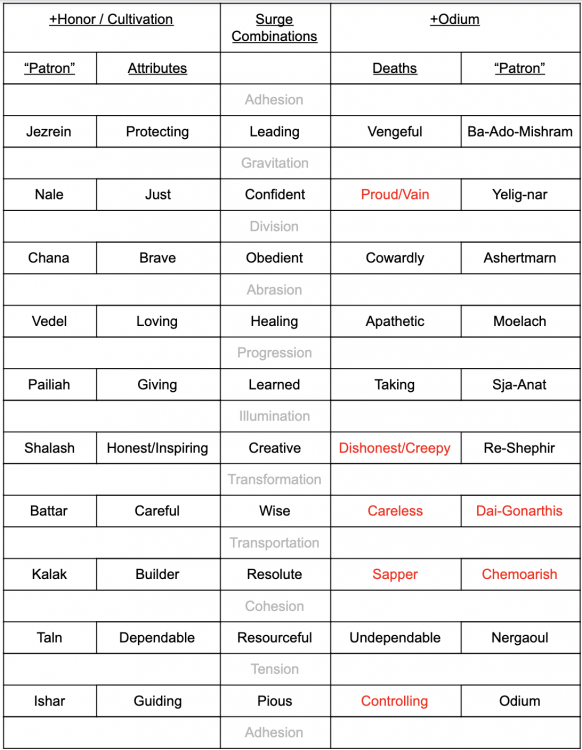
I have this as a reference table, but without definitions it won't really make much sense. Ask me any, that you feel don't fit, I'll be happy to answer why I chose that specific layout. The red ones are more tentative than others, though most of this is speculation anyway, so... keep a saltshaker close by (Start in the central column, and read from center to left for Surgebinding, and from center to right for Voidbinding)
-
Thank you! That ideal was one of the more easy connections to make, once it hit that the ideal fits. As for the Surge/Intent associations with Primary/Secondary attributes, they don't really follow a strict pattern of the Primary always coming from one place, and the secondary always coming from another. Which I'm relatively okay with, because I have it on good authority that the table is not perfectly correct in the associations it makes. One good example of this is how Soulcasting Essence/Body Focus are associated with the Orders by pairing soulcasting gem/radiant eye colors. This holds better for some orders than others. Say, a Windrunner is Translucent Air and gases, which is okay with the Honorspren appearing as translucent blue spren. A Willshaper is associated with the Essence of Metal, and the Reachers do look like they have metallic copper skin. Same for Elscallers being associated with oil and oily liquids, which fits the name and description of Inkspren. The Stoneward spren look like molten stone, Ashspren have connotations to fire and ash. So far, so good. Not the best associations, but the themes do hold. Well, not so much the Truthwatcher and Edgedancer spren. The Edgedancer spren, or the Cultivationspren, are green, and attention is drawn to how their hair looks like it's made of plant-like vines; however, Pulp/plant matter and hair are associated with the Truthwatchers and their emerald eyes. Similarly, the Truthwatcher spren looks like light passing through glass or crystal, when Lucentia, and quartz/glass/crystal is the Edgedancer essence. You'd also imagine that Truthwatchers would have the Body Focus of eyes, because... you know, watching. But nope. When I asked Peter about this, his response was this: In other words, practically any way of twisting that table for speculation is... technically, fair game. Thank you! I will eventually, as I near completion. The idea right now is to explore 7 of the Unmade in relation to their potentially paired Orders, with Dai-Gonarthis and Chemorish leaving us not much to work with. I will probably do Yelig-nar and Ba-Ado-Mishram in one next time, then one for Re-Shephir, and cover the Bondsmiths, Willshapers and Elscallers in the capstone post, in which I will talk about the full, unified shape of Surgebinding and Voidbinding I'm building towards, and one potential reason why the Voidbinding Chart exists, and what it's meant to represent. I can add that final post to that Hall of yours, and link back to the others in it. As it stands, I only have series of posts that establish thematic connections, but with no sort of... over-arching directive.
-
Table of Contents: 4. Some curious parallels between Moelach, the Silent Gatherers, and Edgedancers 5. Truths and Secrets; Of Watching and Taking 3, 9. Ashertmarn and Nergaoul 1. Moash, Ba-Ado-Mishram and the Windrunners There's been a lot going on in real life for me, so I haven't been able to get these in as quickly as possible. Here's the next two parallels - Ashertmarn and the Dustbringers, and Nergoul and the Stonewards. 3. Ashertmarn and the Dustbringers Parallel 1: By Inversion of Ideals Ideals Unknown. Parallel 2: By Inversion of Attributes Dustbringer attributes: Obedient, Brave Thematic Inversion: Obedient, Cowardly The idea I present is simple - I believe that in the two divine attributes, one attribute is a direct result of the combination of the Surges the magic is about, and the other is a further extrapolation on the first, a modifier of sorts, that comes from the intent of the Shards whose magic you're looking at. A good example would be that a Windrunner is "Leading" because a Windrunner is a living expression of Adhesion and Gravitation combined, and that they are "Protecting" because of the association of that magic with Honor and Cultivation. Another would be to say a Lightweaver is "Creative" because they are a living expression of the Surges of Illumination and Transformation, and their "Honest"-y is a result of the intents of Honor and Cultivation. Here, the Surges are Division and Abrasion. Combined, they represent extreme destruction, entropy. This makes Dustbringers a living expression of utter passion, someone who feels powerful emotions. And I think this is where the "Obedient" stems from - a desire to channel their inner passion by devoting it to some purpose. Add the intent of Honor and Cultivation to this, and you get someone who chooses to do the responsible thing, and does not give in to the whim of the moment. Radiants of this Order feel emotions strongly, and it is in their oath-progression that they learn to not get carried away by them, as it is the responsible thing to do. They exemplify bravery and obedience by not giving in to their base-most desires and not running away from their responsibilities even when that is the easier thing to do. They are the guardians and the sentinels of society, holding back their passions and inner destruction until it is needed in service of a greater cause. Add Odium to that "Obedient" however, and you get what Ashertmarn represents. The Revel asks its members to give in to the emotions that they feel and encourages it as a means of escape. Yes, times are tough. The end is coming. So run away from your responsibilities, run away and let loose your deepest desires - a cowardly thing to do. People who give in are Obedient for listening to these "commands" of giving in, yet they are Cowardly because the command asks them to let go of responsibility and give up the fight. Parallel 3: By Surges Dustbringer Surges: Division, Abrasion The Revel is a force of destruction and entropy too. It is over-indulgence, and it consumes resources at an exorbitant rate. When you read through the chapters of the Revel, it feels like there's a lot of friction grating onto the minds of those most consumed by it, not to mention some, frankly, bizarre... shoutouts to decay and rot around the Revel. Parallel 4: Special The last thing I want to mention is to look at the Dustbringer-equivalent symbol on the Voidbinding chart. That symbol can be seen as a stylised representation of a giant crab/lobster thing, seen from the front. This is similar to what little of Ashertmarn we've seen in the Cognitive Realm, and what it implied of his full form. 9. Nergoul and the Stonewards Parallel 1: By Inversion of Ideals Ideals Unknown - but we do have point of speculation from this WoB. "I will stand when others fall." fits Taln extremely well, who is practically the literal embodiment of that ideal. Add to that this context, from the in-world Word of Radiance: Interestingly, the same concept, and that context of a focus on Strength, also applies very much to those affected by Nergaoul's Thrill - properly known as the Thrill of Conquest/Contest. The idea behind it is that of hostile opposition, of fighting between men, of victory over others. "I will stand when others fall." Parallel 2: By Inversion of Attributes Stoneward attributes: Resourceful, Dependable Thematic Inversion: Resourceful, Undependable Here, the Surges are Cohesion and Tension. While we don't know the exact nature of each of these, it is safe to go by dictionary definitions. And in this, Cohesion represents how well things fit together, and Tension would be about opposition between things. And being a living embodiment of them both to could lead to the "Resourceful" trait, where its about being quick and clever in overcoming challenge. Add the intent of Honor and Cultivation to this, and you get someone who is Dependable. Someone who makes an Oath and stands by it, and stands out in this quality even over other Knights Radiant. Someone who is both Dependable and Resourceful - the archetype that is the quintessential honorable Warrior. Add Odium to that "Resourceful" however, and you get what Nergoul represents. The thrill makes people lust and look for battle, and they lose themselves in that battle lust. Those under the Thrill can no longer be depended on to keep their heads or focus on an objective - the Thrill makes them addicts of its effects, caring only for their next hit and losing themselves in its embrace. Under its influence, there's no friend and foe, there is only your opponent and how you'll defeat them. It doesn't temper your resourcefulness however, as shown by several characters in Dalinar's flashbacks using innovative methods to fight and hurt and win, when under the influence of the Thrill. Parallel 3: By Surges Stoneward Surges: Cohesion, Tension On Merriam Webster, the definition of Tension reads, 1 a: inner striving, unrest, or imbalance often with physiological indication of emotion b: a state of latent hostility or opposition between individuals or groups c: a balance maintained in an artistic work between opposing forces or elements 2 a: the act or action of stretching or the condition or degree of being stretched to stiffness : TAUTNESS b: STRESS sense 1b 3 a: either of two balancing forces causing or tending to cause extension On Merriam Webster, the definition of Cohesion reads, 1: the act or state of sticking together tightly especially : UNITY : the lack of cohesion in the Party — The Times Literary Supplement (London) : cohesion among soldiers in a unit 2: union between similar plant parts or organs 3: molecular attraction by which the particles of a body are united throughout the mass So, Tension and Cohesion can fit Nergaoul's Thrill, by the definitions in purple highlights. Reduce Cohesion and increase Tension, and suddenly you have an army of soldiers all fighting and killing each other, consumed in battle-lust.
-
My own take on it is very different, but this is good work regardless. Well done!
-
I think the common theory is that Liss is Chanarach, not Shalash. This is mostly based on the fact that Chanarach was known as the Guard, and Liss, as an assassin, is an inversion of that.
-
 I like this. A Lot. I'm not too keen on the structure you've built into the ideals, I'd need a little more convincing to get there. But I think you've hit on the general concept of the Willshapers. The Innovators of society.
 -
Table of Contents: 4. Some curious parallels between Moelach, the Silent Gatherers, and Edgedancers 5. Truths and Secrets; Of Watching and Taking 3, 9. Ashertmarn and Nergaoul 1. Moash, Ba-Ado-Mishram and the Windrunners I’ll be using the same general template for this as I did for Moelach. Here, I'm comparing Sja-anat with the Truthwatcher concept. Parallel 1: By Inversion of Ideals Ideals Unknown. Parallel 2: By Inversion of Attributes Truthwatcher attributes: Learned, Giving Thematic Inversion: some generalisation of the Taker of Secrets In comparing the Edgedancers and the Silent Gatherers, the idea they both share is this idea of the medicine man, the quintessential “Healer.” Edgedancers are the positive Healer concept, the doctors of society, who seek to help and truly “care” for their patients. Medicine men that heal ailments. The Silent Gatherers are the dark version of this idea, the dark side of medicine. Their “patients” are their guinea pigs, sacrificed for the greater good of society. Conceptually/Thematically, they kind of represent those that experiment and test on whoever they can, arguing that the suffering they cause will help millions more. Here, with the Truthwatchers, I think the focus is very much on knowledge and secrets, Learning in the most literal sense. I speculate that the Truthwatcher element represents the teachers of society - The ideal, good take on that idea are the teachers that seek truth and teach it selflessly, seek to enable you, giving you a chance to better and improve yourself. The dark take on that idea is the corrupt teacher - someone who takes the chance to be you from yourself, selfishly corrupting/subverting your truths into whatever suits them. Combine Progression and Illumination, and you get some form of "Learned". Add Honor and Cultivation to that Learned, and you get "Giving" - someone selflessly enabling of others to better themselves. Add Odium to the Learned however, and you get "Taking" - someone selfishly disabling of others' own identities, someone who if corrupting of others to his/her own ends. Parallel 3: By Surges Truthwatcher Surges: Progression, Illumination Sja-anat’s only known ability so far is Enlightening. It is implied that this is what she uses to corrupt. Now, I’m not saying this matters, but as far as obvious things go, it’s En-light-ening. (Sorry :p) Enlightening Here’s what Merriam Webster has to say about Enlightening, the word: : providing or tending to provide knowledge, understanding, or insight Here’s what googling it brings up: 1: give (someone) greater knowledge and understanding about a subject or situation. a: "give (someone) spiritual knowledge or insight. b: shed light on (an object). Here’s what Enlightened means, to Merriam Webster: 1: freed from ignorance and misinformation 2: based on full comprehension of the problems involved Illumination In contrast, here’s what Merriam Webster has to say about Illumination: 1: the action of illuminating or state of being illuminated: such as a: spiritual or intellectual enlightenment b (1): a lighting up b (2): decorative lighting or lighting effects c: decoration by the art of illuminating 2: the luminous flux per unit area on an intercepting surface at any given point 3: one of the decorative features used in the art of illuminating or in decorative lighting Here’s Google’s definition of Illumination, from Oxford: 1: Lighting or light. a: (often illuminations) A display of lights on a building or other structure. 2: The art of illuminating a manuscript. 3: Clarification. a: Spiritual or intellectual enlightenment. 4: another term for illuminance So... yeah. I don’t think I have to do too much work on tying Enlightening to Illumination. Not Physical Illumination, as in the manipulation of light, but something more Cognitive, or potentially Spiritual, like how Adhesion is more than just Pressure and Vacuum. Here, it’s about understanding. Progression. Here’s what Nohadon has to say about the nature of existence in all three realms: As far as I understand it, the mechanic behind Progression seems to be dealing with ideals. You have a platonic ideal, which is your true Spiritual ideal. But, this is not the only factor, as Kaladin’s slave brands are arguably more a part of his cognitive, deeply subconscious image of himself as opposed to a part of his Spiritual self. The spiritual provides a ground truth, and the cognitive can, within reason, shape that ground truth to create a truth for you at any given moment - and this truth is what Progression actually uses as reference when healing you. Another factor is this WoB. There, Brandon pretty clearly states that in most cosmere healing, including Progression based healing, when the healer and healed are two separate people, then both their perceptions matter in shaping the truth/ideal that the magic will use as reference. The Point. Sheesh, that took some setup. The idea is that Sja-anat’s Enlightening could be a twisted version of Progression-based healing magic. The sequence is simple - if you are Sja-anat, then some use of Illumination could be used to “enlighten” your target to your version of their Truth, your version of their perceived ideal self. Then, it’s a simple matter of using Progression to “heal” them to this new twisted ideal of themselves. The fact that for such healing both perceptions matter probably also helps in “overpowering” the old ideal of whatever you are Enlightening. I ended up getting into more specific mechanics than I wanted to get into. Oops. Parallel 4: Names, Attributes, Abilities, and Trends First, Order names. Every Order name, for the Orders we know about in any detail, is evocative of what the surgebinders of that order can do with the magic they have. These are not realmatically accurate images - the name “Windrunners” doesn’t give us the mechanics of how the Windrunners actually fly, but it still evokes the idea that Radiants of this Order specialise in “running on the wind.” Similarly, the name “Lightweavers” neither tells us how light is woven realmatically, nor does it give us the specifics of their abilities - but it does evoke the idea that Radiants of the Order of Lightweavers specialise in weaving light with the magic they have. Similarly, Bondsmiths forge bonds. Truthwatchers? They watch truth. They see. Second, attributes. The attributes associated with any given Order are something more… innate. They describe characteristics of Surgebinders of the associated “Radiant element” categorically. Radiants that attract and bond Honorspren are categorically natural Leaders, and they are driven by a desire to Protect those around them. Radiants that attract and bond Cryptics are categorically Creative, and they have to be Honest with themselves about who/what they are. I believe this has realmatic basis in the living ideas that those spren represent, but I’ll leave that discussion for either the comments, or another post. With this in mind, the Truthwatchers have semantic dissonance between what they are implied to do with their magic, and what their attributes paint them as being. Does a Truthwatcher watch Truth (knowledge goes in to the Truthwatcher from outside him)? Or give it (knowledge goes out from the Truthwatcher to others)? How does this relate to that passage about them from the in-world WoR? This carries on to Sja-anat too. She is the Taker of Secrets (knowledge goes in to her from others). Yet Enlightening means to show someone a Truth (knowledge goes out from her to others). By meaning, “Enlightening” has an inverse thematic parallel to the implied meaning of the double word “Truthwatcher” - “Showing Truth” vs “Watching Truth.” Similarly, the implied nature of Sja-anat by her epithet (or name) is a thematic inversion of the implied nature of the Truthwatchers by their attributes - “Taker of Secrets” vs “Learned and Giving.” Moreover, Sja-anat’s epithet - the Taker of Secrets, is like a different version of what the name “Truthwatcher” implies. Taking truths, vs Watching them. Both are about the magic user learning truths from outside. Similarly, Enlightening is like what the Truthwatcher attributes imply they are like - “Showing Truth” is very much like a Learned person Giving back to society. Both imply that the user brings truths to others. This particular fact may be important in Renarin’s case, who, when using his healing capabilities on at least one occasion, has shown Adolin a perfected version of himself, his true spiritual self. (yay for confusing pronouns. The last "himself" and "his" refer to Adolin here). The elephant in the room then, is Renarin’s visions. I have a theory on what’s happening there, and it does have something to do with a corrupted Glys. But I don’t think it has anything to do with Truthwatchering, at least nothing that will be available to others. I think what’s happening there is that whatever ailed Renarin before, and gave him his fits originally, was something realmatic that manifested in all three aspects of him. With his bond to Glys, now it has changed to what it is now - specifically the futuresight visions. I don’t think any other Truthwatchers, uncorrupted or otherwise, are going to get that, unless they were suffering from the same “illness” that Renarin was. And with that I’m finally done. This was probably the longest one of these.
-
Nergaoul, I'm leaning on attributing to the Stonewards. Windrunners are taken in my current model. The open slots are Skybreakers, Willshapers, and Elsecallers. Yelig-nar can go in place of the Skybreakers (Amaram and Aesudan can be considered Vain but Confident -> believing their own hype over any external code of law, which is the exact opposite of the Skybreaker progression - of giving oneself to an external code of law due to a desire to be just but lack of confidence in one's own ability to distinguish good from evil, and then through experience, slowly gaining confidence in one's own ability to subjectively interpret and apply the more objective code/law chosen. And Yelig-nar could consume by Division) or the Elsecallers (some inversion of Wise and Careful also fits them just as much, and one could say that Yelig-nar is using their individual bond with the three realms to Transport himself slowly in the physical, slowly making them undergo a twisted Transformation to make a vessel for him, with all the crystals spouting out of them and their hearts getting replaced with gemhearts and all). Though, as you people've mentioned, there are thematic parallels between him and Willshapers too. So, I'm still leaving him open. Wow, that is super condensed, and heavy reading. Sorry!
-
I can make far better arguments for another candidate to mirror Truthwatchers. I will eventually make that post. Also, I know of that WoB, and over time, wrestling with it, I've come to think that it's not as explicit as it seems. There's several, small things that make me think that there's a difference between a Knight Radiant Order, a Surgebinder, and the powerset of a Surge-pair. The Honorblades grant the powerset of a Surge-pair. This includes what you can do with that magic - so Jezrein's Honorblade is Adhesion + Gravitation, and it allows one to manipulate gravity, or stick things together, etc. This is the base magic granted to the Heralds. A Surgebinder, like Kaladin, is a living expression of a Surge-pair. This includes the powerset of that Surge-pair, but it also means that Kaladin has to be a specific kind of person. The ideals and attributes that are associated with his Surge-pair are natural extensions of Adhesion and Gravitation filtered through the visual of Honor and Cultivation, and Kaladin also has to incorporate that inti his very existence. This is an extension of the magic, and this is a Surgebinder, who is also a Radiant, but this doesn't necessarily make him a member of the Order of Windrunners. A Knight Radiant Order, I don't think is inherently magical (though at this point it might as well be) - it is an organization that is made up of a specific flavour of Surgebinders. For this to unilaterally exist, Ishar had to play a hand in things, asking of spren and men so that all Surgebinders would always view themselves as Knights Radiant, and all of them always belonged to their orders. But this had to be accomplished, and is not inherently a part of the magic, though I suspect things have changed enough that any non-order Surgebinders probably won't show up. Now, I'm equating The Silent Gatherers to the Surgebinders of the Edgedancer Order, minus the powerset (for now atleast. Them not having powers now doesn't mean they will not have powers eventually. It doesn't mean they will either, but it also doesn't discount them from gaining them in the future, particularly now that Odium has an incentive to back the Diagram Organisation.) I'm equating Moelach to the Vedel and the Edgedancer Honorblade, except in this case, it's not a sword, but an entity with some level of sapience. He has the powerset, but without any of the extra faff that a Surgebinder has to go through/uphold/be/qualify with. Or in his case, the mindless-ness excuses him from the requirement of having a particular personality. It's different in some way.
-
Table of Contents: 4. Some curious parallels between Moelach, the Silent Gatherers, and Edgedancers 5. Truths and Secrets; Of Watching and Taking 3, 9. Ashertmarn and Nergaoul 1. Moash, Ba-Ado-Mishram and the Windrunners Moelach and the Silent Gatherers have some interesting parallels and relationships to what we know of the Edgedancers. Parallel 1: By Inversion of Ideals Lift gives us two of the Edgedancer Ideals: 2. I will remember those who have been forgotten. 3. I will listen to those who have been ignored. This is who Taravangian says the silent gatherers kill, to get Death Rattles: Parallel 2: By Inversion of Attributes Edgedancer attributes: Healing, Loving Inference - Edgedancer Radiants usually serve as Healers, backed by having access to Growth and Regrowth by means of Progression. Both Lift and their ideals in general paint them as truly caring for the individual lives of everyone they help. To them, the ignored and the forgotten are an opportunity, for those are the people who need the most help and healing to make things better. Relevant Epigraph: Inverted attributes: Healing, Apathetic The Silent Gatherers are literally Healers in a hospital, who kill apathetically because those deaths might give them more Death Rattles. They are Apathetic towards the individual, arguing that the individual suffering they cause will eventually help society. From a certain perspective, one could say that for them, the ignored and the forgotten are also an opportunity - here, these are the people who can be safely killed to get more Death Rattles. Parallel 3: By Surges Edgedancer surges: Abrasion, Progression. What about Moelach and his effects backs this? I’m basing my answer to this question entirely on specific interpretations of certain quotes. These are informed interpretations, but it does mean I could be way off. First, here is a quote by the Stormfather: This is relevant, because this introduces the idea of “the movement of time” being a “fundamental force” on the Double Eye, alongside “pressure” and “gravitation.” However, "pressure" and "gravitation" are accounted for on the list of the known 10 Surges, in Adhesion and Gravitation. This implies that some other surge fundamentally represents this "movement of time." Naturally, the the question arises - which one? Here's a definition of the word Progression, from Merriam Webster: 1 a: sequence of numbers in which each term is related to its predecessor by a uniform law 2 a: the action or process of progressing : ADVANCE b: a continuous and connected series : SEQUENCE 3 a: succession of musical tones or chords b: the movement of musical parts in harmony c: SEQUENCE sense 2c A quick google search brings up this, presumably from Oxford Dictionary: noun: the process of developing or moving gradually towards a more advanced state. • a succession; a series music • a passage or movement from one note or chord to another. math • short for arithmetic progression, geometric progression, or harmonic progression. astrology • a predictive technique in which the daily movement of the planets, starting from the day of birth, represents a year in the subject's life. So, yes. This could be very easily interpreted as the movement of time. Linear time can be interpreted as a progression, or a sequence... a string of moments, each moment coming after the previous one and leading to the next. Or call it a continous line, whichever works for your imagination. But time... progresses, it keeps on ticking. It moves on, marches forward. Constantly. Forward movement along such a progression of time can explain what little we know of Growth. In the absence of true backward time travel, Regrowth can be explained as a form of backward movement of time - going back to a previous state/moment, to before you were wounded. Now, in practice and effect, this can get a little wonky, because of how this actually takes place by looking at ideals and such, but even then, this interpretation holds semantically. The second surge of relevance is Abrasion. From the Merriam Webster website, this is the definition of Abrasion: 1 a: a wearing, grinding, or rubbing away by friction b: Irritation 2: an abraded area of the skin or mucous membrane A quick google search brings up this, likely from Oxford Dictionary: noun: the process of scraping or wearing something away. • an area damaged by scraping or wearing away. With these interpretations of Abrasion and Progression in mind, read what Jezrien has to say about Moelach:
-
Also, potential connections to other names on Roshar I've been trying to find:- Ba-Ado-Mishram: Ado: Adonalsium, Adolin. Symmetrised as "Adoda" in Alethi, meaning "light" Mish-: Mishim. Name for the moon possibly borrowed from the original Dawnsingers/Dawnchant and later symmetrised to Mishim -ram: Amaram. Meaning or connection unknown and, for Chemoarish: -moa-: Moash. Meaning unknown, but was considered to be Singer-like by Lady Leshvi. Possible masculine/feminine noun form relationship between moash/moarish For Yelig-nar: Nar: Dalinar, Renarin. Evi says it means "like unto." For Re-Shephir: Re-: Renarin. Evi says it has no meaning, it simply means him. Dai-Gonarthis: Similar to Kai-Garnis, the name Odium calls a Thunderclast.
-
My one call is that the Fused we saw was one of the later generations of Fused, and will have true Voidbinding capabilities, as opposed to the earlier Fused, which were Surgebinding with Voidlight. My particular call for this one is Voidish Illumination, with his black clothing being made of Midnight Essence.
-
Would it be possible for you submit this to the Arcanum?
-
This WoB may help: Then there is this:
-
Is there a similarity in the way Yelig-nar seems to be consuming Amaram's soul in the climax of OB, and the way Nightblood destroys people?
-
Hoid is like a priest of Adonalsium, and potentially it's Cognitive Shadow was imprinted on him in much the same way as the Mists or The Stormfather were/are Cognitive Shadows of Preservation and Honor respectively. He has lost his God, and is looking for some true spark of Divinity ever since. Nightblood uses an Endowment-Ruin copied version of Voidish Division (the way Nightblood destroys the spirit of something has similarities to how Amaram is consumed by Yelig-nar). That to the Nightwatcher Life is change. So when Lift asked her to not change, to the Nightwatcher it meant anathema - how can something live and also not change? So her solution was to make her like a Cognitive Shadow, but one that never died, and is still alive. This is what makes Lift something that should not exist naturally.
-
Thank you! Here you go! I will admit, I am a little ashamed of how I handled the responses.
-
I've slept on this, and I do largely find my self seeing the distinction between the two now as you see it; I wasn't aware before these two posts that there was a distinction to be made. Hence the frustration. I tried to make arguments, and in response I thought I got "Well I see a distinction between magic and magic systems," and nothing on the actual arguments I made, when I didn't even mean to differentiate between the two. Now, I don't see Syl's shapeshifting or Pattern's levitation in the same vein as the Unmade effects. Why? For one, these things don't affect anything other than these creatures, and feel more like a consequence of the kind of existence they live - pieces of energy having come alive and not having a complete presence in the Physical. Pattern doesn't levitate Adolin, Syl doesn't turn a random boot into Shallan on a beach. These things only affect themselves, and their own indeterminate forms. Any magic the spren can do to affect other things in the world however, has so far come directly from the Surges they represent. Pattern creates vibrations or sound waves, Syl can stick things together with effort. Edit Addendum: This is sort of in the vein as Nergaoul's looking like a red mist with shifting shapes inside, Ashertmarn's appearance in the physical like a black heart, or Sja-anat's ability to appear in mirrors and look a little different everytime. I'm neither ascribing those effects to the old magic nor to Voidbinding. I do find myself disagreeing with this though. We can call Allomancy a magic system or magic; Allomancy, Vin with the Mists, and by extension the Well of Ascension are all the same thing, different only in scale and the sheer amount of power involved. They are on one big sliding scale. All those things are investiture flowing through you, and being channeled into an effect along the way. Just, in Allomancy the power comes from outside and is shaped directly (it stays in you for barely an instant of time), and so you need some way to focus it. With the Mists, you don't need metal, you will is enough, because they flow through you. The Well of Ascension is the same thing, but on an even larger scale. Relevant Wob. So, the more I think about it, the less I find a need to actually distinguish between the two. If there is a difference, it is more in scale and scope than anything truly mechanical. Brandon even calls surgebinding just magic in that WoB. Technically, he doesn't distinguish between the two. He's rarely, if ever, said that Roshar has exactly thirty systems. It's always "close to" or "around" twenty or thirty. Which makes sense, 31 is still close to thirty. It is precisely the fact that he counts it outside that makes me push for the Unmade to be inside. Because them being outside pushes the count closer to 35 or even 40. And even in my diagram, I count the Old Magic outside the 30 magic systems he's mentioned. And trust me, I feel far less confident in this than I may seem. Edit Addendum: I'm not even advocating for everything the Unmade do to be Voidbinding. I'm really only pushing for them to be right on the line. There are effects I ascribe to several of them that are their own: Yelig-nar's granting of all 10 Surges; Ashertmarn's pushing of over-induglence into his cohesive flock; etc.
