Note: I restored this from a saved copy I had, after I had completely deconstructed this here. Certain links and tags may be missing or inaccurate. I've also moved on from a lot of the ideas I discuss here - they've grown into a different model. If you received a notification for a tag, I'm sorry, I had removed the tags in the interim and had to re-add them for completeness.
In discussions on the nature of Rosharan magic, some of the many unanswered questions and mysteries are these: What is Voidbinding? What are the Unmade? How does everything we know of Voidbinding actually fit with what we know of Rosharan magic?
In this post, I aim to try and answer some of these questions. But a lot of what I'm about to say is heavily speculated, and so perhaps it would be wise to start with how I went down this road in the first place. About a month ago, some discussion on the nature of the Unmade brought forth this question: What sort of magic are the Unmade using? This entire theory is essentially trying to answer this one central question.
To even begin to fit the Unmade in the greater framework of Rosharan magic, let's first map it out. Others are more suited to answer on the history and realmatics of why this framework exists; I'm only looking at WoBs that tell us what sort of magic systems do exist on Roshar quantitatively. So, here, Brandon says:
From here, and remember, this is before Oathbringer, and so this is before we saw most of the examples I'm gonna use in this post:
There's also this, where Brandon is explicitly asked about the magic count on Roshar, and this is a paraphrased description given by Brandon about the Way of Kings in 2009.
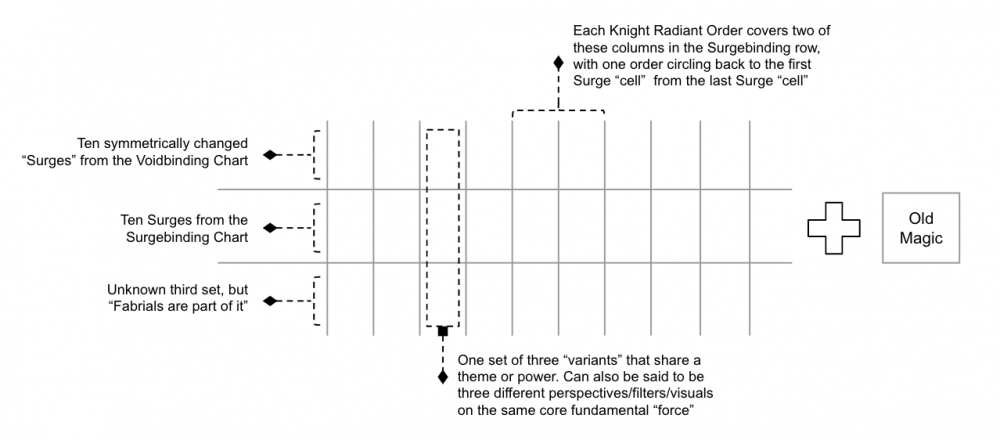
Basically, the framework we get looks something like this:
It is pretty clear where the Surgebinding Chart fits in this diagram - the entire middle row covers all 10 Surges, and groups of two cells in that row cover all 10 Knight Radiant Orders. If you want to fit the Voidbinding Chart, then take the mapping we just did for the middle row, and apply it to the top row. There is an unknown third set that deals with Fabrials, and potentially more, so there's that too. This leaves us with the Old Magic.
There are two primary camps on this that I am aware of - one says that the Old Magic is the old Ashynite magic system of the Humans, and the other says that Cultivation/Nightwatcher's Boon-Curse magic is the Old Magic. To me, this WoB is a pretty strong indication towards saying that the Boon-Curse magic of Cultivation and the Nightwatcher is the Old Magic.
So finally, we come to the actual question. Now that we've got Voidbinding, Surgebinding, Fabrials, and even the Old Magic mapped out on the framework given to us by Brandon in WoBs, where do the Unmade fit?
There was an idea...
The first clue to the mystery comes from Taravangian, and a WoB. This WoB says that Taravangian calls them a phrase in this WoR Chapter 81 epigraph. He does, but he calls them several things. I speculate that the relevant phrase is not “a conundrum, a flair” or a “waste of time”, but rather “Like the spren of human emotions, only much more nasty.” Why?
Consider this WoB. Brandon says the Gravitation works in the way it does because it is filtered through the visual of Honor. This is why lashings are like bonds - you make a bond between a thing and other things or directions, and the influence of gravity changes according to these bonds. And this doesn’t just hold for Gravitation; there are four Surges which have a dominant influence of Honor - going anticlockwise: Gravitation, Adhesion, Tension and Cohesion. All of these deal with bonds in some form or another. Similarly, there are four Surges which should have a dominant influence of Cultivation - going clockwise: Abrasion, Progression, Illumination and Transformation. I don’t quite understand what the visual of Cultivation is to be able to say how it applies to these four. I think it is about serving change, or… well, cultivating. Two more Surges: Division and Transportation, are right on the line, and should have been influenced by both Honor and Cultivation.
But if this holds, then Voidbinding should have the filter of Odium. And if the Unmade are truly Voidbinding, then his filter of “all emotion and passion” should apply, even if he is not completely right about it. Because that is what he thinks he is, and so that is the direction in which he channels Odium. So, in Voidbinding, all 10 of these Surges should still have the same core theme, the same core idea, but now it will be filtered through this “emotional” visual of Odium. In other words, the Voidish manifestation of… say Transformation, will still be dealing with permanent change brought forth by the interaction between realms, but instead of Soulcasting, where the constituent matter of something changes form (preserving mass), it will now do something Odious, something self-serving, hatefully destructive, and not restricted to affecting only the physical matter of things.
The second clue comes from looking at Sja-anat, and her Enlightening. The question is simple in nature - if all magic on Roshar has to be either following one of 10 “themes” or fall into the category of the old magic, and Sja-anat is decidedly not at the Valley, then what is Enlightening?
From what we know, Enlightening is the process by which Sja-anat corrupts spren and men. Now remember, we have two broad descriptors we are looking for in any Voidish manifestation: a.) it should deal with more esoteric emotional or nature-based properties and not all physical properties, and b.) it should be selfish, hateful and destructive by nature. With these in mind, one could say that Enlightening is Transformation as Odium sees realmatic change; i.e. causing permanent change in the nature of something, through corruption. In effect, if Soulcasting is Transformation applied to change the substance of things via their soul, then Enlightening is Transformation applied to (hatefully) change the spirit or nature of living beings, potentially also through their Cognitive aspects. One works on things, and on the substance of those things, through the filter of Honor and Cultivation; the other covers the changing of spirit and nature through the filter of Odium.
If this is true, then the backbone of Sja-anat’s effects is Voidish Transformation. This checks another tick-box: Any explanation of Voidbinding must also cover Khriss's comment in Arcanum Unbounded. There, she says that Voidbinding is a cousin to the old magic. The Unmade powers using Voidbinding as a backbone makes at least one manifestation of Voidbinding a cousin to, or similar to, the Boon-Curse magic of the Nightwatcher - both are not given to men to use as they see fit, but are manifest through powerful spren. And perhaps - and more importantly - it is one more clue in the bigger mystery of fitting Unmade magic in the greater framework of Rosharan magic - perhaps, they each use one Voidish “Surge” as the basis of their effects.
Exploring Unmade Powers
With all of this, let’s take a look at all the known Unmade, and try and see which core idea seems to fit their effects the most, and why.
1. Sja-anat - Voidish Transformation
I covered Transformation extremely quickly up above, and since this was the root of this theory, it is only fitting that I start here. My original pitch for the distinction between Soulcasting and Enlightening was that one works on things, and the other works on beings. Now of course, the flaw in this seems to be that Soulcasting also works on people. Well, yes. But also no. Soulcasting has always been shown to work on the constituent Physical matter, and it does so by going through the Cognitive aspect of said matter and convincing it to be something else. When it works on people, it works on the Physical substance of those people, by changing their flesh and bones into something else. Not on their Spiritual aspects. It always changes a thing into a different thing.
Enlightening, however, is the exact opposite. It changes the Spiritual aspect of a being, potentially also using its Cognitive aspect as an interface. This may also play into why Sja-anat is called the Taker of Secrets. That name may be a clue to the Enlightening equivalent of “convincing the Cognitive aspect” of Soulcasting. My guess is that it involves torturing your victim or manipulating them to get into their heads, and touching their souls through this process. Regardless, Enlightening works on people, and it changes people into different people. It doesn’t focus on changing their constituent physical matter into different matter, but rather, it focuses on changing their souls, and turning them into corrupted versions of themselves.
The other thing with Enlightening is that Sja-anat is still learning its use; it has now been shown to corrupt and affect Radiantspren. So when I say people, I really mean every kind of living being, anything that has a degree of sentience (or sapience, I always get confused between the two). I suspect Enlightening is also what was responsible for corrupting the palace guard at Kholin Palace.
The last thing I wanted to point out was to look at both the Surge and Voidish variants of Transformation, and what they tell us about the general trend in Surgebinding and Voidbinding abilities. Surgebinding powers largely tend to focus on the Physical realm (with some exceptions), using the other realms to primarily supplement their effects. Transportation is a bit of an outlier, but even there, the Voidbinding variant seems to just focus on a different realm over the Surgebinding variant.
2. Yelig-nar - Voidish Division
Division is one of two Surges that lies exactly in between Honor and Cultivation on the Double Eye Charts. While we haven’t seen any first person uses, I subscribe to @Pagerunner's excellent ideas outlined in this thread, of it being capable of releasing chemical energy by breaking molecular bonds. This is thematically on point, as Division would then involve the breaking of bonds, which is a line right between Honor and Cultivation - using bonds to affect change. It is also perhaps relevant to note that in an older version of the Double Eye, there were two separate powers - Entropy and Decay, which seem to have been folded into one in the published books.
Coming back to Yelig-nar, there are two primary effects ascribed to him: the first and most spectacular is that it’s host is granted the ability to channel all 10 Surges, and the second is that the host’s body is consumed and crystals start growing out of their bodies.
I suspect that this second effect is the primary use of Voidish Division; to cannibalise souls for power. In much the same way as Surge Division breaks bonds in physical matter and releases energy in the physical world, the Voidish variant, maybe, burns or breaks apart spirit-webs and releases the investiture contained therein. People who cannot control him start having their souls uncontrollably consumed (read: burned like dry firewood) to release all the investiture they contain. In this case, the violet crystals we see growing on Amaram in the climax of OB could be crystalised or solidified investiture (a solid form of what is normally gaseous Voidlight), because the massive amounts of investiture contained in his soul (as a sentient being) are being released at an exorbitant rate, with nowhere to go. There is precedent for this elsewhere in the Cosmere; the pits of Hathsin also grow crystals from a spiritual leak. Atium can only grow in Hathsin once this crystal formation is complete. This and this WoB are also relevant. Credit to @Master_Moridin for pointing them out, and for @Extesian for helping out with looking up descriptions of the Pits of Hathsin.
There is also an indication that those who can control Yelig-nar aren’t thoroughly consumed. This “control the power” aspect could be that with enough will, one may be able to “suppress the flames,” in a manner of speaking. To sort of control this consumption process to only burn as much of themselves and release as much investiture from said burning as they need, instead of the alternative; uncontrollably burning all of their soul and releasing all of the investiture inside. The crystals are a hazard - a sign that the rate of burning is too high. You’re literally producing more investiture, and faster, than you can hold and expend, so it’s finding its own way out of your soul - by overloading the same channel using which the violet-black mist of Voidlight was coming through.
With this said, I don’t think Yelig-nar’s other effect - the granting of access to all 10 Surges - has anything to do with Voidbinding. That seems to be a unique ability given to Yelig-nar by Odium. This makes sense, as the only use of Odium’s manifestation of Division is to generate power at one’s own cost. Voidish Knights may have another surge where they can channel it, but Yelig-nar, by default, has only one. So Yelig-nar can generate power, but has nowhere to put it. Voidlight isn’t a part of any investiture cycle, so there’s no point to it leaking. So, instead, Yelig-nar gets to be an expression of ambition and greed and hunger for power; he gets his own unique twist, one where the massive amounts of power he allows for the generation of can be channelled into something. The fact that he grants all 10 surges creates a big temptation to try and bond him, which is a very insidious, Odium-like manipulation to do. Most people who give into their greed and ingest a gem will probably not have the willpower or “passion” to control him (because of that very flaw of giving in to one's desires), and consequently go on to fail, die, and do damage in their dying throes, and that serves Odium. Those that do control him may be more susceptible to Odium, by having a splinter of Odium bonded to their soul, and that may serve him too.
P.S.: Perhaps this is also how the Fused get Voidlight, and is also perhaps another factor contributing to their souls being so battered.
P.P.S.: This might be a clue to how gemhearts are made in the natural ecology of Roshar - crystalised investiture (stormlight?) that gently, gradually accumulates over a creature’s lifetime.
3. Nergaoul - Voidish Abrasion
Surge Abrasion lies on the Cultivation half of the Double Eye charts, though I do not know the rationale behind how its powers match up with the perspective of Cultivation. Though the fact that we’ve only seen this from the perspective of Lift, and that when she wasn’t aspiring to understand it at the time probably means we may have seen very little of its actual capabilities. Surgebinding Abrasion, also called termed “slicking”, allows one to control friction between two surfaces, to the point of completely negating it.
I think Voidish Abrasion is manifest through Nergaoul, in the Thrill. Many people over on the Discord have likened Nergaoul and Ashertmarn’s effects to Allomantic Rioting and Soothing (but not respectively), and while I think the comparison has merit, I think it’s also not completely accurate. See, Rioting and Soothing are manifestations of Preservation’s system, and so while they may work by inflaming or suppressing parts of one’s psyche, they do not cause any permanent harm to it. Preservation protects, and so its magic system tends towards not having the capability to directly cause harm to another - any harm done must come indirectly, and by the choice of the user. Odium however, is all kinds of Hatred compounded in one - his magic will tend towards destructive means to achieve its ends.
So, with the Thrill, Odium seems to be doing something similar to Rioting, but I speculate that this is not how Odium works. Odium would much rather burn then influence - and if he wants one thing to dominate over others, he would rather destroy every other thing than build that one thing up. So this is what I speculate - Voidish Abrasion is targeted mental abrasion of one’s psyche. In much the same way as friction causes its own kind of wound on one’s skin (Google tells me those are called abrasions), Voidish Abrasion can be used to scratch out the outer layers of one’s mind and expose the insides, even if it’s effects can be temporary. Nergaoul for example, could be eroding away the human mind to expose the more primal, feral, animal mind behind it - in some, exposing the thrill of physical challenge; in others, exposing a primal lust to hunt and fight and kill. Skillful use by an actual Knight may also allow this to expose fear, or other primal attributes.
If this is true, prolonged exposure to the Thrill should also have the effect of actually damaging your psyche - the kind of abrasions it puts on your Cognitive aspect should eventually turn into real holes and cracks, more serious wounds. And this is something we actually get to see happen with Sadeas troops - for them to (forcefully) be bonded to voidspren must have required some kind of hole in their souls.
P.S.: This may also have played a role in some questions with what happened to Dalinar. With this, Odium left his mind broken and exposed, knowing that even as it heals over time, the scars will remain. Cultivation, on seeing this, may have cleaned and made certain precise cuts to change the course of such natural healing, and affect the final product. Perhaps this is why Odium never noticed her manipulations - he was looking at only the presence of such residual mental scar tissue in a healed Dalinar’s mind, which he was expecting to see. So he was content in merely seeing it present, whereas Cultivation’s work was hidden in the shape of it.
4. Ashertmarn - Voidish Cohesion
I struggled with this one for a long time, and my explanation for this still isn’t very good. The idea here comes from a different reading of what the word Cohesion means, and it’s a little… you’ll see as you read this.
See, I think Voidish Cohesion, in keeping with the other esoteric, mental and/or nature-oriented effects of Voidbinding, allows for the creation of a cohesive, almost hivemind-like entity with the caster at its center. It allows for people to then be influenced by this effect, and feel a pull towards it. To join it, they give up their individuality and become part of a greater whole. Voidish Cohesion keeps this thing together, by allowing to (perhaps forcefully) influence people to give up their own individual emotions and passions and lose themselves in the directions of this greater entity itself.
Ashertmarn’s effects have also (read: mostly) been described as causing an increase in indulgence of all kinds. I think Ashertmarn uses this Voidish Cohesion to create and maintain himself at the center of this Revel, as it’s Heart. However, he doesn’t have the mind to direct it - this is where the overindulgence aspect of the Revel comes into play. Voidish Cohesion isn’t responsible for it. Rather, each of the mindless Unmade compensate for their lack of mind by having given a very strong general focus to their effects. Moelach doesn’t direct what gets shown in individual Death Rattles, he just creates a general pull towards the Spiritual. Nergaoul can’t choose exactly which parts get eroded from any one person’s mind, he does a general thing for everyone. Both of them have a strong, general directive that they push through into their effects. I think Odium un-made Ashertmarn in such a manner that he doesn’t have a direct mind to control this Cohesive Cognitive entity (the Revel) - it instead pushes this overwhelming animalistic need for overindulgence into the Revel. That serves to give direction to the Revel, and what gives it the name.
Tldr; the Heart of the Revel becomes the Heart of the Revel by Voidish Cohesion, and makes it a Revel by Odious intent.
In a Voidish Knight’s hands, this could serve to do something very similar to creating a mind control aura, by allowing the Knight to expand their mind and join up with and influence other people’s cognitive aspects, or to influence them to join up with his. Thematically, this effect is akin to the evil “will-casting” trope, but with Sanderson’s own unique take on it.
5. Re-shephir - Voidish Illumination
I didn’t know how this connected into Illumination, beyond a general sense of Re-Shephir and Shallan matching up in the way they see these powers. I suspect the primary use of Voidish Illumination - in the hands of a proper Knight - is to create Midnight Essence, and to then channel this into creating corporeal physical shapes made out of pure shadow. Why? Because this WoB implies that Midnight Essence is essentially the repurposed titular aether from The Aether of Night.
Thematically, this power would then contrast with Surge Illumination differently than other Surgebinding-Voidbinding power differentials. Most of the time, Voidish powers seem to be focused more in the Cognitive and Spiritual realms, whereas Surgebinding focuses more on the Physical realm. Here, Lightweaving has slight Spiritual and Cognitive components, but most of it focuses towards manipulating Light in the Physical realm to create incorporeal, or like Shallan does at the end of OB, semi-corporeal Illusions. Voidish Illumination seems to also be focused on the Physical, perhaps with even less of a Spiritual or Cognitive component.
The other things is, Re-Shepir creates these shadow creatures using Midnight Essence. And I do not know if these are a part of Re-Shephir's uniqueness, or if that applies to all uses of Voidish Illumination in general. If Renarin's arc is anything like the main protagonist's arc from Aether of Night, then most likely, the creatures will stay with Re-Shephir, and Renarin will be able to do other things with Midnight Essence. Though all of this is mere speculation at this point.
6. Moelach - Voidish Transportation
This one is a little easier to connect to a Surge, but very hard to figure out the actual mechanics of. In this WoB, Brandon describes Transportation as a force that pulls you through realms. Now, the Surgebinding variant seems to have two effects: one, to allow someone to transition between Physical and Cognitive realms; and two, to allow one to induce motion. There are indications that Transportation also deals with transitioning through the Spiritual, because it can also allow teleportation over some actual physical distance, and the Oathgates… well, they exist. But until we see this onscreen, I don’t know how that aspect works or looks like (although, if Oathgates are any hint, Surgebinding Transportation, even when using the Spiritual, does not allow one to see it, only to go through it, like a door. Thank @Calderis for the analogy).
On the other hand, multiple sources say Moelach’s effects trigger only during realmatic transition. Mechanically, Moelach seems to be creating a baseline field, and any within that field feel a constant pull into the spiritual. Anytime you’re crossing between realms, this weak pull is enough to pull your mind into the Spiritual a little, and show you small glimpses of it. I think this is very well foreshadowed in Mistborn, with Elend and Kelsier being able to transcend/transition a little into the Spiritual at the moment of their deaths. There, Atium was the connecting cause - Elend sees a glimpse of the future because his Atium flares; Kelsier sees a glimpse of the past because his Malatium flares. Both these things should be possible under Moelach, his effects seem to be something similar - of pulling into the Spiritual a little and showing a small glimpse of it.
Thematically then, Surgebinding Transportation seems to deal with actually transitioning across realms, which is an effect that may overlap with Voidbinding Transportation. But, Voidbinding Transportation seems to emphasize using this transitional ability to send your mind into the Spritual to see/peer into it, whereas (heavy speculation) Surgebinding Transportation seems to emphasize actually going in and out of the Physical and Cognitive, and (on occasion, and dangerously) through the Spiritual.
On the Discord, and on the Shardcast, others have raised the possibility that Moelach is the Unmade, or potentially one of several Unmade, referred to by the Dysian in the Kaza interlude in OB. I do not know if Moelach can also peer into people and pull out information, when they are pulled towards the Spiritual during moments of realmatic transition.
It is also interesting to note that in Vorinism, seeing the Future is considered of the enemy. And this is one of two known ways where Voidbinding deals with looking at the Future; Renarin definitely does not have Voidish Transportation (right…?), and he’s still able to see the future. His future-sight seems to stem from the Voidish interpretation of Progression (or Time) instead, perhaps as a resonance between Voidish Illumination and whatever Progression he has, because his Progression is also weirdly normal.
Conclusion
At the end of these, we're left with four Surges: Gravitation, Adhesion, Tension and Progression; and three Unmade: Ba-Ado-Mishram, Dai-Gonarthis, and Chemoarish. This means that one of these Surges does not have a Voidish manifestation in any of the Unmade, and there are arguments for why this left-out surge could be Adhesion or Progression. This WoB says that among the Unmade, there isn't an equivalent to Bondsmiths. Which is fair, Bondsmiths are weird. But one could take that to mean that Adhesion is missing among the Unmade, because Bondsmiths primarily focus on Adhesion. Or it could be talking about the Divine Attributes. However, while we don't have much to go on, I would speculate that Ba-Ado-Mishram channels Voidish Adhesion, if only because the one bit about her tells us that she was "able to connect to the Parsh and supply them with Voidlight, like Odium once did."
Another option is Progression, which, I think is the more likely of the two to not get corrupted. If Adhesion and Progression are expressions of Honor and Cultivation, then Cultivation is alive, Honor isn't. If one of these two should still be uncorrupted, it should be Progression. Besides, the fact that Renarin has normal-ish Progression could be attributed to there not being a proper Voidish manifestation of Progression yet.
Another important aspect of Odium having any of his own magic on Roshar comes from this WoB. It implies that Odium had to take certain steps for Voidbinding to even exist. This leads directly into...
The Unmade are Dawnshards
This is not something that occurred to me. I do not know if this is true. But, it is something worth considering. There are several things that make this more likely. For one, there is this WoB, which says that one Dawnshard is not like the others. Then there is the name itself; this WoB has things to say. And lastly, and perhaps most importantly, the Fused most certainly don't Voidbind. This may deal with the history of Roshar a bit, but the reason most Fused don't voidbind may be tied to the fact that Odium hadn't Unmade any of the Dawnshards yet, there was no Voidbinding at the time. Perhaps, it was only through the corruption of each individual Dawnshard that each seperate manifestation of Voidbinding came to be. In this sense, Yelig-nar is certainly one of the first - he grants regular Surges, and he is present during Nohadon's time, which is before the formation of the Knights Radiant.
There is also the line that Dawnshards were used to destroy Ashyn, and I don't know how to interpret that, because a.) it breaks the "dawn" naming convention, and b.) how do you get a Shard to Ashyn without going through the intervening space, when spren are still bound to Roshar in modern day?
I think Brandon is being really coy with the name Unmade. It evokes the idea of the antonym of "made," but I don't think that is the case. I think Brandon intentionally chose the name to give that impression, whereas the real in-world meaning could easily be more along the lines of "made by His unholy hands", as in corrupted, or remade, into a fundamentally wrong form, or in a fundamentally wrong manner.
Ten Deaths
The last thing of any import that I want to talk about, is the concept of the Ten Deaths. This is something that one Knight Radiant mentions in one of Dalinar's visions, in respect to Midnight Essence. I think these are something that was part of Knight Radiant culture and teaching, and had roots in actual dangers they faced on the field. Specifically, I think the Ten Deaths were meant to reflect Radiant lore on the effects of Voidbinding. Because it makes sense, right? Every effect of Voidbinding is basically focused on user gaining at the cost of both their allies and enemies. In the case of Yelig-nar, which any Radiant could potentially have ingested and used (and they even had greater temptation, because of their greater power), the cost comes from themselves too. All of these effects are insidiously dangerous to the Radiants on the field, being caught off guard by Nergaoul or Ashertmarn sounds like a bad idea.
So... yeah.
The End
In conclusion, there is something I want to point out. The Knights Radiant are Brandon’s take on White Paladins - they are driven by Honor, channel divine power, have a selflessness about them, get heavy armor, fall into different categories where some heal, some fanatically seek justice, and they even have Oaths that primarily drive them to do good.
In contrast, Voidish Knights should then be the quintessential evil, Black Paladin archetype - one that is primarily driven by hatred and selfishness. Sith to the Knight Radiant Jedi. Renarin is a good egg, but he’s one. And we don’t even know much about his powers. The Voidish powers I outline here seem to be much more suited to dark paladins - being able to burn or consume souls for power; to torture people or manipulate people with lies to get in their heads and corrupt them; to be able to mind control a group of people, making them lose themselves into a greater mob directed by the paladin at it's heart; of being able to bring out the base, feral, primal instincts of your allies to aid them in battle, or enhance the fear your enemies feel and break their morale; of being able to twist shadow to their will; all of it.
So, have I succeeded in finding Voidbinding? I don’t know. I’m certain that my specific descriptions of what each Voidish ability does aren’t right on target every time. But I do think that I’m looking in the right place for it. This is also my first proper theory on the forums, and I hope I haven’t managed to get too many details wrong.
Thanks for reading!