



Inquisitor #5
-
Posts
304 -
Joined
-
Last visited
-
Days Won
2
Content Type
Profiles
News
Forums
Blogs
Gallery
Events
Everything posted by Inquisitor #5
-
Taln is a very problematic character...[Discuss]
Inquisitor #5 replied to KaladinWorldsinger's topic in Stormlight Archive
I want to say that nothing in my post implies, one way or the other, whether his mental state is natural or magical. Just that he's broken. Hmm Well, this thread is good for making me think. I've realised that our conceptions of the Heralds are likely quite different. I think we need to differentiate three things, I don't think Herald madness equals broken-ness, nor broken-ness breaking. Herald madness is this thing: OK, looking at this, it seems my division of Herald stuff isn't quite accurate. It would seem that Herald madness is moreso the manifestation of several underlying things, than its own thing. We still have multiple factors affecting the mental states of the Heralds. The torture, their age, and perception. At least. All the Heralds, including Taln, are broken. The fact that they are not human anymore might just lead to them breaking in non-human ways. In any case, the madness is not a consequence of breaking, rather of being broken. Elantris: Given that we learn in RoW that spren can break from repeated trauma, in a way similar to, but distinct from, becoming a deadeye, I don't find it unreasonable that the Heralds would break in a similar way. Let me also take the time to properly adress the OP, apologies in advance if I come accross as rude or condescending. I'm not finding a good point to adress this, so I'll adress it here. Taln breaking would just mean that he was overwhelmed by the torture, that he gave in and let the Return start again. It doesn't change the fact that Taln is thoroughly broken. Though I suppose it somewhat cheapens him if he didn't break. Taln isn't a human, he's power in a human shape. We know that his physical abilities are superhuman, why not his mental abilities? And I do wonder, if one manages to hold out for 100 years, how much more is another 100 years, etc? If your reality is just a blur of pain, and the only thing you can do is hold to a single idea, a single hope amid the pain, then why could one not hold on? It is, and the Heralds are ridiculously old, but Taln obviously doesn't know how long it's been, even in his moment of lucidity. Good point, and it makes Taln come across as a bit off, does it not? Huh, I don't agree at all. For one thing, one person's suffering does not invalidate another's. For another, Taln isn't infallible, he's self-sacrificing and stubborn to a fault. The same thing that let him hold out for so long are also his biggest flaws. He let himself be utterly broken, rather than do anything selfish. He's honestly maladjusted, when lucid he thanks Ash for being abandoned, for giving humanity a wonderful gift, even as she wishes that he hate her. Forgiveness, no, redemption, yes. I don't see why we have to quantify it like that. We haven't been in Taln's pov enough to know how he thinks when lucid. I'm not sure that's true. I do agree that the Oathpact is not a good solution, but one person's choice to uphold it does not legitimise it. From what we've seen, it seems the Heralds went to Honor, not the other way round. The guy who vividly hallucinates that everything is on fire got through torture like it was nothing? He even thinks that torture means life. (Though whether that's his or humanity's is unclear. Hmm.) He's probably more akin to a damaged spren. That phrasing is hilariously ridiculous, lovely. ¤_¤ -
[Poll] [Discuss] Did Jasnah do the right thing?
Inquisitor #5 replied to Szeth Pancakes's topic in Stormlight Archive
Now, this might be different between legal systems, but my understanding is that if you kill someone in self-defence it's manslaughter, and if you kill someone after they're no longer a threat, it's murder. Using force beyond what's necessary to defend yourself and others isn't self-defence, and Jasnah could reasonably have neutralised the attackers non-lethaly. Hmm, looking it up it seems the distinctions in English are first degree murder, second degree murder (or voluntary manslaughter) and involuntary manslaughter. The first is premeditated killing, the second killing in the moment (intending to kill) and the last killing without meaning to. Under such a system, Jasnah is definitely guilty of first degree murder, as she planned to kill. I don't know. It didn't happen that way, and I can't say how she would have acted in that situation. Which doesn't change that she went out with the intent to kill. Possible, but we have no reason to assume that to be the case. Actually, given this exchange: -WoK, chapter 36 We can assume this not to be the case. Outside Shinovar? Say that you know there's a neighborhood with a crime problem, and you put a valuable item in said neighborhood seemingly unguarded, but you actually have someone watching it at all times. If someone takes the item, and you arrest them for the crime they commited, is that moral? They have definitely broken the law, but if you set this up specifically with the intent to provoke a crime so that you could arrest someone, you have at least acted immorally. You are guilty of entrapment. As is Jasnah, she deliberately provoked a crime. I find myself disagreeing with this, I don't think the killings were justified. She can't claim self-defence, they were not a realistic threat to her. She had non-lethal options, she could have Soulcast their clothes into stone or metal or she could have sliced their legs with her Blade. This also lets me adress why I don't think the whole "shouldn't a woman be able to walk the streets?"-thing holds water. I wholeheartedly agree that everybody should be able to walk the streets unmolested. However, I don't think it flies as a justification for vigilantism. If she had been innocently strolling the city and gone down this street unknowingly, I would accept her reasoning far more readily. If it was genuine self-defence, if she was attacked unprovoked, her reasoning holds and the killings are far more justified. But as it stands she uses the reasoning as an excuse to provoke the criminals, painting a thin veneer of self-defence on her actions. But what she does is carry out vigilante justice. Heh, working through it, I think the killings aren't just, moral or ethical. They are possibly correct, however. I feel a lot like I feel about Adolin killing Sadeas here. I was in the camp that was basically screaming "Adolin, no!" I basically feel that while Sadeas had to be dealt with, that was the wrong way to go about it. In both cases, there's no other workable recourse, but that doesn't make it right. ¤_¤ -
Hmm, in Dalinar's case, I don't think he's attuning a rhythm so much as being attuned to it through the Thrill. I don't think it has much to do with Nergaoul specifically, but the Unmade in general. Odium's tone is one of the three Pure tones of Roshar, makes sense to me. I disagree that it is done consciously in the provided quote. It's probably similar to Navani being able to hear Honor's tone with Raboniel's help. Rock's humming lines up with one of the rhythms, helping him find it, but he doesn't consciously reach for it. I'll have to disagree there: -RoW, chapter 110 I think we can safely say that Navani's also on that list. It would seem that one possible way to hear at least some rhythms is to let a spren in, though obviously not in all cases. I don't think this is the case, I think it's more being open to the Investiture that the rhythm belongs to and possibly mindset. We know that singers sometimes attune a specific rhythm to try to find a particular mindset. So in Dalinar's case, he's infused by the Thrill and in a receptive mindset. We also know that Rock has something special going on, so he might be closer to how singers can (apparently) just naturally tell that the rhythms are there. This is also quite timely, as I noticed something similar recently, though a different character. -Oathbringer, chapter 120 Which I thought sounded kind of like this: -RoW, chapter 76 This also sounds quite similar Dalinar in the grip of the Thrill. I would posit that, though Nergaoul was present at Thaylen City, Amaram got his rhythm from Yelig-nar, if nothing else because he doesn't seem to be gripped in battle fury. I can also imagine that the Unmade are somewhat jealous, or that it's simply a matter of Investiture saturation. Similar to how Timbre says Rlain is already spoken for. So, we have (possibly) four known examples, and three of those involve being connected to Investiture somehow, the Thrill (which is described as seeming to tremble to the beat of Dalinar's sword), Yelig-nar, which seems to make Amaram move to something like Odium's rhythm, and the Sibling. There's definitely a lot up with the rhythms. Seeing as Venli's stoneshaping gets a bit... weird... RoW, chapter 83 And that Brandon has said this about Rlain: Which is also interesting, as it mentions Rlain's deeper connection to the rhythms. (Great, now I want to see both a singer and human of each standard and Enlightened order) Navani's knowledge of the (most basic) rhythms might influence how her powers manifest and generally what she's able to do. Beyond the influence on the magics, I also don't know what the implications of this is, though it's probably foreshadowing that all Roshar will be able to hear the rhythms eventually. ¤_¤
-
Taln is a very problematic character...[Discuss]
Inquisitor #5 replied to KaladinWorldsinger's topic in Stormlight Archive
So, as people have already mentioned, Taln didn't break under torture, in that he never betrayed his oath. But the torture broke him. Badly. -WoR, interlude I-7 I think it's safe to say that he's thoroughly scarred by his four-and-a-half millenia of torture. I imagine that a lot of the time simply blurred together into a continuous experience of suffering, just being lost in agony. And the Heralds are obviously superhuman in several respects. Taln is something extra, to be fair. Presumably something like having the kind of mind that doesn't easily give in to torture, coupled with being superhuman. I could also see the whole Herald madness thing being helpful here, as he probably didn't suffer the same sort of reaction to people's perception as the others. Assuming that his mind was busy with pain. We know that the Stonewards are the Radiants most similar to their patron in temprament, and it's not improbable that the perception of Taln is an exaggeration of his known traits, such as stubborness. In conclusion, the torture broke all the Heralds, but only caused nine of them to give in. Or all are broken by the torture, but not all broke under torture. ¤_¤ -
[Poll] [Discuss] Did Jasnah do the right thing?
Inquisitor #5 replied to Szeth Pancakes's topic in Stormlight Archive
As someone who does not believe the death penalty to be justified, she should not have killed them. She's also not justified in killing them in self-defence, as they were no threat to her and she had non-lethal options. In addition, she has no formal authority in Kharbrant, she's acting outside the law. Even if the men would have been sentenced to death in court, she does not have the right to kill them. She deliberately provoked the men to attack her, similar to how IRL police have at times provoked crimes to arrest people. This is not justifiable. Can I suggest a workable alternative to the particular situation laid out here, no. The men had already been let off by corrupt watchmen, so there was obviously no workable way to bring them to justice within the system as it stood. -WoK, chapter 36 Hard disagree, the intent behind your actions matters. -WoK, chapter 36 -WoK, chapter 36 She went into the city intending to kill them. She didn't happen to be attacked, she deliberately went to a part of town with a known criminal problem, fully intent on removing said criminals by killing them. She did this while flaunting her wealth, when she expected robbers and murderers to be around. She's not at fault for their choice of action in response to this, but she certainly meant to provoke them. Yes, that I agree with fully. Anyone should be able to feel safe in whatever place they find themselves. I would say, given that she went out with the full intent to kill them, it was never self-defence. Also, depending on how far along her oaths she was at the time, they posed somewhere between a minuscule to zero threat to her. Good point. What? No seriously, what? If I kill someone, regardless of what they are guilty of, it's still murder. Or manslaughter, if my intent wasn't to kill. Oh, no, she specifically went after the group that had killed theatergoers along this street, the same ones who are suspected of bribing the watch. She very definitely intended to kill these exact people. Though I suppose she didn't intend to kill these exact individuals, rather the individuals that made up this particular group. Capable, sure. Able, maybe. Had there been more men, or had they been positioned differently, Shallan could have been stabbed by someone Jasnah hadn't been focusing on. So I wouldn't say that she definitely didn't endanger Shallan, even if the outcome was that she sustained no physical trauma. She was also perfectly willing to subject Shallan to the psychological trauma of seeing people killed. Small sidenote, she actually isn't a proponent of singer genocide. -Oathbringer, chapter 39 She is justifying sending the Heralds back to Braize to Kaladin, basically saying "we can try this thing that you find distasteful, or we can try this thing that's far more distasteful, if you like." ¤_¤ -
Honestly, the simplest thing to do here would probably be to do Kalad's Phantoms, but bigger. Encase bone in stone or metal, let the Breath do the rest. You'd just need some Command shenanigans to let it respond to the pilot. Though you would probably run into fun* physics problems once you scale it up, but at least it should be able to keep its own balance. (*actual fun not guaranteed) So, the interesting thing here is that I could see it going the same way as I propose for Awakening, depending on if the skeleton could be spread out or not. The other thing you could do is possibly end up with an amalgamate monster, basically. Think something similar to how the Sleepless work, have multiple skeletals grab/hook onto eachother to form one interlinked giant. Problem here is that you'd need to coordinate all the skeletals so that the whole thing doesn't trip and fall, and making sure that the bones can take the stress. Things snapping or becoming Invested bonemeal is not in your best interest. Hmm, you'd need to be able to modulate Push/Pull strength pretty finely, or the movements would be very janky. Given that mecha have some inherent problems (small footprint for their mass, balance, inconvenient center of gravity and I'm pretty sure a lot of strain on the materials), janky movements is not something you'd want. We do know from BoM that it's possible to mechanically store the weight of objects: -BoM, chapter 29 So Scadrial could solve stress from mass and the problem of a too small footprint. AonDor is probably the system that I think is most likely to be able to easily solve all the issues with humanoid warmachines. AonDor seems able to do darn near anything, as long as you know what you're doing. They could probably levitate the parts, make them work as a cohesive whole and possibly even find a way around the balance problem. But as you mention, getting them to work outside Arelon would be trickier. This is probably the least viable, from my perspective, possibly tied with Bloodsealing. Problem here is that you're square/cubing a living thing. You'd either need a constant flow of Investiture to heal it, or a way to either lower body temperature or bleed off heat. It'd cook itself otherwise. And this one also has the problem of being made of squishy organics, it can bleed, have muscles destroyed, tendons cut and nerves severed. It'd also be easy to compromise through electrical attack. Sticking to something that moves by the power of Investiture just seems far more practical. Mechanical greatshell with half-shard plating? Sign me up! Most functional overall design, multiple limbs to support the mass. Low centre of mass, good. Have to figure out how to move the actuators effectively and not have the limbs interfere with eachother. Must also have some kind of suspension to deal with uneven terrain. Hard to crack from the outside, vulnerable to mechanical failure. Gems cracking under strain would be a big problem, as well as limbs getting stuck or entangled. This could break the conjoiners that make the thing move on either end, or compromise the limb joints. Fuel and energy-hungry, even more so if Lashings are used to lighten the mech. Possible problem of creating its own frame of reference, making the whole thing not work. Least likely to fall over and break. ¤_¤
-
So, I've not read the entire thread, so excuse me if I end up retreading covered ground. So, standard conjoined gems gives you two objects that act as one. If each half weighs 5 grams, lifting one requires work equivalent to lifting a single ≈10 gram object. The effective mass is is M1 + M2 + Md, that is mass of gem one plus mass of gem two plus effective mass from decay, depending on distance. We know that force is transferred between gems, nothing is being added to the system. My understanding is, post RoW, that work is split evenly between the conjoined gems. Thus, for a standard conjoiner, doing the work to move 5g 2 metres, will move the conjoiner 1m. Working off this, I see no reason to assume that the underlying mechanics are any different once you start messing with the proportions. Same basic principles, work is trasferred, nothing is added, and work is split evenly between the gems. Say then that you have a 5g and a 25g gem. Their effective mass is ≈30g. Doing enough work to move 25g 2m moves the larger gem one metre, and the smaller gem, having the same amount of work done to it, five metres. Both halves of the pair experience the same amount of work, but the distance they move are inversely proportional to their masses. They are a magical pulley, simply a way to exchange work with distance, albeit a very compact one. Assuming my interpretation to be correct, the posited device couldn't work, there's no additional force working on the second gem. They'd simply get stuck in an equilibrium. In fact, if the device was built from perfect, indestructible materials, it makes an immovable object, as neither gem could move without moving the other a different distance, which it can't do without the materials being able to give. I know I've disagreed with @Ookla the Frustrated on this before, and I stand by what I said then. If the interpretation that energy is added to the system is true, it still can not work. If the larger gem can pull the smaller forward, this means that they try to move at different speeds, otherwise the larger gem can not experience a pull. If this is true, each gem accelerates the other in a feedback loop. This means that materials that are not arbitrarily durable will break under the stress. As far as we know, the "entanglement" of the gems is absolute, it can not break through material stress. We then have three points of failure, the integrity of the gems, the fabrial cage, and the physical link between the gems. If the mounting doesn't give, the gems either crack simply from physical stress or at least one shoots out of its cage, decoupling the device. If the cages can't give, the gems break or the mounting rips apart. If the gems can't give, at least one rips free of its cage or the mounting rips apart. If none of the materials give, then infinite energy is required to start it. And even if these were solvable problems, assuming that Stormlight adds power to the system, the consumption should increase the faster it goes, to the point that Dalinar with bronze Compounding riding it, holding the Perpendicularity open forever would not be a sufficient fuel source. I also fail to see how this could be the case, as we know that work is transferred between standard conjoiners, rather than energy added to the system. You'd expect to only have to do the work to move half the mass of the conjoined gems in that case. So the difference in mass can not work on the same principles if energy is added into the system. As for the question of what the point would be if energy wasn't added to the system, it allows one to use space efficiently, for one. Part of the problem with the Fourth Bridge is that they can only feasably have a few such ships. If you can shrink the ground lattice to one hundreth (or whatever) the size, you can have a lot more lattices moving at the same time, as well as being able to fly far further without having to disjoin the lattice and turn around. Or, with a few advances, you could take something like this: Which translates rotation into linear motion. (I think, might have the wrong terminology.) The Rosharans can theoretically make steam engines. Or Soulcast steam turbines, if you're feeling spicy. This can translate Stormlight into work, boiling the water using heatrials. So if you then set up an exchanger between rotation and linear motion, with a conjoiner on one end and a reverser on the other end, where the motion triggers the disjoining of the gems in turn, you can drive whatever is attached to the fabrials forward on both the forward and backward motion, assuming that the planes are isolated. Pair this with the unequal paired fabrials, and you can drive something forward very fast withouth having to have a lot of motion on the driving end. The fact that you can exchange work and distance also leads to being able to save time as well as space. If you can move the lattice at the same speed as with equal conjoiners, what you're moving will cover more distance over the same time. So there are lots of uses for it, even if energy isn't added to the system. ¤_¤
.jpeg.85b0bf8eb45fd478a450ccf9b75e75a8.jpeg)
.jpeg.7e0a778482f7c66611221970787c6d11.jpeg)
-
theory What Odium is really up to and why it won't work[Discuss]
Inquisitor #5 replied to ZHRPhoenix's topic in Cosmere Discussion
So, for one, the word used to name a Shard is incomplete, too non-descriptive, too narrow. The ocean is wet, but "wet" is an inadequate term to describe it. Then we have this: -Oathbringer, chapter 57 -RoW, interlude I-2 -RoW, chapter 113 -RoW, chapter 114 So, a few takeaways here, one; yes, Odium is fear, just as Odium is apparently all strong emotion, two; that is not exactly what people notice first, I don't think the power would lie about its nature to Taravangian, three; if the nature of the power was "fear" then why does it want to be questioned, challenged? There's also the fact that Shard Intents aren't self-directed, Ruin's MO wasn't destroying himself, for instance. To me this is like claiming only Tanavast could be honourable. Rayse is afraid of being not himself, he's afraid of changing due to holding multiple Shards, he's afraid of there being people who can challenge his primacy. Dude wants to be top dog, and anyone else on the same level is a threat. Well: The whole Sel situation seems to be due to inexperience. So, fun ambiguity here, it's not clear if Mercy was on either side, and if so which, or if it was a three-way clash. Ehh, given that the Evil and the Shades are not known to be related, I'm doubtful. I'd also imagine that it's more that Threnody is "irradiated" from the clash. It's also possible that Rayse had more of an idea of what not to do that time around, so he didn't have to resort to shenanigans. I also fail to see why Mercy would have wanted it that way, I'm not sure how that lines up with their Intent. I could definitely see some of that, given that the power of Honor and Cultivation keeps Odium trapped, even after the death of Tanavast. The interesting thing there is that Tanavast didn't die until around the False Desolation. I'm not sure what exactly him splintering himself would have acomplished, rather that Odium splintering him, other than being able to choose what spren were created from it. That tracks. Do you mean between a Shard and a Splinter? Sliver is usually taken to mean someone who held a portion of a Shard, and Splinter a piece of a Shard that has come alive (like spren.) And I'm pretty sure that would typically just be a "bigger" Splinter. Thanks, I hate it. This idea really doesn't sit well with me, it both makes the Stormfather less unique and potentially introduces shenanigans that don't fit with established systems. Or, if it has no bearing on the people bonded to these spren, what's the point? Thanks, I hate it. I think Syl is already special enough, Ancient Daughter and all that, and we don't need more things making Kaladin the best thing sinced sliced chull dung. To me this doesn't make much sense. Which does not mean that having less than a whole Shard makes it easier. Also, here's Harmony being very clear about his particular dilemma: -RoW, chapter 28 epigraph, emphasis mine The problem isn't holding two Shards, the problem is holding two Shards that are in direct opposition. That's not to say that holding multiple Shards wouldn't restrict you somewhat, but in most cases not anywhere near the level of Harmony. No, he is what he wants to be and doesn't want a second Intent changing him. -WoR, chapter 71 epigraph, emphasis mine Rayse wants to be and remain Odium, it's about his nature changing, rather than him being restricted. I don't see it. I also think a cohesive whole would be preferable, having fewer weak points. In addition to that, Adonalsium does not seem to have had any problem acting, so the Shards are probably more limited, because it's hard-to-impossible for a Vessel to act against the Intent of their Shard, while a being with all of these contextualised by eachother should make it pretty easy to act. Something is definitely up with Odium being able to kill Vessels and Splinter Shards, especially since we know that Cultivation was helping Honor against Odium. But we clearly don't have the full story there. Given that Tanavast says that the Dawnshards are lost in one of the visions, I doubt it. And if he did do that, would these new "semi-shards" be further derivations of Honor? Yes and no, Harmony clearly still has two Intents, though the powers are intermingled. Noo... That wouldn't work, I think. Dalinar could probably release him, but it'd have to be with Intent. He couldn't be tricked into it. There's also a question of, why should Dalinar trust the new Vessel, it's still Odium? It would also lead to some odd interactions, and possibly amount to nothing. -RoW, chapter 112 These are the terms set between Dalinar and Odium. We also know that this agreement is made between Odium and Dalinar, not Rayse and Dalinar: -RoW, chapter 114 Dalinar would probably be in breach of the contract made, if he releases Odium. And given that: -RoW, chapter 112 This leads me to believe that if Taravangian were to somehow trick Dalinar to release him, Taravangian would be violating the good faith agreement, because he knows he's bound by the deal. He'd be in the same position as Rayse breaking his word in that case. Wouldn't that just be a retread of how Rayse was offed? Given that Taravangian is certain of his own superiority, I don't see it. -RoW, chapter 114 And earlier in that same chapter it's noted that the power is moulding him. Isn't this basically what happened with Vin at the end of HoA? Someone using the power of a Shard before it managed to restrict them? I also fail to see how this would be the "true end" of Odium, even a splintered Shard can be "reforged" somehow. The only thing would be if the Vessel of another Shard took up Odium as well. Oh, I hope not. There'd be something very... boring, I suppose, about the endgame antagonist being such an evil overlord archetype. I... really don't see it. Rayse tried to be proactive about threats to him, he was never interested in having his own system. Seeing as he wanted to be the only god, just going off somewhere and claiming his own system wouldn't have been conducive to his goal. If you knew the end of the world was coming, wouldn't you be? Given his original plan, no, not really. The Diagram says: "You must become king. Of Everything." And given how Taravangian was trying to bargain with Rayse, it would seem the plan was to secure a deal in which his subjects were spared. If he rules everyone Odium can't touch them. I don't think that fighting with everything you've got because you're cornered and resenting everyone around you is not the same. Rayse is also clearly not paranoid about everyone, he wants control, but he doesn't fear revealing himself. He's angry when he comes to Taravangian, and is clearly not even entertaining the idea that he might be vulnerable. Turns out he was. Well, the power is almost wearing the person at this point. Compare to Ruin getting emotional in Secret History, the power breaks through the mask. Keep in mind that Rayse has spent thousands of years being shaped by Odium as well. Well, he has no reason to take the deal unless it looks preferable to not taking the deal. He's got basically all the time in the world and he's a functional god. What reason does he have to take the deal if he feels that he's got the upper hand? I don't know if it's fear, but that is arguable either way. In any case, he would be throwing away his greatest trump card if it was revealed the Odium wasn't Rayse anymore. -WoR, chapter 114 It's important to him that people think him dead, as it affords him more freedom. Also, I definitely get the feeling that the power is raging, not fearful. Fear feels inherently more passive, this power wants to lash out and take vengence, not to protect itself. So, I'm gonna quote this again: -RoW, chapter 113, emphasis mine We also know from Secret History that the stronger a person's Connection to the Shard, the more fit they are to be its Vessel. And no, a person's disposition doesn't have to line up with the nature of the Shard, but it's helpful. But Taravangian being called perfect kinda implies that he's very much lined up with the nature of the power, does it not? He wishes to prevent what is percieved as the end of the world and the extinction of humanity, feeling that he can't do enough alone makes a lot of sense. You can call it fear or knowing that he's outmatched. How so? I fundamentally disagree with any reading of Taravangian as benevolent. Also, in one of the things I've already quoted, the one that has "broken gods" in it, we can see that Taravangian already thinks that he's better than the existing Shards. I don't think the man with the ego to believe that he, personally, should be the one to save the world, that any sacrifice is worth it to achieve that goal, is going to worry that he's not good enough. He wanted to rule all of Roshar so that he could bargain for their safety, as seen when he makes a deal with Odium. His end-goal has never been to rule: -RoW, chapter 114 I see little reason to believe he's lying to himself here. That is something that I can see, though I don't know exactly why he'd seek rule of the cosmere. Not quite: -WoR, chapter 114 She was hoping, but didn't know. Ehh? What? That was not my impression of that scene at all, nor of the purpose of the boon and curse. I doubt it. Pretty sure that'd just be Splinters. Again, this is like saying that only Honor can be honourable or that only Ruin can destroy. And this particular fear is probably the fear that holding multiple Shards would change his nature. The powers are intermingled. Again, someone being afraid doesn't mean that their nature is fear. ¤_¤ -
theory Oddities With Atium
Inquisitor #5 replied to LewsTherinTelescope's topic in Cosmere Discussion
Oh gosh, it's Investiture echolocation. You are probably not "hearing" the actual output from another Investiture user, but the "echo" against their power. That works so much better for me than simply sensing their power. I think. The Rhythms and the Well muddy things here. Though I suppose that "hearing" the echo of your own bronze pulses would use the same sense. Of course, that explanation only works if bronze actually projects something outward. In this case, copper produces a "deadened" bubble, nothing "echoes" back from it. Interesting. I've always pictured it as a bar graph, Pushing makes the bars shorter (pushing them down) and Pulling making them longer (pulling them up.) So to me that's always worked. Hmm, I see. Though I feel like my problem here isn't so much remembering the pattern (which is fully consistent, elemental metals always Pull, alloys always Push) as finding that the pattern doesn't seem to fit the effects as I'd concieve them. I think I basically have to imagine it as a Doppler shift, Pulling makes the "time wave" longer, making you experience time at a slower rate than the outside world, Pushing compresses it, making it shorter, and you experience time more quickly compared to the outside. I'm not sure I could puzzle out what they mean while fully awake if I didn't already know what I was trying to say. Isn't it fun when you have a concept in your head, but don't know how to verbalise it? That is interesting. So, we know that there are multiple possible patterns. Just counting base Allomancy, there are four patterns for metal type, and two each for Internal/External and Push/Pull. The question is what this actually means. We know one variable from the quote above, Internal/External affects the frequency of the pulse. Now, I think we can safely say that the frequency of each Internal/External metal is not consistent. If they all had the same beat it should not take training to pick them out. Aaand looking at the rest of the scene where Vin trains with Marsh this goes out the window... darn it... Marsh claims that "a long pulse that beats against you and has a quick pattern will be pewter" which is... argh... Unless quick pattern just means that it consists of a loop of few beats? This does (kinda) give us another data point however, it implies that the pulses of Physical metals have a quick pattern. Whatever that means. My entire being is screaming that the pulse of each metal should be an interference pattern. Foiled by Investiture physics... I will still say, Push/Pull seems the easiest to distinguish, while pulse length and speed seem harder to pick up on. Hmm, I do realise that I've probably been thinking about this wrong. It's probably not an interference pattern. Push/Pull creates the feel of the pulse, Internal/External creates the frequency of the pulse and metal group creates the pattern of the pulse. That works. So, just from how hard it is to tell bronze and iron apart (and just being able to tell that one is Pushing, one Pulling makes Marsh think Vin's been practising), the variance in frequency and pattern seems very slight. Or it's an untrained ear and two competing imputs. It still feels like all physical metals can't exhibit the exact same pattern, just at different frequencies and in different directions. It feels like it would be too easy to tell. Maybe not though. It would be really helpful to get an in-depth look at all of allomancy from an experienced seeker. As for the rest of it, I got nothing. I will fully conceed that my harebrained speculation isn't exactly solid. That makes perfect sense though, it's just Ruin's Investiture being filtered, not Preservation's. Though I suppose saying that here means I implicitly contradict my own assertion that there should be variance in the pattern within a metal group. That's fine. I'm still walking away with a more solid theory on bronze pulses. ¤_¤ -
theory Oddities With Atium
Inquisitor #5 replied to LewsTherinTelescope's topic in Cosmere Discussion
Fair, fair. That explanation sounds a lot like "well, each category has to have an internal and external pair." Turns out that the stagnant, oppressive empire might not be the best place for scientific study. I'm not sure I understand what you mean here. Steel and iron and brass and zinc are the pairs that make intuitive sense, IMO. The Enhancement metals make at least thematic sense, but might actually be "backward." It can be argued that wiping metal reserves should be a Pushing effect and consuming them explosively a Pulling one. Internal Temporal are... honestly arbitrary, as far as I can tell. I guess gold pulls something to you, thematically? Heh, maybe I should have gone through all the external ones first. External Temporal are really weird. To me they feel entirely backward. The intuitive effect of Pulling on time is that it compresses it around you, making it pass faster. I suppose I can see the idea of "grabbing" time and slowing its passage as well. Hmm... Internal Physical make sense to me, the idea that one lets you more easily affect the world, the other making it easier for the world to affect you. Internal Mental are an absolute mess and makes me think about Investiture fields. I'm sure this is an idea that's been hit upon before, though I have, IIRC, not been involved in any such discussion. (And I wish that I could take full credit for this idea, but proper credit for the basis I'm rambling from goes to my cousin, who isn't on the Shard AFAIK.) So, Investiture fields, or the most sensible explanation for how all this works, IMO. So, Investiture has associated waveforms, this information was seeded in Mistborn, reinforced in SA and ultimately confirmed outright in RoW. Investiure seems to produce a field around the user/holder. This field is related and unique to the nature of the power in question. This field allows the Investiture to affect things within it, either actively (e.g. steel and iron) or passively (e.g. Heightenings, Internal metals.) Gosh, I hope these ramblings make some degree of sense, just trying to phrase this is making my head spin. I think something along the lines of a spherical field surrounding the... do we have a generic term for "Investiture user?" (Or possibly something like a magnetic field, but this is Investiture physics, not proper physics, so who knows.) The exception is fields that only overlap the person and possibly things they touch, not sure how this part works exactly. It might also be that it simply is a field that doesn't propagate beyond the person, one that propagates by touch and one that affects everything within it. (Think the difference between a Soulcaster fabrial and Radiant, which I'd say is reinforced by the fact that something is either in a speed bubble or not, touch brings something into the Soulcaster "bubble.") The field varies in size by the power (and probably things like Allomantic strength, where applicable, given Rashek's ability to blanket soothe all of Luthadel) and determines the range of the power. The clearest example of this is probably the speed bubbles, being clearly delineated. So, in Allomancy, we have four (standard) catgories of metal/power, Physical, Mental, Temporal and Enhancement. Within each category, there are the further divisions of Pushing, Pulling, Internal and External. The above should be known by everyone in the thread, so why bring it up? Why follow the rambling on Investiture fields and waveforms with this? So, there's the interesting fact that all the Internal metals seem to have an Investiture field that only affects the user... except the Mental metals. One creates a field that "silences" Allomantic pulses, and presumably other Investiture pulses as well. The other creates a field in which you can "hear" the same Allomantic pulses, and other pulses if you know what you're doing. (Singer Seeker when Brandon?) Why are these Internal metals so... odd? Why are they the only ones that affect your surroundings no matter what you do? I posit that we have misunderstood Allomancy in yet another way. (Why stop when we're overturning a ton of established theory anyway? ) We know that for every Push, there's a Pull, as it were. All the Mental metals might actually be External and all Enhancement metals Internal. We know that at least Leeching works by touch, Primer Cube notwithstanding. Under my waveform/field scheme the Allomantic pulses and Tones of Roshar are also both expressions of the waveform of the Investiture. Which also leads to some interesting conjectures, like that you should be able to sense a difference between Allomancy depending on the fuel source, even if the base pulse is the same. Bronze is also interesting here (Pushing metal ) because of the mechanics of how it works. Can you sense Investiture being used outside your range/field? Can you sense it if your Investiture fields simply overlap? Does the originator of the Investiture you sense have to be fully within your field? Why can you even sense pulses from Internal metals? This turned rambly, but hopefully somewhat understandable. (Might make a proper writeup if I ever figure out how to phrase it properly...) ¤_¤ -
Incorrect citations in Herald articles
Inquisitor #5 replied to Inquisitor #5's topic in The Coppermind Wiki
No problem. Fair, fair. Happy to help when I can. OK, awesome, that's really clear. Without this info I'd probably have been too afraid to touch anything in any kind of brackets... Done. Happy to do it now that I know how. ¤_¤ -
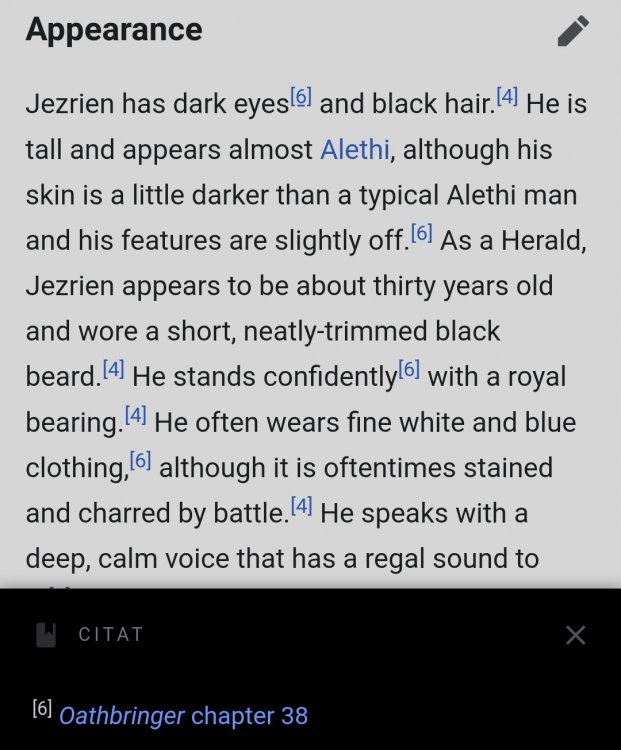
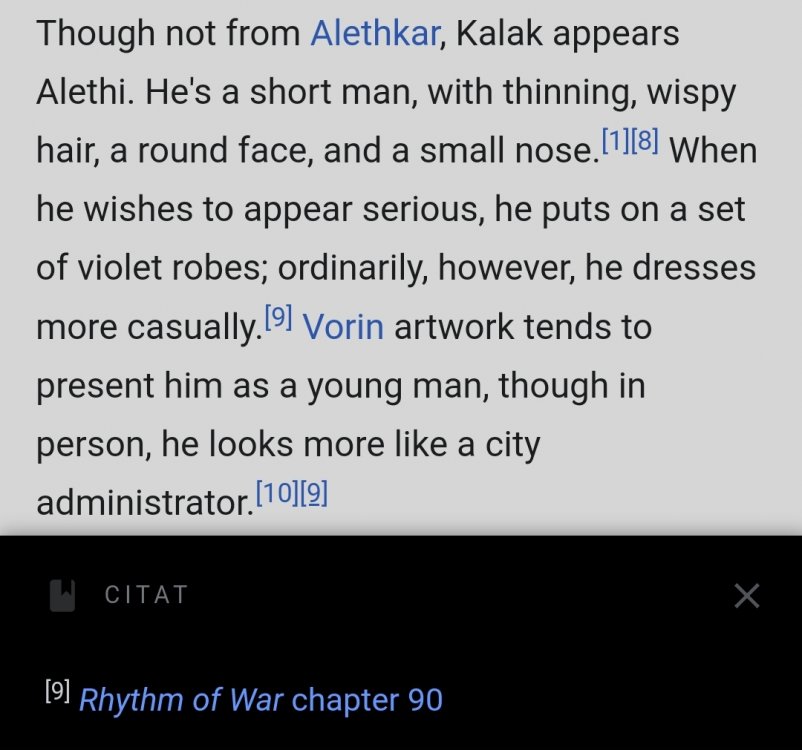
So, I was trying to find some details for another post, and discovered that at least two articles about the Heralds (Kalak and Jezrien) have citations pointing to the wrong chapters. Jezrien's article has this, on his apperance: As seen in the picture, citation 6 points to Oathbringer, chapter 38. However, after a lot of poring over it, I could not find any of these details in said chapter, indeed, Jezrien doesn't show up in it at all. I think this has been muddied by this chapter being one where Dalinar is interacting with other people inside the vision of Aharietiam, just like the chapter where these details actually appear, chapter 42. Similarly, Kalak's article has this: Rhythm of War, chapter 90 does contain the violet robes, but the comparison to a city administrator is found in chapter 82. As a sidenote, I don't think that the reference to the violet robes is enough to support a declarative statement. -Rhythm of War, chapter 90 Ehh, I don't know the right way to correct this, but I trust that other people do. ¤_¤
-
One thing here that doesn't make sense to me is that if the Oathpact was made sequentially, they wouldn't have needed to figure out that it could "probably" be shifted to one person. Just like people with unplaceable ethnicity is a typical indicator of worldhoppers, I believe that unplaceable age is a typical indicator of Cognitive Shadows. We get a few descriptions of how someone looks twenty, or maybe thirty, or forty, but their eyes look older. Or how someone has smooth skin and suddenly seem to have the wrinkles of someone's who is seventy. Indeed. This is probably due to a combination of their nature as Cognitive Shadows and being major religious/cultural/historical figures. We know that Cognitive Shadows are affected by people's perceptions of them, like spren, and that the Heralds' madness is (at least partly) a product of the perception of them clashing with their minds. Spoilered for technically including microscopic Elantris spoilers. So it wouldn't be that weird if those same perceptions, especially given that the Heralds have bodies created for them, influence how the Heralds appear. Jezrien is a regal man, looking neither too young for the image of a powerful ruler, nor like a man in decline, the very image of a king. Nale is an imposing man, stern and implacable. A judge presiding over everything. Ash is described like this: -WoK, interlude I-7 So Ash looks quite interesting. She is described as beautiful elsewhere, definitely later in the same interlude, which makes sense. She's also described as a woman, not a girl. Her being lean could point to her having a fit physique. Along with her height, she would probably be described as stunning and easily draw people's attention. In the present day, her apparent mixed features would probably also serve to make her stand out even more. So, given how many words I've expended on her, turns out that this is harder to pin down, though presumably she would be generally thought attractive/beautiful to the people of Roshar. Another interesting thing to note is that Ash appears lighteyed, having violet eyes so pale they're almost white, unlike Jezrien and Taln, who both have dark eyes. (This also contained an interesting thing that I've not noticed before, the Alethi would probably look wiry to us, being taller but not broader.) Taln is built like a not just a barn, but an entire farming estate. Not too much to note about him, he's a larger than life (heh) warrior. Kalak is described as looking an administrator and writes that people would come to him with their problems, that he was decisive, capable and authoritative. So he's probably seen as an administrator or planner. I don't want to read too much into the Divine Attributes on the Essence chart, but the ones that would equate to Kalak are Resolute and Builder, which would seem to line up with a city planner, administrator and arbitrator. Taln's mantra also mentions that Kalak will teach the casting of bronze, though I'm not sure why exactly he's assigned that, unless it's simply that he can organise it effectively. Ishar looks like an old, bearded man, which is a very typical conception of wisdom. And I believe we don't have a ton of description of the others, soo... So, this is interesting. I already quoted a description of Ash, and she doesn't really look "western" beyond her skin tone and hair, and the hair isn't really indicative, Alethi black and all. Jezrien is described as: -Oathbringer, chapter 42 So Jezrien being a touch darker than someone who reads as Alethi, together with his features being off somehow, it's not hard to believe that Jezrien is Ash's biological father. I can see that, though more so that the Heralds were assembled over a longer time, not that they were made Heralds at different times. Of course, something weird is up, Ash thinks about how Taln is the only one among them to have never worn a crown, so either she was a queen of a separate kingdom or Jezrien abdicated in her favour. Then again, the entire timeline of the Ashynite exodus, human conquest of Roshar and creation of the Oathpact is... really, really screwy. The Heralds (possibly excepting Ash) were born on Ashyn, lived through the exodus and conquest, and were still alive to become Heralds once the singers went over to Odium. The fact that Honor (and probably Cultivation) back the humans here is also... odd. I suppose the Herald flashback might shed some light on all of this, but everything here is still... off somehow. I read this as simply assembling the group that would become the Heralds, not that the Oathpact exists as anything but an idea at this point. So a few things to note here, Jezrien is described from the perspective of Rosharans, the Rosharan year is 1.1 Earth years, so someone in their late thirties would be roughly 39-43 to us, rather than 36-39. So if Ash looks 23 (roughly 25 Earth years, roughly where the brain is mature), she can be a woman and still have Jezrien be 18 Earth years older that her. Also, if Jezrien was a king, it wouldn't be that strange if he had a child/children early in life. Kings have been quite eager to secure an heir historically IRL. Oh, and if Ash is physically younger, you get an even greater possible span for Jezrien's age when she was born. While I could see that as a Windrunner thing (though maybe less so than arranging for someone else to adopt, as Windrunners are at risk, what with the fighting), Jezrien was possibly not quite as Windrunner-y as the order of Radiants, even if they were patterned on his example. -Oathbringer, chapter 64 And we know that Heralds aren't held to the same oaths as Radiants. Err, there are only ten Surges? I mean: I also don't see why the Honorblades would have to be created sequentially, nor why they wouldn't simply have been created simultaneously. The Oathpact is also obviously not wholly tied to the Honorblades, as abandoning the Blades didn't free the Heralds from the Oathpact. We also know that the Heralds have occasionally swapped Blades around: So they are clearly not tied to a specific person in the sequence. I also don't think that a progressive buildup makes a lot of sense when the vengeful souls of the dead are waging war against you. And all of them had to have been Heralds the first time the Fused were sealed, as we know that the first times the Heralds lasted for hundreds of years, which would not have allowed people to join later. ¤_¤
-
Infiltrating the Hallandren Court of Gods
Inquisitor #5 replied to Trusk'our's topic in Cosmere Discussion
Or you could, assuming that normal Breath and divine Breath have the same underlying nature, use a nicrosil spike. Nicrosil steals standard Breath. Also, per the Hemalurgy chart, atium wouldn't actually work, as it only steals powers. And given the size of the spike, Inquisitor spikes are hecka oversized, Vin's earring is enough to grant her extra bronze. Even then, it's not exactly clear what exactly would be happening to the spike here, is the Breath becoming Invested in the spike? Is it simply holding on to the Breath? Interestingly, if it's the first, you might not be able to give up a stolen Breath, seeing as Hemalurgic charge sticks to the spike, as seen with Vin's earring. Actually, that might be the case in either case. Or it depends on how the natures of Breath and Hemalurgy interact. Ah, yes, the "best" way to do murder. But yeah, that'd be safer. I think you might still be wanted for murder, depending on if a Returned is seen as a living person during that week. But yeah, far less of a hassle. Yeah, I can see Endowment permitting it, but you may be in a lot of trouble if she doesn't. I'm also unsure what exactly allows Endowment to smite someone, she presumably can't just reach out and kill anyone in the cosmere, though I can definitely see having a lot of her Investiture being something that'd let her smite you. If one subscribes to the idea that Nalthian humans were directly created by Endowment, it might be that one must be Nalthian, or that she could only take away her Investiture from an existing system. Though that seems to go against her Intent. Also, to add to a point in my first post, I found this WoB: So it seems that you would not need additional Breath. ¤_¤ -
Infiltrating the Hallandren Court of Gods
Inquisitor #5 replied to Trusk'our's topic in Cosmere Discussion
Could they actually? Would having the divine Breath actually allow them to do the whole body manipulation thing? If they were a person of normal stature and not like an image of a god, people might start having questions. It would also be a bit weird, I think, that nobody seems to have been around for the supposed Return of this person. I can also believe that something would be... weird... about their aura because of the Hemalurgy. Maybe distorting colours in a similar way to Nightblood. The divine Breath might also feel... off... to people with aura recognition, due to the Hemalurgic decay The decay might also mean that you wouldn't get the whole Heightening package, probably only reaching Fourth, close to Fifth. I don't think we know how many weeks are in a Nalthian year, nor the length of a Nalthian year, but the week is eight days long, so we're not working with earth units here. We actually don't know that a divine Breath would't eat a Breath each week if it was spiked into someone. If that is an inherent function of the Breath, rather than a function of keeping this corpse moving, then you should still need to feed it. It might even need "food" more often, on account of the Hemalurgic decay. People might also notice that the extra Breath just accumulates if it's not consumed, which would be very suspicious. I'm not sure the Returned have a budget, they are just given what they want. It would also be suspicious if one asked for money, as they'd have nowhere to spend it. I also imagine that what enters and leaves the Court of Gods would be kept track of, to prevent unscrupulous priests from making a pretty penny fencing goods their god was done with. With all the intriguing at the Court, it also wouldn't be that strange if a "Returned" getting extra Breath was found out pretty quickly. And this whole scheme requires that their entire priesthood either be decieved or sworn to secrecy, beyond the ones in on the scheme. The political power would be dependent on their deific domain, they don't hold blanket influence. There's also the question of: why does our (probable) worldhopper care about Hallandren politics? They would have luxury, as long as they weren't found out, but it's also a gilded cage. No matter the outcome of this scheme, something's gonna happen. And the longer they stay in the Court of Gods, the more discontent people will be with them not giving up their Breath. And the longer they keep up their Breath accumulation scheme, the more likely they are to be found out. There's also the possible issue of what exactly the divine Breath is. If the divine Breath is the Cognotive Shadow, then you have the problem of stapling another person to yourself, whatever that'd entail. One that probably isn't terribly happy with you, I might add. Also what Honorless said. Edit: also, the Court of Gods is the likeliest place to find a Returned to spike, so you'd need to get in there just to make the spike. After that everyone'd probably be on high alert because a Returned has either died (if you left the body) or gone missing (if you disposed of the body) and that's the situation you'd be entering the Court of Gods in. ¤_¤ -
Hmm, I think this is actually not exactly the case. I think you can be morally opposed to Hemalurgy (say, for reasons of Spiritual maiming), while still being pro-choice. The way I ended up thinking about this, "standard" Hemalurgy ends up in the same space, ethically, as organ harvesting and trading in stolen organs. Plus the whole killing people thing. Hemalurgy practiced with the consent of the "donor" is still... iffy... Depends on your views on euthenasia, I suppose. Assuming that people figure out how to Hemalurg without killing people, you could have "ethical Hemalurgy" by using willing "donors" and unsealed goldminds. Would also work for organ donation in general. You'd still get the mental trauma of this, of course, unless people can tap metalminds while sedated. As for the idea of using it for executions, it might be considered needlessly cruel as a method, and you have to take into account the morality of executing people. I think Gandalf says it very well in LotR: I don't think the death penalty is moral, personally. And it's alread been pointed out that this could lead to a perverse incentive to convict metalborn for their abilities. For the suicide question, that simply falls along the lines of if you think suicide is immoral, I think. If someone commits suicide, they should not be judged for that, so long as their chosen method doesn't harm or kill other people. And the entire moral culpability lies with the dead person in the case of auto-Hemalurgy, but it might be distasteful to people to actually use the spike left behind. I also think that "assembly-line Hemalurgy" using petri dish embryos is... honestly horrifying, just for the callousness of it. And that's from someone who both likes Hemalurgy (it has so much potential!) and thinks that abortion is justified. I suppose it's a line of what you consider justified/ethical to do with human cells and stuff. (Like we've agreed to not clone humans, IRL.) It'd still be preferable to repeatedly spiking people with gold medallions, as the "donor" is insensate and unable to experience trauma. A spike factory using people who can legally consent to the process would inflict so much trauma, even before and Spiritual "scar tissue" builds up, and whatever that does. WoB spoilered for slight Words of Radoance spoilers: Thia tells us that there's some permanent "scarring" even when it gets patched over. WoB spoilered for length: This tells us that Miles, who is used as the example, would need a lot of healing stored to be able to heal it properly. So even if that's ethical, it's not like you could just churn out spikes at a breakneck pace, unless you had a huge team of gold compounders constantly making unkeyed goldminds for your factory, though I suppose the viability of the setup is a separate discussion from it being ethical. I suppose it might be considered ethical as long as you stop before the effects of repeated "soul scarring" start being noticable, but that feels like a moral grey area still. Given that the Set have found that three spikes is below the threshold for letting Harmony control them, I think it's safe to say that he'd step in if someone tried shenanigans like that. It's quite possible that that many spikes would also warp you beyond what a single linchpin can stabilise, though I conceed that that is entirely speculation. We also have no reason to believe that Marsh has more than one linchpin spike stabilising his more than twenty spikes, so I might be entirely off base. ¤_¤
-
theory Oddities With Atium
Inquisitor #5 replied to LewsTherinTelescope's topic in Cosmere Discussion
Would you look at that. I guess an Era 1 reread might be in order. Possible So Hoid could not have... wait... That would work as a plausible explanation for that. And today on "things about Allomancy I never noticed." Rusts! What the heck is up with that? Bronze might also be the same way, a "bubble" around you where you can "hear." Also, copper and bronze are backwards. It feels like the elemental metal should let you sense, as with tin. The entire classification system seems flawed (even if the categories are true, going off the Hemalurgy chart.) The physical and emotional external metals let you do things, the only metals with active effects, btw, but the temporal and enhancement metals are a binary burn/not burn. I didn't expect to find even more cracks in Allomancy. And I'm not sure if this is the right place to start rambling about Investiture fields and what the heck copperclouds and bronze pulses actually are and why burning copper prevents emotional Allomancy but copperclouds do not. ¤_¤ -
theory Oddities With Atium
Inquisitor #5 replied to LewsTherinTelescope's topic in Cosmere Discussion
Huh, did Rashek discover malatium? In any case, I think this might be relevant: -Mistborn: Secret History, part 6, chapter 1 Ruin claims that malatium was his plan, and one of Shezler's prisoners thinks that he's not entirely sane. I think it's safe to say that Shezler had a guide to the correct recipe, and if Rashek also found out about it, well, someone was whispering to him as well. Other than that, Rashek couldn't reveal the existence of another metal without overturning his own propaganda and possibly incentivising people to start experimenting or finding out that atium was weird. Atium having any known alloy would also clue people into that gold should have a counterpart, and the discovery of Allomantic electrum would ruin (heh) the atium economy and possibly the whole scheme to hide the atium among the kandra. Huh, I had missed those. Yeah, that makes my interpretation less likely. I actually wonder about that (can't remember if this is ever said explicitly); if steel would register as really bad iron to a Lurcher. I assume that impure elemental metals could still be burned, just like bad alloys, but I don't know the tipping point where viability ceases. Hmm, things get really weird when the godmetals enter the equation... If atium being a natural electrum-atium alloy prevents non-Allomancers from actualising the power, and there isn't really a difference between Allomantically burning godmetal and just actualising its power, then it's less likely that having the ability to burn a godmetal would let you burn its alloys. But then you throw lerasium into the mix and... it becomes confusing. Though, looking through the WoBs on lerasium, it's never expressly stated that anyone can burn lerasium alloys. It's an easy assumption to make, and I'm not convinced that this is true, but it's possible that lerasium alloys being burnable by anyone is just an assumption we made. There's a lot of things implying it, but it's not stated outright. Urgh... There's also this incredibly infuriating WoB: Which implies that we don't really get lerasium yet either. "Certain metals" and whatnot. So, godmetals seem to be complicated. Heh, I didn't notice it myself before either, and the Metallic Arts are my favourite magic systems. I don't mean it has to be exactly like Renarin's stained glass-o-vision, but further up the scale of Fortune from standard atium shadows. Though I suppose Renarin gets snapshots, rather than a continuous image. Fair enough It would also break the whole scheme of Allomancy far too early if a metal seemed to do both internal and external. It might be similar to Renarin's (probably) Voidbinding, it's accessed through the Radiant bond, so it has to follow the rules of the Radiant bond, or in this case, through the scheme of Allomancy, so it has to obey the rules of Allomancy. ¤_¤ -
Phew Heh, I do try to be thorough. And given this definition: -Oxford Languages I can see why strident might be used about me. Heh. Anyway, moving on from my personal failings. Things like that happen to all of us. That I agree with, along with bog standard superstition and denial about how normal people, people you know, can do horrible things. It's easy to blame evil spirits for turning someone voilent, for instance. Oh, I definitely agree 100%. Given this WoB: As well as this one (Mistborn: Secret History spoilers) I'd say there's strong support for that idea. I think that's mostly just that he's been driving them to be his for decades, but goals can align. See also these: -Oathbringer, chapter 117 -Oathbringer, chapter 118 -Oathbringer, chapter 118 Odium has been driving people of the current generation to be his for a looong time. Both events referenced in the second quote are found in the first flashback in Oathbringer, chapter 3, which is given as 34 years ago. Another interesting thing, from Ash's pov: -Oathbringer, chapter 117 Where it's both attributed to Odium and his spren. Though the difference might be an academic one, what with Voidspren being (at least partly) of Odium. (I also have a theory that while Tanavast was alive he checked the Nahel bond in some way, preventing this bonding from taking place during earlier Desolations, just as Sja-anat apparently couldn't Enlighted Radiant spren before.) I can 100% believe that Rayse, being an absolute drama queen, is just making himself look cool. (This is the guy who staged an entire battle for show in Oathbringer, after all.) Yeah, I'm not really sure exactly what's going on there. I think that the base mechanic is the bonding mechanic that's all over Roshar, but what the heck the specifics are, well... Fair enough. The way you said it sounded a lot like the idea of the Devil (or whatever) acting as a tempter and trying to make people do evil to me. Acting dishonourable just for the sake of acting dishonourable. I agree entirely that he tried to get humanity to his side though. (If he was "anti-honour" he'd not tolerate the conduct of the shanay-im.) Yeah, that tracks. Agreed, there probably aren't enough spheres to bribe the greediest Rosharan sailor to go to the middle of the ocean. Yeah, or some other sapient species. Humans would obviously blend in the best, of course. Depends on what you mean by "swayed by Odium." I don't think they are working for/with him just because. Just because they aren't molded by him like the Sadeas soldiers, doesn't mean they aren't swayed. Well, raising an army wouldn't do you much good if they didn't listen to you. So he obviously would need some way of influencing them. I suppose the way this was phrased made it read like a God and the Devil fighting over human souls narrative to me, which may not have been your intent. Yes Yes Yes, I read this as stemming from his nature as Truthless. He thinks he's a horrible being who doesn't deserve sunlight. I think he's breaking from, well, everything about his situation. He's conditioned to loathe himself for being Truthless, his religion/culture tells him that he has to do whatever the holder of his oathstone says, but that he's still responsible for the actions his masters have him commit. That kind of thing is probably going to mess you up. He wants to die and hates everyone he's killed for not killing him and hates himself. I don't think the sunlight is connected to his feeling of hatred, other than through the significance of the sun in Stone Shamanism. That I agree with. Given that shamanic traditions are about interacting with a world of spirits, I think it's either the spirit of the sun, the sun representing a spirit, or the sun being deified in itself. There's also this bit: -WoR, chapter 88 Nale differentiates Szeth from the religion of the Shin, but we have no reason to doubt Szeth's statement about Stone Shamanism. I will admit that Szeth's statement is a bit ambiguous, in that it's not possible to tell if it's meant as "the spirits of the stones, the sun and the stars," or "the spirits of the stones and the sun and stars." In any case, I don't think that Stone Shamanism really has more abstract gods, but more so direct representations of the things themselves. As in, I don't think that they have a god of the sun, but the sun is a god. And if they worship representations of the natural world, then I don't think that it's weird to see something as present and overwhelming as the sun as the greatest of the gods. God of gods in a similar way to king of kings. I also think that Szeth calling Nale "Nin-son-God" indicates that whatever his conception of "God," it probably doesn't equate to Odium. Looking for a different thing, I also found this: -Oathbringer, chapter 106 So it seems that calling the Heralds name-son-God (or -daughter-God, presumably) is standard Shin practice, so it sounds more like Honor is deified, if anything. It feels strange if the Heralds are associated with Odium. The idea that the Shin worship Odium also doesn't really track to me, for a few reasons: I don't think that the idea of being the ones who remember lines up well with worshipping Odium. Also: -both RoW, chapter 111 Szeth says that the Shin kept the Heralds' secrets (presumably that they didn't actually win at the Last Desolation) and that they were not going to give the Honorblades back. Ishar claims the Shin merely held the Blades for the Heralds and that they had made gods of the Unmade. Neither feels like an indication that the Shin historically worshipped Odium, if they did, why keep the secrets and not try to undermine the idea of the Heralds. The worship of the Unmade also sounds like a recent thing to me. Would that not have been happening historically, as an effect of worshipping Odium? (Funnily enough, I do think that the Stone Shamanate are not to be trusted, just for different reasons.) Huh. I don't think it means anything, probably just a mistake or something. And I think it's just mundane hatred. Especially in light of this: If being close to something tied to Honor makes things like the Thrill less able to affect people (which should be the Honorblades), that makes the hatred Szeth feels more likely to be mundane on origin. Yes: There we disagree. I don't think the things we see from Szeth are taboos, he simply feels that he should hide his shame, not that being in the sun is taboo. I also can't recall where it's stated that the Tashikki have to cover up in the sun, they just have to cover up before Nun Raylisi, whatever that means. If you have a quote on that the sun is equated with Nun Raylisi, I'd love to see it. He might simply be an abstract spirit, who can see you anywhere outside Tashikk. If nothing else, why do they wear shiquas at night? "Lands that know Tashi" presumably means Tashikk. Seeing how it's said that Tashi/Ishar supposedly protects them, they presumably don't need the protection of the shiqua. It's very, very odd if that is not the case. -Edgedancer, chapter 8 And I feel like it would be odd to say "Tashi, [title of someone else], [title of Tashi]." Since Tashi almost has to be "Binder of the World." I think it's pretty safe to say that "God of Gods" also refers to him. That's my take on it. Ishar also calls himself "Herald of Heralds" in his letter to the coalition, which is interesting. Seeing as, at the market in Edgedancer, chapter 8, someone swears by "Tashi above!" I don't think I agree They need to cover themselves from Nun Raylisi, but I've seen no evidence that means the sun, or even something in the sky. Yes, given that he explicitly lists the sun as a Shin god, I'd say that that tracks. Respectfully disagree. I can see how you think, but I don't agree with your conclusion. I'm pretty sure it's not just the face, I think that the reason for the shiqua and how you're supposed to wear it is because they need to cover themselves as much as possible. But yes, it's supposed to protect them from Nun Raylisi in some fashion. Ah, I see those as entirely separate statements. Being in the sun is entirely divorced from wearing the shiqua, IMO. If Nun Raylisi is simply a Devil-figure/evil spirit/evil god, then he can have the ability to percieve things without there being some thing that he sees from. Covering up so that the nebulous evil entity can't see/affect you. Excellent point. I also want to add a bit on the descriptions of Odium being the heat of the sun and an all-consuming flame and the like. So, here's our description of Odium: -Oathbringer, chapter 57 To me this is the description of the overwhelming nature of a Shard. Mistborn: Secret History: And as I've already said, I think the heat and darkness angle is more "correct" for Odium. There's also this part, when Dalinar goes to the Nightwatcher: -Oathbringer, chapter 114 This sounds a lot like a Dalinar who becomes Odium's champion, or a Dalinar careening down the path to becoming that champion. And there's quite a bit of destructive fire in there as well. And there's these interesting tidbits: -both RoW, chapter 11 Leshwi's soul looks like a flame in Shadesmar and the word brands evokes a branding iron, further heat/burning/fire associations for Odium. Finally, because I have to stop typing sometime, there's this: -both RoW, chapter 14 So, Leshwi is a high lady, one of a hundred Fused who are of high enough rank to be present at assemblies like these. Not only do I find it unlikely that there would be ten thousand Fused souls lying around for Thaylen Field, and given that the Fused wake up in waves (only about thirty high-ranked Fused are present here in RoW) those could only have been part of the very first wave(s.) If the number of high-rank Fused is in any way proportional to the number of lower-rank Fused, there'd be somewhere between, like, thirty to fifty thousand total Fused, possibly more. I really don't think that's reasonable, feels like too many. I also feel that if there are that many, someone who is "merely a soldier" is very unlikely to be important enough to be of Leshwi's rank. So I feel like Venli must be mistaken about those being Fused, or something odd is going on. Happy you appreciate it. ¤_¤
-
Complete kneejerk, hating the change, possibly influenced by my ASD. Looking at them aside from that, I agree that the Coppermind logo looks very good, even if I generally don't like "modern" design. The Shard logo looks a bit odd compared to the others, not being a single base colour with a gold detail. The others are also symmetrical, which is always nice. I think I'd have favoured a diamond shape (like playing cards) breaking off at the tip, with a the rest being the darker blue. As a positive, it makes sense that the 17' Shard has an umbrella of brands that have a single identity, which the new logos do quite well. ¤_¤
-
I wholeheartedly agree here, except for Odium being equated with the heat of the sun, or the sun being used simply as a part of the world, pretty much everything connecting the sun to Odium is about the sun setting. There are also other things connecting Odium to darkness: All Way of Kings epigraphs. -WoK, chapter 71 The end is named as the True Desolation, Night of Sorrows and Everstorm, two of which are indisputably connected to Odium, so this is an Odium-darkness/Odium-night paralell. They bring darkness. I'll admit, this is the most questionable sample on this list. If "they" are indeed the Voidbringers, then this is another darkness association. Light grows distant and the storm never stops. A never-ceasing storm could maybe be called an Everstorm? (Might also be about Kaladin's Braize vision, but that still retains an Odium connection.) They come rasping, and the lights fail. Seems a pretty obvious reference to the singers/Fused. Then there's also this: -WoR, interlude I-14 Which may tie into how at least one of the Sleepless thinks that Dalinar will destroy them, because he has "made the decision of Honor." In addition, if the coming of night/end of day and darkness are symbolic of Odium, there's also this: Way of Kings epigraph Besides this, there's also a negative reference with a positive sun connotation. Way of Kings epigraph While the Silent Gatherers consider it questionable, it's still interesting. The implication here might be that "I" should not be dying while it's still day. Lending a positivity to the sun. I have a very hard time believing that the folkloric Voidbringers, who can inhabit hearts of men, can be based on the ancient Desolations, and my counterargument is in the very quote you provided. Turash, a Fused, is suprised and awed (going by speaking to Subservience) at this turn of events. Why would he, whom Rayse praises for retaining his sanity, not be aware of this if it happened historically? I also wonder if there are really enough Fused around to bond/possess ten thousand soldiers. It's also a bit odd that Turash says "you have learned," rather than "we can" or something like that? Why is other Fused inhabiting humans Odium learning to do so? That is actually really interesting, I'd not caught that. I think I want to quibble the word "possess" however, their actions are, IMO, too frenzied for a coherent being to be in the driver's seat. (It also slots right into my staunch position on the Nahel Bond and such, neato.) Probably because humans and singers don't have the same... "Spiritual physiology," the singer soul is made to accept a spren into it, an adult singer is sort of incomplete without it. The Fused incarnating is them entering the gemheart and presumably forcing out the soul of the singer, while what happens here is probably closer to a Radiant bond, them seeping into the cracks of souls, not filling a Spiritual void and then expanding enough to force the singer out. Something like that. If I may, [Citation Needed]. Given what Rayse says in RoW, his long game was to create Surgebinder soldiers, forged in the crucible of Desolations. I'm pretty sure that Odium is not a tempting Satan-figure. I also think that the entire dual nature thing is theological, people have free will, therefore they can choose how to act. This is just Vorin set-dressing. Heh, seeing as Rayse's plan was to make humanity his army, this turns out entirely backwards. Ehh, that doesn't seem entirely clear to me. That is commentary on human nature. It's saying nothing about it being dual. The rest is basically saying "turns out great responsibility doesn't come with great power." I'd say that most things aren't just a single thing, they have multiple properties, that's just a side-effect of existence. Moving on to the whole "god of gods" bit. I feel that, as stated above, the sun does not represent Odium, and I don't think that every reference to "god of gods" is to Odium. This is Odium, called god of gods by the listeners, as he's the one above the ones they refer to as gods, the Fused. Seeing as Szeth's religion is shamanistic and worships the spirits of the stones, the stars and the sun, the most distinct feature of the sky could easily be interpreted as the greatest. None of these associate Odium to the sun, the closest is Szeth feeling hatred while being in sunlight, but that's tenuous at best. How? Where? Do you have a quote on that? I can not remember that ever being said. They do? I tried looking through Edgedancer, though I was basically scanning for "shiqua" so I might have missed something. Add to that that the Coppermind (which, to be fair, is fallible) doesn't mention the sun in either the Tashikk or shiqua articles. It also feels weird given two things, one of them in your quote. If Nun Raylisi is the sun, why does a Tashikki like being out in the sun? It feels like something that would be very rare given culture and religion in that case. The other is that the orphanage is Tashi's Light, which presumably isn't a blasphemous name or an inherent contradiction. Add to that the exclamation of "Tashi above!" in chapter 8 of Edgedancer, and it might be Tashi/Ishar who has a sun-association, if anyone. I have already said that I don't think that each "god of gods" has to be the same. The listener reference is undeniably Odium, the Tashikki is to Ishar, presumably because of his primacy, being above the Nine, and the last is to the sun in Stone shamanism. Again, god of the Fused—god of gods. I really don't see it. I think that is just a poetic way of saying "it very tall." And in any case, I'd read it more as an Honor association than Odium. It's also interesting to note, the Rosharan star looks white, as opposed to our familiar yellow, and I think that it would be far easier to culturally associate the white light of the sun with the white (unless you really look) light of the storms, of Honor. On the other hand, Voidlight basically glows dark, it's described as seeming to suck in the light around it. Now, I am prepared to agree that the sun's heat has a heavy Odium-association, but I don't think the sun's light does. Then again, there's quite a bit of heat imagery in general attached to Odium, isn't there? The heat of a sun is a good description, but we also see it in other places. The Everstorm is often dry and ashen, as well as sometimes having cinders. Odium has heavy heat/fire and end-of-day/darkness symbolism. Notice also how Taln is halucinating that everything burns, presumably as an effect of the torture. And of course, there are all the times quoted in the OP where Odium's being is described as the heat of the sun or multiple suns, though I think the emphasis there is on the heat, burning to ash and melting and the like. Oh, and on the note of the Radiants-sun comparisons, that might mostly be because of how glowy they are. So I suppose in conclusion, I disagree that every mention of the sun means the same thing, heat vs light, rising vs setting and the whole god of gods bit, though I think there's some merit to this. I also hope I didn't come across as too abrasive, I might have been a bit rude at parts, my apologies. ¤_¤
-
theory Oddities With Atium
Inquisitor #5 replied to LewsTherinTelescope's topic in Cosmere Discussion
I wish to add to something brought up in the OP, but that LTT doesn't seem to have taken in this direction. Specifically citation 14: This might be old hat, but I'd never thought about it before, and I don't recall anyone pointing it out either. The pattern here is wrong, atium, given as a pulling metal, acts like electrum, a pushing metal. Seeing the past/alternate present is a pulling effect, why does pure atium not show others' pasts? I think LTT's conclusion is the easiest solution. The Pits precipitate an electrum-atium alloy, aligning the effects of atium and electrum when burned. Malatium presumably simply has a large enough proportion of gold to overwrite the natural silver content. Atium (probably) grants the mental processing boost required to make use of the power, as well as skewing it in an external direction, possibly simply as an effect of skewing the power towards the Spiritual. Electrum grants the nature, glimpsing the immediate future, skewing it away from the fuller vision of the future that access to the Spiritual/Fortune typically grants. In malatium, the gold provides the nature, skewing the raw power of atium towards pasts/alternate presents. Pure atium would presumably grant something more similar to Renarin's visions. It may also be that the way electrum-atium and gold-atium work are simply the power of Ruin, from the atium, filtering through the metal, rather than the standard power of Preservation. (Working from the assumption that, based on Allomancy and the fabrial info in RoW, the Investiture/metal interaction is broadly true, regardless of the nature of the Investiture.) I'm not sure why the atium externalises the power entirely, rather than doing both internal and external, since we know that it's possible to see yourself from Renarin. Though you will of course throw off any future-vision by reacting to it. It might of course simply be that the power of Ruin is directed outward, similar to how he can slip into cracks. So you might have to do something on the level of Elend's "I can see forever"-moment or messing around at the level of the Bands to get a vision that encompasses yourself as well. Especially given this WoB: Emphasis mine. Since the self-directed electrum can reach that same moment of trascendence, it stands to reason that an externally focused power could reach the same from the other side. ¤_¤ -
theory Is "Physical Adhesion" even a thing?
Inquisitor #5 replied to LewsTherinTelescope's topic in Cosmere Discussion
Well, I did say "apparently." Assuming that your read of the WoP is correct, this tracks. The atium stockpiled by the kandra could be burned by mistings after all. Yeah, I know we disagreed on this in the other thread. I think I'm more amenable to it post-WoP. Description of electrum: Hmm, the problem here is what "expansive" is supposed to mean, though if atium was meant to foreshadow (heh) Fortune, then letting you do more than just glimpse the future makes sense. That is fair, no limit mentioned on atium. I don't think that pure atium on its own would cause a moment of transcendental understanding like that, but I could see it being more similar to Renarin's stuff. Makes sense. The description of atium alloys producing "expanded mental and temporal effects" might play a part in how atium shadows are generated for everything around you, not just one or a few specific things. Vin's vision of Rashek could also possibly read as more expansive than her own gold shadow, pretty sure she gets more information out of it. Then again, her mind doesn't have to deal with the trip of burning gold in that moment. Yeah, I think that with pure atium, he'd have gotten even more. He's basically getting a huge dose of Fortune in one go, but if it hadn't been adulterated it would have carried even further. Or there's only so much Fortune that can be squeezed into one moment. Given how we never get a description of duralumin steel/iron transcending metals in that way, probably. Or even more so. Then again, the atium itself is the power-source in this case, so there isn't more Investiture to channel. Which I think is what has to be happening with the modular strength of the Bands. More Investiture per unit of metal. Then again, channeling more Investiture should burn the metals faster. So maybe it's just how well you can use the Investiture once you have it? And I just caught that you said electrum and not atium... So the power source thing is out. Given this WoB: Emphasis mine. I think that the Bands would be the "easiest" way to get to that point. That's fair. It's too bad ferrings didn't exist back then. Assuming the Keepers/full Feruchemists to be a Feruchemical wild card, the same as mistborn are for Allomancy. I can totally see him doing that. I suppose that's consistent. That makes sense, yes. Especially with how the trick to find atium mistings was to spike (heh) the punch at a party with atium and creating a disturbance that would cause people to unconsciously burn metal. It would have created a bunch of false positives otherwise. Fair enough. I do think that someone who had the ability to burn atium Allomantically would be able to burn any atium alloy. In a similar way to how lerasium can be burned by anyone, but also has some Allomantic effect. So, anyone with correct Connection could non-Allomantically burn a godmetal, a mistborn could Allomantically burn godmetal (uncertain how exactly Connection plays into that one.) Yeah, it probably should. I spotted something trawling through WoBs that I want to comment on there. Yet another fun thing about WoB trawling: finding something you've never thought about, or seeing something in a new context. Yeah, true. This still allows the Ruinquisitors to have done that kind of stuff during the atium shortage post-Final Empire. Theoretically. Yeah, it is. I suppose they already knew what the "lower metals" did, seeing as they were used for the known Hemalurgic constructs of the time. Gold was probably also known, or at least easier to figure out once they got their hands on Feruchemists. I could see Rashek having sussed out all the mundane metals during his Ascension, when he figured out his constructs. The "lower metals" that steal powers also steal within their quadrant, so it'd be easy to assume that the "higher metals" would steal things related to themselves. But who knows how all that experimenting went, honestly. Hrr, darn. Hmm, that does seem to imply that they incorporate it somehow. Now, if Vasher would be kind enough to tell us how Stormlight feels. (I'd hazard similar to a young Breath, from sheer energetic-ness, but a different "flavour." And Lifelight might be even better, judging by what it allegedly does to plants.) Isn't it just? Mhm, makes one wonder how many systems are actually on a spectrum. IMO, Allomancy is, with the tipping points being trace metals, metal in people and " My God, it's full of stars." Possibly in that order. So it seems like it works best if it's similar to the Awakener. Huh, neat. Hmm, given that this kind of Awakening doesn't permanently stick the Breath to something, it's still keyex to the Awakener. And given that canine would have an easier time with canine-shaped things. (Sidenote, something something kandra.) The closer to the Awakener something is, the easier it is for the Breath to inhabit. It's probably in a similar way to how Soulcasting air into a solid is hard. The closer to "you" something is, the easier it is to tell it to be "you." Something like that. Yeah. It's an explosive energy that wants to "do" where Breath wants to "be." I could see wanting to be "life" translating to motion and doing and in general things that make people feel "alive." No explanation for it feeling stormy though, other than there just being a lot of Investiture that wants to "do." This one, spilered for irrelevance to the current discussion: Neat. Those sound quite similar to what I speculated. I'll take that as a win. I like that interpretation. And I am so here for it! I love the feeling of discovery when these things happen. (OT: of all the things to pique my interest in Aether of Night, heh.) Hmm, maybe. Then again, it does just seem more "clingy," like Voidlight. Actually, the Fused seem to have quite the similarity to Awakeners. The shanay-im don't consume their Light to fly, for one. It's like the self-directed version of their power acts like a Heightening, in a way. It's just a passive benefit. Though it doesn't line up perfectly, as the Heightenings don't really grant active powers. Then again, there's this WoB: It might just be the nature of the power involved, rather than a hard limitation. Yeah, Breath wants to make things more alive, it would seem. Why, thank you. Yeah, I hadn't thought of that before either. Sometimes these things just click into place. Oh gosh, all of Surgebinding can be reduced like that, can't it? "You are one," "down is that way," "you are not one," "you are slippery," "biology happens at this pace," "waveforms are here," "you are this," "this is there," "you are pliable" and "you are stiff" or something like that. Fair enough. Yeah, sounds pretty reasonable. ¤_¤ -
theory Is "Physical Adhesion" even a thing?
Inquisitor #5 replied to LewsTherinTelescope's topic in Cosmere Discussion
Well, depending on how this is to be interpreted (I've seen the argument that it would only relate to the Mistborn screenplay, not the books) it invalidates the entire debate. My initial reaction was "that makes sense, I hate it." It handily explains why Hemalurgic atium must be refined. It might even provide a bit more of an explanation for why Ruin couldn't find the atium, if it wasn't pure, then it might have worked to occlude his sense of it. It makes sense that a misting would be able to burn their atium alloy as well, seeing as you can burn metals with improper ratios. And since atium is the fuel source, unlike regular Allomancy, you're presumably piggybacking it on the standard burn, getting an admixture effect. And the ability to burn atium would naturally let you burn any atium alloy, just the other way around. It does raise the question of why atium and atium-electrum (apparently) do the same thing. Though it handily explains malatium. Argh, it makes sense and throws the Metallic Arts out of whack. Is Feruchemical age a property of atium or electrum-atium? Marsh is presumably able to store/tap age in his atium spikes, but... argh... He might have metalminds pilfered off a keeper, in addition to the bag of atium. He needs to have at least two atium spikes... I think. Would electrum Feruchemy let you store in unprocessed atium? I think that Marsh was granted A-atium and F-atium, rather than electrum, requiring atium spikes. (I spent far too much time staring at the Metallic Arts charts yesterday, and then a bunch of time on Wikipedia trying to figure out if cadmium makes a viable spike.) Assuming that ore compositions on Scadrial are about the same as RL Earth, they can have access to cadmium during the time of ash, as it's a zink byproduct. So they could theoretically have stolen Temporal Allomancy, but it would be unlikely IMO, cadmium is rare, and more importantly soft. Its Mohs hardness is 2, fingernails are 2–2.5 and gold is 2.5–3 (thanks Wikipedia.) I don't think it's likely that they stole electrum Allomancy to power up Inqusitors. So two atium spikes, stealing powers outside the standard set. Thankfully gold and electrum steal Hybrid Feruchemy and Enhancement Allomancy, so the known metals are consistent with powers displayed by the souped up Inquisitors. Did we ever get a viewpoint from a misting burning atium? It's been so long, I honestly can't remember. Though, atium Allomancy should enable atium-alloy burning, as I said above. Of course, in view of this, Marsh's ability to burn atium post Catacendre is no longer a significant data point if Allomancy never actually changed. And I just thought of the idea of being able to piggyback godmetals you don't have a Connection to by alloying them. Well, that got long... and sidetracked... Anyway... Fair, fair. I don't think so, though I've never even considered it before. I also don't know what difference it would make. Hmm... It would depend on exactly what happens on his "feast day." Is the Divine Breath incorporating the Investiture and a bit of itself consumed? Based on how the entire thing allegedly disappears if there isn't enough Investiture to feed on, I'd think that's not what happens. Then again, it could be a function of dipping below the Fifth Heightening, however fractionally. Then again, their persistence might not be a function of the Fifth Heightening. It feels like that might be the thing still... If they dip below things get ontological. Maybe. So Vasher might be a double fossil, Stormlight in the shape of a Divine Breath. I also just realised how similar the Heightenings and the Ideals are, which might be reinforced by Riino too. They are both tipping points on a scale, the gradient of the Heightenings is just spelled out. Huh... Yeah, I suppose it can be analogised to a battery, the unit of battery doesn't change, but the amount of charge it can hold does. If it's part of a person's "anima" or life force, it makes sense if it would decrease in potency as a person ages. And yeah, there is internal variation, which is why the number of Breaths is approximate. Though standardised average Breath is still probably the best contender for the basic Investiture unit. Nalthis is interesting. Hmm, that makes sense. Breath wants to be not just in the shape of life, but the shape of human. We see it in the cloth Vasher uses to lift himself up, for one. That one looks like muscle and sinew moving under skin, if I recall. It might even be the shape of the Awakener specifically, seeing as Vasher doesn't patch the holes in his clothing corresponding to scars, IIRC. The Lights don't want to be in a particular shape and possibly want to not be in a particular shape. Yeah, I didn't find a WoB (possibly) confirming a position I'd had for years until earlier this year, and it was from 2014. That makes sense, in a roundabout way. Like the Breath patterning to the existing ex-being. Makes some sense with Clod as well, the Lifeless is influenced by... something about who this used to be. Possibly patterning off neurological patterns and/or Cognitive/Spiritual shenanigans. Makes me wonder if making a Lifeless from a fresher body makes it "better." It might allow the Breath to access/pattern off the Spiritweb before it unravels. Or I might be entirely off base, I'll have to track this WoB down. That might be the case. It might also have something to do with them being "supposed" to go there, unlike Light, which is on a planet that's not supposed to even have humans. Maybe so. Radiants seemingly reach Investiture saturation long before Awakeners, though. Then again, Breath is "human-shaped" and "life-shaped," so it might just be that the Breath "slots in" more easily. It's not this explosive energy that wants out. But yeah, it might be that it's easier to Invest something with Investiture that aligns with the nature of the existing Investiture (Breath and Breath, Light and Spren) just like we have no indication that a fuller metalmind is any harder to keep filling than an empty one. Fair, it might be a bit like when Vivenna pours Breath into, IIRC, Tonk Fah's cloak, but doesn't manage to tell it to do anything. It might be that the only real difference is wether the Breath can be reclaimed, when it goes into something too close to living (standard person, Lifeless, Returned) it starts sticking to them as theirs. I... see... Yeah, that sounds pretty accurate. Oh, that probably helped. I suppose the worldhopper clause doesn't preclude information diseminated from worldhoppers. Oh, yeah. I suppose there is a nature to it, an extra spark of life. Especially with how Awakened things want to be human-shaped. But yeah, it's very raw, and not filtered through something like a metal or Aon. Yeah. Fair, fair. Same basic principle, different application. Seems fair. Huh, neat. Makes sense with this WoB as well: But yeah, something enters/attaches to the soul, and it is reflected Physically (to varying degrees). It's just done as a natural function for the listeners, one that doesn't require killing and brutality, and is reversible. I sure hope that's true. Fair enough. That actually sounds similar to the original premise of this thread, (or at least what someone said back on page one, IIRC) a Physical manifestation of a Spiritual property. Just like "you are one" can stick things together, "down is that way" could enable flight-ish, no? In my mind there still has to be some fundamental underlying that then. I suppose that just as the Spiritual aspect is the perfect version, there should be a Spiritual, "perfect" framework that everything else derives from. Then you'd get wibbly wobbly once the Cognitive entered into it. Something like that. Though the very fundamental mechanics of the cosmere will probably not be deeply important, at least in the short term. And hey, as long as the stories keep being satisfying. And we can keep making, if not accurate, at least plausible predictions. ¤_¤ -
theory Is "Physical Adhesion" even a thing?
Inquisitor #5 replied to LewsTherinTelescope's topic in Cosmere Discussion
That's fair. I'm assuming there is a set of base mechanics governing Shards and Vessels, that might be further modified or added to by the nature of the Shard, the Cognitive aspect of the Vessel and how aligned to the Intent the Vessel is. Leras get some form of backlash even when he's not the one destroying. (Nature) Ati channeled Ruin towards entropy, presumably as opposed to mindless destruction. (Cognitive) Kelsier has a problem wielding Preservation in part because he's much closer to Ruin. (Alignment) We have very few of the fundamental rules of Shards and Vessels however. I think what we've got are: 1) Investing somewhere somehow anchors the Shard to the place Invested. 2) an agreement made binds the power of the Shard. 3) Vessels are "essentially incapable" of breaking their word, as it wounds them and/or puts them in the power of the other party(/ies) of the agreement. 4) negotiating with a Vessel is done in good faith, they are not like genies of fay, exploiting loopholes of wording to screw you over. They hold to what (they think) they agreed to, not the letter of the agreement. None of this seems to inherently affect how the magic systems play out, however. We don't have a clear rule for that, though there should be a governing principle. I think that messing with magic systems might fall under nature/Intent and Cognitive aspect, Honor restricting the Surges/Surgebinding fits well with the whole rules thing he seems to have going. Under that view it's interesting that Preservation allowed the amount of manipulation of allomancy that was done, though to be fair, we don't have any indication of when this was done, IIRC. It might have happened before Preservation overrode Leras. Or it's just that swapping where the SDNA was expressed (only mistborn vs mistings) was less of a burden than altering existing SDNA to be something else entirely. Yeah, mistborn are... interesting... They basically seem like allomancers unbound. Assuming that Kelsier is right when he says that trying to burn a metal that isn't an allomantic metal will kill you (and that it's not just Lord Ruler propaganda to keep people from experimenting), mistborn have a distinct disadvantage in how they can burn any metal. Of course, this is just swapping where the ability to burn what was expressed, not changing or removing the effects of those things. Maybe. Then again, the Bands are way more complicated than they should be if mistborn can burn any metal. If that is true you should be able to store "mistborn-ness" in nicrosilmind, but it's discrete powers which is aaaaaaaaaaaa! I could see that, it really depends on how exactly things work. If Raboniel is right that the Surges are of Honor and Cultivation, it might be possible. If the Surges are more fundamental, less probable. Hmm, Marsh's ability to burn atium didn't go away with the Catacendre, so obviously restoring allomancy to the way it was naturally at least didn't swap the nature of existing hemalurgic charges. Urgh. Yeah, it might be outside the purview of a Shard once another has their fingers in there. Fair, fair. I think to use any of the Lights, there has to be a Connection to the appropriate Shard(s?), but that's not something that a little hemalurgy can't solve. Or a less gruesome hack, if one wills. Then again, Vasher, who may or may not have a hack... Then again again, the way he describes the highstorm is also kind of interesting in this context: -WoR, interlude I-6 So there might be enough "pressure" to Invest him to? Or, based on what we learn from the fabrial lecture in RoW, it's possible that he acts a bit like a gem in the Arnist method, when his Returned-ness starts feeding on Investiture, it might just create a "vaccum," drawing in nearby Light. Or it works a bit like how a body will break itself down when not fed to perpetuate the most vital functions, but if fed will use that material instead. In the same way, the Divine Breath might consume any available "free" Investiture before itself. I lean a bit towards the latter, we already see a different Invested Entity feed on whatever (Nightblood, obviously), so it doesn't seem that much of a stretch. We also know that Lifeless need reinfusion eventually, if nothing else from wear and tear. It might simply be that most Awakening has the Breath reclaimed fast enough that there isn't an appreciable difference, especially as people tend to think of Breath as an indivisible unit. And, well, people who aren't directly animated by the Breath might just not need the extra oumph to function, so it's just stored up or used up at such a slow rate that you'd never notice. I also think the idea that Vasher can survive off Light, but hasn't figured out using it for Awakening but can use it for sustenance, might point to not having the appropriate Connection. He can be Invested with it, but can't actively use it. Or his Divine Breath can absorb it, as it's just free Investiture, not keyed to any Identity. Something like that. Heh, I did not think that going back up here to add a point about Vasher would lead to a sharp turn into Awakening theory. I could also see it maybe needing a bit of power to "prime" allomancy, since burning metals pulls Preservation's power through a specific key to do things. I suppose that depends on where it plugs in. And then we have the thought of Light-fueled feruchemy, and anything that bypasses the inherent balance of that system makes things go out of whack very quickly. Fair enough. And as we see with Lifeless (and NB) versus Awakened ropes or something, Awakening already has a bit of variation with how it affects things, able to make both Invested objects with Commands and also properly living beings. Huh... I like to think that I'm pretty well versed in the WoBs, and then things like this happen. I had completely missed that, neato. Yep, "my Breff to Jeff" seems to be Awakening then. Aaand I don't think I've ever thought about how weird Breath is before, why can you keep shoving it into a very Invested system? Is there just not a point where saturation is impossible? The God King is ridiculously Invested, and they just keep pouring more into him. To reiterate a previous point: aaaaaaaa! So I'm not sure that's truly a separate thing. Yeah, I've definitely come around at this point. I suppose it follows all the standard rules of Awakening, putting Investiture in something via Intent and Command (it doesn't seem to require the proper visualisation of more complex Awakening, but then again, "everyone" knows what it does), draining colour in the process. I find it interesting in that it seems to be another very primal system, working very close to the cosmere fundamentals laid out in Dawnshard. But yes, that is also neat. (Also, it's really funny to see how much it shows that Adolin was trained by an Awakener if you know where to look.) -both WoR, chapter 35 -Oathbringer, chapter 120 The WoR bits showcase visualisation along with the (possibly native to Blade-bonds) commands. The bit from Oathbringer I read as being very similar to Awakening, he knows what he wants to make happen (summon Blade) and gives a Command (Please!) The idea/visualisation probably carries the most weight there, as the Command is very non-specific, but he knows exactly what summoning his Blade is like. Yeah, allomancy is... weird... Then again, so are the Selish systems. But they of course have a whole lot of stuff going on, soo... Yep, Breath makes the world more vivid/alive and follows the idea of Endowment very well too. Neaters. Well, that's just a question that hurts my brain now. The Old Magic is a formalised system that works on internal rules, but it's... weird... And for some reason Cultivation/the Nightwatcher (don't know which one) isn't super amenable to offworlders, or possibly people who aren't derived from the Yolish population, so people from Scadrial and (probably) Nalthis. But it's a magic system of one in that case. Cultivation touching people doesn't work quite like the Old Magic, after all, as seen with Dalinar. It's a system of magic, but not a magic system? Err, that'll just get confusing. Are the Simple Rules a magic system? It's a system that governs an expression of Investiture, but I'd say no. And, three for three: aaaaaaaaa! Erm, well, you see... ... I don't think that's a magic system. It probably is the most fundamental manifestation of Investiture available in the cosmere at present. It is governed by rules. I suppose it's a bit like looking at a microwave oven and asking "is this the Cosmic Microwave Background?" or as Good Omens put it, "It was for the same reason that people in Trafalgar Square can't see England." I suppose they are basically playing around with Intent and Command, very close to the basics. Especially given how Awakening seems to basically work on the same principles as the Dawnshards, and this WoB: I feel like the easiest solution to why Nalthis would be closest to figuring out how the cosmere works, would be that their Investiture manifests along very basic lines. Which I suppose also makes a lot of sense, given that Endowment (seemingly) just gives everyone a piece of Investiture without having it filter through anything or changing its nature. But unlike allomancy it requires knowing what you're doing, versus the on/off, discrete powers of allomancy. (And now I have the picture of a shady dealer going "pst, kid, want some Endowment?") To bring this back around, I do think that using the category of magic system would be helpful for discussion, if nothing else to establish what the system discussed isn't. Fair, fair. I suppose it's easy to lump the standard fauna spren bond in with the specialised fauna spren bond. Possibly the thing that greatshells and whatnot have is closer to "natural fabrial." But yeah, the singera are wild. Their physiology is... something... Given that changing forms requires the storm, I think the most satisfying explanation for what's happening is that they tap into Progression, and their body "regrows" to match the intermingled singer and spren, using the storm for power. I don't really know of any other way to explain the massive physiological changes, while keeping skin pattern no less. It has to be Investiture-powered change in any case, because I have no reason to think that that's just a thing that can happen physically. I suppose if it does come from intermingling the spren's nature with the singer's Spiritweb for the template, then yes, that's very similar to the Radiant bond. And I think you could almost argue that Surgebinding is debating the laws of physics, with all the "voice" and Command and "attuned" stuff... Heh, fair. Though I'm not sure how much of that is it being in the Cognitive and inhabited by Syl's people, what with "the laws of physics are just an agreement between friends, we keep it up to not break your brains." I'd also say that while you are telling the laws of physics to sit pretty by doing magic at them, the underlying truths of the universe still hold. A Windrunner's Lashing doesn't cause all of gravity everywhere to go haywire, for instance. I might also have thought of IRL physics, rather than cosmere physics when I wrote that. And even then, there should still be a rule which the exceptions work by. Some inescapable fundamental. Well said. ¤_¤
.jpeg.85b0bf8eb45fd478a450ccf9b75e75a8.jpeg)
.jpeg.7e0a778482f7c66611221970787c6d11.jpeg)

