



Jofwu
-
Posts
1700 -
Joined
-
Last visited
-
Days Won
5
Content Type
Profiles
News
Forums
Blogs
Gallery
Events
Everything posted by Jofwu
-
Odium's number seems to be 9:
-
From the AU tour on November 30th: We're not getting Nightblood (the sequel) anytime soon. We're not getting The Lost Metal anytime particularly soon, and there's no reason to think she would be on Scadrial. I'm feeling pretty confident that we'll see her in Oathbringer. Might just be a brief cameo. Might be hard to spot. But I think that's definitely where we'll find her.
-
/u/Topsyt on Reddit posted a great theory today about Cusicesh. And I think one of the comments, by /u/statemint, rounded the theory out really well. You can see the link for the original. Cusicesh Cusicesh is a massive (100 ft tall), strange spren (supposedly) who appears every day in the Kasitor Bay of Iri. He appears at the same time (7:46 am), splashes out illusory waves of water, rapidly flashes various human faces while facing the Origin, and then submerges. He is locally known as "Cusicesh the Protector", and many worship him. Those nearby, who witness Cusicesh's display, feel "drained" according to Axies: Dai-gonarthis Dai-gonarthis, also called the Black Fisher, is only mentioned once (quote below). /u/Topsyt notes that his name (and alias) has a strong resemblance to Dagon, a pagan, Canaanite deity associated (traditionally) with fish. This follows the usual naming convention for suspected Unmade (see Moelach/Nergaoul and Moloch/Nergal). Paired with the cryptic introduction of Dai-gonarthis, there is little doubt he is an Unmade. Connection: the sea Note that both Cusicesh and Dai-gonarthis are related to the sea. Cusicesh "resides" in Kasitor Bay and splashes illusory waves of water. Dai-gonarthis is known as the Black Fisher and is perhaps inspired by a god that has connections to the sea. Connection: "draining" people Notice what the person in the Death Rattle above is saying. The speaker feels deep hurt and sorrow then calls to Dai-gonarthis. Next Dai-gonarthis "holds" that sorrow and "consumes" it. Might we say that he has "drained" the speaker's deep emotions? We have strong reason to suspect that the Unmade affect (or, perhaps, infect) the people within a certain area. Nergaoul causes the Thrill while Death Rattles are related to Moelach, and from what Taravangian says we have reason to believe that proximity to these matter. Could it be that Dai-gonarthis is an Unmade who siezes and consumes... emotions?... something from those who are nearby. This is very similar to Axies' experience with Cusicesh, who left feeling "as if something had been leeched from him". Two Interpretations /u/Topsyt argues that Cusicesh is Dai-gonarthis. There are a number of connections between the two, as we have seen. He further argues that Brandon likes to hide things in plain sight, and Cusicesh as an Unmade would be just that. There's also a notable conversation between Shallan and Pattern where Shallan (somewhat mistakenly) relates Cusicesh and Odium. A tease perhaps? /u/statemint takes another approach. The connections between the two are certainly present. But how do you explain Dai-gonarthis's... apparent weakness? Under the original theory, we can only guess. Maybe he has been weakened somehow. Maybe he is biding his time. Maybe he is having more influence than we realize. But perhaps there's an obvious answer. Cusicesh is known as "the Protector". Could it be that he is, indeed, protecting the Iriali from Dai-gonarthis? Could it be that Cusicesh is actually a spren who is holding Dai-gonarthis captive, consequently limiting the range and effect of the Unmade's influence to nearly nothing? Additional Speculation From the Wikipedia page, Dagon was sometimes viewed as a "protector". If Cusicesh is indeed Dai-gonarthis himself, this connection seems fitting. Furthermore, Dagon was also sometimes considered a judge of the dead. Perhaps this is related to the faces that Cusicesh displays? (this fits with either theory, I think) What do you guys think? See any other connections here? Anybody have additional insights on Dagon which might hint at more? If the "draining" feeling is associated with Dai-gonarthis, what do you think is going on there?
-
How utterly bizzare... From this page: Note that "mixed gender" is a less weird way to say "prepubescent girls with penises". The artwork seems to be 50/50 on whether the children are clothed or not. Also 50/50 on happy children in happy settings versus children being violently attacked by adults.
-
Yes, it's suggesting that "Acolent" (sand masters in training, like Kenton) is considered a non-permanent rank. Seven "real" ranks plus Acolents.
-
@extesian My mistake. You posted the same quote on the first page, so my interpretation of your post was, "Guys, why are you still debating this. I already posted the WoB." Don't mean to suggest you should stop hoping for Windrunner Rlain.
-
The debate isn't about whether we'll see another Windrunner speak oaths. It's about whether we'll see another Windrunner speak oaths in Oathbringer. The thread began with the statement: "I heard there is going to be a new windrunner in the next book." That WoB only says "in a future book".
-
(3) Navigating large bodies of water? Rosharans don't stray far from land for pretty good reasons.
-
Touche! That's right. To speak more on the tattoo... I'm much more comfortable with @Pagerunner's interpretation of the Kholin symbols. Not fond of the white-space theory. I see the overarching "K", the twirly "L", and the swooshy "N". I don't have a problem with the "N" being 'outside' of the "K" because of the way it's off to the side. I'm uncomfortable with the fact that it feels backwards, and I'm uncomfortable with the idea that it might be only half of the glyph. But... perhaps that's what the 'apostrophe'-like line in the top left is supposed to indicate? I'm more inclined to imagine that Nazh is mistaken; that Kholin and tanat form one glyph, that's essentially got them superimposed on top of one another with subtle asymmetry to suggest both. Kind of like Tolkien's symbol. However, I'm not seeing how it works with that interpretation. I think it's worth remembering that "tanat" is the number 9. It's possible that we're not looking for a unique glyph for "tanat" (e.g. the T-N-T symbols) but rather the symbol for 9 (an inverted V).
-
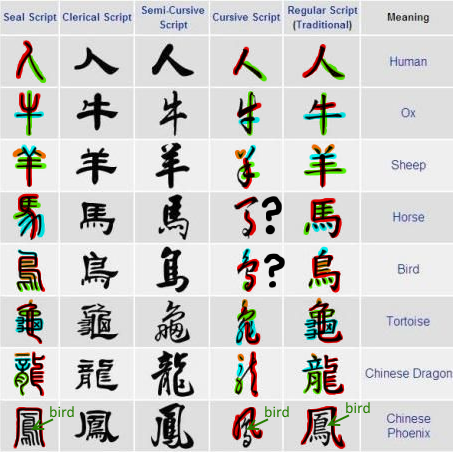
My own interpretation of the glyphs, paired with Isaac's comments, falls somewhere in between the two of you. I think the glyphs are more structured than you seem to be going for @Pagerunner, and I think @Harakeke's difficulty is a result of looking for connections where they don't exist. I know very little about Chinese, but I imagine we can draw a lot of parallels with out that language developed. I put this together: I've tried to make some connections between elements of these characters as we've done with the glyphs. I don't mean to make TOO close of a comparrison. There are some obvious differences. Notably would be the existence (presumably) of the graphemes used in glyphs (the "letters", which Harakeke has attempted to translate some some success) compared to the pictorial nature of Chinese (while the Chinese symbols can be broken down into lines, theose lines don't generally have any meaning of their own). But I think this helps to illustrate how symbols can change over time and in style. For me the variations can appear to be wildly different. If I saw both the "seal script" and "regular script" for horse randomly scribbled around (amidst other characters), I wouldn't casually recognize that those two are the same thing. But it's not terribly hard to see how somebody can. The "cursive script" takes it even further. With the other two, if you threw these in a pile and asked me to pair them together, I could probably do it. But the cursive? Probably not. And yet there are people to whom this is not a problem. In each case (Chinese or glyphs) we have to consider both changes over time AND changes in style (basic vs. caligriphic vs. quickly scribbled, etc.). I think it's interesting that we see glyphs popping up "naturally" around the Knights Radiant. (when Kaladin speaks an oath, on ancient Shardplate, etc.) I think we have to assume that those are the original script, which dates back to (or before) the creation of the Knights Radiant. I expect these glyphs were constructed of a set of graphemes representing consonants (and possible vowels as well, or syllables). They may or may not have been written symmetrically. It seems likely to me that the symmetry was a stylistic option. It's not hard to see how symmetry might be used for importance or formality or emphasis, and this was warped by time and Vorinism until it became the standard. I think the emphasis shifted from the component graphemes to something more pictorial eventually. Screw-you lines were probably added first, in ways that didn't bother someone literate. Then the graphemes themselves began to (occasionally) see fundamental alterations. Parts of one might be removed, reshaped, or added to, and eventually they might be removed altogether. This was all possible because, by this point, people were looking at the general shape and flow of lines rather than all the components. And the result is modern Alethi/Vorin glyphs. Can you still see the original graphemes? Sometimes yes... sometimes not. A glyph might have a few clear graphemes, right alongside those that were altered notably. Kholin is a great example. The K stuck around with little alteration. The L got a lot more curvy with a loop at the top end. The N degraded to a sweeping hook. Nobody would look at the Kholin glyph and think, "Ah, K-L-N, it says Kholin." They would recognize the overall shape for one. They would recognize the center line and the strong mark (once "K") enveloping the rest of the glyph. They'd recognized the 3 shaped symbol beneath the "K", with some kind of embellishment on the top end. And they'd recognize the outward swoop on the edges. So when you look at the tattoo (more on that later), you're not looking for K-L-N. If you spot those in an unfamiliar glyph, that's certainly a helpful indicator. But what you're really looking for is what I've described above. Someone who is literate in glyphs doesn't necessarily know all of the ancient graphemes. They might naturally have picked up on some of them... but they're not necessarily going to look at an unknown, complicated, new glyph and be able to figure out what it means by analyzing the components. If I'm wrong about this, let me know. My belief here is based on Shallan's explanation that she "knows the major, minor, and topical glyphs". This implies you have to learn them like the alphabet. But this is also where glyphpairs come in. I imagine that there's a large number of standard glyphs that you'd learn to be considered literate. And I get the sense these can be combined in creative ways to make other words. Imagine there is no glyph for "cloud", for example. Rather, it's created using the glyphs for "sky" and "smoke". So there IS an element of learning beyond knowing the right individual glyphs. Being literate isn't just about memorizing glyphs, but knowing how to combine them. There's also probably a component of understanding context. For example, Kaladin sees the glyph "morom" and believes it is probably refering to a location. I don't think he read, "MRM, oh that's some district I've heard about". Rather he recognizes "morom" and it's meaning, but understands that it's a highlord's district by nature of it being paired with "sas" and branded on someone's forehead. In the end, I think trying to recognize the component graphemes IS useful. Because the present glyphs are rooted in ancient glyphs which were comprised of those graphemes. But we have to recognized that they may be warped significantly. I'm a bit more hesitant to say that they can be moved around for convenience like Pagerunner describes. That would imply those individual elements have distinct meaning, even if separated from the glyph. You can't swap positions of the symbols in a proper "Kholin" glyph and get something legible. But that's completely different from movement over time, which is arguably the case with "Roshar". The argument there isn't that someone just decided to move and/or change the "Sh" on a whim one day; the argument is that it slowly distorted/moved/got replaced over the course of many centuries. Lastly, I think we have to be extra careful with the Bridge Four tattoo... I'm not convinced that just anybody would understand it. It's heavily artistic. The point isn't to be a clear record of the slave's freedom. It's a tattoo on somebody's forehead covering up a brand. It's there to deter people from questioning your freedom, not to serve as an official record. It's not there so that the questioner can read it. Does that all make sense? That's my understanding. Sorry this is so long.
-
Hm, not to go too far into a tangent, but this got my mind stirring... I always assumed the existence of spheres (i.e. gems in a ball of glass) was based on the usage of Radiants. Meaning Radiants essentially started to use them, then they became a form of money, and so on. But now I'm wondering if the Radiants used straight up cabochons (because, perhaps, they are more efficient at holding stormlight). And then spheres were derived from these (people needed smaller gems for normal monetary use... added the glass to keep them a reasonable size... and started cutting them because that was easier and they looked prettier).
-
This is an interesting question... I think the answer is no. I would argue that AonDor is clearly based on geography rather than national borders, so without evidence to the contrary I think we have to assume Selish magic is tied to geographical location. But I have always wondered what's going on with magic in Emperor's Soul. Is there a WoB on it? It's odd that we see multiple magic systems at work, but no mention of their relative strengths with respect to location. Is Shai very far from home? I've always assumed not. What happens if she travels somewhere distant? How does weakened Forgery work? Stamps just don't stick as easily? What happens if Ashravan goes on a diplomatic mission to Arelon? Will the magic holding him together fail, or is he okay, or is he okay as long as he doesn't need to be restamped?
-
Click the little "eyeball" button on the toolbar at the top of where you type your post.
-
Worth pointing out that there was an AMA on /r/fantasy four days ago, on 2017-02-10. Feeling pretty strongly that the March 10th date listed on /r/fantasy was incorrect, and that this AMA isn't actually going to happen (that is, that it has already happened). That said, we'd love to have you in /r/brandonsanderson, /r/stormlight_archive, /r/mistborn, and /r/cosmere!
-
And it's not just the horse. His shining armor and magic sword are swiftly becoming knock-off versions of the real thing, and his princess needs no saving (she saved him in the end of WoR).
-
But doesn't he call Kalad's Phantoms Lifeless? Maybe not...
-
Easy, I was quoting from the BioChromatic Breath page, which is where I expected discussion on the four types to be. You were looking at the Awakening page, I see now. Like I said, the choice of "organic" was poor. Seems like there's room for interesting discussion on 2 and 3 though. What's the difference between an Awakened human, an Awakened squirrel, and an Awakened pile of straw in the shape of a human/animal? Don't remember the story well enough. The amount of Breaths required? Are we sure the squirrel would be considered Type 3? Sounds like you would argue that when Vasher says "human body" he really means "something that was once sentient"? I buy that.
-
Spool, what are you referring to on Coppermind? All I see under Type IV is an ambiguous: Were you referring to something about one of the other "Types"? Anyways... Warbreaker chapter 46: Without further evidence, it seems to me that the four types should be: One: human body with sentience Two: human body without sentience Three: non-human object without sentience Four: non-human object with sentience. This does make animals a bit ambiguous. Can you have a Returned animal? Or can you only go Type 4? I imagine that by "organic" they were (poorly) referring to something animal.
-
@esamitch Your final work you've been posting in the gallery is awesome!
-
I tried "ideal" and "word" and didn't get anything. Brandon gets LOTS of "kind words" from people btw. This search functionality appears to only go back 7 months, so it's possible the source is just older than that. (not sure how far back Pagerunner has gone) Also possible that he said it somewhere else besides Reddit.
-
That's true. Worth mentioning that we've also been collection WoB's in /r/cosmere since the AU tour. As far as I can tell, we've been pretty thorough, and this is definitely the sort of thing that would make those lists. So if he DID say this, I strongly suspect it would have to be from before late November.
-
I've got a browser plugin (moderator toolbox) which allows you to search people's comment history on Reddit. Searched as many terms as I could think of for both Brandon and Peter, and I can't find anything there about a Windrunner swearing oaths in Oathbringer.
-
@Nashan'Elin, I'm curious... I just downvoted that last post and then upvoted (un-downvoted) it. Any notification for that?
-
I'm under the impression that perhaps he was onboadd with that... Until the Diagram happened.
-
Can't hurt to try!

