



PanLin
-
Posts
155 -
Joined
-
Last visited
-
Days Won
1
Content Type
Profiles
News
Forums
Blogs
Gallery
Events
Everything posted by PanLin
-
Self-diagnosis is valid, and not everyone experiences all of the markers, or even the same markers in the same way; if it resonates with you, consider yourself part of the neurospicy gang
-
What great timing—I literally got my autism diagnosis the other day, after being recommended to be assessed for it during my ADHD assessment
-
Harmonic Resonance and Investiture: A Unified Field Theory
PanLin replied to JohnTMS's topic in Cosmere Discussion
Ooooh maths and music, I'm SO here for it. First up, I think this is a fantastic theory that really has bones. It's clear you've put a lot of thought into it. Sanderson has put too much emphasis on tones, rhythms and resonance for it all to be meaningless. Something about this feels like a bit of a leap in logic, but I can't quite place why. Maybe it's simply that, while there is a direct relationship, that formula is too simple (unless n is doing some super heavy lifting)? I think the missing piece is just something around Intent, which is obviously super impactful in the Cosmere and potentially more difficult to represent in a mathematical formula. I was literally thinking this as I read the previous section; a sign of a very logically constructed thesis imo! We know that Adonalsium could've been split into any number of Shards; assigning each one a unique set of intervals instead of a single unique frequency gives us a functionally infinite playground, as opposed to being restricted by the Planck frequency (unless there's genuinely a realmatic difference between, say, 440Hz and 440.0000001Hz, which is kind of feasible, if a little unsatisfying). It also means that, for example, both Ambition's and Whimsy's Tone could be played in the key of C, but they would still be wildly different Tones; the important bit is the relative harmonics, not the absolute frequencies themselves. From this, I wonder if the humble sin wave is Adonalsium's Pure Tone, regardless of the actual frequency, and each of the Shards technically has a Pure Chord, or a Pure overTone (if you want to maintain the terminology used in-world), with the number of component tones related to how fractured that Shard is. This could also help to explain the purpose of Intent in mortals trying to create Tones. We know that Intent is needed to generate a Pure Tone with opposing polarity, so maybe, with the naturally Invested nature of the Cosmere, one can naturally vocalise a sound that has only the right intervals, something that is impossible to do in the real world. Also, normally (assuming western notation that is somewhat allergic to microtones), once we hit 13 notes in a chord, that's functionally the same as a 12-note chord. However, the use of Intent means that, for example, someone accurately generating Adonalsium's Tone would literally be creating a pure sin wave, which means an octave is realmatically distinct. Some extrapolations: If Adonalsium had only been split into two, we might expect those two Shards to each have a unique dyad (maybe a major and minor third, or an octave and a fifth) In reality, every Shard has a unique hexadecad with 16 component tones When Harmony and Retribution ascended, they each collapsed their constituent hexadecads into octads Theoretically, one could generate a hexadecad for a Shard that doesn't (but might have, under different circumstances) exist Similarly, one could generate a triacontadyad (really testing my knowledge of prefixes here) to imitate the 32-interval Pure Tone of an even more fractured Shard Without the Shards actually existing, I'm not sure a mortal actually could create those last two examples, similar to how lerasium and atium stopped naturally occurring when Harmony ascended. It raises some other interesting questions though, using Harmony as an example: Do Harmony and Discord have different octads? Can a Shard's Pure Tone change over time to reflect changes in its Intent? Does Harmony's overTone have any relation to Preservation's and Ruin's, or is it an entirely new set of intervals? What happens if Preservation's Tone is generated near Harmony? Would it resonate with that part of Harmony, increasing Preservation's expression within the combined Shard and potentially making it easier to forcibly split him back into Preservation and Ruin? Could Preservation's or Ruin's Tone be used to make the splitting of harmonium into lerasium and atium more reliable? Further, could someone create an artificial triacontadyad and split lerasium into two new God Metals? I got carried away and started to address this above. I don't think your translator has met its limit, I just think this isn't quite the right approach for combined Shards. It sounds like you're contradicting the core of your theory by first saying that intervals are the important part, and then saying that an individual frequency defines the combined Shard (but if I've just misunderstood, please correct me!). Maybe, instead, the specific overTones of a Shard help to inform (or are informed by? Not sure on the cause/effect here) how compatible two Shards are. Maybe Honor and Odium just happened to share more intervals in common that Preservation and Ruin did, making the resulting expression stronger as a result of more resonant intervals. Personally, I think Shardic Tones becoming less complex as they re-approach Adonalsium is a neater theory that is also more in keeping with the idea that Adonalsium was a stable expression that got mad screwed up (technical term) by the Shattering, but I appreciate I've just come in out of nowhere and taken liberties with your theory, so apologies for that Also, bonus thought: how does this map to different allomantic metals having different rhythms? Are they a different set of tones and rhythms entirely, or just modulations and harmonic resonances of specific parts of Preservation's Tone? eg: burning copper emphasises Preservation's overTone's third interval while weakening its seventh, and bronze does the opposite? Similarly, (spoilers for Emberdark): -
I had a slightly different interpretation of this—considering how he previously said he'd like courage, and then the ability to know what to do, I think he asked for something along the lines of "I want to understand how the people around me think, so I don't have to fear surprises or worry about doing the wrong thing". Following that, I think he received: Boon: a Connection to the cognitive aspects of those around him (eg: tasting the tea that everyone around him is drinking) Curse: an extremely weak physical presence, to the point where people can only sense him under specific conditions (visible while being sought, corporeal while being hurt, etc) Honestly, I think this is a side effect, something that Baxil has learned minimises the effects of his curse, or maybe prevents him from something like losing his sense of Identity (depends on the nature of his transformation into a cognitive shadow).
-
Whatever's going on with Kelsier is very different to the situation with the Fused, but even still, that kind of IS how the Fused work. Spoilers for Stormlight, seeing as we're in the Mistborn forum: Kel's scars mark him as the Survivor of Hathsin, which is only going to be even more important to his Identity now there's a whole religion behind it. He's even known simply as the Lord of Scars, for Preservation's sake. We also have this WoB that seems to imply he simply hemalurgically stapled his soul back to his own skeleton: Whether it's his own body regenerated from just a skeleton, or a host body, the amount of Investiture and spiritual presence that Kel has is forcing it to adopt a form that more closely resembles his cognitive Identity. And spoilers for the Secret Projects: All of this is to say that yes, Kel's body is almost certainly just re-adopting the scars to match his cognitive Identity, and at this point I genuinely think he'll be stuck with them forever.
-
Those are genuinely compelling quotes and arguments, but I don't think I'm quite on board considering what we know (though limited) about Virtuosity. Unless yellow and black are represented by humans with Virtuosity's Investiture and the nightmares/shroud. Or maybe Hion lines are like a waste by-product, where the yellow is consumed and used, leaving only the cyan and magenta to leak out. I think that one makes more sense tbh, considering how important duality is on Komashi—the spirits always split into two parts, so maybe there's actually a triality, and the yellow part represents the Investiture that's used up, which is why we don't see it. Maybe it's simply to do with how Virtuosity splintered herself. 100% agree, though that doesn't point to Viruosity anymore than any other Shard. Who knows what that sneaky dragon is up to. Virtuosity's influence would work nicely with Cryptics and Lightweavers (like you mentioned above about their potential relationship with Dawn/Light), but I think Reason's influence could be broader—Dustbringers, Edgedancers, Truthwatchers, Lightweavers and Elsecallers all deal with truth/understanding, and if Jasnah is anything to go by for the personality traits of Elsecallers, then that Order feels extremely Reason-coded. It absolutely is, I love this stuff That does sound compelling, but then by the same logic we can say that Reachers represent Scadrial because they're made of metal But yes, this. Definitely possible. I wonder if we can extrapolate a Shard for each type of Radiant spren, where each one was inspired by a Shard based on Honor's perception of them, for example: Reachers: Preservation Mistspren: Ruin / Endowment Ashspren: Endowment / Ruin Honorspren: Honor Cultivationspren: Cultivation Cryptics: Virtuosity
-
Oh that's such a cool idea! The ork-style ponytails have strong Mongolian vibes, so I can see that working really well. Innovative kit-bashing is probs one of my favourite things about the hobby. Tbh I run far more grots than boyz so I have a lot of boyz arms and hair pieces and whatnot that I don't need, so let me know if you need any!
-
Could it have been Reason? And all of this was an intentional (or at least semi-intentional) ploy to stay hidden from the other Shards? It could be that Reason was actually the first Shard on Roshar, known as Dawn by the people there, and they went into hiding before Honor and Cultivation got there. I can feel a rabbit hole calling to me, but I wonder if (assuming it is Reason) there's any relationship between Reason and Truthwatchers / Mistspren?
-
As a dedicated ork player, it's my duty to inform everyone that orks are objectively the best faction. WAAAAAAGH!!!! My favourite squig type is the ones bred for long hair which then bite onto an ork's scalp and stay there, as orks can't grow hair naturally.
-
The Shards have two independent grouping systems, not one — a theory
PanLin replied to Lemons's topic in Cosmere Discussion
No worries! -
The Shards have two independent grouping systems, not one — a theory
PanLin replied to Lemons's topic in Cosmere Discussion
Sure, and Honor can't contain the entropy assigned to Ruin, and Autonomy can't contain the binding connection assigned to Dominion. Nothing here says that Devotion only contained that one type of love. If anything, the wording implies that Aona had other aspects too. Devotion contains the gentle care and love of a comforting mother, but the Shard's name is Devotion, not Care or Support or Maternity. If so much effort has been put into the text to show us that Odium refused being named anything other than Odium, even to something as closely related as Passion, then we can't just dismiss the definition of a Shard's name, especially when that Shard has been dead for millennia. The interactions we've seen with what remains of Devotion shouldn't be used as safe evidence that we fully understand her Intent. An interpretation, sure, but one I disagree with. I don't think there's enough here to straight up say my interpretation is wrong. There's also this unrelated WoB highlighting how Sanderson uses the phrase 'you could argue': Agreed! Although I would argue again that the wording of this quote: implies that Odium's target was Aona, not necessarily Devotion. Honor says that Aona was among the best of them. Tbh, multiple things can be true at once, and actually work together to answer why Odium went to Sel: Multi-shard systems are a bigger threat than mono-shard systems Devotion's emotional purview threatened Odium's (which I think is more evidence that they aren't opposites) Dominion's Intent somehow clashed with Odium's Rayse knew that Aona was one of the best among the vessels and would therefore not sit back and let him continue his crusade I sure do! I don't think I implied anything to with 'virtue' in my suggestion? None of the Shards are 'good' or 'evil', and they all consider different things to be virtues. My argument in proposing Odium and Virtuosity is because: Odium represents Identity loss He fully removes or supercharges people's emotions, sometimes against their will He created the Fused, immortal beings that have to forcibly override others' Identities to continue living Odium as an emotion is usually an extreme hate/disgust as a response to something, ie: letting external factors override your normal judgement and self-control He's constantly manipulating people to override their wants and needs with his own Virtuosity represents a form of Identity mastery A virtuoso becomes one after a great deal of dedicated training and self-control Investiture related to Virtuosity is attracted to self-expression, as well as the Fibonnaci sequence—a mathematical pattern that repeatedly shows up in nature Virtuosity as a concept is purely an internal goal, training a skill to perfection regardless of any external factors Odium (or even Passion) is a loss of control over your sense of self, where Virtuosity is the trained self-discipline required to understand and express one's sense of self perfectly. -
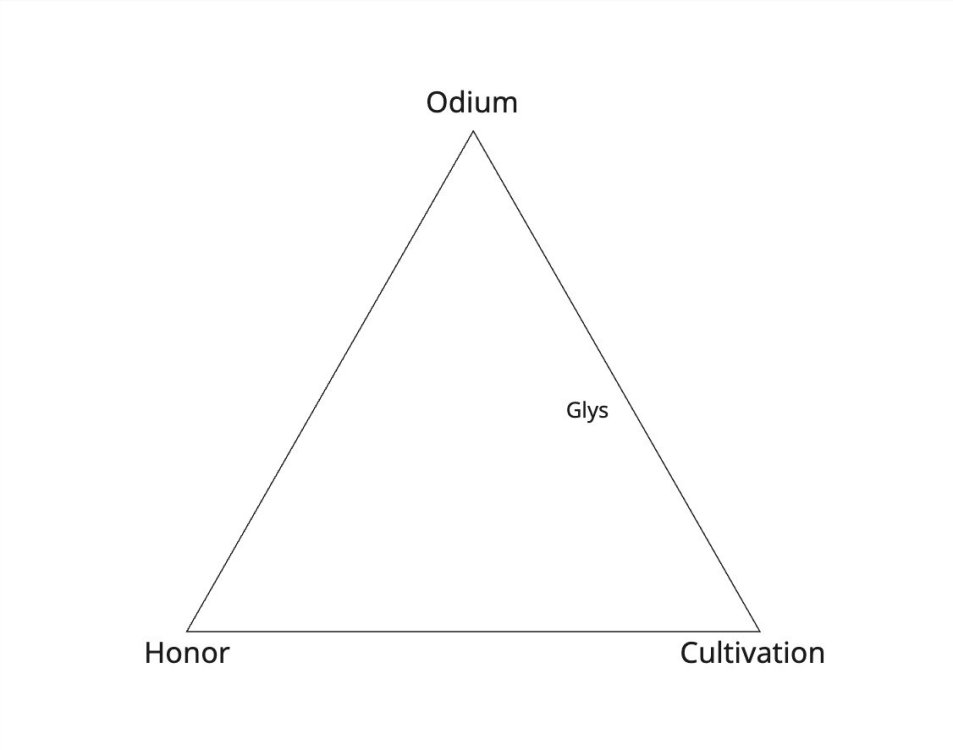
Ah, my wording was a bit heavy handed—iirc, the Oaths were set up with input from Honor, Cultivation and Ishar after the radiant spren were inspired by the Heralds and started created Radiants. From the wiki: It seems that Honor only intended to give Surgebinding to the people involved with the Oathpact, whom he could directly judge and vet. Then, when Radiants started appearing, he got Cultivation involved to help define rules and progression. The Heralds were a static "here's the maximum power all in one go", where Radiants gain power over time, which implies that aspect came from either Cultivation, Ishar, the spren themselves, or a combined effort from everyone involved. In my head, I have a tendency to simplify that to "Honor created the Heralds and initial oaths/rules, Cultivation created the progression system of ideals", which isn't quite accurate, my bad to say that one of the Radiant spren is purely of Cultivation (though their ability to use Stormlight admittedly raises some questions). I think that variety will be very important. Because it should be safe from Retribution's influence even without the protection of the Oathpact. Which might be a point in favor of Cultivationspren, since most of the Mistspren we know are corrupted. But I can't shake the idea that Mistspren matter more. Yeah ok, so that raises another question, especially with the quote @Master_Moridin shared: And a related WoB: It feels to me that the only way to reconcile all of this is to say: All spren on Roshar have at least some of Honor and Cultivation in them (I suspect the Oathpact prevented Odium being included in this, despite his rhythm being accepted by Roshar) When Renarin says, "Glys says ... something about a Rhythm of War...", I think there's a bit of unreliable narrator going on here. The Rhythm of War is the only combined rhythm that's been directly experimented with, but Glys and Tumi actually contain all three Shards (and would therefore be susceptible to any of the three anti-Lights), something that does seem to be supported by the wiki: Ah well there goes that theory. I guess it's Cultivationspren after all. Thank you for finding the quote. Not necessarily, if we take the above into account! Seeing as Surgebinding carries the touch of both Honor and Cultivation, it could even be that, regardless of whose essence a spren is made from, they become a mixture of Honor and Cultvation simply by being a Radiant spren and possessing the ability to grant Radiant Surgebinding. Excuse the terrible diagrams, but everything we've seen about spren is more complicated and interconnected. I really think that Radiant spren are of both H+C, and when someone says something like "A spren of both Honor and Odium", it's less an absolute and more like: So technically, yes, Glys is of Honor and Odium, and the person saying that is highlighting those two Shards as the ones they consider to be the most important when talking about Radiant spren, but kind of dismissing/forgetting Cultivation's influence (which is exactly what Cultivation wants). Taking "both Honor and Odium" to mean there's no influence from Cultivation would go directly against other evidence in the books and WoBs like this one: Looking at this now, it almost feels like direct manipulation of Tanner and Rayse from Kor. She gave them two options for meting out powers, and one was obviously designed to appeal to Honor. Another thing worth noting from that chapter is that Kor also enters this agreement. I feel like it's often characterized as a pact between Honor and Odium that she just happened to be there for. But it's her pact too. It certainly was, thanks! This speaks to a wider piece of context that I think people underestimate sometimes—Cultivation is sneaky as hell. Just like Taravangian convinced people he was just a frail, emotional, harmless old man, part of Cultivation's approach to her plans is preventing people from knowing anything, including whether she's involved or to what extent. Whenever she's even remotely involved with something, we should assume that she has more influence than she lets on, and that her involvement furthers plans of hers of which we're not even aware. Oh neat, I'm glad! Long may the rabbit hole continue.
-
I promise I mean nothing negative when I say this, but it sounds like your objection essentially boils down to 'I don't like this topic', which is fine; as @Returned said, not everything in every book will appeal to every single person. The only way to make any kind of art appeal to literally everyone is to make it so bland and lacking in substance that it stops being art.
-
some weird thangs I noticed about aluminum
PanLin replied to chipofIsharsblade's topic in Cosmere Discussion
Imo this goes against your theory—all Investiture is keyed to a Shard when it leaves the spriritual realm. Burning steel and iron still lets one see metalminds, and they can even push/pull them with enough Investiture. Aluminum is just straight up invisible and immune, which matches its allomantic and hemalurgic effects. Does that mean nicrosil has innate magical properties because it can store Investiture? If it were, Preservation likely wouldn't have included it as a 'normal' metal in allomancy, unless we're being lied to about the allomantic metals again, like with Atium, Malatium, Nalatium and Lerasium (although its appearance in both feruchemy and hemalurgy implies our current 16-metal model is the correct one). Plus, as others have mentioned, when a Shard is shattered or merged, the godmetal associated with that Shard stops naturally occurring and can only be synthesised via Invested means. They were wildly Invested, yes. Not sure what you mean about them acting like a godmetal though? I don't recall this one but would love to be corrected—ping me if you find it! My understanding is that godmetals are the physical manifestation of a Shard's Investiture; concentrating a bunch of Investiture in one place creates power and effects comparable to a godmetal, but doesn't spontaneously create one. WoB: Yes, they consume it. They're also kept in an aluminum sheath specifically because the aluminum blocks that effect. If aluminum were invested, Nightblood should simply be able to consume that too. They're both names for Autonomy's godmetal. Trellium is just named after a particular avatar of Autonomy (I don't know if that means it has different properties to 'true' Bavadinium, but I suspect not). -
Fringe theory, but what if there were originally 10 'cityspren' (I've been calling them Advancementspren in my notes)? Odium could've originally intended to turn all 10 into Unmade, and simply failed to get to and corrupt the Sibling. The Fused occupying Urithiru could just have been them trying to finish the job. Unless Odium's (or Rayse's) aversion to Adhesion prevented him from doing this. Agreed; Wind, Stone and Night are effectively Adonalsiumspren. H+C didn't modify their rhythms to match Roshar; Roshar was spiritually adapted to include them (which happened again when the Oathpact trapped Odium in the system).
-
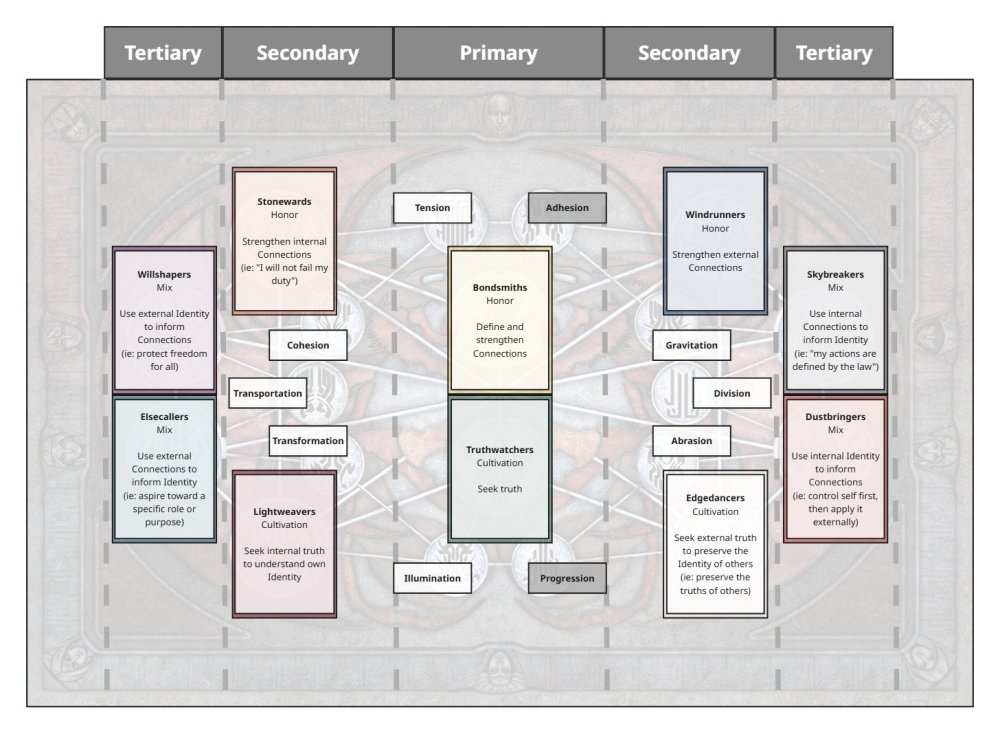
So I think it's more nebulous than that (because of course it is; everything in the Cosmere is), but that the double eye diagram implies three 'tiers' of Radiant: Primary: almost purely aligned to one Shard (Bondsmith and Truthwatcher) Secondary: still aligned to one Shard, but with more influence from the other Tertiary: equally influenced by both Shards, with more abstract concepts/philosophies I created this diagram in another thread to help visualise what I mean. There also seems to be a general pattern of Honor-leaning Radiants focusing more on Connection and Cultivation-leaning Radiants focusing more on Identity, but that isn't the important bit here. I agree! I think Mistspren are the closest candidate for Cultivation's 'true' spren, and the Cultivationspren and Cryptics are both mostly (but not entirely) aligned to Cultivation. The naming of spren seems to be partially up to the spren and partially based on the perception of Rosharans, as indicated by these WoBs: (In the above WoB, Sanderson refuses to comment on which Shard Cryptics are associated with, which seems a weird thing to RAFO, considering both Cultivationspren and Honorspren exist. To me, that implies there's something deeper going on and that we shouldn't put too much stock into what names spren and humans give to the different spren) Yep, same deal. I'd wager they're close, like maybe even 95%, but none of the Radiant spren are purely of one Shard, like how Seons are almost but not entirely chunks of Devotion. I essentially agree with this, too. Honorspren and Cultivationspren occupy the same (but mirrored) relational space in the double eye. Bondsmiths require a bond with a special class of spren, so the natural (imo) conclusion is that, originally, Honor intended to create a Radiant spren equivalent to mistspren but never finished the job, so the gap was filled when H+C created the three special spren. I don't think it's quite as straightforward as saying that Cultivation created the missing spren (because she didn't; the Stormfather and the Sibling both contain Honor's essence too), but more that Cultivation used those special spren to fill the gap in the Radiant model. We know she was responsible for the oaths/ideals, and therefore was capable of modifying the original Radiant model as defined by Honor.
-
The Shards have two independent grouping systems, not one — a theory
PanLin replied to Lemons's topic in Cosmere Discussion
Ah I don't think I was clear enough, apologies. I'm not trying to say that Odium contains love and care, I'm saying that the emotion odium is itself a passionate emotion, and that people have a tendency to misinterpret the concept of passion. 'Passion' doesn't just mean 'love'; it can refer to any heightened emotion, particularly one that overrides someone's normal decision-making (which is pretty on-brand for Odium). The word even comes from the Latin word for 'suffering'. Sure, the Shardic Intent was adamant in retaining the hateful focus of Odium, but it's a big leap of logic to assume that means Passion would've been a 180 flip. Rayse also still preferred the term Passion, regardless of whether he could convince the Shard to agree. Devotion is also a form of passion—losing oneself entirely to the object of one's devotion. One could make the argument that Odium and Devotion are opposites in the same way that one could make the argument that Preservation and Endowment are opposites, simply because one maintains a status quo while the other changes it (and by that logic, one could basically argue that any of the Shards could be a candidate for Preservation's opposite). There are, imo, much better candidates for opposites to Odium and Devotion; for example: Odium <-> Virtuosity; loss of self to emotion vs absolute control and perfection of self Devotion <-> Autonomy; prioritising a goal or relationship vs prioritising the self Did he? Or did he prioritise Sel and Roshar as multi-Shard systems (and therefore a greater potential threat to him), as implied by these WoBs: Like others have pointed out, I think people are putting too much stock in the wording of 'one could make that argument'. If Sanderson intended for Odium and Devotion to be true opposing forces, that answer would either have been 'yes' or 'RAFO'. The Cosmere is rife with people 'making the argument' that, for example, all kinetic Investiture is Surgebinding, or that there are only 10 allomantic metals, or that (Emberdark spoilers) Because of a mixture of the normal muddiness when trying to find the complete, objective 'truth' of historical events, and because of the very tangible effect that perception and Intent have in the Cosmere, I really don't think that one WoB is enough for us to conclude that Odium and Devotion actually are opposites. -
The Shards have two independent grouping systems, not one — a theory
PanLin replied to Lemons's topic in Cosmere Discussion
Yeah exactly, my current headcanon is that the Dawnshards split Adonalsium into four protoShards representing the Dawnshards, then the vessels organised themselves so each group of four would look after one protoShard; when taking a chunk of that power, each vessel coloured the protoShard with their personal perception of what it means (eg: Leras was part of the 'Exist' group, and his understanding of 'Exist' as something stable and unchanging created the Shard Preservation from that power). Can I ask, considered by whom? Love and hate aren't opposites; Odium is even known as Passion by a lot of people. -
This would all nicely mirror how we learned about a fourth moon and potential fourth Shard on Roshar, after being told there were only three of each. All of this honestly sounds really reasonable and I'm mostly on board, but how do you reconcile the fact that none of the Bondsmith spren or ancient spren have mentioned or even made any allusions to a fourth ancient spren? Thematically, I'd be fully on board with this, considering how important 4 is across the Cosmere; it would just feel off considering we have quotes like this: Unless this fourth one was killed or consumed even before Honor and Cultivation got there, so long ago that even the weakened surviving ancient spren don't have the cognition left to recall them.
-
Considering most of his books are for an adult audience, anything approaching a sex scene is actually really lacking in detail, especially compared to a lot of other authors. Kind of, but he's on record saying that he loves how the recent rise in romantasy is getting more adults back into reading in general. He doesn't like writing smut himself but has no issue with other people finding enjoyment in writing or reading it.
-
There are some really interesting WoBs building on this idea, and inspired by the fact that singers can basically change their form at will. Sanderson has also said a few times that he wants to include more queer characters, he just wants to make sure he does it right. You can find them all with this search query: https://wob.coppermind.net/adv_search/?query=transgender (I'm conscious we're in the Stormlight forum, so just be careful of spoilers if you haven't read the other Cosmere books!). The first WoB below is spoiler-free if you're up to date on Stormlight: Minor spoilers for Warbreaker: Minor spoilers for Mistborn: Which is all to say that various applications of Investiture seem to hint that we might see a rise in transhumanism and other forms of radical self-expression in the future of the Cosmere, let alone just gender non-conformity.
-
yep! I mean, that conversation you're quoting is in itself canonical evidence that the Sibling is non-binary. Gender is a purely social construct, and the Sibling clearly doesn't feel like they're either male or female, hence: non-binary / agender. Technically, all parshendi are non-binary because their society recognises 4 genders, so an agender parshendi would technically be non-quarternary instead (but agender is probably cleaner).
-
Thanks for sharing, this really resonated with me. tw for self-harm details in spoiler: Anyway, I hope you're doing ok! I see my own scars as a permanent reminder of how far I've come since making them; I hope you can get to a similar point. I know people throw this sort of invite around willy-nilly, but my DMs are open if you (or anyone else reading this) ever do need to vent/chat with a friendly ear who might understand some of what you're going through
-
The Shards have two independent grouping systems, not one — a theory
PanLin replied to Lemons's topic in Cosmere Discussion
Oh yeah, Shard mapping is my jam. I know you said the specific names aren't final, but can I ask how you came to the conclusion of these specific pairings? For the Dawnshards, did you try to fill out the blank two first and then work toward the Shards, or did you group the Shards and work backward to see what was missing? And where did Adonalsium's aspects come from? It kind of feels like you just picked some that would work alongside the Dawnshards as personality mappings, and not like a cohesive, comprehensive framework for the overall personality of God. Starting with a criticism (sorry!). It's been mentioned a few times that Preservation and Ruin are kind of unique in how perfectly they mirror each other, and that all the Shards don't have 'true' opposites. WoBs: Now, that doesn't necessarily mean the Shards didn't start as a perfect mapping like you propose, and it's just that they've drifted over time due to Intent, Identity and perception. Personally, I think it does imply that they've never been a perfect mapping, and that (who'd've thunk it) killing a god and sharing its power among a group of people is pretty messy work. Also, Honor and Odium definitely aren't opposites. Harmony is constantly fighting to keep both of his Shardic Intents happy and balanced; if he doesn't want to become Discord, he basically just has to not interfere or do anything at all. Retribution carries no such turmoil (as far as we've seen), and it seems perfectly acceptable to warmonger while keeping both Honor and Odium happy. Some quotes from the end of Wind and Truth below; they pretty strongly imply that the two Shards can synergise and amplify each other as long as Taravangian manages them properly, which is very different to Sazed's experience with Preservation and Ruin. EDIT: I see you addressed this anyway: Valid, I'm on board, but I still don't think Honor and Odium can be called opposites by any stretch. Odium is pure emotion; if it did have a true opposite, I'd expect it to be something like Virtuosity or Reason. So we're Myers-Briggs-ing the Shards? Can I just ask where this is confirmed, please? Would love to read up on it. I agree pretty wholeheartedly with this. Preservation and Ruin wanted completely antithetical things, but Dominion and Devotion both essentially seem to want the same thing (Unity), and just have different thoughts on how to get there. Even further, I think they both carry a similar thread of "sacrifice self for the greater good", they mostly just differ on whether people should be able to choose that sacrifice or not. On individual Shards: Whimsy as Honor's opposite is a much cleaner pairing imo! But yeah like you say, it's hard to say anything with full conviction until we see what Whimsy is actually like in-text. On both of these points, I think there's probably a bit of both going on. We know that Sanderson intentionally set it up so cognitive Perception has a real, tangible effect on the universe. Even if the Shattering created 16 perfectly spaced Shards of 8 pairs of opposing Intents, they've since been taken on by a range of different people with a range of different backgrounds and a range of different ideas about what it means to be a god. Further, like we've seen with spren and other Shardic Splinters, they will have been warped even further over the last few millenia by the perceptions of everyone in the Cosmere; stories, myths and legends all have tangible effects on entities like the Shards. Which is all to say: I concede that, even though it's confirmed that Preservation/Ruin is the only true opposite now, that doesn't mean there weren't more true opposites when the Shards originally ascended. Personally, I think the Intents and perceptions of the to-be-vessels messed the whole system up the moment they killed Adonalsium, but that's kind of moot until we learn more about the Shattering. -
Don't see why not! Although you'd obviously have to make sure you were somewhere extremely safe while the world zips around you. You'd also probably have to pop out of the bubble every now and then to eat, sleep, and do other things necessary to stay alive. Spoilers for Stormlight Archive: WoB: Almost certainly—Sanderson has stated a few times, both in-text and in WoBs, that all savantism carries negative side effects as a sort of narrative deterrent to just burning lots of metals all the time. All allomantic savantism creates a dependency/addiction on that metal, for a start. As for the specific effects, I don't think we know for sure yet. Cadmium and Bendalloy side-step relativity issues by pulling extra energy directly from the spiritual realm, so there might be something there. Maybe their spiritweb starts to become unstable, or they start to become untethered from the physical realm? WoB:

