



PanLin
-
Posts
161 -
Joined
-
Last visited
-
Days Won
1
Content Type
Profiles
News
Forums
Blogs
Gallery
Events
Everything posted by PanLin
-
Anyone noticed Renarin's name is significant?
PanLin replied to RandomCable's topic in Stormlight Archive
From the wiki: Sounds like Evi wanted him to basically be named Re Dalinarson. Son of Thorns is interesting, though. Just grabbed the glyphs from the wiki: The consonants are nice and symmetrical, but not sure if the vowels are intentional—a better match for the pattern would be 'Renaron'.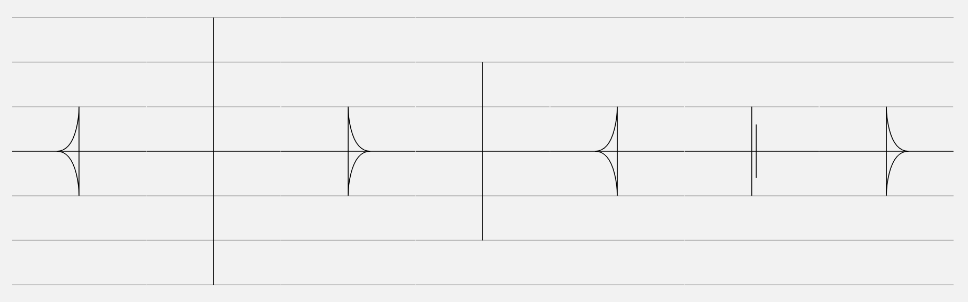
-
In addition to the cool ways others have mentioned in this thread, I think the biggest advantage is that you can change the shape your spren manifests in on the fly—we've seen Kal change Syl's form mid-combat to great effect. At any time, immediately, you can summon your spren or change their form to whatever you need in that exact moment. I also suggested a shard-swiss-army-knife as an idea, but the nature of the Nahel bond means your spren IS a Swiss army knife at all times anyway. You can, for example, use them as a shield to block an incoming projectile, switch to a grappling hook to get to a better vantage point, switch to a sword to clear any obstacles there, switch to a megaphone to shout some orders/information, switch to a javelin to throw it at the person who sent the original projectile at you, then immediately resummon them to you as a shield, all in a matter of seconds.
-
Wasing the reading of this, phrasing ising the nearing of styling of High Imperial Fun idea! Great lil lunchtime activity. Here's my go (I didn't intend to title it, but 'Patterns' seems an obvious one): Poetry and math, Patterns express balance, creating complementing patterns, Math affects balanced rhythm; poetry affects emotional expression, Patterns for both need each, both affect patterns, Me, David? No, Goliath understands and harmonises both, David binds rhythm, nothing expressive in, Patterns, In expressing nothing, rhythm binds David, Both harmonising and understanding: Goliath, not David. My Patterns, affecting both, each needing both for patterns, Expression emotionally affects poetry; rhythm balanced affects math, Patterns, complementing, create balanced, expressive patterns, Math and poetry. (happy to receive feedback or be told I've broken some Vorin rules with it)
-
There aren't any obvious dragons on Roshar, but Cultivation Invested it anyway. I take it back! My bad, was clearly just a few days out of date on my WoBs thanks for linking it, @Schizoposting
-
Gosh, my first recommendation, thanks although now I have to live up to it... Side note, but I really love how these secret projects give Sanderson the opportunity to write Cosmere books with a different voice/style than the core books. As usual, I got carried away and wrote a much longer post than I intended. Apologies! I made a bunch of notes as I read through the two chapters (which I really enjoyed, can't wait for the book), but a lot of them aren't relevant to this question, so I'll try to stay on track. I think it'll be set on either Mythos, Bjendal or an entirely new planet that hasn't been mentioned at all yet. In order of likelihood, my money's on: entirely new (maybe Valor's shardworld, and the 'time travel' (imagine me doing air quotes as I say that) is a glimpse into her Invested Art) Mythos Bjendal (travel being disrupted to the planet gives a nice excuse as to why everything here feels so isolated from the Cosmere, but then Hoid and December's mum both managed it so who knows. Maybe December's mum, if she was a worldhopper, had something to do with the travel being disrupted. I also try not to put too much stock in what rules Hoid follows and breaks, the sneaky little gremlin that he is) Relevant WoB: It's unclear whether that means brand new, or a planet that's been mentioned but not seen in-text yet. Firstly, the linguistic nerd in me thought the place names (Riverside and Mountaincrest) might hold a clue, as Hoid is clearly translating actual proper nouns (it'd be like referring to Belarus as 'White Russia'), but: there are so many potential place names with 'river' in the name (same irl) that it'd be a bit of a needle in a haystack afaik (please correct me if I missed any!) there are no existing Cosmere place names with the same etymology (like Streambank or Edge-of-Channel or something) I even went through all the aons, but there aren't any known locations on Sel with 'Eno' (the aon for 'water') in the name, and the other aons we know are too tangentially related to 'river' to consider. The WoB I quoted disqualifies most planets, so I'll just do a quick debunk of all the other planets that have at least been mentioned: Ashyn 'disease' immediately rings Ashyn bells, but, as others have noted, it sounds too far removed from what we know of Silence Divine for this story to be related to it. Also, the disease (singular; I'm not counting December's infertility as a disease in this sense without knowing more about her and her heritage) doesn't appear to have any positive side effects that might imply it comes from that Invested Art. I do think there might be an Invested source to the disease (potentially the demon), as it strikes very precisely, ignores December completely (part of the reason I think 'somewhere far away' implies her mum was a worldhopper), and kills exactly one tenth of the population (we've seen afflictions affecting a specific number of people for a specific purpose before with Preservation). The disease killing one in ten people also sounds a bit Rosharan, but that isn't a new planet so Braize Just included this for completion. It's sort of a new planet but sort of not, but regardless, there's nothing in the worldbuilding in these chapters that includes any reference to singers, Odium, immortal Invested souls, or anything else that would point to Braize. Even if this story is set way in the past, we've seen no reference to the weirdness or 'original purpose' that Braize exhibited before the Shards got there, and we know that Braize wasn't inhabited before then. Plus, Hoid is here, which at least implies this is after the Shattering. If it's set so far in the future that Braize has humans living on it, then all bets are off and this entire post is redundant. Obrodai It's unlikely that Hoid would visit this planet without some sort of disguise after the warning he received, unless this book is set in the past—that same warning mentioned Hoid shouldn't return, meaning he's been there before. There isn't really enough in these two chapters to support or discredit the idea that an avatar of Autonomy is here (maybe it's the demon ). Vax Seems super unlikely purely for the fact that there is no mention of non-humans here. It could be that the peoples of Vax are quite segregated, but the existence of people with mixed heritage implies otherwise: I did consider whether Eddlin might shed some light on Vax and its likelihood for this story, but tbh as a worldhopping arcanist, I don't think much about him can be considered 'typical' of a native Vaxilian. Yolen It would have to be set WAY in the past (or future, I guess) for the tech level to match up. Also, no mention of dragons (maybe the demon is actually a dragon ). That pretty clearly just leaves Mythos and Bjendal, which we know basically nothing about, or an entirely new planet that hasn't even been mentioned. Let me know if I missed any other candidates! Speculation ahoy! This is a fun tangent; we know that time travel will never be a thing in the Cosmere, which leaves a few theories: the memories of those 6 decades didn't actually 'happen', and December actually received a super in-depth vision of one particular future that might have happened her new life is technically in a sort of simulation, like what happened on Komashi her new life is all happening in a version of her planet that was moved to or recreated in the spiritual realm, like Kharbranth The third option doesn't really account for the 'time travel' in itself, and I don't think Sanderson would pull an 'it was all a dream' on us with the second option, so I really think it might be the first one. Either way, it's super weird and is likely the result of either direct intervention from a super-Invested being, or a new Invested Art. I genuinely could see it being Valor's. The method of acquiring an Art is more related to its Shard than the stuff you can do with it; maybe one of Valor's Invested Art abilities is gaining knowledge of the worst possible future thread your life might take in order to try to prevent it, and is gained simply by being as incredibly lonely as December is described as being at multiple points, along with an inherent sense of justice and doing the right thing (plus maybe some inherent Connection to Valor, like we see from Preservation, Endowment, and Devotion/Dominion). What's happening with December has given her far too much specific knowledge of the future to simply be an increase in Fortune, but maybe this story will show how Hoid got access to his Fortune abilities?
-
Honestly looks great! Super interesting chart, very comprehensive. My only qualm is that I don't think hemalurgy should be an innate 'character creation' trait. The other metallic arts are innate, but anyone can use hemalurgy (though I suppose the importance of that distinction depends on the purpose of this chart). Also, what's the difference between koloss-blooded and spiked-koloss-blooded?
-
The Shattering and the Dawnshards (a geometric model)
PanLin replied to Kenzal Hunter's topic in Cosmere Discussion
Ooh, this is interesting! I think I'd have to see a proposed model of the Shards before getting fully on board and abandoning my Intent-led thinking, but I am a big fan of the 4D geometry. Would you expect the Dawnshards to have had less individual influence over the creation of the Shards than most theories assume, then? As each Shard has four 'edges' (technically 4D hyperplanes, but 'edges' makes my brain hurt less), one for each Dawnshard? -
From WaT: Presumably (granted, this is speculation), currency will be charged using Retribution's light instead now. Taravangian has shown a vested interest in keeping Roshar stable and able to sustain his future interplanetary armies and logistics, so I'd imagine he'd have no problem regularly charging spheres, whether that's done by individuals or banks and other financial institutions. I could even see that become the new minting process for currency, where Retribution decides whose spheres get charged and only those spheres count as legal tender. Wouldn't put it past Taravangian to exert such egotistical control over the world's finances. Unsure—it's likely that the Light itself would be a viable source, but if Retribution has to actively grant his Light to those who ask for it, he'll almost certainly just not give it to people who are against him. It's the main reason I'm so interested to see what Lift does next; it's quite possible that, at least for a while, she'll be the only active Knight Radiant on Roshar that hasn't sworn allegiance to Retribution.
-
Possible improvements to Navani's flying fabrials.
PanLin replied to Grubfriend's topic in Cosmere Discussion
Conjoined fabrials don't work across realms, and mandras can't pull things in the physical realm like they do in the cognitive (unless someone continues Ishar's experiments successfully). -
Before I start being a party pooper, I just want to say that this is a really interesting idea. I love thinking about how hemalurgy in particular can interact with other Invested arts. I think this is the bit I'm getting tripped up on, for two reasons. First, Nicrosil stores the ability to use a specific Invested power, not raw Investiture itself. I don't think this interaction would line up the way you expect it to. The Set were doing something wacky with it (either with other metals involved, physical spike design, extra Commands, or something else) that we don't entirely understand yet. Second, compounding is quite a specific interaction that uses a feruchemically charged metal to change its allomantic effect and bypass the normal limitations an allomancer would face when drawing power from Preservation. Do you have any sources that imply a Nicrosil-boosted feruchemist would get back more than they put in, or would they just tap and deplete their metalmind faster? The spiritual trauma isn't something you can just bin the memories of and be back to normal—all hemalurgy is inherently chaotic and destructive, and repeated use like this would keep damaging and scarring the surrounding spiritweb, even if (and that's a big if) the hole itself were to be healed each time. Spoilers for Warbreaker: @Treamayne beat me to it while I was writing this, so I won't link the same WoBs as they did
-
Well, he had to ask someone else to punch him to remove a tooth, which I think is enough evidence that he can't hurt himself either. Seeing as the rock thing was part of a joke/insult, I assume he only pretended to hit himself.
-
[Hemalurgy] What spike would you use to steal stubbornness?
PanLin replied to Cephandrious Maxtori's question in Cosmere Q&A
You're so right my b, I've updated my answer so it's actually about hemalurgy. Essentially, I think stubbornness (if we assume you mean it as a positive trait) is a more emotional than cognitive trait, so I'd go for zinc over copper. -
Surges and their relation to the Order's beliefs and Ideals.
PanLin replied to CoderDrag0n8's topic in Stormlight Archive
Ah dangit, thanks, fixed the typo -
[Hemalurgy] What spike would you use to steal stubbornness?
PanLin replied to Cephandrious Maxtori's question in Cosmere Q&A
Hiding my first answer in a spoiler in shame because I misread and managed to answer for feruchemical traits, not hemalurgy (but my thought process is mostly the same): I still want to give a kind of two-part answer based on your reading of 'stubbornness'. If it's about the inability or unwillingness to adapt when faced with new information or evidence, then that's actually a sign of either lower cognitive capacity (being unable to form new reasoning and adapt existing thought processes) or lower emotional capacity (refusing to abandon a previously held belief purely because it's more comfortable). But if you're coming from the angle of stubbornness as a positive trait to stick to one's convictions and hold to what is true even when it's difficult to do so, then I would either suggest: gold for access to F-electrum zinc for the emotional capacity For this second reading of stubbornness, I think zinc is a better fit than copper—it's not about being able to rationalise what's right, it's about sticking to it even when it's difficult or when you're in the minority, which is emotional resilience. It's annoying that warmth and determination did swap places, or else brass would've been a great candidate. -
Possible improvements to Navani's flying fabrials.
PanLin replied to Grubfriend's topic in Cosmere Discussion
Ah that's a good point. I suppose it depends whether the fuel is gathered through mundane or Invested means (eg: mined coal vs soulcast fuel). I wonder how long it'll be before Roshar gets access to Zephyr spores, or even a Fabrial that just converts Warlight directly into matter-based propulsion as their version of a chemical propulsion rocket booster. I agree with your real-world-sucks parallel! Spoilers for IotE: The extra concept of fossil fuel mining weakening a Shard is interesting and very plausible, especially on Scadrial where the planet was made directly by the Shards and is therefore more strongly Invested by Harmony than a lot of other planets. Maybe the same could be said for crem and Cultivation. Somewhat related and potentially a fun read: there's a worldbuilding project called Cathedris that I've been following for a while that takes the real-world concept of whalefalls (where a slowly decomposing whale carcass takes so long to be used up that it creates its own temporary ecosystem) and applies it to gods. Your example with Harmony reminded me, but this is a much more direct application: the gods in that setting (now mostly mad and dying following a big ol' divine war) have physical bodies made of extremely valuable materials that people have learned to mine and build their entire industrial infrastructure from. I do that same check to make sure I'm in the Cosmere forum all the time -
Surges and their relation to the Order's beliefs and Ideals.
PanLin replied to CoderDrag0n8's topic in Stormlight Archive
Oh fun! For the record, I agree with you and fully believe there's a pattern there. I actually did some thinking on this the other day while prepping for my Ideals theory (no pressure to go read it unless you're interested, I'm just going to copy-paste the important section here: So yeah, I agree with this framing! I kind of treat Bondsmiths and Truthwatchers as the cardinal poles of the Radiants and move outward from there, so secondary orders (four connections) are still mostly aligned with either Honor or Cultivation and are abstractions of Bondsmiths and Truthwatchers in internal/external pairs. Tertiary orders (three connections) are even further abstracted and are less aligned with a specific Shard, drawing from them both in a more balanced way. Which is all to say that I basically agree with you. For example, Truthwatchers seek truth, nice and simple, then Elselcallers abstract it a bit and apply it more externally (seeking truths about people that would otherwise be lost to time). I also find it much easier to visualise as a diagram, imo it makes the connections and 'tiers' really clear: I'd be super interested to hear your thoughts on that and where it aligns and clashes with your thinking!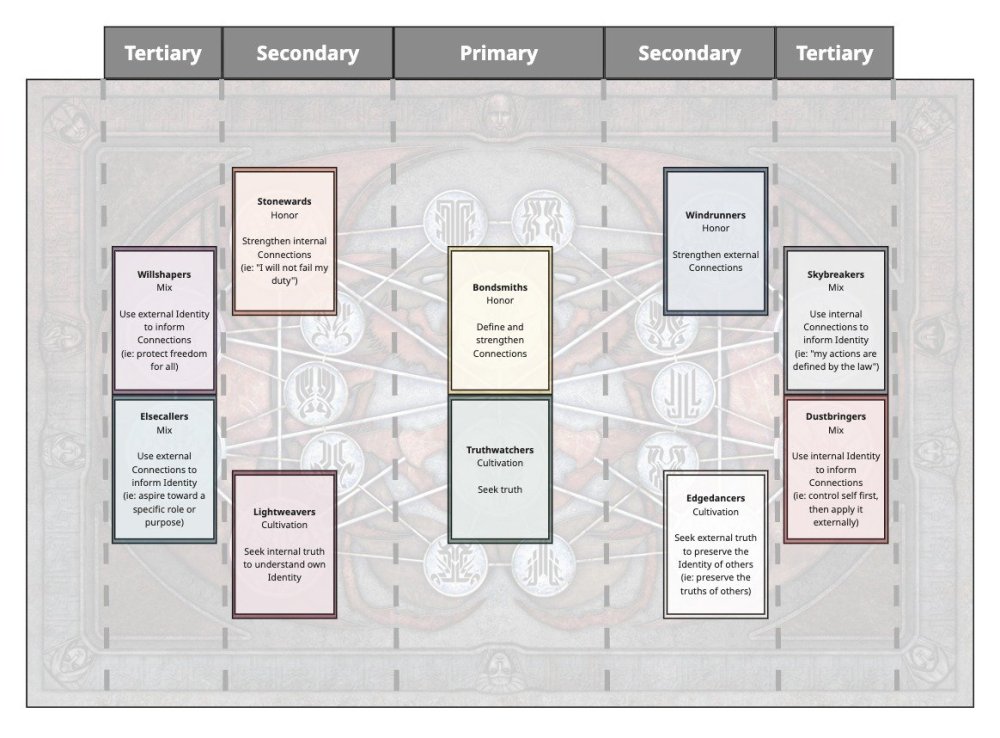
-
Possible improvements to Navani's flying fabrials.
PanLin replied to Grubfriend's topic in Cosmere Discussion
And at that point, it probably is more efficient to just mount some steam-powered propellers on the Bridge and only use the conjoiners for vertical movement. -
Possible improvements to Navani's flying fabrials.
PanLin replied to Grubfriend's topic in Cosmere Discussion
I mean, not necessarily—move the horizontal controller in a curve and the Bridge will follow that curve. Having the two controllers always reminded me of a video game controller or an Etch A Sketch. Precise control comes from coordinating the movements of the two controllers (but yes, I'll grant you that the controllers for the Bridge are slightly bigger than an Etch A Sketch). I really had a good look around before posting this, so I hope I'm not saying something that's already be suggested, but I wonder if brass on the controller or zinc on the Bridge's lattice could be used to amplify the distance travelled (presumably by either requiring more Investiture, making the controller harder to move like upshifting on a bicycle, or both). Or maybe they would just make the conjoinment more efficient over larger distances? Could just be that duralumin has a similar effect on Fabrials as it does on Allomancy, but we might not know for a while—Vin kind of accelerated the technological development of aluminum and its alloys because she knew there was a new alloy that would be allomantically viable, which isn't a push we have on Roshar (unless someone like Nirvani makes the observation that Fabrial metal effects tend to come in alloy-pairs). That said, I like your idea too, and it makes intuitive sense—the chunk with less living Investiture in it moves further compared to the larger chunk. Would be handy to find a way to make asymmetrical conjoiners that doesn't require Raysium, too (heck, maybe copper could do a similar thing). Yeah, sounds like a different packaging of the same concept. I think the main limiter here would be how much more difficult it gets to move the controllers. They seem to operate like gearboxes, so it's always going to be a balance between distance and force (unless they find a way to fuel the movement with Investiture instead). Anything you want to just wordvomit on and then work out later? We have seen a sort of rudimentary blinking code used on spanreeds a few times—I think the closest to Morse code was in Dawnshard after Huio stumbles on his aluminum discovery, but I don't have that book on me rn to check. Well that's going to be handy for spaceflight Even for normal airflight, imagine being able to fully negate any gravitational pull on an aircraft, leaving the pilot able to freely navigate in three dimensions. As for my input, I would LOVE to know how the other allomantic metals interact with Fabrials. Stuff like: can cadmium be used to change a Fabrial's local perception of time, to account for time dilation? (especially as the Cosmere enters the space age, the ability to track time in specific locations by letting some clocks on your ship ignore the time dilation experience by the ship is HUGE) is there more to aluminium, based on its actual allomantic effect? Is there a way to use its interactions with Identity to either unkey any incoming Investiture or blank a Fabrial spren's Identity, to allow it to use any Light, or even Breaths or Hion? can electrum allow a Fabrial to self-adjust and predict things without it needing to be Awakened? Not going to go through all of them, but there's a lot of potentially fun realmatic engineering waiting to be unlocked there. -
Surges and their relation to the Order's beliefs and Ideals.
PanLin replied to CoderDrag0n8's topic in Stormlight Archive
Great timing, I've been doing a whole bunch of thinking on the Radiants recently. What sort of connection are you trying to find? Looks like you're trying to formalise both the theme of each order from their two Surges, and the theme of each Surge from their two orders? -
Not me finally giving in and buying the RPG and world guide instead of relying on the Coppermind (I'll probably play a game soon anyway, so it was only a matter of time). Side note, but I believe that's exactly what happened to create Ashyn's disease magic—a natural expression of both Cultivation's and Odium's influence, similar to feruchemy, and powered by something I'm referring to in my notes as Blightlight. I mean, part of my reasoning is that we do see it, just not as explicitly as creating a new Surge for Surgebinders, and not in a way that people in-universe (Rosharans are unreliable narrators for classifying Invested Arts) would look at it and go "oh hey, that's Odium's Surge". It does, but that's exactly what happened! From the RPG: Whether that means the Fused did technically have Surges and just didn't learn to harness them until later, or they straight up couldn't access them to start with, the timeline is: I agree the Unmade are still a big unknown, but I don't agree with your logic here. Being able to use a Surge doesn't necessarily mean someone has to have a Nahel bond—Honorblades and Nightblood grant them, Odium granted them directly on Ashyn, and there's really nothing to say that accessing Odium's power requires the same mechanics as a formalised Invested Art created by two different Shards. So again, the terms Rosharans use to describe Invested Arts and the powers within them are not fully reliable. Got a WoB to confirm this point (bolded the relevant bits): Sanderson explicitly states here that someone in-universe referring to someone as a Bondsmith means they have powers associated with a Bondsmith, but doesn't necessarily mean they're actually a Bondsmith under the definition of the Kinghts Radiant. Similarly, he confirms that there weren't Elsecallers, and Ishar himself opened the portal to Roshar that was referred to as Elsecalling. Something weird, powerful and dangerous was going on with the Surges on Ashyn, and imo Sanderson has intentionally been using muddy terms and in-universe bias to obfuscate exactly how it all worked. Regardless, Ishar used Transportation, accessed Surges without a spren or Honorblade, and wasn't a Bondsmith according the proper definition. It might be possible that Ishar had access to Adhesion, but that would break canon, not just my theories, as we know Odium can't grant Adhesion (unless, of course, that was a limitation placed on him via the Oathpact). As for being granted Surges on Ashyn, we're explicitly told a few times that Odium did exactly that. From the wiki: But of course, that comes with the consistent pinch of salt that Rosharans call all Invested Arts Surgebinding, and tend to blur concepts like Surges, fundamental forces, and other concepts. My understanding here was that Honor sort of abandoned the people of Roshar, but he didn't stop Investing the planet at all. There may well have been time for it to manifest—like I mentioned above, I believe that it did, just potentially not as a 'Surge' that would be recognisable as such by Rosharans, and in a more subtle way that didn't fit the nice, neat framework set up by Honor and Cultivation. And the Oathpact defined the orders and powers of the future Radiants; my point there is that, for an eleventh Surge (and therefore order) to pop up from Odium's influence, Odium would have had to rewrite the core rules of the magic system as put in place by Honor and the Oathpact. Also, I think it's important to remember that Odium never meant to Invest Roshar or stay there for any longer than he needed to. It's very possible that he did all he could to avoid his power becoming an official part of the Rosharan system until it was forced to by the Oathpact. Slight tangent, but Sel is an edge case—Odium killed the vessels, splintered the powers, and stuffed them into the cognitive realm to mix and stew and whatever else. Plus, Devotion and Dominion had already Invested Sel, so the planet and its people were already receptive to their Investiture. Ah gotcha. Yeah, agreed, those oaths would've been up to the spren of each order, which were inspired by the powers and ideals of each Herald, and further moulded by the perceptions of everyone on Roshar as to what those heralds, orders and powers represent. No matter which way you cut it, the Intent of the oaths comes (whether directly or indirectly) from Honor, and the progression system of them from Cultivation. And yes, I fully agree on the problems pretty standard fare for the Cosmere though—difficulty defining things and understanding their realmatic workings has been a constant since we were told as a Fact that there are only 10 allomantic metals. Relevant WoB: Yeah, sure. I would imagine that, with all radiant spren being of Honor and Cultivation, there would be part of their nature/Intent that makes them incapable of accepting wildly antithetical oaths. I don't know that for a fact though, and they are for sure fallible. That doesn't change the idea that there might be an underlying pattern to what the oaths should represent across orders. Thanks! I've been hooked on that idea ever since I learned that Honor alone created the Heralds. This is also the bit I'm more intersested in tbh. Oh for sure, this is wildly speculative—I just really felt like there was an underlying pattern to what we do know and wanted to explore it. So I've been relying on the Coppermind's examples until now, but I did go and finally buy the RPG (before I saw you'd pasted the oaths below thanks anyway!). I spoke about Skybreaker quests specifically, and I was trying to unify how those quests fit with the themes of the oaths in other orders. The extra context you've given me has shifted my mind slightly, but not enough to abandon my theory—I still think the third ideal being some sort of internal shift and realignment toward the true sense of the order (instead of one's personal beliefs) holds for the Ideal of Dedication. As for the fourth ideal, with the extra ideals from the RPG, I think I missed the mark by making them too introspective and similar to the Windrunner ideal (although I had tried to liken it to the Crusade too as a practical lesson to learn). I now think it's something more about taking the philosphy of the order and applying it to the world in a more active and impactful way (Edgedancers go from remembering to telling, Skybreakers embark on a Crusade, Willshapers go from freeing individuals to creating a system that ensures freedom, etc). Not snarky at all! I want to be challenged like this, I love it. If there's in-text evidence that genuinely goes against my head-canon, I'll happily modify/update/discard. This post is already super long, so I'll similarly put my responses to you in a spoiler.
-
Investiture on Anti-Investiture annihilation
PanLin replied to Cephandrious Maxtori's question in Cosmere Q&A
Ah apologies, didn't mean to tell you stuff you already know but yes, this still applies to annihilation. From the wiki: The energy comes from the conversion of Investiture and anti-Investiture. That wiki also states that the relationship is similar to matter and antimatter in real world physics. From the wiki page on Annihilation: Whether the end result is matter, energy, new Investiture, or something entirely different, the rule of conservation still applies and nothing is truly destroyed. Edit: ah sorry, I'm on the move and just realised I haven't answered your question. Please hold, I'll update in a sec @Ati_Simp new answer for you: What happens after annihilation So, a couple of WoBs are useful here. So, I'd say we can confidently say from this that matter, energy and Investiture being the same thing means they can be freely converted for however long without breaking conservation. The bit I bolded seems to imply that this recycling would naturally happen even after the Investiture has been converted to energy, but it is a bit vague as to whether this is a natural process or he just means that it would naturally find its way back to the spiritual realm because of interactions with other agents and forces. I also thought that purified Dor still returned to the Dor, which would mean that Investiture that's converted to energy still 'remembers' the Shard its keyed to and would end up back there, but the last WoB I linked makes it sound like Sanderson's shifting his perspective on that a bit. Either way, it defo isn't permanently gone. I really want to get myself to a convention to ask this question in person now -
Investiture on Anti-Investiture annihilation
PanLin replied to Cephandrious Maxtori's question in Cosmere Q&A
A core rule of the Cosmere is that Investiture can't be created or destroyed, just like matter and energy in the real world. The Investiture and anti-Investiture are both converted directly to energy (and potentially some matter) in the form of an explosion. -
Yeah, basically! Not sure about 'out loud' so much as 'directly in Kaladin's head' for the same reasons he was able to wake up at all—being super close to the fourth ideal and extremely aligned with Honor's Intent (and therefore the part of the Sibling that was of Honor).
-
Pretty sure it's exactly this—the Sibling trying to reach out to someone to help them. Directly after this, the Sibling manages to get actual words through to Kaladin.
-
Going to apologise in advance—apparently I have a lot to say Ah, now this is a good spanner in my theory! I do have some thoughts as to why. Pick your poison, but essentially I believe that every Shard has a True Surge. Side note, but all of this is keeping in mind the context that everything in the Cosmere is subject to perception and Intent. The form of the Sub-astrals is the most obvious example that comes to mind. We also know that, like you pointed out, Honor warped and constrained the powers of the Heralds and Radiants to make them fit his pattern (just like Preservation specifically decided to use 16 metallic powers, set up which specific metals granted which powers, and changed which ones naturally expressed to fit his goals). Which is all to say: we already know that people's perception of everything in the Cosmere, including stuff like fundamental forces, inherently changes how those things operate and express. Odium couldn't use his True Surge while bound by the Oathpact Odium doesn't create; he corrupts Personally, I lean toward the second explanation, but regardless, it's very possible that Odium did grant a ninth Surge to humans on Ashyn, and that they didn't have access to Adhesion or Progression (people being referred to as Bondsmiths back then doesn't necessarily mean they specifically had access to Adhesion). Maybe this is why everything went so badly on Ashyn: Odium's Surge was just too destructive and focused on Reducing. Basically everything we actually know about Odium is contextually defined by the effects of the Oathpact on him; we simply don't know enough about him. As for what Odium's True Surge might be, I suspect something destructive, impulsive, antithetical to a stable Identity, and much more emotionally coded than Adhesion or Progression. Maybe something like Antipode/Compulsion/Coercion/Impulse (although actually, Impulse might be Whimsy's True Surge). Just as there didn't need to be 10 Surges, the 16 Shards aren't like 'core', essential parts of the universe. They're perception-warped fragments of divinity each with their own character and Intent. If I'm right with this (big 'if', I know), then the True Surges are similarly not essential powers/forces. In the same way that Lerasium and Atium stopped occurring naturally after Harmony ascended (and I suspect that Harmony's True Surge would change if he ever properly becomes Discord), Adhesion as we know it shouldn't be accessible anymore. Sorry, not sure I follow the logic of the bolded bit. Correct me if I'm wrong, but I thought Odium became part of Roshar because of the Oathpact, and that the Sibling 'broke' because of the Recreance and the imprisonment of Ba Ado Mishram? As for the rest of your point here, it's also worth noting that Honor and Cultivation had a few thousand years of uninterrupted shenanigans on Roshar before Odium got involved. Even then, Odium was restricted and mostly bound to Braize for almost all of his time on Roshar. Logically, we would expect Honor and Cultivation's influence to be stronger in general than Odium's. Odium absolutely does imo have a True Surge, but that doesn't mean Radiants would just automatically get access to it, especially when the pattern of Radiants was so strongly and specifically defined by Honor and the Oathpact. Also, Scadrial and its people were created directly by Preservation and Ruin, so naturally their Intents warped the planet and its rules and magic systems faster and more drastically. Roshar already existed before Honor, Cultivation and Odium Invested it. We may be missing each other here—my understanding is the the Oathpact was sworn first, directly between Honor and the Heralds, and had nothing to do with ideals. This original oath is where Honor's Intent mostly came in, by defining exactly how the Surges could be used. Cultivation then worked with Honor to define the ideals and formalise the Progression (hehe) of the Knights Radiant. Also, my thinking is that the Yolish Surges are the real 'fundamental forces', and they're not bound to specific Shards—any Shard can grant access to any of them through their Invested Art. I posited in my other theory that Adhesion is sort of an Honor-specific expression of Yolish Cohesion, and that Progression is a Cultivation-specific expression of Yolish Illumination. With that logic, Honor didn't have to 'steal' or co-opt Progression, he just had to incorporate a version of Illumination that he knew was Cultivation's domain. Rioting and Soothing don't seem very Preservation-coded at all, but he could still grant those powers. Hm, I think, if it were that drastic, those words simply wouldn't be accepted. It's up to the spren's judgement, but we've seen words not be accepted before. The whole point is that the spren decides whether your words (and more importantly, what you mean by them) are viable words to level up in your chosen Order. I agree that your example goes against what the Radiants stand for, and therefore wouldn't be accepted. I have put an unhealthy amount of time and thought into this, yes
