



PanLin
-
Posts
179 -
Joined
-
Last visited
-
Days Won
1
Content Type
Profiles
News
Forums
Blogs
Gallery
Events
Everything posted by PanLin
-
mood I know this is an annoying answer, but it depends! I personally started with Final Empire (the first Mistborn book) and was immediately hooked, but that is quite a meaty commitment for your first one, so depends if you mind getting stuck into a big book first. Sanderson actually recently said that he currently recommends one of three books to new people: Final Empire. One of his earlier books, the start of the Mistborn trilogy; he's described it as Ocean's Eleven meets My Fair Lady, but with a really cool magic system Tress and the Emerald Sea. A smaller, more recent standalone book, with easter eggs to other works (but no actual spoilers!); it's a fun, mostly light-hearted adventure book on a planet where the oceans are made of sand Emperor's Soul. Another small, recent standalone book; it's a lot of people's favourite single book he's written, a very well contained, tense, psychological thriller with some super interesting and insightful character work
-
Hey! Oh that's cool! I would love to run a Cosmere RPG, but I think the members of my group that haven't read Sanderson wouldn't be interested, and I'd worry about giving lore spoilers to those who are in-progress currently planning an Eberron campaign using the Daggerheart system instead. Is it a spoiler to ask what your players are playing as?
-
My Identity/Connection theory must be one of like 1000 Dawnshard theories at this point—I will do my best not to be personally offended. @Xelaadryth Just want to preface this by saying that this looks really interesting, and my notes and questions below come from a place of inquiry and wanting to discuss ideas, not from a place of trying to poopoo your ideas or anything Also, welcome to the Shard! A great way to start getting involved is to pop an intro post in the welcome forum. Could you expand on this, please? I'm not sure I understand what you mean, or how your theory solves this in a way that other theories don't (if you have any examples, that would be super helpful!). DESIGN - Cognitive CHANGE - Temporal EXIST - Physical CONNECT - Spiritual I agree on mapping Dawnshards to realms, and your assignment of EXIST and CONNECT (I've been calling it MERGE, basically the same thing). DESIGN feels off to me. How do you Command something to DESIGN? Designing is something you do yourself when interacting with the thing you're designing, not something you cause to happen in something when interacting with it. (also, on a meta note, part of me doubts that Sanderson would use that word specifically for a Dawnshard when we already have a character called Design) I feel like something that represents the 'thing' rather than the person giving the Commands would work better here, maybe something like REVEAL or YIELD to represent what the thing is actually doing that allows it to be understood, like the cosmic equivalent of doing some research before starting a DIY project. As I understand it, using the four together is what allows for true 'creation'; CHANGE is specifically about remaking, not creating. I'll avoid commenting on the specific Shard mappings for now (I'm more interested in understanding the rationale for your Dawnshard definitions first), but if some Shards can be swapped to other Dawnshards, isn't that evidence that those mappings aren't well enough defined/justified? I'm on board with this line of thinking! Though I'd argue that this framing makes Invention a stronger CHANGE candidate than a DESIGN one. Does every Shard have to have an opposite? We know that Preservation and Ruin are the only 'true' opposing Shards, so I'm not sure that's necessarily a hole that needs filling. That said, the act of Mercy (sacrificing your own morals or desires in order to protect or preserve someone else) seems like a great opposing force to Ambition imo. Occams's razor, and all that. I like the idea of edge Shards defining the range of what each Dawnshard means, but wouldn't that mean that a CHANGE Shard crossing into EXIST and an EXIST Shard crossing into CHANGE would have more in common? Treating them as opposites seems antithetical to the rest of your theory. A lot of your theory (and this is pretty common in other theories I've seen) seems to treat '16' as an inherently important number, which we know isn't the case. How would this theory look if there had actually been, say, 17 Shards? Or any other number?
-
 Shallan has a shardblade Shallan has a double bond (I went wild when Testament was first spotted in the CR) I remember the first time Shallan summoned a blade without counting heartbeats—I messaged my friends who were further ahead than me, and essentially got a RAFO from them Kaladin would be the new Herald Honor and Odium would combine to form Retribution (though I initially thought Dalinar would be the one to hold them) Adolin would 'heal' Maya Elhokar was seeing spren Zahel was Vasher The 'Sja-Anat' that Szeth saw wasn't actually Sja-Anat Taravangian would replace Rayse Humans weren't native to Roshar Being unable to recall his wife's name was Dalinar's boon, not his curse Honor was never 'dead', and Tanavast's death was related to BAO Shardblades and plate are 'dead' spren Roshadium and other animals have their own spren bonds I know there were others, but I can't remember them all So I also predicted this, but I also thought it was so obvious that it wasn't really a prediction. I wasn't on the forums at the time, but was this genuinely a point of contention?
 -
Whoops, thanks for calling me out! I'm so used to spending time in the Cosmere boards. Added a spoiler tag
-
Dalinar manifesting the Stormfather stuff
PanLin replied to Ascended Grubberfly's topic in Stormlight Archive
The Stormfather not appearing as a blade was a specific request from him, but yes, the Sibling can't be manifested as one because they already exist in the physical realm as Urithiru. As for the rest, a big plot point throughout the Stormlight Archive is the tension between the Stormfather's wishes to do things his way, and Dalinar's insistence on changing the Stormfather and forcing their bond to do things the Stormfather doesn't want to do. This is essentially a very clear example of that tension, and consistently approaching a Radiant bond in this way is a surefire way to eventually create a deadeye. -
It sounds like you're familiar with programming, so I'm just going to point out that it's fully possible (and arguably more efficient) to use AonDor with the same methodologies as Object-Oriented Programming. Build a function, say AD_Teleport, with some variables built-in, something like AD_Teleport(x,y,z), where: x = the radius of the area to teleport y = direction z = teleport distance All the specifics—like the units of measurement to use for x and z, and defining y as 'degrees from magnetic north' or something—can be hard-coded into that function. Then you can just call that function by writing an AonDor like AD_Teleport(10,57,200) for a quick, easy, ready-to-go teleport spell.
-
Spoilers for Mistborn: Without being too spoilery, just remember that everyone has their own goals and moral frameworks, and also remember that Sanderson loves to use unreliable narrators to hide realmatic secrets. RAFO!
-
Sadeas' Ironic Line about Uniting Them [WaT Spoilers]
PanLin replied to ApprenticeArtificer's topic in Stormlight Archive
'Wrong' is an interesting word to use; I think Sadeas just had more in common with Dominion's definition of uniting people than with Honor's. I currently think one of the Dawnshards is Merge, and that both Dominion and Honor essentially came from that and just have different methodologies on what it means to merge or increase Connection. 100% intentional This line of thinking makes me think of the debate between Taravangian and Jasnah. They both purported to fully believe in utilitarianism, and Taravangian used that to explain how his goals and methods are inevitable if you take a purely utilitarian view toward creating a stable, safe system for humanity. I don't know if Sadeas was intentionally being utilitarian (and there was definitely more than a little ego with him, something that Taravangian coincidentally shares), and while his methods were undeniably selfish and a little evil, I don't think he was necessarily 'wrong'. -
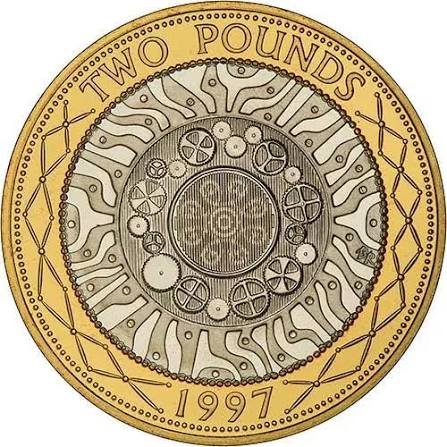
At least for the coin Hoid gave to Wax, I immediately thought of a British £2 coin:
-
Adonalsium was 4 barbershop quartets in a trench coat
PanLin replied to JohnTMS's topic in Cosmere Discussion
I deeply resonate with this I know I just responded to a similar comment of yours in another post, but I really don't think Change relates to entropy, especially when we know part of the Change Dawnshard is about making things better, and we have Shards like Ruin who are all about entropy as an end-state, not as a tool to then remake things differently. Oooh, this is an interesting framing. Reminds me of your other topic talking about Shardic Tones as intervals instead of actual tones. Some questions: Shouldn't each interval have either one Shard, or the same number of Shards as every other interval? Rather than stuff like simply 'the tonic' and specifically 'flat seventh', how about something like: Exist: fully resolved chords (major, minor, open fifth, maybe octave) Change: directional unresolved chords (suspensions, sevenths, etc) ???: non-directional tension/colour chords (full tones, major sevenths, etc) ???: fully discordant chords (tritones, semitonal clusters, microtones, etc) (I obviously have my own thoughts on the other two Dawnshards, but I'll avoid bringing my tinfoil hat into contact with yours for this) I'm sort of extrapolating, but it feels like you're describing the Dawnshards as four 'types' of interval (which I'm fully on board with). Having one Shard be represented by fully discordant chords also satisfies the WoB that one Dawnshard is unlike the others. Let me know if you need another baritone! -
surges Theory: A Complete True Surge Framework for all Sixteen Shards
PanLin replied to PanLin's topic in Cosmere Discussion
Indeed it is! So far, we mostly know about Resonances in-text as basically 'a bonus ability that arises from the interaction of multiple powers or types of Investiture'. Everything in the Cosmere has underlying rules that take what we understand as a contextual example and reframes it as a natural result of hard laws. For example, we used to think 'Progression' just meant 'healing', but we now understand it be an alignment of the physical and cognitive self, which takes everything that used to feel weird about Progression and neatly explains it. So, Identity and Connection are core aspects of the Cosmere, no-one I've seen has reasonable been able to argue otherwise. My initial Dawnshard model only featured those two aspects, but the more I look at it, the more it feels like Fortune also fits alongside them. All three of these are things that everything in the Cosmere innately has. When positing this as an opposing aspect to Connection (ie: something that increases an entity's ability to pursue a beneficial end-state for itself rather than binding to other entities), then Entropy seems (at least, to me) a very natural opposing aspect to Identity (ie: something that weakens the self as opposed to more strongly establishing it). Having 'Entropy' in that set also satisfies the WoB that one Dawnshard isn't like the others (but honestly, there's 101 ways to satisfy that). When I started looking at fundamental forces and their relationships to the Surges, I originally tried mapping each one to a Dawnshard (and therefore a spiritual aspect), but it very quickly felt like I was trying to squeeze stuff into a box that didn't fit. So I went back to the drawing board and tried to define what was actually going on, and it hit me: the fundamental forces all describe interactions, where the Dawnshards (at least in my mind) describe characteristics. So, the forces are emergent reactions that happen when stuff reacts to other stuff. At this point, I basically asked myself 'what other realmatic terms do we have that don't fit into my current model', and it really just seemed to click (this list is ordered in how strongly I feel these mappings make sense): Perception handles information, filters, and the effects of information and wave functions between entities. From the wiki: Intent is essentially how an Identity chooses to manifest and exert its presence on the world, which sounds like an uncanny way of applying the Strong Nuclear force (the force that keeps the basic building blocks of the universe together and allowing for stuff to even have an Identity Resonance is the emergent effects that come from the interactions between entities, and can trigger extra effects (like radioactive decay and fusion) that the individual entities aren't capable of doing by themselves Investiture is one of the core things that make up the universe; it has a spiritual mass, warps spacetime, and defines positioning and interactions in the spiritual realm in the same way gravity does in the physical realm Actually, the one I'm least convinced about here is Investiture. Considering it's meant to be a third state of 'stuff' alongside mass and energy, it feels weird having it exist in frameworks like this that don't also explicitly mention mass and energy. I have considered that these three states instead map to the Dawnshards (exist-mass, reduce-energy, merge-investiture, change-???), which I might revisit at some point. oh thanks! the linguistics nerd in me had a lot of fun making those Yeah? I'll keep my eyes peeled, would be super interested to hear your thoughts! oh, very true! Actually (and I could very well be influenced by my own confirmation bias here), I think they could map slightly differently: Exist: reducing temperature reduces entropy Change: energy can only be changed and transferred Reduce: entropy always increases Merge: (something to do with Adonalsium; if my model holds (big 'if'), I would expect it to somehow mirror the effect of Merge) Considering we know Change has a directive to remake and better things, I doubt it maps to pure entropy. as a fellow music person, you really should I actually covered this in my Dawnshard post Basically, I think Ati either chose or was forced to be a Reduce vessel; either option would fit my mapping of Reduce as essentially Identity-reducing, ironically making Ati a perfect candidate. The text version isn't up on the Coppermind yet, but this question was essentially asked in the recent London Comic Con, and the answer was that the Shards might have been different if the Intents of the vessels had been different, which implies the exact opposite: there was no 'default' set of Shards, and the ones we have were influenced (if not completely defined) by the specific people involved in the Shattering. Initially my Dawnshard model didn't have Fortune or Entropy. I may still change Fortune in future (maybe it works better as one of the force aspects instead), but my thinking for Entropy is essentially: Exist carries a mandate to increase/maintain Identity; if Reduce opposes that, then it must carry a mandate to weaken and break down Identity, which feels to me like Entropy on a spritual level. Interesting—I won't extend this already-rambling post with a bunch of speculation here (unless you'd like to get into it!), but I'm definitely copy-pasting this into my notes for future reference! I do think Command is just an expression of Intent, but again maybe my thoughts will change in future Yep, I know in that example, I'm specifically stating the effect of increasing the Connection of a Resonance between two entities, which is a synchronisation. Agreed on Gravitation! It's part of why I'm less confident of Investiture for Gravity. For Progression, I can certainly see the argument, but increasing the Perception/EM of an entity's Identity/Existence should result in self-actualisation, hence Virtuosity; Perception (and Cultivation) deals too heavily with increased Connection of a system to be purely an Identity effect. Seconded and agreed, this would make a lot of sense. -
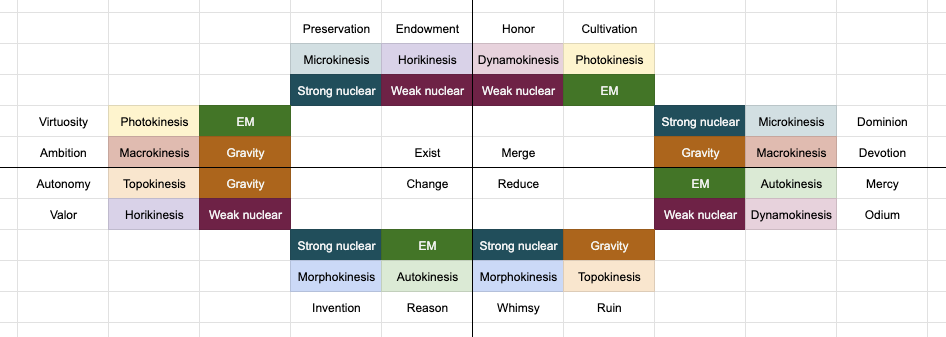
I'm back on my realmatic holisticity madness normal, sensible research. Most of the WoBs that helped me here are already linked in my two other theories below, but there's a new one from the recent Comic Con in London: the 16 Shards could've been different if the vessels had different Intents and Perceptions during the Shattering (can't see it on Coppermind yet, sorry!). This basically confirms one of the underlying assumptions I'd made when making the first theory below (vindication!). I'm going to be talking about three different types of Surge, so for reference, here's my shorthand: R-Surge: The 10 Rosharan Surges we know and love Y-Surge: The 8 Yolish Surges that existed ages ago and are free from Honor's influence T-Surge: The 16 True Surges; hypothetical Surges for each Shard, to mirror Adhesion for Honor and Progression for Cultivation This one also builds on a couple of my previous theories, if you fancy doing some extra credit: The Shards can be essentially expressed as perception-warped Identity/Connection vectors There are only 8 Surges in the Cosmere, and Adhesion and Progression are the 'True' Surges of Honor and Cultivation If you don't want to read those (no shade—I ramble a lot), here's a quick primer: Shards as Identity/Connection vectors There are only eight Surges Note: I created a uniform set of names for the Y-Surges. I know Hoid has said that Yolen had lightweaving, but we also know that he was talking to a Rosharan at the time (who are prone, for example, to calling all forms of kinetic Investiture 'Surgebinding'). He was also likely tapping Connection in some way to speak Alethi (I think that's what he was speaking at the time?), which we know from multiple examples has an inconsistent way of translating some concepts. I don't think it's a contradiction to suggest that Yolen had a different name for the Y-Surge behind lightweaving. As with any Shard theory, it's also important to remember that the method by which one gains access to an Invested Art is WAY more related to that Shard than the powers one gets from that Art. For example, one of the Rosharan Surges is Division, which seems pretty antithetical to Honor, and most allomantic abilities don't vibe well with Preservation's Intent. I've summarised the ones we know about here: The actual theory bit Oof, I really do ramble. Just as the Dawnshards represent the four 'core' aspects of the Cosmere, I believe the four fundamental forces manifest in the Cosmere as another set of four realmatic attributes, ones that every conscious being has: Investiture Perception Intent Resonance It's actually quite straightforward to map the forces to these attributes (almost as if it were intentional ). Some of the links may seem a bit abstract, until you remember that the forces describe physical phenomena, whereas the aspects describe spiritual ones. Gravity warps spacetime and determines the distribution and effect of mass: Investiture EM governs information and energy transfer: Perception Strong Nuclear defines what stuff is: Intent Weak Nuclear describes how stuff interacts and transitions between states: Resonance Yolish Surge Force Governs Spiritual aspect Macrokinesis Gravity mass attraction, orbital dynamics, spacetime manipulation Investiture Macrokinesis Gravity mass attraction, orbital dynamics, spacetime manipulation Investiture Topokinesis Gravity spatial translation, wormholes, realm traversal Investiture Topokinesis Gravity spatial translation, wormholes, realm traversal Investiture Photokinesis EM EM radiation, information transfer, energy transfer Perception Photokinesis EM EM radiation, information transfer, energy transfer Perception Autokinesis EM contact mechanics, surface tension, friction coefficients Perception Autokinesis EM contact mechanics, surface tension, friction coefficients Perception Microkinesis Strong nuclear internal configuration, plastic deformation, structural continuity Intent Microkinesis Strong nuclear internal configuration, plastic deformation, structural continuity Intent Morphokinesis Strong nuclear transmutation, state change, energy / matter / investiture conversion Intent Morphokinesis Strong nuclear transmutation, state change, energy / matter / investiture conversion Intent Horikinesis Weak nuclear strain threshold, fracture mechanics, brittleness / ductility Resonance Dynamokinesis Weak nuclear tensile stress, surface tension, mechanical strain Resonance Dynamokinesis Weak nuclear tensile stress, surface tension, mechanical strain Resonance Horikinesis Weak nuclear strain threshold, fracture mechanics, brittleness / ductility Resonance From this, it seems like a logical next step to create a grid of 16 True Surges by combining these two groups of four. Activity time! In the first spoiler below, there's a grid of the names of the 16 T-Surges. In the second spoiler, I've added the names of the Shards. See if you can guess with T-Surge belongs to each Shard, then check the second spoiler to see how your answers compare to mine. Be sure to comment to tell me why I'm wrong! In each case, we're essentially able to look at the Spiritual Aspects and Realmatic Attributes and say: If you apply [Attribute] to [Aspect], that means you [T-Surge] For example: If you apply Connection to Resonance, that means you synchronise distinct entities and bind them together (Adhesion) If you apply Connection to Perception, that means you align how two related entities perceive each other (Progression, ie: modifying the physical self to better align with the cognitive self) And, because I'm a data engineer and can't help myself, here's a nice(ish) graphic showing the Shards as a grid: And a full table showing the relationships of all the concepts I've spoken about: I only started this theory by going "huh, I wonder if every Shard has a True Surge", and ended up just reinforcing my belief that there are only 8 Surges in the Cosmere, each of them a derivative of one of the fundamental forces.
-
I don't think that reading is wrong! Every conscious entity in the Cosmere has its own tone: Therefore, we can happily extrapolate that Intent and tone (along with Identity, Perception, and a whole host of other things) are heavily linked to each other. Modifying one aspect has a knock-on effect to the others.
-
Basically, yeah! I understood RoW to implictly confirm that, and the wiki seems to agree: The process of making, for example, Stormlight, is to literally cut the Investiture off from its Shardic source and forcibly impose the opposite Intent on it.
-
Investiture Terms *difference between anti and negative*
PanLin replied to AgentGato's topic in Cosmere Discussion
First up, I believe Emberdark is still recent enough that you should try to use spoiler tags when talking about it. Never mind, cut-off is 9 months! Thanks @Frustration I think this comes back to the idea that in the real world, we just have matter and energy, but in the Cosmere, Investiture sits alongside those two as a third kind of 'thing' that stuff can exist as. From that, the way I understand it is that negative Investiture (aka the Evil) is a subtype of anti-Investiture, but one that was created through wildly destructive means and that possesses its own kind of self-awareness. Which is to say, they sort of are the same thing, at least in reference to the Evil. All negative Investiture is anti-Investiture, but not all anti-Investiture is negative Investiture. Also, welcome to the Shard! A solid first step would be introducing yourself in the introduction forums -
I'm enjoying my current experience judging so much that I would also like to sign up as a player, please! In particular, I would love the opportunity to play as an Elantrian or any kind of metalborn, but I'll happily experiment with whatever I'm given.
-
Yep, I'm aware I addressed that later in my post, actually: Everything we know about allomancy points to the metals being a key to access a specific power. When burning a metal, Preservation's Investiture sort of comes pre-packaged with the ability for that metal. If it is cleanable and storable at all, I suspect it'd be much harder than for other forms of Investiture. I know the phrasing of the question made it sound like the idea was to use Investiture to create the metals from scratch, which is just spending Investiture to create metals that obviously don't have the original Shard's fingerprint on them, in order to use them for allomancy. It could work; it just seems like a very roundabout and lossy way to achieve it. I was just pointing out that a more efficient method would likely be to use Invested abilities to either find or develop better ways to synthesise the metals needed for allomancy, as the metals themselves don't need any special treatment.
-
So, there's a difference in the Cosmere between little-i identity and big-I Identity, and Sanderson is very careful about when he capitalises words related to realmatics (Identity, Connection, and Fortune (among others) are different things to identity, connection and fortune): identity: the bits of your personality you're asking about; memories, mannerisms, everything that makes you you Identity: basically a spiritual fingerprint; it's how the Cosmere knows which spiritweb you're attached to I struggled to find any specific WoBs for this, but here's what I did find: Your identity is heavily dependent on your perception of yourself, which doesn't necessarily change when your Identity does. If you wanted to use feruchemy to change your identity, I think you'd have more luck using copper (see how much Dalinar's identity and self-perception changed after his memories were altered by Cultivation). To think of it a different way: storing your Identity doesn't make you lose your memories or personality or anything, so it tracks that tapping someone else's Identity wouldn't give you theirs. This stuff is related to Investiture and therefore stored in nicrosil metalminds. Changes to Identity (maybe by tapping someone else's Identity they've already stored in aluminum) would let you use someone else's metalmind, but in order to use their Invested abilities, that metalmind would need to be nicrosil (or certain god metals). Soul stamping does more than just change your Identity—it sort of rewrites your past, therefore changing both your identity and Identity.
-
I see it's been moved no harm done!
-
Windrunners are their best scouts, and Dalinar only suspects that something's wrong; he doesn't know that Stormlight and Radiant abilities are being blocked. I'm cautious to say any more while you haven't finished the book, as I don't remember which bits happen when exactly. Not a plot hole though, in my opinion. Keep reading
-
I agree with the answers everyone else has given above, but there's another fun RPG seed this question raises—is there anyone else hanging out on the Scadrian sub-astral? Depending on when in the timeline you set it, the Pits of Hathsin used to be the main thoroughfare of an interplanetary trade route. Even if it takes a while for Rosharans to show up looking for the blade, I'm sure most people would be curious if they happened to notice an Invested humanoid with scratched-out eyes wandering around in the cognitive realm.
-
So, as I understand it, harmonium isn't an alloy in the traditional sense: When Wax does split harmonium, there are a few things going on: a huge amount of energy feeding directly into the harmonium Autonomy's god metal (which is probably the most important factor) a specific Intent from Wax (an Invested individual himself) to create lerasium and atium Brass, for example, is made of mostly copper with a fair bit of zinc. The copper and zinc still exist in brass; they're just arranged differently. Harmonium doesn't contain bits of lerasium and atium. God metals are pure, solid manifestations of a Shard's Investiture, so it's more like harmonium is the spiritual child of lerasium and atium, and (to further the analogy) splitting harmonium into lerasium and atium is like someone trying to split your DNA down the middle to create a DNA sample of each of your parents. My theory (but this is an extrapolation of what we know) is that some of the harmonium in Wax's experiment was essentially shunted into the spiritual realm by the trellium, forced to be keyed to different Shards based on Wax's Intent and the nature of harmonium, and then yanked back into the physical realm. We don't even have proper confirmation that Adonalsium has a god metal. There are a bunch of WoBs (technically a tiny spoiler for Stormlight in one of them, but nothing important) under this search string. Going to answer the next one in a spoiler seeing as we're in the Mistborn forum: Ah, just seen this! Probably, yeah
-
Minor correction—Honor (or maybe Tanavast) considers 5 to be weak. That passage isn't saying that 5 is an inherently weak number in the Cosmere, it's just a reflection of a Shard's personal preference; Endowment seems to love the number 5 (and, interestingly, there are 10 defined Heightenings). I was under the impression that Honor, Ishar and Cultivation all sort of worked together to define the oaths. From the wiki: Still, we don't know exactly why there are 5. It's possible there isn't any significance to this number at all, and it's just the number of 'lessons' the three of them agreed Radiants need to learn before earning their full abilities as a Knight Radiant. It genuinely could just be that Sanderson thought 10 Oaths would be unwieldy and make each one less distinct, but I know that isn't a very satisfying in-universe answer.
-
Self-diagnosis is valid, and not everyone experiences all of the markers, or even the same markers in the same way; if it resonates with you, consider yourself part of the neurospicy gang
