



PanLin
-
Posts
162 -
Joined
-
Last visited
-
Days Won
1
Content Type
Profiles
News
Forums
Blogs
Gallery
Events
Everything posted by PanLin
-
Matter = energy = Investiture I aways assumed that a spren manifesting a larger object simply required more Investiture/energy to both create and maintain, especially when reading about Nomad summing Aux as various things, which seems to be supported on Aux's wiki: Conversely, with a smaller item, part of them should just sort of remain in the cognitive realm, like how emotion spren are only partially visible in the physical realm while their 'true', whole form is only visible in the cognitive.
-
[discuss] One Thousand Years, but who is counting?
PanLin replied to ParaTulip's topic in Cosmere Discussion
@ParaTulip thanks for responding regardless! Personally, I'm very much on the other side of the fence there I find going back and forth with one unbroken mini-essay at a time overwhelming and prone to missing interesting topics. Different strokes for different folks. -
[Discuss] Jasnah: An analysis of a monster
PanLin replied to Frustration's topic in Stormlight Archive
I'm not sure I fall quite as hard on the 'morally repugnant' side, but otherwise yes I completely agree with this. Jasnah is arrogant and has, imo, big issues with empathy. I reckon she gets a bit of a free pass in-universe as a Kholin and because of her reputation as a leading scholar, and in-text as a POV character. Exactly this, she doesn't build relationships in a healthy way; she collects resources. Even looking at her relationship with Hoid, she primarily valued the intellectual challenge: How arrogant do you have to be to reluctantly consider that maaayyyybe this figure of myth—someone with thousands of years of experience, potentially a wider range of Invested abilities than anyone else in the Cosmere, and a first-name relationship with the gods—is on the same level as you when no-one in your life ever has been, and might just about be your intellectual superior? Even when ending that relationship, she did the equivalent of breaking up via text then cowardly leaving, just to avoid handling Hoid and the situation with any kind of respect. The biggest part of her debate with Taravangian and Fen, at least from my perspective when I first read it, was this exact revelation—when she claims to be purely utilitarian she's either a hypocrite or a villain. Jasnah knew that she, in Fen's place, would've taken the deal, and only wanted Fen to take a different decision to aid her own goals. I really thought she and Taravangian were kindred spirits until we saw that Taravangian had lied to Cultivation and rescued all of Kharbranth in the spiritual realm. I think, in his place, Jasnah wouldn't have considered that, and would genuinely have viewed the sacrifice of the city as a worthwhile cost for getting one up on a Shard and removing what she would have considered as an unnecessary weakness. I genuinely hadn't considered the similarities to Amaram, but you're totally right. It'll be super interesting to see how this all plays out for her POV book, and whether her character will double down on what we've seen of her so far, or have a sort of redemption arc triggered by her debate with Taravangian. -
Perma-Spike (and as an aside, Blood-Spikes)
PanLin replied to Through the Living Wrath's topic in Mistborn
So this is an interesting discussion, but honestly I think you're underestimating the severity of this splicing. I just want to take a step back to look at what Compounding does. I'm also going to start using F-Compounding and H-Compounding to differentiate between feruchemy and hemalurgy. With normal Allomancy, metals are used to essentially prop the right window open to Preservation's power. As long as your Spiritweb has the right feature to allow you to use a given metal, then as long as you're burning that metal, that specific window stays open and that specific power is fed to you directly from Preservation's Investiture. The metal isn't a fuel, but a filter/key. If an Allomancer tries to burn a metalmind with a different Identity to their own, nothing happens. When F-Compounding, some of the Investiture that should be coming from Preservation is actually coming from the metalmind. Firstly, this changes the type of key from whatever it should be allomantically to be the feruchemical one, basically as a signal to the Spiritual Realm that is routed to Preservation. This means that, instead of accessing one of the abilities designed by Preservation for allomancers, it's accessing the feruchemical attribute in a way that was never meant to happen. Secondly, it acts as a sort of catalyst and wildly increases the amount of the attribute available as it isn't being carefully controlled by the limits Preservation put in place; the Investiture from the metalmind itself either widens the allomantic 'window' or piggy-backs on the active Connection between the allomancer and Preservation to create its own link, suddenly flooding the allomancer with wayyyy more of the ability than should be possible, and definitely more than is safe. Essentially, F-Compounding uses allomancy as a tool to bypass the rules of feruchemy—instead of drawing from the metalmind, you're using the metalmind as a template to draw directly from Preservation. If we apply that same thinking to Hemalurgy, it's honestly pretty scary: Normal hemalurgy stores attributes similar to feruchemy, but also contains the torn and damaged pieces of the Spiritweb it came from Hemalurgic spiking grants a Connection to Ruin Allomancy only Connects to Preservation because every Allomancer has a piece of Preservation in their Spiritweb, and burning an allomantic metal creates a spiritual bridge between those two pieces of Preservation The act of burning itself is not unique to Preservation (if it were, Hoid wouldn't have been able to burn Lerasium to become an allomancer). This means that the type of Connection granted by burning a metal is dependent on either what is being burned, who is burning it, or both The purpose of a hemalurgic spike is to attach a limited piece of someone's Spiritweb to your own If F-Compounding uses the attribute in a metalmind as a template to grab more of it, then logically H-Compounding uses the Spiritweb chunk in the spike as a template to grab more of it (ie: more of the Spiritweb, not just the attribute) Hemalurgic spikes almost always contain an Identity different to your own and some scraps of Connection from the original Spiritweb Spikes use Ruin's investiture to force the Spiritweb chunk to graft to yours, overwriting/bypassing the difference in Identity F-Compounding forcefully grabs the attribute matching the stored one from the spiritual realm and rams it into the allomancer So, taking all of those bits of context into account, a hemalurgic spike would, first of all, change the allomantic key in a weird way—not only would it replace the allomantic power with the hemalurgic one, but it would also contain the code (or coordinates or whatever) to the Spiritweb of the person the spike came from. It would then Connect to that donor's Spiritweb, along with either a Connection to Preservation that is corrupted by Ruin, an equal Connection to both Shards, or a Connection to Ruin alone. By that logic, H-Compounding forcefully grabs the Spiritweb matching the stored chunk and rams it into the allomancer, ignoring Shardic oversight and using Ruin's destructive Investiture to make it stick. It's not just 'stronger hemalurgy', it's a wildly chaotic mashing of two souls. There's no guarantee the allomancer would even be themselves in any meaningful way after that, let alone be stable or sane enough to hold the combination of two minds and souls in a useful way. Even normal hemalurgic spikes permanently change the recipient's physical and spiritual make-up. There's really no telling what physical and spiritual changes would come from something as destructive as this, or whether they'd even be able to have children. "more advanced addition—some jumbling" doesn't begin to cover it. -
Oh good! Genuinely a fun little thought experiment. Ohhhh that makes sense, in which case ignore everything I said about divine rhythms Oh that's a fun idea, I really like it. Wouldn't be the first time we've seen the same term used for different things! Rosharan humans straight up refer to all Invested Arts as Surgebinding, the arrogant whatsits. Ah ok, that all makes sense and adds extra context, thanks! I am going to die on the hill that Apathy feels wrong for F-Tin though, sorryyy! Apathy is an emotional response (or rather, a lack of one), not something related to senses or awareness. Yay glad I could help! Ah ok, I kind of glossed over that context in my suggestions, my b. That's valid, allows for a fair bit of wiggle room in assigning emotions to metals. Through that lens, A-Copper does work for Paranoia as something you might do in response to that emotion. Ah ok, I wonder if Fraudulence would actually be a better candidate for Envy, then? A sort of expression of "if I can't have it, neither can you". Fraudulence sounds like it would fit better in the cognitive metals, maybe A-Copper or A-Brass. Valid Ohhhhh interesting, well metals on Scadrial hold a similar reverence to storms on Roshar, so maybe Rhythm of Alloys? Hm ok, I'm going to push back on this one again, sorry! Tapping Connection shouldn't increase understanding like that; when people use it to speak other languages, they learn nothing about it, don't perceive themselves to be speaking it at all, and can't speak it after losing the Connection again, for example. Storing Connection would reduce the strength of your Connections in general and would actually reduce your ability to empathise with people or even make them feel safe enough around you to open up like that. The rhythms should represent that; Tapping-polarity should signal openness and acceptance and comfort and trust, and Storing-polarity the opposite. 'Understanding' might work in the sense that a good therapist will seek to understand your emotions, but even then the underlying emotions at play are love and acceptance. I get the reasoning you're trying to go for, but trying to liken Connection to understanding (especially understanding explanations and such) is too much of a stretch of one of the most important concepts in the Cosmere imo. Yep fair! I think my disagreement here was born of me glossing over the context for why you're making these rhythms (totally my bad!). Even in that context, A-Bendalloy's Contemplation feels too directional/cognitive (but maybe that's intentional, especially if you're sticking with Indignation for A-Zinc); I think I'd lean toward something like Patience, or maybe Vigor if you wanted a more direct opposite to Lethargy (though don't quote me on 'Vigor', I don't think that feels right either). Honestly I agree, any excuse for a good pun is golden and shouldn't be dismissed out of hand Ohohoh new fabrials? feruchemical medallions? (you don't have to answer) I didn't even notice the pun in that one but yes fantastic, happy to help! Understood, apologies if that came off condescending! And yeah, if you're leaning more toward vibes/perceptions/emotions, then Recuperation totally works. No worries!
-
[discuss] One Thousand Years, but who is counting?
PanLin replied to ParaTulip's topic in Cosmere Discussion
Did he? He avoided killing his grandson, refused to give Taravangian what he wanted, and used the Sunmaker's Gambit to slap a divine 'kick me' sign on Retribution's back. He took an impossible situation and still found a way to surprise a god and force Taravangian into a place of weakness. Nothing would technically stop any of this and Taravangian loves a good loophole, but where Rayse may have wanted to be free but was more respectful of the word of the law (or at least more predictable and stubborn), Taravangian wanted to remain bound so he could build up his power and experience as Retribution before the other Shards started acting against him. That's the whole reason Dalinar did what he did. That said, I would expect that the oath would have specified '1000 Rosharan years' or something, although I don't have any evidence for that one! This bit is true of all Shards anyway. They can bend rules, but the more severely they do so, the more they risk damage to themselves or the opening of weaknesses that can be exploited by other Shards. From the wiki: Taravangian does care, a hell of a lot! He just genuinely believes in the utilitarian approach that Jasnah thought she adhered to: actively sacrificing some lives and restricting everyone's freedom is a worthwhile cost to ensure order and safety for the majority, under Retribution's uncontested rule. Essentially, yeah. Exactly the same struggle that Tanavast faced with Honor, and that Harmony currently faces with Preservation and Ruin. Although, we've obviously seen some evidence that Honor might be maturing in its perspective on oaths. 100% shaped. Perception is wildly important and powerful in the Cosmere. Ehhh, I think even stating that Jasnah is the most morally upright person on Roshar is an interesting and subjective moral claim she certainly likes to think she is, but we saw in her debate with Taravangian that if she actually exemplified the moral code she aims for, she would agree with Taravangian on a lot of things. A big part of that scene was showing to us (and to everyone in that room) that, when Jasnah claims to prioritise utilitarianism, she's either on Taravangian's side or a hypocrite. I could see this happen, maybe if she abdicates the Alethi throne for Gavinor. Would be an interesting development of that debate to have Jasnah and Retribution in such close proximity to each other. However, I think I'm inclined to believe that the Kholins will all try to stay safe in Urithiru for now (but Jasnah's always been a rebel, so who knows). -
Why was Lopen's arm healed but Kaladin's tattoo was not removed
PanLin replied to FlameOutsideOfStaf's question in Cosmere Q&A
So it's important to remember that Progression (and most forms of Investiture-based healing) doesn't technically 'heal' in the way you might assume. It changes your physical body to match your cognitive and spiritual perception of yourself. The Lopen evidently still thought of himself as someone with two arms, so he was able to use Stormlight to manifest his missing arm and 'restore' his personal image of himself. Kaladin's scar was sooooo integral to his perception of himself and where he was on his personal journey, so Progression couldn't heal it. Similarly, his own Stormlight rejected the tattoo because it was covering/modifying that scar, which went too strongly against his self-perception. Some relevant WoBs (technically some minor spoilers for Stormlight and Elantris): -
Perma-Spike (and as an aside, Blood-Spikes)
PanLin replied to Through the Living Wrath's topic in Mistborn
I don't think it's quite the same—normal Hemalurgy is like attaching a piece of someone else's soul to yours (albeit destructively), whereas this sounds more like having your Spiritweb permanently fused with the whole soul of the donor. Combined Identities, shared Connections, all sorts of weird shenanigans. It's something we don't understand the consequences of yet, but almost certainly would be far more destructive and chaotic than normal spiking. Metallic Arts are passed down through sDNA inheritance, so a parent with such mangled and bloated sDNA absolutely would have an effect on their child. This is a neat (though potentially horrifying) idea. Considering the mess that would be made of a repeatedly spiked Spiritweb, you'd really have to know what you were doing when it came to extracting the right powers, and I wonder if the same Identity contamination would apply to this as with normal spiking. From the wiki: Agreed. Ruin's Invested Art is the stealing and destructive grafting of Spiritweb pieces. Once a spike has been made, it's just a loose bit of Spiritweb. Exactly the same concept as organs dying if they're not transplanted fast enough, or a plant cutting starting to die until you graft it onto another one and it can access the nutrients it needs. The 'corpse' analogy gives us everything we need there: theoretically, you could always look at a dead person's Spiritweb and (with the right knowledge) know which attributes they had in life, it'll just be inert and unable to grant those attributes anymore. Kelsier is a Sliver, which makes his soul (and therefore Spiritweb) able to exist indefinitely. His only issue is that, since he died, he's lost his natural Connection to the physical realm. From the wiki: 'Indefinitely' basically confirms that his Spiritweb wouldn't decay. -
Fun project! I could be wrong, but there are only 32 listed, which makes sense. If the extra is Preservation's, why not include Ruin too? EDIT: Ah, just seen 'Rhythm of the Mist - Counterpart to Peace', sorry! I assume that's Harmony's, then? If so, I'm not sure 'Peace' entirely lines up with Harmony's Intent. As for the names themselves, a lot of it is quite subjective so I probs won't go line-by-line; they mostly sound cool and thematic though! Also, something interesting to consider that I haven't really thought about before—A-Bronze detects kinetic Investiture, not static. Stored metalminds don't have a rhythm themselves, but tapping and filling them do. All of the rhythms we do know of are quite directional (eg: Amusement and Irritation are different rhythms, not two expressions of the same rhythm of Reaction or whatever). Allomancy is obviously monodirectional (burn the metal, get the ability) but feruchemy is bidirectional. Does that mean that feruchemical rhythms should have two rhythms? One for storing, one for tapping (eg: F-Tin could produce either the rhythm of Awareness or Ignorance)? Or is it just the one rhythm as an increase of that attribute, and the difference between storing and tapping is just whether the attribute is increasing in the metalmind or in the feruchemist? It all raises a fun question, too. If someone were able to perfectly recreate, say, the Rhythm of Envy while holding some Investiture, could they emulate an iron-pull? That all said, assuming one rhythm per metalmind, a few do stick out to me. If I don't mention one, assume I think it's great. And please bear in mind, all of this is wildly subjective and you have no reason to take any of my suggestions into consideration! Physical Rhythms Alacrity and Authority are *chef's kiss*. Consequence feels off but I can't place why. I think it implies movement too strongly. Maybe Presence would be better? I think generally speaking, the allomantic metals should be more active, and the feruchemical ones more passive. To that end, maybe Insight for A-Tin and Awareness for F-Tin (to borrow from the Kandra blessing)? A-Pewter should have more oomph to it imo. Could literally just be Rhythm of Strength? Momentum? (though that might be better for F-Electrum) Cognitive Rhythms A-Zinc increases any emotions, not specific ones; this could easily be Mania, maybe Anxiety. We know Soothing Stations were used to basically keep the Skaa depressed. This one would be a better fit for Apathy than F-Tin. Or you could lean into old Bipolar terminology and call this one Depression to counter A-Zinc's Mania. Imo Paranoia has the wrong connotations for A-Copper; something like Isolation would fit better. Why not Rhythm of Attunement for A-Bronze? That's basically what it allows Seekers to do. Spiritual Rhythms Fraudulence feels a bit out of left field. Could use Denial or Impotence instead? For F-Chromium, I mean, Fortune is right there otherwise, sure, Opportunity works. Not sure about either of the Nicrosil ones. All Metallic Arts associate Nicrosil with Investiture, so it could be considered the spiritual counterpart to Pewter and either Zinc or Copper. I'd love to suggest Endowment for A-Nicrosil, but obvs that's taken, so maybe Empowerment or Encouragement for A-Nicrosil, and Elevation or literally just Investment for F-Nicrosil? Pride for F-Aluminum's Identity is fantastic, so F-Duralumin should mirror that to represent what it means to have a stronger Connection. Something like Empathy or Alignment. Basically, I don't think the conscious understanding that Comprehension implies is necessary or even all that strongly related to Connection. Temporal Rhythms Ah jeez, sorry, I apparently don't agree with your temporal naming at all Perseverance works well, though! The external temporal allomantic metals should be two sides of the same coin, but currently they seem a bit mismatched, and I'm not sure about the physical and cognitive implications of them. Something like Impatience or Anxiety for A-Cadmium and Patience for A-Bendalloy might suit the overall emotional theme of rhythms better? Or if you wanted to leave the emotional connotations too and use purely temporal terms, they could literally just be Contraction and Dilation (the actual scientific terms for time compressing and stretching for an observer). Same for the internal ones; Guilt seems too directionally loaded (similar to what I said about A-Zinc) and Hesitance just feels out of place. I think a more neutral Reflection would be good for A-Gold, and something directly related to the future like Forethought. Heck, you could even take inspiration from Greek myth and use Hindsight and Foresight. Suspense is a very literal interpretation for breath I do enjoy that, and I suppose there's nothing wrong with it, but personally I'd swap it for something that represents either the effects of increased oxygenation or the concept of being able to survive in places you shouldn't, something like Sustenance or Sufficiency or Saturation. Unsure on this one tbh. I also got stuck on Energy for a bit; there's a lot of overlap conceptually with Breath, Investiture, Healing and Strength. If A-Nicrosil sticks to Encouragement, then I think Empowerment could be a good one for this. Apologies if you already know this, but something to remember about healing and regrowth in the Cosmere is that they're a bit tainted conceptually by mortals' understanding of 'healing'. When someone accesses Progression or F-Gold, what's actually happening is they're using Investiture to create, recreate or shape a physical body to better match its cognitive perception of itself (it's why Edgedancers and Truthwatchers can't heal super old wounds; that wound has become part of the person's image of themselves). It doesn't necessarily recuperate or ameliorate. With that in mind, a better name for this rhythm might literally be Embodiment, or maybe Quintessence or Manifestation. To summarise, my suggested list would be (and again, I'm not trying to say this is better than yours, it's all just personal preference):
-
The way I understand it is: Honor alone created the Heralds. One big static oath, everyone bound to it as a Cognitive Shadow powered directly by Honor (Honorblades are purely Honor's god metal) Honor and Cultivation then worked together to create the Radiants, based on the Heralds. A series of progressive oaths unique to each order that bind people while encouraging growth (Shardblades and Shardplate are made of both god metals)
-
Of course it was but why stop there? We know from the drones that pretty complex stuff rivalling modern tech is possible. If they're capable of emulating a given spike, why not have one half become a spike, and the other half a controller that lets you reprogram which ability it gives on the fly? This is a fun concept though, like a spiritual walkie-talkie. I wonder if you could form a proper Nahel bond and share Invested abilities. Personally, I'd like to experiment with creating a sort of Investiture condenser. We know matter, energy and Investiture can be converted among each other, so turn one half into a sort of lightning rod that takes in energy (or a solid fuel engine that burns matter like an Allomancer), converts it into Investiture, and sends it to the other half, a handheld Investiture battery. Similar to Lift's Lifelight metabolism. The scope of usefulness of something like that would be insane, although I wonder whether the Investiture would be unkeyed or of Virtuosity (artlight, maybe?).
-
Honestly, release order is fine. That said, this post on the Cosmere Discussion forum has exactly what you're looking for. Be careful though, there are some minor spoilers further down that page if you haven't read everything yet (but it's spoiler free up until the 'Reading Order' section afaik). If you don't want to risk the spoilers, then really just go with release order. I will just paste two bullet points from the Reading Order I linked to:
-
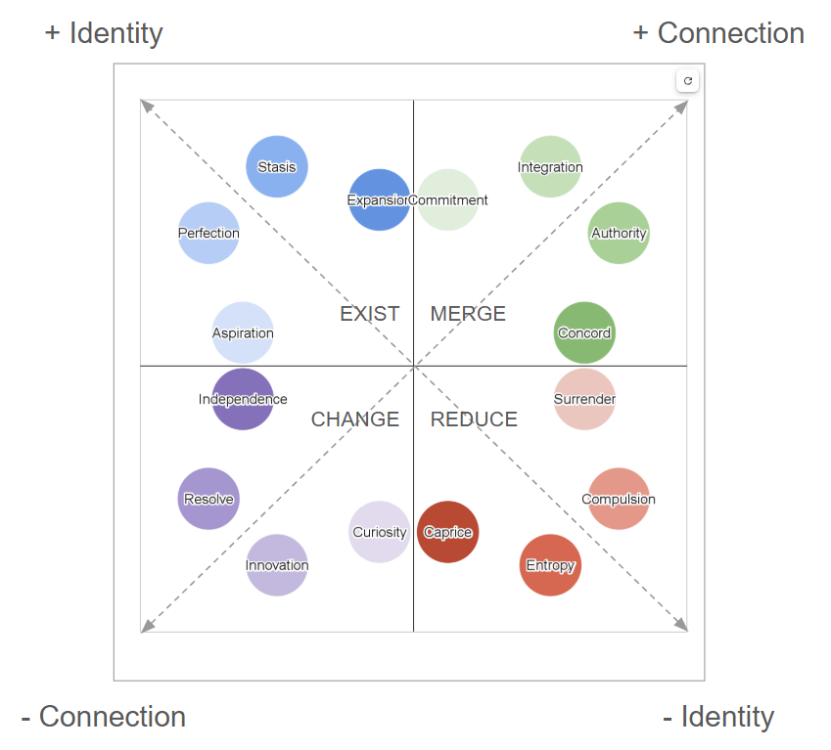
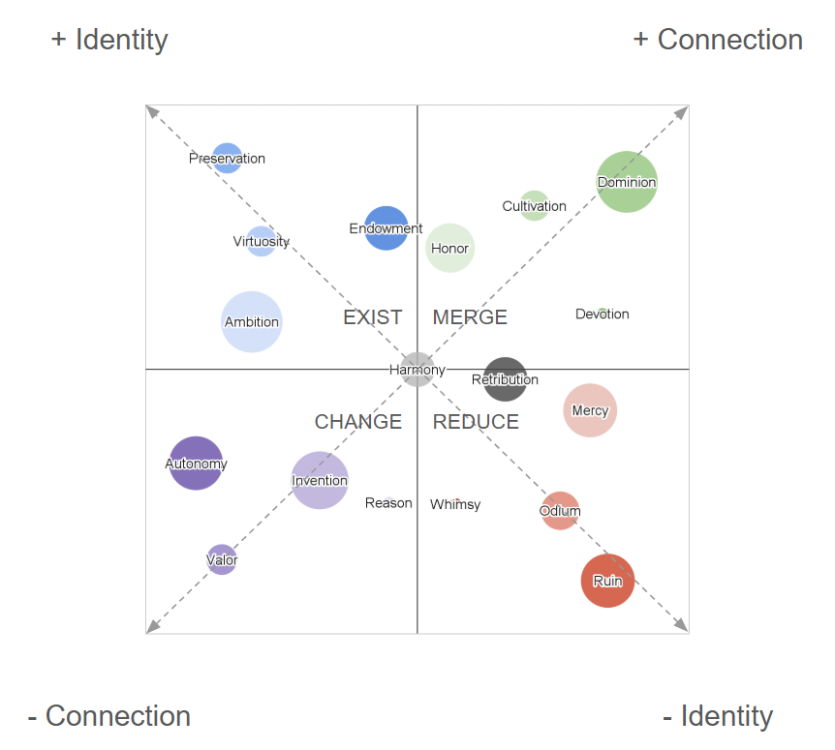
tl;dr: I theorise that the Dawnshards represent the Commands one can take relating to the core axes of the Cosmere, Identity and Connection: Exist increases Identity Reduce decreases Identity Merge increases Connection Change decreases Connection The Shards are imperfect expressions of divinity that took the shape they did specifically because of the individual vessels who took them up. Each Dawnshard created a quarter of Adonalsium that represented that Dawnshard's Command, and four people each took part of that quarter, influencing it with their own perception of what that Command means. This means the Shards can be expressed as vectors on a plane made of two axes, Identity and Connection, as follows (where a larger bubble means a more forceful expression, and a smaller bubble means a more subtle one, though I'm less focused on that distinction in this post): The evidence: This worked well in my last post. Rather than link to things in the text, I've just collated here a bunch of stuff that led me to this theory. I've linked to WoBs where possible, but some of it is from the books themselves. Cosmere mechanics: Investiture is another form of existence alongside matter and energy, not a core aspect like Identity and Connection Spiritwebs are made of Investiture in the Spiritual realm and define a person's Identity and Connection (more on Investiture and how it's a different class of concept to Connection) The nature of Shards: The 16 Shards are not essential building blocks, and could theoretically be split further Rysn's mural showed something splitting into 4, and then into 16 almost but not quite equal pieces Shards are filtered expressions of divinity which allow filtered access to fundamental laws of the universe Shards influence how one accesses an Invested Art, not what is possible with that Invested Art The Shards do not all have perfect opposites The role of perception and Intent: Intent as an expression of Identity was created to give 'wiggle room' to realmatic physics based on perception Shardic Intent is influenced by the Intent and perception of its vessel (and vice versa) Dawnshards permanently and significantly change your soul A vessel going too strongly against its Shard can cause that Shard to leave or splinter Ati as a person was diametrically opposed to the concept of Ruin and tried to change it Tanavast thought he understood Honor but later came to dramatically disagree with it From here on out, assume everything I say is speculative, even if I don't preface it with 'I reckon' or whatever. Matching Shards to Dawnshards First up, some justification as to why I mapped each Shard to the Dawnshards the way I did. This part is largely up to interpretation, especially with how little we know about some of the Shards, and I welcome debate on my specific mapping of the Shards. I am happy with which quadrant contains which Shard. I've put them where they are based on a bunch of evidence and personal interpretation that would make this already-unwieldy post quite silly, but I did want to highlight in particular how each Shard grants its Invested Art: I've left blank the ones we don't know, but IMO this clearly shows how each Shard is related to its Dawnshard. Exist: Of the Exist Shards we know, we can see they share a theme around improving/empowering the self in some way. Change: Only one here, and I'll likely update Autonomy's entry when we have more info. Reduce: Ruin and Odium both require some form of Identity-reduction to acquire their power. Merge: We've experienced Invested Arts from all four of the Merge Shards, and they all share a clear common theme of increasing Connection. Devotion and Dominion have a slight bias toward reducing Identity, and Cultivation and Honor have a slight bias toward increasing it, but their main defining feature is in someway committing to an increase in Connection. Four groups of Shards So we know a group of people got together and killed big-G God using the Dawnshards. From Rysn's mural in particular, it's reasonable to assume that Adonalsium was first split into 4, then into 16. I've seen plenty of theories that posit that the Dawnshards split each of the initial quarters again (so Preservation would be Exist/Exist, Odium might be Reduce/Merge, etc), but there's nothing to say that was the case. It's a neat way of explaining why there are 16 Shards, but we know there didn't have to be 16. There could've been more, or fewer, or Hoid might have taken one to make 17. The only reason there are 16 Shards is because 16 people decided to take up the splintered power. All we can say from that is that Adonalsium was split into four, and then those fragments were split into sixteen mostly (but not perfectly) symmetrical pieces. I think the Dawnshards split Adonalsium into four chunks of divinity that each represented one of the Commands, and the 16 to-be-vessels simply chose some of the essence of each one to look after, unintentionally shaping it by the very nature of interacting with it. For example, only Edgli could've extracted Endowment from Exist, and she physically couldn't have extracted anything different from it, just like I couldn't just decide to start flying. I have split this up assuming 4 people each shared a Dawnshard, probably on agreement to split the power evenly, but there's no reason the actual set-up we have now couldn't be, for example, 5 Exist, 2 Merge, 6 Change and 3 Reduce (although I believe Ati was reluctantly 'forced' to take a Reduce Shard, which implies they did split them evenly). As an example, let's look at what I think happened with Merge: Aona, Skai, Koravellium and Tanavast were chosen to be the stewards of the Merge quadrant. Each of them, based on their personal worldviews and perceptions, understood the Command differently: Aona saw prioritising Connection to others and to ideals over one's own personal desires, so her chunk became Devotion Skai saw the enforcement of Connection above all else, an empire with him at its head to ensure order: Dominion Koravellium (a dragon who was used to looking after mortals) saw individuals as potential pieces of a spiritual whole that need careful pruning to better make them fit: Cultivation Tanavast saw oaths and promises as tools to bind people to each other for structure and strength: Honor In each case, the Shardic Intent was fractured and warped by the perception of each person that took some of the power. 'Cultivation' as a concept didn't exist until Koravellium interacted with the quarter of Adonalsium's broken soul that represented the Merge Dawnshard. Imperfection So the Dawnshards created perfect quarters, and then the vessels created imperfect divisions within those quarters. This is why the Shards mostly don't have perfect opposites. Theoretically, that means there should be an 'ideal' form of the 16 Shards, where they all do have perfect opposites. To that end (and to help me guide where the actual Shards came from), I started from the Dawnshards and thought about what they actually represented. I then looked at how they would sit in a grid and considered their neighbours (eg: an Exist Shard with high Connection relates closer to Merge than to Reduce), giving them names to help guide my thinking. Those 8 together became Protoshards, and from those I suggested what the 16 Ideal Shards might have looked like in a perfect split. I've included these as a sort of 'show your working' so you can see how I arrived at the conclusions I did: So, if Adonalsium were split into 16 purely equal and unmodified Shards, we might expect something like this: When what we actually got was this (I included Harmony and Retribution, for which I simply summed the Identity and Connection values for their constituent Shards): How Honor and Ruin fit Tanavast and Ati are interesting case studies here, and I've put that tangent in a spoiler to save space: Cultivator? I barely know her! (canned laughter) "But Cultivation doesn't Merge things, she literally Changes them!" Excellent point, and one that bugged me for a while, too. But Preservation also changed things, and the biggest consistent thing I've seen across Dawnshard theories is that Preservation is the primo example of an Exist Shard. Another spoiler tag for another tangent:
-
So I have a theory that there are actually only 8 'real' Surges, and that most of the ones we know are clipped, filtered and weakened versions of those. Within that, I reconcile this apparent wishy-washiness between Cohesion and Division by saying that they are imbalanced versions of the original Surges: OG Cohesion (Microkinesis) was about manipulating internal structures (what something actually is) OG Division was about controlling strain thresholds (how much strain something can take before breaking) Also, the footnote of this WoB implies that Sanderson gave an answer relating to nuclear bonds, not to Nahel ones. I think it still holds that Division couldn't break a spiritual bond like Harmonium.
-
Unfortunately not; Harmonium is a spiritual alloy, not a physical one. From the wiki:
-
Ah ok fine, it sounds like we're just using slightly different terminology to describe the same concept then. I essentially agree with you, but I still think the categorisation is off. The more we learn about Investiture and Invested Arts, the more it becomes apparent that they all basically work the same way, and the flavour of the different arts comes from the specific abilities / manifestations / initiations etc. We don't have to align perfectly on this, I'm just going to lay out my perspective with a handy table (I love an excuse for a spreadsheet): I've grabbed a handful of non-exhaustive examples to illustrate my point: throughout the Invested Arts, there is a distinct difference between what the Art is and what the Art allows someone to do. Some effects are acheivable via multiple different Arts. For our examples in this thread: Biochromatic Breaths are the Invested Art of Endowment; people can Awaken while having nothing to do with Endowment Hemalurgy is the Invested Art of Ruin; people can create transferable Spiritweb chunks while having nothing to do with Ruin There's also a difference between the Command/focus/filter for an Art and how it's traditionally fueled. Mistings can fuel their specific ability with unkeyed Investiture instead of Connecting to Preservation, Returned can live off Stormlight, etc. From the WoB you quoted: Like, this explicitly states that Awakening isn't unique to Endowment's Invested Art. But as I say, this mostly sounds like a semantic issue and that we agree on the core concepts. 100% agreed. I think there must be a way of integrating stuff like that into someone's Spiritweb, it's just that the Scadrians only know how to do it violently using Hemalurgy. They corrupted the Sunheart in a way that would allow it to be forcefully shoved into someone's Spiritweb, which is the bit that involves Ruin's influence. On reflection, I think you're right on this point. The Cinderhearts themselves are all (I believe) from Threnodites so must carry an inherent Connection. Oh that's a fun concept. Part of me wants to say that, surely if it were that easy, there would be factions on Nalthis doing this already. That said, they might just not have the knowledge / technology, or maybe messing with Breaths like that is sacrilegious to them. Obviously Breaths in an object inherently have a sort of Identity-coded lock on them, but Hemalurgic spikes shouldn't care about that. This is one of those things that I feel like we just don't have the evidence to answer it directly, but I don't see why it wouldn't work. I wonder whether holding a Breath like that would feel any different to holding one normally. Side note, I just went to do some research on this and the first result was a post by you from a few months back really living up to your 'Hemalurgy Enthusiast' title. I think this was the conclusion I was getting at in a roundabout way. We know that Hemalurgic spikes cause permanent damage, so I would say that yes, the 'hole' it leaves would make it easier for other Investiture to get in. It may even be possible to make a very precise spike with the express purpose of cutting into a Spiritweb in a certain way that allows for a whole bunch of stuff to be grafted onto it.
-
Well I'm going to start with a disclaimer that the books obviously trump everything else. I'm using a few different sources to try and answer a very hypothetical question. That said, 1g of Pewter (for a 5 minute burn), at a density of 7.2 g/ml, is about 0.14 ml, which can very easily be stirred through a small vial of liquid for easy consumption. To burn for 20 hours, one would need 1 * (60 / 5) * 20 or 240g, which comes to 33 ml. Even if we assume flaring doubles that usage and they flared the whole time, that's still only 66 ml of metal. Vin and Kel had backpacks full of Pewter for that run iirc, so that's easily doable. Actually, now I'm running the numbers, it feels like the RPG doesn't make Pewter burn fast enough
-
Sorry, I should've clarified—the RPG resource classes them as instant, which is game logic and doesn't necessarily translate. You're absolutely correct, thanks for clarifying!
-
Cultivation's Perpendicularity (and extra pools)
PanLin replied to Trusk'our's topic in Stormlight Archive
This gave me a chuckle, thanks. 'Perpendicularity' is a vague term when applied to the physical realm. Physically, there are multiple distinct collections of Cultivation's Investiture, in much the same way the Pits of Hathsin continuously grew multiple geodes containing Ruin's. The Horneaters apparently ascribe special meaning to the Pool, but that is just the biggest or most accessible, at least in the physical realm. If you know what you're doing, coming into contact (do you actually have to touch them?) with any of that Investiture will be enough for you to access it. IIRC Cultivation's Perpendicularity was a singular, regulated pool in Shadesmar. Presumably, the Pool the Horneaters talk about is where you're most likely to enter the physical realm when entering from Shadesmar. I wouldn't be surprised if it's also in the centre of all those other pools, and Cultivation's Investiture used to just spread out from the main Pool and infuse nearby water. I also love this, and didn't know that bit about multiple pools either. Neat. -
Yes it is, and yes it would, technically. As you say, someone burning duralumin could do it faster, but if you're a Mistborn I'd actually recommend you burn aluminum instead; the goal is just to get rid of the metal, and using duralumin to burn that much of anything repeatedly is a sure-fire way to get yourself hurt by becoming a pewter savant (and losing your sense of pain so much that you don't notice potentialy life-threatening wounds). As for the technicalities, I don't have the Mistborn Adventure Game myself, but someone shared burn times in this Reddit thread, which states that a gram of Pewter burns in 5 minutes (and duralumin and aluminum are both instant, of course). Some quick (and wildly speculative) maths: Swords for sword swallowing tend to be made of stainless steel and weigh between 600 to 900 grams Pewter is roughly 0.928 times as heavy as stainless steel If we assume a 600 gram stainless steel sword (taking a low estimate to account for the handle), an equivalent-sized pewter one would weigh 556.8 grams At 5 mins per gram, that would take 2,784 minutes (or 46 hours and 24 minutes) without flaring The adventure game doesn't handle flaring in a linear way, so there isn't really a way to calculate that. It never seems to use metals more than twice as quickly though, so we can assume a maximum of 23 hours and 12 minutes (though it may be longer). Disclaimer: I'm not a professional sword swallower; if anyone has any more accurate numbers, I'd be happy to rerun the math. Second disclaimer: A lot of this gritty math probably wouldn't hold in a book, but it's fun to speculate. Third disclaimer (whoops): For my first run of this, I wildly underestimated the weight of a sword.
-
Spoilers for Mistborn: It also raises an interesting question: Can Ascension be a gradual process, as you start to exert more of your will over the Shard than the current vessel does, or does the 'ownership' of the Shard always suddenly snap to you once you reach a certain threshold? Like a similar conversation we're having (which I'll avoid mentioning so I can skip the spoiler tags), Connection used like this does seem to be a two-way street; if Odium were sufficiently distracted, I reckon Ishar may well have been able to done something similar (though I agree with @JustQuestin2004's point on scale), although it seems like he was more focused on the stuff happening in Shinovar and may not have been realmatically aware enough to realise that was an option. Was that definitely Honor's Perpendicularity? We know the Oathpact was weakening and starting to allow for some funky shenanigans, especially with Bondsmiths, so maybe Ishar was more directly manipulating Connection like he did on Ashyn before becoming a Herald, which actually gives more credence to the idea that he might have been strong enough and well-versed enough with Connection to exert some control over the Fused Singers. So I don't think these are quite analogous. Odium directly sustains the Fused and actively determines how they access Investiture. From the wiki, and a WoB: These imply that the Fused got their abilities directly and actively from Odium, who could have decided to sever that at any point. As for your examples: Allomancers contain a piece of Preservation in their Spiritweb Endowment gave her Investiture to the people of Nalthis freely, no strings attached The Dor passively imbues the people of Sel with its power In all those cases, someone else exerting some influence over the Shard wouldn't affect current users of their Invested Arts as the stuff that allows those Arts has already happened and doesn't require upkeep (I could actually be convinced otherwise on the Dor). This example wouldn't be invalidating a whole magic system, it would just be interrupting/rewriting an active Connection, which we know Ishar is well versed in from stuff like his attempt to steal the Stormfather's Nahel Bond with Dalinar. I mean, he was pretty certifiably insane. I do! I think there's a fine line, and the Shard can influence its vessel a hell of a lot and can just up and leave, but ultimately, from what we've seen, the Shard carries power and Intent, but the vessel is in control. I think the 'prohibition' that we saw from Preservation was essentially the same resistance and uneasiness we've seen with Tanavast/Honor, Dalinar/Stormfather, and Taravangium/Odium. The power just didn't want to do that sort of thing, especially in opposition to Ruin. Someone with enough force of will could probably force it anyway, but that would risk the Shard either leaving the vessel (like Honor did to Tanavast) or just splintering from the stress and opposed will (similar to broken Radiant bonds turning spren into deadeyes). In Preservation's case, a person like that probably wouldn't be able to take up Preservation's power to start with anyway. Spoilers for Secret History: My point is that Shards probably can't outright prohibit their vessel from doing anything, but the need for a Connection to result in Ascension probably soft-filters out most people that would try to do something in direct opposition to that Shard.
-
Man, I get those two mixed up every damn time. Thanks for correcting me!
-
I think what's actually happening here (and your points above helped me nail down (excuse the pun) my thoughts), is that we were first exposed to this idea of stealing and attaching Spiritweb pieces via Ruin and Hemalurgy, so we're using that terminology to refer to everything related to it. It's like if someone learns the word 'cat', then sees a dog and thinks "fluffy, four legs, tail, must be a cat". Spoilers for Emberdark: Also, Sunhearts seem to be this little spiritual battery that still contain someone's Spiritweb (or at least an Investiture-saturated copy of it, similar to Returned) in addition to the 200 BEUs they got obliterated with: Now, with my speculative hat on for a sec, my current theory is that Ruin (along with Odium, Whimsy and Mercy) are all fractured Intents of the same Dawnshard, one that is characterised by reducing Identity and increasing entropy. Finally, my point: All Hemalurgy is Spiritweb theft and reattachment, but not all Spiritweb theft and reattachment is Hemalurgy. The Scadrians looked at the Sunhearts and taught the Cinder King the only way they knew how to mess with Spiritwebs like that, necessarily incorporating Ruin's Identity-eroding influence, and the only way something of Ruin can be attached to a Spiritweb is by brutally piercing it and damaging the host's Identity and Connection. This is interesting, too. It's like they used Ruin's power to invade Spiritwebs to sort of open a window, then discarded Ruin's bit entirely and just used the opening made by it to slot the cleanish Sunheart in. I think I disagree with this bit though (but please correct me if I'm about to say something demonstrably false). We know that Hemalurgic spikes grant a Connection to Ruin, which is why Ruin could control the inquisitors and why Harmony can now control the kandra. We also know that Rebeke could exert control over the Charred, but struggled to when going directly against the Cinder King's will. To me, this implies that both of them (and everyone with a Cinderheart) are actually connected to Ruin; Cinder King and Rebeke are simply strong enough to hijack that Connection to exert their will (especially without direct interference from Ruin/Harmony). Based on the bit above about opening windows, I think they still have a Connection to Ruin (and therefore each other and the Charred) because it took his Invested Art to attach the Cinderhearts to them, but thanks to some of the heat being drained away, they escaped being so warped by Ruin's influence that they lost their Identity completely. Basically, I think Rebeke was actually super Connected to Cinder King still; they were both just free enough of Ruin's Identity-damaging influence. I think Hemalurgy itself does require Ruin's Investiture, but there are ways (like you've said here) to attach chunks of Investiture/Identity/Connection to someone's Spiritweb without Ruin's destructive methods. I also think Vyre's spikes are just straight up Hemalurgy, or at least close enough to it that Ruin's influence is involved; on my model (I know this is speculative), Odium and Ruin both naturally reduce Identity anyway, so Ruin's influence would be harder to spot here compared to how drastically his Investiture modifies Sunhearts. Now that's an interesting one. I agree that extra Intent would be needed (which Hemalurgy seems to require by default), but Breaths are specifically willingly given. If you attach your own Breath to a spike or otherwise get permission, I think it would work (but at that point, it'd be easier to just give the Breath directly), but I wonder if you managed to take a Breath by force or remove it from an Awakened object, would that Breath just immediately leave the recipient as soon as you spiked them, and end up back from where it was taken? Or would the Hemalurgic Intent override the Biochromatic Intent? But ultimately yes, I agree with the bit I've bolded. Two separate processes. With Hemalurgy, Ruin is involved in both of them, but with Cinderhearts, he's only involved with the implantation. Yeah agreed, I think Ruin's corruption in this case affects the Intent and Identity of the Investiture, but not the power level. Ah, define 'true Spiritweb fragment' I really think, in the future of the Cosmere, we'll start to see people getting more comfortable with understanding and modifying Spiritwebs. The ultimate end goal there would be the ability to just create, rewrite, and delete parts of someone's soul as if you're programming an operating system, but I don't know if that ability will ever be widely available to mortals. But yeah, with enough understanding of Identity and Connection, maybe you could take a chunk of unkeyed Investiture and something to contain it (metal, crystal, whatever), then just write your own Spiritweb mod from scratch. In this analogy, all Hemalurgy is doing is going "I know this section of code is sort of responsible for this effect, so I'm going to remove it and add it to my own project". It's inherently destructive, imprecise, and comes with trailing bits of the donor's Identity and Connection, but I really think there must be a way of copying the code onto a blank spike instead, and leaving the donor unharmed.
-
Yeah, this is genuinely the explanation I'm leaning toward the most. We know Rayse was predictably spiteful and impulsive; that's why Hoid is so much more worried about Taravangian as a vessel than he was about Rayse. Yep, agreed! Rayse didn't use Adhesion because he hated everything that Honor and Tanavast represented, and couldn't bear the blow to his ego that would come from using Honor's Truest Surge. And from one of the WoB's I quoted at the start: It would be very on-brand for Rayse to spread propaganda (or just constantly trash-talk) on Honor and his signature ability. Taravangian, however, is cold, calculating, and has no reason to hate Honor as it's now part of him. Mayyybe, but the guy had the ability to make Gav experience 20 years in the space of an hour. I don't think Shards are beholden to the same time limits as we are. But yeah, still likely wasn't high on his agenda, and now all of Roshar is trapped in a time bubble, and I don't know what affect that'll have on the ability of other Shards to come and interfere with him. But yeah maybe, with Warlight, we'll see both Adhesion Fused (with accompanying Voidspren) and a tenth Unmade (or maybe creating Unmade was something specific to Rayse, or something that the power of Honor would oppose too much). So this can be read one of two ways: Adhesion actually was just unavailable to Odium/Voidlight (and we're both completely wrong) but is available to Retribution Rayse actively blocked his access to Adhesion, same as everyone else under his command, and Taravangian holds no such grudge I actually disagree with this one. We know humans on Ashyn were given access to the Surges by Odium. Based on my theory above, I think Odium granted the original 8 Surges to humans (no Adhesion or Progression). Then, after everything went down with humanity's arrival on Roshar, Odium switching to favour the Singers, and the creation of the Heralds and the Oathpact, he started granting powers in a different way, inspired by the Knights Radiant. He incorporated Progression but refused to use Adhesion out of a mixture of pride and spite.
-
While I do actually quote that a lot (great quote), I wasn't trying to say Metalborn will stop existing. Syndrome wanted to replace Supers entirely by giving non-powered people technological abilities. Scadrians are already dealing with a population that is decreasing in Invested potential, and are exploring ways to innovate with new (and sometimes alien) technology and hold onto past abilities (spikes) in order to create stronger Invested people. Like Frustration said, I think you're moving the goalposts of your original "we ought to see this breeding programme as it's logical and possible to concentrate Metalborn powers to recreate Mistborn and Fullborn": I'm fully on board with people across Scadrial trying to breed for Allomantic potential (as others have mentioned, the Set already tried something like this, and it happened on a smaller scale during the Final Empire). My point is, and has always been, simply that Metalborn inheritance does not work in a way that would allow people to selectively breed for specific powers, let alone to consolidate them into one person. 'Less relevant' does not equal 'superfluous', and you've missed the point of my argument. In fact, natural-born Metalborn will continue to be incredibly valuable. Unfortunately, Metalborn traits are not physically genetic and therefore cannot be selectively bred for. If we get spiritual genetics involved, though? Direct Spiritweb manipulations, creation of more artificial Lerasium, etc? Then we might see something like this. But it can't, not in the way you set out in your original message. Metalborn traits are not reliably presented and passed on like breeding sheep for thicker wool, or breeding Pokemon for specific IVs. Allomantic potential in general? Maybe, but it isn't guaranteed, and we know the potential of the general population has been dropping since the Lord Ruler started his empire despite groups of people working to preserve it. Specific abilities? Absolutely not, at least not with current Scadrian understanding. So to clarify, as I think the discussion has drifted from where we started: I agree that groups of people might be breeding selectively to try to preserve/strengthen Metalborn potential. I do not think it is viable or possible to set up a large scale project with the goal of creating people with specific powers (let alone Mistborn or Fullborn) without a greater understanding and capability of Spiritweb modifications, as Metalborn abilities are not a physically genetic trait. These modifications have slowly started with Hemalurgy research, and based on what we have seen in-text, Scadrians seem more interested in technological developments than genetic ones, but would absolutely jump at the chance to reliably create new Metalborn if their knowledge, technology, and realmatic abilities allow for it. I so nearly brought this up myself also, surely it'll be the Warlight Archives if anything?

