



PanLin
-
Posts
161 -
Joined
-
Last visited
-
Days Won
1
Content Type
Profiles
News
Forums
Blogs
Gallery
Events
Everything posted by PanLin
-
 Yeah valid callout! I should've addressed it in my post. I spoke about this in my 8 Surges theory, but essentially: Honor and Cultivation were already heavily invested in Roshar and each other by that point; Adhesion and Progression, therefore, were also part of Roshar The Oathpact had 9 original volunteers, a number Honor refused to use. 8 original Surges plus his own left one gap, which I reckon he just used Cultivation's power (either directly or just as inspiration) to make 10 (it could just as easily been 1, 4 or 16 members, in which case would likely not have needed to be hacked together with Honor's and Cultivation's True Surges, and also confirms that the concept of the 20 Surges isn't some Cosmere constant) If it was just inspiration, it gives a potential reason as to why Odium could use Progression but not Adhesion—Adhesion was a True Surge from another Shard, but Progression was just an expression of Investiture inspired by another Shard, and therefore had fewer restrictions around it It's less that Fused don't accept the other two Shards, and more that Odium was either unable to access Adhesion or was somehow prevented from using it There are plenty of hints throughout the books that Odium mostly had a vendetta against Honor Ultimately, a Shard's influence is more over how an Invested Art is acquired than it is about the powers that Art allows for. Honor originally created a system based purely on oaths, and Cultivation adapted it to include her influence in the form of growth and progression (kind of related, but I still view Surgebinding as Honor's Invested Art—the true combo Art of Honor and Cultivation is, imo, Fabrials AKA Lifebinding) Feruchemy came about without the direct action of either Preservation OR Ruin; creating an Invested Art that simply uses the already-existing influence of another Shard (especially a Shard you're so close to and have spent thousands of years co-Investing a planet with) seems a minor feat in comparison Fully agree with you on this bit, except for one thing—Honor didn't put the ideals in place; they came later, with Cultivation's help. Also, her not wanting to interfere directly with the feud actually adds more evidence as to why both Honor and Odium could access Progression. Yep, I agree! My suggested ideals aren't 'these are the words people need to say', but a general learning objective. We've seen three different third-level Windrunner oaths, but they all essentially represent the same idea. It's up to the spren (who were chosen, invested and put to the job by Honor and Cultivation) to decide whether the words a radiant speaks, along with what they actually mean by those words, are close enough to the lesson they need to learn to advance. For example, I've suggested 'I will share the stories of the forgotten, so they are not lost' as the fifth Edgedancer ideal. If you were a particularly scholarly Edgedancer dealing with insecurities about not being well suited to the front lines of battle, something like 'I will document the stories of lost cultures for future generations to read' could easily be accepted by your cultivationspren (Edgedancer Sazed, anyone?). I appreciate you sharing them with me! I had already considered them, but it's always worth exploring stuff like this. I don't think what you've raised is enough to change my mind for now, but I'm very happy for you to challenge me further.
 -
tl;dr: The point of the Knights Radiant isn't to make people better (although that's a common side-effect); they're about Honor and Cultivation creating a framework to train and mould mortals to handle powers and realmatic concepts in the way those two Shards believe is best for Roshar and the Cosmere. Additionally, the 10 orders aren't just random expressions of two Surges; they're realmatically informed expressions of Identity and Connection as defined by both their position and the number of connections they have in the Double Eye diagram. Intro To link back to my theory that everything in the Cosmere can be described as a vector on a 2D Identity/Connection plane, I propose that all orders are designed to take an individual, with the various spren entrusted with the job of identifying candidates for each order, and train them to modify their sense of Identity until it aligns perfectly with Honor and Cultivation's idea of the powers and responsibilities of that order, Connecting them to Roshar and the two Shards and achieving a sort of enlightenment. Self-improvement is a tool to reach that goal, not the goal itself. Honor set out the rules and limits that define which powers people are allowed to have and which spren grant those powers, and Cultivation defined the evolutions and 'corrections' (according to Cultivation's judgement) someone would have to make to their Identity in order to self-actualise and properly Connect them to the philosophy of each order. This is a process that takes five steps, each of which requires a related oath (unique to each person) to strive toward that ideal: Opting in to whole process (Honor and Cultivation respect agency, unlike, say, Odium and Ruin) Committing to the core philosophy of the order Removing personal bias to start shaping Identity Understanding limits to ensure control and alignment Achieving a sort of enlightenment by Connecting personal Identity perfectly with the philosophy of the order Inspiration Just a quick shout-out to @Karger and his series of theories on the ideals across the orders (a big inspiration for me thinking about it all). If people are interested, I might do a similar deep-dive into each order as its own topic, but I don't currently plan to. Known Ideals / Themes With any theory, the best place to start is with what we know: Happy to chat through any specifics on this, but essentially I look at those and can immediately see patterns in each level. Obviously we have very few examples on fourth and fifth ideals, but there is a commonality. From these examples, I put together what I consider to be the overall themes: I'll come back to it below, but I also think that Lightweavers and Elsecallers aren't outliers at all, and both fit the point of the ideals perfectly. Getting metaphysical I couldn't help myself in adding this in, and I do think it helps guide our thinking as to what the oaths and ideals actually are. Pulling from my theory that there are only 8 true surges (Adhesion and Progression, and therefore Bondsmith and Truthwatcher, were directly added by Honor and Cultivation as pure representations of themselves), we can naturally group the 10 orders into three groups, based on their position and the number of connections they have in the Double Eye diagram: Orders with four connections all have a direct connection to one of the two 'God Orders', aka primary orders. These orders can be considered as abstractions of those primary orders that operate solely on either Identity or Connection (eg: Windrunners and Stonewards take the core concept of Bondsmiths and contextually apply it in different ways). Orders with three connections lack a connection to a primary order and can be considered as further abstractions, operating on some combination of Identity and Connection (eg: Skybreakers use an external Connection to laws or other structures to inform their Identity, where Elsecallers define a Connection they wish to fulfill and use that to inform their growth and Identity). Primary orders: Bondsmith (pure Honor) Truthwatcher (pure Cultivation) Secondary orders: Windrunner (external Bondsmith abstraction, Connection) Edgedancer (external Truthwatcher abstraction, Identity) Lightweaver (internal Truthwatcher abstraction, Identity) Stoneward (internal Bondsmith abstraction, Connection) Tertiary orders: Skybreakers (internalised Connection to inform Identity) Dustbringers (internalised Identity to inform Connection) Elsecallers (externalised Connection to inform Identity) Willshapers (externalised Identity to inform Connection) Context Matters Now, especially because we have so few examples for each order, it's hugely important to remember that the ideals are unique to each individual. Kaladin, Teft and Lopen all swore the third ideal of the Windrunners with slightly different, but heavily related, words. Another big one to keep in mind here is Jasnah; she has a... unique outlook on life, and we know from the official website that Elsecallers are about reaching personal potential, attracting a wide range of people. Jasnah's approach to the order should not be taken as the default example, but should be considered through the lens of her personality. This is true of all the orders, I just felt like Jasnah was the most obvious example to use. To explain what I mean, below is an extension of the above table with the contextual bits added, using Kaladin as an example. Kaladin's internal struggles have always centred around being a failure and considering himself so bad at protecting others that he actually blames himself for their deaths/losses/struggles. He carries a hell of a lot of shame, self-hatred and depression around this fact, considering himself not worthy of basic human needs like love and happiness. The further he gets into the oaths, the more they target and address his personal fears and other emotional baggage preventing him from achieving self-actualisation. The first hint of this is his third ideal, swearing to protect those he hates as long as it's the right thing to do (much like Teft, he hates himself, so this is an important step both for advancing through the ideals and for preparing himself to make future oaths). By the end of Wind and Truth, this has evolved into finally accepting that he IS deserving of love, and that being physically unable to protect everyone doesn't mean that he's a failure, or that he should give up; he swears an oath to protect himself first, so that he can survive and protect everyone he can. I've also added another example to the Willshapers section, using myself as an example to predict what my ideals might be. In each of the sections below, I propose a set of 'generic' ideals, which can be viewed as something like templates; general lessons that people have to internalise and apply to themselves before advancing to the next level. Windrunners Skybreakers Dustbringers Edgedancers Truthwatchers Lightweavers Elsecallers Willshapers Personal Willshaper example: Stonewards Bondsmiths Summary In case you just want to look at all the ideals in one place, here you go: As always, thoughts and discussion welcome!
-
Happy to help! It's tricky to look at reading orders and plan your journey without spoiling yourself, so let me know if there any other questions you have, but ultimately I agree with @Treamayne—pick up whatever book looks appealing to you next. If in doubt, you really can't go wrong with release order. There are easter eggs in earlier books that don't make sense until you've read later ones anyway, so afaik there isn't a way to be prepared for every single easter egg, reference, and appearance of a certain bard on your first read-through. That said, this is as good a plan as any! I almost went into more detail, but I'm holding myself back this order looks good, and I'm jealous of you being able to read them for the first time. Yeah, if it's the same three as you referenced above, read them whenever—Secret History might have some references you don't understand yet, but again, you're never going to avoid that entirely. EDIT: Emperor's Soul: Yes White Sand: Just the prologue, I think. The full books are graphic novels (with audio adaptations) Forests of Hell: Yes Sixth of the Dusk: Yes, but this same story (with some extra bits) is reused wholesale as flashback sequences in Isles of the Emberdark—you can either skip it for now until you get to Emberdark, or read the old version here anyway. Entirely up to you Everything else: Yes
-
The only one I feel strongly about is that you should absolutely read Warbreaker before continuing with Stormlight. With these two, I'd recommend you read Elantris before Tress. Emberdark and Sunlit Man are both set in the future of the Cosmere a bit—I read them in release order (Sunlit Man, Wind and Truth, Emberdark) and really enjoyed them all, but some people think you should read Sunlit Man after Wind and Truth. Difficult to explain why without spoilers, but honestly I think release order is fine and added to my enjoyment of Sunlit Man in particular.
-
In addition to the restrictions others have mentioned, I think the biggest drawback of AonDor is that you have to understand exactly what it is you want to achieve and how you plan to achieve it. A big example is the ending of Elantris, where the teleportation only worked because Adien knew the exact distance and heading to go from A to B. With feruchemy, you can innately tap and store an attribute without thinking about it. Allomantic emotion manipulation doesn't need you to understand specific differences between emotions or how they affect brain chemistry, it just needs an Intent to allow your cognitive aspect to interact directly with the target's. When Awakening something, a Command can be fairly simple as it's filtered through your Intent to get the result you're hoping for. In all of these cases, Invested Arts work by achieving some end result directly, where AonDor is method-led; it's not just "move us to Teoras" (which might be how an Elsecaller achieves the same thing), it's "spatially translate specifically these people x paces in a straight line at this specific heading". Sure, AonDor can theoretically do anything, like a programming language for the Cosmere. The obvious parallel drawback to that is that you need to give the 'computer' extremely specific instructions; if you forget one semi-colon or use the wrong input format or whatever, the spell will either fail or have wildly different results. AonDor doesn't sympathetically pick up on the caster's Intent in the way other invested arts do.
-
Gosh, a lot happening here since I last checked in. Or maybe a different resonance to the one normal Truthwatchers would get? True, but across the Cosmere, emotions seem very closely tied to Intent and Identity; if Bondsmiths have the greatest control over Connection, maybe Truthwatchers have the greatest control over Identity, and therefore emotions? Oh 100%. I have a spreadsheet where I'm organising all my thoughts and theories on this that's currently at 18 tabs I think the Shards have four 'themes' related to the acquisition of their invested art (you can read here if you're interested). Within that, Ruin and Odium share a theme of Identity reduction/sacrifice. We know that Hemalurgy irreparably damages the spiritweb of both the donor and the recipient, and that Ruin's power allows for the full domination of people with enough of his Investiture (an ability Harmony now has). Odium regularly steals or amplifies the emotions of people (a theme consistent across a lot of the Unmade), which further strengthens this relationship between emotions and Identity, and the main mechanic of the Fused's immortality is the requirement to possess (or replace/hijack the Identity of) a host each time they come back. This is interesting! As @Atlas333 and @Frustration pointed out, I'm going to avoid making any big leaps in logic based on stuff that only appears in the RPGs, but I do think a dataset of 1 (Renarin) is far too small to make any sweeping statements about what exactly Enlightened Truthwatchers can or can't do. This is also interesting—it could just be that we don't understand the Surge of Illumination well enough yet. We're led to believe that its primary power is creating illusions, but we were also led to believe that there were only 10 allomantic metals so maybe, like I set out in my table above, Illumination is just the power to take cognitive concepts and project them into physical space (would also better explain the map that Shallan and Dalinar created better than just 'hehe quirky power interaction'); Lightweavers are naturally better at illusions thanks to their resonant mnemonic abilities, but the Surge itself is so much more than that. I mean, I'm obviously biased too (but eager to have my theories outright disproven, that's how scientific enquiry works!), but I agree with this sentiment. There's also the wildcard aspect that, as a Ghostblood, we simply don't know what other abilities/tech Mraize had access to, and how those may have influenced his expression of Surges and other abilities. Sanderson does love to obscure realmatic mechanics by exposing us to abnormal applications of them before we truly understand them. Yes! When I put my chart together, I specifically excluded the 'hey this isn't normal' abilities of Bondsmiths, but as I started to fill in the blanks of the other Enlightened abilities, I realised it fit too well to be a coincidence. (although, maybe my inherent bias and propensity for getting stuck in rabbit holes led me to make those connections) Which really just, in my opinion at least, adds credence to the idea that, ultimately, Sja-Anat gives spren a greater Connection to the spiritual realm, and that non-Enlightened spren could theoretically provide the same abilities if they managed to achieve that Connection a different way. EDIT: Forgot to add, I'm also semi-operating on my other theory that there are only 8 'true' Surges of Roshar, and that Honor and Cultivation created the double eye model by inserting their own influence directly (topic here if anyone's interested). This would mean that Bondsmiths and Truthwatchers are of a different 'class' of Order than the other eight; rules and restrictions that apply to the others might not apply in the same way to these two.
-
I know, I didn't say it was
-
Well, Sanderson has all but confirmed that time travel to affect the past isn't possible in the Cosmere. Even then, that's only the first hurdle, and everything in my post above still applies.
-
I'm going to answer your message in a wonky order to hopefully make the concepts flow better. Also, to start, some relevant WoBs: I mean, not exactly infeasible, but it's a similar issue to trying to burn someone else's metalmind, or a shardblade, or a Seon; anything with its own Investiture that either isn't keyed to your Identity, doesn't have a Connection to you, or has an Identity of its own, is extremely difficult to allomantically burn or otherwise incorporate into your sDNA. If you could bypass the Investiture/Identity restriction, then probably either: - your first suggestion: same as steel, the material originally used to forge the blade that became Nightblood (possibly either also granting some Breaths, or turning the allomantic effect into a Compounded feruchemical effect thanks to the extra Investiture and Connection to a Shard) - same as Edglium, Endowment's god metal, whatever that may be (possibly including a side effect that's similar to becoming a Returned) Personally, I think, assuming you managed to bypass the Identity/Investiture restrictions and weren't immediately consumed by Nightblood when trying to burn the chip, something akin to burning Edglium would be the most likely outcome. I'm going to answer this a few times as I'm not sure whether you mean their normal 'destroy evil' Command, their new ability to grant Surgebinding, or their general destructive capabilities. Either way though, probably not (at least, not in a useful way). On destroying evil: like the WoBs said, burning an Awakened metal will just return the Breaths to you. The Command to destroy evil was part of the Awakening, but the Breaths themselves are just little bitesize chunks of Endowment. They'll make you more powerful, but it'll be in the form of gaining higher levels of Heightening. On Surgebinding: even the Heralds could only access Surgebinding via their Honorblades (or before that, presumably some sort of agreement with Odium that is no longer in place). Just containing more Investiture, and Investiture not even related to Honor or Roshar, wouldn't grant those abilities. On general destruction: again, the Command was specific to Nightblood's creation so likely wouldn't transfer like that. They also need a HUGE amount of Investiture to do their thing, so if you don't have that readily available to sacrifice, you'd likely get consumed immediately on trying it anyway, like your third point. Eventually, yeah! You mentioned not knowing much about the Cosmere so I won't give specific examples (although this forum allows for most spoilers, so be careful!), but there are multiple examples throughout the Cosmere of concentrated Investiture spontaneously developing its own Identity. We even saw it in Stormlight with the child-like form of Honor. In this case, either the Investiture would consider itself completely separate from Nightblood and eventually just sort of 'wake up' as a new entity, or enough of Nightblood would remain in it that the new Identity would be sort of like their child, similar to the relationship between spren and Shards.
-
Yep, right on both parts, my bad. No idea how I managed to blank the memories of Mraize Lightweaving. Yeah, valid. Something about it doesn't sit right with me, but the evidence does point to it. So where does that leave the scene with Adolin? Pure coincidence? An expression of Renarin's powers similar to that scene with Moash?
-
Yep, valid points, but I think I have reasonable counterpoints. Firstly, even the WoB you quoted states that the apparent asymmetry of Surges is mostly a story writing decision: Secondly, I thought (and please correct me if I'm wrong) that we never explicitly saw Mraize Lightweave? That said, I'm not one to rely on a cop-out answer, so my real answers are either: - the idea of a 'major' Surge is dependent on the individual, not the order, and only affects the order in which Surges are raised to their enlightened level - they were in the spiritual realm, and Mraize and Iyatil having some control over the visions and Shallan's perception while there is arguably more fuel for my theory - Mraize is an even weirder example than Renarin. If he did use Invested illusions, we can't say for sure it was because of Rosharan Lightweaving
-
tl;dr: Sja-anat enlightens spren by giving them a stronger Connection to the spiritual realm. The Radiant powers they grant are therefore filtered through, and strengthened by, the spiritual realm. What does enlightening itself do? No list of WoBs this time—most of this thinking comes from in-text evidence and the application of wider realmatics to Rosharan concepts. That said, the wiki excerpts on Sja-anat and spren are interesting: So there's in-text confirmation that spren who have been enlightened have a greater affinity (or Connection) to the spiritual realm. Both of Renarin's surges are enlightened Many people theorise that when a truespren is enlightened, a Nahel bond with them produces one 'normal' Surge and one enlightened, pointing to Renarin's use of Progression as evidence. It's a convenient way to explain what is apparently happening in-text, but: It's not a very satisfying explanation It leans into this idea that each radiant order has a 'major' and 'minor' Surge (an idea I've never really subscribed to) It assumes that we already know everything we need to (absence of evidence is not the same as evidence of absence) Besides, we do have evidence of something unusual with Renarin's Progression: the 'perfected version' that Adolin briefly felt of himself when being healed by Renarin. We've seen this sort of thing before with stuff like Shallan's portraits and A-Gold, but not with any other use of Progression; it can, however, easily be explained if we say that enlightened Progression heals according to one's spiritual self instead of their cognitive. From Oathbringer: Progression normally works by changing someone's physical form to match their cognitive form. What if enlightened Progression, filtered through a spren with a stronger Connection to the spiritual realm, changes someone's physical form to match their spiritual form? I'd wager that, for the most part, it wouldn't look any different to onlookers. Hell, most people aren't realmatically aware enough to know how normal Progression works; they just see Stormlight-powered healing and think "magic". I actually think this might be one of the reasons Truthwatchers are the first enlightened radiants we've been properly exposed to, intentionally using Progression as a sort of red herring to cheekily go "nothing unusual here, no no" before we get some sort of classic Sanderson reveal in the future. I'm still just a rat in a cave Not to get too distracted (aka my future epitaph), but Plato's Theory of Forms (which has some uncanny overlap with Cosmere realmatics) posits that the physical world is just a shadowy imitation and interpretation of reality, which exists outside of time and space in a realm of pure concepts. Further, his Allegory of the Cave (it's an interesting read if you're unfamiliar, go read it!) suggests three 'levels' of reality: the shadows on the wall, the people casting those shadows, and the world outside the cave. Most normal people assume the role of someone who has spent their entire life in the cave, viewing the shadows as their entire understanding of reality; seeing beyond those shadows is the first step toward enlightenment (a pure coincidence, I'm sure...). Applying that to the Cosmere, we can see a very obvious relationship between the three realms: Spiritual: actual reality, a realm made purely of Investiture that defines the Identity and Connection of everyone and everything in existence (the real world outside the cave) Cognitive: a realm of thought and interpretation that takes the real world of the spiritual realm and gives it context (the people casting the shadows) Physical: the world we know, a limited representation of the other realms (the shadows on the wall) Upgrades, people. Upgrades I bring this all up because I think enlightened spren essentially give access to the same Surges, but literally enlightened in a philosophical sense. The physical and cognitive effects of normal Surges become cognitive and spiritual effects for enlightened Radiants. Progression, as mentioned above, goes from using a cognitive template to using a spiritual template for healing. Illumination allows Lightweavers to physically represent cognitive visions; it logically follows that a realmatically 'upgraded' version of that would cognitively represent spiritual visions. This is exactly what we see in Renarin; he glimpses the spiritual realm, which comes hand-in-hand with visions of potential futures. The enlightened version of Illumination isn't simply 'Futuresight', but limited access to the spiritual realm and the cognitive means to understand it, a 2-for-1 combo extremely similar to the atium/electrum alloy from Mistborn era 1. Below is a table I've put together, extrapolating these concepts to all the Rosharan Surges. I think I'm happy with it, but would love to discuss any parts of it that don't seem right or are just straight up contradicted by the books. I also think this is an important step toward answering questions like 'what is Voidbinding' and how both that and enlightened spren are related to the Unmade in general, but I want to get this part really watertight before I do that. Thoughts / feedback / fun facts / challenges / insults / praise welcome!
-
An interesting theory, and I love anything involving Sja-anat. I could be wrong, but I'm pretty sure the first sentence was just the influence of Ivory and a hint that she's an Elsecaller, arguably the order most closely tied to the cognitive realm (where all shadows fall the wrong way, explaining the second sentence). These are both true, but: I don't think we have any evidence to imply that Sja-anat can enlighten people directly Ivory doesn't look like an enlightened inkspren Sja-anat has only recently been enlightening true spren (so likely couldn't have enlightened either Jasnah or Ivory while Jasnah was a child) Sorry to directly poopoo everything—that evidence certainly could point to something like that if we didn't already have better explanations for it all (hello, Occam). All that said, it's true that we don't know exactly what happened to Jasnah when she was young. Maybe Sja-anat, as someone with access to the spiritual realm and futuresight, did attempt to interact with either Jasnah or Ivory while Jasnah was young. I don't really think there's much to posit that as a probable theory when it goes against what we actually do know about Sja-anat and, again, her childhood can more easily be explained by simple parental abuse or cognitive realm shenanigans (although it would be very on-brand for Sanderson to reveal some super realmatically important explanation for Jasnah's childhood when she gets her own POV book).
-
Nice, easy, straightfoward answer: yes! Excerpt from Wind and Truth, chapter 21: Bonds in some form exist all over the shop across the Cosmere—Aviar, seons, skaze, aethers, shardblades, shardplate, gemhearts, and almost certainly others. The special thing about Roshar is just how Honor and Cultivation formalised the processes, oaths, and power sets of the Knights Radiant. Personally, I think those earlier bonds (before Honor and Cultivation created the Knights Radiant) may have been less structured and potentially given access to different abilities, but essentially, yes, it was possible.
-
Yup! And I mean, this is true in the real world anyway, but especially in the Cosmere; Sanderson pulls heavily from the philosophy of Plato's Forms (the theory that the physical world is only an imitation of the real world, which is composed of Forms, or in the Cosmere, Spiritwebs) and Animism (the idea that every person, animal, object, location, and even concept has its own identity and soul). Both are really interesting to read about and imo help to explain and give context to how the Cosmere fundamentally works, and why some concepts in the Cosmere are the way they are. A good example is Progression—being unable to heal old or otherwise notable wounds sounds like a weird implementation of a healing power to start with, until you realise that what it's actually doing is reshaping someone's physical form to better represent their cognitive Identity and Spiritweb (or Form, as in Plato's definition). I'm getting carried away, but I bring this up because that story about beauty really leans into these concepts without fully stating them. Perception holds sooo much weight in the Cosmere, from which vessels hold which Shards, to the creation and evolution of spren, to so much more outside the Stormlight Archive (which I won't bring up here obvs). I really think Sanderson intentionally used Hoid talking about beauty here as a sort of proxy to get us, the readers, to really internalise those questions and to think about what it means to love or enjoy or appreciate something. In the Cosmere, the spiritual realm is where divinity lives, and it's also where people (and animals and objects and concepts) are truly defined. Those true, divine concepts are conceptualised in the cognitive realm, and represented with context in the physical. In a setup like that, the most important thing someone can do is simply be themselves. Art, beauty, Identity, Connection, Fortune, Investiture, pride, guilt, love, loss—it's all the same thing, and to live is to define what your Identity is as an individual within that while navigating your Connections with everyone and everything else that's doing the same.
-
Agreed! Ooh ok, now that's very different to there being two distinct mists, and I can get on board. We know Harmony struggles with balancing his two Shardic Intents, so maybe the Intent of his essence (and therefore the mists) is changeable.
-
Ah gotcha. Our interpretations may just be different here then. I wouldn't consider anything called 'smoke' to be referring to the mists, especially when Sanderson is as intentional as he is when referring to realmatically important things like this. That WoB was from before Era 2 was published, and in-text evidence trumps WoBs, so the excerpt you shared earlier actually cancels out that WoB: Pretty clearly states here that the mists that used to be of Preservation are now of Harmony and therefore contain both Preservation and Ruin (hence their ability to power hemalurgy). I don't think mists when seen at night count. Sorry, not trying to be rude, I just don't think any of that implies there are two different mists, especially when everything we know about Harmony repeatedly reinforces that he contains, as one combined entity, everything that used to be either Preservation or Ruin.
-
From the wiki: And a WoB: Whether mists in general existed before Preservation, the notable mists we see throughout the books that specifically react to Investiture, move in ways normal mists don't, and have fed into the mythology of Scadrial, are fully of Preservation (and later, Harmony). For the part you quoted, the reason Ruin couldn't stop them completely is because they were of Preservation. All he could do was scare them into being more active. I didn't think we did have two sets of mists? Era 1 had Preservation's, briefly egged on and made more dangerous by Ruin, and Era 2 has Harmony's. Harmony's existence means naturally occurring manifestations of Preservation or Ruin as individual Shards shouldn't be possible. Where do we see two types of mist? I'll have to go back and do some reading. Well sure, I didn't mean they happen literally every day but a valid correction nonetheless. This is all I meant to imply when using 'daily life'. Oh interesting. I can certainly see the appeal, but wowza that's a big job (if it even is possible). And Autonomy does have a way of messing with Perpendicularities that seems to go against modern realmatic understanding, so maybe some sort of Cognitive manipulation is how she does it? Her Investiture on Drominad seems heavily linked with cognitive empowerment, so I wouldn't be too surprised if there's a link there. Changing the form of the whole Sub-Astral might be too much, but some tricksy cognitive shenanigans around her main Perpendicularity does sound pretty on-brand for Autonomy.
-
I wonder how much influence Harmony has over this. The mists could well be too integral to Scadrial's self-perception, but they were created in the first place by Preservation. I suppose it would be a form of Soul Stamping, but on a planetary scale. Probably not something that would happen without intentional effort, especially not within a few millennia. And really, what reason would someone have to intentionally change a planet's Identity like that? This is an important point and I agree, but also the mists are still very present in daily life, and Scadrians (even non-Metalborn) are constantly exposed to these unnatural, mythological mists, which I'm sure does a lot to reinforce their importance.
-
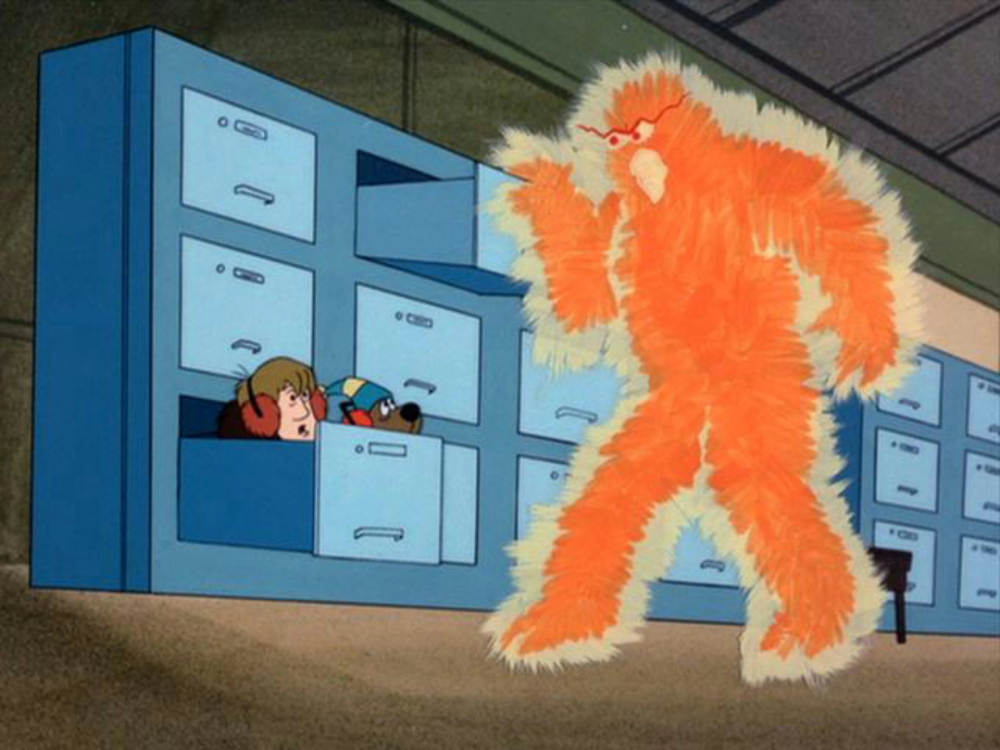
Oh that's fun to think about. I think it would take either a LONG time or a whole bunch of cultural significance for anything to replace the importance of the mists in Scadrian culture, but it's certainly possible. I promise I'm taking this seriously and I do 100% think it's possible, but my first thought was that everyone in the physical realm (instead of looking like misty ghosts) will look like the 10,000 volt ghost from Scooby Doo when viewed from the cognitive. Expanse of Polarity, maybe? Maintains the push/pull aesthetic they love so much over there.
-
Basically, yeah. From the wiki: The shape of the cognitive realm is primarily defined by perception. It isn't so much that sub-astrals match the shape of the planet they're next to, more that they match the collective perception of the people on that planet, naturally shaping the sub-astral to match. The cognitive realm is basically flat anyway; trying to accurately map a 3d universe onto it would be ridiculous. Big WoB incoming, but I've bolded the important bit: So yeah, the cognitive realm, as the name implies, exists as cognitive activity. The more cognitive activity nearby, the larger the space gets. This is why FTL travel is currently possible through the cognitive realm: there's no-one out in space exhibiting any cognitive activity, and generally speaking, people don't really realise how ridiculously big space actually is. Both of those facts mean that everything in the cognitive realm associated with outer space currently takes up a lot less space than it should. The more people start to explore physical space, the larger that space will be in the corresponding areas of the cognitive realm, and travel through the cognitive realm will gradually get less efficient. It'll likely always be more efficient than physical space travel, but definitely less efficient than it used to be. We might even see new subastrals start to pop up around moons and space stations if they have a large and consistent enough population. EDIT: Just went to fact check myself and found this WoB contradicting my crossed-out point but confirming my space station one: EDIT 2, Electric Boogaloo: Nope, I was right the first time, found a more recent WoB: This really bugged me and I had to find an answer—I could've sworn someone in-universe mentioned a concept like this in IotE. So yes, the cognitive realm will get bigger over time to match the more accurate perception people have of the size of space (and the universe in general) as technology and understanding increase, but it will always be faster to navigate outer space in the cognitive realm than the physical realm.
-
Was Navigation originally an aviar ability?
PanLin replied to Atlas333's topic in Cosmere Discussion
Nice find! Quite possible, yeah. Raises an interesting question, too—is there a functional difference between an aviar ability and a human one? Or is the actual 'magic system' at play here just somehow gaining access to Autonomy's Investiture via the Perpendicularity? Aviar have evolved a symbiosis with worms that are naturally able to consume it, and humans need extra help (like Patji's blessing) to access it, but that doesn't necessarily mean that aviar are the core part of the magic system. Also, much of the wildlife on and near Patji expresses some sort of cognitive ability; presumably, those are also due to Autonomy's Investiture. Perhaps it's simply that any life that shows a willingness to survive against all odds is rewarded by Patji as an avatar of Autonomy, and over the years those abilities have been passed down through the generations until they've become just a normal part of the ecosystem. Either way, it would make sense for an Invested Art related to Autonomy to enhance/grant something specific to the individual. On this, I agree with you that changing from an aviar ability to a human one and setting it up like this was a narrative choice for that specific story. Seems like it's been left pretty open for him to come back at any time and be like "and if a shetland pony gains access to Patji's power, their specific ability is telepathic neighing" or whatever. Although, I would argue that the main reason others have to negotiate and respect Dusk's people is because there's a whopping great serpent made of Evil protecting the only known place that can create aviar. Pssh, not sure that's possible here of all places. -
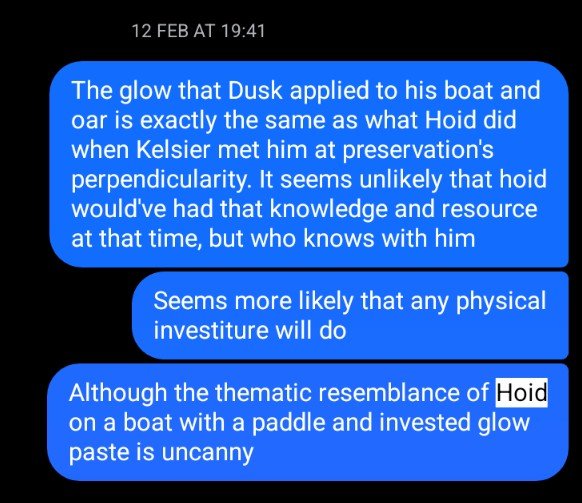
Well, raw investiture is super strongly affected by perception (Komashi's Nightmares, Threnodite Entities, spren creation, personality/Identity shifts in the Heralds). If it looks enough like a liquid, the unconscious perception of everyone who observes it is likely enough to make it act like liquid. Then, the more it acts like one, the more strongly it's perceived as one. That doesn't mean it _is_ a liquid though. Either Hoid has the knowledge and ability to shape raw investiture like that (maybe it's even keyed to him and his Identity somehow?), or it simply does just act enough like a liquid that you can pop it in a flask in your pocket.
-
Literally had this exact thought on my own recent re-read of Secret History As I said in that message, I suspect that any raw investiture gives the same effect. My gut says it's the same sort of Dor that Moonlight uses in The Lost Metal, but I'm really not basing that on anything other than vibes. Is there a reason it couldn't have been liquid stormlight?
-
Matter = energy = Investiture I aways assumed that a spren manifesting a larger object simply required more Investiture/energy to both create and maintain, especially when reading about Nomad summing Aux as various things, which seems to be supported on Aux's wiki: Conversely, with a smaller item, part of them should just sort of remain in the cognitive realm, like how emotion spren are only partially visible in the physical realm while their 'true', whole form is only visible in the cognitive.

