

.jpg.1dd2f423f3f3b2380628029ecf9674bd.jpg)

Ixthos
-
Posts
1333 -
Joined
-
Last visited
-
Days Won
2
Content Type
Profiles
News
Forums
Blogs
Gallery
Events
Everything posted by Ixthos
-
 Just quickly posting some preliminary possible relations the shards might have: I will go into more detail later, but if anyone has any feedback on this, including my initial allocations of the ordered goals, etc. please let me know. Also, do note that this is assuming Wisdom is a shard, and if Wisdom is one then together then at least two members of each type is present, which can be a seed to work out the other shards. Opposite members then are: Preservation - Ruin (outward physical [edit: or temporal] block) Cultivation - Endowment (outward physical [edit: or temporal] block) Honour - Autonomy (outwards? inwards? spiritual or mental block) Dominion - Devotion Wisdom - Odium (outward? mental or spiritual block) This is all preliminary, and Ambition hasn't been placed. This also can work in a sense of Honour and Autonomy stated as being more opposite than most, which makes sense in that Autonomy doesn't want external restrictions, but they wouldn't be as opposed as Preservation and Ruin, as one can still wish to be free of other's restrictions while also being bound by one's own promises to others or to oneself, just not externally imposed ones. Wisdom would be the opposite of acting emotionally, but again not as opposed as Preservation and Ruin as it is possible for wise actions to also be what your heart tells you, and Odium and Honour can still pair - not oppose - in that one can make rash agreements. Cultivation wants things to increase and takes a structured approach, while Endowment has systems in place to drain excess gifts from the system, making sure things circulate, sometimes going up and sometimes down, but no real long term growth or change. Note that the mental or spiritual block is distinct from the spiritual or mental block. I will also comment on why there are four blocks, rather than two types of rows as is the case for the goals, etc. types, and this especially relates to Allomancy. Until then I hope everyone has a great weekend!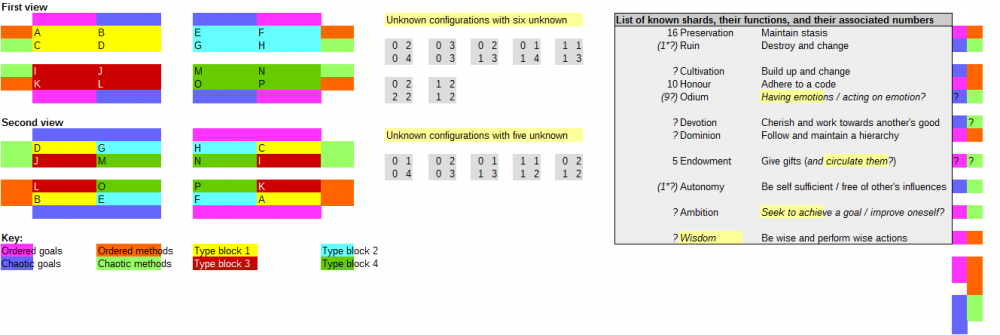
-
Moral Miscalculations of Mr. Sanderson in Oathbringer
Ixthos replied to a topic in Stormlight Archive
@Parallax I would like to ask you a question. You said Dalinar's actions at the Rift were irredeemable - what do you consider the cutoff for something being irredeemable? If someone kills one person, can they be redeemed, or how many before they can't be? Or if not the number, then if someone burns someone to death, are they also irredeemable, or is it the number? -
Which will be the last books published in the Cosmere series ?
Ixthos replied to Friendshipspren's question in Cosmere Q&A
We all make mistakes :-) the number of times I've misremembered something sometimes amazes me. With regards to White Sand, that is a side story much like Warbreaker, in that as Brandon originally outlined the Cosmere it wasn't necessary to read it in order to understand the whole story, much the same way Warbreaker adds to Oathbringer - and the end of Words of Radiance - but isn't needed to understand it. See the following link: https://www.17thshard.com/forum/topic/57305-the-original-cosmere-outline/ -
Which will be the last books published in the Cosmere series ?
Ixthos replied to Friendshipspren's question in Cosmere Q&A
Afraid not: -
Which will be the last books published in the Cosmere series ?
Ixthos replied to Friendshipspren's question in Cosmere Q&A
Brandon has a core structure to the Cosmere with Elantris, Mistborn, Stormlight Archive, and Dragonsteel as the main series, with side series such as Warbreaker and Arcanum Unbounded as supplemental stories that add to the whole but aren't needed to fully understand it. The core books, however, tell the entire arc, and together are the hidden plot for the Cosmere. Internally, Dragonsteel chronologically comes before all the other novels, followed by Elantris, then the first Mistborn novels, then Stormlight, and then the last Mistborn novels. In terms of how Brandon has said he intends to publish them, the order is slightly different: Elantris book 1 (published) Mistborn era one trilogy (published) Stormlight archive first five books / Mistborn era two quadrilogy (concurrently written and published) (in progress) Elantris book 2 (and maybe 3) (unpublished) Mistborn era three trilogy - 1980's (unpublished) Stormlight archive last five books (unpublished) Dragonsteel series (unpublished) Mistborn era four trilogy - space opera (unpublished, last series to be published) This doesn't take into account any side novels, which can be interspersed with the others, and so there might be other side novels after Mistborn 4, or between releases, which are not essential to the main story. See here: https://wob.coppermind.net/events/124/#e1802 and https://www.17thshard.com/forum/topic/57305-the-original-cosmere-outline/. In general check the Arcanum tags for Cosmere sequence, Elantris sequence, etc. In short, Dragonsteel, followed by Mistborn era four, are the last novels, but there might be side stories after they are published. Hope this helped! -
"There is always another secret."
-
@Truthwatcher_17.5 Lots of people agreeing doesn't mean anything ;-) :-P And you are right in that there isn't any confirmation as to Bavadin either once having had multiple personality disorder, or even that Bavadin currently has, but there are hints, and I am convinced this is the case. To elaborate on why I think they originally had multiple personality disorder: Hoid and the letter: The letter indicates that Autonomy is several individual minds, and indicated that Hoid approached the wrong person - but who would Hoid have been trying to reach - he hasn't had much contact with other shards for a long time, and there is no hint that he spoke to any of them since they took up their shards. If Bavadin already was several people, this could explain it - in short: "you tried to talk to someone you knew, but you got the wrong one of us, and we all already know you", therefore before Bavadin took up the shard Bavadin had several personalities. Shallan and the end of Oathbringer: Shallan seems to be splitting into several people, each real and distant, and Lightweaving seems to reinforce this effect, both causing her mind to split and making those other people "real". With the power of a shard, and if I am right and Bavadin might have been another Lightweaver Hoid knew on Yolen, then this could be foreshadowing or a parallel, and even more realised Eric: I don't want to spoil White Sand Prime, but if you've read it I think you know what I am getting at. Mental illness: Brandon has been exploring mental illnesses and disorders in his writing, and I think one of the things he is doing is exploring how abnormal mental processes can be affected by investiture. What would be more interesting then the results of someone with multiple personality disorder taking up a shard? Unique situations of taking up a shard twist: He already have had a unique ascension with Sazed, and I think Stormlight will end - or involve - another, with multiple individuals and their spren taking up a shard. It can make each unique, so rather than a repeat of Hero of Ages, it is something with a twist - first two shards combinding together into a power that invests the land (Sel), then one person taking up two shards (Scadrial), then maybe ten people taking up 1/2/2 and a bit/3 shards (what I think will happen on Roshar), maybe an object taking up another shard or an entire city as the corpse (Silverlight), and then on Yolen in Dragonsteel - in addition to the others, as people taking up shards would be something we would have seen in the Cosmere already - we see an example of one body with several wills taking up a shard. All speculation, yes, but still interesting. I agree it isn't much, but it does make me think that is a direction Brandon might take the story, and it could explain what is happening. @Calderis There probably is only one Bavadin, but if Bavadin had multiple wills, only one would be Bavadin, the rest would probably use different names or call themselves as different things - and that is a fair point you are speculating on :-) I think it would make sense, as either a property of the shard itself, such as Preservation can only listen, Ruin can only talk, and as other restrictions the shard places on the person who has it, such as the increasing pressure to go against the shard even if otherwise someone could force Preservation to cause harm it resists that and the longer it is held the less it can be made to act against its nature - it could be Autonomy has a compulsion to do this, and other shards have a compulsion not to. I know this hasn't been proven, it is just something I think is likely, due to hints at Autonomy and its activities, foreshadowing from how Brandon is exploring interesting situations and edge cases, his interest in exploring mental illnesses and its impact on investiture and investiture on mental illnesses, and the possibility it gives for a unique type of taking up of a shard, one of several I think he will explore.
-
This post is a quick attempt to list possible origins for Autonomy's avatars. Brandon has said he likes Autonomy, and I think that is because Autonomy allows for him to generate new shard-like characters who can have widely varying personalities as well as form pantheons, all on new planets, and so can expand worlds and systems in the Cosmere as needed, while still having the core focus on the main 16, with one of those 16 being able to fill in multiple roles. That still doesn't explain where those minds come from, though. The poll above hopes to find out - and also propose - options that seem the most likely. On Yolen, did Bavadin start with one mind, or several (as each mind would crave the chance to be free of the others)? If one, when Bavadin took up Autonomy, did Autonomy make Bavadin form avatars, and would do so for anyone who took it up? If several, did each personality become an avatar, and was Trell one of them? Or does Autonomy grant this to others, such as a minor character on Taldain, or make new avatars as the situation requires it? Can it be a mixture? What are your thoughts? :-) And do you think Trell is a rogue personality? Did Trell come from Taldain, or are the names on Taldain derived from Trell rather than the other way round? Okay, enough questions :-P
-
Ahhh, I think the problem might have been you not having enough reputation - I'm not sure, but I think that can affect if you can @ someone. Good to know it is sorted now :-)
-
I fully agree, and that is something I really like about Brandon, how he uses optimism to reconstruct the tropes and ideas commonly deconstructed, showing the value in the old while still exploring the new :-) I'd like to try and group the shards we know into a more refined block later on, as well as working on the assumption wisdom is also a shard (for several reasons - complete side note but in what I am writing there are several beings similar to what Brandon has shown, only they exist in several distinct groups / types / "species", people can't take them up, and they are fewer in number, as well as having a hierarchy, but Wisdom is one of them, and that is commonly seen as something of the divine, as Proverbs compares Wisdom to a woman and was the first of God's creation). The shards can match certain ideas of pagan mythologies as well as divine attributes, and I think they have distinct archetypes, such as war, love, wisdom, fate, and so on, with some overlap Before exploring that catagorisation, I do want to have some feedback on two things I've noticed that is important with the types of shards. The first thing: Shards like Honour, and possibly Autonomy, Ambition, Devotion, and Dominion, apply their trait to themselves, so Honour acts honourably, and presumably Devotion would be devoted and not just trying to make everything devoted to her with no caring on her own part (though whether Autonomy and Ambition value their own property and apply it to themselves isn't clear - Odium might want others to hate him?) Shards like Preservation, Ruin, and possibly Cultivation and Endowment, apply their trait externally, even to their own cost, so Preservation doesn't try to preserve himself any more than Ruin tries to ruin himself (presumable the person who can take up a shard must be someone who sees the value in that trait, and some apply to ones own actions as well as some applying only to what you want the world to become) The second thing: Preservation, Ruin, Cultivation, and probably one other, like Endowment, form a block - Ruin and Cultivation are focused on change, Ruin destructive change, Cultivation constructive change, while Preservation and possibly Endowment are focused on maintaining a certain amount of something, with Preservation favouring stasis and Endowment favouring sharing out a finite amount of something - a gift that doesn't grow but can be passed on, remaining unchanged If Preservation is ordered goals, ordered methods, and Ruin is chaotic goals, chaotic methods, and Cultivation is chaotic goals, ordered methods, then the last shard in that block might be ordered goals, chaotic methods, which could be Endowment - it could be argued Endowment is in any of the two quadrants with both order and chaos - or another All the shards in this block are those which don't apply their trait to themselves, and are outwards shards What are your thoughts on this observation? If it makes sense, what other blocks of four could there be, remembering that with six shards not known there could be at least one entire quadrant with no shard revealed?
-
@Atrias This seems to work for me - try linking to me the same way and lets see if that causes any problems.
-
@MasterGhandalf another nice chapter :-) if you are reading this feedback, I would be willing to give you a more full critique, but either way I will just note two points: "We stand as won" - typo, I think you meant one The fight, three against three, all skilled fighters, was a little anticlimactic I look forwards to the next chapter.
-
Thanks :-) Another possibility would be a quad arrangement with goals and approach to achieving those goals, so chaotic goals and chaotic methods, and ordered goals and ordered methods, which could allow, for example, Cultivation to have chaotic goals - the flourishing of life, things outside of her control - using ordered methods - pruning, fertilising, cultivating. So: Four chaotic goals, chaotic methods shards Four chaotic goals, ordered method shards Four ordered goals, chaotic methods shards Four ordered goals, ordered methods shards ... And I actually think I like that idea more, actually ... Of course, the main goal of this was to demonstrate the idea of the main shard worlds having shards with opposite ends of the ideas of order and chaos expressed. I suppose we will know more if the ideas of order and chaos come up in any Cosmere books or in Dragonsteel.
-
I like that one :-) Einstein, Newton, Heisenberg, and Pascal were playing hide and seek. They began the game, Einstein counting, and Pascal and Heisenberg ran off to hide. Netwon, however, just drew a square - with each side 1 metre - on the ground, and then sat down inside it. When Einstein finished counting he turned around, and said to Newton: "I've found you Newton!" But Newton replied: "No, you haven't! You found Pascal!" Oh, and If you are wondering why Heisenberg is in the joke, and where he was hiding ... I'm not certain, but I can tell you how fast he was going ;-) You know, numbers can be very weird. I just heard a rather complex disagreement between the real and imaginary axes - they were having an argument over pi (or maybe it was half a pi? I'm sure they could have done with two pies, or any even number to share). It didn't sound very rational to me, but that's transcendental to the story.
-
I'll just quickly do a breakdown of possible Order and Chaos arrangements - I'm not saying I think this is definitely the case, only that this might be how several are arranged. So, first a list of shards that are known, and the number that aren't - assuming Trell is part of Autonomy and no new pseudo-shards made from the parts of other shards exist: Preservation, Ruin, Cultivation, Honour, Odium, Devotion, Dominion, Autonomy, Ambition, Endowment, (six others) Order shards: Preservation - stasis, things unchanging Dominion - control and hierarchy Honour - adhering to a code (One other) Hybrid shards: Cultivation - shaping and encouraging to grow, order applied to chaos while preserving the chaos Endowment - giving gifts but not controlling what is done with those gifts, the gifts themselves flexible in application but rigid in their obedience Ambition - wanting to achieve own goals, being driven, and so likely wants things ordered according to own desires but chaotic in how that is approached (Five others) Chaos shards: Devotion - caring, emotion, and placing another above yourself - and if everyone does this there is no hierarchy (least chaotic of the chaotic) Ruin - breaking down, changing Odium - breaking bonds, rejecting responsibility for own actions, acting on hatred and so on impulse, doing what you like Autonomy - doing what you want, refusing to be restricted (might be a hybrid shard if prioritising own autonomy but will restrict others to achieve it) This assumes that each exists in one of the three distinct blocks, but it might be that the hybrid shards are in two groups, one being more chaotic and the other more order, and it also is possible that they lie on a line, with even in the chaotic shards section and ordered shards there are those who are more ordered and more chaotic, in which case Devotion is likely the least chaotic.
-
The main point I think we can all agree on is this: when you watch or read something, do you regret having watched it or read it, or don't you? Did it add something to you and your life? Did it make you feel an emotion (... other than strangling the author :-P I mean an emotion they wanted you to feel ... unless it was to strangle them ... :-P ), or make you question something, or give you an insight? If what you watch or read touched you positively, in any form of positivity, rather than made you feel you wasted your time, or your time would have been better spent, then that is something worth watching or reading. Deep or shallow, crude or refined, if in the end you are enriched it was worth it.
-
What’s the Weirdest Thing You’ve Heard Other People Say About You?
Ixthos replied to Draginon's topic in General Discussion
To be fair, if you are immortal then your work can still stand for a thousand years as well as turn to dust before your eyes ... :-P -
This whole post has Warbreaker spoilers:
-
There are so many things to say about Terry Pratchett, one of my favourite authors, and someone who often made you both laugh and think (though someone who I disagreed with on many of his points). My favourite scene is in Witches Abroad, where Granny Weatherwax turned the powers of a voodoo witch against her, using the voodoo witch's own perception and beliefs against her. Pratchett was a brilliant writer, albeit one who in several fundamental philosophical ways I disagreed with, but his writing always made you think. And one of the main forces on the Discworld is that what you thought could define reality. Now, in the Cosmere, this is tied to the interplay between physical reality, cognitive concepts, and spiritual nodes, and so I doubt there could be any argument that in the Cosmere there is indeed an atom of justice, etc., because there would be, just in the cognitive realm, which is just as real as the physical world, and its hard to argue with that when a blade made from one of the inhabitants of that world can cut right through anything physical. This has got me thinking about something, about Cosmere dragons, and about Discworld dragons. It has been a long time since I've read through the series, so if someone who are read Terry Pratchett recently has any corrections, please let me know. As I recall, Brandon is a fan of Pratchett's writing also, and I wonder if he is going to use this idea. And an idea from David Eddings. Discworld deities, like the deities in David Eddings Elenium/Tumuli series, are shaped by belief, and are made by belief. In fact, one of the characters in the Elenium - no spoilers - declares that she willed herself into existence, declaring this in defiance of one of the beings like her, but older. In both Discworld and in one of the books of the Tumuli, lost and forgotten deities are found, desperatly seeking others to believe in them and allow them to become real again. Other stories and games have used this idea, but something I remember from the first Discworld novel is that this idea also applied to dragons. This has me wondering - what if dragons in the Cosmere are a race that willed themselves into existence, or were formed like virtual particles becoming real around the mass of the power of creation, where it settled on Yolen (if dragons are from Yolen, rather than just being life on it), life that congealed around it (with no anti-dragons ... or maybe ... :-P )? What if Cosmere dragons are the first life in the Cosmere (the entire universe or the set of stars / cluster / dwarf galaxy / systems called the Cosmere), and that their type of life being life that willed itself into being due to the mass of investiture near to them, or if it didn't will itself into being was life that eventually learned how to reshape themselves using the Cognitive realm, again to to expose to high levels of investiture from the complete power of reaction, and are now a race defined by belief - their own or others - which accounts for there shapeshifting. As the readable chapters of the original Bridge 4 sequence on Brandon's website show, they are made from, or have skins with, Dragonsteel, an indestructible substance, and seem to have a strong presence in the Cognitive realm. The power of Cosmere healing abilities might be the only thing that could reshape what is obviously invested metal. And, if that wasn't reaching too much already, what if the power of creation was something they gathered together by their own belief, or shaped by their own beliefs - and what if other races are races they originally formed using that power, the dragons are the original progenitor race whose beliefs either shaped the power, or they themselves were shaped by it? One possible scenario is thus: before there was life in the Cosmere there was an ideal of life in the spiritual realm that ideal was a powerful one, a complex one with strong connections to many other ideals due to its diversity and the possible futures it opened up that ideal was connected to the power of creation, itself the centre of the spiritual realm, and so at the site where the greatest concentration of that power in the physical and cognitive realm that ideal was able to shape some of it into its most refined form that proto-spren was able to cross over into the physical realm at the perpendicularity where the power of creation was - the theoretically strongest perpendicularity there could be that proto-spren, by crossing over, became something in both the physical and cognitive realm, and was the first dragon that dragon then dreamed the others into being, and together they formed a civilisation which had beliefs that defined the power of creation, and which they worshipped Or: Dragons came into being as a species before other species They learned about the Cosmere, its nature, and discovered the spiritual realm At the centre of the spiritual realm was the power of creation, which they were able to make manifest on their world That power allowed them to reshape themselves into the ideal of their life, making themselves strong and more capable That power also allowed their beliefs to shape the power slightly They then made or encountered other life, and discovered that sufficient belief would change them Or: the power was already alive, and already connected to the idea of life it made dragons to express its desire to make life, as it might have done elsewhere in other star systems those dragons beliefs formed a feedback loop with the power, and then made new types of life those new types of life had beliefs which allowed them to redefine dragons, causing dragons to withdraw I know there isn't much to support this, but the idea of dragons as a type of spren that became the first physical life in the Cosmere is possibly an interesting one, especially if they made other life, which had the unfortunate side effect of making them susceptible to being reshaped by the beliefs of their own children. What are your thoughts on this? Thanks :-)
-
Let's agree to disagree with Hrathen :-) In many ways it is the very definition of chaos - nothing bounding you, and so your actions are unpredictable. Law is an ordered system, and if you feel laws are restricting you, you break "free", and throw that system into disorder. And if she thinks Harmony is too restrictive, she adds chaos to his world, uncaring of if her actions interfere with his autonomy - the only thing that matters to her is that what she sees as control be removed, and control is order - and remember, there are hints that Autonomy is a collection of minds, so other minds could express Autonomy differently. Another word for everyone having extreme autonomy is also anarchy, and anarchy is a form of chaos (not that I am saying anarchy is chaos, only that they are related). [Edit] Lets use this example: if Honour and Autonomy are walking along the road, and they need to get somewhere quickly, but come across a sign saying "Keep of the grass", and the only shortcut is across the grass, what would each do? Wouldn't Honour, despite wanting to cross the grass, keep off it, while Autonomy would just walk across, because she refuses to have anything restrict her, be they a sign or the desires of others?
-
Fair point about Hrathen, but in that sense I think it would be more of a Dominion-style loyalty than Devotion - he follows the hierarchy because that is what you do - logical order, rather than passionate chaos. Preventing interference is orderly, true, but Autonomy also interferes with others, or at least one of the personalities in Autonomy does. Yet at its heart Autonomy is striving to be free of restriction - I don't want to be interfered with, I want to be free to do what I want, is chaos. Don't touch my stuff, but I will touch yours, because I want to, basically.
-
To be fair, he was a bit shorter than I expected :-P
-
@Nathrangking sorry about taking so long to review this - life has been rather busy lately, and I want to give a thorough review. This review of the new parts doesn't take into account what anyone else has said, so I might be repeating things you have already heard. I've grouped my observations based on type. The writing is very poetic and bordering on flowery - it makes following what is happening a little difficult which might be the point. I'm assuming you are going for what Brandon referred to as stained glass, rather than a clear pane The narration is switching between an omniscient narrator and his own perspective in chapter 1 as well as the prologue, though I didn't notice that in the second chapter - is this intended? Strange imagery, like a barbed slab, a marine with a mace, arrows, things he says become metaphors literally rather than figuratively, gives the story a very surreal nature. Its interesting and wondering about that - you seem to reduce that a lot in the third part, aside from him becoming an echo. Its treating ideas as objects, and metaphors as literal reality - its interesting but a bit jarring, so if that was your intention then well done :-) Some context information is being given a little too late for the previous sentence or paragraph to make sense, such as when we are told he shouted after the fact - silence greeted his shout is an example, as is his reaction to the release forms when he asks in outrage what is this before we are told what the problem is, and the answer came in part way though the dialogue from the nurse, and it makes following what is happening a little hard to follow I rather liked some of the descriptions, such as seeing with his left hand, I thought that was a nice touch, along with several others Unclear if he actually is seeing these metaphoric descriptions, or feeling the things described as flowing from him, etc., as he isn't reacting to them - is he perceiving his dialogue becoming snakes which fly filled with poison? That seems to reduce in scenes where he is wearing the glasses, so are they his own attempts to make sense of a world he can't see? On that, it's strange how he was seeing the surreal world - or it was being described, as he doesn't react to it - before putting the glasses back on, which makes me wonder if he has become infected by something, or if he really is just deeply traumatised. Also, the sudden shift into the medival-esque setting was again surreal, though perhaps his seeming under-reaction to that is again an indication he isn't fully whole Not exactly sure what was happening with the kingdom - was the nephew's forces attacking the king? Where the invaders the civilians, the men and woman and children being the invaders? It is still a little jarring to read and a little hard to follow everything that is happening - for a while I thought the king had suddenly been attacked and his head cut off while his disembodied head pleaded he wasn't to blame - it took rereading it to realise it was again metaphors of his throat being seized, and his crown that fell, but I wasn't fully following what was happening, trying to figure out if the nephew actually had vanished, trying to follow the events so I got confused at that part. Still, this looks rather interesting and I am interested in what is happening, and hope it will be made clear - at the end, will what has happened be made clear, or explanations presented which might not be the answer but provide possible explanations? I never watched it but the Prisoner - a surreal series about a captive agent in a strange beachside village - got a lot of flack in the end because it ended on a bizarre note with the true mastermind being ... the main character himself! And they never explained what had happened. Are you going for that in the end, or a plausible but also hinted at maybe not the case answer at the end that will pull everything together and make subsequent re-reads have a new light? I'm interested in what happens next :-)
-
That might work, but I think some shards might fit into a spectrum as well as being clearly defined, so maybe four very ordered shards, four very chaotic shards, and eight which are a mixture, as I will address below. What about Hrathen? It is possible to be passionate without that passion being manifest as an outward display of emotion :-) I did mention Cultivation as a mixture in the first post, as a combination of order applied to chaos, or chaos and order combined. Autonomy isn't paired with any other shard other than itself, and so could also be a combination, as could Endowment - Awakening is based on giving commands that are obeyed exactly as described, but who or what is given a breath and what commands are given are outside of ones control and are very flexible. It could be that shards more clearly on one side are drawn to shards more clearly on the other. I think that there are clearly order shards, clearly chaos shards, and shards that lean more one way than the other while being a mixture or are equally one or the other, and those more dually aligned tend to clump with one another. This is mainly about multi-shard settings, but could have applications outside of those planets and hint at the nature of both Yolen beliefs and the nature of how the power was split.
-
If this doesn't seem too presumptuous, do you agree that Honour (following a rigid code), Preservation (stasis), and Dominion (control and hierarchy) all seem like different expressions of the idea of order, and antithetical to the idea of chaos (chaos as in random and change, not primordial unshaped matter)?
