

.jpg.1dd2f423f3f3b2380628029ecf9674bd.jpg)

Ixthos
-
Posts
1333 -
Joined
-
Last visited
-
Days Won
2
Content Type
Profiles
News
Forums
Blogs
Gallery
Events
Everything posted by Ixthos
-
I'll have to read it again to be sure as well, but as I recall one of the Fused said to Odium in shock that Odium must have found a way for spren to bond humans, and Odium replied that it was always possible for spren to bond humans - but I will need to recheck. Also, I think it showed spren leaping into them, but again, I think reading it again would clear that up. Yixli isn't a lesser voidspren, and the Thrill wasn't directed at Kaladin. Likewise, it is mainly about what you are susceptible to - the thrill is one type of passion, but remember there are other types and other emotions inspired by the Unmade. Kaladin isn't a bloodthirsty person, and the Thrill is bloodthirst - his passions, and so the part of him susceptible to bonding, isn't in that direction, and likely is something Syl can't yet grasp, and so doesn't know how to defend Kaladin if it is attacked. Mistborn Hero of Ages spoilers: [Edit] Okay, I found this part: So it looks like you are right about it being one spren, but it also confirms that spren can bond to people - bond - if their emotions line up. [Edit 2] Actually ... just checking again, and it isn't clear if the dark spren is one spren or several - there seems to be only one spren singled out before, the Unmade, rather than the others. So it might be several spren.
-
I think this is the key point, and which supports my theory - the war in Kaladin between honour and passion. As to your statement, yes, I agree that Sadeas' men were susceptible to that particular type of bond because of the thrill, and also because of the type of people they were. This highlights my main point, and the reason I brought up that example: Odium spren bonds don't require oaths, only mindsets. I don't say that Yixli will bond Kaladin the same way the voidspren - possible but not confirmed to be lesser voidspren - bonded Sadeas' men, only that it is the nature of their bonds - passion facilitates voidspren bonds, rather than oaths, and as the quote you provided shows, Kaladin has an internal conflict, and one which - I think - might well be translated into a more literal one.
-
Let us assume they are completely intertwined - something which hasn't happened yet, as I think the bond deepens with each Oath, so only at the fifth ideal do they completely merge, or as close as they can. If that were the case I could believe Syl would be fully aware of Kaladin's connections and would be able to prevent a new one from forming. But two things: one, Syl and Kaladin aren't yet completely intertwined yet, and so there could be gaps present. Two, you yourself are fully aware of yourself, but mosquitoes can still bite you - Syl isn't fully in the cognitive realm any more - that "mass" was moved into the physical, and there isn't much indication she is as aware of the cognitive realm as she once was, and that is also assuming the cognitive realm is where the bond is initiated, where with Shallan and Pattern when they fought the Midnight Mother showed that - while they physically touched - the bond itself is spiritual, and doesn't seem to need physical contact in either the physical or cognitive realms. Still, even if it does require touching in the cognitive realm, do you think Syl would be able to sense Yixli? I can't recall, but didn't the scene with her and Yixli - while she was pretending to be a simple Windspren - involve her not being fully aware of if Yixli could see her and vice versa? Basically, if Syl can't see into the cognitive realm - or exist there as she used to - and if the bond doesn't require physical or cognitive proximity, or if not proximity, then touching - and if you yourself can't keep mosquitoes off of you, it stands to reason that Syl wouldn't be able to prevent the voidspren from bonding Kaladin, especially if Syl and Kaladin aren't fully bonded yet, and Kaladin's passions are like exposing an arm for a mosquito to bite
-
@Green Hoodie Mistborn I don't think Kaladin would leave Syl, but rather that Yixli would insert herself into Kaladin (and as voidspren aren't - at least purely - of Honour, the bond would work differently, much like with Sadeas' men at the end of Oathbringer, without them having to swear any oaths, just having the right mindset), and with or without either him or Syl knowing, but both probably sensing something is off. And at a crucial time he would feel power from her, power at a moment of crisis that would help, and so,you noted, would result in the conflict between Honour and Passion, the two sitting on his shoulders - at least metaphorically - and trying to get him to embrace a different path, each with its own benefits and drawbacks. I think - even though it might seem a little cliche - that Mr. Sanderson would be able to make it work by putting a new spin on it - remember, Honour isn't necesserily good, nor Passion evil - and THAT is what would make it no-longer a cliche. I don't think he would try to hurt Syl, or betray his Oaths, but Yixli might be able to encourage him to favour other approaches which don't violate his oaths but which nevertheless stray from Honour, his bond with Syl stalling while Yixli offers an easier path to the powers needed to protect. And in the end he finds a way to balance the two, and so progress with both. I haven't posted it yet, but one of the posts I'm hoping to make in my post on the six remaining shards in the Cosmere section is an explination of how Honour and Odium are compatible, as Honour is about what you think about / what is important to you in how you conduct yourself in a personal capacity, and Odium is about how you think, so Passionate Honour would be to make rash oaths, or to feel a strong emotional component to the oaths you make. As Kaladin progresses more as a Windrunner, I doubt he will lose his intense emotions, but I do think he will be able to channel them better. On the issue of the bond not being made until the first ideal, I'll need to recheck, but didn't Kaladin survive being strung up before the highstorm before saying the first ideal? I think he might have displayed at least some inhaling of stormlight before that. I'll need to check. Either way, I think voidspren bond differently to Honour's spren - Honour is about holding to ideals, while the spren that took control of Sadeas men only needed a certain mindset - a Passionate mindset. Which character's on Dalinar's side would you say as more passionate than Kaladin? :-) I think the bond would be possible not by Kaladin swearing a Passionate ideal, but by being of a Passionate nature, just as being of an Honourable nature drew Syl but requires fulfilling Honour's requirement of Oaths to bond, something Odium doesn't need. @Config2 I think a lot of what I said above also applies to this, but to continue that point, I don't think Passion is inherently evil, any more than someone who keeps their promises is necessarily good. Yixli might be there to tempt Kaladin if she does bond him, but I also think the reverse is also possible, the good of Passion could be expressed by Kaladin, the evil Odium intended, or Yixli intended, turned to redeem her instead, just as Syl is changed by her bond to Kaladin. @Kalaksbreath I don't think Syl would be able to stop it, especially if Yixli bonds him in a part of his soul Syl can't touch. The mere fact she felt the need to push the gloryspren away from him seems to indicate she feels like other spren might be able to try and claim Kaladin if she isn't careful - and even if she is careful, can we be sure that she can prevent them if they do so in a way she has never seen?
-
Kaladin is going to be bonded by Yixli, the voidspren that he met while travelling with the Parshmen. I have been convinced of this since I first read the scene where he meets her, and I am going to justify why I think this is going to happen, and the possible implications it will have on the story: She is described as similar to Syl, a young spren woman, with key differences highlighted - her colour, moving by pulling the ground up to her rather than flying, etc. - she is the opposite of Syl in an obvious way She spoke highly of him to the Fused before he was found out - her bitterness, along with her interest in him, might make her inclined to try and bring him to heel as punishment for her punishment. So we have both interest expressed in him, praise given about him to her masters, and then punishment for being deceived - thus she would have a reason to have Kaladin on her mind Kaladin is both Honourable and Passionate - I think his passion is what would entice Yixli, especially if she bonds him on orders from Odium to try and turn one of Dalinar's most honourable knights to Odium, showing the difference between the two, but also allowing for the similarities - and the possibility Kaladin can find a way to combine the two and so show the good of passion as well as remaining Honourable SYL initiated the bond with Kaladin, he didn't have a say in the matter, only in progressing the bond. Therefore it seems the Spren have the ability to start the bond, and so if Yixli wanted to bond Kaladin, or was ordered to do so due to Kaladin's passion, she could do so without Kaladin's input. There is no indication that only one spren can bond someone at a time, that bonding a spren prevents others from doing likewise - the only similarity was the Midnight Mother trying to replace Pattern in Shallan, but that could be a case of trying to form a bond and then break the other due to the Midnight Mother's strength - her bond being so powerful it would prevent lower level spren from maintaining the bond, like a thick rope needed at the binding point and preventing thinner ones from being attached - as well as her being similar to a Cryptic, trying to bond to the same point in Shallan Pattern is bonded to, and so another type of spren, or a weaker one, would bond to a different part of the soul. Other magic systems have shown that multiple magic-granting bonds can be maintained at the same time, even of the same type (Warbreaker, Mistborn, Sixth of the Dusk, etc.) [Edit] Also, there is no indication that she needed to remove Pattern, only that she was trying to Syl is jealous of other spren expressing interest in Kaladin, and even batted away gloryspren which flew too close - this scene is right after he escapes from the group where he met Yixli, foreshadowing both Syl's jealousy as well as linking it to Yixli - and if Syl was battering away lesser spren, how would she feel about a voidspren It will allow for voidbinding to be explored - see here for more musings - as well as noted above the positive aspects of passion, once the negative are faced, as well as having a voidspren on hand to act as a So, what do you think? Do you think this is likely, or unlikely, or impossible? If she does bond him, what do you think will be the dynamic between them, and between her and Syl? Thanks! [Edit] Also, Yixli is similar in sound to "Yi - xS - Ly", or in other words Y-S-L ---> S-Y-L, so Syl. She is Syl's foil, and so having her interact with Syl, and competing for Kaladin, would make sense. :-)
-
To add to all of that, there is a chance there might be a cyberpunk Mistborn included as well, at the least as part of the 1980's Mistborn (and maybe the space opera), but also possibly as its own novel: https://wob.coppermind.net/events/10/#e6569, and https://wob.coppermind.net/events/121/#e4729, and https://wob.coppermind.net/events/315/#e10958 (or just look here :-P )
-
@Rebecca you have several possible options to choose from, but if I may ask, does it have to be a poster? Because if you are interested in something a little more hands on, and which might possibly be a little too romantic - but you will have to decide on that - you could try this: It is very mathematical, and requires great care or you will be in a completely different boat. Alternatively, as you said he has read Stormlight Archive - ask him if he will be the Kaladin to your Syl, or if he is willing to Invest some time you might be able to take everyone's Breath away (assuming he's read Warbreaker), and if he has read Mistborn - mainly era two - ask him if he is also feeling the Connection between you to, or he must be tapping Chromium because if he says yes he is a really lucky guy. It all depends on how romantic you do or don't feel is appropriate. Of course, if you mainly want to go with both maths and a poster, you could always say you don't want your relationship to become Complex, but if he goes out with you - for Real - you can always enjoy a slice of Pi afterwards, so long as you don't get into an Irrational Argument about which pie to get. And going with a fellow nerd will be Exponentially more fun than going alone - it will be something he can put in his Log, and you will certainly find the day to be better than anything Imaginary. The choice is yours :-)
-
I suspect that the focus is fundamental to the method of the system, so gems are the only way to use fabrials, but the underlying principles can be applied across systems, such as Vashar manipulating the girls memory, something associated with copper, and Hoid being able to use the core of feruchemy without actually using feruchemy. Honourblades are like medallions in granting abilities, and the Ire stored up connection to use to capture a shard, much like a feruchemist. Now, in other terms, I think - in addition to using one system to power another - the three main ones (Scadrial's, Sel's, Roshar's) might be able to add or adapt parts of or properties of other systems to one another - so perhaps finding a way to turn some Lerasium into a spren and capturing it in a gem, or Hemalurgy being used, or simply finding a way to tie properties of one system into a Sellish glyph.
-

I think I know the remaining six shard names - and I can justify why
Ixthos replied to Ixthos's topic in Cosmere Discussion
This is the second of nine posts detailing the structure of the shards and explaining how they relate and are distinct, and what they are missing. This covers the second row, the "HOW you DO IT" row, or, in other words, the manner and purpose for other people of ones actions. And that last part is key, because this row, and the one that follows, is about people. This one is a little different from the previous post because unlike the previous, this one makes a much bigger assumption - it adds two unknown shards to the list. The purpose of this post is to show how they fit with the others, and to explain how the others in its row relate both to them and to one another, and to the concept of the row itself, the how and its significance for other people. Beginning with the two shards we know, this will take a slightly different approach than the previous post - there we first talked on ORDER, then the ordered approach to order - and what order and an ordered approach meant in that context - followed by the more chaotic, or unbounded and freeform approach, followed by discussing CHAOS. Here, we will instead start with ordered ORDER, and then chaotic CHAOS, and what they have in common for people, and for method. And they both have in common the idea of THE PEOPLE WHO ARE CLOSE TO YOU, or, perhaps, THE PEOPLE IN A PROPER RELATIONSHIP WITH YOU. Now if you are in the proper relation with someone, there are two different ways of looking at it. This is the first, the ordered order, the rigid rules, the uncaring bond that people can be bound by. Dominion is hierarchy, everyone in their place, and everyone knowing their place. There is no need to move outside of it, no need to challenge its structure - it has been arranged this way so that there is no friction between people, and any problem encountered can be overcome. In the end a community only functions when everyone does their part, knows their place, and some parts are to take orders, some are to give them, and some are to stand between others, receiving commands and giving orders. You don't really have to care about what is happening, so long as the structure is maintained properly any issues encountered in the world will handle themselves, so long as you obey the chain of command. Stepping outside of the chain is unthinkable - you disrupt the system, and the predictable responses will fail. So don't do that. Why would you want to? Remain in unity, the right way, and even if something terrible happens, at least you know where you stand. HOW do you do what must be done? You do it by delegation, obedience, and conformity. Ordered relationships, and doing only what is required of you. (Dominion = you behave appropriately to me, either being above and giving ordered, or below and receiving them. I know where you stand, you know where I stand, and lets agree to remain this way, rigid and stationary) Devotion ... to care about others. I don't care who you are, you MATTER. Are you the king? Well I love you, and I am your subject. I will serve you and care for you. But why are you now caring for me? Do ... do you care about my well being? Yes ... yes you do! You don't care that it is beneath you to serve me, a humble peasant! What matters to you is that you see I am sick, and so you tend to me. I am tired, so you take my burden. Yet you are above me in station! Yet you care, and what good is the hierarchy if it doesn't care? Indeed, in the heart - and the significance of this will be clear when Odium is discussed - there is no heirarchy, no set rules of behaviour. Because I love you, I will serve you. Because you love me, I will let you serve me. As the Servant Song says: "Brother, Sister, let me serve you / Let me be as Christ to you / Pray that I might have the grace / to let you be my servant too." And in this Devotion is shown - HOW do you do what must be done? By putting others, your friends and families, PEOPLE YOU KNOW or are connected to, before yourself, regardless of whether they are above you in station or below, and accept from them that same privilege. Chaotic relationships - no fixed structure - and doing ANYTHING that that person needs. (Devotion = you MATTER to me, YOU who I know matter, and so I don't care about what is considered proper protocol, or if this is frowned on by others. I will serve you and love you and work for your good, because nothing matters more than other people, and no people more than those you love) Of course, these two are dynamics which apply to people who have the right relationships with you - people you know, and so can have oblegations towards, or love for. But what about people you don't know, or what about people you know who - UNTHINKABLE - break their relations with you, people you love you hurt you, or people you should obey or who should obey you disobeying or giving unlawful commands? Well, then there are again two responses, two modes. The first approach, Ordered goals, chaotic methods, I am referring to as Vengeance, but that might imply a degree of emotion it doesn't have. Another name might by Payback, Balance, Retribution. BUT NOT JUSTICE - Justice requires a code, and this lacks a code, an approach and restrictions (when Honour is discussed we will see how the Orders of Knights Radiant tie to the shards). This shard is a shard of making sure things get put back the way they should be, and will do ANYTHING to do it - what matters is putting things right - the SYSTEM is what matters, not people, and so whatever it takes to put the system back on track MUST be done. Of course, lacking emotion, and applied to things outside of people - as indeed all of these can also apply to existing systems in the world, machines that should obey or machines that you care for, or institutions and governments or entire nations and peoples, not just individuals - this shard is ulimately dispassionate. Indeed, all the ORDERED goals shards are, while not emotionless, far less prone to outbursts than the CHAOTIC goals shards. This shard is an accountant, balancing the books, or a worker, putting in their shift. The account isn't balanced? Well, track down the problem and fix it, and then move on. Someone broke the law? Well arrest them and go back to your shift. It doesn't matter who you hurt along the way, or the homes you foreclose, the people turned out. The SYSTEM is what matters, and putting things right. HOW do you do what must be done? By putting fixing the system, of making sure it runs smoothly, before the needs and desires of others. No intention to harm them, but no intention of stopping if the are hurt. Ordered relationships, and a chaotic - unrestrained - approach. (Vengeance/Retribution = if you break the system, you will be made to pay, either by fixing the relationship or by extracting the price from you, in any way possible - you matter less than the system does, so what does it matter if fixing the system harms you? The system is the only thing that matters) So, what is the second approach? I call it Mercy or Forgiveness, or Compassion. It is the exact opposite of Vengeance, though not incompatible. Mercy focuses on the individual, and their unstructured ways, and applies a simple, restrictive rule: put them first. They hurt you? It doesn't matter - they do. A friend betrayed you? They are only human, or Kandra, or Sleepless, they make mistakes. Forgive them. CHAOTIC goals - their desires and well being are your goals - with a structured approach - overlook and ignore their mistakes. HOW do you approach what must be done? With forgiveness in your heart, and the knowledge that they matter more than the system. Chaotic goals, and a simple rule. (Mercy/Compassion = the needs of strangers, or those who have wronged you, are more important than the hurt they inflicted. What does a system matter when compared to PEOPLE?) And here we can see similarities and differences. Dominion and Devotion look at relationships you have, or which are working right, while Vengeance and Mercy focus on those which have gone wrong. Dominion and Vengeance look at the system and see it as more valuable than a person, Devotion and Mercy look at a person and see something worth even more than that. Dominion and Mercy are fixated on following simple, straightforwards rules, Vengeance and Devotion think that, for what matters, nothing should stand in the way. So then, how does this relate to the "WHAT you should DO" - the way the world should change over time - block? In an interesting manner. Does Preservation value the system more than the individual? Should Endowment give gifts only to those in a proper relationship, or to anyone who needs them? Should Cultivation build up the person before the society, or mature a nation rather than a person? Does Ruin destroy the sick and the tired so as to grant them rest and peace, or go after a nation that has upset the balance? In the end this block asks the questions: 1) does that which is close to you matter more than those far off, and 2) are people more important than institutions? Answering those questions becomes the reason one does what one does, and changes the reason one does what one is doing. -
I think I know the remaining six shard names - and I can justify why
Ixthos replied to Ixthos's topic in Cosmere Discussion
I'd like to make a series of posts which outline what I think this structure means for the intents of the shards, and how they relate and are distinct, as well as what they are lacking. So I would like to make, over a while, nine posts, consisting of four posts covering the "WHAT you should DO", "HOW you should DO IT", etc. blocks - with this being the first of those - followed by four covering the ORDER, the right method, etc. blocks, and a final post drawing that all and uniting them. Each post also should help explain how I think different blocks tie together, so this post will cover some of how the "WHAT you should DO" i.e. the [[your impact on the world]] block's members interact with each other, and the next post of this type would be the "HOW you should DO IT" i.e. the [[relation to others block]] interacts with both itself and the former block. As always this is speculation, but I think it fits, so please, give me your feedback :-) I think this block is probably the easiest to understand if - and again I repeat this is all speculation ;-) - these shards are all members, and match the ideas I've outlined, as this block is the only complete block of its kind (the other complete block an orthogonal type, which is the "CHAOS, any method" block), and it is the block that directly describes how one should use ones power to affect the world. In short, it is the block about how the powers should be used to cause the world to change over time. In this sense, ORDER is the idea of restriction and restraint, containment, and a guided outcome. In short, the two ORDER members are about maintaining control, for ones own good and for others, and about keeping the system stable. There are, however, two different approaches to this. The shard focused on maintaining order the right way, Preservation, is all about slowing things down, freezing a stable, static moment. It is the shard of a museum, of statues, the present being so valuable it cannot be allowed to change for risk of losing everything. The only true stability is to prevent things from changing, and to shore up anything that breaks down - give of yourself only so as to prevent loss. Everything is precious, so don't let it change - it is too important to risk change destroying it. For this, even breaking something else is too much - you can't sacrifice one thing to preserve another, for that means something has changed, and it is just as valuable as that which was it was destroyed to preserve. Without a mind or other virtues, Preservation cannot triage, and can only sacrifice from itself - others are more valuable than itself. (Preservation is, in a sense, the straight, flat line - time passes, but the Y value doesn't change at all. The pole at the origin, the system with no dynamism at all) Endowment, however, is about bumping the system - it is stability at any cost, using any method? Not exactly - it is about engaging with the system, letting it wobble and move, but still it must remain under control. Let things change, yes, but only a little, and only here and there. Endowment, despite having flexible methods, is still about control, and even the largest spike must be smoothed out eventually, only to return later, the system dynamic and changing, yet still bound - there are limits it cannot cross, but the flexibility is has ... it is freedom to walk within a circle, to any point in that circle, but never to step outside it. To that end, Endowment not only adds to the system, actively giving of itself, but also takes things away, preventing the build up of gifts from destroying the careful balance. Endowment wants you to have, but not to have too much. The system cannot be permitted to let the gifts become a seed for something greater - that would break the stability. (Endowment is, in a sense, a sine wave, or any type of wave - time passes, things flux, but in the end they return to normal. The two poles, complex conjugates, on the Y-axis, the system critically stable) On the flip side are the two CHAOS shards, who are not happy with stability. The system must change, must grow, must decay! What good is it if in the end nothing ever changes? Things must become new! And again, this change takes two different forms. Cultivation is about the change that builds, that grows, that becomes more! You start with something, and you help it grow - and grow it must. Cultivation's concern is for things to become more than they were, but, sometimes, to make something more, something must be taken away. A painful memory, a life as a different, violent man, must be removed, for example, though perhaps it will grow back again. Weeds must be pulled if you want the plant to grow, and when the weeds come back perhaps the planet will be strong enough to fight them off. Two branches are growing, but one is blocking the other - cut if off. You might wound it and make it weaker for now, but it will become stronger for the pruning. Disease? Cut it off, and the rot is inhibited. Of course, those are the distasteful parts, the necessary but unpleasant parts of making something grow. What is far better, far more satisfying and beautiful, is to fertilise, to care for, to nurture, and to provide for it what it needs to make a seed become a tree, and a tree a forest. To do this, a structured approach is needed - this is CHAOS done the right way. Ordered methods, using predictable systems, can be used to make something become strong, and once strong, it can then move on, free of your control, to do its own thing. The only time after it has been released into the wild, the only time to turn your attention back to it, once it is free of your control, is if it then - made strong by your efforts - comes back to consume that which you are now tending to. (Cultivation is, in a sense, the exponential growth, the line that grows to infinity - time passes, and the system grows without bound. The pole, or pair of poles, on the right hand side, the unstable, positive feedback system) Then there is Ruin. Change, yes, but what good is change if it doesn't remove the old, make way for the new, the new that must then itself die for that which must come? Ruin sees the value in removing the old, the worn, the outdated. Don't keep something if it can be replaced, don't grow something if it can't be removed later. Ruin wants things to wind down, to be used and then discarded. But, sometimes, the best way to cut down something is to first make an axe. Ruin can appreciate that, for all that it is an annoyance. Making one axe will let you chop down many more things, and even making the axe requires destroying the wood and metal's origins. Still, in the end the axe itself should be discarded, though perhaps first used to make something else that is new, and sharper, and can cut down even more things than the axe ... after all, its all about letting things have their time, and then moving on. Everything should come to its end. And the best approach is to throw the system into chaos, so that it can become as decayed as it needs to. (Ruin is, in a sense, the exponential decay, the back half of an exponential, always approaching zero but never reaching it. After all, if you reach zero, where do you go? Better to have something left to remove. The pole, or pair of poles, on the left hand side, the stable, negative feedback system) They are similar but different. Preservation and Endowment care for stability at the cost of true, permanent change. Cultivation and Ruin for change, even at the expanse of that stability. Yet both Cultivation and Preservation value what is already there, though one wants to keep it that way - the beauty of potential - and the other wants it to grow - potential fulfilled. Endowment and Ruin would rather that potential remain unfulfilled except as a means for their own goals - Endowment doesn't want there to be anything present which wasn't already given, and Ruin would rather what is present breaks down. Cultivation is the exact opposite of Endowment, yet not incompatible with it - together, they are the drive to give something to someone and then help them nurture it. Preservation and Ruin can together be a recognition of what should be kept and what should be destroyed in order to keep it. Cultivation and Ruin, together, value change, novelty. Preservation and Endowment together value stability, and history. -
I think I know the remaining six shard names - and I can justify why
Ixthos replied to Ixthos's topic in Cosmere Discussion
@robardin Indeed :-P The shard whose vessel is named Rincewind ... and those who use it are Wizzards :-P Though I think for Endowment part of her system is also about taking things back, so while it does tend to accumulate, Returned, Lifeless, and of course Nightblood, exist as a mechanism to drain excess gifts away - each birth adds to the system, but death doesn't always remove it, so a mechanism is needed to make sure that while it does circulate, and does form local high concentrations, it also doesn't build up and destabilise what she has. -
I think I know the remaining six shard names - and I can justify why
Ixthos replied to Ixthos's topic in Cosmere Discussion
I like that :-) my own theory was either Pragmatism (as @Myuken said) or Wisdom, but that works also -
I think I know the remaining six shard names - and I can justify why
Ixthos replied to Ixthos's topic in Cosmere Discussion
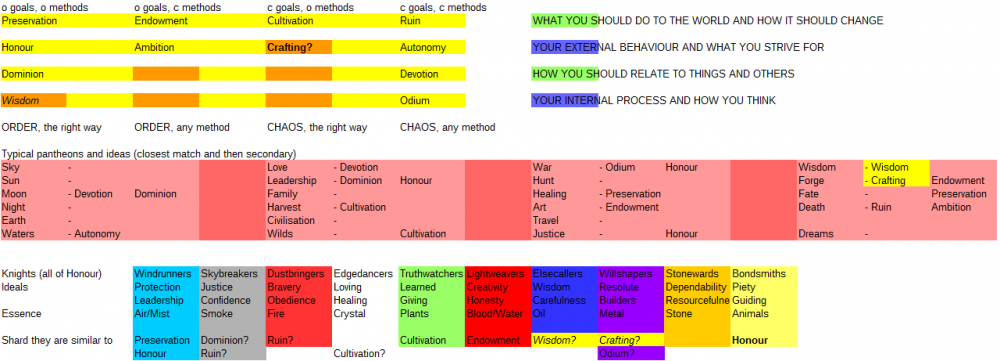
Thanks everyone :-) you are all making good points and I might need to update this chart, as well as expand on my reasoning. @Myuken I think, due to how Odium is going about doing things, that if Vengeance is a shard, and if Vengeance isn't dead or trapped in some manner, that Odium isn't unbalancing anything - after all, Odium can argue that what he is doing is punishing the other shards, so in a sense he is doing what Vengeance would try to do, which might be a problem but a slightly different one. Still, I do think some shards can have overlap in what they value or try to achieve, like Vin as Preservation valuing that life grows, which would match Cultivation. As for Crafting, that probably isn't the right name, but it mainly is as a counter of Ambition - Ambition, in a sense, is about doing anything to get ahead, while Crafting, or Creating/Creativity, or perhaps Altruism (though that might be too similar to Devotion) would focus on using structured approaches to either help others or to make things that are then free to do their own, similar to Cultivation only while Cultivation is about shaping something to help it grow, Crafting, etc., would be about making something new - in a sense to match the idea of the idea of a diety which makes things. @Jaywalk I actually intend to address that later on, but basically I think that Vengeance and Honour together represent the concept of Justice - Vengeance tied to a code - and Honour and Preservation together tie to the concept of Protection - Preserving according to a code. I think all the Knights are actually a combination of Honours ideal pointing at - not a part of, put an arrow towards the idea - the other shards, or at least ten of them. Vengeance might not be the exact right name, but basically the idea of someone who passionless seeks to keep balance, whose only interest is in making sure wrongs are righted not because they care that what is right is no longer the base, but because there shouldn't be any wrongs - someone trying to iron out wrinkles without caring, it's just a job, while Odium is the anger that there are wrinkles. @robardin I agree they aren't all diametrically opposite, or aren't all diametrically opposite, though I think part of that is because some represent concepts which typically are considered opposites but which can function together - Wisdom and Odium, for example, can be combined with a wise heart. Crafting is a slightly problematic name, but an idea similar to it is I think one of them. I agree these might not be the exact names, but I think they are close to the idea - Vengeance might best be considered Balance, or like a police officer whose mission is to keep an eye on everyone and immediately jump on anyone who tries to break the rules. Dreams and Pragmatism might need to swap places, but I think they fit the same quadrant as Wisdom and Odium, in that they are approaches to the nature of goals, either changing them or reaching for ever greater ones. Perhaps it would be better to think then of Dreams as approaching a free-form goal the right way, letting your mind sore and hold on to the right ideas, a positive upwards outlook that is directed towards noble goals while not caring where those goals lead, for example. Pragmatism meanwhile looks at how things are and wants to be grounded, so the approach adapts to the situation but remains fixed with the eyes on the ground, and so both fit in as distinct but similar to Wisdom and Odium, who are head and heart respectively, with Wisdom and Dreams striving for the future, and Pragmatism and Odium fixed on the now. I understand :-) I might not have the exact names, but I think this general approach and stance might be the right form, and I appreciate your feedback :-D -
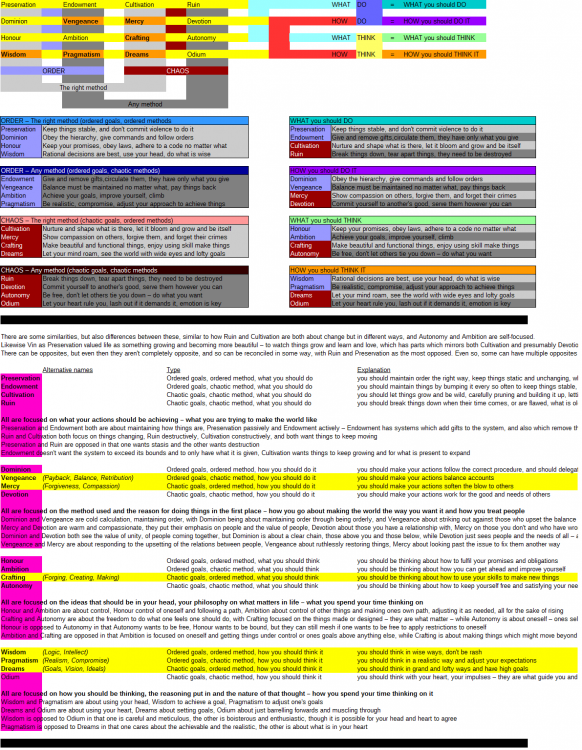
I will go into further detail in a later post, but for now, please tell me your opinion on this assessment: (Note: my initial analysis can be found here.)
-
Okay, I've finished the post, but I feel it should be its own topic, so I will link to it as soon as I have posted it. However, I will list the names of the shards I think haven't been revealed yet. Please be aware this is just speculation, and the names might be slightly different, but they should correspond to these ideas, so alternative names have also been listed. The topic is over here: https://www.17thshard.com/forum/topic/86952-i-think-i-know-the-remaining-six-shard-names-and-i-can-justify-why/ Wisdom (Logic, Intellect) Pragmatism (Realism, Compromise) Dreams (Goals, Vision, Ideals) Vengeance (Payback, Balance, Retribution) Mercy (Forgiveness, Compassion) Crafting (Forging, Creating, Making)
-
Thanks :-) I think I know, I'm making a post about it but it will take some time to get the full description of how they make sense and justifying them - they might not be the right names, and I want to make sure they are consistent, but I think they are the right ideas. The main groupings are, I think, to do with HOW/WHAT, and DOING/THINKING, in addition to ORDERED-GOALS/CHAOTIC-GOALS and ORDERED-METHODS/CHAOTIC-METHODS. I could be wrong, but I think this makes sense. I'll add more later :-D
-
Okay some more preliminary work on the shards structure: In a sense, as Autonomy is the opposite of Honour (freedom vs confinement), but the two can still be combined (free to make own restrictions), so to would Crafting and Ambition be opposites, as one is all about what one can do to make the world obey or improve oneself, while Crafting is all about making beautiful things and useful things for the world, but likewise can be combined, doing anything to make something one feels should be in the world. Preservation (a steady, straight line - hold everything steady) - Ruin (exponential decay - break things down) Endowment (keep the system stable, it must only have what you give it and what you take away) - Cultivation (nurture what is there, encourage things to grow) Honour (live by a code, adhere to laws and promises and obligations) - Autonomy (no restrictions but what you place on yourself, and even then, break them when you want) Crafting (use logic and structure to make something useful, something new, but after that let that new thing be used as it wants) - Ambition (do anything to improve yourself, throw anything into chaos if it advances your goals, and gives you control over other things) Dominion (obey hierarchy, serve those above you, command those below, and fulfil your obligations) - Devotion (love and care for others, high and low alike, and let them love and care for you - either can serve and either command, its about caring) Wisdom (Let logic guide your actions, do not be rash) - Odium (your heart must rule, must make the choices, to lash out or to be tender) Please let me know if you have any feedback! Hope your weekend is going well!
-
ThIngs you're disappointed you won't see in SA 4
Ixthos replied to Necessary Eagle's topic in Stormlight Archive
They knew their mother died before the Way of Kings, and that Dalinar burned the Rift in vengeance - if I remember correctly. What they didn't know, and what Dalinar now remembers, is that Evi actually died in the Rift, not because of it - as I recall Adolin even mentions that the [edit: burning of the] Rift was vengeance for their mother, not the cause of her death. -
Each book in the Stormlight Archive is named after a book in the setting, so The Way of Kings, Words of Radiance, and Oathbringer, are in setting writings, some more recent than others. They also cover the possibility of being book-like things, assuming Rhythm of War is the final title and it isn't a transcribed Listener song. Brandon has written parts of those books which he includes as inserts into the novels, and he knows their contents, but there is no need to write the entire books out, as that would like as long to write as a novel, and wouldn't add anything when they exist to serve the novels, rather than the novels to serve them. They mainly exist as a backdrop, source of information to the characters and readers, and are a theme for novel that shares its name. Hope this helps :-)
-
ThIngs you're disappointed you won't see in SA 4
Ixthos replied to Necessary Eagle's topic in Stormlight Archive
I'm not exactly following you. My original statement was that it would have been insightful to see the reaction of Dalinar's sons to the discovery that their dad - when he was another man - killed their mother. They almost certainly will know this before the book starts, as the book starts a year after the end of Oathbringer, and Dalinar is not likely to have kept this information from them once he found it out, especially if wrote it in a book for everyone to know. That is like finding out you are adopted in your parent's autobiography, rather than them telling you. As for the second, she wasn't a traitor - in fact, if I remember correctly, Dalinar's actions were a betrayal of what he promised and wanted to do for Evi, what he had tried to do for her prior to him being betrayed. Her actions were to try and make the option Dalinar had initially decided on to please her, and to show he wasn't a monster, a reality. She didn't betray him, she instead tried to save him and save everyone, just as Dalinar had initially decided before his offer of a peaceful solution was slapped away. If Evi had succeeded, how would her actions have betrayed Dalinar - that is, hurt him or undermined his goals, when one of his goals when he was thinking more rationally was to spare lives? [Edit:] To clarify - Adolin and Renarin, at the start of Stormlight 4, will know what happened to their mother, almost certainly hearing this from Dalinar. Thus we will see them interacting with Dalinar and each other after they have had time to think on this, rather than us seeing them being told. -
ThIngs you're disappointed you won't see in SA 4
Ixthos replied to Necessary Eagle's topic in Stormlight Archive
I'm not asserting that they won't know, I'm saying that in the one year since Dalinar learnt it he would have likely already have told his children what happened - it is the moral thing to do and he is working at being a better man - and he wouldn't have tried to paint her actions as traitorous, when he knows, and would tell them, that she was trying to solve the problem - was trying to help. -
Quick side question that I want to ask that relates to this topic and would seriously like to here others thoughts on, so I won't make a new topic for it, as it is based off of this idea. Supposing this theory is correct - do you think that the spren of the knights will dissolve into the shard, leaving only the minds of the vessels, but the memories of the spren survive in the new combined ten vessel shard but no longer be distinct individuals, or would the spren survive, buffered by the knight, making the total number of minds present twenty or higher? Or would the minds of the spren merge with the knight that they are linked to, so it wouldn't be (Dalinar) and the (Stormfather), (Renarin) and (Glys) etc., but (Dalinar-Stormfather), and (Renarin-Glys), (Kaladin-Syl-VoidsprenwhoistryingtostealKaladinfromSylHOWDARESHEKALADINISMINEMESYLNOSPRENELSEGOAWAYYOUGOLDENHUSSY!) etc.? What are your thoughts? :-)
-
ThIngs you're disappointed you won't see in SA 4
Ixthos replied to Necessary Eagle's topic in Stormlight Archive
Mistborn spoilers: :-P Tongue outside of cheek, probably Wit's early interactions with the spren - they probably have settled into a dynamic now, and not a lot of it is likely to be seen. Also the reactions of Adolin and Renarin when they first learn the full details of what happened at the Rift - we'll likely hear about it, or have them think on it, but we won't see it. Still, that last one is probably for the best. -
Fair point, though it could be the outside of this hypothetical structure is vulnerable to water (as it is the mucus lining the stomach that makes it resistant) and maybe whatever lines its inside itself is broken down by water-melted shell. Still, fair point :-)
-
To be fair, humans need several substances and elements which, if taken in excess or in the wrong form, can kill. And lets not forget, as described this makes water to the sandlings like stomach acid is to humans, and if stomach acid gets anywhere else on the body it can be very painful. Perhaps the sandlings have an anatomy which allows them to extract the water from what they eat without the water coming into contact with the rest of them? I like this theory :-)

