



ILuvHats
-
Posts
744 -
Joined
-
Last visited
Content Type
Profiles
News
Forums
Blogs
Gallery
Events
Everything posted by ILuvHats
-
Finally, it's here! I've been checking tor.com daily since April to see when it's posted. Here's a link to the cover. https://www.tor.com/2020/08/17/behold-the-cover-to-rhythm-of-war-the-fourth-book-in-brandon-sandersons-stormlight-archive/#comment-878083 I know there will be a news article, but I'm so excited I can't wait. I really love this one. It's my second favorite cover so far after WoK. WoR was too similar to the first cover in my opinion, and OB was particularly disappointing. I didn't dislike it per say, but that wall for a background in OB made the cover feel a bit too monotone, although seeing a thunderclast and Jasnah soul casting made for some epic images. The RoW cover though, it's so vibrant, and the color palette is so different from previous ones. Also, we get to see Adolin! Eeeeeeee! I wasn't sure if the cover would be of the same scene as the Bulgarian one. I was sort of hoping for a different one, just because I felt like seeing the Bulgarian cover first might take away from the novelty of the Whelan cover, but I'm finding that to not be the case. It's just so awesome seeing Shadesmar. By the way, what the storms is that monolithic structure on the back cover?
-
To be fair, they aren't mutually concept. I figure that Cultivation helped Honor throughout most of the Desolations, and if she eventually helped Odium kill Honor, it was later on when she felt there were no other options. Mmm, you're right. That circumstantial evidence goes against the theory. I forgot about that comment from Wyndle. That's a leap of logic in my opinion. The whole issue is muddled. We're still not sure what arrangements and rules governed the situation on Roshar leading to the Desolations. The Oathpact seemed to have bound Odium to the system somehow, but we don't know what that really means. So it's difficult to judge how Honor was killed, or how fully he was shattered. Also, either the existence of spren as small but cohesive units of Honor's investiture, or the fact that the Stormfather was prepared as an heir to Honor could help account for why Honor is seemingly being pulled back together by Dalinar and thus apparently less shattered.
-
I've been doing a reread of Stormlight, so of course I've been revisiting a lot of the ideas and theories that followed Oathbringer. In particular, I've been thinking about Odium claiming "We killed you" after Dalinar kind of sort of ascended. I know there's been a ton of speculation about it, and the idea in the title is not completely original. But recently, I've become convinced that it's true; Cultivation aided Odium in shattering Honor, killing Tanavast. Hopefully, parts of my reasoning are original, but I'm not well read enough on the forums to be sure. Here's my thought process. It boils down to Occam's Razor. I've seen theories about Dalinar resurrecting Adonalsium, or bringing him back together, and when he says "we," Odium is referring to the sixteen who shattered Adonalsium. I've also seen ideas that Dalinar is only bringing together the remnants of Honor, and Odium is referring to Autonomy since she/they were implied to have possibly helped him shatter Devotion and Dominion via a WoB. But these theories complicate things, bringing in beings and deep cosmere lore that casual readers have no prior knowledge of. To them, such a theory coming to fruition might feel like a sort of deus ex machina because it's so out of their purview. While Stormlight will definitely be touching on the wider cosmere more than previous series, I find it hard to believe Brandon will dive that deep into it. More importantly, we have the famous WoB stating there are only three Shards on Roshar. Simplicity demands that Dalinar is reassembling Honor's remnants, possibly reinterpreting the "intent" of the shard. That leaves only two beings with the power necessary to kill Honor in the first place; Odium and Cultivation. But, there is a lot of backlash and opposition to the theory that Cultivation backstabbed Honor, mainly because she and him (Tanavast) were romantically involved. What could drive her to such treachery, to betray one she loved? Well, how about a world that is completely antithetical to the Shard she carries. Because that was what Roshar became during the cycle of Desolations. Progress and evolution did not, could not occur among either human society nor Singer society during these wars. Civilization itself became stagnant on both sides, even regressed. Imagine how much pain it must have caused Cultivation as the world she had Invested in became in her eyes abhorrent, repulsive. And this lasted thousands of years, during which time the shard's intent slowly began to overcome the vessel's personality. Such tension likely accelerated the process, causing Cultivation become more and more a force than an individual, until she became much like Ruin was at the end; a slave to the shard's intent. After trying alongside Honor to defeat Odium for so long, it must have become apparent it was futile, and he could not be defeated. That left only one route to escape a stagnant, decaying world, and that was to shatter Honor. I will admit that it seems odd that Honor died not in the midst of the Desolations, but rather after the "final" one, during a long stretch of relative peace when society could actually grow. But even if all but one of the Heralds had betrayed the Oathpact, would the cycle of Desolations ever end if Honor still headed the human resistance? I doubt it, and think it likely the world have eventually fallen to constant war yet again. I believe that Cultivation backstabbed Honor in order to force a final confrontation with Odium. It was a gamble to lead to greater cultivation. One last gambit. Risk total annihilation for an opportunity to achieve a world that grows. So those are my thoughts. Let me know what you think.
-
It's been so long since I've read the books, I don't remember any specifics about how I reacted to events, but I remember my overall impressions. The third book was definitely kind of disappointing. The direction it went was very different from the previous two, and I didn't feel like the switch was the best executed. And not just the ending, though the ending was the worst. It wasn't as awful as I had anticipated, because some friends had ranted about how terrible it was, but it felt like a very unsatisfying and not at all cathartic death for Tris. Mostly because the death felt a bit contrived. I mean, it's not like she had no chance of surviving. She was facing a wheelchair-bound, old man with a gun. Seriously, she couldn't dive behind cover or knock him off his wheel chair? But it's definitely not just the logic of it, though I can't describe exactly why it wasn't satisfying. That comes from only having read it once 5-6 years ago. I also remember not being impressed with the prose. It felt a bit like the prose of Percy Jackson, but at least Riordan makes up for his somewhat simplistic prose by excellent character development, especially over multiple series. Roth's handling of the characters went downhill from book one, in my opinion. Book 2 was still solid, but book 1 stands out as the obvious highlight in terms of character work. A lot of the problems could be attributed to Roth's young age when she published the first book. I think she wasn't even 20 yet? But the fact I haven't heard about anything else by her makes me think she was a one-hit wonder, and I'm not sure whether her writing has improved or not. That being said, the premise of the series was very original for a YA series. The concept hooked me in book 1, and book 2 continued to be interesting, though book 3 lost me somewhere. Also, the character arc of Tris in book 1, while remaining very typical YA, was definitely enjoyable. But when it comes down to it, I think I prefer most of the other popular YA series I've read, with the exception of the Inheritance Cycle. I think Paolini is overall a better writer than Roth, but looking back, that particular series was so incredibly derivative that I don't have any desire to ever revisit it. Sorry for bashing a series it looks like you enjoyed, @Condensation. I hope you find someone else on the forums shares your passion for the Divergence. In the meantime though, if you ever want to discuss other YA series, I'm all game. Not to derail the thread, but what are your other favorite YA series?
-

What do you see/hear when pattern is on screen
ILuvHats replied to Ascended's topic in Stormlight Archive
I hear Pattern as a constant high pitched humming/buzzing. It’s more organic sounding than a phone or robot, a little like a bee buzzing except not annoying. -
I actually think it wouldn’t be too hard to write an entire season based on the first graphic novel. I felt like the story moved really quickly, enough so that it was a bit difficult at times for me to wrap my head around anything. For example, Personally, I think there are a lot of opportunities to expand on the lore and character motivation, which the graphic novel touched on, but didn’t dive into. So I’m not too concerned about a TV series as long as the effort is put in.
-
Listener Art Form progress gif
ILuvHats commented on Koloss's gallery image in Stormlight Archive Art
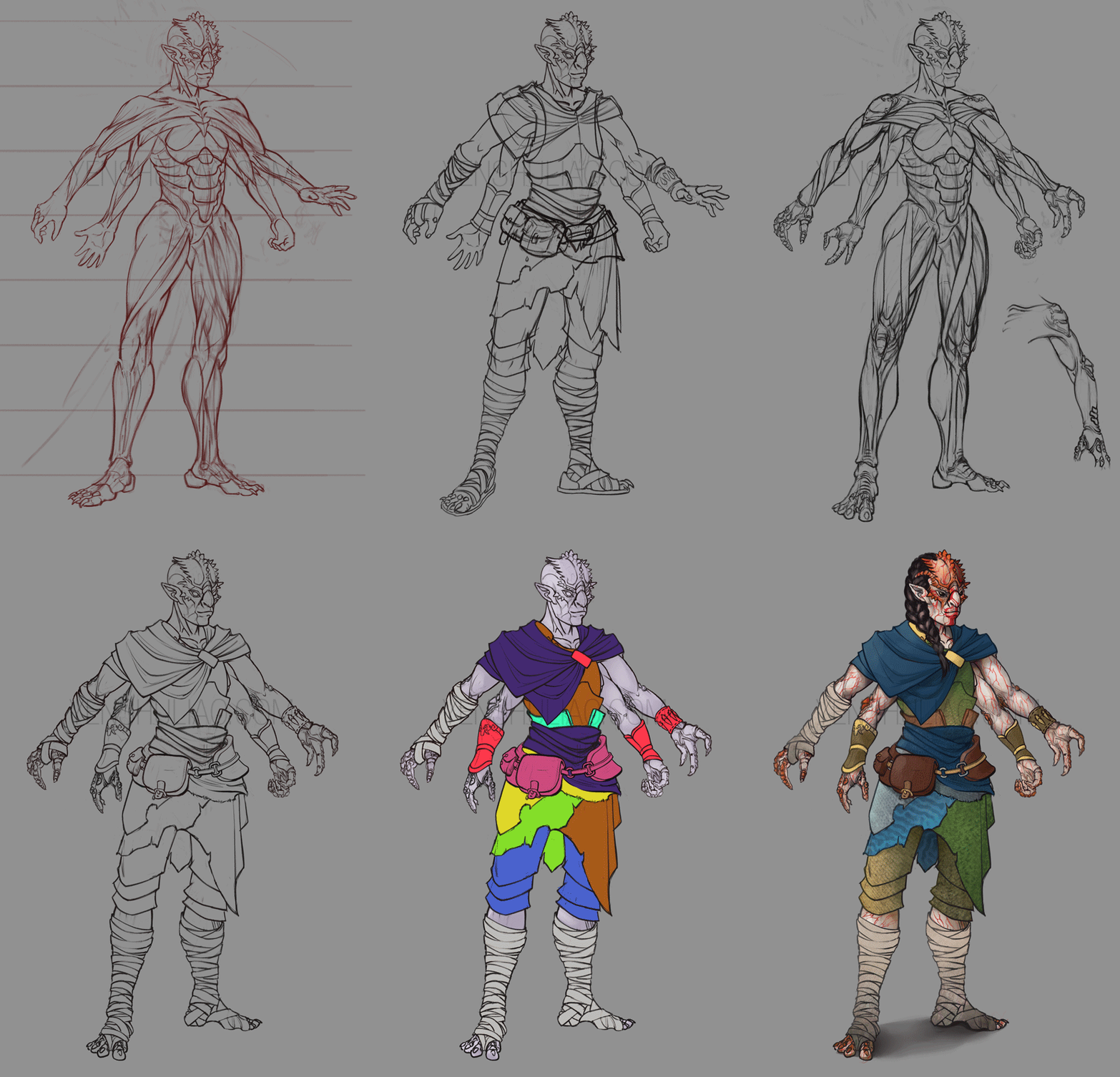 I'm confused. Why does the Listener have 4 arms?
 -
I’m a big fan of fantasy. Duh, I’m on these forums. And I like to think I am widely read, especially when it comes to modern fantasy. However, I have committed the worst crime you can in fantasy, the greatest blasphemy. I’m betting nobody else here has neglected to do the first but has done the second. I like to think I’m special that way. But I am curious how many people have not
-
I'll join as Villin.
-
Really? I won’t say I loved it, but it wasn’t nearly as monotonous as people hyped it up to be. Mostly it was just difficult keeping track of names. Reminded me of War and Peace in that regard. Also, do not read George Washington’s diaries. They sound like they could be interesting, but let me assure you, they don’t have a narrative. He barely mentions the revolutionary war, never mentions his feelings, and refers to other people only in passing. Apparently, back then, most people used diaries as a log of activities/purchases instead of personal memoirs. So mostly what he talks about is the number and types of trees he’s planted in his orchard, the crop yield of his estate, the logistics of his slaves (ugh), the people he visits (but not any conversations they have; more like “Tonight I stayed at this persons house. The next day, I stayed at this person’s house). I have no clue what Washington’s diaries were doing in my curriculum, because they added nothing to my life except an appreciation for the existence of any other type of literature.
-
WoA is generally considered the weakest of Mistborn Era 1. It definitely suffers from middle book syndrome, though personally, I never had trouble getting through it. I get why people struggle with finishing it, but for me, the pacing never felt too slow. Of course, I've suffered through some terribly boring books, so my perception of slow pacing is skewed. Ever read George Washington's diaries? It's the kind of literature that really makes you appreciate the quick pacing of the Silmarillion.
-
Reading the Dresden Files right now, and just got to book 7. It's definitely gotten better and better as the series progresses, and I'm really excited for the two books coming out later this year. I should have caught up by then.
-
The Herdazian general is actually a kandra sent by Harmony to gather information about foreign systems like Roshar. And like Azure, he decided to lead a resistance against the Parsh after getting caught in the middle of the desolation. So, when the general escapes from the hog, he’s not a budding Radiant using Abrasion to slip out of the cuffs. Instead he’s manipulating the flesh around his wrist’s and hands to make them thinner and easier to yank out. The Sleepless and Silence Montane.
-
Siri’s growth is subtle, and not the most interesting IMO. My take on her development is basically that she grew more confident, and it’s basically an un-nuanced take on the coming of age story. She’s not a bad character, but I was more interested in what happened around her and to her than in her personality or growth. Lightsong’s character arc is definitely great. It’s very original, and his charisma pulls you along even when his plot line moves slower. But it’s hard to argue that Vivenna’s growth isn’t the most dramatic, and that’s what I love about her. After the Denth reveal and she hit rock bottom, I found her chapters at least as interesting as Lightsong, perhaps more so. I always love it when a character gets put through the ringer, and it was extremely cathartic because while I sympathized with her, I also felt satisfied that her self-righteous attitude was finally shattered. The early chapters were the only ones that bothered me slightly, and Vivenna’s arrogance quickly became tolerable because a lot of action occurred during her viewpoints. I never really had trouble trudging through her POVs like it sounds like you did. I was annoyed with her, but I can deal with annoying if the people around them are interesting the plot moves quickly. In fact, Shallan’s probably annoyed me more than Vivenna has.
-
Vivenna’s my favorite character of the 4 because of the awesome character growth. Reading her viewpoints at the end is really satisfying because you know where she comes from. That being said, her early viewpoints are frustrating because you just want to yell at her fir being wrong. So I had to go with Lightsong for having the most well rounded viewpoints in terms of how engaged I was.
-
There’s a Writing Excuses episode about pitches at well. You can find it here.
-
Well, as far as I’m aware the highstorm functioned the same before Honor’s death as after. People always infused gems by exposing them to the highstorm. So there doesn’t appear to have been any observable change to it when he was splintered. It’s possible that the amount of stormlight “carried” by the storm became somehow greater, but we have no reason to think that, no evidence. And spren are mostly in the cognitive realm, not the physical.
-
Well Odium has specific reasons for no longer doing that. Spoiler for length. I’m not sure how that WoB addresses Elsecaller_17.5’s point. Yes, Odium used a different method to splinter Honor than D&D. But, if I understand correctly, your theory only allows for 2 methods of splintering. You can shove a shard’s investiture into the cognitive realm and get a situation like Sel, or you can shove the investiture into the physical realm. And I think it’s pretty clear neither of these situations occurred when Honor was splintered. Roshar’s cognitive realm is obviously not like Sel, and if the investiture was dumped into the physical realm, there would probably have been massive ramifications that were easily observable. Honor’s death seems very quiet since no one noticed, which makes me think his investiture, while splintered, is still mostly within the spiritual realm. It’s possible some huge event did occur when Honor’s investiture was stuffed into the physical realm, but since nobody could explain the event, the connection between the two was never made. For example, Honor’s splintering could have caused the Scouring of Aimia, which we have yet to get an description or explanation for. Actually, I kind of like that idea. I’ve always assumed Honor’s death occurred shortly after the Recreance and the Scouring happened in more recent years, maybe a few centuries ago. But the timing for each is left very ambiguous, so who knows, maybe the two events did coincide.
-
Wondering about the future of Fantasy
ILuvHats replied to Frustration's topic in Entertainment Discussion
The way the question was phrased, I had to answer no. I don’t think we’re going to see more and more technological progress in fantasy series themselves because it’s hard to pull off. Most universes that show progression include multiple series to make the necessary time jumps more palatable. That’s the case for Mistborn, Legends of Korra, and since nobody’s mentioned it yet, Abercrombie’s First Law universe. I think such in-world progression will remain relatively rare because of the commitment the author has to make to that single world. Rereading your question, I think you were just asking if we’d see more fantasy worlds with more advanced tech than the traditional medieval setting. And the answer to that is definitely. However, I think the term diversity is more appropriate than progression. Fantasy used to be very cut and dry as in there was medieval, Tolkienesque fantasy, urban fantasy, and very little else. In recent years, we’ve been seeing a lot more variety in the fantasy genre. This includes a rise in flintlock fantasy as well as non-European settings, notable The Poppy Wars or the Rage of Dragons. It’s less a matter of progressing though and more so diversifying. -
Since it seems like you read the article, I'll be using some of the terminology from it. Molten metal is something I've thought about. It's a technical difficulty that could be overcome by ensuring the applied voltage is distributed enough to trigger almost all of the metal (copper's the metal replacing gunpowder). Just as a reminder, materials convert directly to energy upon being triggered, so depending on the distribution of the voltage there could be virtually no residue. There could also be mechanisms designed to eject remaining molten metal, though this feels more problematic. Either way, it's possible to overcome this problem. The guns might have to be cleaned out a few times a year, but not that much more than normal firearms. The metal oxide doesn't react to the applied voltage, so it won't be turned into energy like the metal is. However, it forms in very thin layers. To be precise, CuO forms in layers 10-50 nm thick according to a quick google search. I don't think it should accrue significantly. Sure, but there's a delay to the explosion of biological matter which is hard to predict. Accurately determining the time it takes for the UV radiation to diffuse and trigger an explosion is extremely difficult because it depends on so many variables; the mass, density, and type of wood, the amount of sunlight it's receiving, and the slight differences between magic users' power level. Yours only option is to immediately fire the bolt, in which case you'd shoot the bolt, then have to wait 10-15 minutes before it blows. Not terribly useful except in a few situations. You could decrease the wait time, but at the expense of the explosive power. Metals have problems because people don't have the technical knowhow to cause an electrical charge to be applied upon impact. Dry cell batteries don't even exist yet, and there's no way wet cells could function after being catapulted. The only material that lends itself well to explosive projectiles are ceramics, and there are technical issues ensuring the initial blast doesn't cause it to explode but the impact will. More importantly, the ammunition has to be prepared shortly before being fired since ceramics lose their ability to explode a few hours after being Primed. So, a magic user needs to be on site and able to operate these weapons, which is inherently limited by the rarity of magic users. Explosive projectiles will be limited to hand-held weapons operated by magic users or large siege weapons with a magic user on site. They will exist, but trebuchets/cannons with a non-explosive payload will be more common (while still rare). Again, thank you a ton for your feedback regarding air rifles. I'd completely forgotten they existed and have been weaponized since the 16th century if I recall correctly. Bows vs guns was probably too much of a stress, but pneumatic firearms vs explosive magic tech feels much more natural, and the second could naturally develop from the engineering already done to develop the first. Plus, the tech difference still reflects the cultural one like I wanted. One last thing; I don't know if you saw me edit my reply to your first post, but do you have any thoughts on upscaling pneumatic weaponry to artillery?
-
Sorry for not explaining the magic system, but this wouldn't exactly work. If you want to check the system out, you can do it here. And anyways, Oltux has basically convinced me to make it a matter of pneumatic weaponry vs magic-based gun analogs. It seems a lot more realistic, and wouldn't be as hard to figure out the warfare because it's more similar to real life wars. I guess I wasn't as committed as I thought to the bows vs guns narrative.
-
Shoot, you’re right. I’ll have to rethink a lot of stuff. So now I'm wondering whether pneumatic firearms could scale up to artillery. My gut instinct is no, or at least not efficiently. If that's the case, then castle-style fortresses would never phase out, as you pointed out.
-
I totally agree with your points. Guns without rifling have horrid accuracy, and massed gunfire is your only option. However, as I’m sure you’re aware, massed gunfire is terribly effective at mitigating the inaccuracy of the weapons. When two large groups of people are just shooting into one another, accuracy doesn’t matter that much, and the effective range of the muskets will essentially be their full range. Guerilla warfare definitely favors bows, and I definitely want to create a situation in which guerilla tactics are used a lot. However, the war I’m envisioning is massive, like a miniature version of one of the world wars, involving many nations. And such a war has to be executed on a massive scale which limits guerilla tactics and favors the side with guns. In fact, it’s not even that I’d want such a war to occur in the story; it’s simply that with the technological difference, it’d be unrealistic not to have a war. If the side with guns knows how great an advantage they have, they’d invade in an instant. The state I want to occur is something like the Cold War where both sides are equally matched, so nobody wants to make the first move. Obviously not as stable as the Cold War (if you could call it that) because there’s no MAD, but you get my point. Thanks for the suggestions. The magic system doesn’t really interact with the guns/bullets beyond allowing them to function in the first place, and I’m not interested in changing morphology. But enhancing the arrows with a fantasy toxin that is cheap, mass-producible, and rapidly lethally would have interesting ramifications. For example, you could scale down the size of the bows since impact energy doesn’t matter as much; as long as the tip reaches blood, it doesn’t matter how deeply the arrow pierces. The arrows would become smaller and repeating crossbows would even become possible. I’lol have to think on it more.
-
I've been thinking of a world where gunpowder doesn't exist for mysterious reasons I haven't worked out yet. Some cultures have developed firearm equivalents using magitech, but other societies still use crossbows and bows because they aren't cool with magic users, to put it lightly. So you see the problem. If I want these cultures to come into conflict, how do I level the playing field? First of all, the world is at the peak of an industrial revolution and generally its technology and societies are roughly equivalent to the late 1800s to early 1900s (pre-WWI). Also, I've messed with the history of science so that plastics were invented a hundred years before they should be according to our timeline, so around 1810. Since plastics are established and mass produced, compound bow weapons are on the table, making these weapons more advanced than the medieval versions. Meanwhile, the guns aren't up to modern standards and have only been recently invented (the first prototypes began to occur around the invention of plastics). However, the timeline of gun technology has been rapidly accelerated thanks to industrial machining processes and a society with a higher standard of living. The current firearm technology is somewhat comparable to the early 1800s. Automatic and semiautomatic firearms don't exist, and handheld weapons are limited almost solely to magazine fed muskets and pistols. I won't go into details about the magical mechanics, but essentially a small electrical charge can be applied to generate an explosion as powerful as gunpowder. Solid cell batteries aren't available yet, so miniature-sized electrostatic generators are built into the guns, making them bulkier and heavier than their 1800s analogs. The electrostatic generators have to be manually charged between each shot, which takes a few seconds. Replaceable magazines are common since the magic system lends itself to such technology, but circular bullets are used instead of modern, conical ones. In addition, barrels are smoothbore instead of rifled, which means the bullets don't spin as they leave the barrel and accuracy is greatly reduced. Cartridges are the standard but they're also slightly bulkier and heavier than gunpowder equivalents, so magazines are limited to 6-8 rounds. In summary, the weapons have the accuracy of American Revolution era muskets, but with a rate of fire of 8-10 rounds a minute, so a bit slower than the repeating rifle introduced in the civil war. For comparison, American Revolution era muskets had an approximate fire rate of 3 rounds a minute. Furthermore, the rifles and pistols are both heavier and bulkier than any analogs. Ah yes, and cannons exist which are powered by wet cell batteries, although they're muzzle loaded and not breech loaded. They're also exceedingly rare, so when you're comparing the power level of weapons, focus on the handheld ones. As you can see, I've thought a lot about the guns and not so much about the bows/crossbows. The existence of compound bows helps level the playing field since it makes the bows more powerful and increases the range, but they're still at a huge disadvantage. As I described them, guns take less training to use effectively, have a greater range, have MUCH more compact ammunition, and can fire as fast as a trained bowman and twice as fast as a crossbowman. The only advantage bows and crossbows have is that the user has much greater control over accuracy. I really want to increase the power level of the bow weapons instead of nerfing firearms, but I can't think of any major improvements myself. I'm sure if bows were the primary weapon of choice instead of guns throughout history and polymers were available for constructing compound bows, people could have made them much more powerful than they are today. So if you have any ideas for mind-blowing improvements to bowed weapons, no matter how theoretical, I'd love to hear your suggestions. Also let me know if you don't think it's possible to bring them to a level equaling guns as a I described, and how much you think I'd have to nerf firearms for them to be approximately equal.
-
TOP 10 Reasons the COSMERE should be Animated
ILuvHats replied to prayingforsuperpowers's topic in Cosmere Discussion
Now all we have to do is get some cosmere mangas or light novels written, and then we’ll get our anime . In all seriousness, Japan’s entertainment industry is too insular for anything like this to happen. The success of webtoon anime adaptations like Tower of God could pave the way for an anime industry that draws more on foreign stories, but it could still be decades before western fiction begins to merge with Japan’s fiction. We can always wish though.
