



Treamayne
-
Posts
5390 -
Joined
-
Last visited
-
Days Won
9
Content Type
Profiles
News
Forums
Blogs
Gallery
Events
Everything posted by Treamayne
-
But Kaladin re-oathed on-screen, not off-screen: I believe you don't necessarily have to verbalize them to re-oath, you just have to rededicate yourself to the oaths you have sworn. In recalling them and realizing why they mattered to his decision and making the decision that aligns with the oaths he met the requirements to make the third oath. As for Shallan, it would likely be different. The "truths" of her childhood would not necessarily be the truths for her now. She had to have been at least 3rd ideal to kill her mother so her mother's death could not have been a "truth" that won her the third ideal as a child. Having lost all the ideals except the first because of the trauma of killing her parents, she had to recognize new truths about herself to reclaim the ideals.
-
The linked examples. In the first case, it's almost a direct quote: As far as pronunciation indicators, I think we are reading the same section very differently. Having studied Chinese, Korean and Japanese (and having lived in Korea and Japan), I read this: As "Sas" being in common with his own brand, but "Morom" would have to have a pronunciation indicator. At least, it makes no sense to me that a surgeon's apprentice with an incomplete indication would have all of the highlord district glyphpair's memorized. It seemed more likely that he knows it is a highlord glyphpair due to context, he kno's "Sas" because it is in common with his own brand, and he can guess "morom" due to indicators.
-
This still seems slightly off when compared to the Bridge Four tattoo scene: That scene, when combined with the image between chapters 4 and 5, always seemed to me that since Kaladin learned to read glyphs during his surgeon's apprenticeship that he was able to make the tattoo because there is readable content. This makes me wonder if the "internals" of a glyph are like radicals in Chinese. For example: Dragon (long form and Short form) 龍 -> 龙 And, evolved over time: So, I wonder if it is possible that elements of the internals are what are recognizable and indicate pronunciation and/or meaning. There has to be some standardization if Sigzil could take notes with glyph numbers and Kaladin could stylize Freedom, Kholin, 1173, etc. based off of what his parents taught him. Actually, thinking about it, there seems to be disconnects with other examples of books being read. So, they are memorized more than read; but there seem to be components to "look for" that can indicate meaning or pronunciation. At least that's what I get out of all of this.
-
Awesome post, thank you for sharing that. If he meant related in the standard lingual anthropological sense, then it will be Grammatically related. Many related language families will share an alphabet (Spanish/French/Itailian, Farsi/Pashtu/Dari, etc) but many will also not (Hindi and Urdu, when spoken are called Hindustani and are nearly identical, but use completely different alphabets; Korean and Japanese are related and grammatically similar, but also have very different alphabets and even use their Chinese character loan words differently). What really ties a language family together is the grammar structure. For example, there has been a lot of vocabulary exchange between Chinese and Korean/Japanese; but they aren't consider related as the grammar of Chinese is completely different (despite all three langauge writing with the same/similar logographs, if not exclusively, and sharing related vocabulary). Here is an Ethnologue Hebrew Language tree example to show how related languages can be mapped backwards to common ancestors.
-
That's possible. While I agree the Alethi Glyphs are probably phonetically derived, I think it is more likely that the glyphs and Thaylen alphabet have a common ancestor (I'll call Dawn Script for now, based on the Dawnchant even though the books seem to use Dawnchant for both spoken and written). So, if Dawn Script was an alphabetic system (Abjad, Abugida or even possibly a Syllabary) then it could feasibly evolve in different areas into the phonetic glyph system(s) (Alethi and Veden if they are different) and the Thaylen Abjad and possibly other writing systems.
-
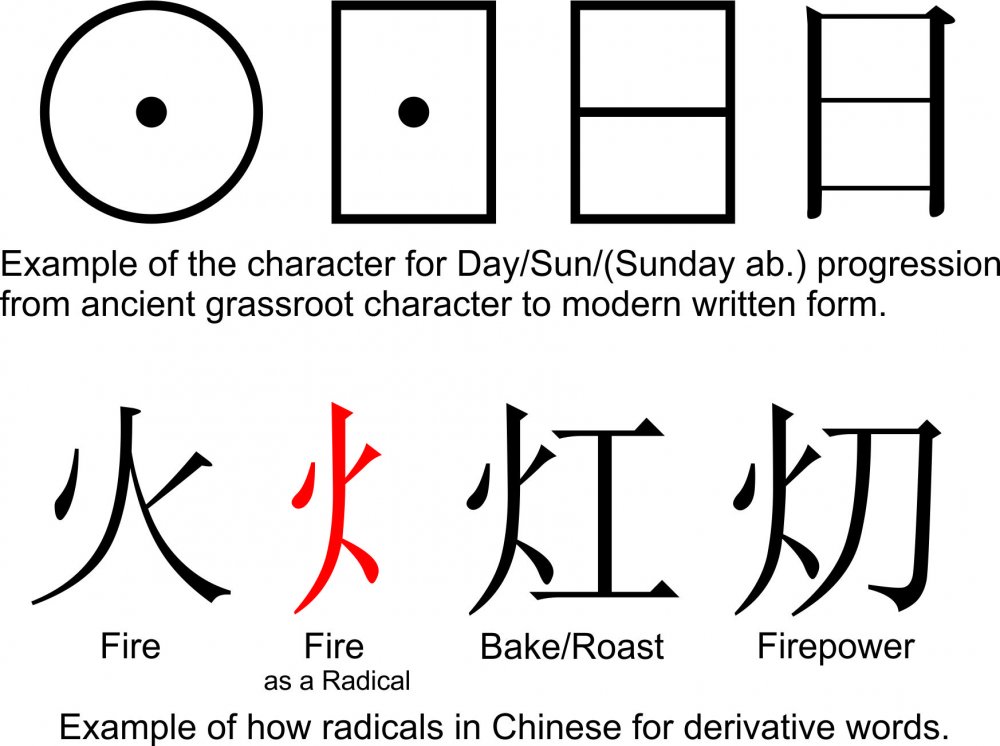
It really depends on how much was borrowed from both real languages. So far, it seems that at one point Alethi glyphs did grow from an alphabet of some kind, where Chinese never had an alphabet at all. In the attached examples, you can see how the grassroot character for "Day" started as a graphical representation of the Sun (circle with a dot) and evolved over time to the modern version. In the second example, I show how the character for "Fire" is also a radical (principal component of a character, many Chinese/Hanja/Kanji dictionaries use Radicals for how you look up characters and words) and that radical is used in building related words. So, in Chinese, if you know the radicals you can sometimes guess, if not the meaning, then at least a relation to a word bearing that radical (though some relationships are quite disparate, such as "Troublesome" uses the fire radical). If the same has been applied to Alethi, then the glyph derivation could be based on meaning. However, if Alethi is a progression from a root alphabet, then it is more likely pronunciation/phonetics derived. Either way, the average Alethi (non-historian) just has to memorize the characters and meanings, much like learning modern Chinese (and anybody that knows some Chinese that tries to read Calligraphy understands how difficult it can be to discern stylized characters). With Korean, King Sejong commissioned the Korean alphabet to be developed based on science (consonants were developed based on the mouth and tongue positions used to say that letter) in order to increase literacy for the masses. Korean has a mix of native words and Chinese-derived (called Sino-Korean), but if you know the Sino pronunciation of a Chinese character or can read some characters, you can usually pick it out of Korean language text solo or in compound words/characters (Examples: day = il (일) and tomorrow = nayil (내일) - or - day/일 = 日 and tree/목 = 木 then East/동 = 東 = Sun rising behind a tree ) I would like to think that Alethi is alphabet derived, and the pronunciation can be guessed it. It would make sense with why glyphs like "Book" are stylized to look like a book if the original was never originally based on the a stylized meaning (like how some Chinese is). I apologize if any of that only makes sense in my own mind.
-
I never viewed those lines through the middle as a connections between orders on opposite sides of the chart (e.g. Windrunners/Lightweavers). I always saw it more as all ten orders converge on the center of the chart. The connections between adjacent orders, always seemed to me because of the shared surge rather than any underlying character or order affiliation/animosity. The only connection lines that did not seem to have an immediate basic reason was Windrunners > Edgedancers and Lightweavers > Stonewards. Interesting theory though (despite that version of the chart showing Dustbringers as Releasers <grin>). The flaw, to me, is in all these connections you make for characters, would imply that connections lines are missing. For instance, with your reasoning above, I would expect a connection between Dalinar and Jasnah, but there isn;t a line between Bondsmiths and Elsecallres.
-

Shallan's drawing of Shalash - similar thing with Syl...?
Treamayne replied to Oversleep's topic in Stormlight Archive
True, but Syl wasn't in the scene with the dream about riding the Highstorm. She doesn't show up until after Rock shaves him in the riddens. In the second dream (WoR, Ch 32) the Stormfather is telling Kaladin how he will betray Syl and kill her and he gets a visions of the Everstorm, Could that one be "involving Syl" enough? The second dream, at least, is a prescient vision rather than a remote viewing of something currently happening. Which begs the question of whether Shallan's drawings were happening when she drew them, or visions of something past or future. -
Shallan's drawing of Shalash - similar thing with Syl...?
Treamayne replied to Oversleep's topic in Stormlight Archive
Except, didn't the referenced WoB say to watch for something similar happening to Syl? So, shouldn't we be looking for an event where Syl "knows" or "sees" something she normally shouldn't? Possibly when she references the red Lightning spren -
The "but that night did present a different stratagem, related to the unique abilities of the Bondsmiths" seemed to imply while dreaming to me. I agree. More specifically, I think Dalinar (and possibly Gavilar before him) in reading Way of Kings, thinking on it, and reciting it stumbled upon the first Oath. Being a proto-radiant, for a while now, was how he was selected by Stormfather to receive the visions (since we don't know specifically why he was chosen for visions). We also know that Kaladin and Shallan both glimpsed Shadesmar when first "unlocking" conscious control of their surges (Gravitation and Transformation respectively). I think the dream was a Bondsmith-style foresight glimpse of Shadesmar that he would progress with his Oaths and be able to surgebind.
-
Favourite Stormlight Archive qoute
Treamayne replied to Asasasyn in White's topic in Stormlight Archive
On the less-obvious humor side, this one tickles me. Not so much a quote of characters speaking in-story. Just a good quote from the story (during the Full Disadvantage Duel) -
Favourite Stormlight Archive qoute
Treamayne replied to Asasasyn in White's topic in Stormlight Archive
Here's the line (last line, WoR, Ch 85: Which is echoed again in Ch 86: One of my favorites was Syl, fighting for Kaladin: Another favorite from Syl was: But, really, for me it culminates in this: -
a few nitpicks on roshar's physical characteristics
Treamayne replied to king of nowhere's topic in Stormlight Archive
But we do have possible evidence that the circumference of Roshar is smaller than that of Earth. In one of the highstorm threads: -
I'm not sure that's true. Shardblades are sized for fighting Voidbringers and <Warbreaker Spoilers> So, most likely, Nightblood is thinner than the average shardblade, but not necessarily smaller overall.
-
I'm not sure that's obvious. I think that is what Dalinar thought (and what BS wanted us to believe at the beginning of WoK); but I think Gavilar really wanted his brother to discover the Oaths. Some of the Sphere threads: here, here and here.
-
Frost from surgebinding doesn't have to be the KR transitioning; it could simply be the Spiritual power of stormlight. In my mind, the effect is so small, though, that it would take excessive amounts of stormlight being used for frost to form (which is pretty much what happens). If this is the case couldn't the "misting" off of stormlight from a KR's skin just be the physical manifestation of stormlight returning to Spirtual?
-
I doubt it was similar to Elsecalling. When we see Jasnah appear, it is in a swirl of light and without condensation (or at least none is mentioned). However shardblades (and possibly Taln) appear, it is different from the way an Elsecaller steps from Cognitive to Physical. M:SH Spoiler: The description implies heat and light. If heat/light is a consistent theme of transition from Cognitive to physical, is it possible that mist/frost is transition from Spiritual to Physical?
-
I'd imagine the champion Dalinar tried to ask about (without a reply) will play a big roll in his activities as well.
-
Wasn't Syl already with him when he defeated Shallan's brother (even if he didn't know it). I think his early aversion to Shards (plate and blade) were because of: 1) The burgeoning Nahel bond includes an aversion to dead shards. 2) He knew taking the blade and plate would make him a light eyes, something he disliked when he turned down the shards in Amaram's army, and couldn't bear the thought of after what Amaram did to him and his squad. Neither of these precludes character development as he and Syl explore their bond and he says more Windrunner Oaths.
-
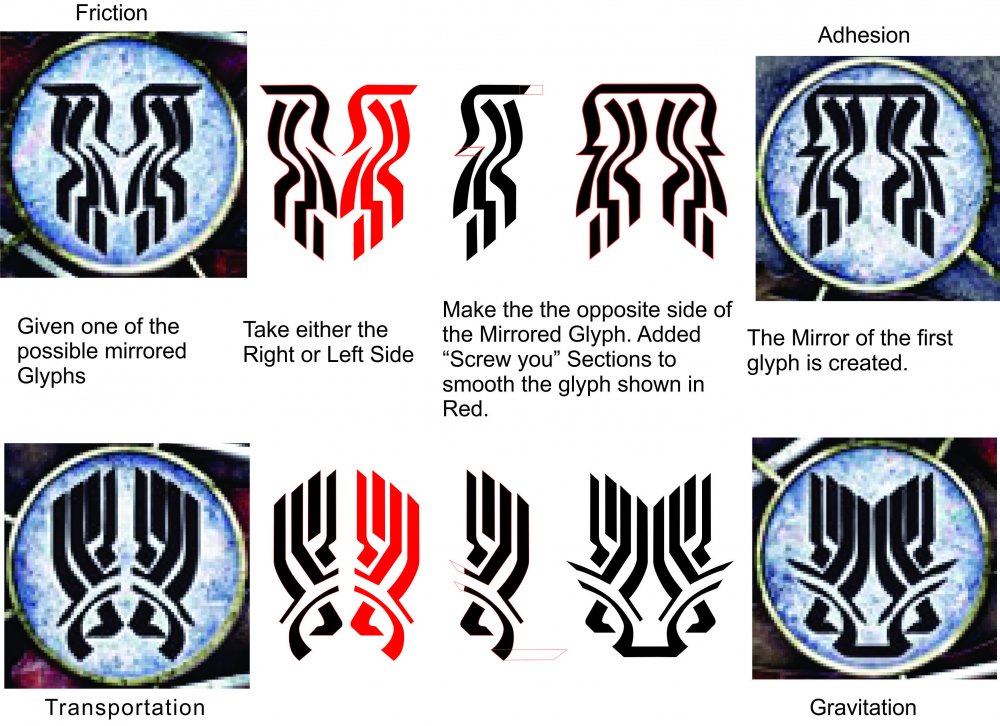
But, could the connections also be based on "type?" Gravitation and Transportation are both "movement" based surges. Friction and Adhesion are similar as well (maybe closer to opposites) and seem to manipulate the same "force" (one to prevent two surface from moving next to each other, one to ease the same movement). If this is the case, I'd probably expect some kind of relationship between Growth and Division (not that we really know what Division does yet). If the remaining pairs are a "mirror plus" conversion, I can see a possible pattern in Cohesion/Illumination* where the top of cohsion is the bottom of illusion (gaining curves for elegance) , the bottom of cohsion is "mirrored" to the top of illusion (straightening curves, same reason maybe). Then illusion adds one element to each, the outside swirls on the bottom and the extra "L"s on top. That may be a stretch thouhg. As soon as I have time, I'll work up a step by step of the possible metamorphosis. * possible relationship in that Cohesion seems to change physical objects - like the hand print in a table example - where Illumination makes ephemeral "changes" via illusions.
-
So, it's been forever since I had time to review and work on my idea (been working midnights all summer, no internet at work). What I alluded to above was that I think I found two pairs of glyphs that are "related;" in that they seem to be mirrors of each other. The remaining six do not obviously follow the same pattern, but it makes me wonder of there are thre more pairs with a different or similar relationship. Anybody else see connections like this among the Glyphs?
-
I'm not sure this is the case. For one, we haven't seen Dakhor's use inside Fjorden's borders to compare with it's use in Arelon and Teo. Also, I think it's partly a difference between active and passive abilities. As I recall, Raoden didn't lose any speed or strength by being in Teo, so teh passive augmentations of being an Elantrian were unaffected by distance (Ch 62) It seems to me that many (if not most) of the abilities in the Dakhor monks are passive augmentations. Speed, strength, etc all seem unaffected by distance for either side. Also, note that Dilaf's resistance to Aons seemed unaffected by distance, but Dilaf was able to cancel the illusion at the wedding from a distance, but he touched the barrier in Teo to cancel it. We don't know if contact with the barrier was required, but we do know he was not required to touch the illusion in Arelon (which is closer to Fjorden). We haven't seen very many active abilities in Dakhor, where most abilities in AonDor seem to be active (draw an Aon to channel the Dor for an effect). Even if the physical augmentations of Dakhor are partially active (due to the bone "symbols" drawn in flesh) we don't know how effective they are in Fjorden to compare to how we see them in Arelon. As far as sacrifices, there seems to be a mismatch. Abilities such as Dilaf's resistance appear to be a permanent mutation based on a single set of sacrifices (50 in this case) to enable the change and make a permanent ability. However, teleportation seems to require a sacrifice for each use. Does this mean any Dakhor monk can teleport, given a willing sacrifice? Do only certain monks have the ability to guide a teleportation, but each use require a sacrifice? I think there just isn't enough information on Dakhor to know.
-
When reading the book, it reminded me of the bit of RPG work I did in COBOL I back in the late 80s/early 90s. Not so much the RPG programming itself, but the UI for the projects we worked on that resulted in output based on how input was modified by the user. Almost similar to many Access databases in businesses 5-15 yrs ago, it's set up for "provided input a,b,c... results in x,y,z." You can also think of it like Madlibs, give a list of input (words/modifiers) and what you use determines what you get.
-
You would probably need something more specific that just Elendel, like the tomb for Vin and Elend. Also, since we know Sazed (Harmony) moved everything when he first took up the shards (he moved all the Cache locations to the same basin so the survivors would all be close) are we even sure of the new location for the original WoA? We saw the new Pits in SoS IIRC, but I don't remember a reference to the new Well location. Alternatively, Harmony's well could be in the Northern roughs, amongst the Crags that used to be the Terris homeland.
-
I was really hoping for a POV break on the Space Station. Just a paragraph or two from Megan or Prof on what they saw in the sky as Calamity's red light went out, then saw the start (and aborted stopping) of a nuclear detonation where Calamity should be. That said, I think I am mostly satisfied. I think the biggest hanging question in my mind was why/how David dreamed Larcener's nightmares. I expected it to be part of his "thematically appropriate" powers (which I originally thought would be appropriate because of the Epics he has killed... a way to discern the fears of others, or possibly cause/transfer them.Basically an Epic that's a predator of Epics), but that idea was crushed when he became Steel Slayer (with abilities similar to Steelheart). I read Calamity ending as if he was either 8 yrs old (or one of my Co-workers), as if saying something over and over would make him right. Then, I interpreted the very abbreviated Goodbye as him being recalled by his people/bosses (poss. against his will) once he subconsciously accepted his mistake. I also thought Brandon left the ending as open as it is so that it was defined by reader interpretation. If you go back and (re-)read some of the classics (e.g. Fahrenheit 451, Robots of Dawn, etc) they rarely have cut-and-dry endings and allow the reader to consider multiple paths for the characters to continue with. This felt similar, many implications with few definite paths forward.

