



Treamayne
-
Posts
5390 -
Joined
-
Last visited
-
Days Won
9
Content Type
Profiles
News
Forums
Blogs
Gallery
Events
Everything posted by Treamayne
-
If not Peace Talks (depending on how far through completion it is) , then Cinder Spires 2 is possible.
-
 Yes, Prof says after Calamity leaves that the orbit has been degraded and that only Calamity kept the ISS from re-entering the atmosphere. My impression was that Calamity put it in a Stationary position on Earth's Dark Side (so it was always visible at night and hidden during the day - Obliteration mentions that he must charge the bomb where Calamity can't see because he hasn't "risen" yet. This also jives with Calamity's nightmare aversion to "Loud" and "Bright"). Combined with the change to glass and his own glow the result is as you see through the books. Also, with no orbital velocity, it would degrade and fall into the atmosphere rather quickly (sans Epic interference).
 -
Or Worldsingers. Given that Mistborn is a while before current SA, could be he was developing the idea of one from the other.
-
[Secret History spoilers] Did we just get another Shard named?
Treamayne replied to PallonianFire's topic in Mistborn
Luck as a trait has a fair literary history. Example: Correia's Grimnoir series features luck magic. Ringworld also dealt heavily with luck as a trait. So it is possible that, in the Cosmere, Luck is a trait and there could be a Fortune Shard because of that. That said, having it in the same Feruchemical "group" as Connection, Investiture and Identity, and knowing that those three traits are world/shard generic, seems to imply that Fortune is a trait that everyone on every world can/does have and that the trait can be manipulated by magic systems. If you take the quote and replace "Fortune" with "Investiture" or "Connection," for example, it would make sense that the feared unknown "intruders" would be using some magic system to manipulate a spiritual trait. So, I think, Fortune is another spiritual trait that is largely untapped, but can be manipulated by some magic systems (including Feruchemy) but that the Ire were not necessarily talking about Chromium Feruchemy specifically. Has anyone made a timeline of how far after the events of Elantris this would have taken place? It seems it would have been difficult to impossible for the Elantrians to have studied Scadrial enough to know much of Feruchemy (when TLR had all but wiped it out at this point) unless they had been studying it prior to TLR's Feruchemist purges. It would seem the chances of that quote being a Feruchemical reference are rather slim. -
SH does mention, at the Inquisitor funeral, that the spikes are removed and stored in blood so they lose less charge and can be granted to other Inquisitors. Also, wasn't it also implied in WoA (when Marsh and Sazed go to the Inquisitor temple) that spikes were re-used there? I'll try to look up the actual references when I can next get to my eBooks.
-
A reading order (minimum spoilers)
Treamayne replied to AlluminumMisting's topic in Cosmere Discussion
I'm not convinced there is one good answer. I think a recommended reading order really needs to take the preferences of the person to whom you are recommending into account. Amongst a few friends, to one who preferred more cerebral fiction, I recommended starting with Elantris and Warbreaker (first two, in either order, depending on which synopsis sounded more enticing). Another friend that I know gets bored without an action driven plot (until hooked) I recommended starting with the Mistborn Trilogy. Another consideration is that Alloy (and the Scadrial second Trilogy) should be far enough after Mistborn that they are ready for the huge amount of change. A few years back (2013) a coworker read Mistborn first (and loved it) but went straight into Alloy of Law. He gave up half-way through and never finished the book or continued with other Brandon books.The change from the Final Empire setting was too drastic and he wasn't invested in the Cosmere enough to keep his interest. -
Mistborn vs Knight Radiant also seems to me as something of a false comparison. As far as we know there is no way for a KR to access all ten surges, so a fair comparison would likely stop at Twinborn (two abilities compared to two Surges). Do we have a WoB that a Nicrosil Compounder would be as powerful as this discussion makes it seem? Otherwise, I would think that a Nicrosil Twinborn (N Ferring + another Allomancy ability) would likely be better in a fight.
-
Well, that would beg the philosophical question as to whether Honor is related to - or - independent of the traits Good and Evil. Is Evil inherently dishonorable? Can a being be both Evil and Honorable?
-
Edit: Random double post. Sorry.
-
In the interest of completeness, are we sure Ym was stabbed? IIRC, as a Truthwatcher his other Surge will be illumination and everyone assumes we never saw him use it. Just because Shallan has to draw to use Illumination, doesn't mean everyone has to do so; especially if it's a different Order's use of a shared power (Jasnah's use of Soulcasting sure doesn't look like Shallan's from the outside).
-
If the collection date was Tanatanev 1173, wouldn't that put it before Lopen joined bridge four? So, even if it was a cousin, it would not have been one we met on page.
-
Re: Taln's possible blade(s). Earlier people were remarking on how ornate Honorblades (including Szeth's) are, but the quote in the prologue doesn't really say that. We know they are "works of art" and have a "flowing design" but that does not imply "ornate." A Katana from Feudal Japan is likely a work of art, but not necessarily ornate. A Ghurka can be considered to have a flowing design, but also does not imply ostentation. I would agree they are likely stylized (the inscriptions imply as much) but I don't think they would be as elaborate as I inferred from the descriptions earlier in the thread. Do we know for sure that the second blade Dalinar bonded really came from the Madman known as Taln? We know that's what he told Amaram: But it seems just as likely that it was one of the Dual-won Blades that was used for the ruse. Especially if the Madman's blade had had no gem and Dalinar did not want that revealed. Civilian Airliners typically fly FL350+ (35,000 ft Mean Sea Level) when transiting more than 2 hours. Small Passenger Aircraft (like B350 King Air have a service ceiling below 30,000 ft, and more commonly fly around 20,000 ft MSL. They are generally undetectable by the unaided eye at those flight levels. With moderate humidity (causes haze at altitude) and or cloud cover, they are generally not visible at 12,000 ft. UAVs, which range from about 2 ft to almost 30 ft in length, are generally undetectable by the unaided eye at 6-10,000 ft. Especially without auditory cues. Air pressure is such that unpressurized aircraft do not require supplemental oxygen for passengers at 10000 ft (when over 10k ft, supplemental oxygen is required and the time of useful consciousness decreases exponentially with each 1000 ft of altitude). In the final battle, we know Szeth and Kaladin got above the cloud tops, which for a normal thunderstorm (and this was a Highstorm) can be anywhere from 15-35,0000 ft MSL; but I would say it is often 22-24,000 ft. Terminal Velocity of a skydiver in freefall is about 195kph (120 mph) when splayed with wind resistance, and can reach over 320kph (200 mph) when arrowed forward, limbs tucked to reduce air velocity. So, with a single lashing and assuming Rosharan gravity is about equal to earth's, the average Windrunner trying to fall quickly over distance would be about the speed of a C-130 Hercules over distance. All that said, even a few hundred feet would seem high to somebody new to this, so Kaladin's estimate of how high he thought he was when first experimenting over the shattered plane is not reliable. We know he can go higher, but I doubt he was over 5000 ft since the terrain he describes would have lost significant detail at higher altitudes. Roads can blend in and be difficult to see that high; and the chasms aren't a contrasting color, especially at night with only moonlight. All that said, I think both theories for Nalan are equally viable, including the third possibility that we don;t know enough about the Heralds and they could have an innate ability to travel through Shadesmar without the Surgebinding of Transportation, like other known Worldhoppers.
-
Well, since we know that dividing the guilty is a "divine skill" of the Skybreakers "...for which no specific Surge or spren grants capacity," why can't "seeing" be the divine skill of Truthwatchers. Just because Renarin's visions are different from how a normal Truthwatcher might experience it does not mean that Truthwatchers, in general, do not have some capacity. When Tanavast's Shadow is explaining future sight, he compares it to a shattering window. What if what a Truthwatcher "sees" is one glimpse of one shard of that window. It's not sop much foretelling the future as it is getting a hint of a possible outcome of a current situation. Where as Renarin is possibly having a strong vision of specific events that exist in most/all possible outcomes of the current situation (he seems to have seen the coming of the Everstorm, but not that there would be an out-of-season Highstorm at the same time that crashes into it.). It would also seem to me that the visions are tied, in some way, to Renarin's epilepsy. Either he has fits because he has visions, or his visions are different (stronger?) because he has fits.
-
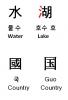
So, I just finished reading this whole thread (whew). I have been working on some ideas and may post some soon if I can flesh them out. First though; I just wanted to throw out one thing I noted, having lived in both Korea and Japan, in the last couple pages: If there is such a relationship, then I would venture to say Thaylen is the Hangul (maybe BoPoMoFo is a more accurate analogy) and the Glyphs are Hanzi. It seems unlikely that an entire pictographic form was developed for glyphs, but sections could certainly undergo a similar simplification process (either in the form of Character to Radical simplification or Long to Short form simplification). This might account for the comment that Writers approach a glyph differently than a reader does. In the attached example, Su is the character for Water and the Red portion of Ho is the Water radical (simplified Su for use in other characters). The other example is Guk (국) - Country in both the Long Form (used in Korea and other areas where Long form is common) and the Short Form (used in PRC and Japan). Just an observation to prompt discussion and to give you all an idea of the angle I am going to approach from as I try to analyze some of the glyphs. ---- Another "food for thought" is that there has been discussions of Alethi vs Vorin vs Veden (etc) glyphs. I think it's possible that when Shallan mentions Major vs Minor vs Topical glyphs; if the Topical glyphs are those merchant glyphs stylized for illiterate customers, then it is possible that the Topical glyphs are universal where the Major and Minor glyphs may be where regional variance is encountered. I know there is no evidence of this, it is more a hypothesis based on extrapolation. If there were a set of glyphs that had become standardized (or were more resistant to regional changes) it would make sense that those glyphs were considered a "separate" glyph type - and Topical glyphs seem to fit that type.
-
Hello everyone, Just a note to say I've been reading furiously and hope I contribute something worth while to this wonderful community. Thanks for having me. And I make my own cookies. They are Pumpkin spice with Chocolate Chip, if anybody wants some. Great end to a wonderful Lamb Curry with Kabulli Palau, maybe some banchan (Korean side dishes) in the meal. Oh, and a cup of Tom Kha Gai as a starter.
