



Yezrien
-
Posts
509 -
Joined
-
Last visited
-
Days Won
1
Content Type
Profiles
News
Forums
Blogs
Gallery
Events
Everything posted by Yezrien
-
Trellsier?
-
I think the simplest answer, in terms of general relativity, is that space and time are two sides of the same coin. When you distort one, you also distort the other. A large mass (like a planet, star, black hole, etc.) warps both space and time around itself. The space warp is basically gravity, and the time warp is time dilation -- time slows down as you approach the center of gravity. Time is moving slightly slower here on Earth than it is in the vacuum of space. A black hole has way more mass than Earth does, so its effects on both space and time are more pronounced. If you get close enough, the gravity is so intense that it's physically impossible to escape (even for a beam of light). And time practically slows to a complete stop.
-
Hurt Emperor's Soul, Heal Bands of Mourning. 3. Emperor's Soul--6 4. The Final Empire--7 5. The Well of Ascension--5 6. The Hero of Ages--6 8. Shadows of Self--10 9. The Bands of Mourning--7 10. Secret History--4 13. The Way of Kings--9 14. Words of Radiance--10 15. Edgedancer--10 16. Warbreaker--9 17. Shadows for Silence in the Forests of Hell--8 18. Sixth of the Dusk--4
-
I'm pretty sure it's end-positive, because stormlight isn't part of the surgebinder. It's an external power source that you draw upon, like Preservation for Allomancers. The difference is that Preservation is easier to access, probably because it hasn't been splintered -- or because Scadrians have an unusually intimate attunement to Preservation, having been created (and invested) by it. I think any system where the body absorbs investiture is end-positive. If it loses investiture, it's end-negative. If it loses some, and then gains it back without loss, that's end-neutral. (If you gain some, and then lose the same amount, that's technically end-neutral, because the net gain/loss is zero... but then Allomancy would be end-neutral. So I think we have to define that as end-positive.) Yeah, I figured a lot of these ideas had been posited before. And you hit the nail (Nale?) on the head with this: I'd like to think my Playdoh theory unifies some older ideas. Connecting hypotheses with evidence.
-
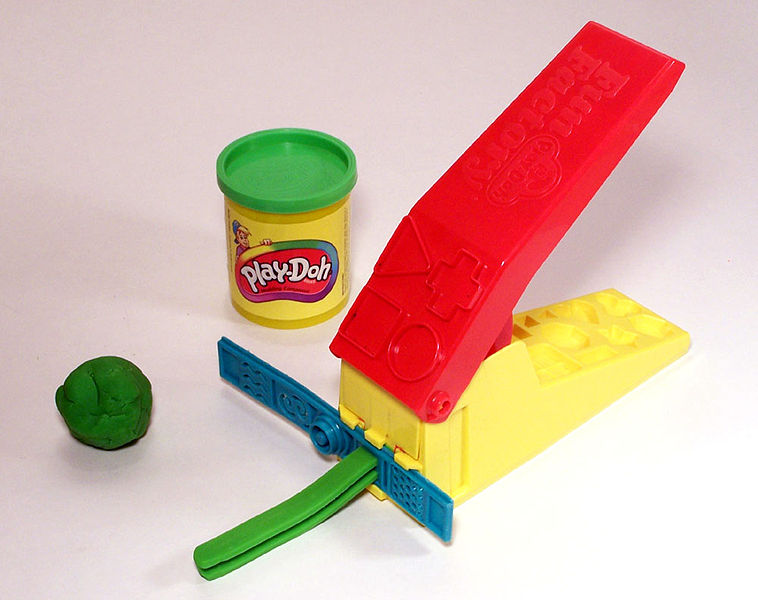
I'm probably oversimplifying some pretty complex issues here, and retreading some old ground. But, as I understand it, all end-positive magic systems in the Cosmere are basically this thing: It's called the Fun Factory(tm). You put your Play-Doh(tm) underneath the red flap, then you push the flap down. The pressure forces the Play-Doh through a hole, extruding it into a funny shape. The blob of Play-Doh that goes into it? That's your investiture source. Preservation. Stormlight. The Dor. It's raw Shardic power. Formless and without specific function. The Fun Factory is you. The Allomancer, or Surgebinder, or Elantrian. You draw that raw, amorphous power into your body, and you turn it into something direct and specific. A force of repulsion against metal. 'Awesomeness' that reduces friction. A light source, or a deadly fireball. But what's that blue thing? That's the hole that your Play-Doh is extruded through. And you can swap it out for a different one. This is the piece that determines what shape your Play-Doh takes. In allomancy, this would be your metal. Each metal produces a different effect, channeling your Preservation-power into a different magical ability. In AonDor, it's the Aons themselves. Which Aon you draw determines the magic. It's the same in Forgery, Dakhor, and ChayShan. All across Sel, it's the shape you make that determines your magical action. On Nalthis, it's about the command. Every awakened object does something different, because each is given a different command. Metals. Shapes/forms. Commands. This blue thing... is the focus. So really, I think this is the definition of focus: It's the element of a magic system that determines the magical effect, or the precise action of investiture. It's the category whose internal variation corresponds to the versatility of the magic system as a whole. (Here's the WoB that backs this up: http://www.theoryland.com/intvsresults.php?kw=allomancy+aon) Which brings us, inevitably, to the question of Roshar. A common theory (endorsed by the Coppermind) is that gemstones are Roshar's focus, because Surgebinders and fabrials both rely on gemstones. But my definition disagrees. Kaladin can draw stormlight from any gemstone (or from a non-gem source), and his powers always remain the same. Whether he uses emerald broams or diamond chips, flying is still flying. Lift, notably, doesn't need gems at all. To find the focus, look for what distinguishes one type of magic from another. What distinguishes an Adhesion-binder from a Transformation-binder? I think there's only one logical answer. It's the spren. Each surgebinder-type bonds with a different spren. Sure, some spren offer overlapping surges, but the basic fact remains: the magic you can do is determined by the spren you bond. The metal you burn. The Aon you draw. The command you give. And fabrials? Fabrials use specific gemstones because specific gemstones trap specific spren. The real exception to this is the Honorblades, which provide surgebinder-bonds, but are not spren. Or are they? They look and behave exactly like ordinary shardblades. Bonding, summoning, cutting. They're not self-aware, like spren are, but they're clearly the same type of entity: splinters. Objects made of investiture. Honor's investiture, which seems to be inherently bond-forming, whether it's sentient or not. So the focus isn't spren, exactly. It's bond-forming splinters -- a category which consists almost entirely of spren, but also includes the Honorblades. This opens up some interesting speculations of Voidbinding. Is it done by bonding different spren, i.e. Voidspren? Or is it like on Scadrial, where different magic systems use the same foci? Maybe Voidbinding is just surgebinding, but with a different power source. Maybe Kaladin could intake the 'voidlight' from the mysterious black sphere, and access a new power-set.
-
Yeah, this interpretation of "Dominion" makes much more sense, especially as Devotion's opposite. Devotion is like a god's loving care for its people, and Dominion is a god's desire to rule and control. Also, lamentspren is probably a solid translation. "Keen" has this obscure meaning: (from Wiktionary)
-
The Set-names as clues to Trell's identity... that's a really interesting idea. And it does sound like Autonomy. "Suit" and "Sequence" are each a single individual -- just like how a multitude of beings, including whole pantheons, are all just Bavadin.
-
Interesting idea. The problem is that the mechanics of Forgery aren't really clear to us yet. We don't know if soulstamps make cognitive changes, or spiritual changes. If it's spiritual, then you're probably right. But if it's cognitive (working like soulcasting), the healing might actually work against the Forgery, helping the original soul-image reassert itself despite the cognitive changes. (Since Kaladin was able to recover from Shardblade limb-deadening, it looks like healing is mainly a spiritual effect. The way his brands refuse to heal, I think that's a cognitive factor interfering with the healing process.) But all this is kind of a moot point. Like all Selish magic systems, Forgery is location-specific. Soulstamps probably wouldn't work outside of the Rose Empire -- let alone on Roshar, where there's no Dor. And Stormlight probably won't be an adequate substitute. Since it comes from a different Shard, it probably won't react to the Selish focus (symbols).
-
Right. I forgot about that. I guess if the patterns are regular enough, laypeople can do some basic calculations. I just like to think the Stormwardens are hiding something.
-
Interesting theory. I've always wondered how the Stormwardens make their predictions, and I always thought "mathematics" was a euphemism for something more intereting. Considering how many secret societies and hidden agendas there are on Roshar, I wouldn't be surprised if the Stormwardens know more than they let on. They've revealed that there's just one Highstorm, circling the world over and over again, but I think there's more to it than that. But I think it's more realmatic than astronomical. I think the prevailing theory is that the Highstorm is a vaporized shardpool -- a mobile perpendicularity, which might explain how so many Rosharans (both human and spren) commonly travel to and from Shadesmar. And if that's the case, I bet the Stormwardens track the Highstorm by observing it in Shadesmar, or by monitoring some kind of captive spren that reacts to its proximity.
-
Rundown of my current Magic Systems and Artifacts
Yezrien replied to Jedal's topic in Creator's Corner
Yeah, the Cosmere works so well, it's hard not to reuse some of Brandon's ideas. No one else has really done it, so we only have one role model. I think this is how new fantasy authors felt about Tolkien, a few decades ago. Some day, once I get my ideas in order, I'll post a thread like this one. Good stuff! -
Rundown of my current Magic Systems and Artifacts
Yezrien replied to Jedal's topic in Creator's Corner
Still, I applaud your ambition. I'm kinda trying the same thing, and it's not easy. That's what makes Brandon special. I like how you've built this mythology for the universe as a whole. It would be interesting to see how different worlds remember different versions of the story, and why. Maybe the Judex of Aia have an inflated view of Melthi's importance, because that's the one piece of the mythos that they interact with. (Maybe it was hidden on their planet for safekeeping, and magic systems just grew around it.) -
And for what it's worth, Elantris is an ancient city with a symmetrical layout, just like Roshar's Dawncities. It's a much simpler symmetry, but it fits the pattern. It makes me wonder if there is (or once was) a form-based magic system on Roshar -- something comparable to Selish magics, but with a rule that says all focus-symbols must be symmetrical. Like it's based on the abstract principle of symmetry, rather than local geography. There's not much evidence for any of this, but it would be a pretty cool explanation for why symmetry is sacred in Vorinism.
-
Talenelat-Elin, "Bearer of All Agonies"
Yezrien replied to Crucible of Shards's topic in Stormlight Archive
It's a stretch, but the anonymous bridgeman could have been having a kind of death rattle. He was about to die, and the men on bridge four were generally considered to be in a perpetual state of 'basically dead already.' Maybe the man was so downtrodden and soul-broken that Moelach could work his magic. -
I've always assumed that 'Voidbringer' is a very large and diverse category of creatures, and that the Parshendi are just a small part of it. They're acting as the forerunners of the Desolation. Soon, though, hordes of more fantastical void-monsters will start crossing over from Braize. (or maybe Ashyn. Who knows?)
-
You're right. Aharietiam wasn't specifically in Shinovar. I was mainly referring to the Honorblades being there, and the possibility that they were originally abandoned there. That, in combination with the apparent lack of spren, points to... something suspicious.
-
Isn't Nightblood already awake? He seems conscious, and very talkative. The biggest difference between him and a living blade-spren (like Pattern or Syl) is that Nightblood is permanently in sword form. But he doesn't seem to mind that much.
-
I suspect the map was made by spren. The clues are in the names and locations of the three seas. The Sea of Lost Lights corresponds to Alethkar/Jah Keved/Alethela, which was Radiant-central, back in the Heraldic Epochs. And since that's where most of the world's shardblades are concentrated, it's probably where the Recreance went down. It's not a big stretch to interpret "Lost Lights" as "lost radiances," or "Fallen Radiants." The Sea of Souls seems to cover the Valley, where the Nightwatcher is found -- the Nightwatcher, who seems to be altering people on the spiritual level. She's a major spren, and the only known spren who deals with souls. But only other spren would know about that. The Sea of Regret covers several modern kingdoms, but I think the most noteworthy is Shinovar, the land without spren. It's also the site of some regrettable events (Aharietiam, the abandonment of the Oathpact and the Honorblades) which only spren seem to remember. Bottom line: all these names suggest a spren-perspective to me.
-
Brightlord Meridas, why are you always butting heads with Kaladin? Because I Am-a-ram. Why do they call him Gaz? Because his 'gaze' is incomplete! I think I've just joined a new Radiant order: the Groanmakers! We are bonded to punspren, and all our Ideals are horrible puns.
-
Why is Rosharan cooking so salty? Sodium reigns.
-
Yeah, a persuasive salesman is one who knows his audience. Who are the buyers? What are they going to use the slaves for? Have the salesman explain, with ridiculous enthusiasm, why his slaves are just what you're looking for! And to push the sleaze, he can try to pass off his atrocities as positives. When he trots out the more broken, despondent slaves, he can call them "docile." Since he's practically starved his slaves, he can call them "low-maintenance." Stuff like that.
-
I just meant an outline. It'll be easier for us to discuss the magic system if we understand the context. What kind of story are you telling? And how does the magic fit into the plot?
-
If there's a secret hidden in the name Adonalsium, I always thought it was in that suffix, -um/-ium. That's the suffix we use to name an element after something (Einsteinium, Bohrium, Atium, Lerasium, ect.), which suggests that Adonalsium is as much a substance as an individual. Probably a metallic substance, which might explain why metal is so important to various magic systems.
-
Just out of curiosity, can you tell us a little more about the story this'll be used in?
-
Adept, perhaps? I think that follows the other two pretty logically. Also, just for the record, the Obsidian Order is a nefarious spy ring in Star Trek. They were pretty important in Deep Space Nine.
