



Yezrien
-
Posts
509 -
Joined
-
Last visited
-
Days Won
1
Content Type
Profiles
News
Forums
Blogs
Gallery
Events
Everything posted by Yezrien
-
Welcome to the last 45 minutes of my life. The tricky part is that we're still not sure what Th looks like. On the Frostlands map, "Alethkar" is "LTHKR," using an T-H digraph, like English. Alethi might be the same way, or they might be using a dedicated letter, like the Greek theta or the Norse thorn. The place to look is they highprince glyphs. Five of them are identified: Kholin, Sadeas, Sebarial, Aladar, and Roion, none of which contain Th. But the remaining five are Ruthar, Hatham, Thanadal, and Vamah -- four of which contain Th. But I've had no luck cracking those.
-
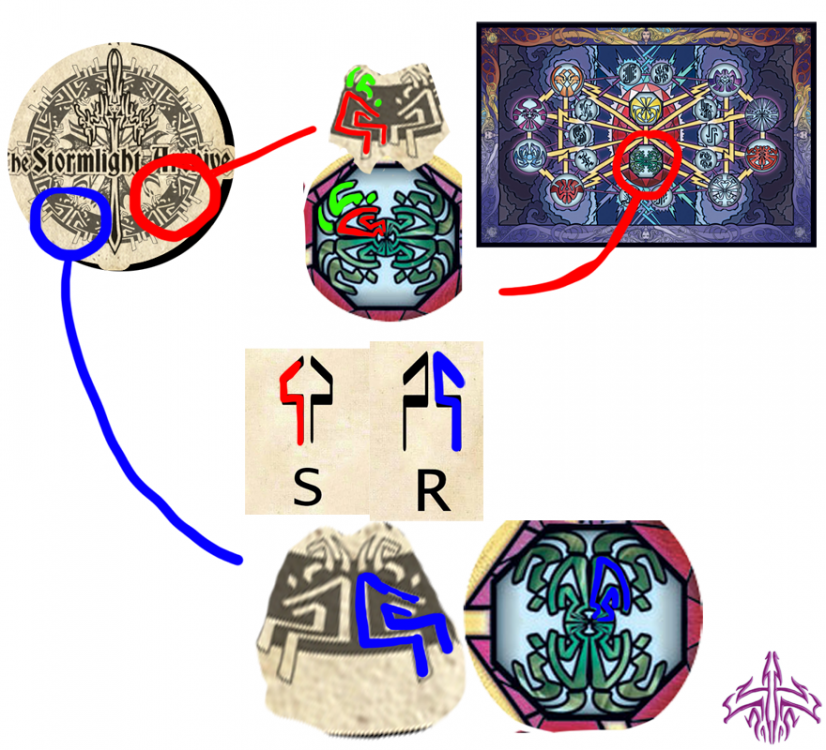
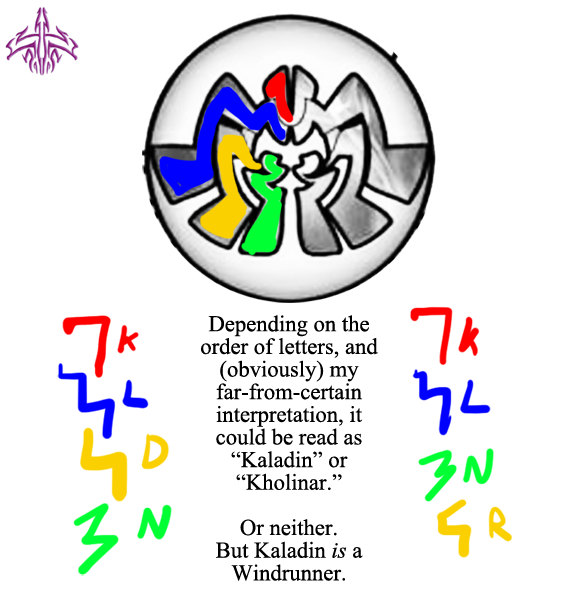
So I've been trying to figure out the the so-called Voidbinding chart (I really don't think it has anything to do with voidbinding). Here's the one thing I can say conclusively: the lower middle symbol, which corresponds to Truthwatchers/Paliah on the surgebinding chart, is the same symbol that makes up the border around the compass rose. The main symbol appears to be an S or an R. The smaller symbols on top (marked in green) might be H, or even Sh. It's hard to tell. Not sure what this means, but given the context of the compass, I'd be inclined to guess that it either says "Roshar" or "Urithiru." In either case, it would suggest that the other symbols on this chart might be places, like, perhaps, the Dawncities. Indeed, the Jezrien/Windrunner symbol looks a bit like "Kholinar." But to me, it also looks a lot like "Kaladin," so my gut feelings might not be reliable here. Really not sure about this one, but here's what I think I'm seeing:
-

Cosmere University Paper Topics/Ideas
Yezrien replied to blakismaximus22's topic in Introduce Yourself!
Yeah, Mistborn and Stormlight both deal extensively with class struggles and cycles of hate. Note the journeys of Kelsier and Kaladin. Both suffered the oppression of a brutal, abusive nobility, and developed a categorical hatred that seemed perfectly rational -- a justified bigotry. Then they're both forced to get over themselves when they're confronted with (respectively) Elend and Dalinar -- the noble who's actually a decent person. Learning to recognize morality and virtue as independent of hegemonic power structures is what makes you a real hero. Something like... "The Kalsier Archetype: The Redemption of the Bigot-Hero in Marxist Fantasy." ("Marxist" being the term that literary critics use to describe any text that explores themes of class struggle and socioeconomic inequality. ("Literary critics" being the term that English professors uses to describe themselves.) And "Kalsier" being a fusion of Kaladin and Kelsier, who've been combined into one being by grotesque hemalurgic soul-stapling, and who must eventually become a shardholder to give us the godmetal "Kalsium.") Storms, I wish I'd read Brandon's books back when I was an English major. -
Identity and connection are two different things. That's why feruchemists have a metal for each. And it's identity that keys a metalmind, not connection. And based on the examples in BoM, the identity-key on your metalmind doesn't allow you to tap it. It just prevents any one else from tapping it. Kelesina's goldmind didn't have anything more than a standard one; it had less. And in TFE, when Vin tries to burn Sazed's metalmind, we're told that the sensation is the same as when a feruchemist tries to tap a metalmind keyed to someone else. So, presumably, an unkeyed metalmind would remove the restriction in both cases. An gold misting could burn Kelesina's gold bracelet, and get a massive burst of healing.
-
Not 100% sure, but I think the implication is that each Sleepless would appear as a single entity in the cognitive realm. I imagine Arclo as an octopus. (Bear with me.) The main body is "submerged" in the cognitive realm, but he has lots of little tentacles reaching above the surface, into the physical. To us, here on the physical, it looks like each tentacle is an independent creature, because we can't see where they all meet.
-
In addition to larger gemstones, maybe the stormlight within a shardplate-system is comparable to stormlight that Shallan stores in Pattern. We don't know much about that process, but maybe it's a more efficient storage system than gemstones; maybe it holds the stormlight a little longer.
-
Can you give me a run-down of book one? A quick beginning-middle-end summary? (Sorry to pelt you with questions like this. I hope this level of interest is flattering, but I realize it could be annoying, too.)
-
So what's the climax of the first book?
-
Yeah, I'm starting to see that. I guess I took it the wrong way because you mentioned Marvel movies and superhero novels in your first post. So what you're really going for is a grimdark tragedy. Which is a perfectly legitimate choice, of course. But it's a really, really dark combination. He learns that he's been tricked into doing evil... but instead of seeking redemption, and following the newly-discovered path of good, he just becomes even more evil. So I'll just say... be careful with this. Dark is good, and negative emotions are the heart and soul of drama -- but there is a limit. Readers need those 'stand up and cheer' moments, especially after a stretch of angst and misery. Even dark stories have a sense of fun. Even tragedies have comic relief. Robert McKee (a screenwriting guru) describes plot as an undulation, like a sine wave. The emotion rises and falls over the course of a story, alternating between positive and negative, triumph and failure, happy and sad. You can end high, or you can end low. But if you don't have enough emotional back-and-forth on the way there... it can get boring.
-
Having him search for the sister is a nice motivation. It's got a very relatable emotional resonance. But there's a drawback, and it's something I've been complaining about in the Mistborn and Stormlight adaptation threads. If he's too caught up in his own personal drama, he seems self-involved, and frustratingly disconnected from the more important high-stakes Ghost conflict. Plus, resurrecting a dead loved one is an inherently selfish act. It begs the question, what about my loved ones? What about everyone else's who died unjustly? What makes you so special? However... there's a tried-and-true way to spin all that into gold. (And now that I think about it, elements of this could be Mistborn's saving grace.) Use the sister to motivate him through the main plot. Give him a mentor character, a wise and charismatic Ghost, who makes a deal with him: Help me stop the Emperor, and I'll tell you how to bring your sister back. So he agrees, and commits to selfless heroism to serve his own selfish needs. Doing the right thing for the wrong reasons (much like the reverse) is hard to fault. Then, of course, shortly after the midpoint, when his bond with the mentor is at its strongest and friendliest, he learns the terrible truth: the dead can't be brought back. The sister is lost. You lied to me! So it all goes awry. Divided we fall. With the bonds of friendship broken, the heroes are weak. They suffer a major defeat, and it looks like the bad guy's going to win. And the liar/mentor is killed. Ian storms off, so angry that he's practically okay with all that. But then, in the final act, he has a change of heart. He thinks back to some critical conversation or image, and realizes what's really important here. He realizes the mentor had only good intentions. He returns to the fold, and inspires his other allies to rejoin the fight, despite the hopelessness. Thinking back to his mentor's wise training, he thinks up some new strategy -- something so crazy it just might work. Just as the Emperor's evil plan is about to come to fruition, Ian and friends attack, and their crazy plan works. They've got him on the ropes. Victory is in sight. And then, the Emperor offers a deal. Because of all the evil, despicable things he's done, he actually can bring back the irretrievably dead. And he proves it, so there's no question that he's lying. Ian, he says, betray them! Stab your friends in the back, and save me. Join my side, and I'll bring your sister back. It's Ian's last temptation. And he passes the test. He shows his growth -- his newfound selflessness, and the strength to finally let go -- by sacrificing what he wants for what's right. Now his flaw, the selfishness, is the starting point of an arc, which ends in pure altruistic sacrifice. That's the stuff of heroes. It still leaves most of the story up in the air, but it should help organize the plot a little.
-
I've thought of another problem that the adaptation might have to tackle. I've also thought of a couple potential solutions:
-
Guesses for future prologue perspectives?
Yezrien replied to PatronOfRot's topic in Stormlight Archive
So far, all the prologue viewpoints have been focal characters in upcoming books. Obviously that can't be true for the whole series (I think the logical maximum is 7 out of 10), but it might predict a few of them. Remaining possibilities include: Renarin Lift Taln Shalash And as for the other three... Gavilar? Taravangian? Maybe focal characters from future series, like Hoid? -
That's a pretty bleak vision of the afterlife, but I guess there's nothing wrong with that. I seems like you've got all the major forces in balance. The motivations and stakes make sense. It's always interesting when the villain genuinely believes he's helping people. I bet this guy has a classic philosophical villain monologue. And you mentioned that he ruled an empire once, over 1000 years ago. Have you considered identifying him as a specific historical emperor? Because there are lots of great candidates. He could be one of the crazy ones, like Nero and Caligula. Or he could be an emperor whose rule was cut tragically short -- so in death, he's hell-bent on ruling once again. Maybe one of the ones from the Year of the Four Emperors. But that's just Rome. Qin-Xi Huangdi, the first emperor of China, was obsessed with becoming immortal. He ate mercury because he thought it would prolong his life... but that plan backfired, leaving him completely insane at the time of his death. A lot of the Mongol Khans might be good, too, but they didn't have empires until the 13th Century. I guess it depends how committed you are to keeping his age above 1000. But really, the the next step is telling the story. Where does Ian fit into all this?
-
What if we drop Kharbranth, and bring Shallan and Jasnah right to the Shattered Plains? The crux of Jasnah's research turns out to be the parshmen-voidbringers theory, so maybe she's set up her research base in the Kholin warcamp, trying to get as close as possible to the Parshendi. And Shallan's her artsy apprentice, who seems to be hiding something. You could actually keep the soulcaster plot more-or-less intact (albeit much compressed). But by moving it to the Plains, and interweaving it with the other storylines, you'd make it much more fun. It'll feel like it's just part of the story, rather than some unrelated side-story, set 500 miles away. Jasnah's atheism could play against Dalinar's whole "God is talking to me" thing. You'd lose Taravangian, but that's a small price to pay for redeeming a main character. I'm sure we can work him in somewhere else. Yes, I think most of us can agree that a TV drama is the best way to faithfully adapt the story. And it's no surprise that everyone's jumping to Game of Thrones as the model. But as @Humpty points out, it would take a ton of money. The CGI alone would put it well beyond GoT. GoT has a gargantuan budget, and they still have to skimp on CGI. They save the flashy monsters for the season finales, and keep the dragons hidden more often than not. But that kind of computer-generated conservatism won't fly on Roshar. Every time someone summons a sharblade, that's CGI. Shardplate? Probably CGI. Spheres full of stormlight? CGI. Highstorms. Chasmfiends, axehounds, whitespines, skyeels, Dalinar's giant bridges, Parshendi chasm-jumpers, rockbuds, grass that moves, every storming cremling on the whole storming planet, and chulls. Somebody please, think of the chulls! (That being said, I would love to see chulls as giant practical animatronics, and Parshendi as Westmore-style make-up effects. But I wouldn't bet on it.) And then, to top it all off, there are spren everywhere. Sure, Syl can be an actress with some (fancy, and therefore expensive) compositing, but every other spren will have to be CG. And you can't do Roshar without the spren. Just wouldn't be right. This is not Game of Thrones. It's more like Star Wars. And so, with that said, I think there are only two ways to get the imagery of the books to work on screen: A three-hour movie with a budget of $250 million, or an animated series. Much as I love the art style of those Star Wars cartoons (and the Genndy Tartakovsky micro-series that inspired them), I agree that it's a little too cartoonish for Stormlight. For a better stylistic touchstone, I'd recommend Legend of Korra. The art's beautiful, and the proportions are realistic enough that even stick-in-the-mud "grown-ups" should be able to watch it without compromising their adult dignity. It's western animation, with a hefty does of anime influence -- which strikes me as a good match for Brandon's sensibilities, and for Stormlight in particular. The harmonious blending of East and West. And here's the best benefit of animation. The characters could be designed exactly as Brandon imagines them -- right down to their skin tones and epicanthic folds. Ergo, we would sidestep the otherwise inevitable whitewashing controversy.
-
So if I'm reading that WoB right, this pseudo-compounding is completely possible. Allomancy isn't dependent on identity. There are no individual power sources; all allomancers draw from the same source: preservation. The only barrier to burning a metalmind is the identity of the feruchemist that charged it. So an unkeyed metalmind should be fair game. Yes, it would break physics. But I think that's the point of expanding the magic systems like this. We're not going to get to the Mistborn space opera by playing Skybreaker with the laws of physics.
-
I agree with both these points, but considering the recent announcements about DMG and Mistborn, I suspect the most likely scenario is a one-movie-per-book Cinematic Cosmere. So adapting WoK into one movie is worth talking about. I think @Nashan'Elin has the right idea, cutting out the interludes, Shallan, and most of the flashbacks. If the movie is successful, the interludes can be produced as side-projects, like Edgedancer. (Or even a multimedia Expanded Cosmere, with tie-in comics and an animated series!) Shallan's story can start in WoR. And we can probably do without the whole Lirin-Roshone odyssey. The story of Amaram's despicable backstabbery should get the message across just fine. And Kaladin's whole Bridge 4 story might have to be compressed a little, to make room for Dalinar. I think it would be a mistake to under-emphasize Dalinar in all this. (And not just because he's my favourite character.) Of the three main characters in WoK, Dalinar is the least... myopic. He's much more in touch with the epic story that's about to unfold. Through the visions, and his quest to unite Alethkar, he's concerned with Roshar's future, and with its past. The other two, by no fault of their own, are too busy with their own lives to worry about the fate of the world. (at least until WoR.) In other words, Kaladin's story is Kaladin's story -- but Dalinar's story is the Stormlight Archive. (And now I'm imagining Stormlight: The Animated Series.)
-
Yeah, that's me in a nutshell. You've clearly got a really comprehensive understanding of how things work. But I'm still wondering why they work. The missing pieces of this puzzle are motivation and stakes. Respectively, why do people do what they're doing, and what will happen if they fail? Basically, I need to know what matters to spirits and ghosts. To us mere mortals, it's all about safety and money. Most of what we do is for one (or both) of those two things. But once you're dead, you don't need those anymore. So what are you fighting for? The Emperor Ghost wants power, but what good does power do him? As a ghost, he's already immortal and indestructible. What does he have to gain? And why would other ghosts join his army? What can he offer them? And if he did gain control of the spirit realm, what would be so bad about that? And this probably ought to be addressed: What's the spirit ream like? What do we have to look forward to after we die? I like the part about auras fading, and spirits eventually fading into nothingness. That could solve a lot of problems. If that applies to ghosts as well, then no one's really immortal -- which means immortality is now something people can want. There's your motivation. And if the bad guys can acquire immortality (or at least forestall their inevitable fading) by somehow hurting people, like eating other spirits... now you've got the stakes.
-
Here's the relevant quote: I think the term "resonance" is a clue. Magic powers are like musical notes -- keys on a piano. You can combine them to get chords, but if you hit too many at once, it's just noise. Not sure what that means realmatically, though. It's funny to think that Wax and Wayne might develop abilities that even Rashek didn't have. It makes me wonder if there are people like Hoid, worldhoppers who can pick and choose from a dozen different magic systems, but limit themselves to two or three, specifically to keep some vital resonance.
-
The three-act paradigm that I'm talking about is a model of story structure. Each act -- and, importantly, each act break -- is defined by specific events and turning points in the story. Here's my reasoning for dividing the book the way I did: So, based on that analysis, I'm pretty confident that the act breaks occur after Parts 1 and 4. But you're right: this does make the proportions a bit wonky. (page counts from my physical copy) Act One: 168 pages (26.5%) Act Two: 403 pages (63.4%) Act Three: 65 pages (10.2%) Whereas the conventional Hollywood wisdom goes like this: Act One: 30 minutes (25%) Act Two: 60 minutes (50%) Act Three: 30 minutes (25%) Comparing those two breakdowns, it looks like TFE's third act is way too short. But in my opinion, act three is actually paced perfectly. It might be little short, but not by much. The real problem is that Act One is too long, and Act Two is way too long. So to trim this thing down to movie-appropriate length, Acts One and Two both need to drop some weight. And if you ask me (which, as I'm quite aware, no one did), the biggest reservoir of unnecessary flab is the balls, and the associated Hose War subplot. In the end, the House War doesn't end up being that important. The day is won by Vin (who killed the Lord Ruler), Marsh (who killed most of the Inquisitors), and the big skaa uprising -- which was probably destined to succeed, House War or no House War, because of their enormous numerical advantage. @Andy92 That's a good point about Sazed. It occurs to me that one of his most important roles in TFE is to teach us about feruchemy, and help us understand the Lord Ruler's compounding. That's critical stuff, because the climax wouldn't make any sense without it. But on screen, it'll look like a whole lot of convoluted exposition. It'll be a real challenge to adapt without boring and confusing a casual audience.
-
@Ironeyes, I knew I'd face a little backlash when I suggested cutting the balls, but you've made some points I didn't anticipate. See, you hit the nail on the head with this comment: That's exactly right. That's what the novel is. But you say it like it's a good thing. (This is the part where I get crucified.) You're talking about the army in the caves, right? And by "mostly political," you mean the army gets destroyed, so it never actually does anything? Because that's a good point. We could cut that out, and just have Ham do some recruiting inside Luthadel, training little cells of fighters. Instead of all the drama of the army being killed, maybe one of the cells gets raided by Inquisitors during a training session, and Ham himself gets killed. That would have a lot more punch, since he's more likable than Yeden. And I think the subsequent books can survive without him. And on the George Lucas point... I think you're giving him too much credit. But this isn't really the place for that rant.
-
-
I guess I'm still not clear on what the Ghosts (the good ones and the bad ones) are really doing. The good Ghosts are supposed to stop rogue spirits, but why? What are the rogue spirits doing that needs to be stopped? And keeping order in the spirit world... what does that look like? Are they like cops? What kind of chaos are they preventing? And the evil Ghosts... they kill Ghosts, but also recruit Ghosts? What's their goal? Is there some grand plan they're working toward?
-
Senna as Trell... it's an interesting theory, and certainly one I've never seen before. I'd love to believe that quotation was some kind of deliberate hint. But the revenge motive doesn't really make sense. For two reasons. 1) Leras is dead already. It would make no sense to punish Harmony for Leras's crimes -- and if Senna's a Shardholder, she'd know that. 2) Leras['s cognitive shadow] only said that because he'd forgotten about his plan. In truth, his plan worked perfectly. He did contain Ruin, and he gave his life to do it. Sure, Ruin killed a lot of people, but it would hardly make sense to blame Leras for that. But maybe you've just got it backwards. Maybe Trell-Senna wants to avenge Leras's death -- and Ati's moral downfall -- by splintering Ruin. (Which can only be accomplished by 'liberating' Ruin's investiture from within all Scadrian life.) Sazed's such a great guy, we often forget that 50% of his power is hell-bent on destroying the universe. Maybe Trell's ultimate goal is to protect the cosmere by splintering the dangerous shards. Maybe Taln's Scar (over Roshar) is actually Trell, coming to attack Odium. EDIT: Actually, Harmony's more than 50% Ruin. A paranoid person might think that Ruin will someday come to dominate Sazed's personality, and unleash his enormous power upon the cosmere as an unstoppable engine of apocalyptic destruction. Maybe Trell has a point.
-
Try turning up your volume. It's pretty quiet. EDIT: Just listened to it. This is some extremely interesting stuff. Answers to old questions, and new questions in need of theorizing.
-
See, I think cutting the balls would actually make the relationship more believable. If she and Elend spend time alone together, without all of high society watching them, she can be herself, and expose more of her own personality. Elend can fall for Vin, and not for Valette. In fact, in my version, I'd have Elend walk in on Vin fighting the coinshots and stealing the atium. Have him learn who she is right off the bat. That way, he can demonstrate his goodness by accepting her, and not turning her in. And their relationship can progress without being based on lies. I could see that working from a film standpoint. Probably introduces Vin and her overall story on screen better than her time in Camon's crew would. Showing Reen with Vin is probably a good idea. If we see Reen early on, then he can appear to Vin throughout the series as an hallucination, which will play a lot better than whispers in her mind. And living life on the street with Reen is definitely a better character intro than Camon and his crew. Camon's prominence in those early chapters is so weird in retrospect. We spend so much time with him, but he's completely irrelevant to the story at large. In other words, he's exactly the kind of time-wasting that a two-hour movie can't afford to include. But I think the book's prologue should stay in. It's like the prologues in The Matrix, Star Wars, and Inglorious Basterds. A plantation is a great way to visually (and therefore quickly) establish the setting. Slavery in a world of ash. A noble in fine clothes, lording over it all. And then Kelsier shows up, wins us over with his charisma, and demonstrates the spectacular magic that exists in this world. I'd add an Inquisitor, though. There's a part in that prologue where the Obligator mentions one, and it sends a shiver down Tresting's spine. That's fine for a book, but on film, I think we need to see the inquisitor, accomanying the Obligator. The Inquisitor is the Final Empire's version of an Imperial Star Destroyer, and it tells us that the bad guys are more disturbing than mere slave-owning tyrants. Kelsier can watch from a distance... but even he won't make his move until the Inquisitor goes away. That shows us how terrifying they are. But if I recall, that older script opened with a quick retelling of the legend of the Lord Ruler. A partial backstory prologue, like LOTR. Which is also a fun idea, but probably not necessary, considering time is a factor. Sorry, I should have made this clearer in my first post. I'm not talking about the divisions in the book. Brandon split TFE into five 'parts,' but a screenplay is generally structured in three acts. All of Brandon's novels do follow the traditional three-act structure, but the second act is always expanded into several act-like units. This is why adapting his work is going to be so tricky. In TFE, Part 1 is Act One, and Part 5 is Act Three. Parts 2, 3, and 4 are all Act 2.

