



Yezrien
-
Posts
509 -
Joined
-
Last visited
-
Days Won
1
Content Type
Profiles
News
Forums
Blogs
Gallery
Events
Everything posted by Yezrien
-
Rundown of my current Magic Systems and Artifacts
Yezrien replied to Jedal's topic in Creator's Corner
So you're building your own Cosmere? -
As I understand it, there are two different types of Shard-imprisonment. The first type is Ruin's prison, a cage of investiture, built by one shard to trap another. The second type is more common. When a Shard's power is invested in a planet's ecosystem, it's like the Shard lays down roots. It becomes impossible for them to leave. As far as I know, all Shards are imprisoned in this sense. But most of them are okay with it. They're happy with the planets they settled on. It's only a form of imprisonment for guys like Odium and Ruin, who yearn to be free and rampage across the Cosmere. To clarify, Ruin is affected by both types. Even once he was free from Preservation's cage, he was still bound to Scadrial because his investiture was still localized there (both in atium, and in the Scadrian people.) He was free to run amok, but he couldn't leave Scadrial until he reclaimed his investiture (by finding the atium stash, and then destroying mankind). It's not exactly clear what keeps Odium trapped, but I suspect it's the second type, the investiture roots. With all these voidspren and voidbindings and voidlight around, it sounds like Odium has a lot of investiture on Roshar (and perhaps Braize). But he might also be confined in a Ruin-style cage. That might explain why (as far as we know) he hasn't appeared or spoken to any characters on Roshar.
-
This would also explain why aluminum is so valuable. It's not just useful, but incredibly rare -- because it's the only metal that can't be easily located (or mined) by allomancers.
-
Hmm, that's an interesting point. I assumed that a spike with enough investiture to create an feruchemist would be at least on par with a small spren, but I really have no way of knowing that. Measuring (or at leas distinguishing) different quantities of investiture is an idea worth theorizing about... But even if one spike wasn't enough, you could just use more than one. I'm sure Spook could assemble enough investiture by organizing a large hemalurgic massacre. Not that he would, but... I don't know. Also, I suspect Kelsier's spikes might have been created by Spook himself. He did apparently believe old allomancers should sacrifice themselves to create spikes. And since Spook was made mistborn by direct Shardic action, he might be more invested than most. He may have given his own life to create the spikes that could resurrect Kelsier.
-
Investiture can be found inside people on Scadrial, and extracted by Hemalurgy. (Or nicrosil feruchemy, but that seems less feasible for Spook.)
-
Sounds nice, and I look forward to seeing more of this world. (Didn't you once say that the black sky tied in with a magic system? That sounds pretty cool.) But as for your three questions... 1) We don't really know him well enough to care about him yet. He hasn't done anything to show us what kind of person he is. Except... he's got lots of problems, but he's not doing anything about them. He's just moping... 2) I'd love to see him do something other than moping. 3) I'm definitely curious about this, but also a bit confused. You mention that "the Empire of the Ebon Sky was fracturing at its very core." That sounds like a pretty serious crisis, but no one seems to be panicking. The only visible problems in the world are Gemmen's issues with his fiancee and his mother. All things considered, this scene has one real problem: Nothing happens. The story does not advance (or even begin). Generally, you want to advance the plot in every scene. If a scene doesn't contain a significant event, the story is idle, which means things can get boring. What you've done here is exposition: giving us the information we need to understand the story ahead. Exposition is important, but it's rarely exciting. Also note that the scene lacks conflict. Gemmen describes conflict, but we don't see any. All we see is the scenic vista, and a man moping. On Writing Excuses, Brandon tells a great story about the process of writing Way of Kings. In earlier drafts, he says, Dalinar just wasn't working. Dalinar spent the book trying to decide if he was crazy, or if his visions were the real deal. He went back and forth, unable to decide. As well he should: it's an important question, with huge implications. But what does it look like? Moping. The solution was to turn this internal conflict into an external one. Brandon made Dalinar believe in the visions uniquivocally (almost), and he made Adolin the skeptic. Instead of debating himself, Dalinar now debates with his son. Now we have tense arguments that strain the bonds of family. And now, instead of being indecisive and static, Dalinar's a strong protagonist. He's got the conviction to stand up for what he believes in. Isn't that better than moping? I think the same trick could work for you. Take some of that inner monologue and make it a conversation. Adversarial and dramatic. This is basically the same as 'show, don't tell.' You could open with Gemmen in the feast hall, and show us how awful it is. Show us how the nobles criticize and mock him. Introduce a couple of Sadeas-types. You can tell us a lot about Gemmen this way. Which insults really get under his skin? And how does he react when they do? Violence? Witty retorts? Restrained, seething silence? Does he admit to his mistake? Does he try to justify it? Or does he deny it? Then, when he escapes to walk the wall, someone could be waiting for him. A friend and ally, who always knows where to find him. More conversation, some arguing, a little quality advice... and then, instead of ending with an "unspoken plea," have him decide what course he'll take. Make this chapter the story of how he arrived at that decision. Aaaaaand that's probably more feedback than you wanted. Sorry to go off like that.
-
I'd theorize that Shardplate is alive, but not necessarily spren. It behaves like a living thing: it takes damage (unlike the blades), and then regenerates by absorbing investiture, just like the Radiants themselves. It could be spren, but it might also be some kind of heavily-invested crystalline life form. Alternatively, plate could easily be made of solid investiture. As we've seen in both Shardblades and the Scadrian god-metals, investiture prefers to be metallic when in solid form. But I don't like the idea that manifesting Shardplate is just another high-level Radiant power. Alethi legends say Shardplate was a gift from the Almighty, and in this case, I think the legend is right. Shardplate sets were specialized non-sentient splinters, created by Honor to support the Radiants.
-
I think you're onto something here.
-
I think this quote from Bands of Mourning might shed some light on this:
-
At the end of Secret History, Kelsier asks Harmony if there's a way for him to get physical again. Harmony says no... but he's lying, and Kelsier knows it. Then, of course, Kelsier manages to do it without Sazed's help. I see two ways to interpret this. 1) Resurrecting a cognitive shadow can be achieved in different ways. Perhaps Sazed could have fixed Kelsier with a snap of his fingers, but preferred not to disrupt the natural rhythms of life and death. Kelsier and Spook then figured out how to achieve the same effect using Hemalurgy. 2) Hemalurgy is the only way of resurrecting a shadow. Sazed refused to tell Kelsier about the possibility because he doesn't like Hemalurgy, and he doesn't want to unleash the knowledge of it into his new world. (But when Kelsier and Spook started experimenting on their own, Sazed wasn't about to quash their free will by stopping them.) I like number two. It's a good source of conflict, and it makes a lot of sense. It also has some interesting implications... For instance, I think Hemalurgy is essential because Kelsier lost his body. If Sazed had all three of Kelsier's realmatic aspects in hand, he could stick them back together, just like Endowment does with the Returned. But what about the Heralds? WoB says they're cognitive shadows, too. And I think we have reason to believe that their resurrections are achieved without their original bodies: 1) They're pretty confident that they'll be resurrected, no matter how they die. Even if their bodies are completely destroyed, they will still return to Braize. 2) It's possible that they die on Roshar, but rise again on Braize. Even if their original bodies are still intact, they might just get new ones, like Kelsier did. We don't know much about what happens to them on Braize... but doesn't Kalak mention something about metal hooks piercing his flesh? What if the heralds are being resurrected via Hemalurgy? What if they all have spikes that we haven't seen yet? Another WoB says we've seen the results of Hemalurgy outside of Scadrial, but we wouldn't recognize it as such. This probably refers to worldhopping Kandra... but maybe it includes the Heralds as well.
-
That would give us a pretty solid 16 books. 3 in the original trilogy 4 with Wax and Wayne 3 for the 1940s "World War" trilogy 3 with the '80s setting 3 in the futuristic space opera.
-
The book's power might be a little more direct than that. Maybe Nohadon was a Bondsmith, and he wrote some of his order's ideals into the book. Anyone who reads the book then has the ideals on the brain, and that forms a little connection, like a weak proto-nahel bond.
-
But, just for the record, cohesion isn't really about things moving together. Both words derive from the Latin haereo, which specifically means "stick" or "attach." Adhere = ad ("to," "at) + haereo ("stick") = stick to [something else] Cohere = cum ("with," "together") + haereo ("stick") = hold together So, in describing a group of soldiers... if they always moved in the same direction, and turned as one, they wouldn't need cohesion. They'd stay together by default, like iron filings all incidentally caught in the same magnetic field. Cohesion is the force that holds the unit together when their individual whims and trajectories would force them apart. It's not about everyone agreeing, but about a strong leader, binding them all together. Hence... "unite them!" And this is more speculation, but I doubt the physical surges will be able to function on the cellular level, because Rosharans (most of them, anyway) are ignorant of cell theory. Much of the magic on Roshar (especially the spren) seems dependent on the cognitive realm, shaped by human perception. Humans perceive discrete objects, and homogenous substances, but not cells. Sinew, for instance, is one of the ten essences, which are the native version of the four elements -- the fundamental substances which, in varying proportions, comprise all things. It doesn't occur to them that sinew (or blood, for that matter, or 'talus') is actually made of smaller units, like cells. Progression (healing) obviously has cellular effects, but its exact mechanism probably isn't even in the physical realm. I think Progression-healers infuse the target with stormlight on the spiritual level. They give the soul the power to heal the body, and the soul itself handles all the nitty-gritty cellular level reconstruction.
-
Yep, nothing's overpowered if it's got a finite power supply. Brandon's 2nd law in action. But I was just speculating about Division being a disintegration effect. It could just as easily be the opposite of Adhesion; the way Kaladin sticks things together by creating a force of attraction, maybe Dustbringers can keep two objects apart by creating repulsion. Like turning any two objects (or people) into same-charge particles. But I lean toward disintegration because of this quote from WoR: And this one, from the Aharietiam prelude: The power of the Dustbringers was "dreadful," and can burn things, including rocks. Since molecular bonds are a form of energy storage, breaking them releases heat. If you disintegrated part of a person, the remaining part would probably be scorched. Maybe division surgebinders are like human lightsabers, vaporizing and cauterizing everything they touch. (Although I guess that would be redundant if they have shardblades...) Then again... that's just assuming that these quotes refer to Division. The Dustbringers' other surge is Abrasion, which I assume is relatively benign because of how Lift uses it. All she does is reduce friction. Nothing too dreadful about that. But I suppose you could also achieve some pretty terrible burning effects by increasing friction.
-
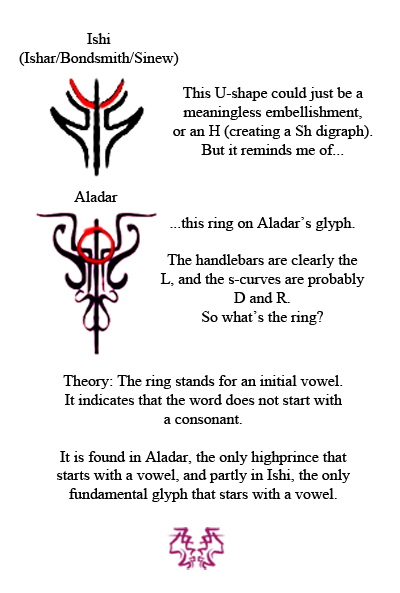
Sorry to change the subject, but here's an observation about some of the glyphs. It's a possible insight that you can't get from the Thaylen script. On the Frostlands map, the word "Alethkar" just starts with L, so obviously the Thaylens don't indicate an initial vowel. But maybe the old proto-Vorin language did. (Most Earth abjads do.)
-
Well, technically Pikachu doesn't qualify. It's the first consonant that's optional, not the final one. Classical Alethi names always end in a consonant. Japanese names almost never do. (And when they do, it's always N.) But several other Pokemon do fit the pattern. Metapod, Nidoran, Venonat, Venomoth, Poliwag, Rapidash, and Marowak, just to name a few.
-
This is just a theory. It's probably too simple to be the whole story. But it makes sense, and I think it could be useful for (among other things) identifying Alethi characters in foreign lands, and creating Alethi OCs for fanfiction. In Writing Excuses, Brandon once mentioned a linguistic paradigm for "classical" Alethi names. He didn't describe it in detail, but he said it was invented to explain 'Dalinar,' which didn't really fit with the Vorin naming convention. He also said that 'Kaladin,' which he came up with by altering 'paladin,' conveniently fit this new classical paradigm. He also said this, in a 2014 interview: But there's a much simpler pattern in these names. And here it is: A simple alternation of Consonants (C) and vowels (V). (C) V C V C V C The initial consonant is in brackets because it's optional. It can be dropped, so names begin with a vowel. But the rest of the sequence doesn't change. No double vowels or double consonants. (Digraphs, like Th and Sh, count as one letter because they represent a single phoneme.) This holds true for the following Alethi names. Dalinar Adolin Renarin Gavilar Elhokar (assuming Lh is a digraph, the Alethi version of a double-L in English) Kaladin Meridas Amaram (coincidentally also a proper Vorin name) Aladar Arafik Avarak Avaran Alabet Lamaril Jakamav Kalishor Isasik Salinor Talanor Thanadal Tinalar Helaran (not Alethi, but close) Notice that all of these are men. This paradigm is only used for male names. As far as I can tell, all Alethi men have either Vorin names, or names in this pattern. (Vorin meaning palindromic, with one letter added, subtracted, or changed.) The only complication is Restares, whose name is neither Vorin nor classical. It violates my classical pattern because of the "ST" in the middle. But since Restares hasn't been confirmed as an Alethi, this may not be a problem. I'm wondering if anyone can see any additional patterns or rules that govern this system. Just for fun, I will now list some names from other Cosmere works that conveniently match this pattern. Galladon. Aredel. Luthadel. Aledin. Aradan (Yomen). Bevidon. Bavadin! Devanex. Dukaler. Galivan. Goradel. Heberen. Ishathon. Caberel. Nikolin. Arelon. Opelon. Duladel. Seraven. Enelan. And now some names from outside the Cosmere, to illustrate the general fantasy-friendly vibe of this paradigm: Saruman. Denethor. Boromir. Faramir. Azeroth. Suramar. Dalaran. Selidor. Eragon. (Po) Dameron. Caladan. Muradin. Mogenar. Telamon. Galadan. Malekith. Malacath. Akatosh. Zenithar. Kynareth. Erikur. (Obviously it also fits many not-so-fantastical names, like Cameron and Oliver. But let's leave reality out of this. Although Pokemon also fits.)
-
Book Recommendation for Sanderson Fan
Yezrien replied to Dubisx's topic in General Brandon Discussion
The Belgariad (and other series) by David Eddings. It's not brilliant or original, but it's fun, easy reading. The first few books are pretty short (by epic fantasy standards), so you can give it a try without making a huge commitment. Dune by Frank Herbert. Basically the exact opposite. Widely recognized as the greatest sci-fi novel ever written. It's also, I believe, the greatest epic fantasy novel ever written. Epic worldbuilding. A great, perfectly-integrated magic system. Intrigue. Action. Romance. Betrayal. Swords and lasers and giant worms! This book has it all. (And even though it's technically part of a series, Dune stands alone. The sequels are optional.) I believe both of these have Brandon's seal of approval. Especially Dune. -
I'm guessing that Surgebinder would reduce the molecular cohesion of the table, giving it the consistency of a foam or viscous liquid, then make the handprint, then return the table to its normal cohesion, making the handprint permanent.
-
"A beginning is the time for taking the most delicate care that the balances are correct." From the Manual of Muad'Dib, by the Princess Irulan.
-
What if the different colors referred to different branches of science? All science is fundamentally the same thing, but every discipline has its own vocabulary and rule systems. Each color can bend/break the rules of a different science. Green is biology, used for medicine and body modification. Red is chemistry, used for transmutation, manufacturing, pharmaceuticals, chemical engineering, etc. Gold is classical mechanics (Newtonian physics), used in engineering, manufacturing, transportation, etc. Purple is psychology, used for therapy, mind control, drug-like artificial emotions, maybe punitive behavior modification... White is quantum physics/string theory, used to manipulate time, space, energy, probability, etc. Black, the theoretical forbidden weave, is metaphysics and philosophy, used to manipulate morality, and the nature of truth. Perhaps it's a "god language," that can manipulate anything and everything at once, but with a dangerous tendency to accidentally destroy the universe.
-
Sorry. Fixed!
-
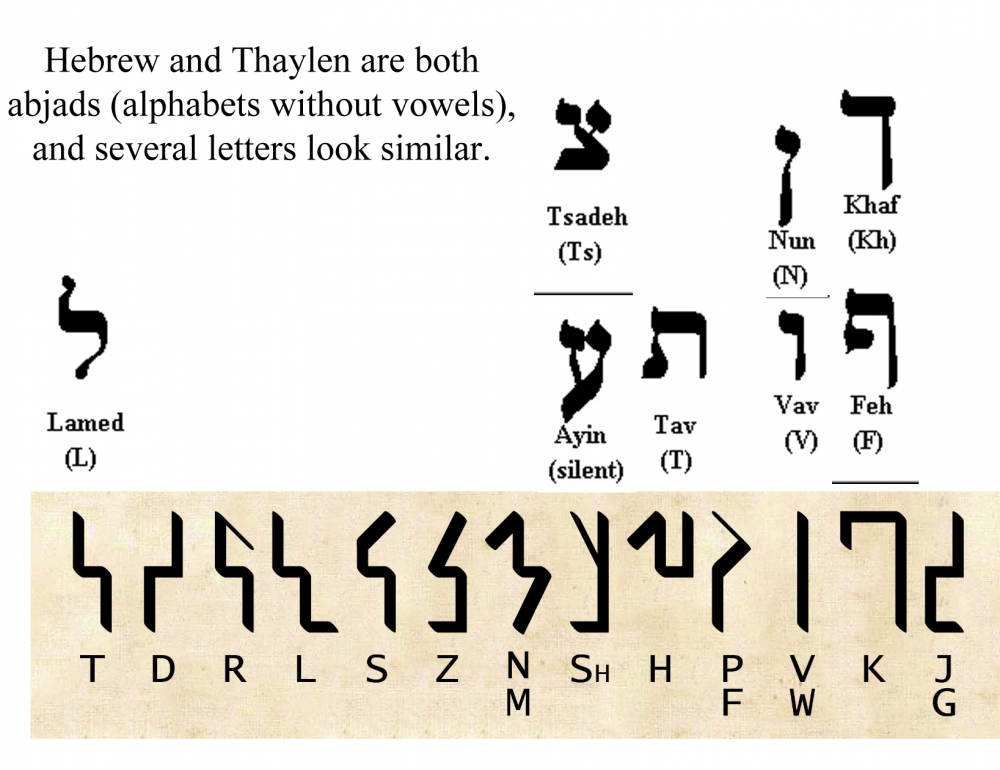
At least in terms of the writing system, I think Thaylen is extremely semitic. Like Hebrew and Arabic (and other semitic languages), the Thaylen alphabet is an abjad -- all consonants, no vowels. The shapes of the letters, with all their hard angles and thick brushstrokes, have a similar aesthetic to Hebrew calligraphy. In fact.... When Isaac says Thaylen and Alethi are related like hangul and hanxi (Chinese chas.), he's obviouslly referring to Alethi glyphpairs, not the women's script. Moreover, I think the relationship he's referring to is actually the reverse of the hangul-hanxi relationship. Hanxi came first. They're Chinese logograms or symbols -- abstract pictures with no phonetic information. Hangul is a phonetic script (like our alphabet), whose letters are derived from pieces of the Hanxi. Alethi glyphs are logograms, like Hanxi, which is why Brandon sometimes compares Alethi to Chinese. But since the Alethi glyphs are phonetically readable, and seem to contain Thaylen letters, it's likely that Thaylen came first, and that Thaylen letters were eventually stylized into Alethi glyphs. (I'm not the first to compare the glyphs with Arabic calligraphy.) I would theorize that the Thaylen alphabet is the original writing system of eastern Roshar. It was probably used by Alethela, Natanatan, Thalath, and others. It probably came from the Heralds, or the Dawnsingers. After the rise of Vorinism, Alethkar (and perhaps other peoples) abandoned the Thaylen script because it wasn't symmetrical, and created the new Vorin alphabet (women's script) to replace it. But Thaylen-based calligraphy continued to be used in heraldry and signage. It incorporated symmetry for aesthetic reasons, and gradually evolved into modern glyphs.
-
The Heralds have been wandering Roshar for 4500 years. It's easy to imagine one of them getting drunk one day, and starting to ramble about how the Almighty makes people immortal, and then condemns them to an eternal cycle of arm-ripping torture. But if said Herald didn't explain the Oathpact and the desolations, people would assume he was talking about evil men, punished by the Almighty for their sins.
-
The Heralds probably weren't quite as powerful as
