



Robinski
-
Posts
4690 -
Joined
-
Last visited
Content Type
Profiles
News
Forums
Blogs
Gallery
Events
Everything posted by Robinski
-
Thank you, Mandamon, finger on the pulse as usual! These are good comments and I wouldn't argue with any of them. Will give serious consideration to bringing the two Saffen sections together, and I agree the Vekalik section is info-heavy. You're right about Karus section, I thought it was going somewhere, but on reflection it's surplus to requirements. Maybe I can make the intros a bit punchier. It's a lot to retain for later anyway. The knights are referred to and addressed using the name of their city, as a convention to maintain continuity, and use their given name if they become king. Possibly some refinement needed there. Concerned now that I've biult the action up too much! Thanks again.
-
Hi all, Here is Chapter 3 of Without Honour. If you've been reading so far you'll know that only getting two viewpoints in a chapter is quite a departure! Okay there's a tiny bit of a third, but look on the bright side, only one of the main ones is new. Still in the introductory phase, but hopefully things are entertaining enough to hold your interest. Bit more action coming in Chapter 4, honest! All comments welcomed, as ever. Best, Robinski
-
Two well-written stories, as the others have said. I had no trouble with the ending of Chatarra, or at least my interpretation of it! For me, Subhash sends Sajid through the portal at his own expense. Once Sajid has gone through, the portal is dead, so when Subhash says he's going home, I take that to mean that he is setting aside his struggle to pay his way in Barcelona, because he has been inspired to return to Kashmir be conventional means (the hard way). Putting a positive spin on it in my mind, I presume he will then be with his wife and children, since there was no indication that anything had happened to them. Anyway, here are my comments on reading the stories. -------------------------------- Chatarra Apologies for line editing included in my comments, but there were bits that I tripped over on what was otherwise a very fluent piece. I'm not sure about the punctuation of the list of things that qualify as chatarra. Also, I struggle with the phrase ‘raw material of life’, which surely is carbon, water, etc., i.e. organic life. I see what you mean about these things being recycled, I don’t think the phrase captures that. The two characters’ names starting with ‘S’ caused confusion for me a couple of times, having to look back and check who was who, is it really necessary? ‘One by one Subhash stomps on the lever that lifts the dented grey dumpster lids...’ – this reads to me as if there is one lever that opens all the lids. I see what you mean, but I think it’s maybe ‘levers’, ‘lift’ and ‘each of the dented...’? I'm not sure, tricky one. You don’t mention the name of the sports team, which I think Subhash would know, that made me stop. When Subhash recalls selling his house is the first impression that I had that he was an adult. Before that point I had been considering him as a child, similar (bit somewhat older) than Sajid. And I struggle with the fact that he just walks away from the dumpster rather than investigating on the spot. Sajid falls to the ground rather than the floor surely. This is an interesting concept. I like the idea behind the story. The setting is well drawn and the characters are effective. Despite these good components, something doesn’t quite click for me. I think that once the screen appears events seem to rush to the end. There’s no sense of wonder in Subhash no real contemplation of the nature of this thing. The end is good, effective, Subhash is no hero taking on the thugs, but he saves the day and has a positive outcome himself in the way the incident inspires him to change his life (or seems to). I think maybe for me it just needed something more between the discovery of the screen and the final scene. --------------------------------------- Diamond Interesting story, well written – I was pulled through it at a good pace, with almost not grammatical issues catching my attention. There was really only one style point that I thought was worth mentioning, as follows; ‘…she had grabbed him by the arms and thrown him across the room...’ I think putting this phrase in Past Perfect tense instead of Simple Past takes the immediacy and energy out of it, not to mention the surprise. Overall, I think it’s a good story. You have a matter-of-fact way of dealing with the futuristic elements which is not overcomplicated, making them easy to accept as part of the story. My only other comment, like others, is about the ending. As I approached the end, I felt sure that there was going to be a twist. The way that Annie left without saying anything each time, the way she talked about her husband in a slightly mysterious and oblique way, I was just waiting, almost expecting, something to come out of left field, but it didn’t. That made the ending a bit flat for me, and I ended up not entirely sure what message I was supposed to take away from the story.
-
I would like to submit Chapter 3 of Without Honour if there is a space.
-

Reading Excuses - 20140127 - Without Honour - Chapter 2 (-)
Robinski replied to Robinski's topic in Reading Excuses
Thank you, Goat, much appreciated, Fair comment, 'loved' is a bit heavy-handed in terms of showing the distance between Gjurd and Saffen, and there isn't really the foreshadowing of that in the short section with Saffen leading into that. I take your point about the brow darkening - I was searching for a different word thatn 'furrow' but there's nothing wrong with it. On Damiel's section, I hope that adding some reference to his motivation within the scene will give it some more 'oomph' per Andy's comment, and justify it's being there - I like the scene, so I will try and fix it. Thanks again! -
Reading Excuses - 20140127 - Without Honour - Chapter 2 (-)
Robinski replied to Robinski's topic in Reading Excuses
Thanks Andy, I think your comments are good. I agree with the point about Gjurd leaving. On reflection, perhaps I could get away with the suddenness if the impression was that he's not leaving her for good, which I can see would need a bigger bust up or more ground work - I'll fix that. Also, a good point about the motivations - I think I could quite easily add a reference or small aside for each that would help to reinforce what they are, or would like to be, moving towards. And I can see to your point about oomph. I'm not sure at this moment what I would do to address that, but I'll give it some thought. I do like to have some build up to action, but maybe it's a bit early to have a 'lull' in Chapter 2. -
Reading Excuses - 20140127 - Without Honour - Chapter 2 (-)
Robinski replied to Robinski's topic in Reading Excuses
Ha ha, busted! Damiel is one of the 2 or 3 main viewpoints in the book, having said that, I would be lying if I said that there weren't any more coming. I'm afraid one of them is at the start of Chapter 3, but it's a view from the other side (as it were), and hopefully quite different, so I don't think it will cause a problem... (easy for me to say). The next one after that is in Chapter 10. Both of these are lesser viewpoints in prominence, if not in importance (I think). I felt that the description of the magic needed to feel different, wider as you say, to try and create a sense of wonder, but limited wonder. I deliberately tried to throw a feint by starting with a description of prestidigitation (i.e. parlour tricks) before something that is actually magical is revealed for the adults - hopefully that works. I like your comment about Marnar and Teimen's second meeting, you are quite right, there isn't enough tension or reference to the earlier encounter - in which I failed to go back and adequately account for the lack of reaction in the bystanders. Two fixes for the first edit. I've developed a habit of ending sections with three asterisks (*) and chapters with five asterisks. I always understood ellipsis to be '...' I don't know if that's a font thing, presumably not, as I'm using Times New Roman. Thank you for those comments, much appreciated. Another viewpoint coming your way on Monday (slots permitting)... -
Another good chapter this one, lots going on, certainly conflict and character development. No obvious leaps and bounds in the plot, but I don’t mind that. I'm looking forward to next Monday already. Goat makes some good comments that I've overlooked below. Especially the blood on Varus when he rejoins the ladies, that's a biggy, but also him throwing the coins to her. My detailed comments follow; Cracking opening paragraph – beautifully encapsulates (and confirms) my impressions of Cadmia, almost like throwing down a challenge to the reader, this girl’s a real pill; I dare you to like her – excellent. And then the second paragraph introduces the subtle tones of the relationship between this particular father and daughter – super stuff. If anything, I'm enjoying that relationship so much that I think I care a little bit less about Varus with each scene involving Cadmia and Murena. I'm over simplifying of course. We need Varus as the centre of the brute force side of things, the point of conflict, and it seems that supernatural(?) goings on are brewing behind his forehead. I can almost feel the pressure inside him building slowly towards a big blowout. Excellent first page – really pushes things forward and makes me keep reading, hungry for more. A style point comes to mind at the end of the page. ‘I am sorry.’ and ‘I will be fine.’ sound rather stilted and formal between father and daughter. I’ve toiled over this myself from time to time. I always used to resist using contractions in pseudo historical settings, but would people really speak that way, especially in family setting? ...and yet Murena addressing Varus on the next page sounds okay. ... and then a couple of contractions that somehow feel more natural. Varus raises several good questions here. Why would Murena give this task to him? I can only think it is because he doesn’t want to leave the house. Cadmia says she will pick, and I'm wondering why her father didn’t give her that authority from the start – or rather tell Varus to approve or veto her choice, but give Cadmia the lead. ‘...softened Varus's heart...’ little bit cheesy for me, and I love a bit of Stilton. Murena’s last line feels rather expositional. ‘...fierce gaze...’ Ouch! She really has a chip on her shoulder over Varus, I wonder if there’s danger of stressing it too heavily, especially here, where it jarred with me a little that she does not know where she’s going – although now I see that she’s playing him – nice one. ‘...not enough gods...’ LOL, think maybe you lost part of the orthodox readership there. This is a nice exchange, but Varus’ reaction feels rather juvenile (his thoughts of pride and satisfaction), getting puffed up when he guesses the answer to a riddle from a girl – perhaps that’s just the effect she has on him, he certainly isn’t great at rising above it. I'm not sure about the characterisation of the tutors who reject Cadmia as ‘ignorant’. Surely, by definition, they are not ignorant, but prejudiced, not the same thing of course. I know it’s Varus’ characterisation, and I suppose he’s uneducated, so probably wouldn’t think in those terms, it just stuck out a bit for me. Part of me questioned Varus thinking of the risk to Cadmia in staying outdoors, but leaving her with an unknown woman who they have just met. I suppose he is relying on his judgement of character. Personally, I think ‘stomped’ sounds like something a child would do. I am by no means a scholar of things Roman, but the description of the stinking alley is at odds with my expectations of Rome. A little reading on Wikipedia indicates that I have probably fallen for some latent Roman ‘propaganda’, but I imagined the famous Roman drainage systems would help manage scenes like the one you describe at the foot of Page 11. I think I was wrong, and you did imply that he is in a sleazy part of the city. Minor point, I see you use Hades’ (possessive), but also Varus’s as possessive. I'm never sure if they are equally acceptable, the two occurring close to each other just caught my eye at this point. It seems very unlikely to me that, in all of Rome, Varus would run into the same priest again, not only that but bump into him in the same way as before, and a crowd gather again. This said – you handle the encounter well, the outer conflict with the priest and Varus’ inner conflict. Maybe there is hidden significance to the priest’s recurring presence, but without being party to that, the situation felt rather implausible. Still, it gives a good sense of Varus’ struggle for control.
-
Here is the second chapter of Without Honour - I've tried to take on some of the comments from the first submission, passive voice, wordiness, etc. There are three viewpoints here, which hopefully is less scattered than the new in the Prologue + Chapter 1. As ever, I would very much appreciate your comments. Please excuse the tracked changes, I had already set this chapter up before reviewing for the comments last week. Cheers, Robinski
-
Great comments, thank you - yes, I still truggle with my old nemesis passive voice - will need to work on that, also sentence and paragraph length. Having a quick look at Chapter 2, I think it might be a bit better on paragraph length. Not making any promises about passive voice though. I'm on Chapter 17 now, and I'll try and address passive from there and come back and improve the rest in the first edit. Thanks again!
-
11/05/13 - Stroniax - The DragonLord Chronicles
Robinski replied to Glaring at the Survivor's topic in Reading Excuses
(Sorry for lateness of my comments, still striving to get through my NaNo backlog.) The writing has a lightness in tone that I quite like, different from the portentous style of some fantasy writing. Reading the thread after writing my detailed comments (below), I see there’s a reference to YA. They did’t have YA when I was a lad, they just had books. So that’s where my viewpoint comes from. Using first person is a bit different (maybe more common in YA, certainly). Personally, I don’t usually like it. I picked up Hunger Games recently and almost put it back down again instantly, but Susanne Collins does it very well. Anyway, I'm willing to keep going for your chapter because that's a personal hang-up of mine – not your problem! For me, this needs some work on its substance, but I think the light tone is promising if there is a good story there. I think as a first chapter it needs to do more to grab the reader’s attention, which is difficult with so little to go on. Also, I'm not getting a sense that the story is going anywhere particularly original, which I think would be something to strive for to keep the reader interested in continuing, but if it’s well written, and almost cast as a comedy you might get away with it. -------------------------- We certainly get a lot of information in a short space of time, but I don’t mind that as it’s not what I would think of as an info-dump. I think “On it.” is a modern expression that feels out of place in a fantasy work. I know there are different opinions on that, but modern expressions take me out of a story that is set in a pseudo-historical (‘low technology’) setting (at least I think that’s what it is). Also, “zoom” feels out of place, did you mean “zone”? Still out of place! Sorry, but all I can think of when I hear neck pinching is Mr. Spock. ‘...the wellfare (sp.) of the room...’? I'm not quite sure what you mean. I don’t like Righor’s tone here, his sidebar about ‘people who have spoken’ makes him sound like a smartarse, Ben is only trying to tell him what he wants to know, then Righor talks over him. I don’t think it’s funny and therefore it fell flat for me. There seems to be very little substance to the discussion about the threat. I guess the Drage is some kind of wise man or prophet. Why is it Ben’s responsibility to speak to him, and why does Ben take on the responsibility of stopping the threat? We don’t really know how serious the threat is, what the world is like and what is at stake. Also, Righor seems to be very open and conversational with Ben, considering he (Righor) was just kidnapped. This is very short for a first chapter and rather light on detail of the setting. I think the setting needs more substance, the threat doesn’t feel significant because we don’t know yet what we’re supposed to care about. I think expanding the chapter to explain (show don't tell, of course) to the reader where we are, who these people are and what they do will make it a more substantial and rewarding reader, and better hook the reader. -
Jan 20 2014 - The Goat- Piercing The Veil Ch.2 Liaf
Robinski replied to The Goat's topic in Reading Excuses
Overall, I enjoyed the chapter. Some detailed comments follow on things that stuck out for me, however I had an issue with the content, as noted below. I'm not sure you can have ‘a beg’ since beg is a verb, I think ‘plea’ is a better word, or just ‘...more like begging’. ‘ran’ sounds like flat out, but I'm picturing more of a jog. I became puzzled at the point when they go up the stairs when I learned they weren’t supposed to be there. At the start of the pursuit, I presumed that they were supposed to relieve the guards, or be relieved by them, either way it seems that whatever they are guarding is now unguarded while they go ‘off piste’. It seems that they have deserted their post. ‘...as silently as...’ I have no quibbles on this piece. The writing is solid, the events are tense and suspenseful in the library, then the chase is afoot, and the pace of that part is good too, but the section is very short and very little actually happens. I would feel a bit cheated by that as a chapter in a book I was reading – although I would presumably have the book, so I just keep reading of course! My point, I suppose, is that while it’s well written, there is no real ‘wow’ factor in this 2,000 odd words. In Tarrito’s chapter there was conflict and controversy. We learned something of the situation and some of the characters. In Chapter 2, we don’t really learn anything, and nothing happens to advance the story, which makes it feel a bit flat, hence my feelings about the chapter as a whole. At this length, you could submit two chapters at a time – and after being underwhelmed with Liaf so far, what I really want is more Tarrito. Reading the other comments now – and your own introduction to the thread (suppose I should have read that first), I have to disagree about Chapter 1 feeling like and add-on, I think it’s a much better opening than this would have been, because Chp.1’s conflict and controversy grabs the attention. -
Thanks Andy, great comments, very helpful. I'm glad I've managed to weed out some of the long sentences, but it is a weakness, I can certainly accept that is takes away from momentum - must try harder ) I'm glad you got the time difference, but probably needs refinement in view of Mandamon's comment. Early exposition, yes, fair comment. Good comment on Saffen's intro - I will look at that. You are spot-on in terms of what the future holds for them of course, and I'm glad you've picked up on those two especially, as they are (will be) at the heart of the story. The scene between Marnar and Teimen is an issue - guilty as charged - I think I just wasn't willing to tackle it at the time. I will fix that. Thank you again.
-
I know there are various ongoing threads at the moment, and I'm enjoying them all. Being last (latest) man in, I'm happy to sit out if there isn't a slot for the 27th, but if there's still a free one on Sunday evening I'd like to put up Chapter 2 of 'Without Honour'.
-
Thank you for those comments. I must admit I needed a kick having lost a lot of momentum after Nano finished, this kind of encouragement is just what I was hoping for! I realise now that there's a flaw in the Prologue. It actually takes place 5 years before the events of Chapter 1, but the reader will not realise that until probably into Chapter 2 or even 3, so that's something for me to fix. I did not even register that there were 6 pov's in such a short space. Hopefully that's not a problem, and they will resolve into 4 ongoing situations. It's fascinating to hear your comments on Teimen and Marnar, the characters are the most important part of any story, so I'm glad they had some impact. Glad you like the map! I'm pretty much lost without one. I've got a DP and a glossary on the go too, but there are too many spoilers to let you have those! On the geography, you are quite right, the physical arrangement does look rather like the Mediterranean, which I'm conscious of, but the cultures, names, etc. for the Svars are from Scandinavian sources, which themselves have a lot of roots in Old Germanic names, it seems. On the length, I think you are right, I'm probably kidding myself at 120k - my first novel was 225k (~700pg.) and was narrower in scope!! and I've still got lots to resolve in this one. Thank you again, I'll aim to put Chapter 2 up next week, slots permitting, I know there's a lot of good stuff running in parallel at the moment, and I haven't even started on 'Physical Magic' yet. (At the risk of sounding like a suck-up, I'm really looking forward to it after reading 'Seeds...').
-
I really enjoyed this chapter, bursting with action and conflict, almost breathless. We learn a lot of background information about Murena’s household and various senators, but it was too highly charged to feel in any way like info dumping. I did have some issues, noted below in detailed comments, but this chapter has really pumped up the energy and excitement levels, and I'm keen to read more – good job. My main points were that I feel Livius was too overtly villainous, certainly from Cadmia’s viewpoint, which is what the reader got. The chapter also seems to put Cadmia at the heart of the action as the protagonist, to the point that Varus seems marginalised. I'm sure he will come back to lead other chapters, but Cadmia seems a more interesting character at this point, certainly the most entertaining, although there is clearly something going on with Varus’s torc and his voices. Cadmia’s opinions about the world around her seem to lack insight and balanced contemplation, and I'm not sure to what extent that is down to her youth and inexperience, or her being close-minded to opposite opinions. Reading the other comments now, I do agree with Goat and Mandamon about the magic system (excellent!), however not so much about the end point being flat. As a father, and a son, I can say that seeing a parent brought to a point of helplessness like that (as I have done a long time ago) is very troubling for a child of any age. We hear from Cadmia after the attack about how protected she feels at her father's touch, and yet by the end he seems to have given up hope, which would be crushing for a child who would probably take her father's protection for granted. So maybe only one more line needed to play that up, if that's your intention. Detailed comments below – I hope that these are useful. ------------------------------------ Not sure ‘flouted’ is the word, ‘flaunted’? The line about a daughter giving him an heir sounds like the daughter producing the heir, rather than (not) being the heir. ‘What a pity she could not beat them like the imbeciles and libertines the(y) were.’ I'm not sure this sentence makes sense. I'm really enjoying seeing things from Cadmia’s viewpoint, she really is gloriously cynical. We are learning a lot here, and yet it in no way feels like an info dump to me, because the delivery is so entertaining. Cadmia thinks of Livius having grace, and yet his words following that thought seem rather graceless. Livius is painted as being overtly villainous, certainly from Cadmia’s viewpoint. The description of him sneering, the snake’s smile, etc. is a bit strong, I half expect him to have a moustache to start twiddling evilly. And yet, listening to his argument impartially, there definitely seem to be valid criticisms to answer. Also, Cadmia’s characterisation of both the other senators and the people of Rome seems close-minded and simplistic. Perhaps that’s how the reader is supposed to see her, but it makes me doubt my impression of Cadmia’s age, in fact, I'm not quite sure where to place it. I like the fact that Cadmia is scheming for her family’s betterment, because that is all she can do as a woman, since her gender is debarred from having any kind of overt or independent influence or leadership role. For me, she is a fascinating mix of cynicism, spite, calculation and loyalty. She clearly seems to love her father, and yet at the same time is disappointed in him, or some of the things he does at least. I enjoyed the encounter with Bantius, he seems naive, but that is foreshadowed in the description of his youth. It does lead me to question Cadmia’s age again, I wonder if I’ve missed or forgotten a reference, is she maybe 16ish and him 20ish? I really like the sentence that talks about human artifice and what Cadmia admires about the garden, very much in tune with the sense that I have of her now. ‘The air around her’ twice in the one sentence. I'm not sure about rose bushes being predators, although it’s a nice image. I thought the attack was well described, the mounting fear in Cadmia and her offer of greater and greater tribute to Diana as each previous offering failed is a novel idea. We learn more about the system of pacts in this chapter, and it’s done by ‘show don’t tell’, which is good. ‘Concern’ doesn’t seem a strong enough reaction for Murena when faced with his daughter holding the head of one who, ostensibly, was a guest in his home, she is spattered in blood, which for all he knows is her own. The image of Rogatus of the blatant glutton is unsophisticated. There are few shades of grey in the secondary characters, which I feel lets down what I think is strong characterisation of Varus, Cadmia and Murena.
-
Hello All, Here (hopefully in your inbox) are the Prologue and Chapter 1 of my NaNoWriMo project this year, currently at 83,800 words (Chapter 16), probably 2/3 of the way through - I don't plan to subject you to the whole thing in weekly instalments, but would very much appreciate your thoughts on the first few chapters, then will finish it with your input and post in Alpha Reader thread, I think. Apologies for the length of this submission (4,700 words - less then the max!) - although having said that the chapters are circa 4,500 to 5,500, but I won't subject you to too many (I hope). Comments very much appreciated. Best, R
-
Another strong chapter, my doubts are almost gone and you’ve overcome my reluctance to read fiction in a historical setting by good writing and strong, nicely drawn characters that I want to find out more about. When I was picking out the next thing on RE to read your title ‘Fire in the Blood’ made me hesitate. It didn’t grab me, somehow it seems a little uninspired, perhaps similar to several established titles. I can see now how it’s entirely appropriate to the story; I'm just not sure how well it would stand out on the shelf. In addition to the enjoyable characters, I like the conflicts that have been established so far. First, the conflict within Murena’s family is not especially original (stepmother and daughter), but it’s well handled so far. Second, the conflict between the newcomer, Varus, and existing members of the household (before he even gets to the guards). Then the conflict between Varus and Rome itself, which is clearly going to develop, but perhaps most significant, and least explored, the conflicts within Varus himself. This is the bit that is still troubling me. He is conscious of the voices, but never seems to analyse or question their presence, and yet I don’t yet get the sense that he is in their thrall in any way, or that he is deranged, so what doesn’t he question their presence? Anyway, my specific comments follow, and looking forward to the next chapter. --------------------------- Ouch! Scorching scene between Varus and the young woman, in the first couple of lines I wasn’t entirely convinced at the incongruous juxtaposition of him being meek and her being commanding, but throughout the exchange there are little tell-tales to the emotions behind her tirade. Then there’s what she is saying which, despite the vehemence behind it appears to come from a place of caring about her father, and yet also tinged with her bitterness. Well done. The one bit in this passage that I'm not keen on is the sentence ‘Do I look like a sir?' She stepped back, gestured down her neatly togad body.’ I don’t like the word ‘togad’, not for the spelling – it just looks weird, but that sentence stands out for me because of how well written and easily read the previous section is. I don’t know – how about ‘elegantly clad form’? I think that phrase could be more elegant. [Page 7] – ‘befitted’ rather than ‘fitted’, I think. When Murena gives Varus the job description, I was a little surprised that he (Varus) did not even slightly question or doubt, even in his thoughts, the suggestion that there might be tasks that are illegal. [Page 9] – I don’t like the word ‘grabbed’ for Murena lifting the wine. I can’t say that I would grab a wine bottle from a table. [Page 11] – ‘higher peak on life's hill’ sounded a bit awkward to me, and would it not be ‘the hill of life’, which sounds even cheesier to be fair. [Page 13] – Why does Murena reach out uncertainly when he shows no sign of being put off by Cadmia’s moodiness earlier in the exchange? I didn’t see that. When Cadmia calls the wife Livia, I think it is maybe the third indirect reference to her being his second wife. You mentioned that she was his ‘young wife’ I think, and the small difference in the ages of the two women at the burial, but is there anything wrong with say Sepunia just coming out and telling Varus, or did I overlook that?
-
Ha ha, yeah the manticore....... Manticore Wars!!! (lol)
-
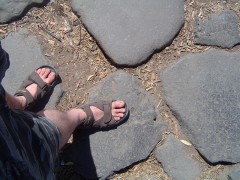 Road by the Romans, sandals by Reeb*ck.
© RCMD
-
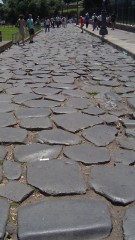
© RCMD
-
I like the description of the city through Varus’ eyes, very evocative images. Varus’ embarrassment seems a little overplayed, I didn’t quite believe that of him, but his exchange with the girl is well done, there’s a nice dynamic there, established very quickly. The joke around ‘Old Lady Rome’ is a nice touch too, well judged I think after the pretty full-on first chapter, to show a touch of a different mood away from the heat of battle. Ha ha, love the description of his difficult progress, I HATE it when people stop right in front of me without looking round! Okay, we’ve had magic introduced at the first chapter, but the mythical creatures came as something of a shock, in a good way. Maybe I'm just a simple soul, but I wasn’t expecting mention of Cyclops and Manticore, so they were a slight slap in the face when they appeared, but I think that’s could, letting the reader experience something of the wondrous and unexpected on entering the city, a bit like Varus. The encounter with the priest is well done, but I struggled a bit with the premise. I can understand Varus’ angry reaction, but then he seems to spend quite a long time assessing the situation. I appreciate that he’s a bit wondered because of the blood lust and the voices, but at the top of Page 7, he thinks ‘He might not follow Jupiter, but he certainly feared him.’ If that’s the case, I'm not convinced he wouldn’t drop the priest’s hand like a hot coal as soon as his status registered. At this point I’ll say that I think there’s a nice flow to the writing, not too heavy on description, but enough to form a picture, although it’s being ancient Rome is, I suppose, an advantage, as most readers can probably form a reasonably representative view from movies, pictures, etc. The reason I comment on the style here is that I found the first instance of phrasing that made me stop. ‘Down that path lay losing himself...,’ doesn’t sound right, I think it’s more ‘Down that path lay the loss of self...,’? Another thing that I only realised when it was pointed out is that Varus is now a ‘scarred freak’ – well, scarred by his burns anyway. If it was mentioned previously in the chapter, it didn’t register with me. Perhaps it would be better drawn out in the first encounter, so that it is in the readers’ mind as we picture Varus travelling through the city. I'm actually a bit of a Romanophile, have visited the city twice – majoring on the historic sites, and was caused to pause again when you described Varus running off on sandals along the cobbled streets. I have no real objection to this, artistic licence being entirely acceptable, however I’ve attached two images (hopefully showing a gallery link below) that I took near the Colosseum. I'm not saying one couldn’t run on it, but I think it would be pretty easy to go head-over-heels. I quite like ‘grime and crime’, but to follow it so soon with ‘hearth and hearts’, for me, is too much, then ‘hustle and bluster’, too much again, I think – and ‘fortress and front’, it’s a bit of a barrage, an alliterative assault! I like the picture you pain of him knocking on the door. I think Thirteenth Legion might be capitalised as a name. I like the sniffing comment, nice twist of humour. The tone of this section has several moments like that, and I like them, interspersed with the tension of Varus’ experience with the voices and the torc. Also, I'm conscious that I don’t know whether the voice behind the door belongs to a man or a woman. Clearly, Varus must know this, so for some reason I feel my knowledge is incomplete. The ‘men and pigeons’ comment struck me as a bit strange, unless it’s a reference I don’t know? That aside, the description of the surrounding buildings and streets it lovely, I feel like I'm back in Rome and the sun is shining. I think the street would be nowhere near as busy as the one at the gate, this seems a very obvious statement – redundant I think. ‘Babes and bags’ – alliteration is a powerful thing, with great power comes great responsibility... I like Sepunia – she seems like a character that will provide some conflict in an interesting way. Nicely handled final scene, the tension in Varus at meeting Murena in the civilian setting, the salute providing some grounding, the family dynamic is also intriguing, I'm keen to learn more about that. Overall, I really enjoyed this chapter. I'm pretty much thoroughly drawn in now and ready to read more. The one thing that is troubling me a bit is Varus’ lack of questioning of the voices that he can hear. While he hasn’t really had a spare moment since entering the city, he’s clearly been living with the voices since Gaul, plenty of time to contemplate what happening to him. To not question them makes me think that he is already much closer to losing his sanity than I might have expected this early in the story. Then again, maybe that’s the case and I should shut my yapper, but it not, I think he might recall earlier conclusions that he might have reached on the subject of the voices.
-
13 Jan 2014 - The Goat - Piercing The Veil Chapter 1 REDONE (V, L)
Robinski replied to The Goat's topic in Reading Excuses
I think that take on the alchemists will be interesting, and would work for me if I knew that about them before we encounter them. Knowing something about how they operate and what they do will make encountering them for the first time less of a double-take moment, so I think your plan of moving them further on make good sense. -
20131111 - andyk - Blood in the Veins Ch.1 (V,L)
Robinski replied to andyk's topic in Reading Excuses
I enjoyed this first chapter well enough. I'm not a big fan of historical fiction in the sense of the setting, I like exploring a setting that I know nothing about, and am learning from scratch, so the Romans vs. The Gauls leaves me a bit cold. I liked the impact of the ambush at the foot of Page 3 (actually the 4th page), I was not expecting that. I think the action in general is well written, it feels dynamic and urgent, the drilled methods of the Romans versus the unguarded aggression of the Gauls. The battle ebbs and flows, and it’s unclear how it’s going to end, or what will happen to Varus at an individual level. This is all good and exciting. I'm not keen on the description of the Gauls’ anger as ‘petty’. Why so? It does nothing to endear Varus to me if he can’t see that his foe is entitled to be angry that their country has been invaded. Not that he would agree with them, but belittling their resistance, to me, shows a lack of awareness and a fair amount of condescension, not endearing qualities. Again, at the foot of Page 5, he doesn’t see how the Gauls have drawn the javelin volley out of the Romans at little cost. In general, I like the harshness that comes from the occasional use of ‘industrial’ language. The post-battle scene is nicely described in terms of Varus’ condition, and his exchange with Murena is convincing, his palpable fear at talking back, so to speak, and his commanders’ magnanimity, but laced with hesitancy. All in all, despite my misgivings (above) coming into the story, I want to read on, so the first chapter has done its job. There’s no info-dump, characters are drawn well enough to distinguish them and there’s a fairly strong hint at where the story is going, which looks like an interesting place. To conclude, well-written chapter, not sure that I like Varus, but so far I still want to know where events take him. -
13 Jan 2014 - The Goat - Piercing The Veil Chapter 1 REDONE (V, L)
Robinski replied to The Goat's topic in Reading Excuses
Interesting opening, there is a good pace to the writing, plenty of action and the main character is quite the tough nut, not particularly sympathetic so far thought, but that doesn’t prevent him from being interesting. The problem I have (as per the detailed comments below) is with the tone of the dialogue, and also with some of the reactions, which seems very ‘by the book’ perhaps a bit predictable. In terms of the comments from others, (1) Where do we get that Tarrito is black, I didn’t get that at all; (2) I agree with Mandamon (there it is again), that the story does not grip the reader from the beginning, the initial action does, but otherwise it seems a standard fantasy plot which has been done a hundred times before – to succeed with that I think it would need a much stronger and more original/intriguing opening; (3) I agree on the name repetition, very noticeable; (4) I disagree on the justification for killing Bylan, I thought Tarrito’s logic was sound, his contact was under suspicion, there was no way back by that point; (5) I was a bit thrown by the dynamic better Galen and Tarrito. Galen does not seem a commanding figure. His reaction was uncontrolled. He seems very emotional, and, to me, doesn’t act like a leader, but maybe he’s just inexperienced. Tarrito is apparently a knife for hire, so are they paying him to help, or does he believe in the cause? If it’s the latter, I don’t think that came across in the chapter. (6) I take Andy’s point about Tarrito coming across as the villain, that doesn’t make him a poor character, but if he is the protagonist, you’re going to need a bigger plot – certainly some conflict in his character and a balancing influence on the story. For me it’s too early to see about Tarrito, but you’ve got an uphill task to sell him now. Breaking Good anyone? Detailed comments follow. ------------------- [Page 1] – I don’t think ‘unjust’ is the right work, is it? Does the blood not belong to people who were unjustly executed? Sorry, but I hate the word squelched, onomatopoeia be damned, I think it’s a word that people should stop using when they turn 15. There are various names that should be capitalised, I would say, sorry to line edit, but it did distract me. Fountain of Faith for one, Main Street on Page 6 and Bay Street on Page 7. [Page 7] – ‘He bumped into what felt like a stone wall. He stumbled and fell backwards. He looked up, and found a barrel chested man, wearing alchemist’s robes, staring back at him.’ – The three instances of the word ‘He’ in quick succession feels disjointed to me. My image of a typical alchemist is certainly being challenged on Page 8. Strom does not speak like an educated ‘scientist’, which I imagine most alchemists would be, they also seem to go around in gangs. [Page 9] – I don’t think the word ‘prepped’ suits the context of what appears to be a fantasy story. It’s a modern word in a pre-high technology setting. [Page 10] – Room 3, it’s the name of the room. I'm not sure I would use the word ‘knob’ in a brothel – door handle? For me, the phrase ‘...the wares she had for sale.’ is a real cliché in this context. I'm struggling with the use of the word ‘yeah’. It’s a fairly modern form of speech that feels out of place in this setting. It seems to me there more suitable alternatives in most instances where it’s used that would not even need ‘yes’ to be used instead. “You Dianne?” he asked. “I am,” she said, “Are you Tarrito.” “Yes.” More importantly, she accepts his word without question – which seems very trusting. [Page 11] – ‘I’m going to make you as good with women as you are with those knives of yours.’ How exactly would he do that? Some parts of the dialogue feel a bit padded out to me, like Galen’s repetition of Tarrito’s line, or ‘What are we going to do now?’ a rather naive thing to say. Galen’s sounds rather innocent, not the streetwise killer that Tarrito appears to be. [Page 14] – Galen’s account of the reason for the theft is a prime example of maid-and-butler dialogue. Galen and Tarrito would have had this discussion long before now, so it only happens now so that the reader can hear it. [Page 15] – There’s ‘prep’ again, it sounds terribly out of place. In fact, I find there is a real modern cast to the dialogue that sounds more like a couple of hoods in Chicago planning a bank heist, it is really pulling me out of the setting. The name ‘Henry Brewer’ sounds in congruous. No-one else has a surname, and ‘Henry Brewer’ is a very 20th century western name, where the others so far have been more exotic, although there was Dianne as well, but that at least has Greek mythology links in the form of Diana. Same comment again at the use of the word ‘dad. What’s wrong with ‘father’?
