Ripheus23
-
Posts
1318 -
Joined
-
Last visited
-
Days Won
2
Content Type
Profiles
News
Forums
Blogs
Gallery
Events
Everything posted by Ripheus23
-
Well I'm thinking Unity had to have been alive/born already [can't get into that debate!!!]? IF Odium meant such a thing when he said the infamous line.
-
Maybe Unity was her child (and Honor's of course!) so she has displacement syndrome or what?
-
The Unmade and Roshar's technology
Ripheus23 replied to Friendshipspren's topic in Stormlight Archive
I'm tired and skimming so IDK if someone already brought this up, but having the parsh slaves for 4500 years must've been a factor in all this, too. -
Just wait until we find out we could've decoded the ending of MBE4 by turning the first sentence in Elantris into an anagram and then translating it into Korean and then Elvish.
-
So small, Dalinar thought. Has he always looked that small?
Ripheus23 replied to Ixthos's topic in Stormlight Archive
I have nothing real to add but storms, Ixthos, that's an insanely good catch about the chapter titles. -
Or maybe it was, "Defend good," instead of, "Destroy evil"?
-
Didn't he tell us elsewhere that the only Shards were H&C???
-
Hmm. I have had to admit a tempering of my ideal, to be honest. Like, I think that sometimes, when it comes to the finite-types of romantic affection, there can be partial/quasi-cases or something, where the flame's spark was set, maybe not fanned too much, but it was there and the fact of it haunts reality with the question of what-might-have-been had the fire grown greater and brighter (or darker...). So the value of the overall model, though, would advert only, or principally, or something like that, just to people who failed(!) to experience the quasi-cases, who were susceptible too much to the flame's enticements. At least, I can say in my own case that by episode 3, I had gotten it into my head that it was an infinite problem for me, emotionally, so coming up with an explanation for episode 4 (the most serious) depended on changing my concept of infinity, or refining it rather (I knew both Kant's finite-indefinite-infinite scheme, but also Cantor's distinction), and worst of all the change seemed (seems!) to fit the case. But I am already obsessed with infinity, so there is a flare of rationalization at issue (or play) here, like: I needed to reconcile my abstract obsession with a kind of number, with my concrete obsession over this or that nice fellow, and voila, I come up with an interpretation of my situation that so conveniently matches my predetermined dread? If there could be a worse, then, it would cancel itself out and be something better: because the extra truth that is "worse" is better. I mean, knowing how this situation is from the inside out, and having no earthly reason to absolutely doubt myself (I do indeed have reasons to doubt myself, as anyone does, but not to the extent of just up and assuming I am and have been hallucinating for sixteen years or what by now: I would've been 15 when it started and I think a lot of other things would have gone differently later had this really started, as a hallucination, then)... For example: Jesus Christ, that was really that long ago?!?! Well anyway, in A Little Blue Kite, this book that just came out like two weeks ago, there's an "immense monster too immense for any one name and hungrier than all the emptiness between all the stars," whose presence is always in shining red letters, and the problem of nothingness is solved by nothingness giving its essence away to form somethingness---that is, nothingness would become something if it weren't always emptying itself of essence. I could not &$%*^@# believe that when I read that. Why? Because I assumed if I read ALBK I would find out that the author knew something I knew, and of all the things for him to know...! So it occurred to me afterwards that the police have never told me not to try to go to Dean. No one has, IIRC. Even after I found out he moved back to the area, where he works, even though everyone knows I went a thousand damnation miles and wandered a city in the desert looking for him... So, I just wonder, like, have they not told me to relent, because they know if I do go to him, he won't object to me being there? Like, either he'll be surprised, or happy, maybe. But if he'd told them that he didn't want me to try to talk to him? So has he never done so? He never has done so online, to me, so either he has no idea that I've tried to talk to him a lot since I last saw him in person (which is maybe peculiar, for different reasons...) or he does and he's never chosen to respond. Or he has responded, and his responses have been intercepted: not even impossible, this is a Facebook scenario we're talking about to a great extent (I mean I met him in person, it only eventually got diverted to Facebook but by then...), and FB themselves were the ones who even later did tell me my account had been hacked, from Colorado Springs (I live in Port Orchard, WA, near Bremerton/Seattle), so who knows? (There are oddly specific reasons for Colorado Springs, but which one applies, IDK. FB just said that was where my account was hacked into from, at least one time.) Whatever, I'm rambling, I even messaged Brandon Sanderson about this because guess where the ^$#@ Dean comes from! The place in Utah that inspired the chasms. I used to mispronounce Kaladin's name, the way they discuss in book 2 even, and this was before I met Dean, so you can imagine... And that's one drop in that ocean. So anyway I messaged Sanderson and no dice, either he has no time to reply to this ^*&@ or he tried and it was blocked or who knows
-
You don't think there's a point of no-return/conclusive failure?
-
So Mraize is a Chocoblood too EDIT: Imagine a future subplot where an Aviar secret society engages the Sleepless or something.
-
I was wondering in general. Has Mraize been confirmed as having an Aviar?
-
"Blizzard announces REALMCRAFT"
-
Oh yeah I forgot those!
-
Given Sanderson's Final Fantasy inspirations, should we be on the look-out for evolved Aviar that people can ride around on---err, chocobos? Or if Aviar ride humans... are humans the chocobos???
-
I was thinking about the wisdom/Prudence/w/e Shard quasi-reveal, and it occurred to me that Passion also sounds like a Shard Intent name. I mean, presumably Rayse is trying to make that his Intent, or believes it is, or what... OR: What if there is another Shard already known as Passion, and Rayse has totally lost his mind on some level and actually/sometimes thinks that he is himself this entirely other person? I have no idea how or why this would be so, though.
-
From the fact that many relationships come to an end, it can be inferred that romantic affection is not necessarily infinite in extent or degree. However, the limit* of romantic ideality is the one that testifies to those who hold that their love is eternal. I think that these alternatives of extent and degree are part of a sort of intrinsic pattern of possible romantic love, intrinsic to the attitude itself that is. First, I want to introduce the category or concept of metafinity. This adverts to Cantor's difference between relative and absolute infinity, but also involves situating notions of relative and absolute finitude. (Technically, there's also a fifth category of the antifinite, here, but that is a story for another time.) Moreover, Kant's spectrum of finite-indefinite-infinite is recapitulated in this idea such that the relative metafinities correspond to the midpoint, with the caveat that some of the form of infinity in general is still given at this midpoint. What does this have to do with the question of how many times you can fall in love? Let's suppose that it would be sort of suspicious for someone to claim that they fell in love, say, ten times. And they're talking passionate, intense, abiding, deep, whatever love. Maybe some people would have the emotional energy to sustain such a number, but I think that on average there is a reason why the number would be lower. So let's suppose a sort of process of emotional development, here, like Kohlberg's(?) stages maybe, whereby on average, the first time someone falls in love, it is probably going to be, for reasons of potential maturity, only to the absolutely finite degree. This supposition resonates with the attitude we adopt towards adolescents who appear to be overdramatic about their romantic suffering. On the other hand, I will not deny that there are authentic, stable cases of high school sweethearts enduring to the end, so to speak. Anyway, then, let's suppose that the next time a person falls in love, on average so to speak, they're likely to feel romantic affection to an indefinite degree. This might cover cases where a person remains in love with someone else just so long as person A is around person B, or common examples of premarital relationships, or whatever along such a line. Next, let's say the likeliest degree of affection is going to be "relatively infinite" and this would underscore attitudes such as the long-term examples of til-death-do-us-part or a less propagandistic gloss of "diamonds mean forever," say. Finally, then, if you fail all the other kinds of love, you get to take the ultimate test: in defiance of possibly all other reason, your heart and your mind will convince you that you can understand the concept of absolute infinity such that you understand the scale and degree of your romantic affection as somehow absolutely infinite. If deontic information states are the only ones that tangibly encode for absolute infinity (Kant's implied thesis, here), then the romantic irreplaceability of the subject of absolutely infinite romantic ideality is tantamount to the inexchangeable value of all unique agents, and at any rate if you feel this way about someone, your feeling should be indelible, irrevocable. Maybe this is infinitely frustrating(!), But maybe it's true as well. In the end, the idea here is that the absolute limit** of romantic ideality as an ordinal function, so to say, gives us the final cardinality in a way (maybe "transfinal" is more fitting a word), though only in the way that the alephs are all relatively infinite, whereas God or the Von Neumann universe or whatever, is/are absolutely this. ("Transcardinal," then, even.) And this cardinality is what fixes the framework for the number of times that you can fall in love. Does this sound ridiculous? I will admit, I have a personal interest in such a notion of "running out of options" here, and I dread that I am making an excuse to "believe in" something I might be better off disbelieving in. */**: Note: the absolute infinite is here situated as the limit of the metafinite order. That is, the four (or five) metafinite concepts go in an exact sequence, and the final element of the sequence is the mapping to absolute infinity. This does not make absolute infinity into the equivalent of a limit cardinal for the entire universe V, or I should say that it should not make the one equal to the other. In fact, my research into the concept of transfinality (my word AFAIK but assuredly not my concept!) testifies to more, on this score, but I'm going to end the addendum on this point.
-
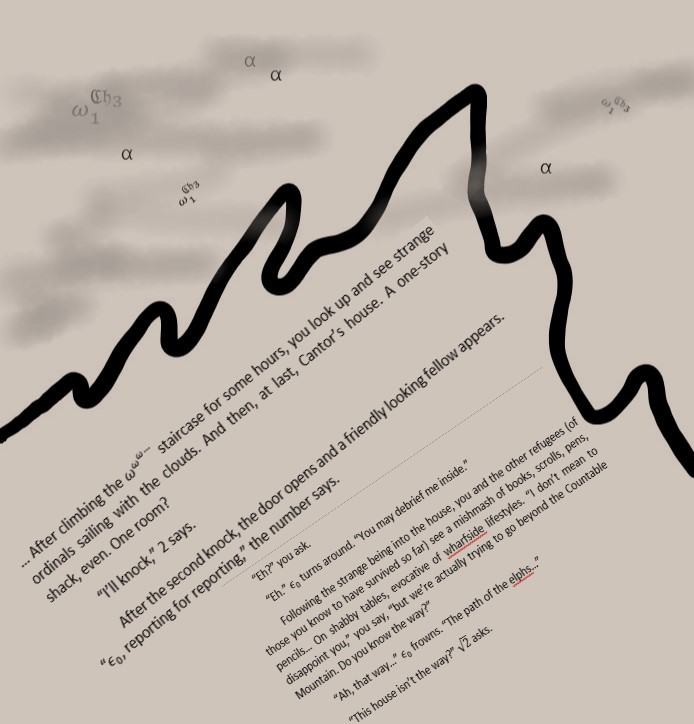
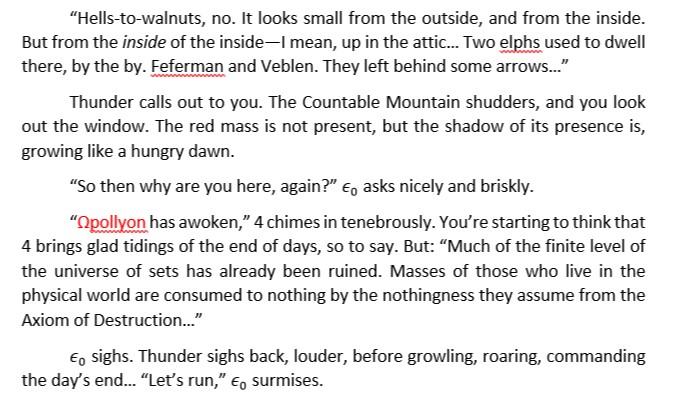
Some more visual prototypes...
-
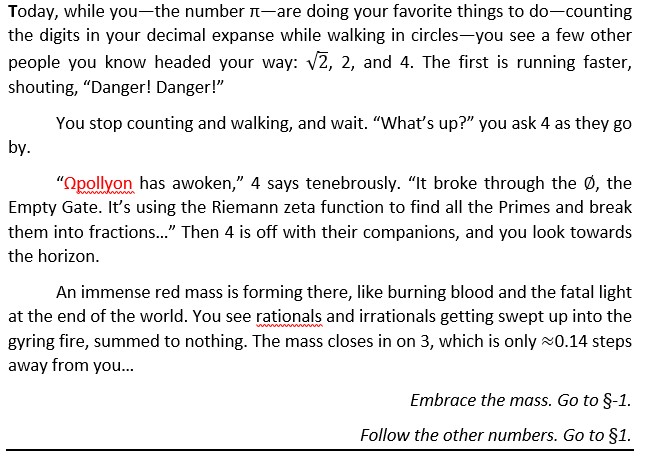
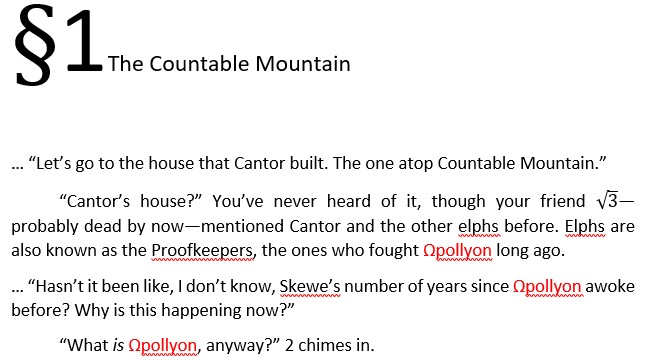
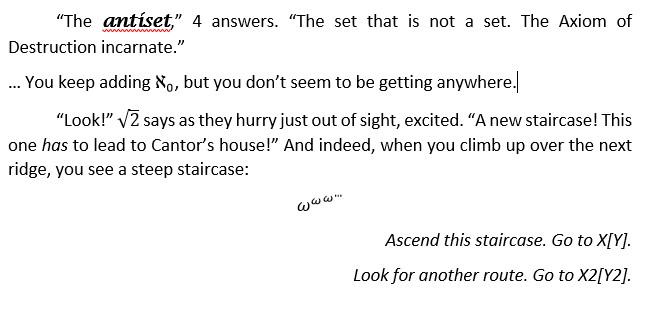
There's supposed to be a scene where √2 gives 4 the √ so 4 can disguise themselves as 2. Anyway, the point about adding aleph-zero but not getting anywhere, is supposed to be part of an actual explanation of the topic, like π asks why adding aleph-zero doesn't do anything, and so on. The section numbers would be well-ordered in the complete document and the choice idea is a nod to Cohen's pluralism: the choices you make take you to ZFC, or ZFC+, or constructivist or intuitionistic or whatever set theory, and then there would be explanations of those subjects, and so on. As for Apollyon, well that IS what the antiset is. In modal logic, the antiset function would define possibility from antipossibility, giving us a perverted modal order. This would form the image of a negative eternity, but then inside actual people, the disproof of the Axiom of Destruction is part of the metaproof of the axioms of transconstruction. So eventually the story would discuss the concept of transfinality, which is the subject of the fourth axiom of my system and the one required for the functional preimage of the deontic apex of transfinality, which has the power to "defeat" Apollyon by invoking absolute infinity in Cantor's religious sense (he also had a mistaken, I think, alternative absolute model that comes down to the antiset image, so the moral of the story is that we have to be careful about our concept of infinity in general, since the divine nature expresses this form of reality, but so does the ultimate enemy...). EDIT: not all of the numbers who are characters will be totally important for "numerical" reasons. Instead, some just illustrate Brouwer's notion of freely chosen digitalization. EDIT 2: and btw you're right, there are supposed to be bonus sections 4: also I needed a number with √ so they can use it as a bow when they shoot Knuth arrows. I swear the actual notation will be explained too like they're on top of the mountain and they are running out of time so they fire the arrow at 2 that makes the formula for the Continuum, so they teleport to the Temple of the Continuum.
-
I'm not sure whether to try to present my model of transfinite arithmetic as a strict essay, or something more like Flatland (or GEB or the surreal-numbers essay set on a magical island, or what!). If I go with the latter, it'll go something like this:
-
All my fixation on this topic has paid off, at least I have clever ideas about it in particular and not just a collage of general impressionistics...