


Ripheus23
-
Posts
1318 -
Joined
-
Last visited
-
Days Won
2
Content Type
Profiles
News
Forums
Blogs
Gallery
Events
Everything posted by Ripheus23
-
Did humans send their souls into Roshar's matter?
Ripheus23 replied to Ripheus23's topic in Cosmere Discussion
Umm Brandon himself isn't settled on how the process works and in a universe where you can have super-permanent tattoos because of spiritual ideals I daresay using objects like Dawnshards to power a soul-sending could "heal" a whole body into existence on the other end, from the available matter, maybe. No crazier than sucking the color out of things to make cloth come to life or ingesting metals in order to be able to move entire planets around, is it? -
Did humans send their souls into Roshar's matter?
Ripheus23 replied to Ripheus23's topic in Cosmere Discussion
Darn -
Did humans send their souls into Roshar's matter?
Ripheus23 replied to Ripheus23's topic in Cosmere Discussion
Spren is a catch-all term, and we know there are equivalents of spren that were formerly people (e.g. the Fused). So actually my idea is now even worse: not only were humans the first Voidbringers, what if they were the first Fused? (Not "officially," but I mean what if humans did the same kind of thing in the beginning?) -
The aleph-spheres...
-
-
-
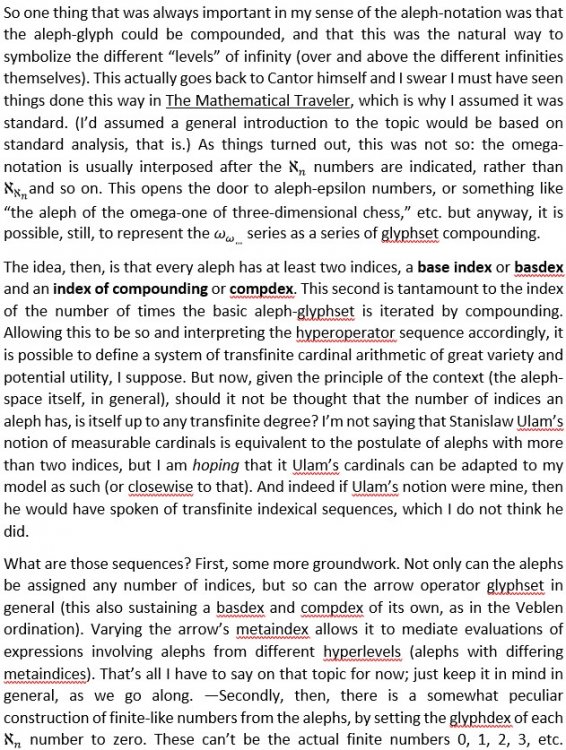
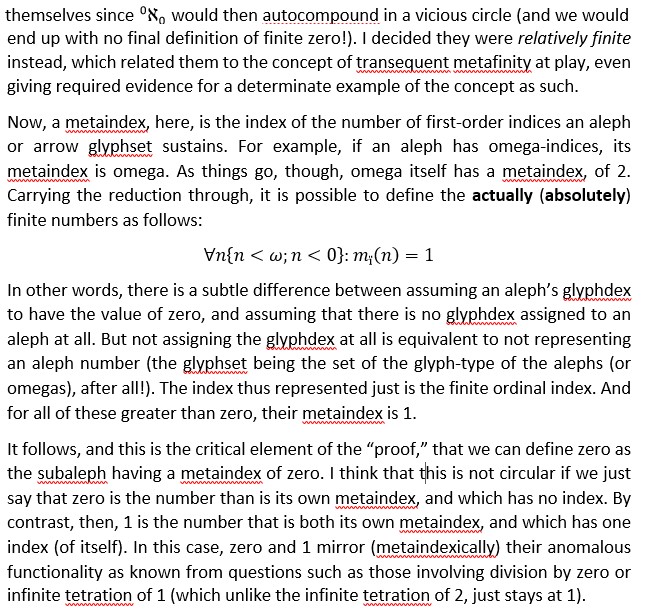
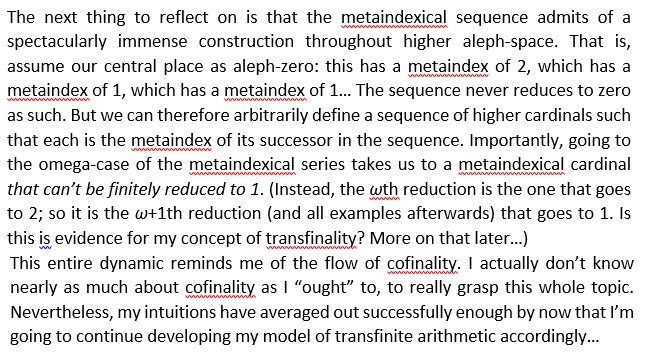
Something I found was that in surreal arithmetic, there are numbers such as "omega minus one." These can fit to the reduction of the omega-metaindex, though anomalously: also, though, the relatively finite numbers can then be defined as the examples of the things like 1 and 2 and so on, anomalously, in the surrealm. In other words, relative 1 is larger than all actual finite numbers and less than omega, in this sense.
However, there also seem to be an infinite number of kinds of zero in the system. Assume any aleph with any metaindex, and assume its glyphdex is 0. If its glyphdex is 0, we will stipulate that all higher indices are 0. At any rate, we can imagine metaindexed alephs all of whose first-order indices are zero. By the principle of comparison, a zero-aleph with more indices is larger than one with less, so we would get the peculiar result that there are infinite relative-zero numbers in a sequence whereby each is larger than the predecessor. In other words, not only would there be infinite number of kinds of zeros, but there would be infinitely larger and larger forms of zero!
-
-
Did humans send their souls into Roshar's matter?
Ripheus23 replied to Ripheus23's topic in Cosmere Discussion
That's what I'd like to know. Maybe there were stages where humans became spren first. -
Using tetration to judge the Continuum Hypothesis
Ripheus23 replied to Ripheus23's topic in General Discussion
Normally I wouldn't post a reply to my own post but I have to acknowledge something, namely a lot of the functions that I thought I discovered, are already known. Hypertowers seem to be Veblen functions, for example. Nevertheless, my intuition about the epsilon numbers and the hyperoperation sequence is therefore much more sound than I thought. -
Did humans send their souls into Roshar's matter?
Ripheus23 replied to Ripheus23's topic in Cosmere Discussion
Idk what you mean by no sense. You can clearly visualize souls being sent into matter to animate it. The visual might be false but it is not meaningless. -
Lol I guess the Veblen hierarchy involves the mechanics of the arithmetic I'm studying. Hmm...
-
For some historical inspiration, I suggest Naked Lunch, which was designed to be readable (sort of haha!) in any order (by section IIRC). EDIT: Actually, having read that book, not sure I can ACTUALLY recommend it haha. Let me say, I recommend it with a bucket of salt, and you don't want to know where that salt came from.
-
I feel like there must be different levels of xatrix functions. Like, in one case you infinitely compound the hypertower's two indexes by the HT's own form. That's maybe the smallest. I actually don't know the counterpart sigma-function case (aleph-zero ^(aleph-zero) aleph-zero ^(aleph-zero)...) for the predecessor to the counterpart xatrix-sigma arithmetic, so although I think the basic xatrix hypertower goes to (omega.1)aleph-zero, I don't know how much further the sigma-case goes, here.
But anyway, compounding the glyphdex and converting it into a series of xatrix hypertowers has to go farther, for the sake of the fact that the simplest aleph-case of a hyperglyph [((aleph-zero)aleph-zero)aleph-zero] already goes farther than the simplest xatrix hypertower (on my occurrent assumptions).
The next major question of form of levels, then, (that I have anyway...) is what happens when we have a xatrix with more than one kind of variable? Like, I've started with ones where all the variables are X, but we could have ones with X and Y, or ones with countably or uncountably many variables? In that event, taking the xatrix function of such a system seems as if it would have to go to some realm of continuously branching levels, even if each level is, inside of itself as such, countable? I don't know. Technically, I still don't have a clear enough presentation of transfinal arithmetic, which is what I'm working towards...
-
Did humans send their souls into Roshar's matter?
Ripheus23 replied to Ripheus23's topic in Cosmere Discussion
Idk were the original humans' bodies formed like thunderclasts maybe? I mean, not on Ashyn, but to get to Roshar. -
I was thinking that, maybe the Spiritual Realm analogy of the Oathgates, the tentative description of the way humans got to Roshar from Ashyn, is what the Dawnshards were. And that what the Dawnshards do, is move souls. So, like, that's part of how the Fused system worked, sending their souls to another planet. But so now, what if the way humans got to Roshar, was by sending their souls into the landscape, like when thunderclasts arise? And that the issue now is that humans won't be able to send their souls somewhere else to survive, if they needed to. Or, without the Dawnshards, they can't replace the Heralds, or something like that.
-
How was Ruin able to talk to tlr ?
Ripheus23 replied to Friendshipspren's topic in Cosmere Discussion
TLR was so used to people referring to him without vowels that Ruin would make a sound like "ttll llrr" and Rashek would react like a cat being "pspspspspsed." -
Depending on what the extra thermodynamics rule is for the cosmere, hmm... Since we don't know what that rule is, though
-
Using tetration to judge the Continuum Hypothesis
Ripheus23 replied to Ripheus23's topic in General Discussion
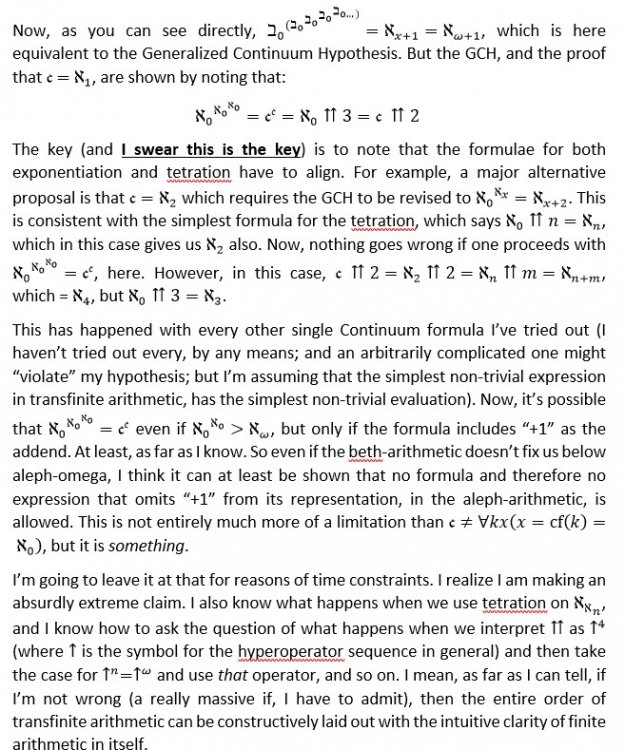
I'm so sorry, augh... The way it works is the GCH goes from 0 to 1. In the tetration formula, you add n and m first, like aleph-0 up-up 2 gives you aleph-(0+2), but to get aleph-1, then, parallel to the GCH, you have to suppose that you subtract 1 from the other result. However, for formal reasons you shouldn't have to subtract, and the need to do so comes from tetration being higher than exponentiation, but so anyway if you switch things around, you can say aleph-n up-up m + 1 = aleph-(n + m), and that gives you the right result. That being said... I'm going to plow ahead with more images because this is so storming fun. Note: besides "aleph-megaliths," the sets in question also sound cool (to me) if denoted aleths. EDIT: Although I cordially say "respondents," I mean critics. My initial post on the subject there involved an allergic reaction to omega-arithmetic (on my part), so I had to go through the meticulous process of having my fear of ordinals disproved. No problem, ultimately, as natural points of entry for the dismissed ordinals, had shown up already in the hyperoperation method of transfinite arithmetic, but by the end of the discussion, no one cared about the rest of my theory (AFAIK) but had lost interest in my proposal due to the massive failure in the initial presentation.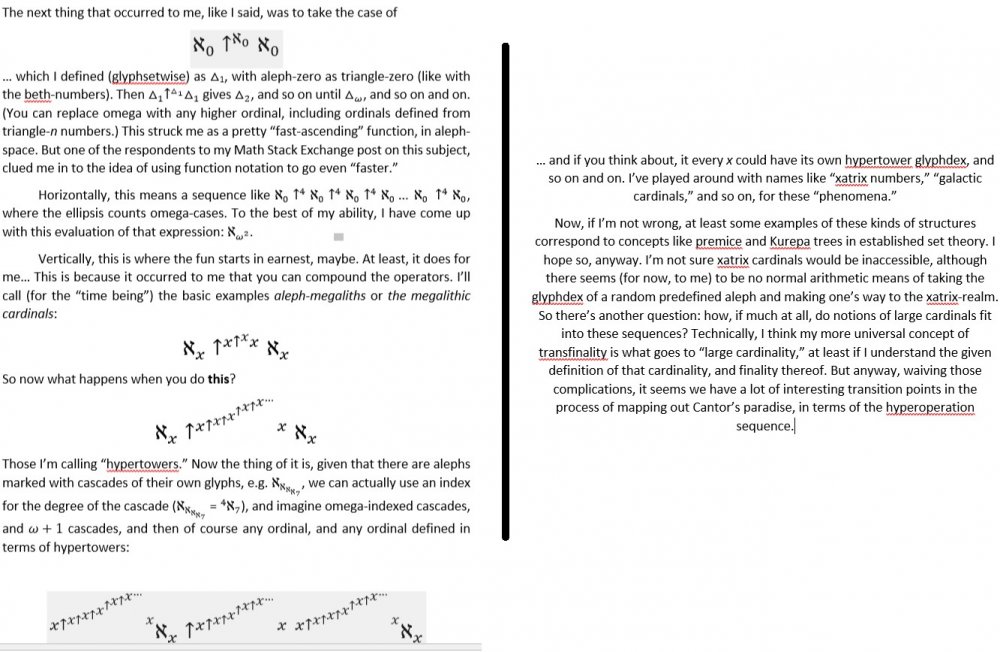
-
Propositionalism is more than sufficient, here. However, I did find a possible application of the sentence-type/token difference, that highlights where abstract indexicals pose a slightly more particular subquestion...
-
For a long time now, I've suspected there must be a direct way to compute the value of 2 to the power of aleph-zero. The original proposal was aleph-one, which I just spent a month a half trying to disprove (not in a strict regimen of ZFC, btw, since "you can't do that"). However, for peculiar reasons I realized this is false, and in fact ended up with what appears to be a basic, nearly direct arithmetic proof that the Continuum is in fact aleph-one, and in fact the formula of the Continuum is the Generalized Continuum Hypothesis. I've written it out in Word so I'll screenshot the calculations: EDIT: The tetration formula equivalent to the GCH is that aleph-n ^^ (m+1) = aleph-m.

-
Mmm fastspren are fast but hard to see while moving...
-
"Maybe for once you get to be saved by someone else, Kaladin." Or whatever Syl said. "Have to grow calluses" to protect yourself: Lirin. "Am I not supposed to want to help others?" The 4th Ideal is about self-protection, which means "calluses," i.e. Shardplate. To literally protect you.
-
Moral Miscalculations of Mr. Sanderson in Oathbringer
Ripheus23 replied to a topic in Stormlight Archive
If there are unforgivable or irredeemable wrongs, then are there... What's a good word... Irrevocable goods? Like, things that once you did them, would count you as good no matter what else. Now I doubt it, but I also think that if there was still irrevocable evil instead, there would be an abstract imbalance between the very concepts of right and wrong. Namely, good has a definition in itself, but evil has to be defined afterward as "whatever is opposite of good." A system where there are eternal sins but not eternal honors seems to run afoul of this dependence. -
Moral Miscalculations of Mr. Sanderson in Oathbringer
Ripheus23 replied to a topic in Stormlight Archive
My two broams: Odium represents damnation ("no longer forgivable") and punishment (actively antiforgiving). I.e. Hell. I mean his realm is the one known as a Hell, after all. This is part of why he is destructive of worlds but still something else entirely, so to say, per a WoB, than Ruin. This question is also an IRL question, of the priority of retributive over or under restorative justice. It's a theme examined elsewhere, too... Anyway, it has a fundamental importance to the overall idea of good and right and virtue, and sin and wrong and evil, and anything else between those, i.e "what is good to do about evil" is an axiomatic question in the domain of ethics concepts. -
We also don't know what powerups the champions get. Basically, I was just thinking for the SA. Wit IS the King's Wit and though the king now be a wee little lad, maybe Dalinar will assume the throne and for some reason would appoint Wit as the good champion.
-
This will be the championship fight. At least, craziest combo I thought of. Also Szeth vs. Nale or, idk, Lift vs. someone.
-
How Would YOU Get Away With Murder? *Oathbringer Spoilers*
Ripheus23 replied to Firebolt-101's topic in Stormlight Archive
Hmm I would get Sadeas to betray a friend, then get the friend's hot-blooded kid alone with the guy, and ZAM knife through the eye.


