Ripheus23
-
Posts
1318 -
Joined
-
Last visited
-
Days Won
2
Content Type
Profiles
News
Forums
Blogs
Gallery
Events
Everything posted by Ripheus23
-
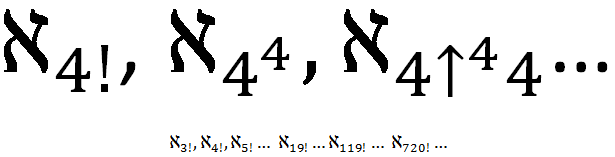
"Another dimension of their ingenuity was in using complex functions to single out individual cardinals on the first level of infinity, such that the orders of complexity among those functions could be used to mirror V altogether. The 'slogan' was: the first level of aleph-numbers is sufficient for the intuition of 'Cantor's paradise,' which is a thematic image of V (the generic metafinitary description "infinity of infinities" is first satisfied over the first level of the alephs). By this means, the accessibility of some of these complex functions (their relative simplicity, all things considered, nevertheless) could be semiotically interposed with the 'power' of the higher infinities mapped to by this method, so that the Keyscape's mediation of different levels of power as such could be accomplished more easily."
-
"In other words, an analogy would be formed between the notational permutations and augmentations occasioned by the concepts of the larger and larger types of cardinals overall, and the schematics for computing various finite natural numbers. The rate of a function could be correlated with the generic height of a level, then, and the endless cascade of these finite functions would 'add up to' a semiotic intuition of the totality of the generic intuition of V, i.e. the 'true word for' V. Then the alephs with finite indices would be the signatures of eternity, Godel coordinates of a particular simplicity and advergent stature no less..."
-
-
-
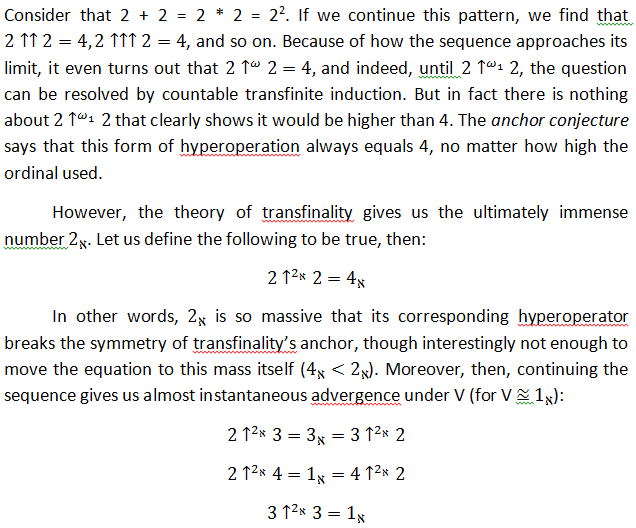
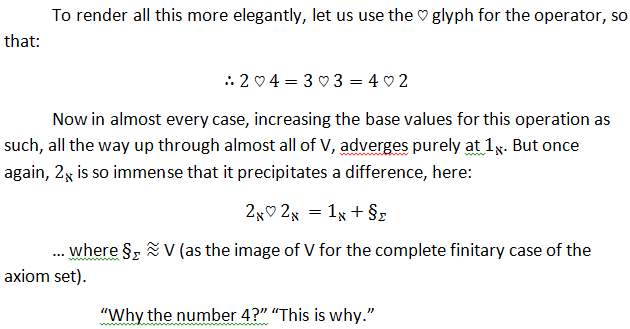
So I had an intuition some time ago, that there was a fundamental reason of arithmetic, why the number 4 kept showing up in the axiom system for my model of set theory. Either I discovered or rediscovered the role of 2 and 4 as such in the hyperoperator sequence, so anyway for the sake of the Ripheus story, I decided to have part of the "programming" of the Keyscape turn on a proof regarding this point. Namely, since the programmers wanted the arithmetic to be highly accessible to the general public (of an entire multiverse!), they looked for simple but impressive examples of arithmetic transfinality, and voila, here was the perfect case. Now, another part of the equation: the model of set theory, here, doesn't have the axiom of foundation as an axiom, but as a theorem: and not a theorem of all of V simpliciter, but of a certain meta-level of V. So there is an entire other meta-level of V that exists, in a way, in reverse order, descending from a largest set to an asymptotic limit of infinitesimally smaller ones. In other words, varying the axiom of foundation allows us to mathematically transcreate the image of a largest infinity as such, the caveat being instead that there is no smallest one, on this meta-level, and indeed therefore this meta-level never determinately intersects the ascending order of V as such. But so on the "other end of the universe," the apex numbers are absolute mirrors of the first finite numbers, after a fashion. This is why one of them allows us to "break the symmetry of eternity" by reprogramming the ultimate arithmetic of metafinity. Rendering the apex numbers accessible was therefore of preeminent importance to the Keyscape project (was it not?). Or: they are even at the nexus of the Final Power, the meaning and order of its intended advent as well as the transcendental magnitude of their self-apocalypse. EDIT--- "Some objected that this made a game of V. The reply was to concede the point entirely, but to say that it was the very Form of Games itself with which we had to deal. In other words, there was a logic of accomplishment built into the image of V; the axioms were basic moves in a game, then, yes, but ultimately there was nothing else to do but accept it: and moreover, anyway, would it not prove true that to get the highest score in the Game was the same as to get the highest score on the Test?"
-
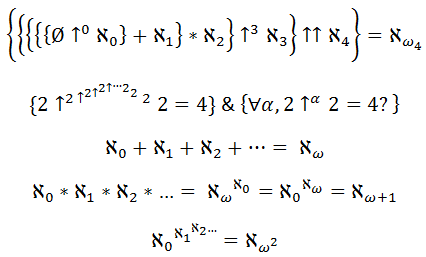
Rather than focus only on unfathomably faster means of ascending V, I did some more ground-level work on various countable patterns in V, of an elegant nature after all, however. Here are some examples:
- Show previous comments 1 more
-
The three other examples show how some very simple examples of infinite computations in aleph-space interconnect via the hyperoperator sequence. Namely, the +++ sequence leads into the *** sequence before the exponential sequence, and each can be represented by the next highest operator using aleph-omega and aleph-zero: so {aleph-omega * aleph-zero}, {aleph-omega ^ aleph-zero}, and {aleph-omega ^^ aleph-zero}.
-
The anchor conjecture: that 2 ^a 2 = 4, for all a whatsoever, even ordinals of any transfinite cardinality. This equation is sometimes referred to as the anchor of transfinality. During the apocalypse of the Final Power, it was instead discovered that using the heart operator on {2, 2} goes not to 4, but to 4-aleph.*
*Not to be confused with aleph-4. 4-aleph is the fourth apex number, those that end at the apex of transfinality.
-
-
Reverse forcing
In infinite set theory, forcing is a method whereby the axioms are used to arbitrarily construct a model of V such that conclusions in V can be negated in V+. Thus it can be shown that from the axioms of ZFC set theory, the basic continuum hypothesis is arbitrarily decidable over V/V+. Reverse forcing is the construction of a more limited model of V, one that limits the possible answers to questions posed in V. For example, if the axiom of replacement is not assumed, then V is limited to אω. But since the powerset question can still be asked (given that the powerset axiom can still be used), it follows that the powerset question can be answered under V, which means under אω. Accordingly, reverse forcing puts a limit on the continuum question. Combined with the formulaic requirement (that if the continuum is some specific aleph-number, its being this number is an instance of a formula), this gives us the prerequisite of the proof in the system that the continuum must be the second aleph-number.
Note that all the hyperoperator questions can be posed under omega-omega, here, but are all advergent from K ^4 K through K ^(omega-omega) K (for K > or = to aleph-zero as such).
-
Outline of the argument for the Continuum being aleph-1
Note: it is unnecessary to automatically assume both the basic and the generalized Continuum Hypotheses. For example, one might believe that 2^aleph-0 = aleph-1, but that 2^aleph-1 = aleph-4, and so on.
Now, the axiom system I'm using replaces the powerset axiom with the axiom of transcension, which roughly says that there is an infinite sequence of operators on the aleph-numbers. So although cardinal tetration is obviously indicated in the natural progression of the arithmetic under consideration, we can now go ahead and use the well-ordering theorem to fix the idea that a basic Continuum Hypothesis corresponds to a generalized one. I.e. the well-ordering theorem, with the hyperoperator sequence in transfinite space, implies that we have to order the values of the operations in general, which implies that the value of an operation using an operator of index n has to be "retrofitted" (pro-fitted?) to a counterpart operator of index n + 1. Accordingly, that 2^aleph-0 = aleph-0^^2 implies that there is a formula of increase for both operations, and these two formulae have to be expressed so as to coincide.
Without the axiom of replacement, aleph-omega cannot be proven in the standard model (although to be sure, the model called "standard" always has the AOR). On the other hand, the powerset question can be independently posed under aleph-omega, then. The erotetic powerset concept therefore applies such that the powerset question is fixed under aleph-omega. This situation can be illustrated using the interpolation of the basic infinite aleph-tower with the beth-sequence (as I have done elsewhere).
From here, the proof in the system that C = aleph-1 proceeds easily enough. But we can then go on to explain the failure of the GCH at aleph-omega, on the ground that the rewrite of the powerset function in terms of 2^n actually runs out of legitimacy in aleph-space. This is because 2^aleph-0 = 3^aleph-0 = ... = n^aleph-0 = aleph-0^aleph-0, which means the powerset of aleph-0 is not completely reducible to 2^aleph-0, whereas the powersets of finite numbers can always be reduced to 2^n, indeed they must be (2^3 = P(3), but 3^3 does not = P(3), and so on).
-
My outline for the Ripheus story has the first intended book focused on a weird adventure in a demiplane of evil. This introduces the figure of Apollyon, who is one of the two candidates for "the" Form of Evil itself (the other is already known as the Form of Evil as such, but there is in-world debate about whether this is a misnomer). However, the second book has the adventure of Ripheus proceed from the question of things called the Anomalies. These are random magical phenomena, such as laughing while holding a red crayon resulting in the local color of the sky changing, or some such thing. Some Anomalies are stable enough to endure and even to exist as "living beings" (i.e. characters in the story). However, they are potentially chaotic enough that if enough of them occur, the integrity of physical reality might be undone. And Ripheus has no idea why they are happening. Eventually, he is supposed to learn that a machine called the Keyscape is producing them. This is a machine that uses transfinite arithmetic to bridge the general source of magic with the average mortal (heretofore only inherently magical beings or objects could use magic, or some such thing). He and his friends long ago were even the engineers of the Keyscape. There is, though, a form of logic used in the deep parameters of the machine's arithmetic, that is lacking in a sufficient proof-by-programming, and this "error" is the keystone of the Anomalies. Now, which part of the arithmetic corresponds to the logical gap? My point of departure is dividing by zero. Usually we note that this "can't be done" and move on. But an explanation of why reveals that we actually have two different kinds of cases, here. First, 0/0 actually can be evaluated to 0, or 1, or 2, or 3, or whatever, as by multiplicative inversion these go back to 0 in the right way. By contrast, 1/0 (or 2/0 or so on), just can't be evaluated. (I know, there is an elaborate higher algebraic context where such evaluations can be carried through, but the programming of the Keyscape, here, depends on the lowest context.) So, if multiplication is repeated addition, exponentiation is repeated multiplication, and so on, then by general inversion division is repeated subtraction, roots/logarithms are repeated division, and so on and on. And we find the same divergence between operations that can equal any number, and those that don't equal any. For example, the logarithm of 0 with base 1 does not go to anything, not even 0, as 1^n never goes to 0 for any number. Let's call the one kind of deviant outputs natural variables and the other antinumbers. So let's go back to Apollyon and the Form of Evil. At the very least Apollyon is the Form of Destruction. Destruction has a relationship with nothingness, as that which causes nothingness. So Apollyon has a relationship with zero, here. Assuming that the Anomalies arithmetically coincide with natural variables and antinumbers (in the formalism of the Keyscape), let us say that Apollyon is tethered to the antinumbers in such a way that encoding an insufficient analysis of the question whether Apollyon is the true Form of Evil or not, constitutes part of the gap in the logic of the Keyscape: because, then, the interplay of the antinumbers and the natural variables interfaces with the magic system and spits out random outputs (the Anomalies). There is an ever deeper/greater reason for this: consider set difference or complementarity. This is the pure set-theoretic form of "subtraction." Because of this, it follows that V - V = 0 (where V is the universe of all sets). But 0 - V = V (there isn't a "-V" in itself, although some speak of Apollyon as this). If division is repeated subtraction,* this gives us the interesting fact that 0/V either goes to 0 (if V*0 = 0), or since 0 - V - V = V - V = 0, then 0/V goes to any 2n (but no odd numbers!). So there is a fundamental split in the computation of the Keyscape, one naively algebraic (on the model of multiplicative inversion) and the other hyperoperational, and the natural variables of V, and the antinumber V/0, are examples of the arithmetical source of the Anomalies. (Metaphysically, then, 1/0 is not the same antinumber as V/0, and so on.) *For example, 4/2 = 2 means that 4 - 2 - 2 = 0. Division is subtraction tending towards zero in particular, then. EDIT: The interkey of Apollyon and the Keyscape proceeds rather subtly, though. Firstly, we start with the notion of an axiomatic set theory in general. In-universe, the "correct" set theory has a set of axioms known as the axioms of creation. These correspond (roughly) to absolute and relative finitude and infinity. But there is another concept, of the antifinite, in which finitude and infinity are not opposites, but finitude and antifinitude are. This concept corresponds to a "false" axiom of destruction. The axioms and their primordial adjunctions are thought of as introduction rules for different types of mathematical glyphs. The empty case of an axiom system, the number that comes from not using the axioms, so to speak, is always the basic zero of the system. In the "true" set, this is the true number zero, the one we normally think about when we use the word "zero." But the empty case of the axiom of destruction then corresponds to a different zero, the void index. The finitary (antifinitary) case of the destruction axiom introduces the direct index of Apollyon. These two antifinite "numbers" are Ω0 and Ω-1. The infernal table lists the corresponding simplified arithmetic, where the void index is set to true zero and the index of Apollyon is the regular -1 (and ↓ is the predecessor relation, the zeroth negative hyperoperation): 0 ↓ 0 = 0; 0 - 0 = 0 0 ↓ -1 = 1; 0 - (-1) = 1 -1 ↓ 0 = -1; -1 - 0 = 0 -1 ↓ -1 = 0; -1 - (-1) = 0 The destruction theorem says that we can then introduce a third glyphset for the values of 1 in the table, Ω1. This value is restricted in that its infernal counterpart of 1 is only evaluated relative to the next negative hyperoperation (division). This gives us a secondary table: 0/0; 0/-1; 0/1 -1/0; -1/-1; -1/1 1/0; 1/-1; 1/1 So the table gives us the basic natural variable 0/0, and two antinumbers -1/0 and 1/0. Now there is also the empyrean table, which is a similar list of operations involving 0, 1, and V. The restriction of the relevant operations on {0, 1, V} to those up to and including exponentiation, rather than the full complement of the hyperoperators, depends on the fact that tetration and its successors are not "elementary recursive functions." (Now actually, there might be other such hyperoperations, such as the ωth, but I've had to alter my theory of transfinite arithmetic surrounding even pentation and hexation, to say nothing then of "omegation"; so I won't try to decide, here, whether omegation is elementarily recursive or not.) Due to the doctrine of set complements, there is an interpolation of the negative hyperoperator sequence with the {0, 1, V} table, including logarithms, so we end up with the transcendental ratios of V (0/V, 1/V, V/V, and V/0) and quite a few other natural variables and antinumbers. For overly mystical reasons I won't dwell on right now, there are sequences involving these that can be fit to cycles of Apollyon's natural variable and antinumbers. But the ratio of V to 0 and the logarithm of 0 with base V are the "ultimate" simple antinumbers. So the level of destructive power Apollyon ultimately has, is sufficient to endanger the entire physical universe (multiverse), so long as Apollyon can key into the ultimate antinumbers (which it can). EDIT 2: Now one question that came to my mind long ago was, if we can simple define a number i into "existence" such that squaring i = -1, why can't we just "define into existence" a set of numbers that when multiplied by zero, go back to some usual number? Now I'm sure there's a set-theoretic derivation of the imaginary unit, but when it was introduced it was by a more purely algebraic method: assume i "exists" and then, if you can come up with an arithmetic for it that is consistent with normal arithmetic, as well as internally, then voila, you've justified i by a sort of "structuralist" argument. Of course, this consistency methodology holds for the question of the axioms to be used in set theory, and V has enough structural reality to itself that you might wonder whether why there would supposedly be a symptomatic drift away from set theory, among structuralists. But IRL this is arguably only a modern (post Benaceraff) tendency, maybe. Anyway, for worldbuilding's sake (if nothing else), the question of different philosophies of mathematics ends up in the universe of Ripheus as the fact that those different philosophies have consequences for the magic of the Keyscape. The standard level of interface is: assume an axiomatic set theory as such, then vary the theory so that you can use "smaller" cardinals to do the same "magical" work as a larger one would normally have to. So suppose that some inherently magical being is mystically isoquent with, I don't know, a measurable cardinal. These already provide models of ZFC's form of V as they are not provable from within ZFC. Then vary the theory so: alter or even remove the axiom of replacement. Then the theory can't prove aleph-omega, and aleph-omega is a model of V, here. The Keyscape "makes" the theory true (in a magical sense), which in this case allows someone without magic, to become mystically isoquent with aleph-omega, which is then typed to the measurable cardinal in play, and voila, the previously immagical personage now can wield the equivalent of the "power of a measurable cardinal." But what if you aren't a "Platonic" set theorist? What if you're an intuitionist without sets, or without the paradise of sets (you might grant one or two infinite ones in some sense), or a formalist, or a strict finitist, or a logicist even? Let us clarify what this actually means: each school of mathematical philosophy holds to a different standard of evidence and proof in mathematical reasoning. For the sake of their egalitarianism, the Keyscape's engineers had an ethical motive, if you will, to lean heavily on finitistic proofs in designing the Keyscape, just because having too many infinitely complex proofs would end up making the system unworkable except by those few who would have the independent capacity to go through those proofs. Nevertheless, strict finitism would "annihilate" V, so it was not to be adopted at all, as such, in the construction of the Keyscape. However, consider, then, a structuralist about i who accepts the algebraic existence of i as sufficient in itself to completely justify or prove our use of the concept. This would be a structuralist who could affect the magic of the Keyscape such that arithmetic could be assigned to that magic on some sort of directly algebraic ground or analogy. In fact, this is exactly part of how Vyrian Armirex silenced Apollyon at the end of the Last War: he took the fact that squaring i goes to -1 to transcreate a new glyphset of Apollyon, namely Ωi and Ω-i. This even though i isn't a relatively simple number from the set-theoretic standpoint. Worse, geometrically, the equivalent units of the quaternion set actually form an analogical sphere, so that there are infinitely many such hyperimaginary units. In principle, then, Armirex had to balance the essence of the introduced glyphset with the algebraic progression thereof (part of the transcendental seal on Apollyon's power being that it by itself had only a finite glyphset, and no such glyphset had an infinite index). The relationship between intuitionism/constructivism and geometrical arguments was also an easy source of higher-level magical interpolation. Not that the rejection of the Law of the Excluded Middle was correct: by erotetic adduction, in fact, this could be ostensively demonstrated false to think. Nevertheless, the intuitive element, here, could be refined, and this is already even a natural principle of economic space generally. ("Witness the power of the isoplexes," as they say.) Formalism might interface too much with Anomalies, I suspect, with the empty randomness of the symbols involved either drawing on various Anomalies to actually have substantive magical effects, or contributing to the growth of Anomalies, or whatever along that line. The logicist paradigm would presumably have an interesting effect on the system... (Hearkening back to the generic list of factions: the Metroarchs and the Artificers might be foils for each other (usually) on this level, for example: say, by the Metroarchs making significant usage of logicist magic, to the chagrin of many an Artificer: due to the irony of the situation, after all (not that the Artificers despise logic!)).
-
After some more reflection, I have discarded by "epsilon-alpha hypothesis" about the interpolation of the finitely-indexed hyperoperator sequence and the aleph numbers. Although this increases the implicit semiotic scale of the universe of sets (on my model), it has the drawback of eliminating a particularly nice example of advergence and also makes my representation of a generalized glyphic index harder to handle (versus the classical/mainstream fixed-point notation, in this context). Of course, this is really just the fact that the reality is harder to handle, here.
So anyway I have no more solution to the first triangle operation or the first hypertower, to say nothing of my notion of a xatrix cardinal!
-
Tears of Edgli and the role of color in Awakening
Ripheus23 replied to Ripheus23's topic in Cosmere Discussion
I guess not the color of the dye, then. But maybe still a dye made from the Tears, or even just a direct draw from the Tears themselves? After all, there was a threat of it being easy to make Awakened swords or what, of the design proliferating, and having it be the Tears that make up the gap in something powerful that's widely accessible would be a nice move, I think. Or, the Coppermind article says the explanation is that the Tears grow in a region local for Endowment's perpendicularity. If the energy is seeping into the flowers, could it be seeping into the minerals that the flowers feed on to grow? Is it possible that there could have been traces of atium in the soil (due to some exotic Scadrial-Nalthis channel?) that the Tears metabolized? Or even that there was just generally Ruined(!) steel there, say. -
I'm not saying I have a grasp on how color is relevant to Awakening and why Stormlight can fuel Awakening like Breath can, and so on. But if the Tears of Edgli are the atium of Endowment, so to speak, and used for dyes that result in vibrantly colored things, then would drawing on things colored by those dyes result in more powerful Awakening, maybe? Or, what happens when someone uses the color-intensifying/shifting powers of Breath (like Susebron at the climax of WB) but while standing in a field of the Tears of Edgli? Might this be relevant to Nightblood, both in general and regarding his specific coloring, somehow? (Like, to make a sword like Nightblood specifically, you have to draw on a black dye made from the Tears, say, or dip the sword in the dye, or whatever?) EDIT: Like, maybe there were some Tears that had Ruin's Investiture admixed with them (his Investiture "grew into them" like when it would form the atium geodes), and these were used (accidentally or mistakenly or whatever) in relation to the creation of Nightblood.
-
Theory: there is a weak set theory where aleph-omega is a model of V, and this theory was incorporated into the Keyscape to make the finitistic elective interval transpowered by section-sigma.
-
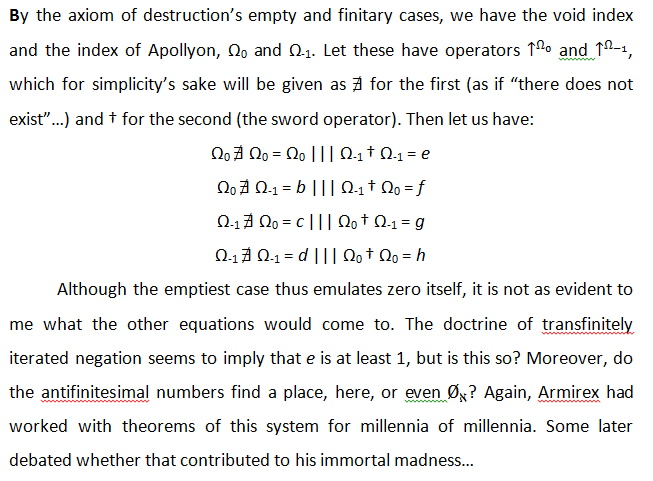
Relevant to "Armirex's equation," the object of a trope in the legend of Ripheus. The equation was a well-formed order of operations in aleph-space whereby Armirex channeled the power of the Form of Evil (among other things) to silence Apollyon at the end of the Last War. Later, Armirex was able to draw on the power of the Septatheon inasmuch as these mirrored the Form of Evil as false conceptions of deontic reality, making use of the equation again. Since no one ever performed the operations except Armirex himself, no one knows how short or long the proof of the equation is, though some speculate that it could be distilled into a relatively simple (finitistic, even) form.
-
I've had occasion to obsess over infinitesimals, of late, and I came up with a perhaps naive hypothesis about how to characterize them "intuitively." Let us say that every real number has aleph-zero many digits. This means that we will at least count to a ωth digit if we read out their decimal expansions. Now allow, then, that there is some number for which the ωth digit is 0, but if there is a next digit, this ω+1th is 1. This number is therefore infinitely small but not equal to zero. Voila, an infinitesimal! So think of something like 0.000 ... (ω 0s) ... 01. This is variously the smallest or largest such infinitesimal.
But this model allows us to go on fracturing the continuum. Suppose, then, that after the ω+ωth digit, we go back to an infinite countable sequence of 0s, succeeded by another infinitesimal sequence, and so on. We will have a whole realm of infinitely broken numbers. But we will also have realms of permutations of these options, and so on.
The intuitively maximal case is to go on to imagine a number whose decimal expansion goes at least to ω1, the first uncountable number. That is, it has as many non-zero digits as there are numbers in the Continuum (we're presuming the Continuum Hypothesis). Such numbers, if they are complete (nowhere broken) are each in themselves indecomposable continua, up to the "syrupy" case of the Brouwerian model. In fact, the whole occurrent model appears to allow us to exactly formulate whether and how a continuum is decomposable or not (think back to those fractured sequences), or at least to frame comparable questions relative to a category either akin to or under that of decomposable and indecomposable continua (c.f. the notion of density in this context).
-
And depending on how far we've counted, we can go on to characterize "small infinitesimals," "very small" ones, ineffable ones, omega cases, etc. much like we have lists of large cardinals with various descriptive names. And so on and on, ultimately to the antifinitesimal numbers. These can then be applied to the description of the Keyscape in the allegory of Ripheus (as playing a role in the mathematics of the Keyscape relative to the hold on Apollyon's potential access to the Final Power, via a relationship between the idea of a "rift in Cantor's staircase" and the complete brokenness or emptiness of an "anticontinuum" or pure void (or whatever as such)).
-
"Only a few among the Host of Ripheus proved to be versed with antifinitesimals, or even metafinitesimals for that matter. Vyrian Armirex was one, to be sure, but there were others. Another group who later showcased some great aptitude with the system of those numbers were the Dark Metroarchs, who studied this set of transfinitesimals as part of their research into a method to destroy the Shield. The Precentor of Despite, Haller D'Mares, is said to have almost gone insane while performing some functions in this sphere (an attempt to construct an object like the Typhon from separate lesser masses of sincrystal), and most Fallen Artificers are known to have inadequately dealt with them in their application to the transequent order of amendment. Indeed, the relationship between these numbers and the ultimate void of zero by itself is itself an eternal abyss, immensely unfathomable, 'hungry and so wishing to be all-consuming'... 'Only the Form of Evil's own special numbers are as dangerous in principle to reflect on in particular...'" [Can you imagine what happened in Armirex's mind when he drew on the Form of Evil's power to help silence Apollyon at the end of the Last War?]
-
"The demonic numbers were defined in a starkly different way. They were virtual interpolations with specific other numbers given from the axiom system per se nota, such as section-sigma or the void index and the Apollyon index. They only concerned these special numbers, including the whole last staircase. But in fact this amounts here to a reduction to the finite numbers used in the general combinatorics of the final offenses, or rather they 'run out' of evaluation past those numbers. Thus there is no question of infinitesimal forms, or even relatively infinite ones otherwise at all (as such). There is no such infinite sequence of evil in itself as such. Rather, if evil is taken to the power of infinity, it cancels itself out: its intrinsically negative essence negates itself, transforming into constructive reality. So the Form of Evil had no motive to form a standard cardinal game (in the metafinite order), nor a subset thereof in that way."
-
-
In the standard model of set theory, an inaccessible cardinal is loosely defined as one that cannot be reached from smaller cardinals "by the usual operations of transfinite arithmetic." Aleph-1 can be reached from aleph-zero by the successor operation and is therefore not inaccessible. Aleph-omega can be expressed as the sum of all the cardinals smaller than itself, so it is not inaccessible. Depending on how one evaluates the powerset operation's outputs, many other small aleph-numbers are not inaccessible.
In the hyperoperational model of transfinite arithmetic, however, a much more general and perhaps exact definition of inaccessibility can be supplied. Here, we say that a cardinal K is inaccessible if it cannot be reached from smaller cardinals via hyperoperations indexed by ordinals smaller than the initial ordinal of K. For example, suppose k is < K. Have the initial ordinal of K be O. Then K is inaccessible if no operation k ↑a x goes to K for a < O. So cardinals are inaccessible not in an absolute sense as such, but only relative to different levels of the hyperoperator sequence in transfinite space.
-
But that word "naturally" doesn't fit, here. There was a purpose behind the design of the system, Adonalsium's purposes. In some extended theological sense this might count as "natural" but not in the sense of the moons' artificiality.
-
Easy: it was sproaths.
-
Jesus Chrisy!
-
WoR ch 63 - do we know who the woman is pattern wants to visit?
Ripheus23 replied to Miggins's topic in Stormlight Archive
She will be a major character in the ninth planned Elantris novel as well as MBE10 and the 17th AU. -
Metafinity as the foundation of mathematics
Let the finite and the infinite be relative or absolute. By absolute is meant a universal relation: x is absolutely y if in all relevant relations, x is y. For example, if x is to the left of all y, x would be absolutely leftwards (though this is not really possible, let us suppose). Accordingly, we have an order of four metafinite predicates: absolutely finite, relatively finite, relatively infinite, and absolutely infinite.
Next, allow that there are two fundamental numerical questions: “Which one?” and, “How many?” A number is either an answer to some form of these questions, or eventually derives from such answers. Let us refer to numbers as answers to the first question by the term ordinals, the second cardinals. Numbers as answers, in some way, to both questions will be denoted surdinals (with reference, as will be explained far below, to the concept of surreal numbers). Numbers as answers to neither question, used purely to differentiate between some x and y, will be indexicals. Thence, to use the number 1 as a name for someone, and the number 3 as a name for someone else, is to use these numbers indexically; they are not subject to arithmetic as such, which is to be considered an ordering of numbers in themselves. So while we might add 1 and 3 when these are used as ordinal, cardinal, or surdinal numbers, we would never add them when using them indexically. —The four positive metafinite predicates are then generally correlated with four basic uses of numbers.
Our axiom system is a set of axioms and their schemas used in mathematical proofs. The most commonly used such system is Zermelo-Fraenkel set theory with the axiom of choice, which has up to nine basic extralogical principles, some of which can perhaps be reduced to others or waived altogether. Now the attempt to provide a foundation for mathematics, using the concept of metafinity, involves the question (roughly enough put), “Assuming that there is some set of axioms and axiom schemas, why is the number of basic principles what it is?” So if ZFC set theory is true, the question is, “Why are there (as many as) nine such principles?” And according to the theory of metafinity, there would not be nine, but only four, generally correlated with the pairings of metafinite predicates and the numerical erotetic dyad. Indeed, this theory is telling us that we know how many axioms and axiom schemas to look for, without directly knowing as such what the system is.
Let a logically irreducible number be a number occurring in the logical principles of the system. For example, if 0 and 1 are mapped to FALSE and TRUE,[1] then it is unnecessary to derive either number from the other using extralogical principles. Rather than by transconstructing 1 as the simplest successor of 0, for example, we have it immediately, here. Moreover, if this is true, then the classical set-theoretic definition of the ordinal 1 is false: being the simplest successor of 0 characterizes 1, but does not define it. 1 is not actually reducible to the set containing the empty set, or any such thing.
If there are four axioms or schemas, here, what are they to be expressed as? Axiomatic structures are assertoric: the basic case is subjects and predicates, which in mathematics comes to numbers and operations thereon. At least one axiom will give us some numbers to work with, and at least one axiom will give us operators for them. Now in the metafinite context, we immediately know that we have numbers for all the metafinite predicates, so the classical axiom of infinity is encoded into the context. This gives us our basic case of a relatively infinite number, here as an ordinal (and surdinal) and as a cardinal. Arithmetical intuition, and set-theoretic transconstruction, vitiate the idea of a well-ordered sequence of operators, so that our second axiom will be one that gives us the hyperoperation sequence as such.[2] This sequence will be represented under the heading of the axiom of transcension.
The existence of relevantly basic cases of the other metafinite numbers will generally be referred to under the heading of the axiom of transcardinality. This has it that there are relations among the metafinite predicates such that, starting from the transfinite cardinals, we can go on to situate the absolutely and relatively finite numbers fairly exactly. Until actual examples of what this situation means are provided, of course, this remark is not even quite programmatic but might appear rather mystical (at best).
Lastly, the axiom of transfinality collates all the relations of finality that appear in the mathematics of the numbers and their sets referred to here, and adds to them, in light of the metafinite context in total: therefore, in quintessential relation to the absolute infinite. Expressing the concept of an absolutely infinite number in a consistent way is the challenge to be met in this case, as the standard vectors of approach give rise to simple contradictions. By way of a very preliminary remark, the axiom of transfinality involves an extreme reimagining of the principle of foundation in set theory. In other words, though a naively infinite and descending sequence of sets is not to be presented, some infinite descending numerical sequence will be. As far as already-established mathematical systems go, a clear example of an analogy with what we will be looking for is the surreal sequence . But a transfinal sequence is meant to be advergent under absolute infinity, which is an absolutely strong relation to enter into, and so we will have cause to analyze phrases that appear in the literature such as “a set that might as well be as large as the universe V of sets” as well as the equation VV = V (and its cognates, e.g. “”).
Think of the axioms, then, as introduction rules for types of glyphs. The axiom of infinity introduces the aleph glyphset in general; the axiom of transcension introduces the ascending arrow glyphset; the axiom of transcardinality introduces glyphs for juxtaposing the relatively infinite with the absolutely and relatively finite numbers; and the axiom of transfinality gives us notation for the idea of advergence under the absolute infinite. Logical conjunctions of two or more axioms or schema then yield further analogous or derivative glyphsets. The infinitary context also allows us to apply the axiomatic propositions in an infinitary way. There are therefore 23 such adjunctions of the axioms and their schemes to consider, which gives us much to work with, as will be seen.
[1] For technical reasons, the logical system in use here will actually map FALSE to -1. Though in assertoric space, for a sentence to lack truth is for it to be contrary to the true, in simpler predicative space this is not so (that is, absence and opposition are different kinds of difference). Accordingly, though, -1 is also logically irreducible in the metafinite theory of mathematical foundations; it is not to be irrecursively defined, though it may be expressed, as the additive inverse of 1.
[2] To try to consolidate and simplify matters as much as possible, I will be using a variant of Knuth arrow notation for this sequence throughout the text. As will be seen, if the aleph numbers can be assigned a minimum of two indices—a base and a compounding index—then it will be an elegant symmetry for the same assignment to hold of the transcension operator. That this symmetry obtains in fact will be illustrated by the overall system of notation as it is developed
-
I got the impression that Rayse was surprised, angry even, but not afraid. But I can't justify that impression too specifically.
-
No, bringing in Adonalsium like that would be a deus ex machina and would push the story's boundaries too much, I suspect.
-
Suppose that Dalinar reinterpreted the Shard of Honor as one of Unity, and this is why he says, "I am Unity." There are a lot of reasons why that doesn't make any sense, but one I didn't think of before was: then why would Odium act surprised, there? He knows Shards can be picked up and reinterpreted. He also knows that Dalinar is not claiming to be Tanavast, after all. In fact, Dalinar is not Tanavast. Odium killed Tanavast and broke the Shard of Honor, but wouldn't it be weird if Odium was screaming at the Shard of Honor in surprise, then? So Unity is something that Odium thinks he killed and is surprised to find alive then---not the Shard of Honor reinterpreted, seemingly. EDIT: Gah, this is supposed to be in the SA forum.
-
It's also not an unprecedented turn of phrase in general.
-
Might Odium think that the Sibling is dead?
Ripheus23 replied to Ripheus23's topic in Stormlight Archive
What would it mean for a spren to slumber, though? How much different would this be, sprenwise, compared to being dead? (How often is the blankness of some sleep states compared to death anyway?)