



Elegy
-
Posts
945 -
Joined
-
Last visited
Content Type
Profiles
News
Forums
Blogs
Gallery
Events
Everything posted by Elegy
-
It's confirmed that it's the latter: --- I always thought that was the most logical choice, especially since Hoid likes the Shard. But it isn't one we know:
-
Is there any non-Sanderson book you've read and liked a lot recently? What's the most comfortable room color? Is there any smell that makes you feel nostalgic?
-
I actually saved that one for the next Cosmere drought (probably next year, between Rhythm of War and Lost Metal). But yes, I could imagine doing the same for that one once I've read it, if noone else has done it by then.
-
Iroh is one of the most likeable characters ever and Zuko has one of the best arcs ever, so it's pretty much a tie between the two for me, with maybe a slight tendency towards Iroh for how instrumental is he is for the fantastic things about Zuko's arc. My other faves are the rest of the core Gaang, Azula, and Mai.
-
Two relevant WOBs: So those three are not the only systems, since Brandon counts fabrials as one as well. Looking for a symmetrical pattern in three of them might not work out that well. Also, Scadrial's magic being so fundamentally different in the way they work is mostly because the Shards perceived themselves as contrasts of each other, so the magic systems behaved in a similar way. Things on Roshar don't seem to be that simple, since two of the Shards were closely working together, and there's three of them and the lines between which system is of which Shard seems very blurred to me (at least with Honor and Cultivation). They would probably not be as clear-cut in their categorization.
-
I see. But in that case, Autonomy would basically unite in order to divide, so to speak, which, as far as I know, does not seem to be the way the Shardic intents work - Preservation is about preserving, yet he could never destroy to preserve. Instead, he just can't destroy, even if it's in order to preserve. So, following that logic, I don't think Autonomy's goal would be uniting anything, because she just couldn't, even in order to create more autonomy by doing it. That's at least my perspective on it. Maybe things like that indeed change via perception, but all I can do at the moment is going off from the examples we have. My personal theory about why Autonomy (possibly) helped getting rid of the Sel Shards would be basically two seperate things, the first one more likely than the second: The first one, maybe they just despise those Shards that have settled on the same planet, since they don't want too much interaction between them and instead wants them to be independent. The second one ... As soon as a Shard is Splintered, many Splinters are created, and with time (because Investiture), they become sapient, "autonomous" individuals. So Autonomy would principally prefer one thousand Seons over Devotion/one thousand Skaize over Dominion, because it just adds up to more autonomy. Maybe it's both at the same time. Again though, that's all guessing on my part.
-
Autonomy talk is always cool. So, I don't really get the second one, that's actually the concept of Unity or Dominion, which I see at cross-purposes with Autonomy. From what we know, Autonomy seems to want nations seperated, as showcased with Patji's attempts to keep the Ones Above from First of the Sun, possibly Skathan's politics of isolation on Taldain's darkside (if he's involved with Autonomy, we do not know), the Sand Lord's (probably called Nalt?) apparent scheme to extinguish the Sand Masters since they have too much power, Autonomy's isolation of Taldain itself from the rest of the cosmere, and - assuming that Trell is indeed an avatar of Autonomy - the "Faceless Immortal"'s words about invading Scadrial because it has developed too far - probably because they don't want to risk a planet developing faster than light travel and colonize other worlds, degrading their "autonomy" (as will eventually happen from what we see in Sixth of the Dusk, although we don't know whether those are Scadrians or not). I personally think that Autonomy places avatars so those can oversee development on the respective world and intervene (directly or indirectly, given the situation) as soon as a certain line is crossed. That said, that theory has a flaw, and this flaw applies to every theory about Autonomy's grander scheme: The avatars don't work together. As the second letter in Oathbringer (written by Patji) states: "As the waves of the sea must continue to surge, so must our will continue resolute. Alone. Did you expect anything else from us? We need not suffer the interference of another." Of course, this is also in line with Autonomy's intent: Even the avatars are autonomous and work alone. Yet, they all are still Autonomy's Investiture and have a certain tendency, so maybe she just knows (possibly taking future sight into account) that they will eventually help her purpose, even though each of them has their own preferences and assessments. In general, I agree that Autonomy will become a huge deal for the Cosmere at one point or another. Don't know about her as a main villain in Era 4 though, I still kind of believe that we haven't even heard of the things that will be the core conflicts in that story. Knowing Brandon ...
-
Both Sides He didn’t notice the glass door before it was too late. “Oh dear”, one passerby said, laughed, and went on. “Very funny”, he replied, rubbing his head, then noticed someone on the other side running into that same door, whincing. He chuckled. She scowled at him and left, offended.
-
The Lord of the Rings
-
So, there's this WOB: So yeah, while this is not canonical, it seems like the Rosharan System is one of the younger or youngest ones in the cosmere. (I noticed that the other systems with white stars - Taldain and Drominad - are both somewhat notable in terms of astronomy. I took that as Adonalsium experimenting with weirder solar system concepts before the Shattering.) Since there is no fourth white star on the constellation map, Yolen's star is most probably either yellow or red, whatever that means. I like the thought that the red ones tend to be the oldest ones and it's one of those, but that's just guessing at this point.
-
A Conversation “It’s just like I tell you. They’re falling from the sky like bomb shells. Whether you believe it or not.” “But I don’t see anything.”, I say. “Elephants”, he continues. “Fleeing from the cheetahs, I bet. Can’t blame them either.” “We’re in town”, I remind him, but he doesn’t listen.
-
A Problem She couldn’t have told you why she had left him alive. There he was, running. Maybe I should go after him, she thought. But it was too late. Or was it? damnation it, she thought and lit a cigarette. She called her boss: “Hey, I think we got a problem.”
-
No, there's actually a pretty big part of the ATLA fanbase that vocally dislikes it. A lot of people complain about how every season is a complete story, but I don't think that's the actual problem. It shouldn't have held them back from actually developing the characters or creating tension with situations that feel like they have stakes. They just didn't do it and missed so many opportunities to make the series actually compelling that I find it weird that it's from the same creators who made the original, which is a masterpiece in most of the things that LOK lacks in. That said, I personally think it's okay, at the bottom line. It's technically more advanced than the original series, the action scenes are very well-done and the music is great. There's two characters that I like a lot (Lin and Tenzin), but even those don't really have any significant arc, they mostly just are who they are and I like who they are. So, there's stuff to love and I understand why other people like it. But yeah, the complete experience just felt very hollow to me.
-
I don't speak Spanish either (had a few years of it in school, but can't say I remember much), so I can't say much about the contents, but the presentation is absolutely phenomenal. I stumbled over it only a few weeks ago (at most) and considered making a thread about it but didn't really know what exactly to say. The Roshar page is fantastic: https://roshar.cosmere.es/ Technically speaking, it would make a lot of sense for the blue planet on the left to be First of the Sun and the red one maybe Ashyn, since both have the same color in their respective system map depictions. Then again, both planets are fairly unimportant, while other, more important planets would have been left out in that case. Another possibility might be that these are the 5 major shardworlds we have seen on-page and the colors are purely symbolical. Then, it would make the most sense for the red one to be Scadrial, due to the volcanos, the red sun, and rust as a symbol for Ruin. The blue one might be Sel, but the strongest connection between Sel and the color blue I can find is the lake. It definitely has a huge landmass though, just like Sel. I also agree that the green one is probably Nalthis, since the places we've seen from that world have kind of a tropical climate, so it fits thematically. And the right one is probably Taldain, yeah. Maybe someone on the forums here has been involved in the site and can give more definite answers? There's also this loose rendition of the constellation map that I found really nice: The effort that went into the page in general is admirable
-
Ahh, now I understand, I didn't consider that, that's interesting. I think the Honorblades make that kind of unlikely, since they predate the Orders and already follow the same combinations of powers and were held by the according Heralds. Of course, the table positions could predate Honorblades and originally referred to the Heralds, but I don't think we have good hints for that... The Orders being somewhat sorted after their roles in their society might also be connected to the Surges, since some of those are better for fighting, so the Orders who have use for those are clustered at one place and the ones who don't at another. Most of the Surges make practical sense for the Orders, after all. But yeah, interesting ... Food for thought for sure!
-

I Grasp At Straws (Dustbringers)
Elegy replied to BasementDwellingRadiant's topic in Stormlight Archive
Yeah I see where you're coming from. But I think the colors they chose for the Quiz are more reliable, since the symbols on that chart, from what it looks like, are made from gemstones, so there is some lightning/shimmering going on, which makes it kinda muddy in places what the actual colors are supposed to be. The Quiz icons are clearer and from an official source just as well, which is why I would prioritize them when it comes to the color associations. But yeah, Stonewards look pretty bronze on the WOK chart. -
Yes, I agree, and that's basically what I was getting at: The table is sorted by which Order has access to which Surges, not by their themes. And if the Surges and the themes are not directly connected, there's nothing that indicates that the positions of the Orders are thematically relevant. The positions are only relevant for the Surges they have access to, is what I was trying to say.
-
The relationships between the Knights Radiant Orders have somewhat become one of my "Cosmere obsessions". These are some very interesting observations. However, I think that in order to understand how the Orders relate to each other physically on the chart, it's important to ask why the Orders are positioned the way they are. E.g. why are the Skybreakers between the Windrunners and the Dustbringers. And that's actually because they share the Surges. For all we know, there might not be another reason for Skybreakers being between Windrunners and Dustbringers and opposite to Lightweavers other than just them sharing Gravitation with the first and Division with the second, and are the farthest from the third in the Surge-based pattern. So, from that perspective, it's not quite clear whether it's worthwhile to think about the physical relationships of the Orders on the chart in any other way than that - these share Surges, these don't, and so it goes in a circle. There could be a deeper scheme to this pattern, since the Surges and the Orders' themes might be inseperably connected in a thematical way (so which Order has which Surges is so profoundly dependent on what they represent that you would automatically create a thematical pattern by creating a Surge-based pattern), but for now, I personally am kinda reluctant about that and therefore prefer to think of the chart as just that - the Orders sorted after their abilities, not the themes they represent. Sorting them after themes, ideals and possibly even stuff like Spiritual/Cognitive or Honor/Cultivation might have completely different results. For example, Skybreakers and Dustbringers seem to be opposites to me in some ways. Every sequence of oaths represents a specific development, a character arc that is loosely demanded from every member. The Skybreakers start off following one specific code of law, but with every oath, they become more about representing justice yourself instead, with the last oath being themed towards becoming the law - they learn to be confident in their decisions even without the law. The Dustbringers, on the other hand, are hot-headed, and from what we know (which admittedly isn't much), their Knights Radiant Order arc seems to be directed towards becoming more controlled and obedient. So the Skybreakers are overly obedient and must become more confident on their own. The Dustbringers, on the other hand, are over-confident and have to become more obedient. So, what I'm trying to say is, the Orders are probably all related in a very intricate system, but I'm not completely sold on that system being what the chart depicts. There are probably a lot of other ways the Orders could be sorted instead.
-
Not at all, that theory is actually the logical conclusion, I think . . . After reading chapter 38, my initial thought was something like "Oh no, he's going to do that to his characters", and that haunted me for hours afterwards. That's actually why I thought so much about it and came to believe that this wouldn't really be Brandon's way of storytelling, and in my opinion generally not a good way to do it. But I believe a lot of other authors would do it. I personally just hope that he doesn't.
-
I generally agree with this, and it's true that this is not necessarily the place for elaborate political discussions and instead a place to talk about Brandon's books. But those books aren't completely apolitical, just like there's no book that could ever be really apolitical, since everything exists in a political context and portrays things that have an analogy in political reality - and that's why I think it's important to be able to talk about stuff like this even on this platform. - So, this is not a response to a particular comment anymore, but my general opinion: Discrimination is a major theme of not only the Stormlight Archive but a lot of Cosmere and Brandon works in general ... When talking about his books, it's also important to be able to talk about these things and how they relate to reality. After all, the books are born from that political/cultural reality. Brandon himself has repeatedly stated that parts of the Stormlight Archive are a reflection of American history in particular. The Parshendi are in part a comment on colonialization, and in the Dusty Wheel interview some weeks ago he said that one character's history has deliberate similarities to how the "heroes" of history have often actually done terrible things as well and compared it to the nuclear bombing of Hiroshima and Nagasaki. This could go on for ages: Are Taln's thousands of years of pain a recognition of hundreds of years of slavery, the pain of over 12 million of black people abducted and brought to Western countries? Maybe that's a stretch, I'm not really the one to judge, but it is something that needs to be discussed. If we bar that way, we deny the complete significance of anything Brandon writes outside of, well, the mere "stuff that's fun to read" component. And there is no stuff to read, no matter how fun, that doesn't have at least some political implications, and it is important to acknowledge these in a forum dedicated to these books. So, there is no clear line between talking about fiction (what this forum is designed for) and talking about cultural and political topics, which is why the second one will necessarily become a thing and should always be allowed and even encouraged. And of course there should be boundaries to those discussions, and constructive moderation is the key in that case, I completely agree that there has to be some restriction to how they are held and phrased. But they must happen, Black Lives Matter discussions included. Anyway, kudos to the staff because I think this is the most civil site I have ever been logged into, I admire the efforts!
-
There are two reasons why I personally dislike this theory. The first is the thing about the first five being a somewhat concluded story. It would be very odd to comfort someone with what would basically be: "Well, you'll live to read the first 5 and will have an ending that is some of what might be your favorite characters being tortured for what could be the rest of eternity, so don't you worry." The second reason is storytelling-related and has been touched upon many times: Aside from being predictable, it would also set the situation on the same level as it was before the saga even began, there would be a lack of progress and it wouldn't feel like anything has been achieved at all since it's back to square one. It doesn't fit with how important progress and change are to Brandon's writing philosophy. Even in the very first Mistborn book alone, we get a stronger sense of moving forward in the setting than we'd get for the whole front five of extra long Stormlight books in this case.
-
It seems logical, but this WOB lists the Unmade and godspren on two different power levels: Also, the Surge interaction kinda contradicts the 1+1 symmetric principle, since they have Resonances, which is a third power, in a way. The Sibling could maybe be understood as the Resonance of Honor and Cultivation, if you want to put it that way ... So it's not more asymmetric than that. I personally still believe that it's a mix. It would fit the theme of the two Shards being lovers ... I like the thought that they wanted one of the godspren to be their child together. In that case, it would also make sense that it's called the "Sibling", since it's the sibling to both the Stormfather and the Nightwatcher to equal measures. If it wasn't a mix of both, it wouldn't be more of a sibling than the Nightwatcher and the Stormfather are to each other, so the name wouldn't really say anything. Those are my two cents, anyway.
-
I Grasp At Straws (Dustbringers)
Elegy replied to BasementDwellingRadiant's topic in Stormlight Archive
It might be an aesthetic choice - the symbol in the middle is probably meant to look like fire (due to "spark" being the Essence associated with Dustbringers) and would seem less so with a red framework. So now it looks like fire in the dark? That makes me think about what the other symbols are meant to represent (some guesses ... Windrunners = wings, Skybreakers = sword, Truthwatchers = plant, Bondsmiths = crown), but that's a different topic I guess. It could also have a meaning related to how the Dustbringers' sprens are not on the side of the other Radiant Orders anymore, but I doubt that. I would guess that these symbols predate that development. It's actually a somewhat brighter shade of red (in comparison to the Lightweaver's deep red). Orange is the Stonewards color, although it looks kinda brown on the Way of Kings chart. If you look at the Radiant Quiz symbols, the Dustbringer red isn't all that deep either, especially compared to the Lightweaver red. I think it all works out. -
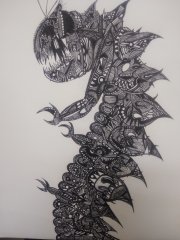 This looks fantastic, very distinctive! Also, the shape reminds me of H. R. Giger's works, which is, of course, a compliment.
 -
There's also these from Stormlight: And the White Sand map: If you count constellation/solar system maps, that opens up a whole other can of worms ... But those aren't of much use for reference while reading the books, so I'll leave it at that!
