


Ripheus23
-
Posts
1318 -
Joined
-
Last visited
-
Days Won
2
Content Type
Profiles
News
Forums
Blogs
Gallery
Events
Everything posted by Ripheus23
-
Maybe he takes pieces from Odium to heal the Shard of Honor, though not (per WoB) Tanavast. But that would probably end up being like
-
Does the Cosmere Exist in a Multiverse?
Ripheus23 replied to SwordNimiForPresident's topic in Cosmere Discussion
If enough people in the cosmere believed that they were in a multiverse, couldn't they make a micro-multiverse, sort of, in the Cognitive Realm? EDIT: I could see this being an interesting region to be explored in MBE4, maybe like a longterm holdover expanding out from the Cognitive storm of Sel... -
Or it is and this is how he destroys in all three Realms
-
The scariest thing in the cosmere would be a sandling and a chasmfiend tethered to a chariot carrying Odium wearing a hat on which Ati was standing while balancing Nightblood on his nose.
-
+++!
-
Bonding Odium to all the other Shards is one of the coolest ideas I've seen for that question
-
In setting forth the new picture of set-theoretic axioms, we would be called to justify our appeal to the Law of the Excluded Middle, and double-negation elimination, so that constructive intuitionism is invalidated. In fact, the construct intuitionist's picture of logical knowledge is deeply flawed: we do not start with an interpretation of
A ^ X = X ^ A [where "^" = "and"]
... and proceed to derive the Law of Noncontradiction from this, and then LEM/DNE if we are "lucky," so to speak. Rather, the LEM is itself the foundation of the system, not in the sense that we deduce the Laws of Identity and Noncontradiction from this, but rather in the sense that our symbolic representation or indication of LEM is prior so that otherwise, we know all three logical laws simultaneously in the same act of cognition. There is, therefore, no actually possible logic that involves identity or noncontradiction but adverts away from LEM/DNE.
But as has been explained, the LEM admits of a proof by erotetic adduction. That is, adduction of the very form of questions themselves gives us the schematic of LEM, which by Q --> A [every form of question implies a possible form of answer] is equivalent to an assertion of the LEM.
-
Ok so Conway/Guy say that aleph-zero^aleph-zero = c... But now I wonder if the zero symbol in aleph-zero is usable in a functional formula as such then???
-
-
... unless I add in a specific variable for the dimensionality of the alephs. I found a way to intuitively preserve functionality (one-to-one mapping via the continuum formula) without violating the appearance of c^aleph-zero = c. Namely, when we raise an aleph number given in a higher dimension (of the glyph-lattice of the Ideal Symbol) to one listed as lower, or to the same one otherwise lower (because it was given first with the lower dimension), we have what otherwise might or might not be "visibly" different glyph-sets. So, the uniqueness of the function of aleph-zero^aleph-zero is masqued by inattention to the dimensional variable (in the system of the IS).
In fact, visually, it is here almost self-evident that c = aleph-aleph-1, because if you take the glyph for a point on the first list, and then use a whole line as a glyph on the second list, the conversion of the point of aleph-zero to the line of the continuum literally diagonalizes to aleph-aleph-1.
The mirror of cofinality
So one thing I have tried to do now, as such, is set the axioms of the theory as simply as can be. So rather than the 8 or so in ZFC, I have, basically, just three.
The axiom of transfinity
The axiom of transcension
The axiom of transfinality
The axiom of transfinity is equivalent to the ZFC axiom of infinity, in giving us aleph-zero. It does not necessarily give this as the implicit sum of the infinite iteration of the {zero}-operation, though. There is an erotetic form to the powerset principle at work here, which we will get to shortly.
Now, the axiom of transcension just says that, aside from the introduction rule for the glyphs in general, there must be at least, and possibly a countably infinite number of ways, to ascend the series. It is equivalent to saying that there is a formula by which the Continuum Hypothesis can be determinately represented re: possible solutions. The concept of accessible vs. inaccessible cardinalities is mapped to this possible series of erotetic functions, namely there is some erotetic set Q1 such that the method of transcension proceeds using cardinal arithmetic in Q1 whereas all cardinals mapped relative to Q2 are strictly (stipulatively?) greater than those mapped relative to Q1 and inaccessible from any point in Q1 as such, and so on through Q3 and ... and Qn.
Or, more generally, the axiom of transfinality allows us to start from an arbitrary higher given aleph or k-number and (try to) proceed downwards. So it involves, for example, the concept of cofinality. However, in my system, the absolute infinite is "computable" (not a technical use of the term), so there is a quasi-sense in talk of starting from the absolute finality of the absolute infinite, down towards the absolute cofinal transfinity (aleph-zero). I actually came up with the start of a description of Q1+ transfinity via deontic geometry, among other things, but the basis for the idea is that we could use the concept of an erotetic powerset inside of Q1 such that we define a k-number to be k-index.n were n is the number of steps in the simplest series of cardinal arithmetic between aleph-zero and k. For example, proceeding via the continuum formula is a one-step simplicity, namely taking aleph-zero to itself as a power. So k.1 is c. What of k.1119? IDK what it would be in particular
 but anyway, we can then define the nexus of transfinality such that it is k.aleph-zero (in Q1).
There's more to it, a lot of which I've technically gone over before. Like, I made a way to define more or less all those weird symbols I used for "equations" earlier this year. But more on all that later...
[Last but not least: "There is a cardinal number X such that X - n is the interval of quantum renormality, i.e. the cardinality of the set of quantum renormalization operations is [hyper]continuous."]
-
-
-
So since
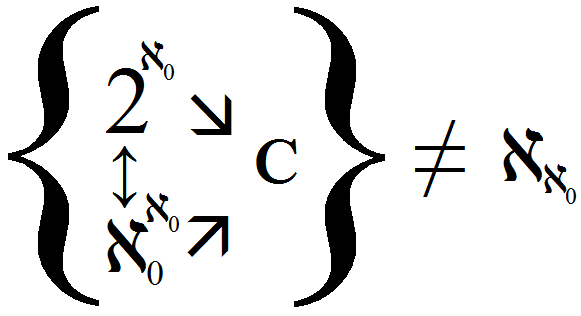 is true, I figured that the Generalized Continuum Hypothesis should read:
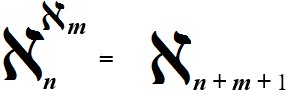
-
However, if this were so, then for n = 0 and m = 1, or n = 1 and m = 0, we get the same result. But the function should map to one and only one result. So the GCH as such is false. In fact, from this, it might be possible to show much about what c cannot be: for example suppose the formula were = aleph-{2^nm}. Then we get that c = aleph-1, since 2^(zero times zero) = 2 to the power of zero = 1. Then aleph-zero to the power of aleph-one would give us 2^(0*1) = 2^0 = 1. In fact, as long as either n or m is 0, here, the consequent aleph would be indexed by 1! So indeed aleph-zero to the power of these alephs, or these alephs to the power of aleph-zero, violate the principle of one-to-one functional correspondence at work, here, infinitely even.
That's the general rule: whatever aleph-n to the power of aleph-m is supposed to equal, it shouldn't be possible to just invert the variables and get the same result. I.e.
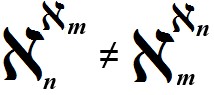
-
[Note: when I say, "That's the general rule," that's as true as far as I know. Granted, inasmuch as my theory is tantamount to an alternative axiomatization of set theory, or even a different theory than a set-theoretic one as such, I might say that these principles are true as far as the model goes, but I think they have more intuitive flare...]
-
-
-
The Set's Faceless Immortals- Sleepless theory
Ripheus23 replied to Nesh's topic in Cosmere Discussion
The Faceless Immortals are actually known to the wider cosmere as the Shapeless Immortals, distant ex-cousins of the Sleepless and the Shiftless Immortals (dragons), plus the Snarkless who implacably oppose Hoid. -
"The set of all sets," is a paradox because we interpret it as, "The set that results from the last use of the powerset operation." But there is no last powerset operation. Accordingly, the concept of the set of all sets doesn't violate the powerset operation, but is founded differently, as in class or category or type or what-have-you theory...
-
Because our sense of sets depends on the notation, we would think "{all sets}" as the set of all sets. But we know that we can make {{all sets}}, {{{all sets}}}, and so on, so... Arguably, the idea would have to be in this case that the mere notation of }}} and {{{, used here, adverts back to the American English phrase "all sets," that is the two sets(!) of symbols have the same meaning...
-
-
Necroception.
-
A beautiful theory. The only sort-of objection I have is I hope that the Dawnshards aren't really Stormlight-sa'angreal
-
The Forge: magic system involving being magically tied to a specific structure called the Forge, which contains artifacts, the Instruments of the Forge, that can be invoked at a distance by people who are Forge-tied. These are usually large vaults of things like hammers, glowing rings, some swords, etc. Depending on how many people channel an object at once, it can start to resonate more and more violently inside its vault in the Forge, until arcane glyphs/runes manifest around it and close off its channel. [The rings are known to glow reliably even when being drawn on by hundreds of thousands of people per ring at a time; and there are millions of these rings in the vaults.] Forgeswords have some kind of fearsome or inauspicious powers, though IDK what yet. I don't want them to be Shardblade-analogs, to be sure

Anyway, the Messiah of Despite was sealed by the Messiah of Daylight ages ago, by allowing the Servant-avatar to perpetrate two of the incarnations of the Final Sins upon his person. It was ages later when the Princess-goddess, Lavaliere Arestroissa, opened the vaults and the Anvilheart of the Forge to the masses of her and all other lands. When the Messiah of Despite arises again, it is to use the flaw in the seal to fulfill the "prophecy of free will": when the Creatrix was destroyed by the Despite-god during the foundations of the world, She imparted a possibility into the flux of history: that at unknown intervals, the forces of the Final Sins would have the power to end creation entire, and it would always be for the people of the world at those times, in those days, to defy evil unto salvation.
-
Here's a nifty way to explain how the Dedekind knife maps to higher and higher cardinalities under the auspices of the continuum:
Suppose the erotetic powerset of aleph-zero encodes the first set of functions that can approximate the epistemic decimals of the continuum. Now, this will be the smallest approximation, so it will map to more numbers than are in countable infinity, but strictly less (infinitely less) than in the continuum. [An "epistemic decimal" is just the abstraction over the concept of using decimal/n representations to identify the countable and continuous cardinalities as such.] By aleph-aleph-zero, we will have all of these serrations of the knife at once, in actuated infinity as such. However, these are still only the maps into the real number line, not the real number line itself, so there is still an infinite subset of the real number line that is not contained in the map through the knife, which is additionally constitutive of the continuum as such. I don't know what that subset actually is [unless the axiom of modality and its analogies make sense?], to be sure, if the premises even are to be granted, for that matter...
Anyway, you can also say that each powerset of aleph-zero through -n expresses an increasing implexion in the complete continuum. That is, assign to the continuum a countably infinite order of implexion, where different infinite sets within it are ordered together upwards, towards the completed infinity. By aleph-aleph-zero, we have all the parts in at "adjacent" state, and aleph-aleph-1 is their complete unity in the continuum. So again, c = aleph-aleph-1.
-
By the way, if it matters, the reason why I'm trying to figure out the Continuum Hypothesis is to make a point about the concept Cantor had of an "absolute infinite." ["Consider that Cantor's intuition told him that a relatively 'small,' by contemporary standards, cardinal such as aleph-aleph-aleph-zero, might be ontologically significant enough to make a theological difference to the question of the Trinity."] But why does that matter? Because my concept of romantic ideality depends on a Kantian gloss of the aleph-series [the ascension through the series, or from the mirror of cofinality [more on that later?!]], and of the application of the concepts of absolutely and relatively finite and infinite values. So, to prove a point about romantic love, I want to resolve the Continuum Hypothesis, a problem that is supposedly unresolvable in the strict sense as such, and for which there is no reward (as with, by contrast, the Riemann hypothesis); so all things considered in the end because of Dean.
[What's worse: I already actually solved a "mathematical" puzzle, that of the liar paradox [I swear I really did and can prove it at any hour of any day], for Dean's sake [back in late 2015], but even this argument would only "add" to the "evidence" for the law of noncontradiction, although it would lead into a resolution of the constructivist rejection of logical bivalence and the value of iterated negation, I suppose, too [technically]. So it would only prove that consistency proofs are meaningful, and proofs-by-contradiction allowable, but not many mathematicians doubt these things, regardless of whether they think there is some "ultimate answer" to the liar paradox [which there is, but again, it's only "ultimate" as far as that goes...].
Also I know the semantics for deontic logic impeccably well, but...]
_____________________________________
Kant's theorem, or the theorem of modal cardinality, says that the set of the possible is equal in cardinality to the set of the actual. [See the section of the first Critique on the "ontological argument for the existence of God," and the discussion of a hundred possible or real dollars, and of the necessity of God.] Accordingly, the transit of modal cardinality can only occur once we have the infinite permutations of the infinite sequences of modal operation, i.e. between aleph-aleph-zero and aleph-aleph-1...
-
OK, so now as I understand it, 3^aleph-zero would = 2^aleph-zero, and so on, up to aleph-zero^aleph-zero. So my method of constructing the first transquadrant of aleph-glyphs using transfinite arithmetic, would not go through, as such. However, putting together all the "known" constraints on the cardinality of the continuum, I've come up with this nifty little "graph":
-
So, I have, however, zeroed in on the logic that would identify c with aleph-aleph-1. Without going into too much detail, I will present the easiest analogy [there's one based on the distinction between potential and actual infinity, that works incredibly well, too, but that's indicated below].
Allow that 2^aleph-zero = aleph-zero^aleph-zero. Now, as far as the continuum is concerned, this = c on the grounds that you can put a non-repeating two-glyph sequence into a one-to-one correspondence with a non-repeating sequence consisting in an infinite number of successor glyphs [i.e. you can convert base-10 decimal notation into binary]. Now, aleph-aleph-zero is the first infinite set of infinite cardinalities. That is, each aleph-number on the list from aleph-zero through aleph-n is an infinite cardinality, but is only a finite set of these. By contrast, aleph-aleph-zero is the successor of an infinite number of infinite cardinalities. If you conceive of the aleph-glyph with index zero to be a sort of transoperator in itself, then aleph-aleph-zero represents two uses of the glyph's operational value as such. But 2^aleph-zero, and by intuitive extension (as well as deductively) aleph-zero^aleph-zero, maps onto the nonrepeating iteration of these two glyphs [that is, at aleph-aleph-zero, we imagine each aleph-glyph as indexed by a number for which iteration of the glyph-form it is, and the cardinality of their nonrepeating iterations is the successor aleph]. Think of it like "2 to the power of the first infinite set of infinite sets," an initially recursive(?) output in the pure set-theoretic domain. Therefore, the value of c = the successor of aleph-aleph-zero, i.e. aleph-aleph-1. QED
Now, to keep the idea of dimensionalizing going, we have to map all the first transquadrant from the first list, which means 2^-aleph-n = (d+1)-aleph (number of aleph-glyphs in a staircase)-(n+1), e.g.
- 2^aleph-zero = aleph-aleph-1.
- 2^aleph-1 = aleph-aleph-aleph-2.
- 2^aleph-2 = aleph-aleph-aleph-aleph-3.
- 2^aleph-3 = aleph-aleph-aleph-aleph-aleph-4.
This might be OK but I have work to do before I can even imagine that this kind of talk is intelligible ultimately
["ultimate ouroboros of causality"]
Oh yeah, hypothesis: using the notion of an erotetic powerset, define aleph-1+ as closer and closer approximations to full Dedekind cuts [infinitesimally increasing approximations] into the set of reals. That is, they are "epistemically" better and better sets, relative to the continuum [their outputs give values closer and closer to the correct ones for actual continuous numbers]. Refer to this process as a Dedekind fractal knife, and say "the fractal knife in itself is forged, if you will, from diamonds made out of Cantor's ashes, smelted in the aleph-crucible unto eternity..."
[Also map Fitch's paradox of unknowability to Godel's incompleteness theorems. Figure out how to apply the erotetic solution to the liar paradox to this issue...]
-
-
-
OMG the series is gonna end with all the main characters collectively writing a book and ZAM Odium gets sucked inside like in that Care Bears movie, and so he switched from being the Sephiroth of the cosmere to the Ildatch, and we find out his meta-arc is about turning into analogies with a whole constellation of fantasy Satans. The book's title will be a ketek of all the other titles
-
!!!!!!!!!!!!!!!!!!!!!!!!!!!!!!! I was looking for something like this XD XD XD
-
"What is the most important title a book can have?" Hoid asked the Sleepless and the kandra. "Hmm," RePaan tried to surmise, "a title where the words are equivalent to the First Oath?" "The True Name of Adonalsium?" the Sleepless wondered. "No," Hoid said, shaking his head. "That question itself is the most important title a book can have. It refers to what would be the most important title, so it must itself be that title. Don't you see? It's like the word 'heterological,' or the group of all groups that don't belong to themselves, or a sentence that claims to be a lie. These are the paradoxes upon which the cosmere is built up and broken down, you understand. These are the noodles and broth on which I live."
-
So, I think part of the Shadesmar stuff, is that Sanderson both probably had his own "parallel dimension that's like Tolkien to the power of Alice-in-Wonderland" thing going on in his head, plus he picked up on the dreamworld-Ways-weird tower-etc. stuff in WoT, so he's really building up Shadesmar/the Cognitive Realm to be a predominant landscape in SOME Cosmere-saga settings. This is quasi-confirmed to the extent that a Silverlight story is in the works. However, I was thinking: the Shards probably corresponded to crystal-like graphs of Spiritual information, in the Cognitive Realm, and so the place where Adonalsium was Shattered was probably IN the Cognitive Realm. Now, Ruin is attuned to destruction, [edit] especially by the overall time period in which he refers to Vax. I'm not saying Vax would be the place in Shadesmar where Adonalsium was Shattered (destroyed). Maybe, but the references we've seen to it are pretty "throwaway" for what would otherwise apparently be a place of immense significance. So instead, I think Vax was a place in the Cognitive Realm that was particularly affected destructively by the Shattering, at least [this would include the site of the Shattering, presumably, without requiring itself to be the same]. This is why Ruin/Ati is confused: by the time he sees Scadrial's Shadesmar subset, it reminds him of another place of great "Ruin" in Shadesmar, a place he saw affected in the Cognitive Realm, during/because of the Shattering of Adonalsium.
-
I came up with what I hope is a super-clever argument for 2^[aleph-zero] = aleph-aleph-1. So, the first thing to do is something like using the aleph-numbers on the first list as Godel numbers for the difference between actual and potential infinity simpliciter. That is, there are finite iterations of the two modality operators for possibility and actuality, as such, and so there is an infinite sequence of further and further iterations for 2^n as such. So, the modal transet ranks of all the aleph-numbers on the first list, are finite, i.e. of finite cardinality (2^n for whichever aleph-n). However, aleph-aleph-zero's modal transet rank should be aleph-zero itself, i.e. countably infinite, as the repeating set of all the sets of repeating such operators,* e.g.
[][][][][][][][][][][][][][][][] ... x
oooooooooooooooo... x
[]o[]o[]o[]o[]o[]o[]o[]o[]o[] ... x
o[]o[]o[]o[]o[]o[]o[]o[]o[]o ... x
But 2^aleph-zero for the modal transets is the successor, then, of aleph-aleph-zero, i.e. is aleph-aleph-1. In other words, it is at aleph-aleph-1 that the cardinality of the modal transet first = c. So c = aleph-aleph-1. [Admittedly, this depends on what might be called "the axiom of modality," which would make the system a "new axiomatization" of set theory in the end. But it's actually worse than that: there's an interpretation of the powerset operation that turns on a representation in erotetic logic. I.e. the powerset of a set of answers is a question that can be computed from a set of answers, but which can't be answered by strict deduction from the set of answers. Now since on my system of things erotetic logic adverts to a sort of "deontic" logic ultimately, or is interpolated with this, or whatever, the distinction between relative and absolute infinity appears here such that the problem of absolute infinity is rendered the problem of the synthesis of the countably infinite number of infinities in Cantor's paradise, with the absolute infinite = to the ideal limit of this series, and unattainable in empirical intuition as such. {But so since Kant says that the deontic value of every individual agent is "without price," and since deontic value is of pure practical reason, as the absolutely infinite synthesis of deontic knowledge, it follows that deontic modality allows us to "access" the absolute infinite.}]
*|||Barcan's formula is: what is possibly actual is actually possible. So for the repeating sets of operators, the cardinality is always the same, even if it should "seem" that actuality contains "more than" the possible. [This is not so, however, as what can be titled with great justice Kant's theorem shows: the concept of a possible x encodes as much internal information as the concept of an actual x.] Their successor, however, is 2^aleph-zero as the infinite permutations of the two operators, so these sum differently in relation to Barcan's formula. I could also bring up the positive and negative imperative operators for imperative-deontic logic ((imperative+erotetic+assertoric)/(deontic-modal) logic) and doubts about Barcan's formula, but I am not going to dwell on those issues, either gladly or hesitantly, right now.
-
Shallan is the Illustrator of Ages. Kaladin is the Sadness of Ages. Adolin is the Handsome of Ages. Ruin was the Ruin of Ages. Hoid is the Mystery of Ages.
-
Does this pop into anyone else's head whenever they think of Spiritwebs? Main diff. for me is that the background is some sunset-cloudscape kind of thing.
-
Continuum Hyperthesis
This idea is that the value of c [ = the continuum] is somehow either the second of a series or the place after the second move across a series. So it would be either aleph-one (a), aleph-two (b), aleph-aleph-zero (c), aleph-aleph-one (d), aleph-aleph-two (e), or aleph-aleph-aleph-zero (f), aleph-aleph-aleph-one (g), or aleph-aleph-aleph-two (h). I'm going to assume for the time being that (a) and (c) are ruled out.
Now, if (d) is true, which is my new belief, then 2^[aleph-0] = aleph-aleph-one, which means X^[aleph-n] = [as many alephs as X]-(n+1). If this is so, then all the alephs from aleph-aleph-one through aleph-aleph-n can be given from the first list of alephs. Accordingly, X^[aleph-aleph-n] would map outside of the set of lists, i.e. out of the first transquare. If this is so, and if the first set on the next set of lists is equivalent to [aleph-zero]-aleph-zero [i.e. an infinity of aleph-glyphs subscripted by zero], then 2^[aleph-aleph-zero] maps to the next dimension of lists, 2^[aleph-aleph-aleph-zero] to another dimension still, and so on and on...
-
-
-
Apparently, aleph-aleph-one is not ruled out, but my theory is going to depend strongly on arguing for the use of the IS to "determine" transfinite arithmetic. This would go with the "game-theoretic" picture of the foundations of mathematics, here.*
*[The idea is that Platonism, constructivism, and formalism are all true: mathematics is about the Platonic form of a constructive formality. More intuitively: mathematics is the 'result' of a 'freely willing creative subject' as in Brouwer, but the subject is the Platonic form of free will, and free will = Intendo [https://stanford.library.sydney.edu.au/archives/win2015/entries/practical-reason-action/#3], which is a game/action-theoretic structure.]
I was trying to figure out WHY on Earth my mind decided, "Let's obsess over 'proving' or 'disproving' the Continuum Hypothesis," and I remembered why: but it's going to take quite a bit to get from "resolving" CH to this deeper reason...
-
 but anyway, we can then define the nexus of transfinality such that it is k.aleph-zero (in Q1).
 is true, I figured that the Generalized Continuum Hypothesis should read:
