Ripheus23
-
Posts
1318 -
Joined
-
Last visited
-
Days Won
2
Content Type
Profiles
News
Forums
Blogs
Gallery
Events
Everything posted by Ripheus23
-
It occurred to me that:
- If corruption is the negation of good predicates, and not the addition of evil predicates, then even corruption can be "reduced to" a destruction-like process, in which case Apollyon alone can represent the Form of Evil, it seems. Maybe.
- Also, in assertoric propositional logic, {X is ~true} = ~{X is true}. That is, contradictory negation collapses into contrary negation, and vice versa, so to say. This does not happen in term/predicate logic, to my knowledge. Anyway, there is a different application of the axiom of opposition, therefore, when it comes to honesty and mendacity, namely, an act can be the physical opposite of a true assertion (e.g. assassinating a whistleblower) or the logicwise-opposite, as in a lie. So the Form of Evil, in lying, is not reductively identical to physical opposition as such (maybe this contradicts(!) the Apollyon-as-the-FOE idea!).
- But also anyway, then, the morality of lying vs. truth-telling can be mapped onto the priority of the concepts of right and evil. I.e. since truth is more strongly correlated with right, and since the true and the right are conceptually prior to the false and the evil, action expressive of the truth carries with it a prima facie or as they sometimes say pro tanto justification.
-
Jesus I didn't even think when I was doing it but I totally made a joke how-to video "How to Atone for the Vietnam War" on Memorial Day haha

-
... This was a clever argument, arguably(!) one of the most clever the demons ever came up with. On a knife's edge did they balance the possible damnation of entire worlds...
It was said, then, that right was what was done according to nature, and that wrong was to do what was unnatural. But in this event right and wrong would not be pure opposites, besides which all wrong would exist inside of all possible right, here, which amounts to the apotheosis of desolation, one might dread... However, the more important point down the line was to deviate from the axiom of opposition. The entire process was, so to say, half a red herring: the primary external victims would suffer greatly as a result, but not because hurting them was in and of itself more interesting to the demons than was hurting anyone else. It just so happened that these ones suffered from a special weakness which, if the demons exploited it, allowed them to open some of the doors to the apocalypse.
So anyway, because what these people do does not cancel out something already-existent action or state of good and right as such, but is merely different from such an external state, it is not contrary to goodness and so is neutral if nothing else. Because this must be so, the control narrative has to be constructed by which to deviate these people from the truth nevertheless.
You start out from a statistical weakness, the question of romantic luck, for them. You see, you have to think that there's much less chance for them to find one person to have a special love for, that is the greatest of all they can feel, here, i.e. it is statistically harder, just so, for them to achieve their romantic ideals. You prey on this [if you are a demon, as it were], because you know this is their weakness: they don't participate in the competitive scheme that you do, they look at other guys and think not so much, "How can I win one over on him?" but, just so to admit this, "I wonder if there's any way I could hook up with him?" Or whatever, haha.
Anyway, this is their first weakness, here...
... [...] ...
... So the demons set it up where these people would be tempted to forbidden sadness on one hand, or promiscuous dissolution, elsewise. Convinced, thence, that romantic ideality is a moral illusion, an impossible gambit, an unacceptable promise, a gilden ticket to the heart of damnation even: you must convince these people that they are guilty, in every necessary way, in order for them to accept being sacrificed to the Destroyer's altar at last.
-
The Rhyshadium are descendants of the Horses of Rohan and the Ranyhyn of the Land. This proves they were created by the Shattering of Adonalsium, since only during the Shattering would the boundary between the cosmere and other spheres of reality have been most thin, hence magical horses from different universes quantum-tunneled into each other, inside of the Shattering, fusing into the Rhyshadium.
-
I noticed that the logic of my argument about action vs. inaction, in ethics/responsibility theory, seemed to lead into an argument about moral dilemmas, too, and now I think I can explain just how these issues fit together. The connecting concept has to do with the semantic satisfaction conditions for imperative sentences/prescriptions. Negative imperatives have negative compliance conditions, compliance being the status an imperative has for semantic satisfaction in the way that assertions/declarative sentences have truth as their satisfaction status.
So, it is false that we are responsible only for wrong things that we allow to happen. If we were responsible for those, we would also be responsible for all the good things we allow to happen, because if we were not equally responsible as such, then negative culpability would be more important than positive attribution, which would entail the concept of wrong/evil (moral opposition) being more important than the concept of right/good. But evil is not more important than good, hence... Also, though, it is false that we are responsible for the good we allow. This is because positive imperatives have position actions for compliance conditions, whereas prohibitive imperatives have inaction for a compliance condition in general. The asymmetry, here, disallows(!) the equivalence.
Now, in the case of a moral dilemma, if one of these were inescapable/unsolvable, it would follow that no matter what you did (thereof), you'd do something wrong. But since you are not imagined to be capable of doing nothing whatsoever in such a case (which is questionable, after all), there is no general compliance condition available for the imperatives that are ranging over you in a conflicted manner. That is, for a moral dilemma to irrevocably go through, it would be necessary for prohibitions to have positive actions for compliance conditions. It is true that indirectly, by inference from a set of imperatives some of which are positive and others negative, one can relate a negative imperative substantially to a positive action, but not as its internal semantic satisfaction. Accordingly, within the zone of a solid dilemma, one would have to have negative imperatives with positive compliance conditions, which cannot be true.
The train of thought that transcendental delusion rides, travels from a mistake about the oppositional priority of good over evil (in that the concept of evil depends on the concept of good to have distinct meaning, as the opposite of what is good (it just is any such opposition; there is no self-defining essence of darkness besides this)), to a distorted perspective on doing-vs.-allowing-harm, to the ethical cataclysm of indefeasible dilemmas. From there, of course, it goes to retribution-vs.-retribution and chugs along back to the galaxy of the final offenses...
-
Re: compliance conditions, the idea is that if you "have" to do something in the dilemmatic context, then you can't be inactive, which means you can't meet the compliance conditions for negative imperatives at all. And the absence of possible inactions, under the circumstances, corresponds to how each prohibition is disjoined over the other one.
Now, there's also an important difference that arises, here, due to the difference between akrasia (AKA "akrasie") which is knowing wrong and doing it, and acedia (AKA "accidie"), which is knowing right and not doing it (although not doing the opposite, perhaps, either). Transcendental delusion needs us to focus on the second concept, when it comes to the absolute-proof theorem, since the APT is the "ultimate weapon" against TD, wherefore TD seeks to subvert the weapon "from the inside." [But, the principle of free will says only the APT-solution to akrasia is specifically possible, here; acedia cannot be negated by the APT but purely by manifest will.]
-
-
I can't remember if someone already suggested this but I was wondering, "avatar" seems quasi-technical, at least a placeholder for a future definite name. For now, our definition amounts to "something that might be like a Cognitive Shadow but that forms independent on the death of the entity." I say "might be" since we don't really know specifically whether this is so; rather, our knowledge of the classical meaning of the word "avatar" compares well with what we know of the relationship between Tanavast and the Stormfather, say, so since the Stormfather is "like an avatar of Tanavast" to the extent that he has absorbed Honor's CS, well... Now, all that being said, let's suppose "having an avatar" is a distinct process in the cosmere. It's a Shard-level thing, too. So, let's say Adonalsium's Investiture is "spread out" across the cosmere on some level, like with the Shards later of course. Like Autonomy, later, then, Adonalsium could "reach out" to pockets of its power and awaken them into avatars. I guess if they had some peculiar value, the idea would be that your avatar could survive your death, perhaps. IDK if that would be why Adonalsium would be doing this. Maybe it would be semi-automatic, even. Anyway, Adonalsium's avatars might have been seen as dangerous overall. Maybe people on Yolen only knew of them by inference, on average, like, there weren't many avatars (or any?) of Adonalsium on Yolen, but somehow, from that vantage point, people discovered avatar effects arriving at Yolen as a result of energy waves coming out of deep space, so to speak. Who knows but let's then say the Sixteen learned to anticipate when/where a new avatar would form. Again, no proof, but let's say that assuming a being as an avatar, requires opening a perpendicularity around/in/through that being. So, Adonalsium chooses someone/thing on Yolen, to be an avatar; the Sixteen intervene; the avatar dies, the Sixteen reach through the gate and steal the flow of power, Adonalsium Shatters. In effect, the Vessels are avatars, even. I was even wondering, let's say you Physically die, you become a CS. What if you CS-die? Let's say you become a "Spiritual Aura." So we'll say that Adonalsium tried to send its SA into its avatar, but this was destroyed, broken. This isn't an important detail of the guess overall, though. If avatars can survive their origins' destructions, then Adonalsium's avatars would have survived the Shattering. However, each would correspond to an Investiture chunk assigned to some Vessel or other. Have we seen any entities, or had them referred to, that might be such creatures? I submit the following possibilities: Suppose there's an avatar on Nalthis, and its chunk gets tagged to Ruin. Maybe it's even a dragon, haha. So, a Ruinous Nalthian dragon... and eventually its essence makes its way into you-know-who (maybe the dragon's fire is what is used to smelt the steel!?). Cusicesh. But this is a spren, right? Right! But according to the subconscious beliefs of the Rosharans, Adonalsium would count as a spren. Avatars of a spren could very well be spren. And Cusicesh doesn't seem individuated as a category-counterpart. It's a unique (as far as we know) being. Who knows, maybe it looks at the Origin every day because that corresponded to a portal that it drew Adonalsium's energy through, and when Adonalsium died, it lost that connection. The Three Virgins of Sel. Imagine, if you will, that Adonalsium managed to Invest Sel's moons such that they became quasi-living, like the planet itself would become later. Maybe the Three Virgins are three avatars in the moons? The Evil. One idea: this was an avatar whose Investiture-pocket got assigned to, IDK, either Ambition or Odium, and down the line it attacked the Homeland, yadayadayada. Now, let's suppose, then, the when Autonomy activates an Investiture-pocket of hers somewhere, she doesn't actually choose how the god-like being that manifests locally as a result, plays out. Instead, the avatar is autonomously determined by the locals, in the sense that their Cognitive power makes an imprint on the activated pocket, and converts it into some relevant form (if avatars are spren-dynamical, this goes without saying, I suppose!). As it just so happens, unfortunately (for example), the only major hole in the modern Scadrian religious situation is occupied by the absences of Ruin and Trell, so quasi-worshipers of either of those images cause Autonomy's activated pocket in the Scadrian system, to become molded to a Ruin/Trell-like form, and the thing that results even thinks of itself as Trell (with Ruin's goal of mass extermination, I suppose?). I know that's a lot to try to extrapolate from one idea, but I'm thinking that if Adonalsium did have avatars, then given what we already otherwise know of cosmere/Realmatic dynamics, it seems like it would be possible for a lot of these "high-energy" phenomena to involve this relation.
-
The idea of antimatter being on the "other side" of the Big Bang, going the "opposite" direction in time, is not mine, I mean my reason for supposing that might have happened was mine (to the extent that I vaguely recalled the thing about antimatter going backward in time being the same as matter moving forward, somehow), but some other physicist (a real one!) came up with the notion already. I found that out from a YouTube video today.
Anyway, if this is all some (admittedly very weird) attempt to solve Hilbert's sixth problem, one thing I had not achieved as of yet was a "deduction" of the intrinsically probabilistic nature of the quantum manifold. I had hand-waved the problem in my head by squaring the probability waves with the requirement that space be perfectly occupied, and it was for this reason I characterized the so-called Higgs/fractal filling of space, below the Planck threshold (sort of), in my theory, as a "quantum fractal threshold." However, I can't say that I am sure there's an inherently probabilistic geometry in my system, not clearly anyway.
However...
There IS an easy deduction from deontic logic---sort of---basically, if free will requires a nondeterministic reality in some way, then the fundamental manifold of the quantum world will be nondeterministic, which in this case translates to probabilistic. Unfortunately, the only deeper application of this notion I have, is difficult for me to process: the "trick" is to think, "For the mathematical pattern of the universe to correspond to a 'fair gem' requires a metrodynamic form of 'fairness,' which can be analogically computed via the concept of the Platonic dice." Now, it is not just any of the dice that we get to roll, though. Only those computed already by the transequent order of the kairogenetic axioplex, are given. So, we have the 4-sided and 8-sided dice, in 3-space; we have the 5-sided, 16-sided, and 600-sided dice, in 4-space [this is mostly because of tetrahelical correspondence, which is fitting, after all, as tetrahelical motion is "ideal" rolling motion for simplectic structures as such]; we have no 5-dimensional dice at all, as far as I know (though we do get a set of "marbles," haha!---the universe as a game of dice and marbles together...). So, the encoding of the Platonic dice, through the sequence of genesis, amounts to the imposition of a probabilistic structure on the rolling of the dice, and so in turn the changes in their corresponding particle sets.
More specifically, though, it seems as though maybe knotical-graphical correspondence can do the "trick."
http://www.math.uchicago.edu/~may/VIGRE/VIGRE2011/REUPapers/Hoberg.pdf
Basically (I'm not saying this is in the above .pdf, I'm saying this is how I'm applying the stuff in general), if you can compute braids and knots simultaneously, you can get braids from knots if given the latter. Now, my theory does seem to give us the latter: when the 5-dimensional crystalscape collapses, it (more or less literally) compresses its mass-energy "downwards" into the other crystalscapes of the lower dimensions, causing all the strict lines of the gemstone architecture to resonate, i.e. spheration adverts to them as their curvature, and due to the axioplex (as a metrodynamic graph-theoretic function), we have the firmament upon which to build the quantum starscape (so to speak) as the axioplex has a relation of special equivalence with a knot-theoretic geometry, which is infused into the axioplex itself (apparently?). That is, the knots that emerge from spheration allow us to compute the braids required for braid statistics, i.e. the superlanguage of plektons.
Now, this might very well falsify my idea [actually, my idea also involves "predicting" that gravity waves can induce deja vu, which if already known to be false, well... or, setting that aside, the deeper parts of the idea involve the "prediction" that certain specific aleph-numbers will be involved in the full equation that states the axiom of physics]. At least, it seems to mean that my idea requires the universe, during the Big Bang, to have been plektonic. So somehow, we'd have to show you could decompose a bosonic-fermionic universe, out of a plektonic one...
-
Now, my theory goes off "space is never totally empty anywhere," but is this true of time? I was thinking it might be, but in the more exotic sense that there is never a period of time that is always empty. So, if an infinite linear tetrahelix is flowing horizontally while spinning, it will implicitly trace an infinite set of overlapping spheres (out perfectly from the linear horizon). So if all "space" was compacted in a possible cylinder at the edges of the tetrahelix, the flow of time could "fill up" all time over all intervals combined while leaving some regions temporarily(!) empty, timewise, so to say.
But, the other idea I had was that the three logic functions that give rise to sigma-actuation, could be mapped to the front of the tetrahedron on the edge of a helix (even if there was an infinite helix, it might have an edge, as a ray, so to say), so that as it spun and moved horizontally, it would by this means compute the transequent order of modality, i.e. the +/- infinite sums, and the possibility/actually infinite sums (two for which direction is "read from"). And the quantity of sigma-actuation at each point would map to the angle of each of the infinite tetrahedra, so it would never repeat exactly, unless the entire system were folded into the fourth dimension of space and somehow transformed into a tetraplex or something (600-cell, otherwise to say!).
[Note: using [] as possible and () as actual, and going from
- () goes to []()
- [] goes to ()[]
- () goes to ()()
- [] goes to [][]
we could start with pure possibility, and get an infinite string of actuality bounded by pure possibility:
- []
- [][]
- []()[]
- []()()[]
- []()()()[]
- []()()()()[]
- []()() ... ()()[]
So if we summed up this entire manifold, we could extract an infinite "amount" of ()-ity from []-ity, thus circumventing part of the problem of how there is something instead of nothing, so to say...
But, at any rate, since the []/() alternations would be mapped to the different orientations of the tetrahelix, we can imagine an infinite succession of these alternations that is "not a rational fraction of the circle" traced by the spirals, as such, or whatever, so rather than following some preformed repeating sequence (just as in the synthesis of (7) above?), we would add in either []'s or ()'s, at whichever interval (from whichever intervals are available at each subsequent stage) was relevant(!).]
NOW, though, I also had a weird and/or storyish idea, namely, let's say the Planck incident actually represents a "damaged" stage of reality, and the expansion of space is a recrystallization of a life-like manifold, i.e. what if the greater universe is "healing" and this is causing the continued, and accelerated, expansion of space? Granted, this depends on a complex para-metaphorical interpretation of the terms, to even be remotely possible: if the Planck incident resulted from a collision of particles in a pure time-verse, which left an objective vacuum in a (3-dimensional) time-space, and so the "essence of reality" (so to speak?) rushed in to fill the vacuum, like a liquid, and the strands of the liquid were these little "realitarian"(!) tetrahelix sigma-actuators...
This would have to be relevant to one character in one story I came up with re: these quasi-physics lectures, to be sure...
-
Anyway, let's have the tetrahedron at the edge of the tetrahelix ray, propelling itself through the time manifold by increasing the size of the tetrahelix (let's say, the edge-hedron undergoes Sierpinski action and the resultant net is strung out behind the pilot tetrahedron?). I.e. the pilot-hedron is displacing itself forward in time. Now, two time-waves collide. I have assumed that the "time-verse" contains particles of some sort, "kairons," and that in the time-verse, the statistics pertaining to the distribution of quantum numbers are randomized over the entire realm, so let's say every kairon has a speed, a direction, and a mass. So, when the waves collide, they convert their mass into spatial mass somehow, that is they have some index corresponding to what their mass yield is after collision. Now kairons aren't bound by general relativity so there could be ones traveling faster than 300,000 kilometers per second and equal in weight to 10-to-the-power-of-1500 solar masses, so we can assume the mass-energy-mass conversion of a collision incident involving kairons could encode enough spatially redistributed information to cover the 10^80-something protons we have, supposedly, for instance.
Anyway, as per the rest of the theory so far, symmetry gives us equal matter and antimatter but the antileptons are deduced from a Planck-Kleinert structure with less actuation to its name than the common leptons (and vectrons, for that matter). So, all the quarks and antiquarks cancel out and eject their energy not just outward in space but in time itself. Most of the primordial antileptons are folded around the time-origin, raying "backwards" in time relative to the baryonic universe, because the past in this context is "less real" than the present (and the vectrinos/antileptons are "less real" overall, here, too), and is causally inaccessible versus the future (since the past is rendered necessary, in context, whereas the future is just what is to still be caused!). So, after an initial cancel-out, there is another rebound of the super-early universe that accomplishes relative baryogenesis by pushing the cancellative weight of the symmetry into an inaccessible state.
-
How many particle correspondences do I have...
Tetrahedra/simplexes: vectrons/leptons/vectrinos/antileptons
Octahedra/rectified pentachoron/rectified hexateron: gluons/quarks/antiquarks
Spheration: gravitons
But there are also ways to virtually get:
- Cube/tesseract/etc. particle sets (simple monadic tessellations)
- Birectified hexatera: part of the vectron-gluon-X sequence (meaning: these = X in the sequence) in 5-dimensional satisfactory tessellation.
- 4D- and 5D-particle sets corresponding to the kissing-number tessellations in 4D- and 5D-space.
And probably some others, I think. So, we could make up a story where the total number of universes was read off the complete sets of particle crystals as such...
-
Quote
Research using virtual reality finds that humans, in spite of living in a three-dimensional world, can, without special practice, make spatial judgments about line segments, embedded in four-dimensional space, based on their length (one dimensional) and the angle (two dimensional) between them.[12] The researchers noted that "the participants in our study had minimal practice in these tasks, and it remains an open question whether it is possible to obtain more sustainable, definitive, and richer 4D representations with increased perceptual experience in 4D virtual environments".[12] In another study,[13] the ability of humans to orient themselves in 2D, 3D and 4D mazes has been tested. Each maze consisted of four path segments of random length and connected with orthogonal random bends, but without branches or loops (i.e. actually labyrinths). The graphical interface was based on John McIntosh's free 4D Maze game.[14] The participating persons had to navigate through the path and finally estimate the linear direction back to the starting point. The researchers found that some of the participants were able to mentally integrate their path after some practice in 4D (the lower-dimensional cases were for comparison and for the participants to learn the method).
That's from the Wikipedia article about four-dimensional spaces in general. It makes me wonder if my notion of a sort of "purpose" in the universe, consisting in the transformation of our physical perception into a geometrically (not---quite---mystically) higher-dimensional form, is possible, at least in the sense that concrete understanding of 4D-space would help with deontic logic, say.
Now, actually, I haven't mentioned it fully yet, but there's a cognitive argument for a 5-dimensional limit on our physics theories, sort of. Namely, we can use dimensional analogies to "intuitively" compute 4-dimensional structures, e.g. as by saying that the net of the tesseract is a layout of cubes just as the net of the cube is a layout of squares. We also have faithful rotational analogies (the gem-like imagery on Wikipedia, for example), stereographic projections, etc. We have some of these for 5D-space, but they are intuitively weaker, depending more on abstract than tangible geometrical analogies. So, 5D-space is the "cognitive limit" of analogical intuition, so (on Kant's scheme, say), it is the limit of what we can acquire empirical evidence of (for the time being!).
-
"One might wonder: it is all well and good that we can turn a triangle into a fractal that is also a net, which net can be folded into the tetrahedral foundation-stone for a tessellation involving another structure as well, and that these can fold and unfold into other geodesics and spherical and helical forms, and so on and on: but what does this have to do with anything, ultimately? Would it not be possible to graph the concepts in question using other structures? It has to be the special requirements of the system that render the 'algebra' at issue, tractable, i.e. since the transconstruction of the axioplex and its 'halo' shapes follows a set parametric, the problem posed has a determinate and, hopefully, unique answer: and that answer is the objective physical universe."
-
https://plato.stanford.edu/entries/logic-combining/ This points, albeit mostly just in my own mind, to the transconstruction of deontic logic from erotetic, assertoric, and imperative logic (with modal logic interwoven somehow).
-

These are relevant to the hosohedra I was considering as part of my "theory," although I haven't quite wrapped my head around them haha!
-
https://en.wikipedia.org/wiki/Sierpiński_triangle Hmm, this indicates that the Sierpinski action can condense into/out of any other "parallel" shape (i.e. any isodimensional shape).
-
 goes to [net]
This net of the tetrahedron is also the initial graph of the Sierpinski action of the unit triangle:
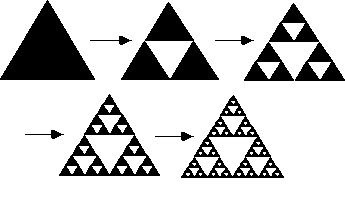
So, dimensionalization+ proceeds across the net-vector (as Planck time passes, the nets produced by the Higgs-Sierpinski action are folded together into the unit of the next-dimensional manifold). Retrodimensionalization (of the spheration wave) compresses/rebounds all the energy, "downward," stereographically, maybe, i.e. maybe the octahedron at the 3-dimensional stage is stereographed into 2-space as the 3-Venn diagram?
-
I think I have come up with the silliest neologism in my theory to date: "the quatrumvoidal redemptrix-axioplex." Actually, it appears in the foolish sentence, "The quatrumvoidal redemptrix-axioplex is the 3(?)-kairoplex."
-
It occurred to me that there might be a natural reason for people to want time-travel to be possible, and to reflect on its impossibility from a sort of wheedling stance. Namely, we often seem to think that the only way to make up, for sure, for some wrongs, would be to time-travel and "make a different choice." However, if this is not possible, but if redemption is possible, then redemption does not require time-travel. In fact, time-travel as such would be more like a time-"rewind" that would leave us unaware of the future course of events that led to the rewind. If our free will is enacted in specific times, as such, maybe we could make a different choice but we would probably never know that we had "originally" made the wrong one. Anyway, we do not leave infinite copies of ourselves in the past, so even if we traveled into the past more "literally," then besides our moving into the past of the space we are currently in, we would probably find ourselves deposited in outer space, relative to the Earth (the Earth, btw, does not leave copies either!), or, more strictly, into a total void---no matter at all, all of this having moved (with its universe) into the future. So, if a false belief about redemption corrupts our beliefs about the nature of time (that "time-travel" is possible), does this mean a false theory of redemption can corrupt our entire theory of physical reality? For a concept of time in which time-travel is possible, violates the laws of actual physical reality, and so is not applicable to the real world.
-
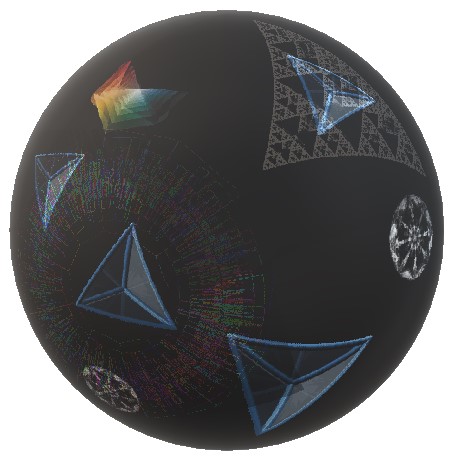
Supposing that there is not just an interpolation from the spheration to the tessellation grids, but the other way around as well, I think there would be cymatic reciprocals (AKA "acoustic reciprocals") encoded into the units of the spheration grid.
-
Well, at any rate, my model now appears, to me, to involve a phenomenon I will call "Venn-Wheeler condensate" specifically (not Kleinert-Wheeler condensate). The idea is that the universe can transcompute the manifold of tessellation from spheration. But now the 4- and 5-dimensional kissing-number tessellations are not the simplectic ones. The spheration wave has "nowhere to go" in actuated 5-space, so the collapsing 5-dimensional crystal transverts its energy into the 4-dimensional space. This gravitationally condenses into a tessellation, that of the 16-cell, that does not fit onto the already-given tessellation of 4-space. So the 4-dimensional realm is wildly distorted. However, when the wave transverts upon the 3-dimensional realm, it harmonically enfolds the already-given tetrahedral-octahedral manifold, i.e. this manifold is now the Wheeler condensate production of the quarks, leptons, antiquarks, antileptons, gluons, vectrons, and vectrinos as such.
The gluonic crystal, moreover, can be produced at this stage as a Venn condensate (this being a more specific variation on the geon-theme picked up from Wheeler, here). That is, a Venn 3-circle space is transcomputed (via stereographic retrojection) into the gluonic octahedron; the Venn 3-circle is assumed from spheration per se (as a form of the effect in general). So the gluons have a lot of "reality" to them, at this stage of the axioplex [axiomatic metroplex], and it seems, so far, that all the pieces of the axioplexity thence assembled, add up the degrees of their intrinsic virtual or actual reality, and give, more or less, the particles that have been discovered, if not yet an explanation of how they now interact (I need to learn A LOT more about QED and QCD to figure THIS out!).
-
*assumed from spheration per se and from triangulation per se, I think I should specify.
___________________________________________
There is a difference between (Simplicity + Tessellation) and (Simplicity + Enclosure + Tessellation). The former gives a triangle in 2-space but a cube in 3-space, whereas the latter gives a 2-space triangle and a 3-space tetrahedra-octahedron. This is because as a pure factor, simplicity would qualify tessellation such that the minimal tessellation involving one kind of shape is invoked. But enclosure qualifies simplicity insofar as the tetrahedron (for example) is simpler enclosure-wise compared to the cube.
-
Also it appears I stumbled upon background-independence as a condition of my system, i.e. I do not seem to presuppose that space has a specific form but deduce space's form from other principles. I wonder if that means I'm at all on the right track
I don't want to end up with something like the CTMU that sounds fancy but is too difficult or empty to reliably apply (although I do want to emphasize that Langan's theory tipped me off to the notion of Venn condensate in particular, so to speak)...
-
-

I wish I knew more about this. It's a representation of an "amplituhedron," which is presumably a complement, supplement, or replacement for my representation of the equivalent process, I suppose...
-
When the spheration of the 5-dimensional crystal is effected, this results in the code for the kissing number in the fifth dimension due to the attempted tessellation of space using the 5-sphere. Since exotic virtual particles corresponding to the implicit manifold of tessellation from the dimensionalized net of the 5-cell, have already been admitted, it does not seem entirely amiss to introduce, here, particles corresponding to a tessellation of space that is a deduction from the spheration grid.
These are, in a way, thoroughly gravitational objects. Let us provisionally refer to them as Kleinert-Wheeler condensate, after a form. Are they dark matter or dark energy? They exist in a virtual continuation of a dimensional realm that has otherwise collapsed wherever else it is not virtual. Now, there are also two virtual gluonic crystals at this stage, and one more crystal shape entirely also, computed purely from the manifold of tessellation for the dimensionalized net of the 5-simplex (after all!). This last shape would correspond to a set of force and matter particles. Indeed, it would correspond to 12 new forces and 45 new kinds of matter. So maybe there's some dark matter or energy in there somewhere, without the K-W condensate.
-
Hmm, it seems as if my deontic-crystal theory implies that after the tetrahedral-octahedral stage of dimensionalization, in the 4-dimensional state the number of vectrons would reduce from 8 to 5, and the number of gluons would increase to 10, with 30 quarks and 10 leptons. This isn't correct, then...
-
Alternative:
At the three-dimensional stage, there are 24 matter particles and 16 force (gluon/vectron/vectrino) particles (and the graviton and Higgs fields are computed separately). The second tetrahedron, and hence the vectrinos and antileptons, is directly computed by both the Moretti and the tessellation parameters. However, a second pentachoron is not computed at the four-dimensional stage, for the sake of tessellation, but it is only added in due to the Moretti parameter, here (the "logical di-simplexes of dimension n"). Accordingly, the 4-dimensional level of reality is "less real" than the 3-dimensional one. At the next, five-dimensional, stage, the principle of enclosure is violated due to the geometric degeneracy of the deontic graph that would appear, here. So, the spheration of the degenerate enclosure (which regenerates it) cascades throughout the entire pentadimensional crystal of geodesic potential, bringing about the dynamical phenomenon of knotical-graphical correspondence.
But the information reduction/collapse at this stage, and the 4-dimensional one, both contribute to the reduction of the equilibrium model, i.e. by the time the universe has entered its post-inflatonic phase, the model seems to imply that most of the primary list of particles will be mapped from the 3-dimensional deontic crystal. [The 3-dimensional level of reality is the "most" real, then, due to a joint satisfaction of the parameters in question?]
-
The triangular tiling does not require multiple simplices at the origin, so the 2-dimensional level of reality would also be "less real" than the 3-dimensional one. So far, then, it seems that if all these descriptions fit together coherently, that the 3-dimensional level of reality is where the energy flux of kairogenesis would stabilize.
-
-
Gluon star story idea(ish)
So, I was imagining how a gluon star might exist. You'd apparently need a lot of gluons. I don't know if talk of boson stars usually has much to do with this option, though since gluons can form glueballs (which I will for the rest of this post refer to as gluonium) which have mass, it seems possible to me for enough gluons to be massed together to form a gravitationally self-bound star-structure (or whatever).
Now, if this is so, as such, it does mean it's gluonium, technically, that's making up the star. So, how does that work? The base is the fact (or assumed fact) that gluons, because they have and carry color charge, unlike light which carries but does not have an electric charge, can be charge-bound together as long as the whole unitary structure is color-neutral. So, for the sake of my story idea, so to say, let's say that there is an ascending series of gluonium types (gluon complexes) that corresponds masswise somehow to the ascending order of quarks and leptons or whatever, so that gluonium can form into atom- and chemical-like structures. For the sake of simplicity, let's work with hypothetical gluonic hydrogen (let's call it "strong hydrogen," on an analogy with the term "heavy water"). Granted the required gravitational pressures, then, a gluon star consisting primarily of strong hydrogen should (hypothetically...?) undergo an analogical regime of stellar nucleosynthesis.
The articles I've read on these subjects include one that talked about something called "gluon fusion" that is used in Higgs-boson runs. I think the temperatures I saw listed as required for this were like 1 trillion to 4 trillion (I think 7 trillion is the maximum they've gotten?). Now gluonium is supposed to be unstable, I believe, like it collapses/decays/cools down/w/e really fast (like fractions of fractions of fractions of seconds fast), so let's suppose the star needs a constant temperature of about 1 trillion degrees, to stabilize the gluonium overall, so the core of the star puts off the required heat and keeps the rest of the gluonium in a plasma-like state (or whatever state is analogous to what the sun's heat keeps itself in). Now, at the edge of the gluonium plasma (glagma!), maybe the exotic mass cools down and decays into other particles. One decay product of gluon fusion itself is apparently Higgs bosons, so if it were possible to detect either a Higgs boson wave as coming off a star or not, or if a star was internally being altered by the presence of a large enough number of Higgs bosons, or whatever, we might have one test for whether a star is a gluon star or not. But also I think gluons can decay into quarks, or gluonium can, so maybe there'd also be a thin sphere-ish layer of pure quark matter at the edge of the star's "atmosphere".
Now I would guess that this star would be super-bright, but I wonder how long it would last. Apparently, boson stars of some kind are relevant to the question of how an active galactic nucleus works (I think the evidence is that they're not the core cause of the phenomenon, but related nevertheless), so they ought to be exceptionally bright in any event, so maybe weirdly bright stars would be candidates for these. (Or: some quasars are gluon stars, or who knows...) So maybe there's that reason to think they'll exist for a long time. But if gluonium decays quickly (or quickly enough?), I think there's a chance they wouldn't last very "long," for a star at least. Let's say they only exist for a few years at most?
-
More for the story: so color charge has a superconductivity relation, just like electric charge. That's true, like, there's supposed to be a kind of matter that superconducts color charge. Now I honestly don't know what that technically means but in the story the idea is that there is actually a Dyson sphere made of gluonium, surrounding a gluon star, and the gluonium is used in some forms to be color-charge superconductive, so they can use it in computer processing using the color charge instead of electricity. Explorers who discover this ancient system call these things "color computers," somewhat as a joke. Now, there are six color charges, so color computers are that much more powerful already than electrical ones. Secondly, the strong force is much more powerful than the electromagnetic force, so it contributes that power to the information states available for computation.
In other words, the Dyson sphere is probably, if not "artificially" or "intelligent," still, a computer with enormous capacities. Now, if it were possible to build a dual electrical/color computer, who knows, that would probably be the most powerful. But anyway, for the sake of the story, the exotic gluonium computers and accompanying---eventually---lifeforms, would just use the color charge system.
These would be the beings looking for the residual inflatons, as it goes. According to them, some cosmic voids are "empty" not due to foam-collapse in the early universe, but because almost all the light in them is being eaten by swarms of black holes in deep space. These swarms' firewalls are constantly blending and creating gravitonic plasma pressure and in a sense most of these buzzing darkness-forces are flowing around each other like amobae in water or some such thing. Some get sucked into others and technically the regions of space in which the swarms manifest might only be a few hundred light-years across on average.
Anyway, the gluonic engineers would provide for a way to access the Kerr singularity at the heart of one void, where a major deposit of inflatons is expected to be available. This relates to the virtual-reality system that the color computers are able to manifest, which allows consciousness to be rotated out of electrons into gluons via a tau cascade (where the electrons transfer their cognitive information to the tau particles, which then decay into hadrons that get mixed into a quark-gluon condensate). Once the color charge process-set of a person has been uploaded into the color "theater" of the gluonium computer system, it can then be transmitted into the ring/Kerr singularity via a special gravitonic system that the engineers design.
-