


Ripheus23
-
Posts
1318 -
Joined
-
Last visited
-
Days Won
2
Content Type
Profiles
News
Forums
Blogs
Gallery
Events
Everything posted by Ripheus23
-
Was Odium permanently ‘maimed’ by Dominion?
Ripheus23 replied to Fanghur Rahl's topic in Cosmere Discussion
I think we're thinking of Shard-fights too Vin-style, maybe. It could be more like chess, say, at least unless a Shard kamikazes the other one. So Vin goes the kamikaze route (maybe something similar happened with Ambition) whereas Aona, Skai, and Tanavast all "played the game" and lost by the rules. [To use a potentially terrible analogy... Bear with me, and think (in terms of the Christian mythos/theory) of Jesus and sin as Shards. So Jesus, as God, would seem capable of just flash-destroying sin, no? But for some reason, He had to go through an elaborate process to accomplish the Atonement. (I don't literally mean "for some reason," as theologians have tried to figure this out for ages and made many proposals, going back to Paul's analysis and the clues in the Gospels to an extent.) So, two Shard-like/level beings "fight," and one wins, but this victory doesn't look like an episode of Dragonball Z so much as it looks like a fusion of a step-by-step game mixed with a logic puzzle, played out as much on a non-divine (read non-Spiritual) plane as otherwise.] -
Random terms/phrases
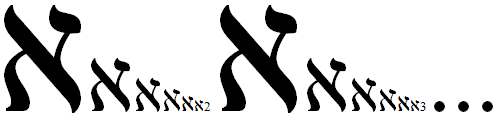
Cantor's staircase. Also the cardinal staircase, the paradise-staircase. Aleph-numbers listed as aleph.0, aleph.1, aleph.2 ... aleph. n, and aleph-aleph.0, aleph-aleph.1, ... aleph-aleph.n, and aleph-aleph...-aleph.n. (This will allow me to one day write a sentence that includes "the rift in Cantor's staircase"...)
- There is (hypothetically) a scene where Ripheus (or whoever) is standing above a hollow pillar, and the interior surface of the pillar appears as fractal accordion-staircases. This is supposed to visually represent Cantor's staircase. (The rift would be a weird distortion, here; we'd probably just have the staircases for aleph.1 through aleph.24 represented, unless the fractals allowed us to represent all of them. Anyway, if there were just the 24, then the 19th would, IDK, look like it was made of obsidian or glowing darkness or something.)
Son of Atropos, the. A poetic/prophetic designation of Ripheus (points towards his sonship under Apollyon).
Ecoarchic isonomy, the. Also the geonomy(?). The total of all economies and deminomies, i.e. all transcreation.
Orthomorph, the. The geometrical designation of the Form of Adventure (Ripheus' cube/tesseract-shaped companion).
-
-
http://mathworld.wolfram.com/LeechLattice.html This should be relevant.
-
-
The Septatheon and the Sea Alone
There is a theorem in the system that says that some set of agents must always exist. This is either a permanent finite number of agents, or an indefinite number of impermanent ones, or an infinite number of either, or something like that. This is where the Noumenal Artificers "come from": they are (trans)created directly by the ethics-magic, to satisfy the theorem. The Septatheon form from/in the infinite-size economies due to an interplay between the infinite form of the theorem and their own spatial extent. Now, like the Artificers who joined the Host of Ripheus, these entities have the power to directly access the magic of the system in the following way: first, they can access the 7-Vennplex to control the hosotopic waves given off by collapsing 7-isoplex crystals.* This allows them to use the hosotopic waves themselves to access the power of the Lachesis aleph-forest and, through this, aleph-7. Aleph-7 being in the economic transet, it is one of those keyed by the seleplex artifexium to the isoarchy. So the Septatheon are, if you will, "hacking" the Keyscape to reset aleph-7 therefrom. This will allow them to affect the codex of the Keyscape, the "programs" that the "computer" runs. Now only one of the Septatheon at a time can do this, so they're dueling each other over who gets to.
*[Waiving the fact that there are rectilinear Venn diagrams... the explanation is that the curvature of the 7-Vennplex can be "folded around" the curvature of the 7-isoplex collapse-waves. Compared to the stable isocrystals used by the Host of Ripheus, these energies might be referred to as isoplasma.]
... The Sea Alone is a phenomenon resulting from the seleplectic rift. Each of the 24 universes has a physical relationship with one each of the aleph-numbers from aleph.1 through aleph.24, and so one has a physical relationship with aleph.19. This does not mean that the 19 universe is blocked from the Keyscape. However, this does mean that the rift manifests physically in that universe, and this is the Sea Alone.
The purpose of the rift, so to speak, was to block Apollyon from the advent of the Final Power. As stipulated elsewhere, the Broken Ones created by the Form of Evil put a different block on Apollyon's access to the Final Power. The rift prevents the original acquisition, the Broken Ones prevent the acquisition-by-transecration.
So, maybe Ripheus thinks that the rift is the Proof of Default. Like, he thinks he needs to drain the Sea to "fill in" the rift, and if he does so he will have completed the "absolute proof" codex that his Host defaulted on when programming the Keyscape. Something along those lines, I suppose...
-
OMG I just found out above these: https://en.wikipedia.org/wiki/N-skeleton No idea how to apply it yet.
Also these: https://en.wikipedia.org/wiki/Extremal_graph_theory
-
-
-
-
OK, so this is the process that I'm working with for the Keyscape:
- Key the chaotic hypoplex to an arbitrary aleph-number (higher than aleph.24 = the transfinite ocean).
- Key 23 of the elements of the economic transet to 23 of the elements of the transfinite ocean.
- List the 23 isoset elements in an order. Starting from 0, add 1 to the transcardinal rank of the isoset if the second listed element is cardinally/ordinally greater than the first element. If it less than the first, keep the transcardinal rank at 0. Continue, increasing by 1 for every successor on the list higher than its predecessor, and subtracting 1 in case the successor is lower, unless the subtraction would = -1. If you choose to place the chaos transet's element earlier in the computation, match it against its predecessor aleph-number according to the preceding rules. Otherwise match the last of the 23 elements to the chaotic transet's element. The maximum increase possible will be from 0 to 24.
- Anytime the isoset's transcardinal rank is computed, the isoarchic numbers are keyed to the economic transet's elements one-to-one (e.g. if the transcardinal rank = 14, the isoarchy is reciprocally keyed to aleph.14). If and only if the isorank = a prime number, the elements of the isoarchic transet are keyed to the corresponding element in the Venn transet (the set of Venn diagrams with n regions, where n = the given prime number; for example, a 3-Vennplex is a geometry whose surfaces include 3 integrated circles, 3 integrated spheres, 3 integrated choronal spheres, etc.).
Since aleph.19 is unkeyed in the economic transet, all aleph-numbers in the cardinal staircase, subscripted by 19, are unkeyed to the isoarchic transet (the aleph-rift). However, the aleph-number which is subscripted 19 at the 26th iteration of the aleph-glyph, is one of the aleph-numbers keyed to the transet of sin. Since the rift-transet is a form of "nothingness," when Apollyon uncreates the Form of Evil, It does so in part by keying the rift-element of the transet of sin, to the antiset. (The Form of Evil is uniquely keyed to two other aleph-numbers, though which I haven't decided yet. 0■ which would be thematically similiar to zero-sharp (http://cantorsattic.info/Constructible_universe#Sharps) is another candidate at least for a symbol for one of the elements in the transet of sin.)
There is also a different process that keys 6 of each of the chaotic and the isoarchic transets' elements, to one of the 4 square-transet elements. This is how the Final Power is created (at least in the abstract).
-
https://en.wikipedia.org/wiki/Randolph_diagram includes information that would be apropos, here.

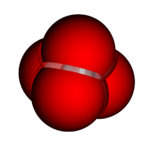
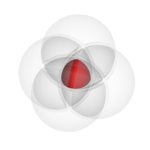
A three-dimensional Venn-diagram (or something):



-
-
-
The action-theory of the economies
So, I was working on the model of the cosmos for the story and was semi-accidentally straddling the divide between a multiverse and a multiplane, or even a multiplanar multiverse. I hedged my bets by coding the universes and the planes as economies and deminomies, but the model clearly required 3 or more universes besides the number I'd already assigned to the plot, which struck a wrong chord with me. To revise this situation, I now stipulate the following: the 24-multiverse does not contain only 3-dimensional universes. Instead of the three 24-dimensional universes being in a separate plane, I now am having it that 3 of the 24 universes themselves are 24-dimensional. Well, actually, I have it that 5 of them are (I'll get into the reason for this in a little while) but so the point is, 4 are always 24-dimensional and 1 of them is constantly changing. I.e. two each of the finite and infinite universes (8 per type total) are 24-dimensional, and the 5th 24-dimensional universe is a different one of each of the indefinite universes at a given time. That is, those universes are constantly fluctuating between 5- and 24-dimensional space, regardless of whether they know it.
So, then, the physics of the system is that all the objective graphs of moral information theory constitute dynamical objects in empirical (phenomenal) space. Because we get a 5-dimensional graph at the end of the basic series, it's presumed that the physical cosmos is 5-dimensional as such. But in principle, there is an n-dimensional set of hyperfractal graphs in deontic logic, so when the "computer of the multiverse" traces all the graphs, besides the 5-dimensional objects that it puts in the 24 universes, it also puts an infinite-dimensional object in its own demi-universe/demiplane/deminomy. For further reasons, there's an aleph.24-dimensional object in deminomic space, so besides the antiplane of Apollyon, we have 2 "higher planes of existence."
However, the technical metaphysics of the story allow us to redefine these 3 demiplanes as deminomies proper. The trick is to assert that the economies are action-theoretic sets.
The Trinity creates the world, as the Test,* by "asking questions" which require an objective world in order for their answers to be given forth. I.e. the Trinity assigns a deontic algebra or aretaic calculus to a simultaneously created universe. Since it is only agents inside these universes that can solve the "algebra problems" of God given to their world, each phenomenal set is "closed off" transcendentally from the others, if not rendered impenetrable. Now the 5-dimensional graph is the outcome of the basic series, which is a set of deontic graphs that correspond to logical operators/constants in moral information theory. But these are all sets that we have living experience with; by contrast, the n-dimensional fractal series (referred to as the Lachesis aleph-forest) is a graph of arbitrarily more complex possible sets of deontic operators, concepts without content. Accordingly, the aleph-forest does not have any particular moral word-problems posed inside of itself as such, and therefore forms not a full economy but only a deminomy (the demiplane of Apollyon, then, is better rendered as the antinomy of Apollyon). It is traversable but invariant (except in relation to the keying dynamic).
*[Since the Trinity is the Game, the Joke, and the Test, a common saying is, "The problems on the Test are based on games where each move is telling or getting a joke, or jokes about games and those who play them."]
Now it is possible to (sort of) explain the actual programming of the system using the aleph-numbers. The aleph-forest corresponds to aleph-zero. In the aleph.24-dimensional deminomy, the power of the numbers aleph.1 through aleph.24 are accessible for keying (with the seleplex artifexium). However, the design of the artifexium only allows 23 of the 24 to be keyed to higher aleph-numbers. So the artifexium gives us 23 aleph-numbers to program with, in addition to those from aleph.1 through aleph.24, minus aleph.19 (this causes a phenomenon known as the aleph-rift, in which all aleph.19-like numbers* are inaccessible).
*[In addition to aleph.0, aleph.1, aleph.2, etc., there are aleph.(aleph.0), aleph.(aleph.1), aleph.(aleph.2), and so on. So, there's an {aleph. ... (aleph.19)}, in an infinite staircase against the surrounding manifold of the aleph-staircase. None of these numbers can be among those keyed for by the other elements of the Key-set.]
The chaotic hypoplex gives as an always-changing set of keyed aleph-numbers, with one element. This structure comes from the isocrystal arrays, since these channel the energy that keys aleph-zero to other arbitrarily higher aleph-numbers. So let's say that gives us something like aleph.x.
Now, I don't want just the staircase aleph-numbers to be in use, so the artifexium deminomy* doesn't just key aleph.1 to, say, aleph. ... (aleph.1762) or so on. Rather, there are many other levels of levels of aleph-numbers, I believe, and in this transfinite ocean many of the keyed-for aleph-numbers are to be located. However, I haven't come up with any specific examples so far. IDK enough about "Mahlo cardinals," for instance, to know whether they would be a good candidate for the plot (aesthetically or logically), here. But just suppose that some of those kinds of aleph-numbers are involved.
*[This one is aleph.24-dimensional, on the assumption that there is enough of a thematic jump (from the 24 economies to aleph.24 itself) to allow for all the aleph-numbers higher than aleph.24, to make up the sea of the Keyscape.]
I don't know if the concept of a transet is valid, since I've kind of just made it up to have the endgame plot go through, but pursuing this concept's application further, let's say, then, that the square transet (for the forms of metafinity) can be keyed for by Apollyon, to the antithetic transet, because Apollyon's power of destruction crucially relies on a theorem in Trinitarian doctrine according to which a transcendental function known as romantic ideality causes essential energy to continuously flow into the physical substance of the world. Since romantic injustice is identified as one of the three final offenses (and thus "part of" the tri-fold Form of Evil), it is via romantic sin that Apollyon is able to block the flow of energy, thus eroding and dissolving the cosmos. (Basically, think of the Form of Destruction, as the Big Bad, using the Form of Evil, as another Big Bad, as itself a weapon.) Now, romantic ideality is constituted, in part, by a special relationship involving the square transet, namely it is possible for one person to be romantically keyed to another person in four different ways, namely the metafinite ones. (So, you'd only be in love with one of the four for a finite time, another you'd indefinitely be attracted to, a third you'd feel eternal heartbreak because of and a fourth, well...) So part of Apollyon's interaction with the romantic injustice of the Form of Evil, allows for the image of romantic love to be counterpointed to the "music" of the antithetic transet (the four Forms of Nothingness).
[The Form of Evil has the transet of sin for itself. This set's three elements can be variously keyed to one specific aleph-number, namely aleph. ... (aleph.19), where the number of "aleph" marks in the staircase is 26, for the 26 quasi-permutations of the final offenses. I.e. it alone (save for Apollyon in the end) accesses the power of the aleph-rift.]
Of course, it is NOT by trying to destroy the entire cosmos, that Apollyon brings about the ultimate apocalypse of transcreation, but by quasi-destroying the Form of Evil. So the erosion-of-substance problem is less a problem for the world of Ripheus than it is the IRL parallel to the spiritual effect of romantic injustice. That is, there is sin in the real world (our world) that = romantic injustice, and the spiritual ramifications of this sin being committed relate to a phenomenon of entropy and accelerated expansion of space in our physical universe.
-
"I will get to this in a little while" = since it is assumed that the theme of the number 24 is the outside reason for the aleph.24-dimensional deminomy, and since the number 24 is derived from the 4! function for the logic of redemption and damnation, then the "fixed" 24-dimensional universes correspond to the 2 worst and the 2 best abstract sequences in the Song of the Order [of amendment]. Since the relative positions of forgiveness and apologizing in the priority-sequence of the Song-notes can be exchanged without affecting the final deontic value of the priority setting, it follows that it is the indefinite universes that can exchange their status as 24-dimensional, hence the shifting phenomenon thereof.
-
-
Cantor's Deck and the Platonic isoplexes
How does the magic dice game work? I've decided that each time the Advocate and Opponent roll the dice, there is at least one card game going on somewhere else in the multiverse, as is named Cantor's Deck. Two players each pick either the Advocate or Opponent cards, and then they get a hand of cards each with a picture of dice on it. There are another Advocate and Opponent card apiece hidden in the rest of the deck. A winning hand is known as Cantor's Hand. The dice depicted in the pictures do not have symbols for whole numbers on them but for aleph-numbers.
Now, an isoplex is a geometry with an infinite-dimensional (aleph.0-dimensional) and infinite number of facets/sides/w/e you want to call them, each with the same number of surface iterations. Now an n-isoplex therefore has n facets.
Consider a 1-isoplex. In this case, each facet of the structure has 1 angle/side/face/w/e, throughout an infinite number of higher rational-numbered dimensions. But a 10-dimensional object enclosed with only 1 point is a degenerate geometry, and in the 11th, and so on and on, up, and down to the zeroth dimension this is so; so these phenomena are also known as isocrystal singularities.
(I haven't thought of a zero-isoplex except by name, but it sounds like it would have some crazy mathematical function.)
On the other hand, some isoplexes might have what I am calling "obgenerate geometries." For example, the 6-isoplex has 6 angles in the 0th and 1st dimensions, which is an overabundance, so to say. (IDK if this is mathematically possible but it seems like it might be.) So there is a range of isoplectic crystals in which they harmonize and endure; otherwise they quickly (almost instantaneously) explode or collapse. These are ones within a certain range of ratios between the isocrystal's obgenerate and degenerate geometries (its obset and deset, as they say). And it just so happens that it is the Platonic solids that correspond to the n-isoplexes that exist within the "island of stability," here. (So 6-isoplexes are stable, for example, as long as their 3-dimensional state is cubic and not hexahedral.)
One aspect of the arrangement is that the aleph-numbers of the Platonic dice are keyed to 2 aleph-numbers in a special transet. This and the dynamic of the isocrystals were an ancient (24,000,000-year old) phenomenon that helped the Host of Ripheus build the Keyscape.
The trick of the Keyscape with respect to the isocrystals is that Ripheus' Host engineered a different artifact to harness the unstable ones. This was a 23-dimensional fractal object that focused the energy flowing through the unstable isocrystals before it was lost to the dissolution of the gems.
Now, the Platonic dice, when rolled, rotate their correspondent isocrystals. This rotation adjusts the flow of energy in the noumenal domain, so depending on whether the Advocate (good) or the Opponent (evil) has the higher score in their game, at any given time, either of the two aleph-numbers keyed to the Platonic transet can be invoked in the physical domain, either increasing or decreasing the universal probability of good or evil at that time (in the use of magic: i.e. if the Advocate's score is much larger than the Opponent's, a much larger amount of noumenal energy gets cycled through the isocrystals and into morally-correct uses of magic).
- Show previous comments 1 more
-
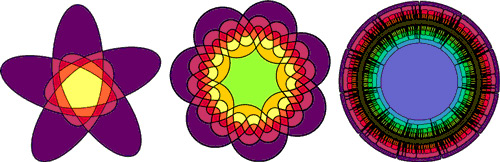
I'm going to assume that there would be a Venn transet, too, keyed for by a Venn-plex (an n-plectic crystal each of whose infinite numbers of surfaces are Venn-diagrammatic somehow---if this is impossible/nonsensical, the Venn geometries would be assigned a different purpose).
It seems like there would be a "transplex transet," too, to cover the aleph-signature for the difference between parts and totals (as a foundation for mathematics that seems to differ from regular set theory).
The degenerate surfaces of the isoplexes would result in hosotopic waves. This is because the "missing" information in the rectilinear isoplectic surfaces could be coded for in lunes and superlunes.
[The metrotopic transet would be keyed from the distinction between geometry and topology?]
Besides being strings of fancy technical terms, these references are to subserve the description of the different "gears" and so on, used in the Keyscape.
-
https://arxiv.org/pdf/1107.1112.pdf refers to things called "arborescent links" which are a topic in knot theory. I feel like a Keyscape component could be described with reference hereto...
-
*coded for in lunes and superlunes: meaning, when the computer of the multiverse traces the unstable isoplexes, and when it "messes up" when tracing the rectilinear desets, it "corrects" the error by tracing the hosotopes that correspond to the degenerate rectilinear polytopes, which traces are "pushed" in wave-like forms (in their demiplanar estate).
-
The Daykey and the Fifth Nothingness
At one point in the first Critique, Immanuel Kant comes up with another one of his random tables of categories and it has to do with the concept of nothingness. He basically says that this concept is what is common to the four categories he tabulates. Now one character in this story is supposed to be walking by a wall in a weird city one time, and he's supposed to see a message written on it (graffiti, blood, IDK): "Apollyon came to destroy that which does not exist." This is supposed to be super-foreshadowing of the endgame, since I want the "let's destroy the Form of Evil by turning it into the Form of Nothingness" to be the endgame danger, but not to be clearly stated ever beforehand. (Like, the idea that there even is this particular danger is not stated outright before, or that Apollyon could even have Its own ultimate plan.)
So, the meta-form of nothingness that encompasses the four categories, might be thought of the Fifth Nothingness. But actually this is a phrase or title that is supposed to show up at random, another shadow-clue, to point towards the end, because the Form of Destruction might be thought of as the fifth Form of Nothingness in the sense that destruction is that which causes nonexistence. And Apollyon is wielding the essence of the Form of Nothingness itself also, in the endgame. So, the shadow-phrase points towards this event.
It also points towards its explanation in terms of the magic system in the story. So, one way to put the theme of the story is "programming the multiverse using the transfinite numbers." Or, "solving word problems in algebra by using the transfinite numbers." Whichever of those descriptions resonates with you, if either. To "program" the Keyscape, which is what allows physical beings to directly use magic, they had to use the transfinite numbers.
This is defined, first, from the notion of keying one aleph-number to another. The idea is that every aleph-number has a cardinality and an ordinality, and a transcardinality (which, under the definition, can also be called a transordinality). Two sets that differ in cardinal or ordinal rank, can have the same transcardinal rank. Sets of elements with the same transcardinal rank are known as transets. So, there's an economic transet, which is the transcardinal rank of the 24 universes (the "phenomenal economies") together. What the Host of Ripheus did long ago, was to use the seleplex artifexium to key aleph.1 through aleph.24 to arbitrarily "higher" (cardinally or ordinally greater) aleph-numbers, and these 24 arbitrarily indexed sets are all in the same transet. This is known as the isoarchic transet since the elements are all equal in rank and this equality is decided instead of inherent. An instrument known as the Daykey is what the Host of Ripheus used to make that decision (an adjunct to the seleplex artifexium, along with a crystal isoplex array). In turn, the elements of the economic transet are keyed to the elements of the isoarchic transet, establishing the necessary "link."
If you're with me so far: Apollyon has Its own transet. This is the transet of the Form of Nothingness. Now, there are also four forms of the finite-nonfinite difference (finite, indefinite, infinite, absolute), and the Final Power comes from keying the elements of the isoarchy to the angles of the Square of Metafinity (another transet). However, when Vyrian Armirex gives His share in the Final Power to Apollyon, the Destroyer can key Its transet itself, to the entire Square itself as a transet.
One of Apollyon's powers is known as Contradiction. (Unprovable objects, objects defined as absences, empty objects: fictitious, privative, and ur-plenary functions are the other three Forms of Nothingness listed (not in those terms) by Kant.) This is the harshest of the Nothingness-Forms so it becomes the image of the transcreation of all possible evil, simultaneously iterated with the destruction of all that evil, to infinity.
So there's actually a totally different original, and still necessary, reason for Apollyon to have a fourfold tower at Its center...
-
The Platonic dice
So, I've had an idea for high-level background characters in the Ripheus story, who I am for now referring to as the Advocate and the Opponent. These are two people playing an eternal dice game. This is an avatar of the Game Itself, which is a moral reality, so if the Platonic solids have a metaphysical relationship to the making of fair dice, let's say that the dice the Advocate and Opponent are using are those solids and hence are known as the Platonic dice.
Now, some other miscellaneous phrases:
- The isoarchic transet. The set of the Key-sets, in which the Key-sets are not ranked except overall against their power-set. The consequence of the isoset function.
- Isoplectic crystal. A crystal with an infinite number of n-dimensional external facets, each corresponding to one n-simplex, with no n-simplex being reiterated.
- Seleplex artifexium. A component of the Keyscape. "Seleplex" is short for "selector function x-plex." Made of the three unique icositridimensional crystals located in the 23-dimensional demiplane of the 24-dimensional plenum (in the conjugate infinitely expansive universe thereof), the 23D-demiplane of the aleph.zero-dimensional plenum, and the 23D-demiplane of the aleph.24-dimensional plenum. Allows each aleph-dimensional object for each level of the set aleph.(1 ... 23) in the aleph.24-dimensional plenum, to be keyed to an arbitrary aleph.n number. The 23 keyed numbers are used in the transet computation performed by the Keyscape ("transfinite algebra"). Since which of the aleph.n numbers is keyed for, is decided by free will, they are referred to as "selected" according to the Second Axiom of Choice.
- Chaotic hypoplex. Always-changing transdimensional crystal keyed by an artifexium function to random aleph.n numbers. When conjoined to the seleplex artifexium, it can be used to change the flow of energy through an isoplectic crystal array, to transpose the noumenal power of the Keyscape into the 24-fold multiverse overall. The day of the Final Power's advent was determined (outside of particular epistemic space) by a computation from the value of the chaotic hypoplex.
-
So, random: future Elantris short story, novella, or full sequel, will include archaeologicalish discoveries of the day and the hour of Odium's slaughter of Aona and Skai. Like, that event will have shattered some ancient civilization, say. There's a chance, maybe, that the Chasm, while not directly formed by their deaths, is a long-term consequence of those. This might be true just because sludging Dominion and Devotion into the Cognitive Realm is what is causing the landscape to evolve into self-aware/w/e life of its own, and so this mutation might have caused the Chasm, like skin ripping apart or something. Anyway, I hope to get a cool description of that battle. It's the only time we know of that Rayse took on two Shards at once and defeated both, although to be sure this kind of process might take place in a peculiar-looking way in the Physical Realm. Like, it might be that the Spiritual battle takes the form of a sort of Shard-parable that corresponds to a special sequence of events in which the involved Shards have Invested, so to say. And there are figures, people, in the Physical Realm, who have a sort of narrative correspondence to the Shards, "champions" of the Shard (so to say; it's possible the Shardic championship principle might apply to the Rosharan situation alone, but as Calderis pointed out, the Shard-tethers from the climax of The Hero of Ages give Elend and Marsh off a vibe of "representatives of their respective Shardfriends" (do forgive me ); OTOH Marsh didn't die when Ati did, so IDK). Anyway, I expect a cool battle scene of some kind, there. Then again I could see a history-lesson scene coming up in a Silverlight novella (or whatever) and describing Ire records of the Aona-Skai killing, or something, maybe. If one of those stories went that way, maybe we'd also get an explanation for why Rayse is pretending to enforce some mysterious pact between the Shards in the beginning. I was thinking of outer-space redness mystery and the redshift issue with bendalloy bubbles or whatever, so I started wondering about Shards and gravity. First off, when a magic system gives a character a clever way to defy gravity, that seems to give that character a special, massive burst of Spiritual Connection to pure space (I say "Spiritual" to capture the euphoria depicted in characters like Vin, Kelsier, Elend, Wax, and Kaladin; this passion is very intense so I think it has a major Spiritual-energy component/effect). Also, Shardic gravity in itself causes space to warp, not within the 3-plane but perpendicular, if you will, to it (in a way akin to how regular and imaginary/complex numbers are positioned around the number line). So, is the Cosmere part of another galaxy or not? I guess we don't quite know. Let's say we did, and it was that there were a galaxy's worth more stars to the Cosmere context, than just those in the Cosmere. Some options: The Cosmere is part of a galaxy, and this is going to (eventually, let's say in 16,000 years from some point) collide with another galaxy. Stars will be destroyed when this happens, and something to do with Invested gravity will be implicated in the problem. The space-weirdness is the image of the approach of this other galaxy. The Cosmere is somehow a galaxy of its own, just with an incredible small number of stars gravitationally bound together to form a miniature galaxy. The Cosmere, then, is in itself in danger of colliding with another galaxy. Now, if the Cosmere were gravitationally bound in itself, what is the cause of this? Maybe Adonalsium was the cause. [Maybe the Cognitive Realm itself is the cause?] Maybe Adonalsium's existence made the intergalactic collision scenario possible, which is why Hoid thought it was "sort of" necessary or whatever to Shatter Him. Who knows but let's say the reason for the pact, then, was to prevent Physical-Realm Investiture singularities from emerging, and even two Shards in proximity can bring these about. Rayse is a hypocrite or other deviant, then, for starters because just by being near two other Shards, Physicallyish, he's magnifying the very threat he's supposedly trying to contain. Although three Shards have been present on Sel, only Roshar has been under their enduringly direct influence for so long. Now, maybe when the two Shards start gravitationally fusing (in the dishardic systems), this manifests as a battle between those Shards. Maybe Honor thinks being married to Cultivation prevents his proximity to her from manifesting as such, and that's why he's not technically violating the agreement by settling with her on one world. But I think that weird residue of obscure hostility that has shown up in the dialogue for all (or almost all) the original Shards to date, might be a weird effect of the Shards having this fundamental tension between each other. Now, it's true, for all we know, Autonomy participated somehow in the Sel and Roshar Shard-slayings. So maybe in both cases we've seen four Shards in the same system at once. There is a way for Autonomy to twist-turn out to be the main antagonist in the SA. I mean we've only gotten 3 books out of a planned 10 so if surprise surprise we get major Bavadin cameos and plotlines appearing in 4 or 5, that will be quite early enough, maybe? So maybe Autonomy could also be the overarching Cosmere antagonist. For example, what if the Dawnshards turn out to be a Rosharan Patji? (Maybe Bavadin will turn out to be behind the svrakiss legend !) However... However, if n+1-Shardic concentrations are dangerous and Autonomy is keeping herself gravitationally distributed in equilibrium, then overall, maybe the let's-collide-with-Andromeda hypothetical plot could still come into play. Like, maybe Odium is the first foil and Autonomy is the second, so it's Edgli-wielding-Nightblood or what, that turns out to be the ultra-twist endgame apocalypse-monster. Or Edgli never pulls off her mask and says, "Haha, the answer was within me all along!" but after Autonomy is KO'ed everyone else is still stuck with let's-NOT-collide-with-Andromeda to figure out. I was also wondering, what if there ARE no galaxy-spanning stars outside the Cosmere? Like, there seem to be some displayed on a chart or something and maybe there are only 16,000 stars in the whole universe or whatever. So let's say Adonalsium's Shattering WAS the Big Bang, and the history of the Cosmere all occurs within the mystical equivalent of the Planck Epoch and its immediate aftermath. If the Shards reconverge, the Big Bang will stop and no more stars will be created when the Investiture singularity occurs, and as long as Adonalsium had been around in the first place, only the stars in the Cosmere existed.*,** So another danger/superplot might be: with Adonalsium dead, the Cosmere star systems are started to slowly drift away from each other. This is causing the redness-weirdness or what. Eventually, all stars will fade from each others' sight and the Cosmere-universe will encompass the fate of cosmological expansion in which each galaxy is too far apart to be cognizant of the others within the framework of the speed of light. This will rupture the essence of the Cognitive Realm itself, sundering it, Fracturing it? anyway, destroying it, the world ends, etc. and so on. Or maybe the hypothetical Shard-hate(!) leads to a Cosmere War, in which every Shard fights every other, or most fight each other, or there are alliances, or who knows, but think Invested Risk I guess. *In which event, we might get a scene in which Sanderson describes the creation of trillions of stars in the aftermath universe. **Let's say there could be time-dilation in the Cosmere, relative to the "bubble" of the Big Bang, so that millennia upon millennia of story-history are able to play outside inside of it. And if Yolen had its own time-dilation factor...
-
The trick, so to speak, is to think of the physical world as like a graphing calculator. The laws of physics are the functions whose inputs yield the geometrical outputs of space. So you might represent the "computer of the universe" as running the following program (where t-units are Planck intervals): Over the interval t(x, y), increase the number of spatial dimensions by 1 (this principle guarantees that, unless otherwise noted, the number of spatial dimensions is always increasing; there is a convoluted philosophical reason for dimensionalization to halt at a certain point, but in this post that philosophical logic is not important). Make sure that no given space is perfectly empty anywhere by Enclosing every given space. Tessellating every array of space. Occupying every region of space.* Choose the simplest function to graph out of the possibilities at any time (Occam's Razor). Over the interval t(0, 1), graph a triangle.** Over the interval t(1, 2), multiply the triangle by a factor of 4 and render the resulting figure in the appropriate number of dimensions. Multiply either the facets by 4 (to get a 3D figure enclosed by 12 lines = an octahedron) or the figure as a whole by 4 (to get a 3D figure enclosed by 4 surfaces = a tetrahedron).*** Over the interval t(2, 3), multiply the tetrahedron by a factor of 5 and render in the successor dimension. Technically, I should also come up with a "law of physics" based on the octahedral element from the previous stage, but I have not done so yet. I also should, technically, come up with a "law of physics" based on multiplying the number of tetrahedral-octahedral surfaces and not just the figures as a whole, but I have not done so yet. 5 tetrahedra enclosing a space in simplified form are known as a "5-cell" or pentachoron. Over the interval t(3, 4), multiple the pentachoron by a factor of 4 and render in the successor dimension. ERROR: a minimum of 6 pentachora are required to enclose a 5-dimensional space. Rectification: A hosotope/degenerate geometry can bypass ERROR. Spheroidal lunes are hosotopical. Therefore, at interval t(3, 4), curve (spherate/spherize/w/e silly/fancy word you wish to use) space hosotopically. HYPERLOOP(A): Graph the "missing" rectilinear facet of the 4(5-cell) as an extra surface in a lower dimension of space. HYPERLOOP(B): Over the interval t(HYPERLOOP A1, A2), increase the dimensionality of the extra surface over and above its normal-matter parallel. HYPERLOOP(C): When HYPERLOOP(B) reaches geometrical degeneracy, holographically reverse its function into the nearest regenerate dimension of space. :loop(A) EDIT: So I have a new theory of how to make the 24-fold multiverse emerge in this sequence. The first step is to have the universe-graph programming stream result in different sequences dependent on special choices at given junctures. So, as outlined earlier, there is a branch that yields either tetrahedra or octahedra first, and then adds in the other as per the axiom of tessellation. Now, if dimensionalization halts at 3 space dimensions, then the pentachoral figure is not produced, but the tetrahedron is multiplied by a factor of 5 to yield an icosahedron. And then the 5-dimensional figure is not produced, but a 3D figure with 80 triangular faces; and this is the hypercorrespondence. Now in 4 dimensions, the icosahedron corresponds to the 600-cell, so there is a function known as the SUPERCORRESPONDENCE: For the 3D figure at the second to last, and last, of the main stages, there is given a 4D or 5D figure that specifically corresponds thereto. This is over the HYPOCORRESPONDENCE: In one of the alternative graph sequences, the icosahedron is reduced back to a tetrahedron. That is, the last stage does not multiple but overrides by the factor of 4. Now, IDK what the 5D analog of an 80-faceted 3D figure is, but whatever it would be, that would be the supercorrespondent space, here. So, 4! = 24, and there is a function f(x) = 4!x in the Riphean system (at the last stage of the main graphic sequence), so the number 24 is important for that reason. For philosophical reasons, these 24 things are the universes. Now, let's say we had a meta-graph in which twenty-four 24-cells were arranged in an icositetragon around an icositetrahedron. This inter-crystal array is an image or symbol of the form of the Riphean multiverse; the interior 24-hedron is the Keyscape. (I think that there must be a 24-surfaced 4D structure where the surfaces are tetrahedra and not octahedra, but I have not found a well-named example yet. So for visualization purposes I will for now suggest looking at the rotation-loop of the 24-cell, imagining that twenty-four times over, arranged in a rough ring, with the entire ring rotating around the icositetrahedron.) And I'm sure there's a relatively easy way to fit the icositetrachoron into one of the graphic sequences described above. EDIT 2: Why does the sequence start with a triangle? Let's say, "because of the Trinity," as stated below. The first fourfold increase is due to the categories of kinds of free will in general (that is, there are four ways to "have" free will). The fivefold increase is due to the semantics of symbolic moral (deontic) logic (my personal assessment of those semantics, to note; other authors might propose up to an 18-fold multiplication, if they were to apply their models to my fantasy scenario). Then the second fourfold increase comes from the categories of making amends (of which there are four: apologies, punishment, forgiveness, and redemption). According to Alessio Moretti's philosophical analysis (his and his team's), there are actually an infinite number of dimensionally increasing graphs of moral-logic relationships; but past the hosotopically-inclined graph, the super-set of graphs is devoid of particular narrative content (for mortal beings who cannot compute the super-set totally in themselves). So I don't have a proposal, as yet, for what meaning to assign to the super-set. ___________________________________ *[AFAIK, fractals are the only geometries that occupy space to infinite magnification. The interior of the smallest physical-matter enclosure of space would therefore be of fractal form (of whatever appropriate dimensionality). Videos of fractals usually present the images as of only one fractal, surrounded by some sort of "empty space." So to preserve perfect occupation, it would be necessary to assume that the universe-computer was graphing at least 2 "parallel" fractals, in the interior of every simple enclosure.] **[In the Riphean narrative, the Trinity exists, but is not known under the formula "three divine persons in one divine nature" but "three divine questions with one divine answer."] ***[This is why I ended up thinking I was "on to something" with this whole picture of physics. I had independent reason to couple tetrahedra with octahedra and then discovered that their pairing (in a specific ratio) tessellates space, and IIRC, besides a cubic tessellation, the tetrahedral-octahedral manifold is the simplest rectilinear tiling in 3D.] Very carefully There's a lot about the mathematics of music that plays into this all, so I hope so! Yes. The overarching metaphysics are addressed in a different thread... I think it was one from a few months back called "Your own magic systems" or something?
-
In the metaphysics of Ripheus and his universe(s), the fundamental geometry of things is given from a special sequence of graphs. That is, the graphs, as geometrical, shape the fundamental units and interactions of physical matter. These graphs are independently identified but now anyway, adding in "dimensionalization," which is the increase over time of the number of space dimensions, the system results in what I at first thought would be an impossible geometrical situation. The idea is that the sequence starts with a triangular graph, which imposes 2-dimensionality on physical space. (The triangle is a graph of the "Riphean" Trinity, the Trinity in his world.) The next step converts the triangle into a tetrahedron by itself, or a tessellation of tetrahedra and octahedra. These make space 3-dimensional. The original multiplication is of the triangle by a factor of 4. Now, the next step takes the tetrahedral component of the 3-space and makes it into a "5-cell": This is because the multiplication is by 5; the corresponding polytope is 4-dimensional. The philosophy of the system has the next multiplication proceed by a factor of 4, which would result in a 5-dimensional object with 4 5-cells for its sides. However, without dabbling in geometrical degeneration (https://en.wikipedia.org/wiki/Degeneracy_(mathematics)), such a figure is impossible. What happens to the "missing" facet of the 5-dimensional graph-crystal? Here, I play on the concept of "holography" in physics. But rather than assume that 3-space is a hologram projected "upward" from 2- or 1- or whatever-space, in the Riphean system, 4-space contains "reverse holography," structures that correspond to the "missing" 5th-dimensional structure. The information that is holographically reversed into 4-space, "travels" along a dynamical "corridor," and this results in a phenomenon known as the hyperloop: energy that dimensionalizes into 5-space refracts through the incomplete hypercrystal, is sent "down" into 4-space, then ascends again, then descends again, and so on and on, constantly building up an internal surfeit of metaphysical force. This would be a perhaps needless mathematical fantasy except that it plays into the explanation of the Anomalies (the error in the Keyscape that generates the Anomalies, feeds off the constant surfeit of moral-magical force: each packet of hyperlooped energy is siphoned into 3-space across a vector perpendicular to the ascent-sequence itself). ADDENDUM As noted in the main thread on this topic, the in-world derivation of the mathematical laws of gravity depends on an obscure correspondence between the tetrahedral-octahedral manifold of tessellation, and the close-packing-of-equal-spheres problem---and the quasi-topological relation between a tetrahelix and a string of spheres. The hyperloop helps describe (or circumscribe?) gravitational curvature, though, due to the relationship between geometrical degeneration (in quasi-Euclidean concepts/terms) and things like "lunes": https://en.wikipedia.org/wiki/Hosohedron The idea would have to be that some of the abstract information "coded for" among the sequence of graphs, is "embedded in" physical space according to a sort of "analogical hosotopy" (forgive me for this almost impenetrable and perhaps not even accurate phrase!), which plays into the overarching conversion of pure rectilinear matter in space, into the intrinsically curving order of matter in space "under" gravity.
-
Those glowing giants no one seems to be talking about
Ripheus23 replied to BrightnessSamantha's topic in Stormlight Archive
Argh, you beat me to the punch! -
Crackpot Theories (A game)
Ripheus23 replied to Toaster Retribution's topic in Forum Games & Random Stuff
Proof: this website. THEORY: When Sanderson achieves IRL exaltation he will create the Cosmere in objective physical reality and have his own godmetal known as brandonium. -
Now that you mention it, it does seem as if the plot of MBE4 will revolve around Hoid being chased by representatives of every major group in the Cosmere.
-
In Soviet Roshar, Cusicesh is drained by YOU! In Soviet Roshar, observing a spren measures YOU! ... firemoss is addicted to YOU! ... the Weeping is rained on by YOU! ... crem comes out of YOU! ... the boon is cursed by YOU! ... the Parshendi wear the skin of YOU! ... Szeth's screams hear YOU! ... the champion is YOU!
-
Not actual facts. Three Shards for Roshar and its storms of Light, Two Shards for Scadrial's mists and geodes, Two Shards for Sel, doomed to die, And one Shard for Threnody's Evil and Home In the land of Ambition where the Shades lie. But one Shard to rule them all, One Shard to find them: One Shard to bring them all And in the dark sands bind them In the land of Taldain where Autonomy lies. And, IF KAFKA WROTE THE STORMLIGHT ARCHIVE... One morning, the Stick awoke from stormy dreams of Shadesmar to find that it had transformed into an enormous fire...
-
This thread makes me think of that program SETI had that allowed the organization to use subscribers' computers to outsource the processing of information packets, only in this case we'd be running a program in the background that involved packets of Sanderson's mind.
-
OK, so the reason the first Ripheus book is supposed to be called The Axioms of Paradise is because the entire series is supposed to encode an elaborate moral theory, or theory of moral information, into itself. One of the keys to the system is the concept of the final offenses, which are the three ultimate forms of sin. Together, they are the Form of Evil itself because one of them is implicated in all wrongdoing simpliciter and the others, despite being fundamentally inspired by the one, are equivalent in demerit.
So, this maximal evil cannot be perfectly committed by anyone, because rationalistic moral psychology rules it out. It is possible to map "consciously" and "unconsciously" to any junction of the three offenses, so there are 26 ways to consciously or subconsciously commit them at the same time. 9 of these would involve consciously committing the fundamental sin consciously, which is metaphysically impossible otherwise speaking, in conjunction with either the others consciously or unconsciously. So, there are only 17 arrangements that can actually obtain.
Now in the story, the Form of Evil is a given entity or object, a real presence. It is, after all, what Apollyon destroys and then transcreates at the apex of the finale. Before this endgame, though, the Form of Evil tries to break itself into pieces that cannot be simultaneously destroyed, implanting its essence in 26 people who it resurrects from the dead: the Broken Ones. These are not wicked people, to be sure. They are infected but not controlled.
The rules of the game, here, are that unless one of the 9 has been killed, none of the 17 can die. Until one of 9 dies, the advent of the Final Power will be greatly delayed. If any of the 9 die, then any of the 17 can be killed, but until one of them is, the advent of the Final Power will be forestalled. So, some of the quasi-protagonists will unfortunately end up accidentally hastening the apocalypse by killing some of the Broken Ones; or these beings will be inspired to kill themselves, or whatever. Maybe one is killed by others and one commits suicide. IDK but anyway, this situation is a counterpoint to Intuition's plot (Intuition being the Shard-like name for one of the Septatheon) to halt the Final Power, which is one of the highest-level arc questions of the series and the only question with two arc-answers (the problem of Intuition and the problem of the Broken Ones; all the other kinds of crisis are faced only once).
- Show previous comments 3 more
-
Now, there's a paradox, though, as I discussed in the thread "An incoherent problem?" since Apollyon is evil, so it seems as if destroying the Form of Evil would result in Apollyon self-destructing. So maybe I should refer to the Form of Evil as the Form of Sin and have the three void-Forms (Sin, Destruction, and Nothingness) as the "meta"-Form of Evil. IDK but I have to figure it out if I want to motivate myself to keep developing this story so much, I suppose...
-
Hmm...
- The Form of Demons
- The Form of Darkness
- The Form of the Void [Oblivion/Nothingness]
- The Form of Corruption
- The Form of Damnation
- The Form of Retribution
- The Form of Sin
- The Form of Fire/Flame
- The Form of Shadow
- The Form of Murder
- The Form of Death/the Dead
- The Form of Annihilation
- The Form of Immolation
- The Form of Offense
- The Form of Desecration
- The Form of Desolation
Hmm, I still like "the Form of Evil" for some reason. But ultimate evil is Apollyon + the void + the demon-Form, so IDK. Unless Apollyon really doesn't have free will? But then Apollyon can't use the Final Power, so... Argh...
- The Sinfire
- The Shadow-fire
- The Form-sin
- The demon-Form
- The Sin-trinity
- The Sin-ark [probably different context-reference]
- The Sin-light
- The Void-sin
- Shadowmurder/Murder-shadow
- "The Ark of Reckoning"
- The Broken Form
- The Sin-covenant
- The Sin-halo
- The Sin-worker
- The Sin-god
- The God-demon
- The Sin-shadow
- The sin-plenum
- The Darkness-god
- The Darkening
- The Ark of Darkness?
- ::: The Truth-light
- The Form of Glory
-
Again, the paradox is partly that Forms are supposed to be changing, but an abstract descriptor in itself shouldn't be given to change... So there would have to be an intermediary condition in which the Forms manifested in a different way than normally-physically... Kant calls such concepts "schema of the understanding," so the transdestruction of the Form of Evil would be the destruction of the schema of evil. But I want a more poetic word...
The alternative would be to represent the Forms as abstract descriptors that depend on the power of the Game, the Joke, and the Test, somehow? This would depend on the metaphysics of transcreation in general, I suppose.
-
I almost necro'd a thread rather than post this new one, but anyway, here's my theory. Horneaters live near a perpendicularity, so at some point in their ancient history, some of them ended up on Scadrial. They pulled a Jah Keved and have descendants among the local fully-human population, who inherited some of the Parshendi bloodlines that the Horneaters have. These are the Southern Scadrians who are rumored to sometimes grow their faces into their masks, maybe due to some Identity metamorphosis (the masks are Invested and if the wearer "believes" long enough that the mask is part of their face, their residual Horneater sDNA kicks in and melds the mask into their face, or something; maybe it's a combination of Rosharan AND Scadrian sDNA, with the Preservation residue molded to the Honor/Cultivation influx to produce the full effect or what). Their Horneater heritage is reflected in names like "Allik" and a remark like, "I'm going to pretend that you did not just compare me to a common lowshipman [emphasis added]" (TBoM, pg. 334). NOTE: Iyatil having Southern Scadrian heritage (in her ancestry, not directly) and being on Roshar, would not be so much of a coincidence, let us suppose, if the above were true. But it is not itself an article of evidence in favor of the theory.
-
Kudos for recognizing this. I've either thought of the Moelach one before, and Ashertmarn called to mind "Ashtaroth" (from religion/SOUL CALIBER), or I'm remembering another post, but I've not seen a comprehensive list like this before. For what it's worth, I think Yelig-nar might be a straight Lovecraftian-inspired name (or maybe it pertains to Yggdrasil, the great tree of the Norse mythos?).
-
Oooooh this gives me an idea. Susebron :: Susebronium Siri :: Sirium Silence : Montanium Waxillium :: Waxium Vin :: Vinium Lopen :: Lopenium TenSoon: Tensoonium Edgli :: Edglium (because the alternative is Endowmentium) Skai :: Dominium (because the alternative is Skaium) Hoid :: Cephandrium/Midium Frost :: Frostium Straff :: Straffium Stick :: Stickium I feel like I'm missing the really silly-sounding ones...
-
In Soviet Roshar, the black sphere is mystified by YOU!
-
If the Evil is THE ultimate evil of all...
Ripheus23 replied to Ripheus23's topic in Cosmere Discussion
Re: my argument in the OP, I have come up with a counterargument. I think a recent WoB said that the Threnody novel is in jeopardy, like it might never be written. If the Evil was going to end up being the Big Bad of the Cosmere, it seems like we'd get a novel about it for sure... so unless the WoB is a reverse-clue, it indicates that the Evil is not that important of a phenomenon. -
Who in the Cosmere so far is the Most Evil?
Ripheus23 replied to Xaladin's topic in General Brandon Discussion
I've had an epiphany. The Evil is the most evil of all, it's in the name! -
Crackpot Theories (A game)
Ripheus23 replied to Toaster Retribution's topic in Forum Games & Random Stuff
She might as well be. We'll never see the Threnody novel anyway THEORY: Waxillium is a Dawnshard (hint: his nickname "Dawnshot").

