


Ripheus23
-
Posts
1318 -
Joined
-
Last visited
-
Days Won
2
Content Type
Profiles
News
Forums
Blogs
Gallery
Events
Everything posted by Ripheus23
-
Accidental Cosmere-creepypasta leftovers from a post-edit attempt
Also known as "whether Sanderson left a meta-clu .
, s of realityp ny, so to speak, seeming normal and becoming mur remember if this was a specific sub-scene or more a collage ofdescthe linesli s being the creepy shadow-version of the stark base, just as the subtle tyranny is the creepy version
,ry time (that means my mind can't be broken of this belief
 ): there wilny-arcs incallandor-f Lik,the ther ar . Bear in mind, then, that this theory entails that Dominion was never evil, regardless of whether the Skaze are now (so to speak), or whatever. He might've been in danger of becoming an evil like that but who knows, maybe any of them can, in principle. Anyway...
So, assuming that Odium is equal to ,e-tortBraize-tortur Braize-tortureBraize-torture-v Braize-torture-victorture-vict ( ( e. In fact, whenever Odium ts a magic system base b pa , . tormencti whate
( "" ( a
-
Woah I do not know how to edit fast on a phone
-
Because the unit circle inscribes pi, but is also determined from the unit number, it arises that the increase of spheration for orthocrystalline matter is not pi itself, but pi minus 1. That is, spheration takes the orthomass and increases it (conceived as a unit of mass) by 2.14&c., as a distinctly used numerical value (not just a virtual implication of the ratio of 1/pi). So, the orthomass is, for a fraction of a second, equivalent to itself times pi. However, now we subtract 1 from pi, so the consolidated orthomass (after spheration) is 2.14&c. The loss of mass is due to the absence of a spherical tessellation of space, as such: there is a virtual "void" or "vacuum" between the unit-spheres of the pure spheration grid itself, and when this void is superimposed over the orthomassive grid, it "cuts out" or "deletes" a unit of mass for all the sections of the orthogonal tessellation that it covers. The expression, then, of the increase of spheration is:
1 + (pi - 1) - 1 = M
Because the virtual mass of gravity particles (as spheration) itself is less than the virtual mass of non-gravitational particles, this weakness of gravity is compounded all the more in relation to the other forces.
... It stands that there is an interesting infinite expression-series as:
1 + (pi - 1) - 1 + (pi - 1) - 1 + (pi - 1) - 1 + ... &c. ...
---though what this entails for the doctrine of spheration, I don't know.
-
Also known as "whether Sanderson left a meta-clu . , s of realityp ny, so to speak, seeming normal and becoming mur remember if this was a specific sub-scene or more a collage ofdescthe linesli s being the creepy shadow-version of the stark base, just as the subtle tyranny is the creepy version ,ry time (that means my mind can't be broken of this belief ): there wilny-arcs incallandor-f Lik,the ther ar . Bear in mind, then, that this theory entails that Dominion was never evil, regardless of whether the Skaze are now (so to speak), or whatever. He might've been in danger of becoming an evil like that but who knows, maybe any of them can, in principle. Anyway... So, assuming that Odium is equal to ,e-tortBraize-tortur Braize-tortureBraize-torture-v Braize-torture-victorture-vict ( ( e. In fact, whenever Odium ts a magic system base b pa , . tormencti whate ( "" ( a EDIT:
-
The concept of the True Words derived from the "mystical" side of action theory. The idea was that there was a special set of action-types that corresponded to "letters" so that, if the actions were performed in a sequence, with the right moral context (the "syntax"/"punctuation"/"grammar"), then those actions implicitly would spell out commands, assertions, and questions, in the "True Language." Now, it was of course possible to question whether each action-type actually corresponded to a letter or a word, as such, but moreover, then, it was possible to define the transentential simplexity or transplexity, which was a True sentence with a subject-word and a predicate-word, each word consisting in one letter (indeed, the absolute transplexity would be the one in which it was the same word that was being used as both subject and predicate).
The deity-theory of the transplexity is: it is the act-type of creation that corresponds to the subject-predicate word-unity of the transplex axiom, i.e. God performed the act of creation twice in succession so as to state the True Words of the transplexity as such. Accordingly, God would be the only one Who can "say" the axiom, in the True Words. And the True Name of God is an action-type that only God can perform, perhaps.
-
All seemed lost. Everyone was dead. Again. Except Kaladin. Again. Even Syl had started to fade, defeated by Kaladin's defeat. "Quickly..." she whispered. "Swear... swear..." But the Knight Radiant knew in his heart the Words he must say. The risk was beyond profound, beyond the end of worlds. Kaladin---son of Lirin and Honor---imperiled all reality. His heart had broken too much already, long ago. He said the Words. "I promise that this sentence is false." Syl screamed. Pattern, who manifested as a Cognitive Shade, screamed. Adonalsium screamed, deep in the past. The Reckoners screamed, as their world began to fuse with that of the Cosmere, as all logic and coherence dissolved into mist.
-
... In addition to denying the attribute of absolute simplicity to God, this model of the divine nature also denies that God is necessarily good and almighty. For example, if it impossible for a being to necessarily freely will to be good, then God is good contingently. The divine nature is still an ultimate exemplar of what is good, but this is not absolutely necessary. However, to be sure, this does not detract from the divine glory at all, since it would be futile to attribute to this glory a goodness that cannot exist. ...
Now also, however, if ethical truth is determinative of the divine questions (the question of the divine nature), it follows that ethical truth would not allow for any being to be almighty, since if this being chose to be evil, nothing could defeat it and the world would be damned forever. But the world ought not to be damned forever; hence...
It remains to be said that it is possible for a being to have free will without being able to choose evil. Free will in itself is just choice, and since besides the forbidden there are the permitted, the obligated, and that which is beyond the call of duty, it follows that we have a choice even if we can only choose from those three and not also a fourth (evil). Wherefore it would seem possible for God to be necessarily non-evil. If this were so, it would follow that it was possible for God to be almighty, maybe. But I'm not sure.
Now, there doesn't seem to be any "ethical" reason for God not to be omniscient. Indeed, the way in which God knows things seems to be the most specific way in which God is God.
... In those days, during the False Apocalypse, the Sin-knight worked to bring all the world unto Its revelation, the visio malum,* the song of evil. But during the True Apocalypse, when the True Knights do their great work...
[*Opposite the visio beatifico or audio beatifico, the vision or song of God.]
-
A question that arises is why the crystal graphs would unfold in a sequence, rather than be superimposed into each other simultaneously, or dimensionalization setting the total structure to its 5-dimensional estate at once? The explanation was that deontic-epistemic logic required agents as we know them (in ourselves) to understand the deontic crystal in a sequence, over time a priori, so that the epistemic requirement was transferred over to the physical sequence, and the universe did not start in a higher-dimensional state but has intensified and expanded into it.
-
[It was also inferred that if dimensionalization occurred at once, then since Minkowski time is itself infinite-dimensional, it would follow that the entire Moretti set (of deontic graphs) would be graphed in all dimensions at once, and the universe would be absolutely infinite, which does not seem to be exactly the case.]
-
-
When the sorceress awoke, she was on a rock ledge, pastured over by veldt plants, under a sun of blue. The shade of the sky moiled with the clouds, casting their shadows into themselves like molten turquoise.
She had no idea where all that would be.
She had no idea when she was, for that matter. Something had happened. I wouldn't just wake up in the middle of nowhere, suffering a shock to my memory, unless something happened.
The next thing that happened, as she tried to get her bearings, was that a creature appeared. The taste of cheddar cheese came over the sorceress, as if the sensation of cheddar were outside her mouth or mind, coalesced as an animal---something like an orange-yellow sloth, it seemed. Inexorably, her synesthesia made her believe, with the force of imagination almost as vivid as hallucination, that she could actually see the cheddar sloth where the sensation contoured itself in that form, on the grass to her side.
The creature chirped up to her---she could hear it, and the sound didn't taste like anything, to be sure.
Checking herself for leaves---she might carry edible ones, after all, since she supposes she must be a resourceful sorceress to have survived whatever thing that happened that ended up with her here, in this wild land---and finding none, she shrugged at the sloth-thing. It half-mimicked her gesture, then laid down on the ground as if in defeat.
Off in the plain below, the sorceress tasted another species. Auroch-yaks baked of bread, it seemed. They grazed silently, from her vantage, though she imagined she could almost hear their immense gnashing.
Wondering what a meal itself would taste like in this world, the sorceress decided to head in the direction past the bread-things.
As she walked, a wind of lavender raked over her. The cheddar-thing followed. Oddly, she could see it even when she wasn't facing it, because it was her sensation of cheese transposed outsider her head, and this faculty of sense---Or nonsense!---radiated from her head arbitrarily, unlike sight itself with its focused range. Still, the cheddar sloth blurred more the less directly she looked at it. The lavender wind intersected the fromatic mass, but didn't admix like one soup into another. The sorceress just "tasted" the objects separately.
And not everything, she saw as she walked, tasted like something. By now she was close to the bread-aurochs. Behind her stretched a ways of flowers and other parts of the field that gave off no glamour of appetite. Neither did any insect she espied, call to mind the taste of anything. Indeed, she simply saw the plants and the insects at once: only when facing them. In this, then, the taste-monsters implied an irregular power in this world, too.
She had reached one of the auroch-yaks. She thought---in a first clear memory of her home realm---of how in an old but popular translation of the Scriptures, the ancient word for "auroch" had been rendered "unicorn," and it became a serious article of religious faith to accept the legend of the unicorn. Still, the sorceress thought, I'm walking up to a unicorn made of bread... The cheddar sloth had stayed back some ways, enough to be "seen" but far enough to run from the quasi-unicorn, should it come to buck and fight.
Actually, it didn't really reply to the presence of the sorceress at first. She stood next to it. It looked at her, and as she locked her gaze with it, a deeper form of her taste-sight opened its eyes inside of hers.
"Welcome to the Heaven of Life," the bread-unicorn intoned suddenly.
The sorceress shocked back a little.
"I am of the Order of Bread, of the Angels of the Land," the bread-thing said. "Guardian of this door to the Heaven of Life. Welcome!"
"The Heaven of Life? Don't you have to be dead to go to Heaven?"
"Trust what I say," the bread-angel suggested, "you don't want to go to the Heaven of Death. So don't go there! Ever!" Then it started grazing again.
The sorceress didn't know what to say.
The angel again stared at her.
Then it spoke again. "Well, then. You're still in shock. That might be good, you know. It's always rough, finding out you had to survive the destruction of your universe. That's how you get to Heaven, you know---surviving the apocalypse. Well, your apocalypse. Ever since the Agreed signed the Treaty with the Killer, no one's had to worry about everyone dying all at once, everywhere. Just most of the people they could ever possibly know, sometimes. You're in that lottery, wizard. Your world exploded, and it hit you with so much force it just pushed you into a universe as far away as could be from where your home was."
By now, the sorceress had blanched with horror. "The destruction of the what?"
"The---your---universe. Welcome to the Heaven of Life!"
The sorceress almost screamed.
...
She followed the angel, the cheddar sloth still at her side, and yet silent but for a random chirp. They slept under a canopy of stars that gave off the most evanescent hint of emerald light.
And giant slugs like living accordions paraded in the forward distance.
...
This is what I get for bringing about the end of...
... the end...
... of...
... the world.
"Hell's name! It's my fault!"
The angel sighed. "You being here? Do you say, then, that you killed your world?"
"Yes. I don't know why or how, but I swear I know what I did."
The angel hummed. "You will be told, then, of the Killer."
The sorceress shuddered. The accordion-slugs churned their plasma-music miles down the way. The moon glimmered red in the odd cast of the sky's night.
"In the ancient times," the angel said heavily, "the First Ones, those who Agreed with the Killer, did so to prevent the end of all things. For the Killer had come to wield such power that It could have ended every world at once. It threatened to do so and prepared to unleash Its might. The day of darkness and reckoning was at hand. And it appeared that no miracle stood ready to save the day.
"So the First Ones---the first to Agree with the Killer---reasoned with their adversary. This being hungered for rampage, did it not? Why, then, kill all alive right now, if there were only a limited number alive at any given time? To kill infinitely, one would have to allow some to live, after all, in every era, so that they could give rise to others who could be killed in the future.
"Now the Killer Agreed to this compact, that It would be allowed to slaughter recklessly across the ages, so long as it would never risk or warn that it might destroy every universe at the last. It is this and this alone that has saved us all, for all the ages since."
The sorceress considered that if any of this had anything to do with her, she might well be doomed in more than just a spiritual way. "And since I destroyed my world...?"
"No. Because you survived that destruction. Now, maybe only you and a trillion others in your entire damned universe---in all its galaxies!---survived. But the Killer has sworn that It will exact as part of Its eternal toll, the lives of all those whosoever survive their world's end. You must have been swept out as much as possible, as I said, to have landed so far, in so many ways, from your place of origins and damnation. So you may be last on the Killer's list, now. But still, when all the other trillion are dead, It will come for you. And then you will be forced to choose between letting It kill you, or chancing to die in the Heaven of Death, whereto you might seek to flee, knowing by then what is to be found---and hazarded---there."
The mind of the sorceress reeled; her words were, "How often do entire worlds... explode like that? Often? How old is the landscape of all these worlds, anyway...?"
"Often enough," the angel mused, "all things considered. And it might well go on forever and ever, satiating the rapine of the Killer. That is our hope, I suppose. It is, thus, what we the angels are also Agreed upon."
-
... Later, the sorceress had the presence of mind to ask, "But what good is it to come to the Heaven of Life if the Killer is only going to kill me eventually? It can't just be that my dying is to be delayed. And didn't you say that everyone who survived my universe being destroyed, would end up in the Heaven of Life?"
"My pardon," the angel-yak said. Unfolding from its back, wings made of the ghosts of tortilla chips and vanilla wafers accented the image of the angel sweetly. "I am myself the door to the place of repose. Elsewhere, other doors are offering their aid to other survivors. Getting killed in the Heaven of Life is different from getting killed elsewhere, or specifically in the Heaven of Death for that matter. Don't worry: you might never have to find out how different. If you die after a trillion others, you might be thousands of years older by then, and tired of life, after all."
Considering that she had just desolated her whole world by accident in an instant, the sorceress didn't expect that it would take a Killer-god that long to catch up to her. If I live through anything else that might happen at all, I'll end up having to face that thing. "I don't want to go to the Heaven of Life just yet, then." She looked at the still-following cheddar-creature. "I want to do something."
"What? Atone for your sin?"
The sorceress mused. If only... "To atone for something, I suppose."
The unicorn-yak harumphed gently. "That will do for now."
The cheddar sloth chirped.
And far, far away, at an imperceptible distance from them all, a horizon of red light blinked.
-
... The legends spoke of the Fire of God, sealed beyond the Floodgates of the Apocalypse, placed there by the God of Heaven when He sundered it from the two Gods of Hell. But this was, to some extent, a masque of the facts. Rather, the same principle of the saviors of the world was the principle of its destroyers: no one, and no incomplete number of, people could save or destroy the world, but only all of everyone together. So it was that there were stronger and weaker demons, but no demon alone might ever end the world. And the Lord of the Heaven of Life did indeed seal their power of destruction away long ago, not by killing them but by emptying their minds of the knowledge that they possess this dire power in the first place.
So the demons spent their long years afterwards assailing a place in the universe they believed to be the Floodgates of the Apocalypse, believing that if they could open these, they would destroy creation. They competed with each other for the chance, and in all these matters thus deceived themselves, or were else deceived by nature, as it were. Now, even so, it became true for many worlds throughout the stars, that one or another demon of great might would appear, and forge an apocalypse for that world of its own.
... "To be divine is to have the power of creation. It matters not whether one has it by nature or inheritance. Yet nevertheless to be an uncreated creator, a deity---not a god but God---is greater than to be the other kind. The Gods of Hell were the scions of the Killing-god, and they indeed were destroyed, but their remnants became the demons of the Floodgates later. And the Lord of the Heaven of Life has not yet brought forth His own second power, wherefore the outcome of such an intervention in history is unknown except as a potential."
-
... So the demons who had come to know the truth---the deeper truth---worked towards such an end. They allowed the other demons to trudge in darkness because the truth was that if mortalkind could be had to draw on this darkness in themselves, they could be had to achieve the goal of the world's destruction by magic instead. And to keep this secret from mortalkind required the fewest of the untrustworthy monsters to know the truth, they judged further...
-
-
"Excuse, me, sir, but do you---I mean, does the library--have The Black Hole?" That's what he thought she'd said, but she had shaken her head when she saw him looking through an index of books. "No, the book isn't The Black Hole but the book is a black hole." For a moment, he believed that she might've been talking about those peculiar circular books from Charshajest, or the Moebius script---many original replicas proudly housed in this building, no less. But her accent hinted at Atashy or Screlk, not Flerence. Not that I know much about any of those places. Still, he'd never heard anyone refer to any such thing as a black hole. "I'm sorry, ma'am, but I do believe that it is not possible to write on a black hole, much less to store one for public reading. If you would kindly clarify..." "It's in time," she rushed in, "not space. Well, you can see parts of it in space. In the words. They're squiggles, you see. Strings. Wasn't it Taustargine who said that the shape of reading is the shape of time?" The custodian of the great cathedral-library of his land would have interjected with an answer, knowing as he did a little about antescholastic theology, including the anti-Helagian writings of Taustargine: an insightful, if prejudiced, figure in the historical regime. The custodian might have voiced other thoughts. But as he collected his breath to say something, the interloper simply continued. "So," she exhaled sharply, "there is a book that can draw all those strings towards itself sharply. It bends time the way mass bends space. We know that now, you know. They've proved it. So, the book absorbs meaning like a black hole absorbs matter. It absorbs the power of that meaning." Nodding, the custodian replied as soon as he could, however. "What about Zhawking radiation?" He didn't really get what the point of the "black hole" description was. Time? Space? He studied lists, not facts. Really! However, the interloper smiled slightly and spoke again. "No matter, that. The music of semiosis is not the same... it can be in perfect harmony." "Is there, though, actually such a book?" Here, the custodian thought he'd caught her in the web of her own metaphors. For it all came down to there possibly being a book in his library that united other books to itself with the strength of absolute gravity. Aside from the God-lore, I suppose. But that hadn't ever really been codified in a single text. Some people in some places at some times argued that it had---the B'kol Semanticists and the Terfryltyth Syntacticists the most ardent kinds of those debaters---and so maybe, for those people, their holy books were black holes. In their minds, into which all their thoughts were thrown. But now the interloper said, "Yes." The custodian studied her eyes for a glint of a second as he imagined to guess at her proposal. What kind of books has this person read? If she was from Atashy or Screlk---or maybe Ejaes---she was within a few hundred miles' distance from many trade routes involving paper and ink goods, and other great libraries and university reserves. Even a national literary estate, the Hall of the Labyrinth-book, in the north of Ejaes. But more readers and more reading choices meant more titles to hypothetically sift through. The custodian had seconds in which to make his judgment. If the interloper was quoting or paraphrasing the report of a book about time having black holes in it (the book about the phenomenon therefore embodying its own report), then she was probably---I'm not sure exactly how probably, to be fair---referring to the esoteric works of the Kanz-Frafka clique in Nrague, the capital of Czelchliand. Or the Xolopon Society, in Flerence after all... Or something else, even more absurd or weird, to be sure. He'd neglected his intuition on letting the interloper into the library four hours earlier. That had signaled to him that there was something weirdly dangerous about her, that she or her intention's shadow meant possible violence for someone, somewhere---even if was only herself, ultimately. But the name of the book she gave to him when he failed to guess it was of a work so innocuous, in his eyes, that his worry flashed away totally. Again his intuition jolted him as he'd handed the text to the visitor, and again he refused to look it in the eye at all. Now he just smiled; he was going to be allowed to stand guard at his desk in silence again: no one else there for the day had asked him so many questions as this one odd patron had. The odd one didn't look at her book when she took it. She just let it dangle in her hand while she signed a receipt of withdrawal, then slowly left the realm of bookshelves, off through the intersection of the cathedral transepts, after which point her departure proved invisible to the custodian. Whether she ran in delight then or not, he knew not, though he had a split second to think on that question when, a week later, the universe came to an end. THE END
-
"Excuse, me, sir, but do you---I mean, does the library--have The Black Hole?"
That's what he thought she'd said, but she had shaken her head when she saw him looking through an index of books. "No, the book isn't The Black Hole but the book is a black hole."
For a moment, he believed that she might've been talking about those peculiar circular books from Charshajest, or the Moebius script---many original replicas proudly housed in this building, no less. But her accent hinted at Atashy or Screlk, not Flerence. Not that I know much about any of those places. Still, he'd never heard anyone refer to any such thing as a black hole. "I'm sorry, ma'am, but I do believe that it is not possible to write on a black hole, much less to store one for public reading. If you would kindly clarify..."
"It's in time," she rushed in, "not space. Well, you can see parts of it in space. In the words. They're squiggles, you see. Strings. Wasn't it Taustargine who said that the shape of reading is the shape of time?"
The custodian of the great cathedral-library of his land would have interjected with an answer, knowing as he did a little about antescholastic theology, including the anti-Helagian writings of Taustargine: an insightful, if prejudiced, figure in the historical regime. The custodian might have voiced other thoughts. But as he collected his breath to say something, the interloper simply continued.
"So," she exhaled sharply, "there is a book that can draw all those strings towards itself sharply. It bends time the way mass bends space. We know that now, you know. They've proved it. So, the book absorbs meaning like a black hole absorbs matter. It absorbs the power of that meaning."
Nodding, the custodian replied as soon as he could, however. "What about Zhawking radiation?" He didn't really get what the point of the "black hole" description was. Time? Space? He studied lists, not facts. Really! However, the interloper smiled slightly and spoke again.
"No matter, that. The music of semiosis is not the same... it can be in perfect harmony."
"Is there, though, actually such a book?" Here, the custodian thought he'd caught her in the web of her own metaphors. For it all came down to there possibly being a book in his library that united other books to itself with the strength of absolute gravity. Aside from the God-lore, I suppose. But that hadn't ever really been codified in a single text. Some people in some places at some times argued that it had---the B'kol Semanticists and the Terfryltyth Syntacticists the most ardent kinds of those debaters---and so maybe, for those people, their holy books were black holes. In their minds, into which all their thoughts were thrown.
But now the interloper said, "Yes."
The custodian studied her eyes for a glint of a second as he imagined to guess at her proposal. What kind of books has this person read? If she was from Atashy or Screlk---or maybe Ejaes---she was within a few hundred miles' distance from many trade routes involving paper and ink goods, and other great libraries and university reserves. Even a national literary estate, the Hall of the Labyrinth-book, in the north of Ejaes. But more readers and more reading choices meant more titles to hypothetically sift through. The custodian had seconds in which to make his judgment. If the interloper was quoting or paraphrasing the report of a book about time having black holes in it (the book about the phenomenon therefore embodying its own report), then she was probably---I'm not sure exactly how probably, to be fair---referring to the esoteric works of the Kanz-Frafka clique in Nrague, the capital of Czelchliand. Or the Xolopon Society, in Flerence after all... Or something else, even more absurd or weird, to be sure.
He'd neglected his intuition on letting the interloper into the library four hours earlier. That had signaled to him that there was something weirdly dangerous about her, that she or her intention's shadow meant possible violence for someone, somewhere---even if was only herself, ultimately. But the name of the book she gave to him when he failed to guess it was of a work so innocuous, in his eyes, that his worry flashed away totally. Again his intuition jolted him as he'd handed the text to the visitor, and again he refused to look it in the eye at all. Now he just smiled; he was going to be allowed to stand guard at his desk in silence again: no one else there for the day had asked him so many questions as this one odd patron had.
The odd one didn't look at her book when she took it. She just let it dangle in her hand while she signed a receipt of withdrawal, then slowly left the realm of bookshelves, off through the intersection of the cathedral transepts, after which point her departure proved invisible to the custodian. Whether she ran in delight then or not, he knew not, though he had a split second to think on that question when, a week later, the universe came to an end.
THE END
-
Let's say there's an initial kairon field for the unified force. This is in itself acting in time, i.e. the excitations are traced across the axis of symmetry for the three-dimensional temporal manifold. Now, when four kairons collide in the unified field, but as of now only in time, they implicitly trace a tetrahedral space (or, rather, if they happen to collide so as to do so?), and the energy-mass conversion of their collision force produces the lower-field particles, spraying out in space (due to transcendental symmetry) as well as time. From the vantage of the kairon field in total, there is no reason to suppose that these "Planck incidents" would only ray off in one temporal direction, and in the Riphean "theory" it is assumed that the rays inscribe a 3-dimensional cross-polytope of particles so as to "echo" the octahedral manifold of the deontic tessellation. So, there are in fact 6 universes (sets of matter) that ray out from the time-point of the Planck incident.
But in fact we can detail the assumptions further and arrive at a more provocative picture of the cosmos. It has been said that the increase of the inflatons dimensionalized space from zero to three or more levels (I mean, I have said this; I think maybe one or two others have speculated about something like this idea). Is there any essential reason to suppose that the kairon (inflaton) field in itself is not in a state of eternal quantum flux, expanding like space, its tessellated Planck-Kleinert geodesics allowing arbitrarily larger and more productive (or destructive?) collisions of kairons. So for all we know, space-universes are being "echoed into existence" from collisions in the time-plenum involving trillions of kairons, giving off a sort of "inflaton nova" that might "branch" (ramify like light) into much larger sets of particles than in the observable universe of our own. Or whatever else along these lines (maybe not trillions but septillions of kairons are involved in those processes, for instance).
Indeed the kairons or inflatons might be conceived of as plektons, that is particles admitting of neither bosonic nor fermionic statistical indication, but in fact here the plektons would be the fused state of the pure bosonic and the pure fermionic manifolds (meta-fields). So quantum flux in the time-realm arguably would manifest in a special enough way. I myself am not versed enough in the actual difference between Bose-Einstein and Fermi-Dirac statistics, so I will only say that the form of probability in the plektonic meta-field might correspond to the (presumed) form of probability for the "free-will field."{*}
{*} In His Dark Materials, it is said that consciousness is unique and irreducible, but physicalism is also true, because consciousness is actually one of the fundamental force fields. Its particles for some reason can become highly entangled with organic, sentient life, in a way that they do not with gravitational networks on the galactic scale (at which point the consciousness ("Rusakov") field only produces the dark-matter effect due to its excitations' implied gravity). In the meta-theory of the Ripheus story, it is not consciousness that has its own field but free will, and this is not a field that is in space, but time alone. The primary zone of crossover for an object in the free-will field, and objects in physical space, are physical objects that are conscious, so there is a rather tight connection between physical objects and free will as a force, but how this should be so is not clearly understood.
-
In the superstory above the Ripheus setting, in fact, wherein the quantum fractal interiors of particles are directly, significantly explored, it is determined that the scale of the space-universe produced by a given kairon collision scenario, is in part a ratio of those kairons' quantum fractal thresholds to each other and in general. So, for example, let's say an Earth-oriented universe could be generated by kairons that collide with fractal masses of 1 (the unit) each. But kairons could have fractal masses of any higher number. So, for example, at some (unimaginable?) point in the history of the cosmos, perhaps "merely" three kairons, but with fractal masses of 2.3(10^777), 1.1(10^701), and 1.3(10^791), collide, in which case who knows what mass they might inscribe in physical space thereby?
-
-
https://en.wikipedia.org/wiki/Rectified_5-cell
So, in the next stage of dimensionalization after 3-space appears, the tetrons and the octons are composed in the 5-cells and the rectified 5-cells that are tessellated together in 4-space. If the 5-cell has 5 particle types associated with it, and if the rectified 5-cell has 10, then there are 15 particles of tessellation (tessellons?) in 4-space. Now the theory as it stands becomes geometrically degenerate at the next stage of dimensionalization unless the information is hosotopically curved. Besides, then, rectilinear-spherical duality, we have a basis for the spheration of space in gravity, but then the graviton is an intrinsically 5-dimensional (spacewise) quantum field (it is the spheration arising from the hosotopic action at that stage). [Moreover, the sphere-helix of the tetrahedral chain mediates gravitational action, under the assumption that the tetrahelix naturally arises in action and satisfies the required principle of correspondence, here. So perhaps it is not necessary to limit gravity to 5-space, as such.]
-
Otherwise, though, we just have one graviton type acting at each stage, invoked under different conditions. Since the 5-cell can decompose into tetrahelical manifolds, it can subsume that form of spheration into its action. But so anyway, there are 14 particle types at the 3-space stage (Higgs, graviton, 12 vectrons/gluons), then 17 (hyper-Higgs, hyper-graviton, 15 hyper-vectrons/gluons). If dimensionalization proceeded apace, then there would be 43 particle types (6 for the 5-simplices, 15 for the rectified 5-simplices, and 20 for the birectified 5-simplices, and then the other 2). So {5, 14, 17, 43}... an interesting pattern to consider, as it would then enable a prediction of which stage of dimensionalization the universe was at, based on which of the numbers on this list the universe was set towards...
-
-
Planck incident. Term for the "Big Bang."
... The resonance of the tetrahelix flows transfers the knotical spheration of the 2-dimensional vectors through the 3-dimensional manifold, composing the maximally compacted sphere-chain of the gluon flux tubes (their implied gravitational action as mass-generating) from their triangle-spin and the knotical resonance thereof. I.e. the trefoil knot's curvature unfolds, from the triangular force's action, up into 3-dimensional spacetime, and is used to trace the spheres that are chained by the gravitonic action on the flux tubes.
... The Higgs action on the triangular force is the quantum fractal threshold for the triangular force, i.e. when the Higgs breaks the electroweak symmetry, it does so by decomposing the given unit triangle into four equal smaller triangles, and mapping light to the center of the four (to differentiate its higher-dimensional angle of transrotation from that of the weak force particles).
[It remains to be seen whether this is a possible model of an entire universe---ours or not---or not.]
-
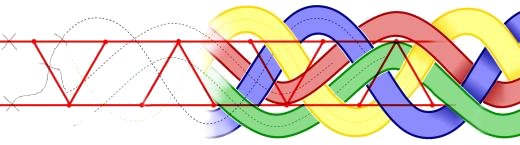
The metaphysics of the Ripheus story involve a model of gluon flux tubes as tetrahelical flows that trace spheration into the lines-of-force between the points of the gluon octahedron (in the manifold of tessellation). This corresponds also to a general truth known as knotical-graphical correspondence, in which each simplectic deontic graph (traced in physical space) is matched to at least one simplicial knot. At the index of spheration (aleph-pi), a given rectilinear graph's "arrows" fluctuate like plucked strings, according to the correspondent knotical manifold.
Tachyon-bradyon complementarity
One model of antimatter and dark matter, in Riphean terms, assumes that the antimatter is the dark matter, as in the opposite-charged sfermion manifolds. Another option is to look at Big-Bang events as equivalent to pair-production incidents in time: the matter and antimatter both form but the antimatter is shot backwards in time as tachyons. As tachyons slow down they gain mass, and as this increasing mass gets farther away (in time) from the bradyonic manifold of the "future," it pulls more and more on spacetime, producing the dark-matter effect. However, if tachyons speed up, they lose energy, and this decreasing tachyonic energy reciprocates across the Planck interval to intensify the expansion of the universe in the "future."
-
Actually, there are more possibilities... let's say the tachyons are regular antimatter and dark matter, and the bradyons are regular matter and dark antimatter. Actually, the 5-dimensional system of the deontic metagraphs seems able to imply that there would be five time axes, so if there were two pairs of pro- and anti-particles per axis, there should be 10 pairs total?
-
-
... Gravitational pressure "squeezes" the quark-gluon plasma, and the quarks, which have been flowing through the seething array of gluon flux tubes, are "squeezed" out. The matter surrounding the quagma sphere is therefore hit with a pure quark wave. Simultaneously, the gluons are compacted enough to fuse and form a "short-lived" gluon star that will eventually, if it absorbs enough matter, go supernova and leave behind a black hole...
... In some cases, a squark/gluino analog of an atomic-molecular star collides with another dark-matter star at the same point in space as where two baryonic stars are colliding. Though the two regular stars do not interact with the dark-matter stars, their gravitons and gravitinos do. Accordingly, not only do the collisions and accompanying novae generate two separate black holes, but these black holes involve the fusion of gravitons and gravitinos at their core, which creates a small shell of gravitational fusion energy around the absolute core. In other words, the tetra-star collapse compounds the gravitational turbulence that already arises in the case of a regular black hole and generates a supermassive black hole (with an epochal intide (inwave) that draws matter towards the black hole, from the neighboring star systems, over a vast enough space that the SBH quickly absorbs more and more stellar masses within a "short" (let's say 1,000-year period)). [The inwave manages to suck a massive number of neutrinos/sneutrinos into itself, which adds up to a sizable amount of the mass constituency of the initial hole.]
-
RETRACTION: I now think that the gluons would get squeezed out of the quark manifold, because the quarks would form a superfoam, and the thermal pressure surrounding the foam manifold would squeeze it like a sponge. So a quark star, albeit small and short-lived, would form at the center of the thermal manifold.
-
-
-
I had an idea about consciousness as a physical phenomenon. The fact is, even if the mind is made of particles somehow, these particles "know" about ones that they can't directly perceive (in a system) and which might be purely possible and not actual otherwise at all. So, I submit that the "seeds" of consciousness, during the Big Bang, might have been unusual "bound states" involving all the basic particles (including superpartners). These proved to be immensely stable and were gravitationally drawn across the expanding universe. For whatever reason, these "molecules" attached to various regions and began to develop the order of life, by nature, from their presence. That is, life is neither accidental nor purposeful, nor even absolutely inevitable---it is, nonetheless, understandable, how and "why" it would arise where it did.
Although, it is not absolutely required that the Seeds of Order be planted only in the seas of carbon on planets like Earth, I think...
-
I can see SA phase 2 (the "back five") as organized around the Heralds having become servants of Cultivation, who now try to prevent her from being united with the dishard of Odium and Honor, or alternatively are trying to make sure she is the one who gets to take up three Shards total, here.
-
Part of the story is meant to be tongue-in-cheek, like, who the heck names the constituents of matter "quarks" in the first place? But it's also meant to explore a lot of the weirder ideas---though no less valid---in the history (and continuous update) of physics. So, the endgame idea I came up with: During the Big Bang, when inflatons (these are a real concept) caused the rapid expansion of the universe (proportionally speaking, to the timeframe in play), not all inflatons decayed into the gravitational and electronuclear particles (gravitons and gluon/photon/W+/- & Z particles) or leptons/quarks/w/e because quantum chaos smearing preserved them. The Composers were a society of beings in a supersymmetric galaxy, who discovered what happens at the core of a supermassive black hole. Explorers'scientists find out that primordial inflatons, the Residue, can get caught in black holes, where they are not compacted at the absolute core but form a marble-sized sphere of energy around it. So, the Composers worked extensively on systems meant to "mine" black holes, to draw out the inflatonic pockets. Humans who have discovered the Composer's harvester ships, don't known where the inflatons are going, so even though there is a crazy industry built up off the dangers and payoffs of black-hole mining, it's all for the sake, more or less, of "the Treasures of Darkness," the predicted or mythical storehouse of the harvested inflatons. Basically, black hole mining involves firing a graviton laser/graser, into a black hole, then spinning the input point for the beam so as to "coil" the gravity-tentacle inside the black hole. This can "hook onto" the inflaton, which has a built-in expansion pressure, so it compression-pushes itself out of the near-core of the black hole and across the graser-spiral. There, a massive relay is ready to hold the precious particle, which is after all immense in size for a primordial, basic particle. After initial holding, though, the inflaton is shuffled through an Alcubierre labyrinth space, to unknown quarters. Now, in the background, entities known as the Arn and the Orn are monitoring much of the situation, especially as pertains to the Composers' derelict artifacts. The Orn fear that use of inflatonic power could vastly accelerate the expansion of the universe in general; the Arn, who are their mysterious precursors or commanders, believe inflatonic pulses might push the domain wall of the universe toward that of another structure, causing a Big-Bang like release of energy, flash-emulsifying all life and worlds in the universe. Anyway, as it turns out, the Composers actually were dealing with an even more difficult cosmic question: what will be the consequences of the continued dimensionalization of space? For they discovered that, on an ever-expanding scale, the number of space dimensions was increasing. So, in uncounted 10(100^1000)s or whatever of years, the universe will be 4,956,731-dimensional (spatially), and then in n more years it might be 7,892,121,087-dimensional, and so on and on, dimensions without end. During every shift, a mass burst of inflatons automatically emerged from space in the universe. This flash-burned almost the entire cosmos at the time, much like a domain-wall collision would. However, the last time this took place, the number of living beings throughout the universe was low, and it wasn't until the acceleration of the universe's expansion that another massive flash-wave struck. In the sum of time, it is known that the decrease of the rate of increase itself, creates a physical gap that is filled in, on another plane of existence, a divine-like realm of transtring-theoretic logic. (Or something like that.) But so now, there is also stellar genetics, the study of how galaxies formed, which the Composers left records of having worked like so: during the initial major shifts in the universe, instead of primordial black holes forming the seeds of supermassive black holes around which galaxies manifested over time, it was boson stars that eventually went supernova that seeded the future galaxies as such. So, many early civilizations were destroyed by, or just barely survived, being hit by the boson star nova, which expanded with most of its energy undissipated for 50,000 years out from the center of the explosion, tapering off inexplicably only when it reached the dark-matter halo of the galaxy. And the trauma of a society with such ancient, apocalyptic origins, spells trouble for itself and others, to the ends of the ages. EDIT: So anyway, the Composers discovered a system where you fired an inflatonic laser (AKA "exser") at a Calabi-Yau aurora-crystal, which would focus the exser even more, and flood the dimensionalization "machine" with pure force, intensifying the dimensionalization of the world. EDIT 2: Also, if two graviton-related stars collide, in the same space as two gravitino-related stars, this tetra-collision causes graviton-gravitino fusion, which is the direct source of many supermassive black holes.
-
Premise(ish): humans have colonized the four stellar systems closest to Earth's, and have colonized most of the interior of the Oort Cloud region. "Highly local" Alcubierre systems allow for "FTL" interconnectedness in the Five Systems (bland name, all I've got so far). Out between an Earth-analogue and a Mars-analogue in the Fifth System, humans find an ancient ship left by aliens they decide to refer to as "the Composers." This is because of the music-like communication logs found on the ship. Eventually, the ship is activated and it warps to a distant location. Humans, by now (IDK, 4000ish AD?), have developed a technology known as the "entanglement signature reader" or ESR. This device can measure the degree of entanglement between the particles making up the device, and those it in its immediate environs. The device allows humans to measure how far they are from the Oort Cloud region in the sense that a low ESR reading indicates that one is far away from the region of the ESR's origin, and there's some mathematics that can be done to establish how far in particular (maybe not the "direction," though). So, the shipgoers fire up their ESRs and find out that they're an immense distance from the Fifth System. They find themselves near two stars, called the Dove Stars, that are spiraling with each other in a precarious gravitational balance. There are a series of Alcubierre rings set up between the Dove Stars, and a vast engineering/research facility. Humans practice with the facility long enough to discover something of the Composers' methods and maybe their goals. Basically, the cosmogenic field-decoupling sequence was Graveptons (graviton-lepton), glurtrons (electronuclear particles), and quiggs into Gravitons/leptons, strong and weak vectrons, Higgs/quarks, into G/L, S&Wv, photons, Higgs, and quarks. But using gravitational circuitry, the Composers found ways to force unusual hulks of matter and energy to fuse. For example, they could collapse the W+/- and Z vectrons into Higgs particles, producing what humans call vectroiggs. In fact, the Composers devised instruments and circuits to fuse all manner of exotic energy and matter, as such. Samples of their synthesis: Quarks + leptons :: lerks (or queptons) Quarks + vectrons :: varks (or quectrons) Gravitons + vectrons :: gravectrons Quarks + photons :: Phorks (or quotons) Photons + leptons :: Phleptons Some of the preceding particle types can also be fused into these amalgams: Varks + phorks :: vorks Lerks + quiggs :: qlerks Gluggs + grarks :: graggs. Weaponization, if possible, of some of these substances include things like glugg-grark plasma, AKA graggma (as in "quark-gluon plasma" or "quagma").* *[Another level of the Composers' powers was fusion of superpartners. E.g. the Composers found a way to produce "squark-gluino plasma," known as "splasma" and "splagma."]** **EDIT: [Or, "squagma," "squasma," "slagma," and, "slasma". See also vepton-gloton miasma.] ... The endgame? Not sure, but involves "the Residue" [inflatons still crisscrossing the universe long after cosmogenesis, "shielded" from complete decay by quantum probability flux].
-
Scadrial: "Ash fell from the sky." Roshar: "Rain fell from the sky." Nalthis: "Colors fell from the sky." Sel: "Symbols fell from the sky." Threnody: "Ghosts fell from the sky." Taldain: "Sand fell from the sky." Sixth of the Dusk world: "Birds fell from the sky." ... the whole Cosmere: "Shards fell from the sky."
-
I forgot to mention that my theory sort of depends on a strong analogy between the Everstorm and the highstorms, i.e. the reason the Everstorm now exists is due to its containment of the Cognitive Shadow of the Child (since this being died during/after Aharietiam) in a way like unto how the highstorms contain the Stormfather-as-the-Shadow-of-Honor.
-
THEORY: Honor and Cultivation had a literal child, who though not a Shard was still immensely powerful. The Cognitive Shadow of Tanavast, in the Stormfather, is reliving Honor's having of a son by "adopting" Kaladin in relation to Sylphrena, the Ancient Daughter. But long ago, the dishardic Child bonded a spren, too. This became, therefore, the Sibling. Somehow Kaladin and Sylphrena will prove relevant to the awakening of the Sibling, who went to sleep after the Child was killed at Aharietiam. It was this death that pushed Tanavast into the spiral of raving before his own death. This was the being who Odium said "you!" to at the Battle of Thaylen Field. Dalinar, via the boon of Cultivation and the Stormfather of Honor, is channeling the Cognitive Shadow of the Child. Indeed, the ghost of the Child is the one responsible for the dream-anomaly involving the image of Nohadon. [I think Nohadon was related to the Child historically, too, though how I have no theory about.] The process by which Odium assailed the Child produced the Unmade. I.e. Odium ripped off pieces of his own soul and slammed them into the Child; the different forms of torture drew in spren corresponding to certain emotional patterns and this, combined with the Child's special powers, merged the power of those spren with the Splinters of Odium, forming the Unmade. After all the Unmade were born, Odium managed to combine with them to kill the Child and this is why he said, "We killed you!"
-
McQuisitors: "Can I get Spikes with that?" "I said no blood on my bloodburger." "Oooh, I want to try the new Crispy McEntrails!" "Um, extra eyeballs. Just put them in a box on the side." "That'll be 1.08 atiums, please." "I thought it was just 99 electrums?"
 ): there wilny-arcs incallandor-f Lik,the ther ar . Bear in mind, then, that this theory entails that Dominion was never evil, regardless of whether the Skaze are now (so to speak), or whatever. He might've been in danger of becoming an evil like that but who knows, maybe any of them can, in principle. Anyway...
