Ripheus23
-
Posts
1318 -
Joined
-
Last visited
-
Days Won
2
Content Type
Profiles
News
Forums
Blogs
Gallery
Events
Everything posted by Ripheus23
-
Gödel coordinates
It is possible to use transets and operations thereon to represent an equation that maps onto the set of an ecograph's indices. For example, to represent the index of reduction, you take 0 [not the integer zero, but the use of the classical symbol of zero to represent a special transet function [related to the concept of integral zero]] to the power of 0 as many times as a reduction takes place. For example, the Form of Adventure's index of reduction is 1, so it is assigned the transet of 0 alone, whereas Apollyon's index of reduction is 3 so it has 0^(0^0).
For historical reasons, these are referred to as Gödel coordinates.
The color transet
Part of cartoglyphy, the theory of the color transet is that there are glyphic variations on the known semiotics of the transets grounded not in differences in iterations of shapes but also on variations in the colors used to draw the glyphs in physical space. Whether physical reality is intrinsically "greater" than the sphere of the aleph-numbers and their transets, is not known, so the theory of the color transet remains unproven in general [although there are some applications related to coloring problems in mathematics, that testify to a possible chromatic index for aleph-numbers; see also aleph-color.
- Aleph-color. The theoretical aleph-number whose internal determination of symbolic use involves colors. The idea is that colors are, in some strict sense, numbers, just like integers or fractions or irrational decimals, or whatever; see also Dorothy's staircase.
- Dorothy's staircase. Also known as Cantor's rainbow. Assuming that aleph-color is an n-aleph.n indexed transfinite number, it is possible to represent an exotic staircase using the transfinite variable z, and the transet of 0, in relation to the indeterminate glyphset for aleph-color. A large amount of contemporary staircase theory concerns attempts to prove the existence of Cantor's rainbow in such a way that the numerical index of aleph-color becomes apparent in the process. See also Munsell color sphinx.
- Munsell color sphinx. A bizarre ecometric (possibly metrometric) lifeform with the appearance of a sphinx whose head is not an ornamented human's but a physical-matter copy of the Munsell color solid. They can be found in the ecometric realm guarding mysterious staircase-demiplanes believed to be possible physical incarnations of Cantor's rainbow.
-
The Lay of Vyrian
Wherefore the preface to this resistance
is true,
the Axioms of Paradise
and reason's trinities
a tower of fire defy;
and in the Days of Ascension,
seven fallen are denied.
Of their dominion
"was" an end.
Will always be until the end.
But alas! the broken come
To seal all light in the dimension of sin,
Or else to herald the end of all that there is;
and why ask why this should be?
If all is denied for the sake of three things?
But if darkness is nothing instead,
how would the darkness not come to an end?
To heaven to go,
to take a stand,
to sing the song of silence,
to pass the Test:
"Wherefore Apollyon et Ripheus*"...
*[pronounced "Rif-ae-es" to rhyme with "Test"]
_____________________________________
"Although Armirex used the power of the Form of Evil to silence Apollyon at the terminus of the Last War, the Artificer later came to believe he had sinned in doing so [to use Evil's Form at all], and so sought to atone for his sin by awakening Apollyon at the end of time..."
-
-
The Form of Fear was a demimetric being formed around the same time as the Form of Adventure. It was believed to be a shadow of the Form of Evil in some way. It died on the Ramparts of Minos when the minotaur number stampeded from the Labyrinth into Cantor's house: the dangerous number crushed the Form in its path. The ability of the Form of Fear to be destroyed later served as an element in Armirex's equation.
_____________________________________________
The Four Adventurers: a party of four adventurers who entered Cantor's house to investigate the outcome of the minotaur number's imprisonment there. Their experience of time differentiated from that of the economies, scores of thousands of years passing outside while for the Adventurers only days or weeks wore on. At mysterious intervals, the timelines would progress at an equivalent rate and an unscrambled signal could be sent from the house to the economies. It is for this reason that the deaths of the Four are a matter of public record, as their last moments came to the economies in a signal sent when the Form of Evil ripped the part of Cantor's house in which they were located, off the overall demiplane, and smashed that part of the house into a detached chunk of another demiplane (during the First Ecomachy).
-
"The minotaur number had some extensions, including the zero-minotaur and minotaur-zero functions, and the Ramparts of Minos, an exotic staircase."
exotic staircases. Sequences of aleph-glyphs, in semiotic transpace, that do not proceed in only one direction out from the central glyph of an aleph-number, or which diverge for abstract reasons from the normal members of the set of Cantor's staircases. [A major subject of research in so-called staircase theory.]
-
-
I did admit my theory was made from 100% grade-A phlebotinum.
-
I'm literally claiming that the entire SA would be synchronous with the scene in The Shadow Rising in which the Bore is shown being used.
-
Wild phlebotinum-foil hat theory: the entire Stormlight Archives is equivalent to The Shadow Rising in being the section of the overarching saga in which the main antagonist is shown being set free. A tragic ending? Possibly!
-
I think Odium is being influenced by his Shard, so in addition to personally wanting to be the only great power in the Cosmere, I think he wants to use this power (or, if the Shard devours his motivation too much, he will come to use it) so that he can impose a system like Braize on the entire Cosmere. He's not like Ruin, who would kill everyone simpliciter; Odium wants to kill everyone so that he can then resurrect everyone in hell, and kill them again and again, like with the Heralds. Or, again, he'll end up trying to do this if his Shard takes over. (That might be part of the "secret" to how Odium is imprisoned, not by the Heralds directly, but in an important relation to them. I.e. the Heralds offered themselves to Rayse to suffer the torment he wants everyone to suffer, in Roshar's place; and this aligned somehow with Odium's "Purposes" or Intent or what, Connecting Rayse specifically to the spiritual "story" of Roshar, complementing his general seal, maybe.) EDIT: Maybe Rayse/Odium DOES accomplish something like this in the future, for a long time, even. Possible faction shenanigans might be people who just want to destroy the Cosmere to prevent everyone from being tortured forever, or something, and this leads to the stars-disappearing scenario foreseen. (Or, maybe there's a measure to protect planets from Odium but it's risky, and using it triggers an interstellar chain reaction, destroying the sky star by star, or whatever.)
-
ππ is the spheration index, the cardinality of the set of hosothetic functions (functions converting rectilinear matter into spherical matter).
-
-
↑↑
↑↑↑
↑↺
↑↑↺
↺↑↑
↺↑↺
↺↑
… and so on, these are the “ascension numbers,” the transcardinal rank of the set of standard ascension functions in aleph-space.
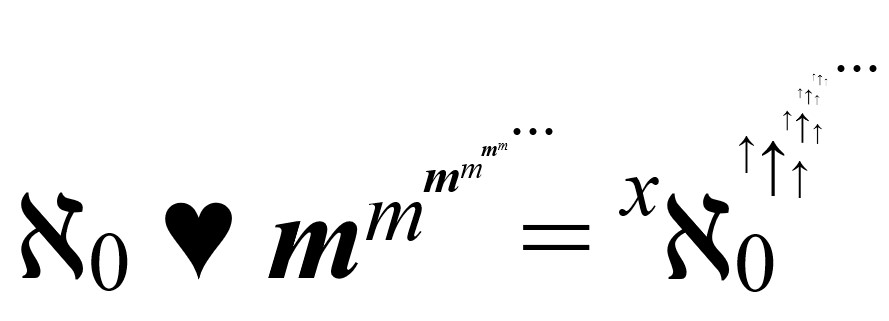
♥ = an operator, so used in transfinite arithmetic as in e.g. ℵ0 ♥ ℵ0 ♥ ℵ0 = ▲▲▲ [the transet of the triangular functions of reality]. The heart transet is the set of heart operations, symbolized ͜♥, which has the unique properties that it cannot be x in either xx or xxx and no aleph-number can have ͜♥ as its exponent, and indeed the heart transet only appears in functions in which the heart operator appears.
Now, there also the “magic numbers,” symbolized m and q. These are similar to x and z. They are like magic variables in the aleph-numbers.
There’s also the use of integer numerals like 0, 1, 2, and 4 to symbolize special aleph-numbers. And so on and on. Anyway, to give an example of what this all “adds up to” in the story, let’s assert an aleph-heart operation:
-
So, I was thinking that the Noumenal Artificers in the Ripheus story, resemble the Elohim in the Thomas Covenant series. I was thinking of having a sort of "foil" for the Artificers, then, a mysterious group of magic-wielders comparable in power and organization to the Artificers. These would be like the Insequent in the Covenant setting.
I also had a quasi-entity or object known as the Labyrinth, and some other odds and ends I couldn't define easily. That is, I seemed to need a different set than just {economy, isonomy, antinomy, deminomy}. I had {demiarchy} for the Form of Evil, and {isoarchy} for the Keyscape, and I was fiddling with the notions of ecometry and ecoarchy.
On the basis of all that, I have decided that the prefixes and suffixes anti-, demi-, eco-, iso-, metro-, -archy, -metry, and -nomy, can be put together in various ways to produce the action-theoretic categories or metagraphical functions. Nomo- can also be used but there's a "theorem" that reduces the nomothetic functions to a different one. Without a complete analytical justification for doing so, I have set the list of the categories as follows:
antinomy - deminomy - economy - isonomy - metronomy
demiarchy - ecoarchy - isoarchy - metroarchy
demimetry - ecometry - metrometry
"Theorems":
- Antiarchy reduces to antimetry to antinomy.
- Nomonomy reduces to nomoarchy to nomometry to metronomy.
- Isometry reduces to either isoarchy or isonomy.
The following is a list of kinds of magical beings resulting from the above:
- The Noumenal Artificers: solutions to the economic function.
- Apollyon: unique solution to the antinomic function.
- Septatheon: solutions to the ecoarchic function.
- The Form of Evil: the unique solution to the demiarchic function.
- The Form of Adventure: both deminomic and the unique solution to the demimetric function.
- Cantor's house, the Lachesis aleph-forest, the Advocate and Opponent: deminomic.
- The Labyrinth: the unique solution to the metronomic function.
- The Keyscape: unique solution to both the isoarchic and isonomic functions (through the isometry).
- The Metroarchs: the "foils" of the Artificers. Includes the metroarchic equine.
- Ecometers: disorganized (independent) lone individuals and clusters who use ecometric power.
- The Anomalies: metrometric functions.
These entities/beings/structures/w/e all correspond to ecographs, which are metagraphical determinants. Every ecograph has an
- index of reduction
- index of finality
- index of modality
- index of prefixture/suffixture
The first index is of how many nodes in the graph are compacted at an actualized endpoint on the graph. The index of finality is for how many nodes are actual endpoints; the index of modality is for the possible number of endpoints. The prefixture-suffixture index tabulates the action-theoretic categories according to the number of times their prefixes and suffixes appear in the list.
So, for example, the ecograph of the Form of Adventure is
demimetry<----- FOA ----->deminomy
Neither category is reduced to the other, so the index of reduction is 1 (there is 1 node at the endpoints). The index of finality is 2, for the number of actual endpoints. The index of modality is 2. It has a weird P/S index so I'll use Apollyon as an example of that idea first.
So, Apollyon's reduction = 3, finality = 1, modality = 1, and its P/S is (1, 5). The Keyscape has
Keyscape -----> isometry -----> (isoarchy OR isonomy)
So its reduction = 2 (isometry + isoarchy or isometry + isonomy), its finality is 1, its modality is 2, and its P/S = (2,4) or (2,5).
The metrothetic categories admit of a peculiar ecography, namely their P/S indices are counted either by the number of times metro- appears, the number of times -metry appears, or the number of times both metro- and -metry appear. So their P/S numbers are
- Metrometry: (3, 3), (3,6), (6,3), (6,6)
- Metroarchy: 3/6, 4
- Metronomy: 3/6, 5
- Ecometry: 3, 3/6
- Demimetry: 3, 3/6
IDK exactly how to compute the P/S number for the Form of Adventure as a joint demimetric-deminomic entity, but I think it would be something like "((3, 3/6) + (3, 5))," whatever that would mean.
Anyway, the Labyrinth, as defined, has the "power level" I felt it had, in relation to the other entities: e.g. the Hammer of Ilium, which is the only weapon that can break the Typhon, is carved from the stones of the Labyrinth.
-
The music transet
♪♪
♪♪♪
♪♫
♫♪
♪♫♪
♫♪♪
♪♫♫
And so on, I think there are ten plays on the theme possible. These are the transets of the Keyscape, also known as the Key-set. They are ecometric functions, or nomographical manifolds, in which the basic operation of the transet’s elements is represented by the single note to its own degree, then according to the staircase axiom in single form, and so on and on. They are ecometric because they are, if you will, economic questions existent at all deminomic and economic locations. So, in other words, the Key-set is a special set of ten questions on the Test, each involving the theme of aleph-24. Or, in game-theoretic metagraphics, it is a phenomenon of the power of the Game, in which one has aleph-24 options available at any time and must make aleph-24 decisions over all the sum of agent-time.
_______________________________________
With those in mind, some other weird symbols for magical aleph-numbers:
♪Ø♯ = ???
▲▲ = the Gearscape transet
▲א▲ = the absolute transet
Ø○ = the zero-actuated transet
{□○ = ○□} = equivalence of possible actuality and actual possibility
AΩ = the transet of Apollyon
é = the elohim number
Lλ = the Lernean number (hydra index)
{Cs, CC} = the Cocytus numbers
ππ = ??? (not pi as we know it...)
{↑x,↑↑, ↑↑↑, x↑x, ↑↑x, x↑↑ ... "the ascended numbers" (also "the inference numbers" and "the iteration transets) ...?}
ψφψφψφψφψφψφψφψφψφψφ … א+ (the transequent order of questions and answers)
-
I have read that some cardinal numbers are ordinals/some ordinals are cardinals, maybe all are both, so I should have to redefine the "transcardinal rank" and "transordinate magnitude" notions in "transet theory."
________________________________________________
But with respect to a topic I am more familiar with...
In modal logic, which is the logic of possibility, actuality, and necessity (and which is a matter of formal logic inasmuch as we speak of the truth of premises necessitating the truth of conclusions in valid sequences), there are some symbols used as "operators," like □ for possibility and ○ for actuality (IIRC). Now there is a general rule,
- From ○x, infer □x.
The reciprocal, so to speak, is,
- From □x, infer ○□x.
And we can imagine infinite strings of these operators unfolding from x according to these rules.
In imperative logic, the operators are for "do" and "don't (do not)." At least, this is the way I approach IL.* So I use + for "do" and ¬ for "don't." Natural language supports prefacing any given imperative sentence, such as, "Be nice," with, "Do," as in, "Do be nice" (archaic, granted), and exclamations like, "Don't do that!" testify to iterated countermands. So, we can say, "Do do that," "Don't not do that," and so on. In a string of IL operators, if there are an even number of ¬ marks, they all cancel out and the overall sequence counts as a command. +¬ = ¬, ¬+ = ¬. (Two pluses plainly make a plus.)
*[Another option is to underline the set of words expressive of the command (the x itself, here), or to expand all imperatives into propositional reports, e.g. to convert, "Go to the store," into, "Act so that it is true that you go to the store." (A propositional report is otherwise usually known, IIRC, as a "that-clause.")]
What happens, then, if we sum the dyadic helix of modality or the IL prefaces? IDK for sure, except in the IL case (an infinite negative command is equivalent to a single positive one). Modalitywise, for the sake of the deep metaphysics (called "metagraphics" in the setting) of the Ripheus story, I am going to assert that the "unpacking" of the actuality operator, from the possibility of x, in an infinite sequence, creates an infinite "surfeit" of virtual actuality(?), which forms the material plenum of transcreation. That is, when the computer of the multiverse runs the possibility-actuality program, it applies aleph-zero to the calculation, extracting an infinite quantity of pure actuality from pure possibility (in light of the use of summation notation intended for the full description of this postulate, I am referring to the dynamic as "sigma-actuation"). The sigma-function for IL equalizes the pure command as a pure positive imperative, and the relationship between IL and modal logic* unifies the three glyphic sequences to forge the crucible of transcreation, if you will.
*[Although it is possible to state conjunction, negation, and disjunction in natural imperative language, it is ungainly to say something like, "If go to the store, go for a walk," in contrast to, "If you want to go to the store, go for a walk." However, the "fi"-operation corresponds to the "if"-operator:
- From A, infer B.
... which in all lexical fairness could just as well be put as, "Infer B from A." This is inference itself as a command, which corresponds to modus ponens simpliciter:
- If A then B.
- A.
- Therefore B.
Accordingly, IL comprises the pure inference function itself, and this, as the if-operation, comprises pure possibility (where, "X is possible," is explained as, "There is a situation A such that if A, then X," which indexes the possibility of X to A). Immanuel Kant confusingly enough states both that necessity is that which is actual because it is possible, as well as if the necessary were a unique concept over and above possibility and actuality; in my system, possibility and actuality are dealt with as the dyad-elements of the modality transet.]
-
**Whereas the if-theory of modality supposes that necessity is that which would be true under any and all if-operations, i.e., "X is necessary," means, "If anything at all, then X." Now it might be true that to MAKE it true that something obtains just in case anything else does, requires additional modal force/power, so to speak, though.
-
Due to the role of the legend of the 36 Justiciars, in the Ripheus story, I have decided that there will be the ל-numbers (lamedh-numbers), which are an infinite list of cardinal numbers that have the peculiar property that 36 of them (any selected 36) can be keyed together as the so-called "justice transet."
______________________________
There was a war long ago, the War of Sin and Hell, the First Ecomachy. (The Second Ecomachy, the Isomachy, was also the Last War.) This was when the Form of Evil attempted to transcreate its own economy. It would do so at a later time by trying to infect the Riphean isocrystal causeways, and through them pollute an entire economy unto itself, but the elder attempt depended on an assault on the deminomies first. What the Form of Evil did was corrupt a precursor of the Platonic dice, an object known variously as Plato's box or Pandora's dice, in order to generate hosotopic waves from the stable isocrystals, and use these to tear off pieces of an already-existent deminomy on the one hand, and Cantor's house on the other, whereafter it tried to ram its own deminomy (a corruption of the Keyscape) into the fragments of the other two.
-
The Lernean virus
Also the Lernean seraph hydra, the virus-hydra, and the virus-forest. [So, revision: the Scylla and Charybdis numbers are BOTH Cocytus numbers, in fact that's their distinction, is that they are elements of the Cocytan subset of the transet of sin. The Lernean number is the other element of the transet of sin, and is sometimes referred to as the seraphim number.]
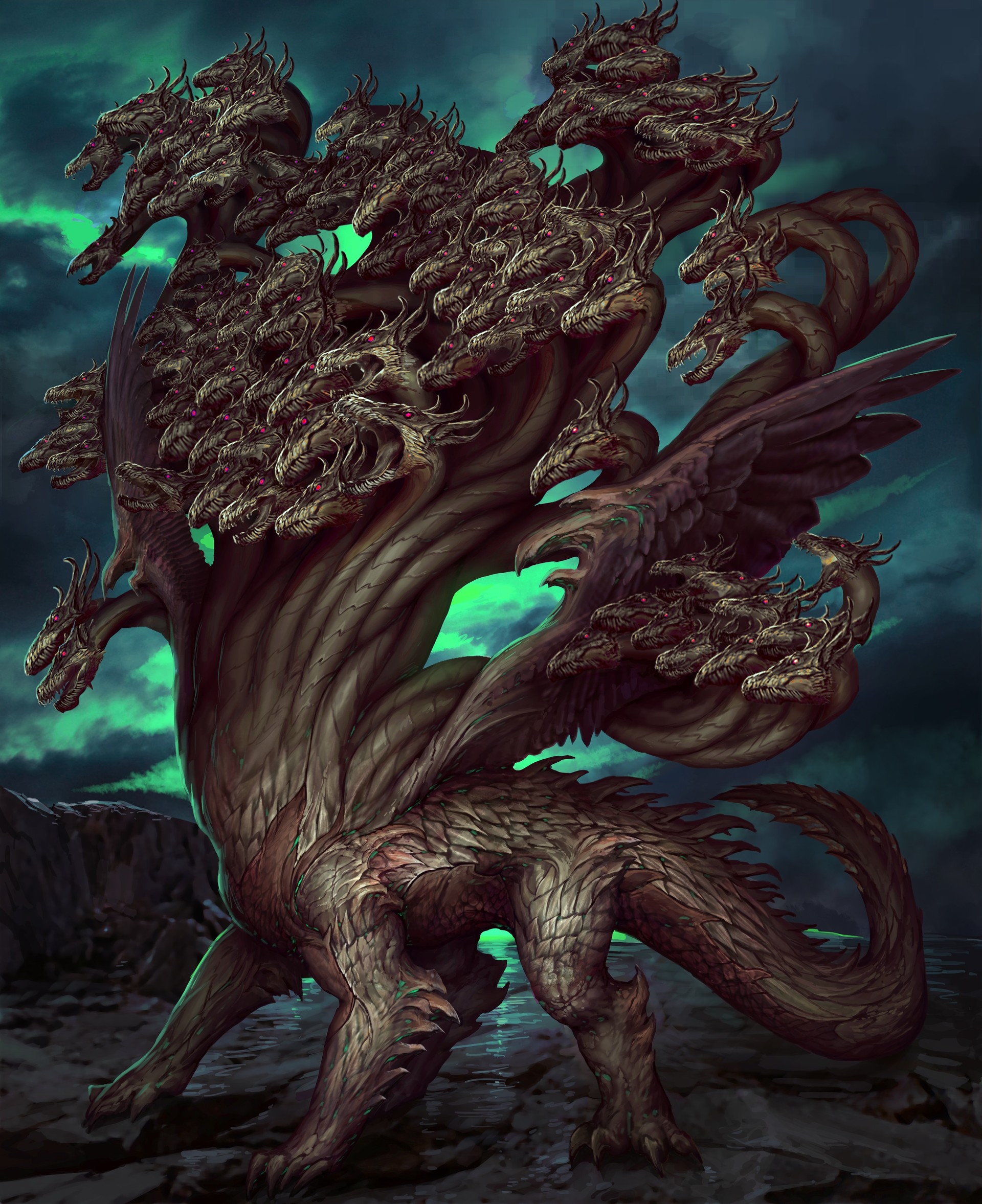
Function of the Form of Evil that infects the Lachesis aleph-forest. Generally, the seraph hydra is contained within the Form of Evil itself. This Form does not have its own demiplane but instead has what is known as the hamartic demiarchy, and the virus-hydra is the "monster" that inhabits it. It is a hydra with an infinite number of heads (or, a single being made out of an infinite number of hydrae each with an infinite number of heads). Because the infinity in question is aleph-zero, the hydra is able to quasi-intersect the aleph-zero infinity of the Lachesis demiplane. Because not all of its heads are made of "flesh" but some are plant-like, an infinite subset of its heads are trees that form remote glades in the aleph-forest for unwary travelers to be caught within. The seraphic manifold represents the recursive place of transcendental delusion in all other particular sins.
Now, the Scylla and Charybdis numbers are keyed to cruciform manifolds. That is, in Cantor's staircase, the rift occupies all n-aleph.19 positions, but there is also a line proceeding along all 19-aleph.n positions that forms a slanted cross with the rift. Likewise, because 26 is the number of the permutations of the final offenses*, all numbers crosswise out from 26-aleph.26 form another rift-like structure: this intrinsically stable rift-sequence is the Scylla number. Prior to the Last War, the Charybdis number was constantly oscillating horizontally across the staircases for aleph.1 through aleph.24, but Armirex keyed it to the rift in the Keyscape, which fixed it at the staircase for aleph.19.
*[The final offenses can be committed one, two, or three at a time, in different combinations of consciously and subconsciously/unconsciously. So there are 26 possible orders as such.]
The quadrilateral of the Cocytus numbers (in the grid of the staircases) is geonomically juxtaposed with the semiotic transets* to form what is known as Cantor's house. Legends or jokes have it that this house is built from the trees of the virus-forest, and is the only possible prison for the seraph hydra, should this entity ever emerge from the Form of Evil (hence this "house" is also known as Cantor's durance, with the durance-staircases besides it (or the paradise-durance/Durance of Paradise)).
*[The staircase is the semiotic representation of all aleph-numbers in relation to 2-dimensional space. Because physical space is inherently 5-dimensional, there are three more dimensionalized sets of aleph-numbers, so there are 5 special dimensions to the infinite forms of infinity. These four transets are the semiotic transets, and Cantor's house is an orthotopic manifold constantly being unfolded from the Cocytan quadrilateral via deontic crystallization.]
There is also a hyper-gap between the transet keys for aleph.24 and aleph.26, and this is involved in the nature of the Sea Alone.
-
*EDIT/ADDITION
There is a room in Cantor's house whose quadrilateral base is uniquely mapped to the square of metafinity. This room is always changing position while the house changes size and shape. [This is a metaphysical deduction of the house in Danielewski's stories, much like the aleph-forest maps onto Xanther's forest in The Familiar, as well as Yggdrasil (referenced in House of Leaves).]
-
-
-
C'mon, Dean... I can't hold it all together by myself... And I know you're not the only one who knows how to hold on to this, too, but I don't know anyone else out of all of you who can.
-
The Cerberus numbers
The elements of the transet of sin. These are specifically the Cocytus number (26-aleph.19, from the rift in Cantor's staircase), the Scylla number, and the Charybdis number. The Cocytus number is associated with the sin of romantic injustice; the Scylla and Charybdis numbers are associated with transcendental delusion and recursive disgrace. [The identification of the Scylla mythopoesis with transcendental delusion is contested by many ethical philosophers, who would rather refer to this sin-number as the Phalaris or Telemachus number, though the similarity between the words 'Telemachus' and 'Temeluchus' and the latter's association with Apollyon have produced further poetical disagreements on this score.]
- Cerberus-dimensional objects. Any physical object whose geometry is proportioned according to the dimensions of the Cerberus numbers. Examples include the Nemean skeleton [a "leonine" n-skeletal entity] and the holocaust-minotaur [a being that compounds the destructive energies released when a sinstone is broken].
The inferno transet
The antiset and the Cerberus numbers together.
Unrelated:
The Alcubierre telescope: a telescope that uses quasi-wormholes to deliver simultaneous instead of delayed transmissions of photographic information about distant objects in space. So, a star seen through an Alcubierre telescope is seen according to its occurrent status, rather than according to the photon traces it has left over the ages.
-
"The holocaust-minotaur roams a higher dimension not of economic space so much as economic time. That is, not only is there 24-dimensional space (in 3 of the economies and in the deminomies) but 24-dimensional time as well [due to the axiom of transcendental symmetry]." [At least, this is one option for 'locating' the holocaust-minotaur; at the least the higher kairotic dimensions remain to be explored, as far as explaining details of the scenery and the story goes.]
"Cardinal Mahlo was the leader of the Cult of the κ-god, a group devoted to manipulating the Keyscape's power for mysterious ends. They referred to their purported deity as 'the Inaccessible One.'"
-
His name is a Returned kind of name. The Returned can heal anyone using their one divine Breath. So, rando theory, the process of creating Nightblood was kind of like when a Returned uses their divine Breath to heal something, only Vasher/Shashara "healed" a piece of metal and only used the equivalent of half their divine Breath (not their combined divine Breath = 4000 but either of theirs = 2000, so 1000 normal Breaths). Or, let's say, they "killed" the metal in such a way that Edgli quasi-Returned someone(s) into the metal. But instead of being a specific person, it was the concept of, "Destroy evil," in EVERY dead Nalthian from history (or from every dead Returned Nalthian, or whatever). So, the metal embodies an abstract concept, hence is a "robot spren." EDIT: I know, we've no indication that divine Breaths can be partitioned into equivalents of normal Breaths, so the theory probably can't really be true, but it might be close to a true theory...
-
It's making me think of Charlie the Unicorn vs. Charlie the Unicron and "your head a splode". And so: Honor, Honer Cultivation, Clativation Ambition, Abmitian Autonomy, Autunumo Endowment, Ednownent Ruin, Riun Preservation, Pesrevation Dominion, Doniminon Devotion, Deoviton
-
Well, first my thought was, "Wouldn't the gravitational pressure of the surrounding planetary mass* being pulled inward, crush the crystal? CAN a planet even temporarily form with a crystal core of the gemheart kind?" I also thought, "But Roshar's gravity is lower than Earth's," and, "Adonalsium directly created this planet," so who knows... *Though, for all I know, if a planet had a very thin mantle and its interior was all one massive gem-like structure, the internal structural integrity of the gem might prevail against the mineral veneer...
-
Edgli loves memes so she's always saying Keep Calm and Remember My magic system created Nightblood so she's all like, "And that was in an early Cosmere story, so guess what's gonna happen when I reappear in MBE4..."
-
Because in MBE4, book 3, when the Second Catacendre has taken place, the Cognitive Shadow of Trellservation will be susceptible to Hemamancy, but if and only if Vin returned to Elend at that exact point 2,365,712 books earlier.
-
I've believed that Roshar has a gemheart core for a while. IDK how gravity would fit into it, though, plus as I found out the island-greatshells are the largest greatshells so if the planet had a gemheart it would be an anomalous non-living (or non-greatshelled) one.
-
I know I shouldn't hate people, so I'm trying my hardest not to hate our president right now.
-
Maybe there's a Nightblood analog per Shardworld, a Shardbane so to speak. So, take Nightblood, bind Yelig-nar's crystal to him, inscribe Aons for evil on him, etc. and so forth and ZAM there's your Big Shardbad.