



Pagerunner
-
Posts
2193 -
Joined
-
Last visited
-
Days Won
9
Content Type
Profiles
News
Forums
Blogs
Gallery
Events
Everything posted by Pagerunner
-

Sixth of the Dusk sequel transcript?
Pagerunner replied to Spren of Kindness's topic in Cosmere Discussion
There's a transcription in the event thread: -
Rhythm of War Online Release Party 11/17/20
Pagerunner replied to JoyBlu's topic in Events and Signings
For any question where the latter is an option, that is always a safe bet to make. -
Rhythm of War Online Release Party 11/17/20
Pagerunner replied to JoyBlu's topic in Events and Signings
Sequel of the Dust transcription: -
Tue quotes themselves: Let's stack these up against previously unknown Shards. We had four old clues: We've got a potential "Ingenuity" and "Wisdom/Prudence": Invention seems pretty well-aligned with Ingenuity. It also sounds like Invention is hiding, which makes me think it's also Clue 1 and Clue 2 (survival-Shard and not-on-a-planet). Clue 3, Hoid's Shard, I suspect would be Whimsy. (I'd also bet it's the kite magic planet.) I haven't read Rhythmatist, so I don't know if Valor/Mercy/Whimsy would fit for there, either. I think it's also notable which Shards weren't named in the letter. If you don't count Honor and Cultivation (which I don't think were explicitly named in the letter), you've only got three Shards not named, the hidden Shards. The most conspicuous is Autonomy, which I think ties in to the "encroaches" of Trell. I don't think anything else fits Prudence, so I'll tentatively label that as another Shard. Which leaves only one true unknown. Oh, and one last thing. We get two clues about Cultivation. The first is a name, from the Alethi glyphs page: Korravellium Avast, She Who Brings the Dews at Dawn. Which may not be a Vessel name; it seems a little long, more like the Elithanithelitheia that I don't remember how it's spelled off the top of my head. But the other Light glyphs on the page mention Tanavast and Rayse in their descriptions, so it's gonna be something close to that. And second is the line from Hoid in Chapter 80 about dragons:"I know of just one on Roshar, and she prefers to hide her true form."
-
Earlier this month, I was reviewing Theoryland for stuff that had never made it into Arcanum, and I found a piece of Q&A from a 2017 interview that had missed being carried over: Which left me feeling totally upended after the following passages in Rhythm of War: We've got a Cognitive Shadow, not from Roshar, who Wit has physically assaulted in the past. One who is known for his scars. I can see no other scenario: this is either Kelsier himself, or a red herring to cause us to think it's Kelsier. The descriptions match him to a T.
-
Rhythm of War Online Release Party 11/17/20
Pagerunner replied to JoyBlu's topic in Events and Signings
I just got an email from my local bookseller with the link and password. It went to my spam folder; everyone waiting for an email should check there. (Your spam folder, not my spam folder, of course.) -
I think you need to take a week or so and mull things over, because there are some pretty big signs in the text that you're ignoring, and some assumptions that you need to recognize and evaluate. First is the word "creation." It's got multiple related meanings; it seems you're using it to describe the final product of the creative process. Like how "the universe" or "reality" could be interchangeable with "creation." But there's a different sense, to describe the actual creative process itself. So when you're trying to come up with how four Dawnshards can sum up creation, don't look at the different aspects of existence, the aspects of the universe. Look at the specific actions required to create anything in any form. And that's why these are "Commands." They're verbs, they're things that are done by an agent to a target. Contrast that with "Intent," which is a goal. Investiture, the very "power of creation" (as it has been referred to before), needs guidance in how to act: Intent tells it what to accomplish, and the Command how to accomplish. Creating the world required the Intents we see from the Shards. (Ruin, Preservation, Endowment, Ambition, etc. All guided Adonalsium in how the world would look like once it was created.) Intents are the "What." But exactly how it was done required the Commands; those are the "How." So here's the turning point: all magic, all Investiture, is the very power of creation, merely applied in novel manners. I say that the four Dawnshards embody the four Commands, and that the four Commands exemplify all types of magic. If you got someone with every magic system and access to the power of sufficient Investiture, they would have the means and mechanisms to create in the same way that Adonalsium originally created the universe. One big aspect is "change for the better," or growth. What are the other three? (The Star Wars expanded universe is a good jumping off point for this thought experiment. The roleplaying games originally classified the Force powers into one of three categories: Alter (external manipulation), Control (mastery of self), and Sense (observation). Alter powers were Mind Trick or Move Object. Control powers were Force Speed or Healing Trance. And Sense powers were Blindsight or Force Visions. Magic was structured. I think the Dawnshards and their Commands are similar structure for cosmere magics. One of these schools of magic is Change. What are the other three?) With that in mind, let's survey some of our magic systems to try to find patterns. What magic systems embody CHANGE? On Roshar, we've got Soulcasting, the Surge of Transformation. I think some of the other Surges embody this, as well, specifically Tension, Cohesion, Division, and Progression. On Scadrial, I think you can essentially describe all of Feruchemy and Hemalurgy this way. Both are an agent using Investiture to manipulate a spiritweb; on Feruchemy it's your own, on Hemalurgy it's others'. Sel has Soulforging. I don't see anything on Nalthis, Taldain, Threnody, or Sixth of the Dusk; but those are all either much more specific and narrow magic systems, or just big question marks for the time being. But each of our three big magic environments has a magic system in the vein of "changing." What are other fundamental types of magic in the cosmere? The next one to jump out at me is "MOVE." Looking back to what little we know about Dragonsteel, we've got microkinesis, the ability to manipulate matter on an atomic level. What other magics in the cosmere move things? Surgebinding has Adhesion, Gravitation, Abrasion, and Transportation. I'd say a good chunk of Allomancy is moving; Steelpushing and the temporal metals for sure, and I'd argue metaphysically that stuff like Rioting or the enhancement metals are all moving, too; either moving someone's mind or moving someone's spirit. Nothing specific with AonDor as a whole, but it certainly has movement-based applications, like teleportation, and many Aons that just strictly apply energy (like fire) are ones I'd classify in this category. Nalthis and Taldain are primarily move-based magic systems; Breath animates things to move and do things, and Sand Mastery (at least as far as we know) is just moving sand. There's one Surge left, which can guide us to a third fundamental type of magic. "SEE." Illumination is how this manifests on Roshar, letting you affect what others see or potentially even letting you see into the Spiritual Realm about others (as we've seen with Renarin and Shallan here and there). In Allomancy, this is atium, which would springboard into any other Fortune-based powers across the cosmere; and also Bronze/Copper would be involved. So, what is the last one? I'm honestly not all that sure. I might be lumping too much into Change , and some of the spiritual manipulations would be in there. I could also try to break down Feruchemy and Hemalurgy into specifics, the sixteen different manifestations of each magic system, and try to line things up. You've got a lot of Change, you've got some Move (with mental speed or memories), you've got some See (with Fortune). But what about the other Spiritual metals? What about Determination? And that takes me back to the other side of the coin. We can look at the fundamental kinds of magic, or we could look at what sorts of fundamental magics would be required to create the world. There needs to be this sense of positive change, to create something out of nothing. There needs to be movement, the world isn't stale and static. There needs to be sight, the intelligent feedback to the agent of creation. But I'm still struggling to come up with a fourth Command, a fourth kind of action needed to create. Unless it involves the original plan; maybe Fortune isn't See, but instead it and the other Spiritual Realm properties have to do with the blueprint of creation, something like Know? I'm not gonna bold it, because I'm not that confident of it. It would be cheesy and sappy, but maybe Love could be another one? Maybe I'll take a week of my own to do some reconsidering. So, now that I've divorced the Intents and the Commands as two independent aspects that determine how Investiture is applied, I start to wonder if the four-in-four groupings on the mural are coincidental with the Dawnshards. The sixteen Intents describe the mind of Adonalsium; the four Commands are specific avenues for his power to act. So I don't think the Dawnshards would necessarily align with Shards, much less exactly four of them apiece. I'd have a hard time distinguishing Shards between Move and Change, specifically Ruin and Preservation. As with the act of creation itself, I'm leaning towards the Dawnshards telling us how Adonalsium was Shattered, not what he was Shattered into.
-
Time for a blast from the past. We're going to go to a time before the 17th Shard, to the old Time Waster's guide forum. To some threads of people talking about Liar of Partinel preview chapters. Peter Ahlstrom said on March 11-13, 2009: Tage, Brandon's brother, said on July 09, 2009: Peter said on August 11, 2009: Since the info was explicitly stated as "not canon," I didn't add these to Arcanum when I was doing my big TWG review. But I kind of filed it away in the back of my mind (and posted about it on my blog, of course). With the big revelations over this past week about Hoid and others in Dragonsteel being Dawnshards, and with the other WoB a few months back that those who were planning to Shatter Adonalsium were "demigods" at that iteration in the cosmere's development, I think I'm starting to see what everyone was actually talking about way back when. First, there were the Dawnshards, Hoid and his young friend (who I presume would be Jerick, the POV from the Bridge Four sequence on Brandon's website). They absorbed their magic abilities from objects like the mural; the Topaz for Hoid. Second, there were the demigods. (So what Peter saw in opposition weren't two Shards against one; it was two Dawnshards against one demigod). Third, the series would have eventually gone on to Shatter Adonalsium and give the Shards as we know them. But back when the basic terminology of Shards and Adonalsium was all first coming out, those who had read Dragonsteel misinterpreted some of the magical phenomena of the book along these lines. So, yeah. Peter and Tage leaked info about the Dawnshards over ten years ago 2009. Crazy how this works, sometimes.
-
The WoBs I linked in my most recent post have Brandon referring to both Szeth and Lift in the A/B/C plot structure he's been using to describe these groups, so that's how we know they're the last two characters to round out our list. We Also know that there are only three core characters to the main group, and that before he wrote their sequence he was expecting the other two of them to have only a few viewpoints. He was modifying these plans throughout the writing process (as I linked in my July post), so it looks to me like planned Szeth viewpoints got trimmed out during drafting. Lift wasn't "demoted"; per Brandon, he "revise[d] the outline so Lift stayed in the tower." Which is where the rest of Group 1 is. If she was being taken off the Shadesmar expedition, I'd expect her natural place to go would be the Azish front with Dalinar and Jasnah and co., but Brandon intentionally placed her at the tower. There are already some seeds to what passes for character development for Lift in the chapters she's appeared in, much less the portion of her interlude we've seen, and I think Brandon's too attached to the character to write her out of the book entirely once he's planned for her. So I fully expect Lift will continue to be one of the book's minor major characters. But, like we've all been saying, we'll find out for sure in a week. Dust off your bragging hats in case Lift or Szeth didn't make the cut, and come after me then.
-
All right, with the final RoW chapter, we can finally close the book on the groupings. They are: Navani/Venli/Kaladin/Lift/Szeth Shallan/Adolin Dalinar/Jasnah. If you had those groupings as your predictions, come on down and claim your tickets. (Who's the earliest person to call those groupings, I wonder? Can anyone beat July 26th?) Brandon just said that Lift was moved out of the group 2 honorspren expedition during drafting, so that confirms her as a main character and explains why the earliest updates had the character split at 4/3/2, with later updates at 5/2/2. And Szeth was confirmed a while back. Also of note is that Taravangian will be our interlude character.
-
Dawnshard Spoiler about Hoid! And everything else!!
Pagerunner replied to Eternal Khol's topic in Cosmere Discussion
"The element" has been confirmed to be lerasium, so not a Dawnshard: https://wob.coppermind.net/events/245/#e5483 There were some relevant WoBs given out yesterday: So Hoid was a Dawnshard, but he's not anymore. I believe he gave up his Dawnshard before the Shattering; that was his opportunity to particpate, and he declined it, and somebody else got his Dawnshard (either freely given or forcibly taken; might that be part of Hoid's grudge against Rayse or Bavadin?) and used it in the Shattering. But he had held it long enough that its effects on his spirit still lingered. -
I don't see any ambiguity. The sun is broken up into four large pieces, and each of the large pieces is broken into four smaller pieces. It's not saying "4 of the large pieces were broken into smaller pieces," it's saying "there were 4 large pieces." I'll counter with my own MSPaint mastery. You've got a single sun. It gets broken up into four identifiable, symmetrical pieces. And each of those pieces, in turn, is broken up. Sixteen pieces of Adonalsium, the sixteen Shards.

-
For the first point, I don't see what is problematic about it. The mural indicates there is some form of commonality among sets of four Shards - Adonalsium, split into four, split into four more each. The Dawnshards aren't the the four; the Dawnshards are specific items/concepts/Investiture that guided the splits. The Shards, together, are the summation of Adonalsium; the Dawnshards are tools that accomplish ends. The commonalities between the infinity of the Shards are the clues to reverse-engineer what the Dawnshards were that divided them (not that created them). And, while one data point does not define a trend, that is what we can see with the single Dawnshard we know about. Change does seem very much like Cultivation, but the concept of Cultivation gains more depth in the destruction required and in the intentions behind it. But the concept of Change can also be further specified and refined to Endowment or Ruin (although it's possible to make quite a variety of cases, similar to how various characters can be argued to the path for multiple Orders of Radiant); Change isn't limited by Cultivation, it's the starting point to take Cultivation from God. We need to start at the Shards and work backwards; not because the Dawnshards are created from the Shards, but because the Shards are the only tangible influence we can see to the Dawnshards' nature. For the second point, I think you've got it backwards. The Dawnshards need to describe life, not just everything in existence. The universe is more than just somethings; you've got the immaterial, you've got the social, the emotional, the spiritual. The existence of the Cognitive Realm shows that the fundamental fabric of the cosmere requires minds to observe it; and the Spiritual Realm holds Connections between people and all the things, material and immaterial, that influence and determine their natures. Intelligent life is not just a part of the cosmere; the cosmere exists for the purpose of developing intelligent life. To look at it from another way, the Dawnshards are fundamental elements of the human (and singer and dragon and sho del etc.) existence. There are views of the physical world that have fundamental elements: the four classical Elements, or the Rosharan ten elements and ten Surges. The Dawnshards you've proposed seem, to me, to be a different take on a similar theme; what does the world require. But I'm saying the world we live in is only one part of our experience, and the Dawnshards will reflect the rest of that. The fundamental elements of creation are more like Physical, Social, Emotional, and Spiritual.
-
The Conundrum of Conjoiners: an Analysis of Navani's Airship
Pagerunner replied to Pagerunner's topic in Cosmere Discussion
Dawnshard update: -
In another thread, I mentioned how Rysn's Dawnshard has similarities to both Cultivation (though theme mostly) and Endowment (through some theme and through the manifestations she experiences at the end). Which ties in with the mural, that has sixteen Shards, four associated with each Dawnshard. We've got three Shards associated with Roshar, and I suspect that each of them are tied to a different Dawnshard. My tack would be to use them as springboards for Dawnshards (or quadrants, as has been the long-maligned yet always popular theory), and to look kind of at the different kinds of spren. It actually brings me back towards the "conflict in literature" meme, but not about conflict, but how reality operates. You've got Nature (the Growth Dawnshard, which would have Endowment/Cultivation/Ruin/Preservation), you've got Emotion (Odium/Devotion/hypothetical-Wisdom-Prudence-what-have-you), you've got Civilization (Honor/Ambition/Dominion/maybe-even-Ingenuity), and you've got Religion (Autonomy). All essential aspects of creation; you need a world, you need it inhabited by actual people, those people need to talk to each other, and those people need to talk to God. And nothing is inherently negative, like Stasis or Destruction. It would be nice to know exactly what all the Dawnshards did back in Dragonsteel. From the WoBs, we know that Hoid could still heal, so I'm actually guessing he had the same Dawnshard that Rysn now holds. The only other thing we know is microkinesis that lets you manipulate individual atoms, which really feels like Civilization to me; you've got to tame the natural order of things and manipulate it as you see fit.
-
Well, looks like I’m not getting any sleep tonight. After a mostly forgettable, low-stakes mild adventure/mystery story, the lore got turned up to 1000%. This seems like a good thread to dump my thoughts in. The mural. It’s obviously referencing the Shattering, what with the sixteen pieces; I think it’s also referencing the four Dawnshards here, too. But these existed before the Shattering of Adonalsium (or else they couldn’t be used to Shatter), so I’m guessing the Commands guided the sixteen Intents, four apiece. This Command feels an awful lot like Cultivation and Endowment, making things change and make things better. (And even Ruin, to a degree.) And Adonalsium had some emotions ascribed to him, as well: “Resignation? Confidence? Understanding?” And lastly, I’m not sure that the gold color is entirely for decoration. We’re learning from fabrial science that metals interact with Investiture in quite a few ways we didn’t anticipate; I wonder if the mural wouldn’t have contained the Dawnshard if it had a different metal. (The “red foil” outlines are somewhat suspicious, as well, for the places we’ve seen red Investiture.) Exactly what Dawnshards are and how they work is a bit of a mystery. We know from Brandon’s annotation that Hoid was a Dawnshard; I assume this is in reference to the “first gem” and how it became worthless for his wearing it. His Dawnshard was contained in a topaz, and then Hoid absorbed it. There are an awful lot of similarities to Breath and Awakening. It’s called a “Command,” Rysn has improved perception of color and pitch at the end of the novella. But while she absorbs it, we see sensations of light and warmth… almost like the mystery light Dalinar has seen a few times. The pieces are there, but I'm not quite sure how to put them together. There are some outstanding mysteries about the larkin and the mandras. It’s one thing if they were leading Chiri-Chiri to start a bond… but why did they guide Cord and Rysn? And then the big old skulls that Rysn thought moved to look at her; I’m thinking that there’s something actually moving in there. Rysn thinks that the Dawnshard has no agency of its own (borne out by the heads moved after Rysn took up the Dawnshard), so it must be whatever was guiding the mandras, whatever let out the big roar right before Chiri-Chiri returned. Mama Larkin, or whoever it is. The Dawnshard refers to Chiri-Chiri as a “Guardian of Ancient Sins.” That implies, to me, that the larkin are, an intelligent race who were tasked with this mission as soon as the Dawnshards needed guarding. The Sleepless say they guard it because they have seen the “end of worlds,” (like what was mentioned in the Oathbringer interlude), so are the “Ancient Sins” the Shattering? Or perhaps the destruction of Ashyn and other planets like it (including, potentially, the Sleepless home world)? So when were the Dawnshards put under guard? After the Shattering? After the destruction of Ashyn? After some point during the Desolations? It must have been prior to the Recreance, but that's a very long amount of time. We’ve only found one Dawnshard; where are the other three? In Way of Kings, Honor references “Dawnshards,” plural, so presumably more of them were on Roshar, if not all of them. What is Honor about to suggest that can’t be done without Dawnshards? Splintering a Shard, I’d guess; he was suggesting they kill Odium. Which, in turn, makes me wonder if Odium has a Dawnshard, and has been using it to Splinter. But the Dawnshards were also used to destroy the Tranquiline Halls (by performing a great feat of magic, as suggested by the novella), so how did they get to Ashyn? Or perhaps the Dawnshards a cosmere-wide “plot point,” and Honor was suggesting that the Radiants track one down, himself oblivious to the fact that one was right under his nose on his very own planet? Who are the enemies who could make full use of a Dawnshard? Are they Shards? Are they powerful magic users? I assume you only need to be a magic user, which is why they won’t let Rysn bond a spren. That's what happened on Ashyn; somebody with a Dawnshard went too far and caused some problems. It also makes me wonder about the “one of them will destroy us” line from the Way of Kings back cover, and maybe the enemies they’re worried about are the Radiants themselves. Neither person in on the secret (Rysn, Cord) are Radiants, after all. If Dalinar looks for a Dawnshard to fight Odium, things could go wrong and destroy Roshar. Lastly, the greatest applications of Surgebinding. If Rysn’s Dawnshard is associated with growth, what we could call Cultivation’s Dawnshard, I’ll go out on a limb and suggest that Ishar used Honor’s Dawnshard to create the Radiants. An extremely powerful Surgebinding to set up the Oaths and the bonds and the Surge associations and all that. He may also have used it to bind the Oathpact. I go a little further and suggest he still has it, although now he doesn’t have Surgebinding to make use of it. Hmm, one more odd line towards the end of the book. Cord knows stories of this Dawnshard coming through the perpendicularity. That implies that the Dawnshards were being moved around separately through the Cosmere. Who brought this one to Roshar? When? And for what purpose (if there is any beyond just hiding it)? Lots to think about. A pleasant surprise, to be sure; I wasn’t expecting this much of a bomb in this story.
-
Only a few thoughts this week: I've got no idea what this epigraph is about. Is this a god metal? Or a normal metal that has other realmatic properties? (Nicrosil is the prime suspect for a lot of these mysteries.) Anywhere we've seen this phenomenon elsewhere? This feels significant. Iron in the Urithiru strata. The cage of the Urithiru fabrial? I had been wondering if ancient fabrials even needed a cage, mostly because the Heart of the Sibling wasn't described with any metal. (Although soulcasters and the Regrowth fabrial both had cages, so there's obviously some function to it.) But now we see where the metal is; it snakes out all the way around the city. In terms of Urithiru's strange architecture, I suspect we'll see some of that coming up once the city's awake. I'm guessing rooms without doors are prison cells made accessible through cohesion fabrials. Small shafts are pneumatic tubes operated by adhesion. And I suspect the "pipe" running right through the walkways transmits Stormlight, and it's out in the open so anybody can tap off of it. Dead-end hallways, I don't have a good guess at; maybe there's a Lightweaving control station or map or something down there? You don't need a room, because everything is virtual? Kaladin has finally caught up to the Syl interlude (which I'm growing increasingly confident is in the first set of interludes). We'll see how long this lasts for... the fact that Kal has a spear on the release party shirt certainly makes me doubt this role has sticking power.
-
I, unfortunately, didn’t have the time I would have liked to keep up with the preview chapters. I’ve been reading them, of course, but I haven’t had the time to write up my thoughts on each chapter as it’s been coming out. Let me remedy that this week and catch up on everything I’ve been thinking about since Chapter Six: Fabrial science. As a reminder, I happened to call the allomantic metal parallels before they became evident. https://www.17thshard.com/forum/topic/91434-row-chapter-6-discussion/?page=2#comment-1040287 I wrote up some comments in another thread https://www.17thshard.com/forum/topic/91441-fabrial-metals/?page=9#comment-1072248, and now the epigraphs have moved beyond what I see as true “fabrial science.” Because fabrials appear to function on several different phenomena. Conjoiners and logicspren clocks and things like the gemstone archive appear to be based on technological applications of specific spren interactions; but the core of fabrials seems to be spren manifesting through a gemstone to cause specific effects. There are several parameters involved: different kinds of metal produce different responses in non-sentient spren, and the spren type and gemstone type also appear to play a role, for a nice big cross-referencable table of potential fabrial manifestations. I’m also going to hold out for silver fabrials to help augment the 8 allomantic pure metals (and 8 corresponding alloys) to get us up to 10 types of fabrial metals. Not mentioned in the epigraphs, unfortunately, but I haven’t given up. One last bit on the anti-Radiant fabrial: Navnai notes that it doesn’t have a spren. I agree with her hypothesis that means it’s like soulcasters and oathgates, where a sentient voidspren is a willing participant; she’ll either be able to see it in Shadesmar, or the voidspren left once the fabrial was captured. Ghostbloods. The more we learn about what’s been going on behind-the-scenes on Roshar, the less it makes sense to me. Why are Ghostbloods killing Alethi highprinces like Thanadal, Vamah, and Ialai Sadeas if they’re truly interested in obtaining Stormlight to take off-world? But anyways, in terms of Ialai’s killer. I don’t think we’ll be able to guess who it is, yet; we haven’t met enough other Lightweavers (although through WoB we know they exist, through Steve Argyle’s stand-in). I think we’ll meet some more of the Order, and it will be one of them. Also, I’ve been rolling the word “Thaidakar” around in my head a little bit. The way the other cosmere planets had extra vowels added to their names (Nalathis, Scadarial) makes me think that, since Alethi don’t like to smash letters together, the name “Thaidakar” may be something more like “Thaidkar.” I’m wondering if that’s a name we’ll eventually recognize, like Temoo = Demoux and Vao = Baon. But Thaidkar = Sidecar is the best I’m able to come up with, and I don’t think the Ghostbloods are run by a motorcycle accessory. But if anyone comes up with a good way to get “Sovereign” out of it, let me know. Renarin does something odd with the Spiritual Realm in Chapter Eight. I suspect it’s Illumination, something very much like what Shallan has done in seeing the good in people (like the people she inspired on the Shattered Plains) and drawing things she has no business knowing (like Shallash or the survivors of the Wind’s Pleasure). Navani’s Message. Someone is mad about fabrials on behalf of the spren. There are two ways I can see this going. 1) This is the Sibling, who is a fabrial wildcard and can willingly mimic any fabrial effect in any gemstone. The concern is that overuse of fabrial technology will destroy Roshar the same way overuse of magic destroyed Ashyn (through interrupting the natural cycles of Investiture), and Navani’s plot will involve her reconciling with, reawakening, and bonding the Sibling. 2) This is entirely a deception by someone seeking to undermine the Radiants, imitating a spren (maybe even the Sibling itself). I am currently partial to Navani as a Willshaper candidate, so I’m tentatively leaning towards option 2, but we’ll see where the plot goes. Willshapers. Rlain’s rejection of a Windrunner spren makes me think he’s being set up for a Willshaper spren, as a specific avenue for Venli and co.’s unification with the rest of the Radiants. (And I’ll ship Vlain, while I’m at it.) That’s the one thing standing in my way on Navani as a Willshaper; it seems like, for now, all the Willshaper spren are going to line up and bond singers. But the Reachers we saw in OB didn’t have a dislike of humans, so maybe there’s no reason both humans and singers can be Willshapers together. Voidlight. I actually did manage to get this out into a post of its own https://www.17thshard.com/forum/topic/92597-gavilars-sphere-and-refined-investiture/#comment-1096372. I’ll spare you the details here, but I think that the mystery Voidlight from Gavilar’s sphere is the fulfillment of what Mraize is looking for with getting Stormlight off-world. Gavilar, who Mraize believes was trying to do the same thing, managed to get it transformed and refined to take it off-world. I know the voidpsren/Fused/Unmade theories are still pretty popular about Gavilar’s spheres, but I think the textual evidence has leaned pretty convincingly towards Voidlight. OB had three big clues: Eshonai in the prologue identifying them as the light of the “king of the gods,” the actual appearance of Voidlight through the Fused using it, and the actual capture of an Unmade in a gemstone. The first two pointed towards Voidlight, the third pointed towards Invested entity. But now Rhythm of War has moved away from that; Voidlight spheres from alternate sources are directly compared to Gavilar’s spheres by people knowledgeable (Navani and Rlain), and Gavilar and his associates were expressly mentioned to be experimenting with Light (not Voidlight or Stormlight, just Light, which encompasses both). And a knowledgeable in-world sources who now had access to both Gavilar’s mystery sphere and to the imprisoned Unmade (i.e. Navani) does not even consider that the sphere might hold an Invested entity, undermining the third observation from OB; she’s 100% looking for what makes it a different kind of Voidlight. Not too many thoughts on Fused and ancient singer culture. One thing that stands out: Soulcast stones for the Nine in Kholinar. Were they Fused Soulcasting? Or are they actually using Soulcaster fabrials? Seems like a contradiction there, using human fabrials to set up something distinctly singer. At the end of Chapter Fourteen, Timbre and Venli briefly mention capturing a human Radiant to train Venli. I wonder if Kaladin gets himself captured again, if we get a nice Faith of the Fallen storyline of him among the singers after the planned raid on Urithiru. Which would be why the release party t-shirt has Kaladin and Venli on it together. Cognitive Shadows. Vasher says that he had his memories taken for a reason. I wonder what other Cognitive Shadows have had some or all of their memories removed for their self-preservation… maybe even put those memories into a coin, eh? Also, we’ll be getting one more Vasher chapter https://wob.coppermind.net/events/440/#e14274. The actual plots of these chapters have been, by and large, unsatisfying for me. It feels like the war has actually gotten less intense; now the Windrunners and the Fused play games in the sky while Edgedancer kids are ice skating around a Singer stronghold. And the Kaladin/Vasher fight was a prime example of an overwritten no-stakes combat; it was tiring to read for the same reason that the mistborn-vs-mistborn fights in Mistborn 2 are tiring for me to reread now that I know they all end. The actual blow-by-blow details of a fight are only as interesting as the reason the fight is happening. And Kaladin’s viewpoints are really laying it on thick through telling, rather than showing. (Which everyone else’s are to a lesser degree, but Kaladin is by far the worst offender.) Which, again, isn’t served by us knowing how it ends; the Syl interlude (that is presumably at the end of Part 1) tells us that Kaladin has gone back to being a surgeon. We know where all this moping and griping is going to end up; Kaladin’s not going to kill himself, he’s going to find a new noncombat job.
-
Social Media Total: 100% (2211/2211) Theoryland Review: 84% (997/1184) Events and Signings Review: 0% (0/397) So, turns out it was not clear by September. And it's not really clear by October, either. Such is life. But do have enough free time to get back on top of WoBs; Arcanum is completely up to date on the latest stuff, Theoryland review is well on its way to being done (I expect it will be completely done by the time Rhythm of War comes out), and I'm planning to use some of my eventual downtime to churn through the Events and Signings review by the end of the calendar year, if not sooner. In terms of the Theoryland review, I've got about fifteen WoBs so far I'm on the fence about; kinda vague or very slightly useful stuff that were initially excluded, and which I may or may not put into Miscellaneous events. They're mostly sentence-length excerpts from interviews that are mostly canned answers, and I need to do a little bit of work to see if we've got their topics covered sufficiently well. So you may see a little bump of really old stuff heading into Arcanum, soon. I'm intrigued to see how the release party events will go, in terms of work required. Previous signing tours would have quite a bit of audio, like 30-40 hours worth in total, but a very small fraction of that would be actual WoBs. But this format will encourage questions more so than a live signing; it's not like half the livestream "questions" will be "wow it's such an honor to meet you" like a real signing line would be. So the actual transcription work may take a lot longer. I'm excited to get this review completely done and be able to personally vouch for Arcanum to be comprehensive as possible. If you told me in 2017 that I'd still be working on this in 2020, I'd be like "wow what a slacker I turned out to be," which is kind of true. I'm looking forward to coming up with some new projects for myself once it's done, for sure. But for the time being, gotta finish up the old stuff, and the Rhythm of War release is a pretty good soft target for that. Don't think I'll make it, but that's okay. I'll have it done for sure by Stormlight Five.
-
With the latest RoW chapter, we finally got an answer to what Gavilar had in his mysterious black spheres. It was, indeed Voidlight. I had been pretty solidly in the Voidlight camp for quite a long while; the prologue made me flip over to imprisoned Voidspren, but Chapter Thirteen and this most recent one got me back. Shame on me for doubting myself. But, though it is an answer, it is not the entirety of the answer. Because Gavilar had more than just one kind of sphere. You may have been wondering facetiously, “If Voidlight is so good, how come Odium never made Voidlight 2?” But it turns out, that just may be what we got in Chapter Sixteen. Relevant passages from this chapter: Navani: Szeth: Nem the Jeweler: Rlain: So, there’s something different about this Voidlight (and, yes, I’m going to keep calling it Voidlight for the time being, since it has the same color and it came from the same source [Gavilar] as other Voidlight spheres). Taking a step back and looking at the big picture, what was Gavilar trying to accomplish with this Voidlight? Excerpts below from the prologue and from Mraize’s lore dump Gavilar: Mraize: So, Gavilar was working with the Heralds to try to overcome the "Connection Problem." His test subjects were Voidlight spheres; I had assumed that he needed actual Invested Entities like spren (which was why I had flipped briefly to the Voidspren camp), but we have since learned that Stormlight and Voidlight themselves have the same Connection limitations. (Which is a little surprising to me, since I thought the Dor being trapped on Sel was a specific function of those Shards’ state, seeing how Awakening and Allomancy and Aviars and whatever ghost gun Nazh had in the Mistborn broadsheets all function perfectly well off-world. But that’s a question for another time.) There were two core problems that Gavilar/the Heralds/the Ghostbloods needed to learn to overcome: how to keep the Investiture from leaking out of its storage containers, and how to remove the Connection inhibitions. Gavilar apparently succeeded at the first. The mystery sphere is noted to have few to no imperfections. Where he got it from is another minor mystery, but I presume it was from spren in Shadesmar or a growth fabrial or something. Nothing too earth-shattering. However, I think he has also succeeded at the second. Some form of modification or corruption that changed the nature of the Voidlight, refining it and allowing it to be taken off-world or used in other magic systems. The two people he was worried about killing him for it, Thaidakar and Restares, were both looking for the same answer: the Ghostbloods for their mercantile aspirations, Restares as Gavilar’s compatriot. This is not the first hint we’ve seen of refined Investiture. It’s mentioned on the Hemalurgy table, of course; atium Hemalurgy only steals any powers if it has been refined. But we’ve also got a number of WoBs over the years about this concept. I have added emphasis: These are hints that refined or purified Investiture transcends the limits that are normally inherent to it. Stormlight is normally only tied to Rosharan magics; but if you can refine it, anyone can use it. I’m still fuzzy on what unrefined atium does in Hemalurgy, but refined atium has no limitations on what it can steal. Refined Investiture in a nicrosil metalminds lets the metalmind be accessed by anybody, not just a nicrosil Feruchemist. And even outside of Invested Arts applications, other limitations can be overcome, as well. Connection of Investiture to a planetary system. Possibly even the Investiture interference principle, which could explain why atium beads can be Pushed and Pulled. Now, this idea is still pretty open-ended; we do have the vast majority of a new book coming, and some early hints are that this concept will be explored pretty heavily, what with the cover being main characters outside the fortress where Restares lives with a secret mission from Mraize and the Ghostbloods to learn what he knows. So I don’t really have any guesses as to how Investiture gets refined. But I’m betting that Gavilar’s mystery sphere with Voidlight 2 is going to be a culmination of these plotlines and something they will learn how to replicate. For better or worse. I am making an intentional decision to put this theory out before the Chapter Sixteen annotation comes out. After all this mystery around the black spheres, and this latest chapter ratcheting it up another notch, I don’t expect that an annotation will be providing us any answers on this subject. We’ll tomorrow if I’m right on that count or not.
-
Well, boys and girls, I recently lost power at my house for about a day due to a hurricane. Left with no internet to distract me, I turned my attention to an old hobby of mine: building with Legos. I've had a project in the back of my mind for a while, one that I've tried out a couple of times unsuccessfully. But this time, I managed to get something I'm reasonably happy with. The torso could use a good redesign, and there's a lot of polishing left to do on it, but it's at least passably recognizable as something that's supposed to be a person. So, without further ado, I would like to introduce you all to my good friend:
Pagerunner.
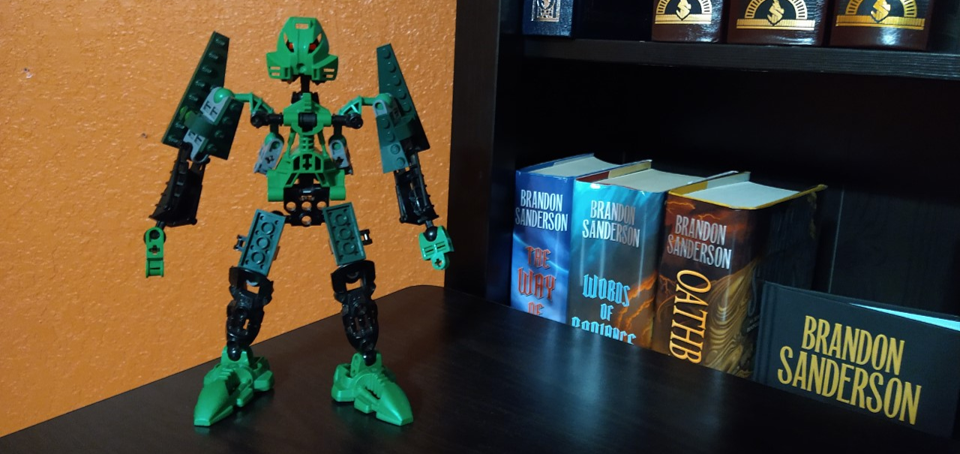
Nothing too crazy on design, except the aforementioned torso. He stands almost the exact height of a hardcover book. For those who are unfamiliar with the lore of Lego's Bionicle universe, Pagerunner is a legendary hero called a Toa, who has both an elemental power and a mask that grants him a special ability. Pagerunner is a Toa of Air, all the better for flying quickly to outrageous conclusions whenever a new prerelease chapter drops. And he wears the Mask of Speed, which lets him race straight to the scene when he hears someone say they got a new WoB.
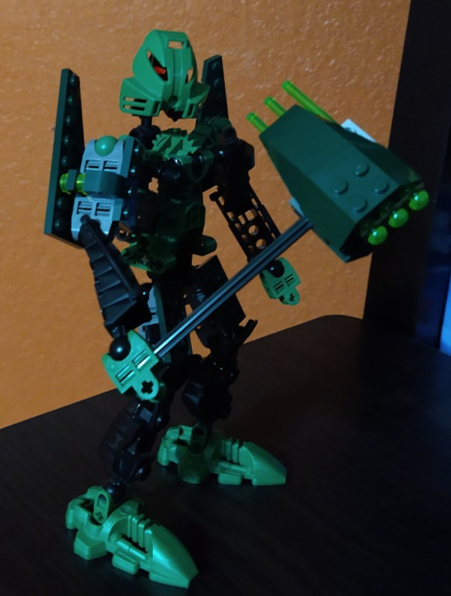
His Toa Tool is the WoB Hammer. He can use it both to crush the theories of anyone within arm's reach and to fire WoB missiles all the way across the internet.
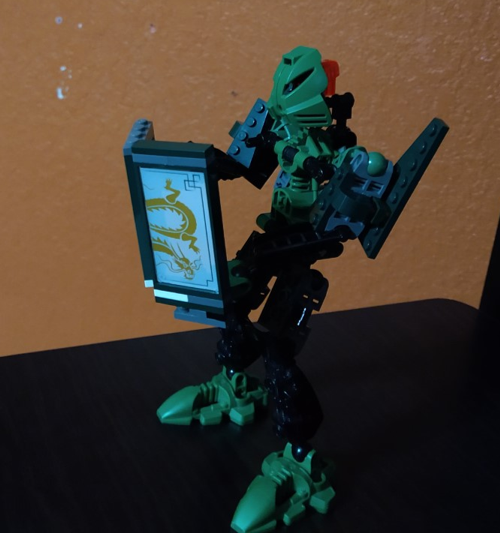
In his other hand, is that some sort of shield? No, it's just a comically large book, although it's certainly thick enough to block an attack or two. It's got a picture of a dragon on the front, but I can't remember what the actual name of the book is... Oh well. I'm sure it'll come back to me eventually.
And, yes, the "book" really does open and close. This is the part of the build that needs the most polishing; I was able to rustle up two hinge pieces, but they're not both in the same color. And some of the dark green pieces on the very top and bottom, I could only find one of. I'll probably finish it up at some point, order some spare bricks off the internet.
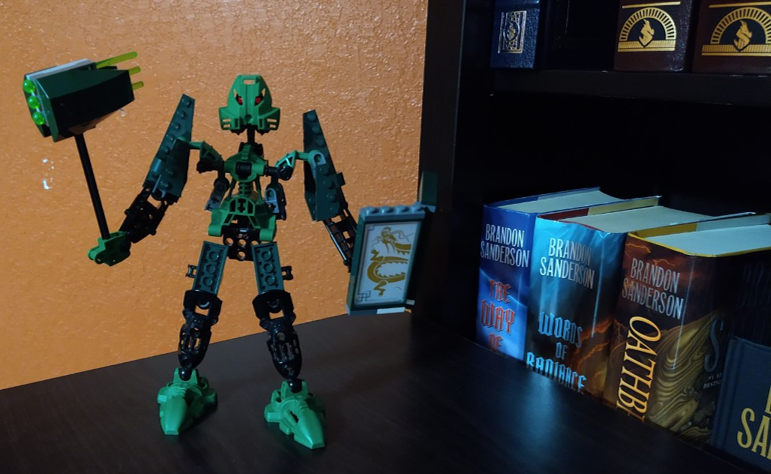
So there he is, in all his glory. I'm no professional Lego builder (for those of you who aren't aware, yes, that is a real job), but it's nice to finally have Pagerunner in a physical embodiment after all these years.
-
I have, unfortunately, not had enough time to be able to keep up with this thread or the other discussions of fabrial mechanics. I've barely had time to read the preview chapters, let alone give the new fabrial mechanics the research and analysis they deserve. So this post will be less-well-cited than I would typically ensure. But I've gotta get some of these thoughts out there anyways, so here goes. I'll start with the basics, which I'm pretty sure everyone is familiar with: fabrial metals are allomantic metals. The effects match up almost perfectly (with tin being a bit of an odd exception, but it still makes sense as a physical pulling effect). Even though Navani only lists six metals, I think by parallels we can determine that steel and copper are the metals for repulsers and something along the lines of concealers, respectively. The big hiccup is the additional stated effect of iron/steel being involved in augmenters/diminishers, but I believe that's a typo. Although I haven't looked through the thread, I would expect this possibility has been raised before. In case it hasn't, I've gone into detail in a reddit comment; long story short, replace "steel and iron" in the Chapter 10 epigraph with "pewter and tin," and everything clicks a whole lot cleaner. With that observation in mind, we move onto something I'll take as axiomatic: there are ten kinds of fabrials, and thus ten fabrial metals. Without even looking at fabrial types, I posited above that we have half of the allomantic metals accounted for. But do we count that as eight metals, or four metals and their alloys? If we do it the first way, then we only have two metals remaining, so we would, at the very least, exclude six allomantic metals in fabrial science. (Which wouldn't be the end of the world, in my mind; we've got physical and cognitive effects, but no enhancement or temporal in fabrials [since we're looking at allomantic quadrants and allomantic effects for parallels, not feruchemical, which is the table that has spiritual effects].) The other way (which is kind of where I'm leaning), we'll have eight metals and eight alloys, leaving two fabrial metals which are not allomantic metals. (Anyone else remember the four unused allomantic symbols, by the way?) We know silver has unique properties in the cosmere due to what we've seen on Threnody, so I think that's a prime suspect. Not sure what the other base metal could be, but if I'm speculating I'm partial to a metalloid like silicon to help us with computer integration of Investiture down the road. But that's not really here nor there. So, let's flip the previous axiom on its side and not look at metals, but look at types of fabrials. I think polarity is a property that subdivides among a single type of fabrials. So augmenters/diminishers are a single item in our list of ten kinds of fabrials, with augmenter being positive polarity and diminisher being our negative polarity. Like I said before, we've got four kinds of fabrials: augmenters/diminishers, attractors/repulsers, rioters/soothers (pending an official name for zinc/brass), and alterters/concealers. We also do have conjoiners/reversers, but I don't think those are a different type, since Navani's list of metals appears to have reached its end. If they had another metal for conjoiners, she'd include it in the list, so that makes me think conjoiners use the same metal as one of the other kinds of fabrials. I'd guess they are rioters of some sort. But we do have a fifth kind of fabrial: Surgebinders/surge suppressors. The voidrial that we saw in the preview chapters shares similarities with parts of the Urithiru pillar, with the addition of an unknown metal in the voidrial (more on that distinction later). I suspect the metal is chromium (since it produces an effect similar to allomantic chromium). These suppressors would be the negative polarity; the positive polarity version would be the surgebinding fabrials we've seen time and time again, Soulcasters and Regrowth fabrials. Which would, quite handily, use nicrosil. I think chromium/nicrosil are better than aluminum/duralumin, because Navani knows and would recognize aluminum if it was the voidrial metal. (Oh, yes, what about aluminum in a cage? I've said this already in the airship mechanics thread, but I don't think aluminum is a part of the cage in Navani's airship. I think it's interfering with aspects of an already existing conjoiner fabrial, but I haven't seen anything since then to change my mind and cause me to think it's part of the cage, especially if Navani concludes her lecture without mentioning aluminum cages. Jury's still out, of course, until the Part is done and Navani's epigraphs are all revealed. But I'm not expecting us to see any mention of aluminum in a cage.) So the critical question from the paragraph before last should be: did I just suggest that Soulcasters need nicrosil? Well, yes and no. This comes down to the distinction between old fabrials and new fabrials. Fabrials of both kinds are all about a spren manifesting itself through a gemstone to cause certain effects. But old fabrials don't have cages; that's the difference Navani notes between the captured voidrial and the gemstone pillar. There's an unknown metal in the voidrial; the pillar has only been described as a bunch of gemstones. I believe that old fabrials had intelligent spren who would consciously manifest the effects upon request utilizing the fabrial's gemstone. That's why you can replace gemstones on a Soulcaster; the spren isn't trapped in the gems, it's using the gems as a conduit. But new fabrials capture more animalistic spren, and they need to be externally coerced into responding certain ways. Trap them inside the gemstone and prod them with certain metals, and they will produce the same effects that an old-fabrial-spren would produce willingly and Intentionally. So the old Surgebinding fabrials don't need nicrosil, because there is no prodding and no cage required. If they want to make brand new Surgebinding fabrials, they would need nicrosil. That all being said, I'm not 100% convinced that nicrosil/chromium are the metals for Surgebinding/suppressing. There is a big gap in my understanding of Mistborn's primer cubes, specifically how they are able to resonate with and replicate other Metallic Arts. Way back when, right after Bands of Mourning came out, I posited that there were two new metals involved in primer cubes: one to provide power (ettmetal), and one to resonate with the specific effect (some unknown metal 2). I wound up asking Brandon about that in person shortly thereafter (which is what confirmed ettmetal as harmonium), so I let the theory slide; godmetals are funky, I'm not gonna complain if ettmetal has multiple effects in a single primer cube. But now I'm wondering if the idea is worth revisiting, that maybe whatever metal is associated with Surgebinding fabrials is also in primer cubes, and in both applications it takes the imprint of a form of Investiture and lets it be replicated. Which could be nicrosil, for what it's worth. But going back to the metal accounting I did up in my third paragraph, I'm back to considering the possibility of two new metal/alloy pairs which interact with Investiture in general (and the Metallic Arts in particular) in new ways. Thanks for coming along for the ride; that's where I'm at right now. We've got a bunch to learn about fabrials in the book, still, so I expect I'll be revising my theories a few times and posting a more fully-fleshed-out one in its own thread shortly after release. But if I've missed any important tidbits (like kinds of metals used in existing fabrials, or new fabrial types I haven't accounted for), please let me know. I'll be the first to admit this post is woefully uncited, so I would not be surprised if I missed some key pieces.
-
I may just be overthinking this, but now that I've overthought it a little bit more, here's why I'm getting confused: We've seen Renarin use normal Progression. And we've seen him see the future, which I assume is Voidish Illumination. He has a lack of Lighweaving, so it appears he does not have regular Illumination. So that caused me to wonder if he's starting to pick up Voidish Progression of some sort. The glowing orbs aren't an end to themselves; they would do something else when he used them, but he's dismissing these precursors before performing the real magic because he doesn't know any better. There are other issues baked in there. We've seen Fused use Lighweaving, so is Renarin really using Voidish Illumination? Alternatively, if he's picking up a third power, maybe he's just starting to learn real Illumination (as a sign that perhaps Glys is naturally uncorrupting himself)? Or this could be a unique Resonance to powers that are never normally paired? So that's why I'm saying I have no idea. Because I do have a lot of ideas and a lot of assumptions that need to be challenged, none of which I believe are defensible. So I'm gonna hope we get payoff in this book, because I don't see enough ground to stand on a position yet.
-
Spren respond to different types of metal in different ways. I wonder if we'll see any similarities to the Metallic Arts. Or if silver is one of the metals involved (which isn't Allomantic). Or what, if any, the aluminum has; as I've said in my detailed thread on conjoiners, I don't think what was described on the Fourth Bridge involves aluminum in the cage; rather, it's the aluminum box blocking effects like we saw in Oathbringer. Secret passages in the chasms. Is this new? Or is it, like I predicted in the Way of Kings Prime thread, something older that was discovered and repurposed? "Veil, however, hadn’t pushed this mission solely to gather evidence for Dalinar. She hadn’t even done it because the Ghostbloods saw Ialai as a threat." Looks like we've still got some dual motives going on. "The hardest thing in the world for Kaladin to do was nothing." Ah, the Fourth Oath again. "Leshwi hummed a loud tone, and the gemstone on her spear began to glow, sucking Stormlight from her prey." Is the humming functional? Moash didn't need to do anything else to kill Jezrien, and that looked similar. Although it wasn't quite the same; taking Stormlight vs something funky about Jezrien's soul and the Oathpact. And there's no hum when she uses it on Kaladin later, so I don't think the hum activates it. Just an affectation, Leshwi interacting with Rhythms. "“Then what are you so worried about?” Navani asked, making a notation on her list. Nearby, Renarin had stepped up to the family with the sniffling children. He summoned a small globe of light, then began bouncing it between his hands. Such a simple thing, but the children who saw it grew wide-eyed, forgetting their fear. ... Renarin couldn’t do that. He could only summon lights, and they did strange, unnatural things sometimes..." I've got nothing. No clue what these lights could be. Voidish Progression, maybe? "She could visit it in person if she wished, using the Oathgates—but something felt different about these visions. ... “I didn’t see anything, Brightness,” Rushu said. “But... I felt something. Like a pulse, a powerful thump. For a moment I felt as if I were falling into eternity...”" Oathgates are apparently functioning to get them into the Cognitive. What's different about what Dalinar does is that it also taps into the Spiritual. Is Navani the only one hearing this tone? "“And I’ve read the journals.” The ones Jasnah would give her, anyway. Storming woman." Gotta save something for Jasnah's flashbacks. "“We’re looking for something else,” Navani said, glancing at Dalinar—then shielding her watering eyes. She blinked, then waved for Rushu to follow her to withdraw back to the nearby command post. “There’s someplace beyond Shadesmar, a place where Dalinar gets this power. Once long ago, the tower was maintained by a Bondsmith like my husband—and from what the spren have said, I conclude that the tower got its power from that place beyond Shadesmar as well.”" Does "like my husband" mean Stormfather Bondsmith? Does it mean Sibling Bondsmith? More interesting implications, since Melishi's power was still active after the abandonment of the tower. I'm guessing it could be any Bondsmith to provide power - if it was a specific Bondsmith spren involved, then the tower would break whenever that Bondsmith would die, unless there was some sort of handoff/retirement/waiting in the wings. The fabrial-like functions of the tower itself would be independently contingent on the Sibling's integration. So we've still got power as long as there's any Bondsmith to manage it, but the functions stopped working when the Sibling retreated.
-
I expect this will be the last week we get two chapters; we're only getting through Chapter 19, and one chapter a week from this point on will give us Chapter 19 on the 10th, a week before release. (Although we're about up at the SDCC reading, so it will fill like even less.) Thoughts on this week's chapters: "Forcing herself to stay in character, Veil gazed up with wonder and confusion, then shied back against the chasm wall, startling a cremling with dark purple colorings." Aimia watch, DefCon 3. "Mraize had explained about this group and their efforts to bring back the Heralds—who had actually never been gone. Gavilar had led them along, used their resources—and their hearts—to further his own goals. During that time, they’d briefly been important movers in the world." So Gavilar didn't come out of the Sons of Honor; he was much like Shallan and the Ghostbloods, using them for his own purposes somehow. I'm trying to keep this Sons of Honor plotline in perspective. Based on Part 1 being the climax of a "hypothetical" book whose contents cover the intervening year, I'm thinking that they really are going to be wrapped up pretty soon. But what about Restares? He's had his name thrown around a few times, and we've gotten zero payoff for that. Fifty honorspren as the hard cap. There's our hints towards the publisher's summary; not that honorspren are no longer willing, but that only a small group will, and now they need to convince the main body. This is still pretty substantial; the Recreance vision had, what, 200 Windrunners? The duels are another very big echo from Way of Kings Prime. "He hadn’t expected to find honor among the enemy." The singers were of Honor, originally. "They had trained for millennia with their powers, and they could fly forever without running out of Voidlight. They only drained it to heal, and—he’d heard—to perform the occasional rare Lashing." Very interesting. I'd been wondering if the Fused Surgebinding was a recent invention, but now it seems that they've had it as long as they've been Fused. When they find a new order of Fused (like in the previous chapters), it's not that the Fused discover a new power; it's just that the humans meet a new kind. (Which, looking back on it, can probably be inferred from Moash seeing nine kinds of Fused, but I wasn't sure that all nine kinds had Surgebinding yet, or if they were aligning themselves into groups more thematically in anticipation of discovering powers. But that seems pretty settled, at this point.) "More importantly, it was set with a gemstone at its base. If the weapon struck Kaladin, that gemstone would suck away Kaladin’s Stormlight and render him unable to heal—a potentially deadly tool against a Radiant, even one infused by Dalinar’s perpendicularity." Sounds a little bit like the fabrial epigraph we just got. "including Cord, who carried Amaram’s old Shardbow strapped to her back and wore the full set of Shardplate she’d found in Aimia." Wait, what? What did Rock do with Amaram's Plate, if that's not Cord's?

