



Yezrien
-
Posts
509 -
Joined
-
Last visited
-
Days Won
1
Content Type
Profiles
News
Forums
Blogs
Gallery
Events
Everything posted by Yezrien
-
 We now tentatively know the approximate locations of Urithiru and all ten Oathgates. I've marked them with blue circles on this map. (I'm guessing with the Aimian one.) You might have noticed that I also marked off a large area in red. This huge area is conspicuously devoid of Oathgates. I call it the Oathgate Deadzone. The central and northern parts of this region are farther from an Oathgate than any other point on the Rosharan landmass. These are the areas which, in the event of a voidbringer attack, would take the longest to receive Radiant assistance. I've got to wonder if there's a reason behind this. The simplest explanation is that this region had the least need for Oathgate-based military aid. Based on the present-day distribution of Shardblades, we might conjecture that Alethela and Valhav, which made up most of the Deadzone in the Silver Kingdoms era, were very strong countries, with lots of combat-ready Radiants among their populations. But if I accepted that explanation, I could hardly justify an ominous name like "the Oathgate Deadzone." So maybe there's another explanation for it. When I think of the old Desolations, I see the Heralds and Radiants spearheading a coordinated global defense. Voidbringers appear somewhere, and within the hour there are Elsecallers and Willshapers on the scene, doing reconnaissance. Within days there'll be a fighting force of Windrunners and Skybreakers, drawing the battle lines and probing the enemy's defenses. And then, a week or two after the initial enemy incursion, the bulk of our forces arrive -- huge armies of radiants, squires, and ordinary soldiers, marched in from the nearest Oathgate. Except in the Deadzone. There, with all the Oathgates far away, the Radiants' response time suffers. The enemy has more time to rally, to dig in, to fortify their position, and be ready for battle. This means the Deadzone is where the Radiants (and humankind in general) are weakest. It's a hole in their global defense network. It's a weakness the enemy can and will exploit. If the Radiants were smart, they would have filled in this gap by building an Oathgate out there, perhaps in modern day Elanar or Northgrip. So why didn't they? Is it because they could rely on local Alethi and Vedens protecting themselves? Or is there a more sinister, catastrophic reason? Well, you know what just happens to be in the Deadzone? The Horneater Peaks. And what's in the Horneater peaks? A shardpool. The only known stationary perpendicularity on Roshar. And I don't think that's a coincidence. I think... if I was sending an army of monsters to invade Roshar, I'd send that army through Shadesmar. And the easiest way to get them into the physical realm is through that perpendicularity in the Horneater Peaks. This is my theory. Odium's unseen voidbringer hordes will arrive en masse through that shardpool. The Horneater peaks are Ground Zero for every desolation. The Radiants probably tried to set up an oathgate-base in the area, but it was always overrun and destroyed early in the desolation. The voidbringers make it their priority to secure their LZ by rapidly and decisively taking control of the region. Expect shock troops. Expect death. From there, they expand outward until Radiant resistance is strong enough to push back. Then a brutal war of attrition begins, with each side trying to cripple the other using behind-enemy-lines surgical strikes -- which is what we've seen in Dalinar's visions. The Oathgate Deadzone is actually enemy territory. Voidbringer Central. Mordor. It always has been, and it's about to be again. And when the monsters of the voidbringer vanguard pour out of the Horneater Oceans, eager to establish their home base, they will not be happy to find a whole human culture camping out around their portal. If the Horneaters don't evacuate their mountains in a hurry, they're about to be wiped out. Hence my clickbait thread title. If that's not bad enough, Hearthstone is also inside the Deadzone. And I think House Davar's estate is as well. And so is Herdaz, and potentially hundreds of Lopen's cousins. The only tangible proof I could find is this: Herdazians and Horneaters both make their homes inside the Deadzone. The two human races descended from Listeners just happen to live inside the region with the worst Oathgate service. Their presence suggests this region was once home to large Listener populations, which I think would confirm my logic: Oathgates, no; Voidbringers, yes. Throw in a perpendicularity, and it can't all be a coincidence, can it? It can, obviously. But maybe it's not! This might be the reason the Alethi and Vedens are so warlike. Their ancestors were living on the front lines. They were the first line of defense when a desolation came, and the last ones fighting to retake their lost territory as it drew to a close. If this theory is at all correct, I think we can expect so see confirmation pretty soon. I predict that we'll soon hear about some very unusual parshman activity in Vedenar. (This part has Oathbringer spoilers.) Either way, I bet we'll know before book 4. Thoughts?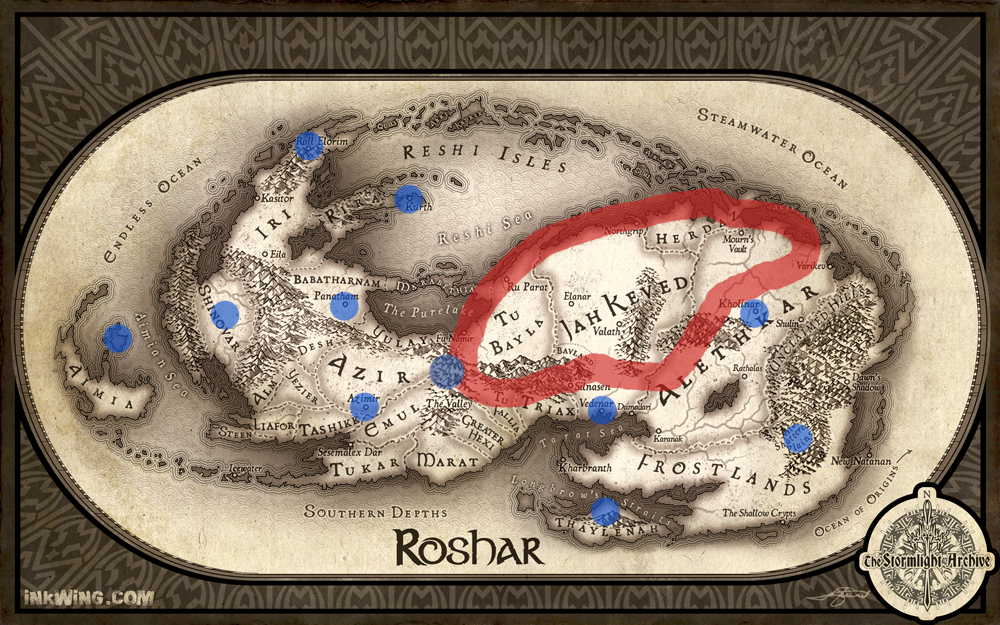
-
It's an interesting theory, but I think you've answered your own question: Shallan has touched a soulcaster without hearing screams. And we know she's had a nahel bond since long before that. So at the very least we can conclude that soulcasters are not the same as shardblades. They could be similar to shardplate, but we don't yet know what that means. They're considered holy relics because they're ancient and unexplained. Until the relatively recent (re)discovery of fabrial science, they were indistinguishable from magic. It makes sense that they'd get a semi-divine reputation. But, in all likelihood, the reason they can't be replicated is because modern fabrial science is still in its infancy. Soulcasters are remnants of a much more advanced era, when the Knights Radiant could build things like Oathgates. But, as Navani tells us, artifabrians have just scratched the surface of what's possible. That's the logical answer, anyway. Truth be told, we know very little about soulcasters. We've never actually seen one work, and ardentia soulcasting remains very mysterious. Maybe you're right; maybe soulcasters are some kind of mystical spren-construct, and modern people just assumed they were fabrials because they haven't yet heard of more fantastical things. But, for the time being, there isn't much evidence of that.
-
A soulcaster is a fabrial, a metallic device powered by a living spren trapped inside a gemstone. See here for more information.
-
No, I think you've raised a valid question. It's not that you've missed something, there's just a lot we still don't know about Shards and investiture. But, from what we've seen, I don't think people can just "pick up" any old scrap of investiture and control it the way a shardholder does. Shards aren't just huge masses of investiture; they have some kind of structure that allows a human to bond with them and take control of all that power. But when a shard is shattered, that mechanism is lost or destroyed.
-
There's been some active theorizing on both of these surges, and some very plausible proposals. Check out this thread, or this one.
-
Well, when the cosmere cinematic universe begins, each film will introduce a super-powerful artifact called an Infinity Mind. It will later be revealed that Adonalsium was a feruchemist, and the Infinity Minds (of which there are six) are Adonalsium's own metalminds. And whoever wears all six of them will wield godlike power. And should a villain attain such power, then it would take all the heroes of the cosmere working together to stop him. But only after they've teamed up on at least two previous occasions.
-
I've always pictured Dalinar much bigger than he's probably supposed to be. Fanart usually depicts him as an average-sized man, but in my mind he's huge and burly. I think it's because the very first description of Dalinar, from the WoK prologue, described him as "powerfully built" or something like that. That was the only visual cue I had to go on, so imagined him being huge. Like World of Warcraft's version of the average human male.
-
I was going by the graphics in the opening credits, which depict humans constructing a giant robot. And by the obvious analogy to nuclear weapons (humans creating the weapon of our own destruction). But, upon further research, I've discovered that now there's apparently this. Which would seem to support your interpretation.
-
What if Urithiru acts like a relay, bouncing teleport signals from one city to another? So you could travel from, say, Kholinar to Azimir, without stopping in Urithiru to chat with a tax collector, but your dematerialized essence would still pass through the Urithiru Central-Oathgate-system-control-hub. That would justify the Oathgates being built to "dial" each other, but it would still allow Urithiru to control the whole system. The Radiants could cut a city off from the gate network just by deactivating the corresponding Urithiru gate. So everyone who uses the system would still have to pay.
-
You make a lot of connections I never noticed before. Porco Rosso cursed by Yubaba... that makes so much sense! I've actually seen fewer than half of these movies, so I can't comment on most of the list, but I'll offer a little thought about Nausicaa. The movie makes it pretty clear that the giant warriors were created by humans, and it undermines the movie's themes if you change that. But I could see the insects as spirits, and the toxic jungle as a magical/spiritual phenomenon purifying the earth. It makes sense that the timeline begins with Mononoke and ends with Nausicaa. In Mononoke, we see humankind's military-industrial growth starting to destroy the natural balance, forcing spirits out of the physical world. And in Nausicaa, we see that process finally escalated to the self-destruction of human civilization, so at last the spirits return to reclaim the world. Only now the spirits are giant insects instead of giant mammals.
-
Galling, the little detail that breaks the 2nd era
Yezrien replied to Beast_c_a_t's topic in Mistborn
This is a pretty cheap answer, but what if Aluminum isn't susceptible to galling in the cosmere? Maybe all aluminum has a little investiture, which, among other effects, reduces friction. We have seen investiture do that. You might even say aluminum guns are just too 'awesome' to gall. -
Chapters 10-12 were released today, and everyone's talking about the big comedy moment: the image of Syl watching Kaladin have sex. Yes, the peeping spren is indeed hilarious. But it's also so much more. I think Brandon may have just dropped some epic foreshadowing, disguised as an innocuous joke. Spren do not respect closed doors. Spren are usually invisible to most people. Radiants are popping up all over Roshar, so sapient spren are about to be almost as common as regular spren. Conclusion? There is no more privacy on Roshar. Every single private conversation and covert activity is vulnerable to spyspren. No secret is safe. The Sleepless are nothing compared to spyspren. We've already seen Pattern used this way, but any Radiant spren should be able to do the same. And it's too big an advantage not to use. In fact, I'm a little disappointed that Shallan hasn't shared this technique with Dalinar and the others. It would probably be a big help in the murder investigation. Speaking of which... Adolin did a bad thing at the end of WoR, and he doesn't think there were any witnesses. Same for the copycat killer. (Assuming Adolin himself isn't the copycat killer.) But there could always be a spyspren. And what about voidspren? What if Odium has little eyes and ears all over the place, and no one can see them?
-
To answer a little more simply, I think we can make a few of concrete statements. Spren existed on Roshar before the Shattering. Some of the spren-based nature magic, like what allows greatshells to grow so big, most likely predates the Shattering. Surgebinding probably developed after the Shattering, since (as far as we know) it started when Honor made the Honorblades. The Old Magic is also most likely post-shattering, since it's connected with Cultivation. There were human-used magic systems in the cosmere before the Shattering, but we know very little about them. Something like lightweaving may have existed on Yolen, which is where the original Shardholders are from, but we don't know whether Adonalsium himself resided there.
-
Standardizing a measurement of investiture.
Yezrien replied to Steeldancer's topic in Cosmere Discussion
Huh. I stand corrected. -
I don't think the "strength of a feruchemist" is a thing. You either are a feruchemist or you aren't. The only personal limit is that you can't store more of an attribute than you have. In other words, a really strong person could fill a pewtermind faster than a weak person, but neither is a more powerful feruchemist. I don't think there's ever been a single reference to a 'powerful feruchemist.' The closest thing would be full feruchemists, like Sazed, who can store in every metal. But Sazed's goldminds were no better than Wayne's.
-
Standardizing a measurement of investiture.
Yezrien replied to Steeldancer's topic in Cosmere Discussion
Correct me if I'm wrong, but feruchemy doesn't have power variations like allomancy does. You can either store weight, or you can't. There are no "strong skimmers" and "weak skimmers." The only limit factor that determines how much weight you can store is how much weight you have. And, of course, how much iron you have, because there is a size-based limit. -
Standardizing a measurement of investiture.
Yezrien replied to Steeldancer's topic in Cosmere Discussion
Yeah, I was thinking there could be something along those lines, like with the "investiture pipeline" the Ire were using. But what about atium and lerasium? Investiture in solid form, with measurable mass. If there was a way to convert investiture between its intangible and solid forms, we could just use mass. Obviously not an option right now, but it might go that way someday. Especially since, if you could crystallize investiture into standardized metal beads, that would make a cool currency for the late-cosmere interstellar civilizations. You could have a whole investiture-based economy, with whole magic systems rising and falling like stock prices. I bet Brandon would like that. -
Standardizing a measurement of investiture.
Yezrien replied to Steeldancer's topic in Cosmere Discussion
I think Allomancy isn't quite right for this question, since all it does is tap into a virtually infinite investiture source. I would try an experiment with feruchemy. Heat (brass) and energy (bendalloy) are both measured in joules. So what's the maximum quantity of, say, heat, that you can store in one gram of brass? And what's the maximum amount of investiture you can store in one gram of nicrosil? Assuming the metals store with the same efficiency/density, those two quantities should be equal. If the brassmind can hold, say, 100 joules of heat, then we might define "one joule of investiture" (or "one millikhriss") as 1/100 of how much you can fit in a one-gram nicrosilmind. And if you can fill nicrosil with Breaths, you now have a conversion rate between Breaths and joules. (Obviously this is all dependent on how nicrosil works, which is not well understood at this point.) You could take some measurements on Roshar, too. I'm sure the luminosity of an infused sphere or gemstone is proportional to the investiture it carries. In fact, Rosharans may have inadvertently already created a standardized system of investiture measure: their gemstone currency. -
It seems like you're focusing on plot and character, which is exactly what a first draft ought to do. Get the bones of the story working right, and everything else can be fixed later. Revising for description isn't necessary until you've finalized the events/places/people you need to describe. However, if you're not really writing a prose novel, you can't really call it a draft. It's more like a very detailed outline. Which is completely fine, of course. Just one warning, though. If you're having trouble with description, the best way to improve is to practice. If your goal is to write a novel, you'll have to write prose eventually. Either way, if you're interested in screenplay format, there's software that makes it easy. Final Draft is expensive, but it's an industry standard, so the free trial is worth checking out. Trelby is a little less fancy, but it's free.
-
I outline like crazy. I think it's an essential skill for any writer. But so is relaxing, and letting yourself write without constraints or guidelines. As they've said on Writing Excuses, no one is 100% an outliner or 100% a discovery writer. We're all hybrids on a spectrum.
-
It's good to remember that, if you're going to get published, you'll be writing several drafts. (And there's no law that says they all have to be in the same language.) Word choice and dialogue are the LAST things you fix. Those are final-draft revisions. Your first few drafts are for fixing the character and plot, which are the same in every language. I think it was Terry Pratchett who said, "for the first draft, you're just telling yourself the story." So, to start, I'd recommend writing in whatever language you're most comfortable with. Then, when you have a great story, you can have that translated into any language in the world. But in terms of publishing, I don't think geography should be a problem. If you write something in English, I'm sure you can send it to New York and London publishers. Here's a Writing Excuses that might clear things up. http://www.writingexcuses.com/2014/08/10/writing-excuses-9-33-microcasting/
-
You're off to an encouraging start. You've clearly built a world full of conflict and intrigue, and I'm very curious about this earth-shattering magic. If you're concerned that it feels fast, it's probably because you've jumped right into the story with very little build-up. It's "in late, out early," which is always a good guiding principle. But what you have here is a story with a steep learning curve. (That's Brandon's terminology.) It means the reader needs a lot of background information to understand the plot. When that's the case, a slower, gentler introduction can be very helpful. For example, seeing these Pureborn characters in such dire situations might have more impact if we'd actually seen the kind of privilege and power they used to live with. And that last line, "Welcome to the Sorrows Guild," would be much more dramatic if we knew what that was. Kyr recognizes their citadel earlier in the chapter; she could tell us who they are, or what kind of reputation they have, by remembering some past encounter with them. But this is obviously stuff you can take care of later in the writing process. In the meantime, keep writing! I look forward to seeing more.
-
Are you referring to the lighteyes? Because that's basically been explained. The Iriali, who have yellow eyes, are not native to Roshar. Perhaps they were created that way. Hope that helps.
-
Looking for Magic System Feedback - Dynatheurgy
Yezrien replied to Yuoaman's topic in Creator's Corner
The emotional cost is very cool. That could lead your story in lots of interesting directions. My concern is the breadth of the abilities. Redirecting energy has become a popular idea in magic systems these days (Pat Rothfuss is probably the best execution), but it comes with a major problem. With enough will and creativity, this magic can be used to do basically anything. So your characters are always either monstrously overpowered, or frustratingly ignorant of their own abilities. Always remember Brandon's Second Law: A magic system is more interesting for its limitations than for its abilities. If you reduce dynatheurgy to a handful of very specific abilities (types of bonds, or whatever) with clearly-defined limitations, it actually becomes more engaging. It helps us understand exactly what the characters are capable of, and it forces the characters to get creative, and use the power in unexpected ways. (Which is actually Brandon's first and third laws, respectively.) -
odium A quick question about Odium.
Yezrien replied to OscarTheSingingHobo's topic in Stormlight Archive
If Cultivation is anything like Preservation, her intent probably makes it very hard for her to do any violence. So she's around, and she's one of the good guys, but she can't participate directly in the conflict with Odium. She can try to undermine him in subtle ways, but she can't overtly challenge his "reign." Before I saw this thread, I always interpreted "the Broken One" as a simple reference to Odium's evil and insanity, but it's interesting to think there might be more to it than that. Maybe he's broken because his power is divided, with too much of it invested in Roshar. Broken in two, so to speak, half on Roshar and half on Braize.
