Spren of Kindness
-
Posts
3063 -
Joined
-
Last visited
-
Days Won
2
Content Type
Profiles
News
Forums
Blogs
Gallery
Events
Status Replies posted by Spren of Kindness
-
Some problems:
- We don't know what shape the universe is
- We don't know the one-way speed of light
- Time is only symmetrical if you don't have a lot of stuff
Some ramifications of those problems:
- We don't know if our universe is symmetrical
- Light could be faster in one direction than another direction
- Time travel could be possible but not really?
SpoilerI'm going to take you down a flipped-up acid trip of geometry and topology like nothing you've ever experienced. This stuff gets wild and makes absolutely no sense despite the fact that it's all completely logical in every conceivable fashion.
It all started way back when Pythagoras invented the triangle. He was looking at lines and such a bunch I guess, and eventually decided what it means to be parallel and what it means to be not parallel. A parallel line will never intersect another parallel line, and any two lines that are not parallel will inevitably intersect at some point or another.
Now this was so simple and so arbitrary that literally every mathematician for centuries to come did everything they could to disprove it for... some reason. None of them could ever get anywhere because they kept inventing new rules for geometry that basically just rephrased exactly what Pythagoras had already decided.
Now before I get into the weird stuff, allow me to jump forwards a bit on our chronology and explain to you the basics of time travel as a little starter trivia. There was this guy called Ole Roemer who calculated the speed of light using some crazy eclipse shenaniganery, and then another fella you might've heard of called Albert Einstein.
By this time people had already pretty much figured out that light was the fastest possible thing in the universe. As a form of pure energy (zero mass) it could always and would always travel at the cosmological speed limit, being ~300,000,000 meters per second. Anything with any amount of mass could approach this limit but never quite reach it (such as lil' protons and neutrons in the Large Hadron Collider, which can go higher than 99.99999% the speed of light).
Einstein had won a Nobel Prize for his work on the photoelectric effect (quantum mechanics, standing waves, emission spectra... that's all an SU for another day), but because he was a scientist he decided to start thinking about other things. Apparently he was real into this whole "cosmological speed limit" thing, and eventually settled on the difference between gravity and acceleration.
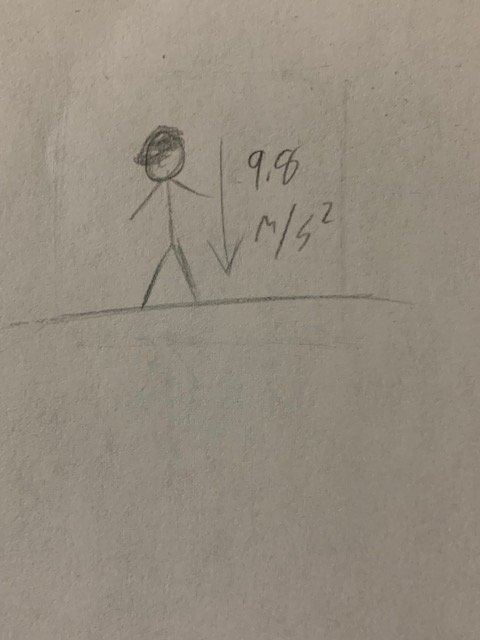
Here we have a couple little Fadrans (Fadrinos, if you will) standing in an isolated area. The first one is under the influence of gravity, which pulls downwards at a rate of 9.8 m/s^2. He feels a constant force because he isn't moving at all, and doesn't accelerate because he's on the floor. You might recognize this sensation: it's called Existing On Earth.
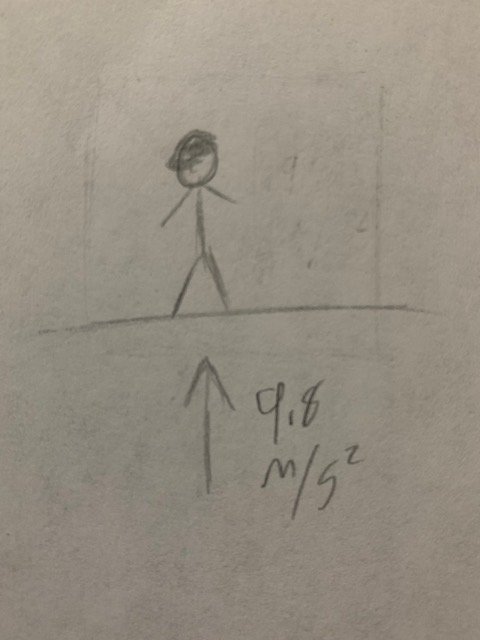
The second Fadrino, however, is being accelerated upwards at 9.8 m/s^2. His little spaceship is in a frictionless, gravityless vacuum - so the acceleration is the only force he experiences. If his spaceship had constant momentum (say, just 9.8 m/s instead 9.8 m/s^2), then eventually he would come to equal speed with the platform and start floating - however, because it's accelerating, it constantly "catches up" to his "getting used to" the speed... meaning that he feels the exact same constant force as Fadrino 1 does on Earth, meaning that it is impossible to differentiate between gravity and acceleration.
So Einstein was thinking about this and realized some funky things.
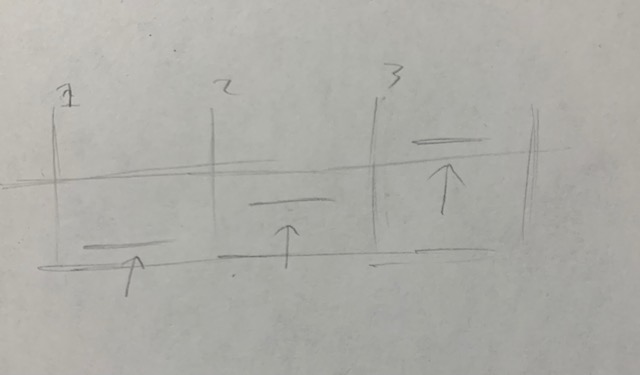
That middle line (pretend it's straight plz my hands are bad) is a beam of light, and the platform is acceleration upwards. Throughout the platform's movement the light's path remains stable, but the platform observes it at different heights based on where it is.
.jpg.49da35b46b9f2cd3db60460647ebe379.jpg)
This means that to Fadrino 2, light appears to curve downwards over time as he accelerates upwards. And what's more, because Acceleration and Gravity are now effectively indistinguishable...
.thumb.jpg.46c521622e0e8d16af36cc7791d85228.jpg)
Fadrino 1 will experience the same thing.
A bunch of scientists decided to team up and figure this out. To first prove that this bending of light in gravity was true, they pointed a bunch of telescopes at the sun and waited for an eclipse: lo and behold, the stars were in the wrong spots. Einstein subsequently became world-famous, which is funny because this wasn't even the thing that won him a Nobel Prize.
Light, of course, always follows a straight line. There's no way to actually bend it. This meant that gravity wasn't a force: gravity was the bending of space. The light was bending to our point of view, because to its point of view the path it's following is still perfectly straight. It's still a straight line, but to us it appears to be bent out of shape.
This began to baffle people, as you might expect, so smart folks like Carl Sagan decided to stop thinking about this kind of thing in three dimensions and downgraded to just two.
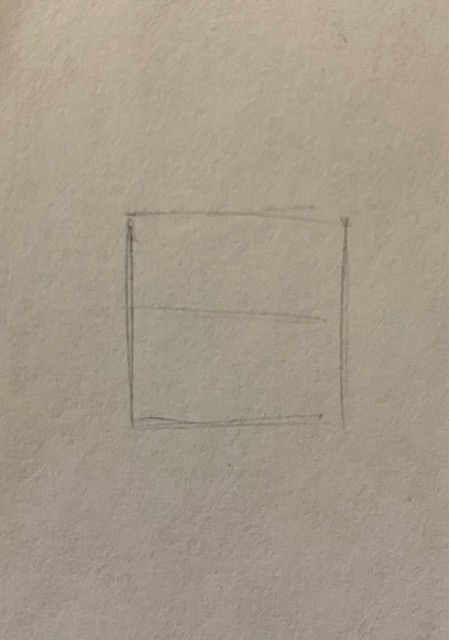
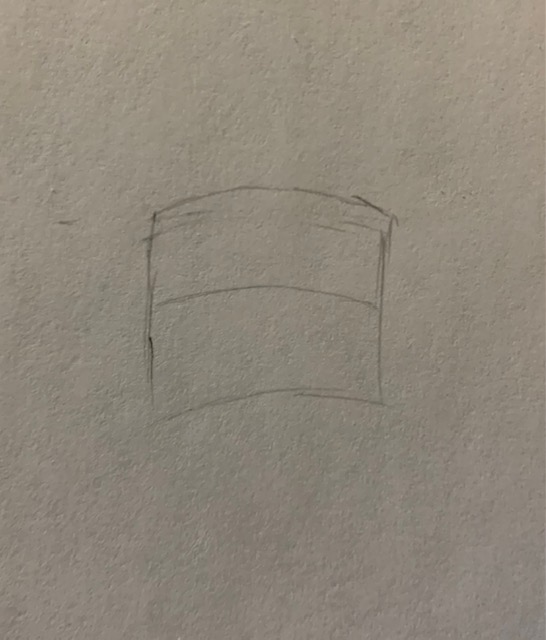
Imagine the line in the middle of both these "squares" is a beam of light. To the light, both of these "squares" are just that - perfect squares. But obviously one is very square-like and the other... isn't. Right?
WRONG.
With the regular square, the light is moving straight along with its edges. The square is straight, and therefore so is the path of light.
With the bendy square, the light is moving in a curve along with the curve of its edges. To the light it is still moving in a straight line, and therefore to the light the square still appears... well, square.
Now you might be thinking "Fadran, you absolute buffoon. Couldn't the light just move in a straight line and cut across anyways? You pixie-coated swine. You swivel-headed pasnip."
The problem is that I had to draw both those guys on a flat piece of paper instead of modeling them in a 3D space. Imagine both those squares are completely flat surfaces - 100% two-dimensional. In a 3D space, the first would take up the X and Y axis, but none of the Z; but the second would take up room in the Z-axis, because it's curved up and down.
I hope this makes sense. Honestly, there's so much stuff that I still have to explain... I'm just going to move on. If you got stuck here then you probably aren't ready for the rest of this stuff.
So hop on back to Pythagoras and his triangles. What you must understand is that all his geometry rules were written given a regular, Euclidean space: that is, where flat things are flat and curvy things are curved. Our universe as we experience it is Euclidean. That's an important word to remember, so I recommend you jot it down on the inside of your eyelid or someplace else you won't forget it.
But then there was this guy who was doing the rounds of trying to disprove Pythagoras' dumb axiom, and decided that instead of finding a different route to the same conclusion he would fabricate a different conclusion and figure out what kind of rules he'd need in order for that conclusion to work.
Bolyai was his name, and weird ideas was his game. He theorized an axiom where a specified point (x) isn't on a specified line (r) - in Euclidean geometry, only one line can exist through x that doesn't eventually intersect r, that being a parallel line. But Bolyai started with assuming some sort of magical anti-geometry where multiple lines of different angles could intersect x without intersecting r.
What was weird was that all his maths worked out just fine here... but he couldn't draw it. He couldn't even really visualize it that well.
But we can nowadays because this hypothetical plane is PRINGLE-SHAPED

Why is this the case? Because there's negative curvature on the inside of this puppy. If you made a flat surface with the properties of a pringle, then the shortest distance between two points would actually be a curve.
This type of geometry is now known as Hyperbolic, which is another word that you should get imprinted on the inside of your other eyelid for safekeeping. Now of course this type of geometry makes no sense to any of us foolish Euclidean beanbags, but we can still appreciate some of the whacky hijinks that happen inside of a Hyperbolic space, such as...
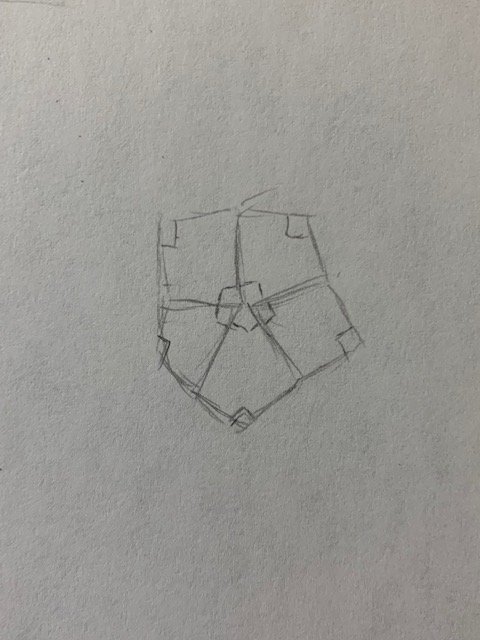
Squares! Obviously these guys are drawn on paper, but imagine them being set on a plane with negative curvature (that is, a Hyperbolic or Pringular plane). What's whacky is that each of these "squares" still have four right angles (360 degrees), but five of them intersect at a single point instead of four, making an absolutely horrendous fractal shape that we can kinda sorta "imagine" to look like this:

That is a flat surface you're looking at, but in order to image it in our regular Hyperbolic world he have to make it all bendy and curvy. If we instead lived in a Hyperbolic world this kind of thing would look perfectly normal to us, and by walking around on a Euclidean plane we'd get vertigo and have to sit down after a few minutes.
Now you might be thinking - hey Fadran, if this is a plane that's flat with negative curvature, then couldn't there be a sort of... opposite Hyperbolic plane? With positive curvature?
And you'd be... CORRECT. For once.
It's called Spherical geometry. Luckily that word is much easier to remember because you're all out of eyelids, and basically it follows a flat plane that exists with the properties of a sphere. Y'know... kind of like how we observe our own planet.
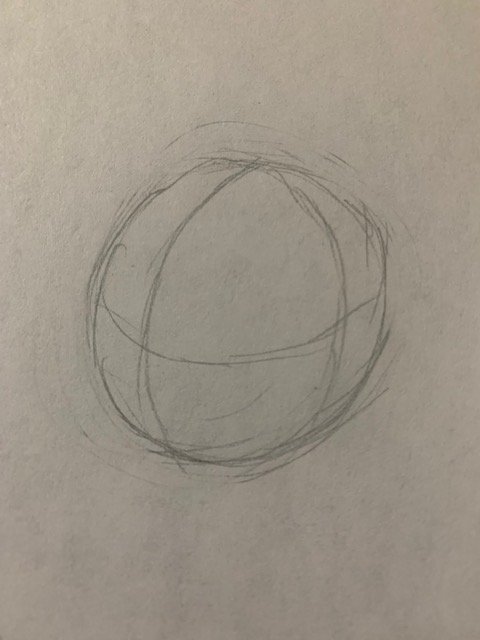
Here is an objectively terrible drawing of a sphere. I have three lines, each effectively running across the three different "middles" of this sphere. Already this should be ringing some "NANI" bells in your brain, because remember that this sphere is representing a flat surface: a flat surface with three middles.
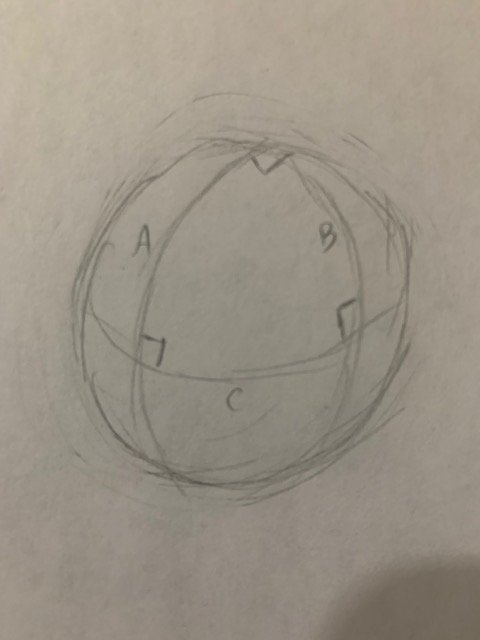
Something absolutely fascinating about this surface is the fact that it has a very unique property: every line is perpendicular at their intersections, but parallel at the midpoint between each one. Because Line A is perpendicular to Line C, and Line C is perpendicular to line B, then that means Line A and Line B are parallel; however, if you view this top down, then you realize that Line A is perpendicular to Line B, and because Line C is also perpendicular to Line B, then Line C is parallel to Line A. So now triangles have 270 degrees instead of 180, squares are also ovals for some reason, and basically nothing makes any sense.
So you might be beginning to see the problem here. I mean, we live on a sphere (the planet Earth), but when we walk from one place to another it sure feels like we're walking in a straight line. That's because we're really small, and so the curvature of the Earth from our point of view feels inconsequential. You have to get really far away to even start to notice it, because the Earth is so big.
You want to know what else is big?
The universe.
The universe is big.
The universe is really big.
The universe, in fact, is so big that maybe it's also not a perfectly Euclidean place at all.
But surely that's something we could measure? Even if it would appear as a flat plane to us; after all, we can still measure the properties of regular Euclidean surfaces down here, meaning we should be able to measure the properties of a Hyperbolic or Spherical plane.
We did this by looking at the CMBR, or Cosmic Microwave Background Radiation. This is the leftover radiation from roughly 370,000 years after the big bang when stuff was finally beginning to cool the heck down and things were finally becoming stuff like atoms and scud. All this stuff cooled in patches, which would follow uniform shapes in a very rough and highly scientific fashion that I'm not the least big qualified to talk about here. If we measure these patche in the CMBR, then we should be able to find the average curvature of spacetime and determine whether or not our universe is Euclidean.
So we did that.
The average curvature of these patches was measured to be about 0.0007
with a margin of error
of 0.0019
As far as we were concerned, the universe was Euclidean.
BUT WHAT IF
WHAT IF
WHAT IF
what if...
instead of having positive or negative curvature...
...our universe had both.
Allow me to introduce you to another principle: Nowhere is Special. When you zoom out wayyy far across our universe - farther than even the likes of light could possibly comprehend - the universe basically becomes a uniform soup. Space is pretty much the same... everywhere. At smaller scales you can observe things like trees and apples and the words "Euclidean" and "Hyperbolic" inscribed on the insides of your eyelids, but when you zoom out so far that even SuperMcDuperMegaClusters of galaxies become nothing more than singular points, then you stop paying much attention to the little stuff like that and more attention to the bigger picture.
At this scale, the average density of the universe is pretty uniform. So is the average temperature, the average energy, and - most notably, in our case - the average curvature. In order to observe the universe with this level of uniformity and at this scale, you wouldn't be able to use any other references for your position, momentum, or anything else - just like you can't have anything to show you whether you're accelerating upwards or being pulled down by gravity in that thought experiment we did with the Fadrinos earlier.
One such ramification of this assumption is that you can't have an edge to the universe, as then all positions would be fixed on an arbitrary plane and therefore (in a sense) observable. This might imply that a Euclidean universe is simply infinite, but allow me to draw your attention to another possibility:
The universe is shaped like a donut.
First of all, this theory works with the potentiality of our universe having both positive and negative curvature (the outer ring has positive, the inner ring has negative). Secondly, the universe has no edge, as no matter which way you go you'll always loop back in on yourself.
What this means is that light, traveling in a "straight" line, would eventually come back to where it started (assuming it traveled along a uniform set of the circle and not in a fancy elliptical mess), meaning that in a theoretical tiny donut universe you could see the back of your own head - similar to how you would if you were hanging out at the event horizon of a Black Hole (which is, by the way, not a good idea).
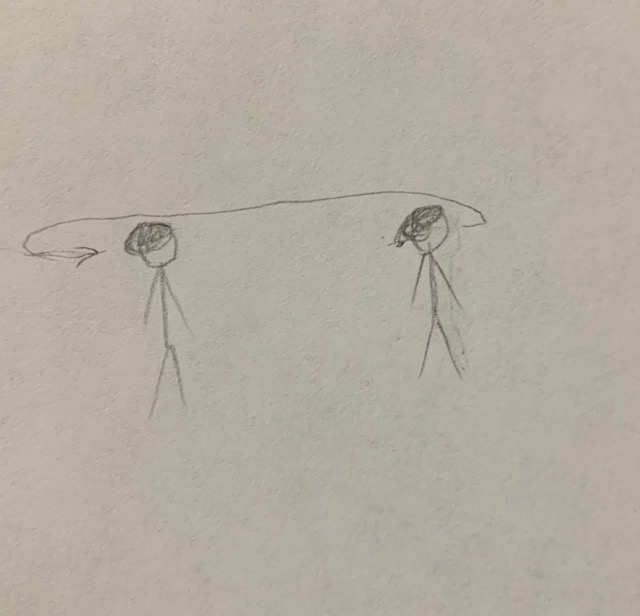
However, we have absolutely no way to prove this. We couldn't even begin to try. Obviously looking for ourselves in the night sky is pointless, because we wouldn't be seeing ourselves. It would take light so long to make the round that we would be seeing space since long before the Earth even existed - but even beyond that, we can't observe this behavior.
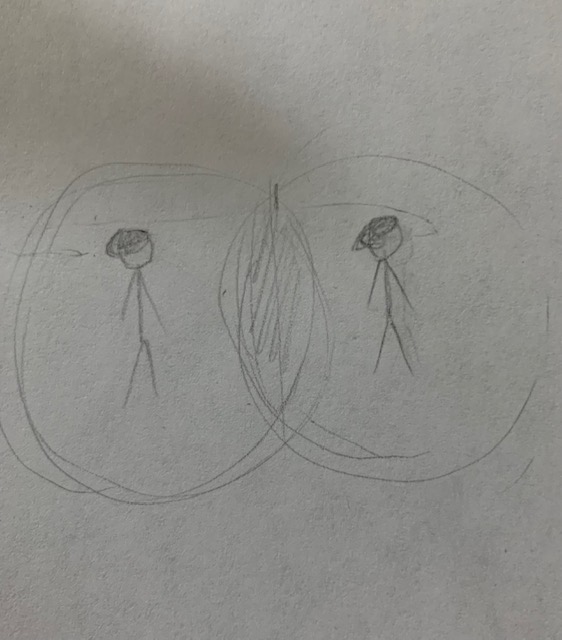
Assume that the circle there represents the observable universe - this is, the amount of space that you can see based on how far light could have come since the dawn of time. If the universe wrapped in on itself, then presumably so would your spheres of observation, and potentially they could overlap. Then by just looking back at the CMBR you could try to find identical patches on either end and prove that the universe is donut-shaped.
But there's a massive problem with this: the CMBR is younger than the universe. It was only created as soon as atoms started to form and began to emit photons (via the photoelectric effect - if you recall, the thing that Einstein did win a Nobel Prize for), which was 370,000 years AFTER the Big Bang. Basically, in order to see yourself in a donut universe, the Universe would have to be smaller than the Observable Universe.
(Kind of reminds me of that Naked Singularity stuff...)
So basically we're back at a stalemate. We can't prove that the universe is a cake pop or a pringle or a donut. Best we can do is think up weird stuff that would happen if the universe was one of those shapes...
Like - hey hang on a minute, a donut universe BREAKS RELATIVITY.
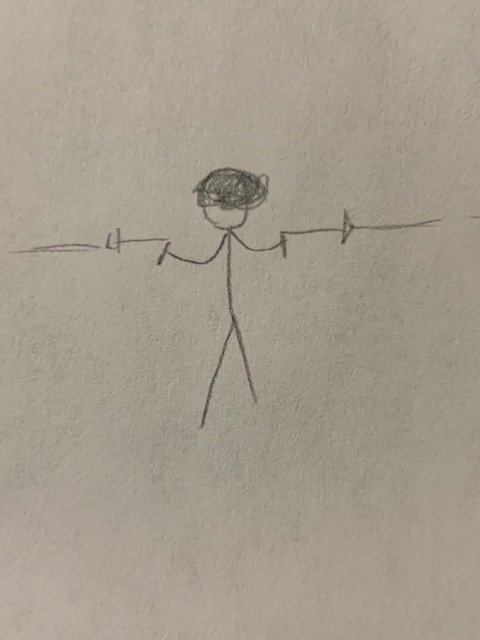
Let's say this Fadrino is firing his laser guns out in two different directions. In a Euclidean universe the lasers are going to propagate out to infinity, but in a Donut universe they'll eventually wrap back around and blast him in the face.
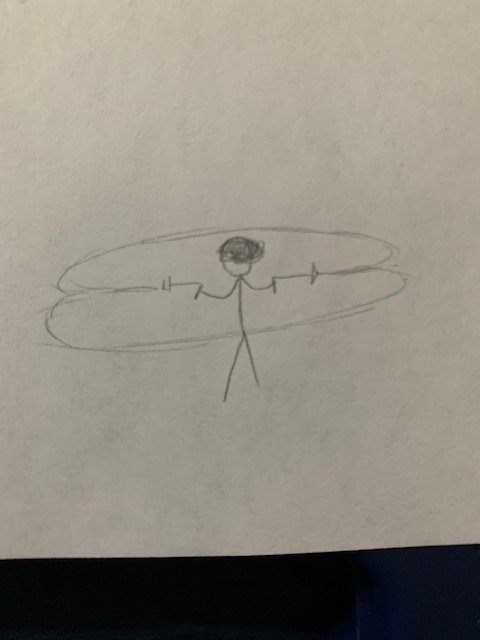
This makes sense, right? Even if this is in our hypothetical micro-sized Donut universe, the principle would technically hold for a regular-sized Donut universe
Now recall that cosmological principle: Nowhere is Special. You cannot tell where you are or where you're going without any point of reference in the vast universe. Basically, this Fadrino has no way of telling whether he's standing still or moving around.
But there's a problem: if he's moving in one direction, then some weird stuff happens...
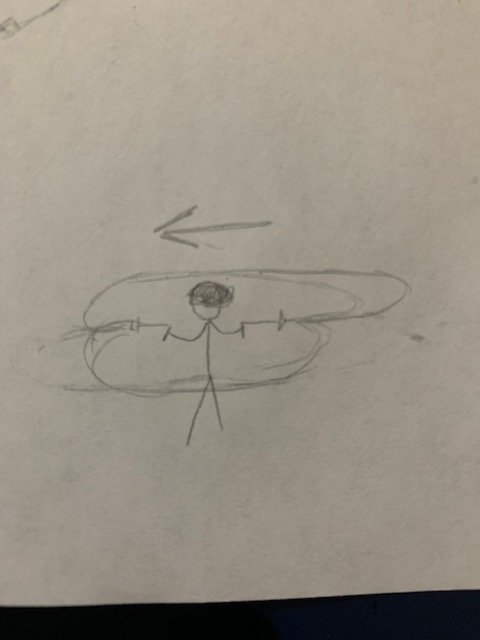
One of the lasers has to travel farther to catch up to him - meaning he would get shot by it after he got shot by the first. This can mean one of two things:
- Relativity was completely wrong and our understanding of reality is so massively flawed that we'd all be better off forgetting about the concept of science altogether.
- There is a singular, ultimate reference frame.
Let's consider the second one, because existential crises are generally debilitating towards one's mental state. If the Fadrino is moving, then he cannot know he is moving - and yet he gets smacked by one laser before the next. To his reference frame, the speed of light is not constant: this is what Albert Einstein would call "not good."
However, there is a way in which this situation functions: if there is a point of reference. Everywhere in the universe is special. There is someway or someplace or something that acts as the ultimate POV, whether that's some hole in reality or God or the squirrel of legend: in a Donut Universe, there is a preferred reference frame outside of all other reference frames.
This reminded me of something I learned in a Veritasium video: that we have never measured the one-way speed of light. The speed of light, the most important constant in all of our universal understanding, has never been measured.
You might think that's stupid. Of course it's been measured, you dummy. You buffoon. You sweatstained pillowcase. We know how fast it is, right? It's 2.99E8 meters per second.
Correct, but we've never... like, really measured that. Light travels in a vacuum at a constant speed and in a constant direction: a straight line, at the speed of (c). But the way we measure it is by sending it one way and then bouncing it back at us, timing how long it takes to reach us and dividing by the distance to get the two-way speed. Divide that by two and you get (c).
But it's impossible to measure it in one direction. Every single experiment we've ever done has required us to send the light there and back again. If you send your laser beam in one direction for a determined distance (say, one kilometer), then you set a clock the moment you shine the laser and stop it as soon as it hits the other side. How do you know when the laser hits the other side? You'd need to receive some kind of indication that it had done so, which cannot go faster than the speed of light.
The only way to receive this indication is to have a mirror at the other side and have the light bounce back at you, then when it hits you again you stop the timer and divide the result by two. Thus, we can only ever calculate the two-way speed of light (check the video to debunk any other stupid ideas you have to measure the light in one direction).
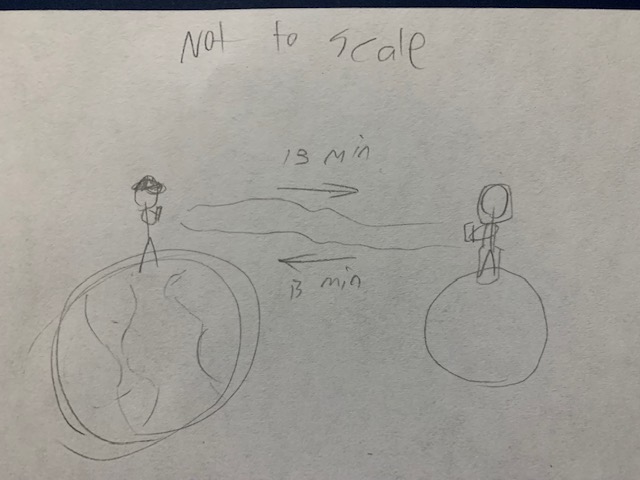
Now this might seem superficial to you, but it could mean any kind of chaos in reality. Say we send a message to someone on Mars, which is roughly 13 light-minutes away.
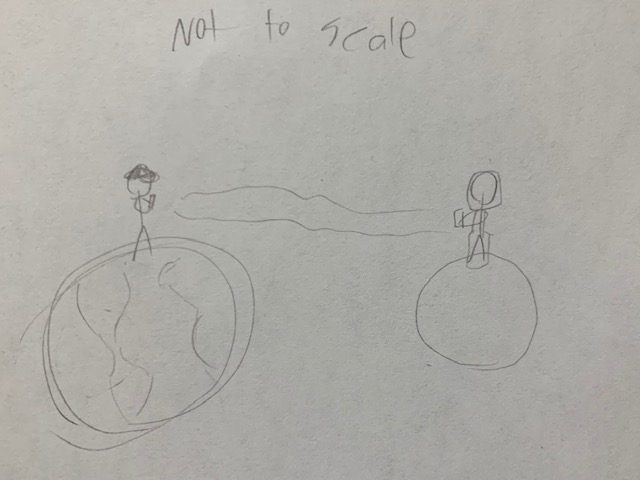
We tell them we sent the message at 12:00 on Earth, and because they want to stay synced with us they set their watch to 12:13 (because it took the message 13 minutes to arrive). Then they send back a reply at 12:13 saying that they're all synced up, which arrives at 12:26 on Earth.
However, because we haven't measured the one-way speed of light, imagine that the light takes 26 minutes to travel to Mars and 0 minutes to travel back to Earth.
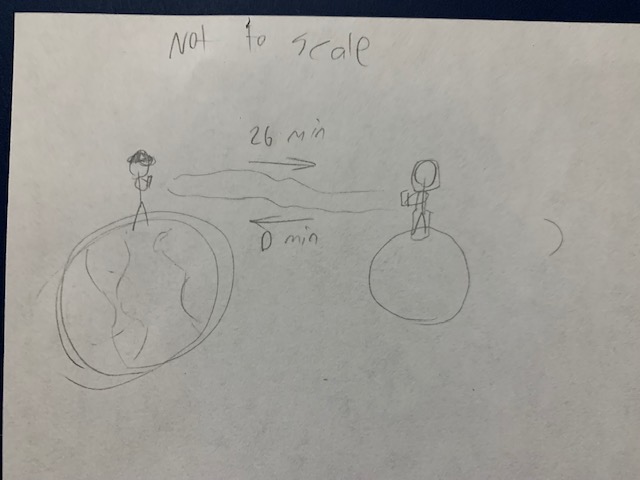
Because we know the two-way trip is 26 light-minutes, when the astronaut receives their message they assume 13 minutes has passed and sets their watch to 12:13 anyways. Then when they send back their message it takes 0 minutes to arrive, but for the same reason the message arrives at 12:26 - so now both the clocks are successfully synced, and there's no way for either one of them to tell the difference between two 13-minute transfers and one 26-minute transfer.
Now you might be thinking "Fadran, you utter dumbulscork. How in the squirrel of legend's name would that make any sense?"
And you're right - it does make more sense to just assume that the speed of light works in every direction. But we can't prove that, no matter how hard we try. And perhaps that the fact that we can't prove the one-way speed of light also supports the fact that we can't prove that our universe is Euclidean because of the weird inconsistencies.
Hell, it could even get worse than that. Consider this scenario:
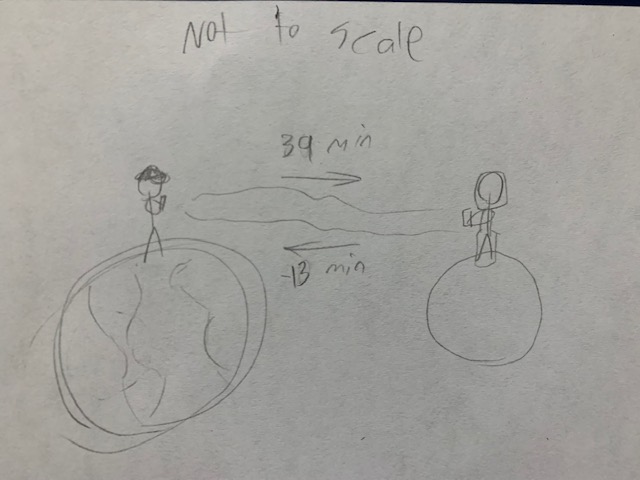
It's still a 26-minute two-way light trip, but now one of the messages is going back in time to account for light being significantly slower the other way. Suddenly time itself is breaking down before our very eyes, all because we can't prove A N Y T H I N G
And what's more, we can't even prove time is a thing at this point, because it isn't even symmetrical! If you take a video of a single particle doing its thing and show it to somebody, they'd have no way of telling whether you played the video backwards or forwards - but if you take a video of an egg splattering on the floor, they'd be pretty darn aware. Because time isn't symmetrical in terms of the laws of thermodynamics: everything tends towards entropy, so you can be pretty sure that the disorder caused by an egg dropping onto the floor is what's going on instead of a bunch of atoms spontaneously combining and working together to turn a bunch of yolk and shell bits into a whole egg and hover it back into the air - but again, you can't technically prove it. Even if it makes so much sense for the egg to have fallen and broken, you can't with a one hundred percent certainty know that that's what happened.
So space might be a donut
Light might prefer one direction to another
And time doesn't make A N Y S E N S E
...
...it is 2 AM
-
Some problems:
- We don't know what shape the universe is
- We don't know the one-way speed of light
- Time is only symmetrical if you don't have a lot of stuff
Some ramifications of those problems:
- We don't know if our universe is symmetrical
- Light could be faster in one direction than another direction
- Time travel could be possible but not really?
SpoilerI'm going to take you down a flipped-up acid trip of geometry and topology like nothing you've ever experienced. This stuff gets wild and makes absolutely no sense despite the fact that it's all completely logical in every conceivable fashion.
It all started way back when Pythagoras invented the triangle. He was looking at lines and such a bunch I guess, and eventually decided what it means to be parallel and what it means to be not parallel. A parallel line will never intersect another parallel line, and any two lines that are not parallel will inevitably intersect at some point or another.
Now this was so simple and so arbitrary that literally every mathematician for centuries to come did everything they could to disprove it for... some reason. None of them could ever get anywhere because they kept inventing new rules for geometry that basically just rephrased exactly what Pythagoras had already decided.
Now before I get into the weird stuff, allow me to jump forwards a bit on our chronology and explain to you the basics of time travel as a little starter trivia. There was this guy called Ole Roemer who calculated the speed of light using some crazy eclipse shenaniganery, and then another fella you might've heard of called Albert Einstein.
By this time people had already pretty much figured out that light was the fastest possible thing in the universe. As a form of pure energy (zero mass) it could always and would always travel at the cosmological speed limit, being ~300,000,000 meters per second. Anything with any amount of mass could approach this limit but never quite reach it (such as lil' protons and neutrons in the Large Hadron Collider, which can go higher than 99.99999% the speed of light).
Einstein had won a Nobel Prize for his work on the photoelectric effect (quantum mechanics, standing waves, emission spectra... that's all an SU for another day), but because he was a scientist he decided to start thinking about other things. Apparently he was real into this whole "cosmological speed limit" thing, and eventually settled on the difference between gravity and acceleration.
Here we have a couple little Fadrans (Fadrinos, if you will) standing in an isolated area. The first one is under the influence of gravity, which pulls downwards at a rate of 9.8 m/s^2. He feels a constant force because he isn't moving at all, and doesn't accelerate because he's on the floor. You might recognize this sensation: it's called Existing On Earth.
The second Fadrino, however, is being accelerated upwards at 9.8 m/s^2. His little spaceship is in a frictionless, gravityless vacuum - so the acceleration is the only force he experiences. If his spaceship had constant momentum (say, just 9.8 m/s instead 9.8 m/s^2), then eventually he would come to equal speed with the platform and start floating - however, because it's accelerating, it constantly "catches up" to his "getting used to" the speed... meaning that he feels the exact same constant force as Fadrino 1 does on Earth, meaning that it is impossible to differentiate between gravity and acceleration.
So Einstein was thinking about this and realized some funky things.
That middle line (pretend it's straight plz my hands are bad) is a beam of light, and the platform is acceleration upwards. Throughout the platform's movement the light's path remains stable, but the platform observes it at different heights based on where it is.
This means that to Fadrino 2, light appears to curve downwards over time as he accelerates upwards. And what's more, because Acceleration and Gravity are now effectively indistinguishable...
Fadrino 1 will experience the same thing.
A bunch of scientists decided to team up and figure this out. To first prove that this bending of light in gravity was true, they pointed a bunch of telescopes at the sun and waited for an eclipse: lo and behold, the stars were in the wrong spots. Einstein subsequently became world-famous, which is funny because this wasn't even the thing that won him a Nobel Prize.
Light, of course, always follows a straight line. There's no way to actually bend it. This meant that gravity wasn't a force: gravity was the bending of space. The light was bending to our point of view, because to its point of view the path it's following is still perfectly straight. It's still a straight line, but to us it appears to be bent out of shape.
This began to baffle people, as you might expect, so smart folks like Carl Sagan decided to stop thinking about this kind of thing in three dimensions and downgraded to just two.
Imagine the line in the middle of both these "squares" is a beam of light. To the light, both of these "squares" are just that - perfect squares. But obviously one is very square-like and the other... isn't. Right?
WRONG.
With the regular square, the light is moving straight along with its edges. The square is straight, and therefore so is the path of light.
With the bendy square, the light is moving in a curve along with the curve of its edges. To the light it is still moving in a straight line, and therefore to the light the square still appears... well, square.
Now you might be thinking "Fadran, you absolute buffoon. Couldn't the light just move in a straight line and cut across anyways? You pixie-coated swine. You swivel-headed pasnip."
The problem is that I had to draw both those guys on a flat piece of paper instead of modeling them in a 3D space. Imagine both those squares are completely flat surfaces - 100% two-dimensional. In a 3D space, the first would take up the X and Y axis, but none of the Z; but the second would take up room in the Z-axis, because it's curved up and down.
I hope this makes sense. Honestly, there's so much stuff that I still have to explain... I'm just going to move on. If you got stuck here then you probably aren't ready for the rest of this stuff.
So hop on back to Pythagoras and his triangles. What you must understand is that all his geometry rules were written given a regular, Euclidean space: that is, where flat things are flat and curvy things are curved. Our universe as we experience it is Euclidean. That's an important word to remember, so I recommend you jot it down on the inside of your eyelid or someplace else you won't forget it.
But then there was this guy who was doing the rounds of trying to disprove Pythagoras' dumb axiom, and decided that instead of finding a different route to the same conclusion he would fabricate a different conclusion and figure out what kind of rules he'd need in order for that conclusion to work.
Bolyai was his name, and weird ideas was his game. He theorized an axiom where a specified point (x) isn't on a specified line (r) - in Euclidean geometry, only one line can exist through x that doesn't eventually intersect r, that being a parallel line. But Bolyai started with assuming some sort of magical anti-geometry where multiple lines of different angles could intersect x without intersecting r.
What was weird was that all his maths worked out just fine here... but he couldn't draw it. He couldn't even really visualize it that well.
But we can nowadays because this hypothetical plane is PRINGLE-SHAPED
Why is this the case? Because there's negative curvature on the inside of this puppy. If you made a flat surface with the properties of a pringle, then the shortest distance between two points would actually be a curve.
This type of geometry is now known as Hyperbolic, which is another word that you should get imprinted on the inside of your other eyelid for safekeeping. Now of course this type of geometry makes no sense to any of us foolish Euclidean beanbags, but we can still appreciate some of the whacky hijinks that happen inside of a Hyperbolic space, such as...
Squares! Obviously these guys are drawn on paper, but imagine them being set on a plane with negative curvature (that is, a Hyperbolic or Pringular plane). What's whacky is that each of these "squares" still have four right angles (360 degrees), but five of them intersect at a single point instead of four, making an absolutely horrendous fractal shape that we can kinda sorta "imagine" to look like this:
That is a flat surface you're looking at, but in order to image it in our regular Hyperbolic world he have to make it all bendy and curvy. If we instead lived in a Hyperbolic world this kind of thing would look perfectly normal to us, and by walking around on a Euclidean plane we'd get vertigo and have to sit down after a few minutes.
Now you might be thinking - hey Fadran, if this is a plane that's flat with negative curvature, then couldn't there be a sort of... opposite Hyperbolic plane? With positive curvature?
And you'd be... CORRECT. For once.
It's called Spherical geometry. Luckily that word is much easier to remember because you're all out of eyelids, and basically it follows a flat plane that exists with the properties of a sphere. Y'know... kind of like how we observe our own planet.
Here is an objectively terrible drawing of a sphere. I have three lines, each effectively running across the three different "middles" of this sphere. Already this should be ringing some "NANI" bells in your brain, because remember that this sphere is representing a flat surface: a flat surface with three middles.
Something absolutely fascinating about this surface is the fact that it has a very unique property: every line is perpendicular at their intersections, but parallel at the midpoint between each one. Because Line A is perpendicular to Line C, and Line C is perpendicular to line B, then that means Line A and Line B are parallel; however, if you view this top down, then you realize that Line A is perpendicular to Line B, and because Line C is also perpendicular to Line B, then Line C is parallel to Line A. So now triangles have 270 degrees instead of 180, squares are also ovals for some reason, and basically nothing makes any sense.
So you might be beginning to see the problem here. I mean, we live on a sphere (the planet Earth), but when we walk from one place to another it sure feels like we're walking in a straight line. That's because we're really small, and so the curvature of the Earth from our point of view feels inconsequential. You have to get really far away to even start to notice it, because the Earth is so big.
You want to know what else is big?
The universe.
The universe is big.
The universe is really big.
The universe, in fact, is so big that maybe it's also not a perfectly Euclidean place at all.
But surely that's something we could measure? Even if it would appear as a flat plane to us; after all, we can still measure the properties of regular Euclidean surfaces down here, meaning we should be able to measure the properties of a Hyperbolic or Spherical plane.
We did this by looking at the CMBR, or Cosmic Microwave Background Radiation. This is the leftover radiation from roughly 370,000 years after the big bang when stuff was finally beginning to cool the heck down and things were finally becoming stuff like atoms and scud. All this stuff cooled in patches, which would follow uniform shapes in a very rough and highly scientific fashion that I'm not the least big qualified to talk about here. If we measure these patche in the CMBR, then we should be able to find the average curvature of spacetime and determine whether or not our universe is Euclidean.
So we did that.
The average curvature of these patches was measured to be about 0.0007
with a margin of error
of 0.0019
As far as we were concerned, the universe was Euclidean.
BUT WHAT IF
WHAT IF
WHAT IF
what if...
instead of having positive or negative curvature...
...our universe had both.
Allow me to introduce you to another principle: Nowhere is Special. When you zoom out wayyy far across our universe - farther than even the likes of light could possibly comprehend - the universe basically becomes a uniform soup. Space is pretty much the same... everywhere. At smaller scales you can observe things like trees and apples and the words "Euclidean" and "Hyperbolic" inscribed on the insides of your eyelids, but when you zoom out so far that even SuperMcDuperMegaClusters of galaxies become nothing more than singular points, then you stop paying much attention to the little stuff like that and more attention to the bigger picture.
At this scale, the average density of the universe is pretty uniform. So is the average temperature, the average energy, and - most notably, in our case - the average curvature. In order to observe the universe with this level of uniformity and at this scale, you wouldn't be able to use any other references for your position, momentum, or anything else - just like you can't have anything to show you whether you're accelerating upwards or being pulled down by gravity in that thought experiment we did with the Fadrinos earlier.
One such ramification of this assumption is that you can't have an edge to the universe, as then all positions would be fixed on an arbitrary plane and therefore (in a sense) observable. This might imply that a Euclidean universe is simply infinite, but allow me to draw your attention to another possibility:
The universe is shaped like a donut.
First of all, this theory works with the potentiality of our universe having both positive and negative curvature (the outer ring has positive, the inner ring has negative). Secondly, the universe has no edge, as no matter which way you go you'll always loop back in on yourself.
What this means is that light, traveling in a "straight" line, would eventually come back to where it started (assuming it traveled along a uniform set of the circle and not in a fancy elliptical mess), meaning that in a theoretical tiny donut universe you could see the back of your own head - similar to how you would if you were hanging out at the event horizon of a Black Hole (which is, by the way, not a good idea).
However, we have absolutely no way to prove this. We couldn't even begin to try. Obviously looking for ourselves in the night sky is pointless, because we wouldn't be seeing ourselves. It would take light so long to make the round that we would be seeing space since long before the Earth even existed - but even beyond that, we can't observe this behavior.
Assume that the circle there represents the observable universe - this is, the amount of space that you can see based on how far light could have come since the dawn of time. If the universe wrapped in on itself, then presumably so would your spheres of observation, and potentially they could overlap. Then by just looking back at the CMBR you could try to find identical patches on either end and prove that the universe is donut-shaped.
But there's a massive problem with this: the CMBR is younger than the universe. It was only created as soon as atoms started to form and began to emit photons (via the photoelectric effect - if you recall, the thing that Einstein did win a Nobel Prize for), which was 370,000 years AFTER the Big Bang. Basically, in order to see yourself in a donut universe, the Universe would have to be smaller than the Observable Universe.
(Kind of reminds me of that Naked Singularity stuff...)
So basically we're back at a stalemate. We can't prove that the universe is a cake pop or a pringle or a donut. Best we can do is think up weird stuff that would happen if the universe was one of those shapes...
Like - hey hang on a minute, a donut universe BREAKS RELATIVITY.
Let's say this Fadrino is firing his laser guns out in two different directions. In a Euclidean universe the lasers are going to propagate out to infinity, but in a Donut universe they'll eventually wrap back around and blast him in the face.
This makes sense, right? Even if this is in our hypothetical micro-sized Donut universe, the principle would technically hold for a regular-sized Donut universe
Now recall that cosmological principle: Nowhere is Special. You cannot tell where you are or where you're going without any point of reference in the vast universe. Basically, this Fadrino has no way of telling whether he's standing still or moving around.
But there's a problem: if he's moving in one direction, then some weird stuff happens...
One of the lasers has to travel farther to catch up to him - meaning he would get shot by it after he got shot by the first. This can mean one of two things:
- Relativity was completely wrong and our understanding of reality is so massively flawed that we'd all be better off forgetting about the concept of science altogether.
- There is a singular, ultimate reference frame.
Let's consider the second one, because existential crises are generally debilitating towards one's mental state. If the Fadrino is moving, then he cannot know he is moving - and yet he gets smacked by one laser before the next. To his reference frame, the speed of light is not constant: this is what Albert Einstein would call "not good."
However, there is a way in which this situation functions: if there is a point of reference. Everywhere in the universe is special. There is someway or someplace or something that acts as the ultimate POV, whether that's some hole in reality or God or the squirrel of legend: in a Donut Universe, there is a preferred reference frame outside of all other reference frames.
This reminded me of something I learned in a Veritasium video: that we have never measured the one-way speed of light. The speed of light, the most important constant in all of our universal understanding, has never been measured.
You might think that's stupid. Of course it's been measured, you dummy. You buffoon. You sweatstained pillowcase. We know how fast it is, right? It's 2.99E8 meters per second.
Correct, but we've never... like, really measured that. Light travels in a vacuum at a constant speed and in a constant direction: a straight line, at the speed of (c). But the way we measure it is by sending it one way and then bouncing it back at us, timing how long it takes to reach us and dividing by the distance to get the two-way speed. Divide that by two and you get (c).
But it's impossible to measure it in one direction. Every single experiment we've ever done has required us to send the light there and back again. If you send your laser beam in one direction for a determined distance (say, one kilometer), then you set a clock the moment you shine the laser and stop it as soon as it hits the other side. How do you know when the laser hits the other side? You'd need to receive some kind of indication that it had done so, which cannot go faster than the speed of light.
The only way to receive this indication is to have a mirror at the other side and have the light bounce back at you, then when it hits you again you stop the timer and divide the result by two. Thus, we can only ever calculate the two-way speed of light (check the video to debunk any other stupid ideas you have to measure the light in one direction).
Now this might seem superficial to you, but it could mean any kind of chaos in reality. Say we send a message to someone on Mars, which is roughly 13 light-minutes away.
We tell them we sent the message at 12:00 on Earth, and because they want to stay synced with us they set their watch to 12:13 (because it took the message 13 minutes to arrive). Then they send back a reply at 12:13 saying that they're all synced up, which arrives at 12:26 on Earth.
However, because we haven't measured the one-way speed of light, imagine that the light takes 26 minutes to travel to Mars and 0 minutes to travel back to Earth.
Because we know the two-way trip is 26 light-minutes, when the astronaut receives their message they assume 13 minutes has passed and sets their watch to 12:13 anyways. Then when they send back their message it takes 0 minutes to arrive, but for the same reason the message arrives at 12:26 - so now both the clocks are successfully synced, and there's no way for either one of them to tell the difference between two 13-minute transfers and one 26-minute transfer.
Now you might be thinking "Fadran, you utter dumbulscork. How in the squirrel of legend's name would that make any sense?"
And you're right - it does make more sense to just assume that the speed of light works in every direction. But we can't prove that, no matter how hard we try. And perhaps that the fact that we can't prove the one-way speed of light also supports the fact that we can't prove that our universe is Euclidean because of the weird inconsistencies.
Hell, it could even get worse than that. Consider this scenario:
It's still a 26-minute two-way light trip, but now one of the messages is going back in time to account for light being significantly slower the other way. Suddenly time itself is breaking down before our very eyes, all because we can't prove A N Y T H I N G
And what's more, we can't even prove time is a thing at this point, because it isn't even symmetrical! If you take a video of a single particle doing its thing and show it to somebody, they'd have no way of telling whether you played the video backwards or forwards - but if you take a video of an egg splattering on the floor, they'd be pretty darn aware. Because time isn't symmetrical in terms of the laws of thermodynamics: everything tends towards entropy, so you can be pretty sure that the disorder caused by an egg dropping onto the floor is what's going on instead of a bunch of atoms spontaneously combining and working together to turn a bunch of yolk and shell bits into a whole egg and hover it back into the air - but again, you can't technically prove it. Even if it makes so much sense for the egg to have fallen and broken, you can't with a one hundred percent certainty know that that's what happened.
So space might be a donut
Light might prefer one direction to another
And time doesn't make A N Y S E N S E
...
...it is 2 AM
-
I don't like YA fantasy anymore
(Exceptions: Rick Riordan's stuff, Skyward saga, Hunger Games)
And I get that the whole thing about having a bunch of twelve-year-olds save the multiverse is there so a bunch of twelve-year-olds can get into reading. As a kid I sustained myself entirely on Brandon Mull - Five Kingdoms was my first real foray into high fantasy.
But now that I'm an adult? It just... hurts to read. There're always these grown adults sending these children into battle and making stupid decisions to make the kids seem smart and epic. And then some god-level monstrosity finally reawakens from his slumber and is defeated by the power of friendship.
Why am I thinking about this? Maybe because I'm watching Rebels? I really like the series, but the fact that they keep sending Sabine and Ezra into these tough-nut situations on their own usually breaks the immersion a bit for me. Some episodes less so than others - like the one where Ezra infiltrates a squad of Imperial Cadets, because Kanan is all "this is the dumbest idea I've ever had we need to pull him out of there" - but a lot of the time it's like "our plan is to have the mandalorian child run down a whole platoon of stormtroopers as a distraction" and I'm like ??? Child soldiers???
(I do really like Rebels though; not crapping on it or anything)
Maybe I'm thinking about this because I was thinking about some fantasy pet peeves I have - all of which tend to show up in YA fiction at some point or another:
- "We've got company!"
- "I'm not leaving here without [][][]"
- [Two sword fighters glaring at each other while their swords are crossed... like I can't hold eye contact with anyone for the life of me and you're telling me that these people hate each other so much that they can't bear to look away for one second?]
- "Believe in yourself. BELIEVE" (somehow they passed this off in The Lego Movie. I guess Morgan Freeman just has that effect)
- [Wisecracks amid the final battle between the protag and antag, including "oh yeah? well -"]
Objectively the worst thing to ever come out of any of these stories are when the twelve-year-old children form lifelong romantic bonds with each other. No, Harrison the sword boy and Verdi the tank top girl are not in love. No, they did not find their other half at the ripe old age of thirteen. If it's written by a christian then neither of these kids know how babies are made, and you're telling me that they're going to kiss at the end of the story and get married in time for the Era 2 sequel? If your prepubescent tweens are going to be kissing then you need to get an appointment with a psychologist. Meeting your future spouse at that age is called arranged marriage, not true love.
(I have some opinions about the very end of AtLA, in case you cannot tell)
And then these children are beating up the bad guy's soldiers left and right? "It's because they use their wits to fight, not just their muscle" man shut up. No tyrant-king of this fantasy world is going to maintain control over his empire with a bunch of brainless monkey guards. No army consists of a billion muscle machines and three characterized elite warriors. It's like in the Kenobi show how the good guys will whack a stormtrooper in the face and they'll just drop their blaster because reasons.
You want to show the protagonists being capable and thinking on their feet? Give them fewer guards to worry about. Instead of twelve on two make it four on three with tight individual v individual combat. You'll never establish the least bit of tension if the sword child can take out two dozen bad guys on his own.
I know, I know... it's YA. It's written for children. No one's forcing me to read any of it. It just bothers me that there are grown adults who are making the decision to send children into battle because they're their "last hope" or some crap like that. Like maybe if the child has some super powerful magical abilities and is practically incapable of dying (Mob Psycho 100 my beloved), but giving them a slim chance of success on some elite mission? It's not worth endangering these kids over, and it's probably even less worth endangering the mission by leaving it up to a bunch of kids.
Basically, I'm being very conscientious about what happens with my younger characters in the Iconar Collective.
-
Show of hands:
Who would actually care (or even notice) if I left the Shard forever without notice
-
I have a very important question for you all.
Answer carefully, for this information may define the way I perceive you for the rest of all time.
You may never answer as important of a question as this in all your life.
Do not take this lightly, else I shall "lightly" take your kneecaps.
SpoilerWhat is your favorite dinosaur? If it be a tie, you may say more than one.
Mine are (don't look at this till after you've answered; I don't want to affect your response):
SpoilerParasaurolophus and Pachycephalosaurus.
Thank you.
-
So, my current story writing method is to hand write, and then type what ensues, right? It helps me pace things better.
Here's the thing. Sometimes, I don't want to type. Sometimes, I get in the groove, I understand the vibe, the words fairly spill out, I've got such a good grasp on the characters. And then, all of a sudden, I have twenty pages I need to type.
That would all be well and good, I can put on some music and spend a couple hours laying on the floor typing.
Except I type really aggressively. Extremely so. So I'm honestly surprised it took so long to find out that the floor is thin enough that my dad had to ask me to stop because he could hear it down below.
In other news, I think this is the first thing I've written where I went to check the Geneva Conventions just to see if I was making my character as bad as I mean for him to be.
-
I've been obsessed with black holes for probably well over a decade and I still have no clue about anything except for how they form and what they do
like apparently how close stuff can orbit without falling in depends on how fast it's spinning, which means that hypothetically it could spin so fast that things could have a stable orbit inside its event horizon such that light could escape and show us what the singularity looks like, and the only reason we don't consider that to be a possibility is because physicists just really don't like thinking about it???
And today I learned that the one we imaged is spinning so bloody fast that we get redshifting on the black hole itself, which is why in that fuzzy image one side is brighter than the other
Don't even get me started on the information paradox, man...
-
hey we're playing mad libs (kinda)
someone give me a noun and a setting
literally any noun, a rock, a tree, a person named jimothy, a planet, go nuts
and literally any setting, 1930s america, fuedal japan, a spacestation slowly being sucked into a black hole, an alien world again, go nuts.
spoiler your answers, ill pick my favorites
-
I've been really low the past few days, and while I'm still on the Star Wars high from Clone Wars I opted to boost my mood a little by watching the most mediocre movies ever made: The Prequels.
As an Original Trilogy purist I figured I should probably re-immerse myself in them in order to formulate a more educated opinion. Not that this rewatch was scientific by any means - I spent an awful lot of the Anakin x Padme scenes on reddit - but I gathered some good intel and reeducated opinions from them.
Without further ado, here we are:
1) The Phantom Menace
I have good memories associated with this movie. Ages ago it was showing in a local cinema for some reason, and my dad took me to go see it. We were watching it in 3D (with the cardboard glasses), and at my age I honestly just had a blast. Podracing, lightsaber duels, big explosions - heck yeah!
A lot of people regard it as the worst Star Wars (or did, anyways, before the Sequels came into being), but I always thought it was a solid standalone at the very least. Something about Obi-Wan Kenobi and Qui-Gon Jinn as the main characters doing their own thing really just gives it this solid vibe for me. Almost like it isn't supposed to be a part of a bigger story, and just that it's an origin for how Obi-Wan came to apprentice Anakin with a bunch of sick action packed in between.
And upon rewatch? It kinda holds up. I'll be completely honest and admit that the Podracing and first half of the Darth Maul duel (truel? Is it a truel if two of them are on the same side?) weren't quite as incredible as I remembered, but that's probably because I've been absolutely saturated with S-tier anime action sequences for the past while. For the truel in particular it really picks up when it's just Obi-Wan versus Maul, even if only for about thirty seconds before he gets kicked into a pit.
Far from my favorite Star Wars, but I really don't think it's as bad as people seem to believe.
Though I guess anything with Jar Jar in it immediately gets negative poitns.
2) Attack of the Clones
I had seen this movie once before.
Once, many moons ago, when my siblings and I were like "hey dad, we've never seen the other Star Wars movies; we should get on that" and he was like "mkay, your loss."
This movie is such a drag. It is so incredibly boring and slow and uneven. Everything just felt so... inconsequential. Obi-Wan Kenobi seeing the massive clone army for the first time is supposed to be this realization of a sinister plot behind the scenes, but instead it's like "mhm. clones." Count Dooku just feels tossed in there haphazardly, and the duel (truel???) against him is far less than interesting for the most part. And don't even get me started on Anakin x Padme, and don't even start getting me started on C3PO.
Running through the factory? Boring.
Jedi leaping into action on Geonosis? Arbitrary.
Clones coming to save everyone's hide? Inconsequential.
But I'll give credit where it's due. I remembered thinking the Yoda vs Dooku fight was absolutely ridiculous as a kid, but it's really not quite as bad as I seemed to remember. The weird screams our lil' green friend made were a little out of place, but I recalled him leaping from wall to wall like a pinball instead of the otherwise decently-paced fight that the two of them had. And Obi-Wan, of course, was as wonderful as always.
Politics were still as underwhelming as always.
3) Revenge of the Sith
In my stark hatred for the prequels during my youth, I always purposefully despised this one out of nothing but spite. So many people I knew insisted that it was the best Star Wars ever made, and I just couldn't put up with the fact that a prequel could be given such a title.
When people say the prequels are good, they mean Revenge of the Sith is good.
And it is.
Maybe I was just happy to come off the absolute drag that was Attack of the Clones, but blimey does this movie hit the spot. Starting off right into several minutes of high-octane space combat, just to leap into a remarkable set of lightsaber action and setting up Palpatine's intentions and Anakin's weaknesses. Anakin and Obi-Wan actually feel like old friends, the battles actually feel like something is happening, and somehow they managed to do with General Grievous in half a movie what they couldn't with Count Dooku in two.
And Padme is somewhat bearable, too!
I'll stick to some of my old opinions though. Anakin going from trying to save Palpatine to killing younglings in five minutes feels as rushed and choppy as always, the Order 66 montage does not feel nearly as consequential as it should, and I feel like the movie would be a hell of a lot better if they could just cut out the Yoda vs Sideous fight altogether.
Some stuff that definitely changed was my opinion of the writing and dialogue as a whole. Like I said, there were weak spots (mostly Anakin x Padme), but honestly a lot of the dialogue seemed a lot better than I seemed to remember. The scene where Palpatine reveals himself to Anakin as the sith lord was actually pretty dang great, I think; and don't even mention literally every word to come out of Kenobi's mouth. And overall the pacing was a heck of a lot better than -
oh I dunno
- Attack of the Clones.
And Anakin vs Obi-Wan, man...
It just...
(>._.)>
I'm still team Original Trilogy but damn this movie slaps.
- Overall -
The prequels aren't great, but they're Star Wars to the bone and always will be. That's how I've seen them ever since I finished Rise of Skywalker: maybe they aren't good, but at least they aren't insulting to the franchise. This is bona fide Star Wars. This is the real deal - the good and the bad.
Yeah, the progression of the plot is less than great in most cases. I agree that Palpatine is the GOAT because he fabricated a war to create an army to turn on the greatest power in the galaxy to conquer it all and rule for dozens of years - and in light of that I honestly wish that that they had more of of the politics. Not more scenes, necessarily, but more of the intricacies and nuances going into it. All we ever saw were the tail ends of his major plays, but there had to have been hundreds or even thousands of other actions and decisions he'd had made along the way to get there. All we saw was the senate cheering and applauding his acceptance of emergency powers and formation of the empire, but what bribes and laws and influences had to go into effect first?
And honestly... that Anakin x Padme? b l e c h. You don't need me to tell you that. How in the world did George Lucas think that two people who'd known each other for a couple days at most meeting up after ten bloody years would wind up making out after just hours and then married less than a week after that? And make that seem at all like a healthy relationship?
That scene in Clone Wars Season 7? The one where Rex guards the door from Kenobi while Anakin talks with Padme over hologram? That one scene developed their relationship a thousand times better than all of Attack of the Clones.
Just... git gud, writers.
I've been spoiled by Andor, is what I've come to realize.
I'm still Team Original, but really that's only because of the significance to Anakin Skywalker's story that these movies add. The Tragedy of Darth Vader the Great: that's what these six movies are about. George Lucas said he wrote all of the original trilogy as one script, starting with Darth Vader entering the starship and ending with him throwing Sideous down the reactor shaft. When we say we're done with the Skywalkers we mean we're done with the Skywalkers: there is nothing more to add to their story. Anakin was and is the Chosen One, bringing balance to the force by destroying the sith.
So maybe I'm not Team Original? Maybe I'm just Team Frick The Sequels like everyone else with a brain.
I actually liked The Force Awakens but that's a discussion for another timeThat's all I got.
B y e
-
So on Brandon’s podcast with Dan Wells, they took this personality quiz that rates your personality with 2000 fictional characters, and after listening I did it myself. There really wasn’t anything worth commenting on— I don’t know most of the characters near the top of my list anyway— until I scrolled to the very bottom.
1999/2000, Mat Cauthon, 13% match
It’s totally true, but it cracked me up. Like, I matched better with Lord Voldemort.
Soooo don’t take my username too seriously xD
-
Dude, wait... hold up -
Like
it's
okay
So you know how I said awhile back that I was picking up The Clone Wars again?
Clone Wars was my childhood. Like, it was my childhood. And also Ninjago but that's a story for another day. I have no memory of this, but my mom tells the story of me constantly insisting my name was Anakin, such that I even carved it into my door at one point - which was weird, considering I had a crush on Ahsoka.
In retrospect, that's actually... quite problematic.
But anyways, back to the story. I didn't actually have access to most of the series. We just had the first couple seasons on DVD, and I never really even watched those front to back - I'd just pick out episodes at random to watch epic lightsaber duels and clone troopers blasting out battle droids.
Then comes Covid. I get sick at one point, and due to a decided lack of rapid testing (y'know... the dark ages), I was confined to my room. Upon request I got the Disney+ account and password, and decided to sink my teeth back into the series to see if it was any good.
I got a few seasons in. Just past all that boring yawnfest Padme politics stuff. Then I got my negative results back and returned to the real world. I wasn't enjoying it by then, so I didn't really miss it much.
Fast forward to now. Two... two years later? Three? Blimey. Anyways, I'm getting these videos in my youtube recommend about Star Wars this and that (probably because I'd just come off Andor and had been binging video essays about how god flipping incredible that show was) - one of which in particular being about the politics of star wars. It had a whole section dedicated to the Clone Wars, but I wound up skipping it because a part of me didn't want to be spoiled.
Then it occured to me.
Me? Spoiled? A show that came out in 2008?
I have Disney+! I have time!
So I start hitting the episodes.
And
holy
h e c k
This show is bloody incredible.
-
new pet peeve just dropped
people verbally abbreviating words that start with 'W'
because 90% of the time, the 'abbreviation' is LONGER
for example:
"world record" 3 syllables
"wr" 4 syllables ("double-you-are")
makes me so mad
-
It's no longer March 3rd
-
A friendly reminder that the fastest recorded man-made object is the Parker Space probe
probably
A friendlier reminder that it was also maybe a manhole cover launched into space by a nuke
-
Oh how I've missed Portal 2...
-
does anyone like valentines day
i feel like everyone either hates it or is indifferent to it
where are the valentines day enjoyers
(i myself am indifferent to it)
-
Brandon sanderson pop quiz
thats right kiddos, you thought being a sanderfan was consequence-free?
no
quiz time
no looking it up, and spoiler your answers
How many pages is rhythm of war?
-
Two truths and a lie: When I was cleaning out my desk drawers today, I found three 3-D printed models of my upper teeth, a box of rocks, and a prism from Miami, Florida.
Which one do you think is the lie?
-
Two truths and a lie: When I was cleaning out my desk drawers today, I found three 3-D printed models of my upper teeth, a box of rocks, and a prism from Miami, Florida.
Which one do you think is the lie?
-
Two truths and a lie: When I was cleaning out my desk drawers today, I found three 3-D printed models of my upper teeth, a box of rocks, and a prism from Miami, Florida.
Which one do you think is the lie?
-
Day 2 of 365,000 words in 365 days (I have got to find a better way to phrase that):
Worldbreaker wc so far: 1,022
Shattered Core wc so far: 4,338
Today's wc: 4,338
Total wc so far: 5,360 -
It frustrates me so much when I figure out exactly how all my problems connect and the vocabulary to explain not only the problems, but how they connect, and then that moment of understanding fades and I'm back at square one.
Maybe I need a string board. Cause that would definitely not cause some people to question the validity of my statements that 'actually, I'm doing pretty good right now', y'know?
Anyway, I'm really glad that it's almost Christmas and that therefore, Christmas Eve candelight service is tomorrow, and that may actually be my favorite part of the holiday.
Not having school is also really nice though, I need recovery time. I mean, I like learning, but this environment is not my favorite way to do it.
-
Quick SU. Poem 40 was written with a purpose in mind. In essence, it was used as part of a proposal. Said proposal was accepted.
-
what is your guilty pleasure media
like a show or movie or artist that you’d be embarrassed to admit you like to someone who you barely know but want to impress. or a piece of media that is generally considered bad or cringe
-
fahrenheit is better than celcius and I will fight you to the death over this
if you're an american who thinks that celcius is better, i am personally charging you with treason and you are sentenced to death by [insert something horrible here]
.jpg.49da35b46b9f2cd3db60460647ebe379.jpg)
.jpg.54c79021b69f3596e812a6fca3d05ee4.jpg)