



Pagerunner
-
Posts
2193 -
Joined
-
Last visited
-
Days Won
9
Content Type
Profiles
News
Forums
Blogs
Gallery
Events
Everything posted by Pagerunner
-
First post is up-to-date with the latest and greatest.
-

Odium/Autonomy Connection, and the Red Mist
Pagerunner replied to The One Who Connects's topic in Cosmere Discussion
Makes you wonder of Honor and Cultivation were victims, or if they laid a trap for Odium, and went all Home Alone on him. -
@Oversleep, another relevant quote for you.
-
It's a good question. We don't know, and the next Mistborn book won't be written 'til at least 2018, maybe even later. (If you find an answer before that, please let us know!)
-
He does, but he doesn't use it very often. I think his last post was about some Secret History continuity, when that story was released. He's more active on Reddit, u/mistborn.
-
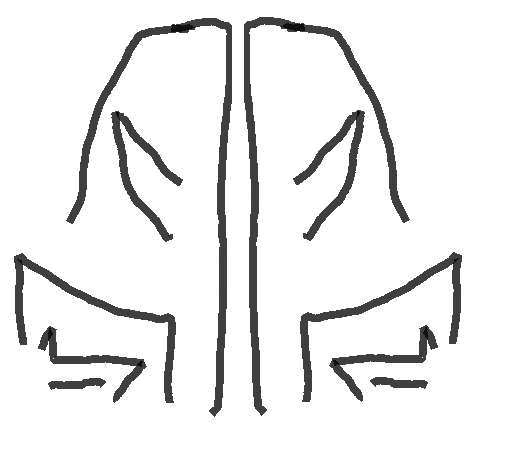
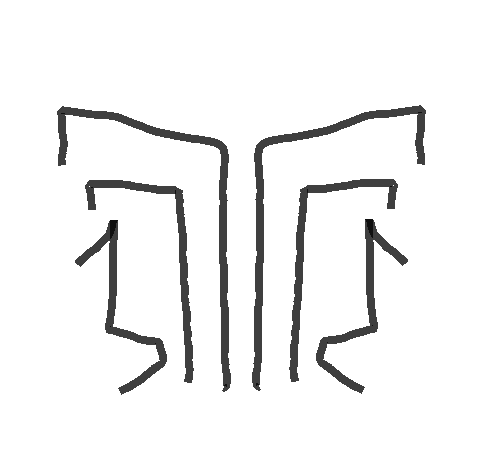
Oh, wow, this is really cool. So, let's say I'm gonna make myself a glyph, based off my avatar. The simplest version can be made using Harekeke's identified glyph-letters, just lined up in a row. But I'm gonna twist it and make the overall shape actually look like my avatar. (Image in spoilers, pardon the crudeness.) And, if people squinted really hard and figured out which lines were screw-you lines that would just make it look more like my avatar, they'd be able to work out that it was developed from: Which would give letters: But without knowing the context, nobody would be able to figure out the word itself: So, we're stuck on the first step with the endsheets; we have to figure out the 'simple' glyph they're based on. Maybe it would be worthwhile to actually develop the simple glyph versions of the Heralds' names and the Silver Kingdoms, so we've got stuff to compare? (You've seen my work, I can do it, but it won't be pretty.)
-
Oh, I think I see it now. Glyphs aren't words; they are pieces of art derived from words. The rules for glyph creation say that you have to build it based on the consonants of the word you're going for, but only very simple glyphs will stop there, and most will add a lot of 'screw you' lines because the goal is the creation of a glyph associated with that word, not a strict recreation of the word itself. Like all us who drive associate a red octagon with "Stop," because of it's association with stop signs. We see a red octagon, we know what it means, even if it doesn't say "Stop" on it. So, most of the glyphs we've seen are identifiers, like an 'avatar,' but if you had to follow certain rules while creating your avatar that tied it back to your 'screen name.' So, there's a Kholin glyph, based on the letters K, L, and N, that signifies Kholin. You can't get all the information for the word 'Kholin' from the glyph, but everyone in Alethkar recognizes that image, and glyph scholars can pick out how it was developed from those three letters. It's possible to create another glyph, based on Kholin, with a different overall shape and different screw-you lines, and when you showed it to people, they'd say "What does this mean?" because they recognize the overall shape they've become accustomed to, not the component pieces. But, if there were two rival Kholin families (let's say Dalinar and Gavilar had split the Kholin princedom in two, North Kholin and South Kholin), the old glyph might stay with Gavilar, and the new one would be Dalinar's. Both are Kholin glyphs, but the ownership and association of each is different. (This makes me think that Roshar and Rishir should have very different glyphs. Same consonants, but you wouldn't use a glyph interchangeably for them both, since Roshar 'owns' one and Rishir would 'own' another.) But the overall shape of a single glyph can be hard to distinguish at a distance; only the perimeter of the glyph is notable. But using two glyphs, you can combine simple shapes to get more permutations. But, again, these are 'owned' by specific highprinces. Dalinar and Elhokar have split their last name into two pieces, chosen probably for what those words mean. (Maybe Sebarial is hard to piece together form his glyphpair because one of the glyphs that would fit better means "butt," so he had to void it. Scratch that, he probably went the other way and stretched so he could include one that means "butt.") So, Dalinar's khokh/linil glyphpair is different than Elhokar's khokh/linil glyphpair. Because they need unique identifiers for the end product, a two-glyph set, easily recognizable at a distance, that is built from pieces of their name. Bridge Four has created their own glyph. Most people won't necessarily be able to understand what it means, until they are told "This stands for Bridge Four." But whoever designed it used the words for "Bridge" and "Four," shaping it to look like a bridge crossing a chasm. Once we've learned what it means, we're not looking for the component pieces; we see a picture of a bridge, and we know it's Bridge Four. Same with their freedom tattoo; they'll point to it and say "this means XYZ," and they can go to someone who can read glyphs to confirm "Yes, I see what they're saying, it does say Dalinar Kholin freed them on such-and-such a date." While that's a very common use, creating an identifying badge, there's also a purer form of art, making a glyph that is extremely complex (like Navani's prayer, or the Surgebinding symbols). It follows the same rule that it must be built on the consonants of that word, but the final product is much more elaborate, since it is first and foremost a piece of art (and should be much more complex than something that can be written in place of a name on a battle map). I suspect there are probably other rules involved, for where the screw-you lines go, what angles they're at, and so on, a form of art that thrives by exerting freedom within strict guidelines (like real-life twelve-tone music). It makes me think that we can't 'read' glyphs, per se. But, if we assume we know what the glyphs mean, we look at the pieces of the glyphs to validate those ideas. So, we think we see city names or country names in the 'Voidbinding' chart. The question shouldn't be, "Take the subglyphs we can identify and see what it spells," but "Can we make a case that the glyph was built from this word we expect?" Don't break apart the glyph into pieces until we've identified what we think the pieces should be. Does this make sense? Am I on target? EDIT: @Landis963, the editor doesn't let me see the original {S} (with square brackets), and it doesn't let me remove the strikethrough formatting. So, I'll be careful going forwards. (Although, I had a square-bracket {B} as well, but it let me remove the bold formatting in the editor. Eh, I won't pretend to understand all the details.)
-
Snow day for me. I'm supposed to be working from home... but I'm really tempted to bring myself up to speed on glyphs, print out large versions of the back endsheet glyphs, and go to town. If I could get some help with some basics: How do we reconcile a letter-based glyph system (the way we're interpreting all of these at the moment) with what we're seeing in the books of glyphs like Khokh or Linil, where they don't correspond to a single letter, but rather a whole syllable, and carry a meaning of their own (like Shash, which means dangerous)? Are glyphs and glyphpairs separate writing systems entirely? (I'm looking at one Kholin glyph, and I can see the "K," but I don't see the L or the N glyphs proposed on the guide on page 1. And then there's another Kholin glyph, which I can see some resemblance even though it's not symmetrical, but the letters appear to be in a different order, and there are four instead of three. But those doesn't look anything like the khokh and linil glyphpair on Dalinar's crest, although they are very stylized.) Also, as I peruse the coppermind, I see there are ten fundamental glyphs. Has anyone tried to identify what they are? I see the women's script has five groupings of letters (vowels, labial [P family], uvular [K family], dental [T family], and alveolar ), with five letters per group (unvoiced stop [P], voiced stop , nasal [M], unvoiced fricative [F], and voiced fricative [V]), with some being more consistent than others. Five by give gives us all Alethi letters, if each letter is defined by a combination of two fundamental glyphs. Or do we have a different idea for what fundamental glyphs are, or if they even apply to letter-glyphs or only for symbol-glyphs? EDIT: Oh no, I used brackets and broke everything. I was trying to type that the alveolar was the S family, and I did it very wrongly, and now it all looks like this. Please ignore the ongoing strikethrough.
-
Oathbringer Prologue (spoilers)
Pagerunner replied to Watcher of Truth's topic in Stormlight Archive
Jasnah is saying they can't be Radiants because there are no Orders around anymore. Like saying you can be a Sand Master without being a part of the Diem. But that doesn't jive with what we've seen elsewhere; you can't get the same Surgebinding powers as Windrunners without following the ideals of the Windrunners and bonding a Windrunner's spren. And the progression of the Nahel bond presumably gives all the Radiant trappings, like Shardblades and Shardplate, regardless of whether or not you're officially part of a hierarchy, which Kaladin, Shallan, and company were not until the end of Book 2. What does it mean to be a Knight Radiant? Is it what Jasnah believes, that it's being part of an organization (which is why she gives the analogy of using a sword but not being in the army)? Is it having the abilities that the Radiant had: Shardblades, Shardplate, Surgebinding, Stormlight? Is it the First Oath, which binds them all in a common path in Roshar? Is it the spren bonds which allows them to remain as Cognitive Shadows, fighting in the Heralds' place on Braize? (Yeah, we're going way down some rabbit trails right now.) It might be splitting hairs over definitions. I think we both agree that being a Surgebinder is only part of being a Radiant. But the way I see it, saying oaths perpetuates all aspects of Radianthood, not just Surgebinding, and that under the current system, you can't be a Surgebinder without being a Radiant or wielding an Honorblade. -
Oathbringer Prologue (spoilers)
Pagerunner replied to Watcher of Truth's topic in Stormlight Archive
What? How is being a Radiant not about Oaths? The only non-Radiant Surgebinders we've seen have had Honorblades. Every other Surgebinder we know about has been a Radiant, and thus said Oaths. Can you please elaborate? -
A huge bunch of mistborn and cosmere metal questions
Pagerunner replied to Fluffy's question in Cosmere Q&A
Hoo, boy, lots of good questions. You're making a nice splash! Most of the specifics of some of the more advanced Feruchemical applications, we don't know beyond what's presented in the books, since Brandon will readily RAFO to preserve future surprises. A couple I can answer: 4) Savantism is something we've seen happen to Allomancers, not to Feruchemists. But that's probably because Feruchemy normally draws from an internal source, so it's not enough to mess anything. At a larger scale, with a larger influx of Investiture, it seems possible to me. But Brandon did recently comment that he's rethinking how Savantism works, because he's worried it doesn't have as drastic consequences for someone like Wax, a Steel Savant. 5) Have you read Bands of Mourning? We see that very application of F.Duralumin in there, Connection to a country. 8) That is a theory that some in-universe subscribe to, but others disagree with. Brandon avoids answering this question for obvious reasons. 10) Allomancers can learn to burn piercings, or anything else in their bodies. I don't think A.Nicrosil will affect Feruchemy, since no metal is consumed and no power is drawn from an external source. 11) The Vessels do have their own personalities, but the Intent of the Shard will eventually overpower them. Ati was overpowered by Ruin, becoming a puppet for the Shard's Intent. Some Vessels, like Rayse, seem to fit very well with their Intent and may not be as affected. 12) Odium intentionally does not pick up other Shards, so as not to dilute his Intent. We have seen a large-scale combination of Shards, with Harmony. Many spren are mixtures of Honor and Cultivation to various degrees. Odium doesn't necessarily have more power than other Shards; he might have better techniques that allow him to kill other Shards, the other Shards might have Invested some of their power in planets and magic systems, or Odium may have had help taking on two Shards at a time (many people think Bavadin is an ally of his). -
Ati was the good man, not Rayse. Rayse was apparently nasty even before he got a hold of Odium. I suspect the Shards themselves did come up with the names, since the Shards of Mistborn referred to each other by Intent, rather than by personal name. We won't know for sure, most likely, until Dragonsteel is published, which tells the story of the Shattering.
-
Why wouldn't they be Alethi? The woman on the border has a covered safehand, so it's not that ancient.
-
I'm still getting up to speed on glyphs, but is it possible that it stands for "Roshar" on compass and "Rishir" in the KR chart? Same consonants, different vowels?
-
The cubes don't hold charge for that long, only a few moments, unless they're plugged into to an ettmetal source. Allik charged the cube using Wax's initial Push against the plate. We haven't seen primer cubes for Feruchemy, but the second ship at the end of the book did indeed have weight-changing machinery, so you can have inanimate objects using Feruchemy. I think it's more of what we have seen, rather than what's possible.
-
I didn't like this mechanics of idea at first, but I'm talking myself into it. I mean, you can make an argument this is possible without Feruchemy. Just take a 20-minute nap every hour, and you won't need to go to bed at all. That doesn't work in real life because our bodies don't work like that and you'll get mad insomnia, but with Feruchemy, that is exactly what you're doing, rearranging the costs and benefits of sleep. I wouldn't argue that going around around 2/3 conked out during most of the day isn't a great way to live your life. But, hey, to each his own.
-
Cosmere University Paper Topics/Ideas
Pagerunner replied to blakismaximus22's topic in General Brandon Discussion
Brandon likes to do deconstructions of common tropes, so you could pull his treatment of one of those. Kelsier is a Christlike figure in many ways, but he's not a typical hero either. He's a psychopath who enjoys killing people. I could go on about the contradictions in Kelsier, but I wouldn't want to write your paper for you. Suffice to say, in the Mistborn annotations (available on Brandon's website), you can learn a lot of what goes into the books that isn't inherently obvious while you're reading them. Once you've written the paper, whatever it winds up being about, feel free to post it. I'm pretty sure I've made posts over 1500 words, so you'll fit right in! -
No, I haven't seen anything on Reddit about that so far. Probably because the quote you're thinking of is from OdysseyCon. Although, that quote doesn't say Book 3, it just says a future Stormlight book. So there might be something else out there. I'll keep my ear to the ground.
-
You ever seen Mission Impossible? If you don't have the appropriate set of ropes and pulleys, Brandon is okay with someone leaving a recorder running on the table near him if you ask. I haven't personally brought a recording device before, but you can look through older signing threads to see who has posted recordings, and they'd probably be willing to give you some more specific advice on the matter.
-
I seem to recall a question from Shadows of Self, involving the number of spikes Bleeder had in her at the end, which I don't know if it was ever resolved. I think the question was, did she have 1 'normal' spike and 1 Trellium spike (and Wax's earring bullet made it 2 normal spikes, allowing Harmony to control her), or did she only have 1 Trellium spike (and the earring made it 2 spikes in total). If memory serves, Brandon was coy at the time, and said he hadn't intentionally written it that ambiguous, but liked how we were working ourselves into knots over it. He said he'd issue an answer at the end of the release tour, but I don't remember ever getting anything conclusive on it. Does anyone know if it was ever answered? If not, this could be a good time to finally tie up that loose end. EDIT: Here's the question I'm thinking of.
-
The Nightwatcher and Parshmen [Oathbringer Prologue Spoilers]
Pagerunner replied to Blightsong's topic in Stormlight Archive
Just checking, have you seen this transcription? Much better than a recording for hammering out details. -
Oathbringer Prologue (spoilers)
Pagerunner replied to Watcher of Truth's topic in Stormlight Archive
That, detective, is the right question. -
The Nightwatcher and Parshmen [Oathbringer Prologue Spoilers]
Pagerunner replied to Blightsong's topic in Stormlight Archive
There's a key difference in what you've laid out and what the prologue says. It's not that an ancient spren was used to trap the parshmen; it's that by trapping an ancient spren, the parshmen were unable to transform as they used to. It's not an addition, Listeners + Spren's Actions = Parshmen. It's a subtraction, Listeners - The Ancient Spren = Parshmen. I considered whether Nightwatcher was the spren Gavilar referred to and spoke briefly about her over in the prologue response thread, but ultimately I don't think it can be her. Gavilar said that the Ancient Spren was captured. The vast bulk of the parshmen are still in slaveform at the end of WoR, so that implies that the Ancient Spren is still captive somewhere. Nightwatcher is free, so that's why I ruled her out. Same for Stormfather; if he was responsible for the transformation, then there shouldn't be parshmen at the time of WoK and WoR. Furthermore, the little we know of Roshar's ancient past suggests that the Listeners, like the spren and the Highstorms, predate the arrival of Honor and Cultivation, and later Odium, in the Rosharan system. That was the major impetus behind my suggestion that the Ancient Spren was of Adonalsium, since the Listeners would need spren to interact with before Adonalsium was Shattered. I do agree that the quote you reference is the same event, but I have a slightly different take on it. I think that Melishi (or Ishar, as I suspect) had the Bondsmith who was bonded to the Ancient Spren trap his own spren somehow to lock the parshmen into slaveform. -
I think it's fine for harmonium, not so much for atium and lerasium (since they can't be all up or all down).
-
Oathbringer Prologue (spoilers)
Pagerunner replied to Watcher of Truth's topic in Stormlight Archive
Reread the transcription. It's very clear Gavilar is referring to a single ancient spren. Which is brand new information, as far as I'm aware.
