



Jofwu
-
Posts
1700 -
Joined
-
Last visited
-
Days Won
5
Content Type
Profiles
News
Forums
Blogs
Gallery
Events
Everything posted by Jofwu
-
@Niteshado If you want to get into organized work on Coppermind, most of our discussion happens on this Discord server. Ever since that was created this forum has seen less usage. We're pretty active in there if you want to join us.
-
I think they are described (at least once) as discs, and I'm pretty sure Brandon imagines them as spherical. Ah! Ishar's artwork comes in handy. They are depicted as spheres there. It doesn't matter whether that's realistic or not, as we know they didn't end up as Roshar's moons naturally anyways. Tidal forces would definitely cause their orbits to degrade, but I think we can wave that away as a long (looooooooooong) term concern. Peter frequently states that they are unstable anyways, on astronomical scales, so I don't think that's something we need to be concerned about. And thanks to @ccstat's great work, it doesn't sound like Rosharan's need to worry about crazy tsunamis. I don't think we need to be too picky about the sizes. The orbits seem loosely defined enough that we can play with that to make them look right. Or we can play with their density if we want them to look bigger or smaller for the same mass. I'm not sure how specific Peter intended his comment to be. I felt it was more of a statement about the general order of magnitude. That is, that they're simply very small compared to Earth's moon. Brandon apparently intends for Nomon to appear larger in the sky than our moon (source), but he also points out that this isn't set in stone.
-
@MountainKing Not sure I understand your point? This quote is referring to the half-shards. The one I mentioned is talking about the Oathgate in Thaylen City.
-
I noticed something about Oathgates the other day and I'm curious how others interpret this. Odium speaking to some of the Fused before he confronts Dalinar in front of Thaylen City (OB chapter 117): Destroy the device, recover its gemstones. It can be rebuilt if the spren aren't compromised. Can't decide of this supports my theory or hurts it. On one hand, the way I read this it sounds like the spren are tied to the gemstones. If they can recover the gemstones then the spren won't be compromised. But I could be misinterpreting Odium here. On the other hand, I'm still not convinced that the Oathgate spren are TRAPPED in these gemstones. From Shallan's conversation with them in Shadesmar they certainly seem bound in some way. But more by a charge given to them by Honor than what we see with spren trapped in gems. I'm also curious what gems Odium is referring to. I looked back at the descriptions on WoR, and I assume he's referring to the gems set in the Oathgate's lanterns. But it would seem there are only two spren, and I imagined more than two gem-lanterns. Could there be more spren involved and we didn't see them all? Does the number of gems not necessarily match the number of spren because they aren't trapped/bound to the gems in a normal 1:1 sort of way?
-
That's a good point. They're in awfully low orbits (to get the 20-hour period), so the speed doesn't vary by large factors. I've calculated a semi-major axis of 5.27R. For the sake of getting a feel for this, if the moon drops to a periapsis altitude of 1R it reaches a maximum of twice the mean orbital velocity. Then apoapsis velocity would be about half the average. (The upper bound, moon grazing the planet surface, only gets up to 3x vs 1/3x) Not a massive difference, but certainly noticeable.
-
That's a very good question. I absolutely think they're smart enough to understand the relative speeds of the moons. Rosharan's are pretty scientifically minded. Equating them to a typical medieval-fantasy tech level is a big mistake. But regardless, you don't need to understand orbital mechanics to see and track how they move. If you've got a clock, you can measure how long it takes them to cross the sky. That said, I think it's very reasonable to suspect that Shallan is merely speaking poetically in that line. Especially given the context.
-
Adding on to @ccstat's work, I think I've collected all references. (note: I've left out the mentions in Sigzil & Wit's stories, which are told in OB Chapters 35 and 67, and at least one other reference that wasn't useful at all) Some I added could probably use a bit more context, but I got the most important stuff. I searched for the moon names, "moon", and "sunset"/"sunrise". Not sure if there are other terms that might catch something... MISC SALAS MOONLESS HOUR NOMON MISHIM A few thoughts and observations... First concerning their clock... Palona lists mealtimes in WoR "at second bell, noon, and tenth bell." In WoR 42 Shallan mentions "first night bell" as being around sunset. This makes me think "first [day] bell" is sunrise (6 am) and first night bell is sunset (6pm). If you count up ten hours I feel like that means they're eating dinner too early though, as tenth bell would be roughly equivalent to 4:50 pm. It's possible there's some overlap. (e.g. 10th bell = xth afternoon bell = first night bell) I think maaaaybe it's possible that it takes nearly an hour for the sun to set at their latitude (and maybe Roshar's atmosphere plays into it taking longer to go dark?). I'm terrible at visualizing/calculating how astronomical movement looks in the sky. Maybe someone else can chime in. In any case, it does make me feel like we're working with a 10-hour clock that's got an am/pm based on sunrise/sunset. Also geography, for the record... the Reshi Isles get up to the equator, but most of Roshar is well into the southern hemisphere. I calculated that the more southern areas get down to nearly 60 degrees south. I believe the Shattered Plains would be around 35-40 degrees south. The mentions of Salas in WoR 42/43 are very detailed. "half past first night bell" = "first moon" = "just after sunset" Then she mentions Salas will reach it's height in the sky in 25 minutes, which is half a Rosharan hour (got a WoP somewhere that they've got 50-minute hours). It's not 100% clear how much time passes between this and the statement that it's "just first moon". Reading the passage, I'm inclined to think no more than 5 minutes pass. She does step away from the spanreed briefly, but doesn't do very much while she waits. If we can assume the time from rise to moonheight is roughly half of the moon's duration in the sky, this suggests Salas is only up for a little over an hour. I think that fits with the info that the moon is nearly set shortly after her meeting with the Ghostbloods. If the meeting started at moonheight and lasted half an hour, the moon would be nearly setting. (and it doesn't seem to take that long) BUT this doesn't fit with Kaladin's TWoK 2 comment that Salas is still up two hours after it rose. We could say that Shallan stepped away from her spanreed longer. Maybe I'm missing something odd (about their latitude?) and the time from rise to moonheight isn't the same as moonheight to set? However, these sorts of details tend to get revised as the story goes. And we've still got to fit the moonless hour in. I think I'm inclined to assume the TWoK timing was retconed... But the faster Salas moves through the sky the more problematic we're going to get with what time it's supposed to appear to other parts of Roshar... So I'm really torn on how to interpret this. During Wit's story, Shallan refers to Mishim as the "slowest of the three moons" which I think is pretty notable. It does seem to be a statement of fact rather than part of the story. This doesn't fit super well with the timing suggested in the Herald artwork... But those could easily be a case of artistic license. We definitely ought to take Shallan's statement as fact above artistic imagery inside of in-world artwork. Wasn't planning to reconcile these observations when I started this, but I think maybe the best way to do so would be to assume (1) Salas is up longer than the WoR passage suggests and (2) Nomon rises a bit later than shown in the artwork. Without those assumptions... Salas is up for one hour. Then the hateful hour. Then you've got about 7 hours left for Nomon and Mishim before the sun starts lightening the sky, with Nomon seeming to take most of it. With those assumptions, Salas is up for perhaps 2.5 hours. Plus an hour of no moon. Nomon rises about 4 hours after sunset (an hour or so before midnight, which matches several comments that it rises late. We've got 6 hours to work with before the sun begins to come up, so let's say Nomon is another 2.5 and then Mishim takes 3.5. Maybe a bit less difference between those two. Still have the issue of the moons rising too early in the west though.
-
No, the moons aren't going anywhere. This has been talked about in the non-spoiler topic linked above, I think. And there are WoBs. When Peter says above that they are "unstable" he means on an astronomical scale. In millions of years they may be in different orbits, get tossed out from the planet, or come crashing into it. But on the timescale of the stories, they won't deviate in a notable way.
-
I had some Oathbringer-related stuff I've been meaning to share, and if we're going to gather Oathbringer moon references, I figure we need a topic in the spoiler board. So I made this:
-
Creating this topic for Oathbringer-related discussion concerning Roshar's moons, as a continuation of this topic: With that said, here's some things I've been meaning to record... (1) Private message with Peter via Reddit about a reference to Salas in Oathbringer: (2) Also an interesting observation concerning the Oathbringer endpages in the Tor edition (Herald artwork): Ishar - Notable that we apparently see the three moons depicted in the background. Not much interesting about this as far as I can tell, but I figure it's worth pointing out. Jezrien - Look very closely at the "buckle" on his belt. There's a circle of the ten polestones, with heliodor at the top. And inside of that circle are three other stones spaced at different angles, seeming to be purple, blue and green... Vedel - Those are also depicted in the stained glass window behind Vedel. We can also see their positions inside the circle with a bit more accuracy here. Also note that we can compare their sizes: the purple one is slightly smaller than the green, and the blue one is definitely largest. I think it's pretty clear that the three stones/circles we see in Jezrien's and Vedel's artwork are depictions of the moons. I believe their positions are actually indicative of their timing--presumably the time that they rise. Think of Vedel's stained glass window as a 10-hour clock (matching Roshar's 20-hour day). Rather than splitting the day by noon/midnight, they split the day by sunrise/sunset. So if you have exactly 10 hours of light/dark, the sun would rise and set at 0:00 (or 10:00, depending on convention) and noon/midnight would be at 5:00. Eyeballing the position of the moons around this circle in Vedel's image, it would suggest that Salas rises around 3/4 of an hour after sundown. Fits pretty well with the descriptions that it rises right around full dark. Nomon is only about 2 hours later, suggesting that Salas moves pretty darn fast. I think there's a WoR reference suggesting Salas reaches full height in half an hour, so that would actually work well. (if I remember right). Nomon sets as Mishim rises, which means it's up for a good 4 hours. Then Mishim would be up for another 2.5 hours or so until sunrise. It's hard to say how exact those positions are meant to be. And I could be interpreting something wrong here? But I think it seems to generally fit the right idea, if nothing else. It also reinforces the idea that they follow the same rise times everywhere. (somehow) It's curious to me that the artist (I think it's supposed to be the same one in both of these?) would inscribe the moons inside of the ten polestones. That's some interesting Vorin (?) imagery and I'm not sure what the meaning could be. The fact that they both have it suggests to me that it has some kind of significance.
-
Yeah, I'm not saying there's no meaning to the chronology at all. Just that at this time I don't imagine it will be very interesting. Brandon's FAQ says Shadows for Silence is between Warbreaker and TWoK, apparently, and that's probably trustworthy. Nothing in the book to place it relative to others, so far as I can remember.
-
Nah, I'm just focused on the Stormlight timeline for now. Honestly though, @Draginon, I think you'll find the overarching cosmere timeline is less interesting than you might think. There's not really much interesting overlap in the stories. There's not any overlap at all, really, with a few simple exceptions. Any general timeline that places the books in order will do. Oversleep has a good one here: The only exception, technically, would be the Stormlight Prelude. As far as I know, we don't have enough details to say where it fits relative to other books. I suppose you could argue Dalinar's visions are set in the past, though technically they aren't real and thus they aren't. Not sure if we know enough to say where they fit in the overall cosmere timeline... But even if we do, I'm skeptical there will be any interesting observations at this point. The best cosmere timeline I know of is this one: https://docs.google.com/spreadsheets/d/1JJtJhHwpKdow01n2-bsT3scVvqJd6lZh4uvpNwcslv8/edit#gid=0. But be aware that it makes a lot of assumptions and guesses. Might be a little out of date. It also doesn't reveal much of interest because (again) there's just not a whole lot of relevance in how the timelines fit together at this point. So far as I'ma ware. Probably the most interesting timeline overlap will happen with Stormlight and Mistborn Era 2. We know that Era 2 is set after Stormlight book 5. It's possible that Stormlight book 5 events play into what's happening on Era 2 Scadrial... And in turn, that might tell us something interesting about the later Stormlight books. Maybe. But we just don't know still.
-
So Tor has started up an Oathbringer reread. They're taking it slowly, at one chapter per week. Following along each week feels to me like a great way to slowly work through this book in detail. I'm planning to put up a thread each week on Reddit. I don't know if I'll have time to write down my own thoughts every week, but I did this time so I figured I would post it here as well! Would love to hear your thoughts on these points, or other things I didn't mention. Prologue: Feels weird reading about the Kholinar Palace now, knowing everything that will happen there. (Unmade taking over, Elhokar dying, part of it being destroyed) I don't recall much further evidence as to who the people with Gavilar are. Amaram is mentioned of course, and the old man is surely Taravangian. My best guess is Restares? He seems to be in-the-know. The two women are a big question mark for me. Adrotagia is the only one I can think to put out there, but even she's a toss-up. There's the question posed of why Gavilar offered this treaty. In TWoK Jasnah thinks it was for Shardblades. I can't remember what the general consensus was. Obviously it actually (primarily) had something to do with "bringing their gods back"... But I don't think I've seen a great explanation for how a treaty helps with that. Huh... How did these listeners get Shards? I imagined they went into hiding before the end of the False Desolation and thus before the Recreance. If nothing else, it suggests their ancestors interacted with humans post-Recreance. It suggests a more colorful past than "they've been hiding in the wild all this time". Gavilar's interpretation of the visions feels confusing to me, and makes me wonder if there's more going on. His solution to "unite them" is to bring the threat of Odium... But don't the visions make it pretty clear that Odium is coming one way or another? Maybe the final message of each vision can be adjusted by Stormfather, and he didn't say the same things to Gavilar. Gavilar clearly knows pretty much the entire story. I wonder how he learned it, because Dalinar's visions didn't give him enough for that. Gavilar must have been really busy putting all of this together over the last year... Or maybe he started digging into the past before his visions? So he knows about Ba-Ado-Mishram and knows the Everstorm will undo things. He also seems to know exactly who the gods are. (It's plural, so not Odium, and he refers to the Unmade as a spren rather than one of their gods.) Given how much he seems to know, this isn't surprising. On the initial read, Gavilar seemed like quite a monster for wanting their gods back. ("your people—the parshmen—were vibrant." ..."your people are as good as corpses.") He still is, of course, but now we know that the implication here is that ALL of the parshmen will be restored. The desire for war is appalling and everything that comes with the Everstorm is bad news... But he DOES want to restore the souls of millions of slaves across Roshar who did nothing wrong. This doesn't justify him or excuse his motivations, but it does make me wonder if he saw honor in this. (and dishonor in the "solution" of the ancient Radiants) The black sphere... So it clearly glows with voidlight, but that doesn't say what it is. A trapped unmade gets thrown out a lot. But he has another one of these and he knows what Unmade are, more or less. I'm really skeptical that he has two captured Unmade. I'm also really skeptical that, even if he did, he would so casually hand one over to Eshonai. I've seen voidspren thrown out, but don't we see a captured stormspren (for stormform) in WoR? I don't think voidspren glow with voidlight when captured in a gem. My opinion would be that the sphere simply contains voidlight... or that it contains one of the Fused. Don't know how he would have either, but I like these explanations best. And lastly, that darn rhythm-voice. During previews I had a theory that it was one of the Heralds (probably Nale or Kalak) trying to sabotage things. Could still be right? From what Ulim says to Venli, I don't think it was simple voidspren directing Klade. Ulim said that Eshonai was a traitor. That she had interfered with their plans. It's certainly suspicious that Venli was present, but... I dunno, I just don't see how that fits. They should want to JOIN Gavilar, no? Could be competing schemes among them, but that's a shot in the dark. I don't see how Odium himself could reach out to Klade at this point either. Still counting this a big mystery.
-
@ccstat Yep, this is my concern. It struck me when Dalinar mentions Salas during [Oathbringer spoilers]. I pointed it out to Peter, and I believe he said that would be a mistake as [Oathbringer spoilers] happens in the early morning. Would have to dig up the PM. In any case, the timing just didn't seem to match well with the time Salas rises in the east. Elliptical orbits make it more complicated and introduce lots of unknowns. Plus there's the fact that Roshar spans well below the equator. Could be error in all this... But I feel like the problem you can see in these numbers isn't going to go away easily. Peter seems to think it will work out, but hasn't done the math. I suspect Brandon set up an impossible moon situation and we'll just have to roll with it, but we'll see. We definitely need to scroll through sometime and compile a list of EVERY reference to the moons. I think there's a good list for TWoK earlier in this topic, but I don't think that was done for WoR, Edgedancer, or Oathbringer.
-

[OB] Glyph Translation Discussion (No Plot Spoilers)
Jofwu replied to Harakeke's topic in Stormlight Archive
I started with 'I' but it's ultimately arbitrary and 'E' was easier to read. It does seem to span both in my opinion. Short 'i', short 'e', and 'ee'. I do strongly think that 'E<' (or 'I<') is a short 'e' because of it's appearance in "Alethela." I think the pronunciation is supposed to be intuitive to us there, along with "Alethkar". I feel more strongly about that pronunciation than I do any of the other E/I variations. It's possible that what we have is a non-diacritic version of each vowel, and that's what we're seeing there... And those instances also all happen to include the '<'. Seems unlikely to me. In any case, I really don't like the idea that it's a stop/aspirate on the following letter. First because we see the aspirate on "Valhav". Seems more likely they'd stick marks for that above those letters themselves. Also, that seems awkward to me considering they essentially read the word forward and backward. I must have been staring at this too long. Definitely messed up those 'A' options... Probably all of them honestly. @Pagerunner, lend us your IPA! I also completely missed the strangeness of the 'A' in "Aimia". Looking back at the original, I'm not sure I agree that it has a '~' above it at all. It looks like part of a water line to me. Or perhaps it's a regular looking 'A' and the top portion of the letter (as you show it) is the '~' (just not super squiggly, and close to the top of the main character). -
[OB] Glyph Translation Discussion (No Plot Spoilers)
Jofwu replied to Harakeke's topic in Stormlight Archive
Thanks, good catch. Yeah, definitely no similarity there. So "double-dot" is the symmetry indicator. Looks like "single-dot", "tilde", and "less-than" appear on vowels only. I guess we really only have two vowel characters shown. Call them 'A' and 'E'. I see all three of these used on 'A', presumably giving a short "ah", a long "ay", and... something else? I see 'A<' used in "Valhav", "Makabakam", and "Tales". Maybe it's this? I suppose in "Kak" it doesn't have one of these. I expect one of them is assumed if you have the double-dots. I see all three used with 'E' as well, if we can assume the "Shin" one has a dot over it? I'm guessing that 'E`' is a short "ih", 'E~' is a long "ee", and 'E<' is a short "eh". In summary, that's: A` = /æ/ A~ = /eɪ/ A< = /ɑː/ or /ɒ/ E` = /ɪ/ E~ = /iː/ E< = /ɛ/ Then there's the weird marks of "greater-than" and "circumflex", both on "Valhav". I'm not going to try to understand the 'V>'... But I feel pretty comfortable assuming that the 'L^' is an aspirated 'L', and that the diacritic generally means an aspirated consonant. Also wanted to point out, just in case it wasn't noticed, that while 'T' and 'K' appear to be the same symbol, the 'T' straddles the strike-through while the 'K' sits beneath it. -
[OB] Glyph Translation Discussion (No Plot Spoilers)
Jofwu replied to Harakeke's topic in Stormlight Archive
So Isaac recently drew out the glyph for determination, KHAKH: The 'KH' phonemes are well known and easy to spot here, leaving an 'A'. Guess what it sort of looks like... -
The article is about as right as it can be. The blade swap happened before Taln arrived, if I'm not mistaken. That means Taln possessed this cleaver-like Shardblade for several weeks before Dalinar took it. I assume the confusion is because people think Taln's blade was swapped very shortly before Dalinar took it. In any case, Taln was still in possession of it before Dalinar. Commenting because it seemed like some people were still confused?
-
[OB] Glyph Translation Discussion (No Plot Spoilers)
Jofwu replied to Harakeke's topic in Stormlight Archive
Looks like a 'T' to me in there as well.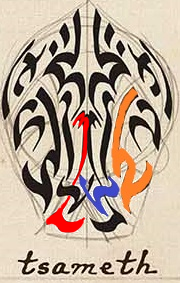
-
[OB] Glyph Translation Discussion (No Plot Spoilers)
Jofwu replied to Harakeke's topic in Stormlight Archive
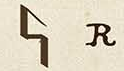
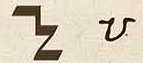
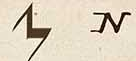
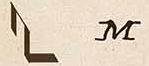
@Wonko the Sane, brilliant work! @Harakeke, I think we're going to need a character chart for yet another Rosharan script. Assuming this is some kind of in-between script, bearing similarities to both glyphs and women's script, was curious if I could find any connections... Turns out there are Compare the glyph "I" phoneme to the "I" in "Rishir", "Aimia", and "Shin Kak Nish". Practically identical, minus diacritics. Compare the glyph "R" phoneme to the "R" in "Rishir" and "Iri". Practically identical, just more script-y. Compare the glyph "SH" phoneme to the "SH" in "Rishir" and "Shin Kak Nish". Have the 'v' portion in common? Compare the glyph "V" phoneme to the "V" in "Valhav". Ignoring the weird diacritic, or merging them, gives you something similar. Edit: Whoops, that's the "U" phoneme. Don't see anything that links that one to the "V" in "Valhav". Compare the glyph "N" phoneme to the "N" in "Natanatan" and "Shin Kak Nish". Similar, if you turn top slant more script-y and add a twirl to the bottom one. Compare the glyph "M" phoneme tot he "M" in "Makabakam" and "Aimia". If you cut off the stem on the left side of this script, the resulting hump and long tail seem to be in common. Not sure what to make of how similar "T" and "K" seem to be in this script. I suppose the glyph "K" phoneme bears some similarity to a portion of the "K" in Makabakam. The letter "E" in this script is essentially the same as "I" with a different diacritic. The glyph "E" phoneme is sort of a warped version of the "I" OR a warped version of the (apparent) diacritic linked with "E". The glyph "A" phoneme is just a dot or small circle, compared to the full letter. But it's worth noting that one of the "A" varieties here uses a single dot as the diacritic. I don't really see much to link "T", "TH", "L", or "S". Also don't see any similarities to women's script beyond the whole center line running down the length of it thing.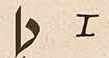



-
[OB] Glyph Translation Discussion (No Plot Spoilers)
Jofwu replied to Harakeke's topic in Stormlight Archive
I've been wondering about these. We know from in-world Words of Radiance that Urithiru was built/placed after/around the formation of the Knights Radiant. I say this because the script is very odd. I think we have evidence that symmetrical glyphs existed BEFORE the Silver Kingdoms and the Knights Radiants. My first guess was that this script might predate glyphs, but I don't think that can be the case. The strikethrough line is very interesting and distinctive. It seems very reminiscent of women's script to me, which makes me wonder if this is an ancestor of that script? The curvy lines of course are definitely reminiscent of glyph graphemes of course. I think the Silver Kingdom names are a very good guess. I wonder two things though... One is whether we have the actual names of those kingdoms. We have the VORIN names for them. Dalinar heard a few in his visions I think, but this could be a "translation" thing that we wouldn't get. And he didn't hear all of them. It's possible they went by something slightly different than what we know. The symmetry in particular is suspect I think. Also, we don't know how those names changed over time. Alethela eventually morphed to Alethkar. When did that happen in relation to this map's dating? Or perhaps I should say in relation to the writing on the map. It's possible that the notations we're trying to make sense of were added well after the drawing itself was created. They look like they were added afterwards, to me. (not to confuse them with Nazh's notations of course-- yeah, I know the "English" ones are him) The leading N in Natanatan bears some similarity to the following two Ns, which makes me think that the letters change form depending on their position in the word. The script looks very Arabic, so that's another thing they would have in common. And that would mean we shouldn't put too much stock in comparing the leading characters to other instances of them. I was wondering if the vowels might be full characters, and then the word is read backwards and forwards. So Natanatan would be written NATAN or Alethela would be written ALETH. Just another concept I thought I'd throw out. It seems possible in some instances, but in others it makes the diacritics more confusing and it doesn't work great for other names. -
@Zizoz thanks for contributing! I must have an issue with the settings, but no worries. Easy for me to move it myself when I get a chance. I have it set to display new things in blue text just so that I don't miss anything that gets added.
-
When Dalinar left Cultivation, did he feel tired or drained in some way?
-
[OB] Glyph Translation Discussion (No Plot Spoilers)
Jofwu replied to Harakeke's topic in Stormlight Archive
@Blazenella They seem to generally be read from top center to bottom outside, but there also seems to be some freedom involved. The main problem here is that it represents an Alethi word. Your guess could be 100% right and we simply don't know what the word means. -
Hm, I'm not sure that's true? Have we seen any cases where a Radiant holding Stormlight uses a fabrial? Shardplate is definitely an odd case, and the hardest to fit into my list. Probably should have left it out, but I thought the Urithiru comparison was an interesting one.

