



Jofwu
-
Posts
1700 -
Joined
-
Last visited
-
Days Won
5
Content Type
Profiles
News
Forums
Blogs
Gallery
Events
Everything posted by Jofwu
-
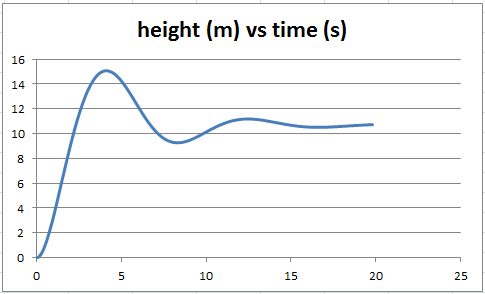
[[Well, I wrote this up yesterday and forgot to submit. Will do so now even though I haven't been able to read the two most recent posts. ]] Ah, I see. I was imagining we have something like F = F1 * f(v), where F is the equation for force, F1 is all of the non-velocity dependent factors, and f(v) is some function of relative velocity with a range from 0 to 1. So perhaps that function something along the lines of f(v) = e^-|v|. When v=0 you get F=F1. The more velocity you have, the smaller percentage you get of F1. Of course you'd need to scale it appropriately along the v-axis, as you've done in your equation with the "/V" term, in order to match the descriptions from the book. If you hold a coin in your hand, you initially experience the full reaction force of F1. But this would only be for a small fraction of a second, as the coin accelerates rapidly to a higher velocity. Then when the coin suddenly stops, you're instantly pushing with a sustained F1. Of course, F1 isn't constant with the distance changing, but I think that gets the idea across. EDIT: Yeah, I tend to favor the simplicity of the first relationship. After giving it some brief thought, I'm hesitant to use relative velocity dotted by unit vector pointing at the target, and with that also goes the idea that an object coming towards you doesn't mean you get more force. It would all just boil down to this basic idea that fast moving things are "slippery", such that they are more difficult to Push. Maybe my intuition is wrong on that. I haven't dug into these books with a mind for this whole problem in a while now, so my memory of examples is sparse. The one thing that does come to mind is that I don't think we ever see anyone stop a projectile that has been Pushed towards them? I would think that if you get "extra" strength to Push something coming towards you then when a coinshot fires a coin at you, it should be relatively trivial to stop the coin mid-air. I don't think that ever happens though. Instead, what we see is Allomancer's merely deflecting in this situation. If you see someone firing a coin at you, you don't try to stop it because that's futile. He can put more energy into it than you can because as the coin gets closer it's already moving fast and will be harder to Push. But you don't have to stop it--you just have to Push it a few inches one way or the other? I toyed around with the simple problem of using a coin on the ground to Push yourself up. I'm not confident I did the numerical solution right... (what's the best way to do this with acceleration dependent on both position and velocity?) But I think it's close enough. I used an initial force of F0=1000N. I used F proportional to e^(-|v|/20) and e^(-|r|/15). (not that I'm committed to those equations, especially for position--just something to work with.) I came up with something like this. Raising the scale factor on velocity let's you reach a higher max height. Raising the scale factor on position lets you reach a higher stable height. This is Pushing with full strength the whole time of course. Turns out a bit more sluggish than feels right. I just adjusted the factors to give a stable height of around 30 feet (something around the height of Luthadel's wall, where they can "hover"). Raising the velocity factor gets you up faster, but comes with more "wobble". Hard to say how much of that is "normal", as the characters don't normally do this exact exercise. I started to apply those same factors to Pushing a coin forwards (and see what happens when we put a wall that makes it suddenly stop at some distance). But as expected you get significant acceleration and velocity. It's too much for me to feel comfortable with the results, but either way I think you'd need to put some drag force in to limit the maximum velocity of the coin. I'm too lazy to do that right now. In any case, it does look like the force will become insignificant very quickly. So when it hits a wall 5 meters away and the velocity function suddenly jumps from [basically] 0 to 1 you will feel a sustained 1000 N force until you stop burning.
-
Took a moment to consider this briefly. In this particular case, velocity does increase more slowly relative to two objects at an angle, but the practical difference depends on your horizontal distance from them relative to your height. The higher you get, the less the angle, and the less of a difference there is. But force is also some function of distance, and the objects at an angle are farther away from you. The difference in the two cases will be most exaggerated there when you are at your lowest. So those two factors roughly offset one another. So again, the actual numbers depend entirely on what functions you come up with. You could really make things lean either way. It looks like this is where the discussion began on whether to use signed relative velocity or absolute value of relative velocity. Or, well, actually it looks like you were originally just using the absolute velocity of the object, and then I argued in favor of using relative velocity. (because that's what Pagerunner's model is using) I don't recall whether we want to maintain the sign of the velocity or not. It seems like you were arguing that an target moving towards you should allow for a stronger Push and a target moving away should allow for a weaker Push. My gut feeling is that it should just use absolute value and these cases are identical. Seems like perhaps the problem you ran into with that approach is that in the game it became easy to "launch" yourself, but then once you are moving very fast relative to everything else it's hard to do any more Pushes. Everything is moving fast and so your Pushes are weak. Hard to grab something else or even to stop? Maybe I'm imagining this, but I think that was the concern. If it IS an issue... it's possible that simply tweaking the velocity affect would help reduce the problem. The other option I can think of would indeed be to retain the relative velocity's sign (so things moving toward you can be Pushed with more force). This would probably need tweaking though (otherwise you could brush aside coins flying towards you with ease). It would also probably mean that e^-v doesn't work very well, because negative velocities (things coming toward you) are going to give a massive boost to your Push force.
-
That sounds backwards. I thought the idea was that you could push harder on something coming towards you and weaker on something moving away. Assuming there's a difference at all. It's hard for me to make assumptions on what this means in practice, because the results heavily depend on what function of velocity you use. All we "know" is that the force for a stationary object should be higher than the force for an object moving away from you. (thus the reason an object suddenly stopping will throw you off balance) Your simulation uses f(v)=e^-v I believe, using positive velocity headed away from you. This would mean your force gets exponentially higher for negative relative velocity, which doesn't work right. I think we proposed that function of velocity before we realized it was important to keep the sign on velocity. Sounds like we want f(v) to be more of a gaussian function centered on zero? But I don't remember all of the details to say for certain. And to be clear, no, I'm not saying sign should be ignored. I think there was a reason not to drop the sign. It should definitely be applicable in all cases. Either using the absolute value of relative velocity (probably wrong?) or signed relative velocity.
-
That very much depends on how the equations shake out. Artemos' quick simulations seem to look about right.
-

Those glowing giants no one seems to be talking about
Jofwu replied to BrightnessSamantha's topic in Stormlight Archive
We've talked about them... We just know so little so there's not much to speculate on. They also show up in one of Dalinar's OB flashbacks. His third? The one where he sees Evi the first time and kills the assassin. When he's on his way back to the feast after going out in the storm he sees one of these things and it chucks a boulder at him. I think there may also be a (potential) vague reference to them in the Eshonai interlude where she swaps to stormform? The general assumption seems to be that they're some kind of spren that follow along with the highstorm. I think there's another WoB out there where someone asks if their existence is known among the general population. Brandon said there are legends, and people just sort of expect weird things to happen in highstorms so they're no real surprise for Rosharans. -
It's totally understandable. I think our intuition says, "Oh, it's exactly like pushing out with your arm or legs. No resistance pushing a small thing. Resistance when you push a big thing. Sudden jolt when you bump into something big." It's easy for Allomancy to feel simple, until you start working through the math and realize a consistent explanation is tricky. Pagerunner's conclusion is pretty good, I think. If you make force a function of the relative velocity, you directly translate the sudden velocity change to a sudden change of force. That's obviously not the only thing that matters of course... On top of velocity, distance is obviously a factor. Mass of the object factors in. Mass of the Allomancer seems to, based on a few statements. Allomancers can have different innate strengths. Maybe they can control the rate of burning to one degree or another for finer control, and if nothing else they can step a discrete amount by flaring. But all of these factors are basically knowns. f1(v) = some function of velocity f2(r) = some function of distance f3(m1) = some function of the mass of metal f4(m2) = some function of the mass of Allomancer f5(strength) = some function of Allomancer's natural strength f6(burnrate) = some function of the burn rate or whether they're flaring or not. f7(?) = other things I'm not thinking of? Force = f1 * f2 * f3 * f4 * f5 * f6 * f7 .... And that's that. So they don't control the force in that they get to set a specific value for the force. Some of the variables (e.g. velocity, distance) are just physical realities. Some of the variables can maybe be controlled by the Allomancer (e.g. flaring). So they burn their metal (i.e. turn the force "on"), intuitively adjust anything they have control over, and then the magnitude of the force simply is what it is. Artemos has a pretty cool game/simulation that lets you try out a few concepts.
-
TLDR for the thread Insert_Anagram_Here linked: We're pretty certain that it's the names of the Silver Kingdoms (which are represented on the map). The script appears to be something between "Dawnscript" and women's script.
-
The poll shows most people in 25-34 range, but the age brackets before that are smaller. If you weight each option by the number of ages represented it looks like teenagers are the most represented per year. Not to say the poll is wrong/bad, as these ranges are a logical way to group things. Just saying that it's misleading about the distribution by age.
-
I think you've got a disconnect concerning how this plays out. (one which seems to be very common) The concept where the Allomancer controls the magnitude of the force is addressed by Model 1. If you Push with a set force, and your own mass doesn't change, then the acceleration you experience never changes regardless of what happens to the coin. In order to to explain the sudden jolt, you basically need to explain why the force changes when the coin hits something. I agree with your numbers until the end. (but I'm just nitpicking... Skip to the next bit for the real argument.) Not sure where 0.5 seconds to stop comes from. I'm getting the Allomancer at about 9 meters above the ground when the coin hits. Add up his kinetic and potential energy at this point gives the work required to stop. (15687 N*m) Dividing by height gives the average force required over that distance as about 1750 N. That's an average acceleration of 21.85 m/s. The time to stop depends completely on the shape of the Force-distance curve. Constant 1750 N will make you stop at the ground after 0.67 seconds. But you could wait until the last centimeter and Push with 1.57 kN, which would put you on the ground sooner, after a very intense deceleration. (Of course that all assumes you have such control over the magnitude of the Force, but that's another matter.) All of that said, I don't have any major issues with what you're describing except this: This is maybe what Oltux72 was trying to get at as well. I don't see any reason to think the Allomancer can sense the coin hitting the ground under this model. The Allomancer isn't involved with conservation of the coin's momentum. That's between the coin and the ground. The coin hits at the velocity you figured and imparts 0.8 N*s of impulse into the ground. And that's really all there is to say about it. All the Allomancer actually feels in this model is the reaction force of the Push, and that never changes.
-
I believe Pagerunner addresses this in Models 2 in his document. This is how a lot of people tend to view Allomancy, and I wouldn't be surprised if it's what Brandon had in mind. But there's a technical inconsistency with the idea. Pagerunner can probably explain it more eloquently, but I'll borrow the examples in his document and try. Mathematically, what you're saying is that the Allomancer mentally controls the rate of displacement between herself and the Pushed object. In other words, you are controlling the relative velocity between yoruself and the thing being Pushed. You could imagine that have a telescoping stick that they can extend or retract at a specific rate which they mentally control. To accelerate something fast, they extend this link fast. To accelerate something slowly, they extend it slowly. When you're pushing something relatively light, little force is required. When it hits a wall you feel a jolt because your "stick" suddenly has no more room to expand without shoving you backwards. You were forcing the coin away from you at X m/s, so when it stops suddenly you get pushed the other direction at X m/s until you consciously let go or ease up on the Push. Pretty intuitive. But it breaks down in some circumstances Say you're falling towards the ground. You take out a coin and Push it towards the ground so that it beats you there. Then the coin hits. What happens? Your intuition says that you keep Pushing and use the coin to slow yourself down as you fall. But the model that we just defined is saying that you control your relative velocity. If the coin was falling X m/s faster than you and it suddenly stops, you get pushed at X m/s upward. That's some intense acceleration that you experience, and nothing like that ever happens in the book. You could adjust your rate of Pushing the moment the coin hits to accommodate for the sudden change, but this just doesn't happen in the books. Your intuition is comparing it to using your hand to push something away, which doesn't work this way. You can push something against a wall and feel a jolt when you make contact. You can fall to the ground arms first and use your arms to ease yourself down. But that's because you are consciously changing the way you push in each case. Guess what happens when I drop you head first, arms out, with a blindfold on? You're going to break your arms. The other problem is that there's not always a change of displacement involved. We have a case where Wax Pushes a metal object against a table and holds it in place. So there's a (relatively?) constant force without any relative velocity. This means the model is kind if inadequate. We aren't controlling the rate that our stick extends here, but rather the force that it is pushing with. And that puts us back into the territory of Model 1. Lastly, you might suppose that perhaps the system is a mix of Models 1 and 2. He addresses this in Model 5 though. Long story short is that the two models are inconsistent with one another, and I don't think there's ever really any evidence to suggest that an Allomancer has to alternate ways that they Push. Could be a subconscious switch that happens... But then you come back around to the "blind" cases. How does it work when you're not looking? Because it doesn't make sense of the system abruptly changes without any information. Is all of this a bad way of thinking about things? Not necessarily. But the goal is to define something more consistent. (darn, Page beat me to it)
-
 Nice! Do you mind if we use this on Coppermind? If so, do you have a website for your artwork that we could use as a source?
 -
The mass of the thing you Push is irrelevant to how much you are accelerated. If I push a coin with 1 Newton and I have a mass of 1 kilogram, then I will accelerate at 1 m/s^2. If I push a house with 1 Newton and I have a mass of 1 kilogram, then I will accelerate at 1 m/s^2. If my mass doesn't change and I Push with a constant force then the acceleration is constant. You brought up electrostatics and gravity, where a sudden increase in a charge or mass would cause the acceleration of some other thing (with a set charge/mass) to suddenly increase. That happens because the force increases.
-
It works for the game pretty well, but I think it does break conservation of energy? It wouldn't matter in the game I expect because the ground is fixed, rather than just another mass that can be pushed around. Looking at the FBDs linked, but removing gravity for simplicity. First you just have the Allomantic force, equal and opposite on each thing. In second scenario, the coin is pushed against the ground, so it experiences a reaction equal to the Allomantic force. Net force on the coin is zero. You have this force also transferred to the Allomancer. But where's that force coming from? With the coin, it's coming from the ground. So if we draw an FBD of the ground, you see a normal force from the coin on it. To satisfy Newton's 3rd law, with your idea that force would have to be doubled. Like we've introduced a connection between the Allomancer and the ground now, and he gets to Push on the ground as well as the coin. So if Allomantic force is F, then the coin has net force of F-F=0, Allomancer has F+F=2F, and ground has -F-F=-2F. But if we look at the original case, Allomancer has F and coin has -F. Now (presumably?) you're burning the same amount of metal in each case, but producing different forces. I guess you could wave it away by saying the extra energy comes from Preservation of course. Just doesn't sit right with me though. The whole idea that you have this connection suddenly with which to push on the ground seems like an unnecessary complication without much concrete evidence for the underlying idea? (just, trying to match observations with a fudge factor)
-
The only way I can make sense of what you're saying is if that's basically the case, though maybe I just don't quite understand you. Let's walk through the algebra to find where the disconnect is. We're in a vacuum and ignoring gravity.The coin has mass M and the Allomancer has mass 100M. The Allomancer chooses to apply a Pusing force F to a coin. Per Newton's 3rd law, both coin and Allomancer experience this force. Per Newton's 2nd law, the coin has acceleration a1 = F/M and the Allomancer has acceleration a2 = F/(100M) = a1/100. They both accelerate at these different rates until the coin strikes a very massive object of mass 1000000000M (that's 9 zeros) such as a wall attached to the ground. The Allomancer is in direct control of the force applies. The magnitude of the force doesn't change. The Allomancer continues to accelerate at a2 = F/(100M) = a1/100. The coin/wall has combined mass 1000000001M. They accelerate at a3 = F/(1000000001M) = a1/1000000001. In the previous reply you equated the mass*acceleration of each object per Newton's 2nd law. So using the same symbols/values that I used above that's: F = (a1)M = (a2)(100M) for the case when the coin is free, and: F = (a3)(100000001M) = (a2)(100M) for the case when the coin becomes anchored. This doesn't give you anything but a ratio of accelerations however. In the first case you get a2/a1 = 1/100. In the second case you get (approximately) a2/a3 = 10000000. Where do you go from here? This is just ratios of acceleration. In the first case the coin is accelerating 100 times faster than the Allomancer. In the second case, the Allomancer is acceleration 10000000 times faster than the coin/wall. I solved the actual values of acceleration above. There's no change to the Allomancer's acceleration in this math. Just in the coin's acceleration. You seem to be saying that the magnitude of the force is "shared" between the coin (or coin/wall) and the Allomancer. In that case you're describing something like: F = (a1)M + (a2)(100M) You're saying the force is fixed and the masses are fixed, so you end up with some kind of ratio on the accelerations. But you're still stuck with just a ratio. It's unclear to me how you determine the value of these accelerations. You could certainly input the Allomancer's acceleration as something very low and you'd get the coin accelerating much faster. And then when the M suddenly becomes 1000000001M and you assume a small acceleration for the coin/wall then the Allomancer's acceleration would be very large. But we're completely making up those accelerations. You need some other relationship defined here if you want to solve for them. In any case, this is a violation of Newton's 3rd law. Forces aren't applied such that they are "shared" like this. In electrostatics or gravitational forces you have some force that's defined (F here). And that same force is applied to each, per F = m1*a1 = m2*a2. You don't get variables amounts of the force going to each of them. They both experience the same force.
-
Oltux72, you're conflating Pagerunner's "Model 1" and "Model 4". What you're describing here is addressed in Model 4. It's the idea that we're dealing with some "effective mass". For the coin being Pushed in a vacuum you just have the mass of the coin, and when the coin is anchored the "effective mass" is... something much larger. You'll have to see Pagerunner's document concerning his critique of Model 4, as I don't remember what he says on the matter. Speaking for myself... If we run with this and assume that the Allomancer control's the magnitude of the force, then we go back to the problem of having no acceleration discontinuity. It doesn't matter of the mass of the coin suddenly becomes something much larger. The magnitude of the force is fixed, the mass of the Allomancer is fixed, so the magnitude of the acceleration never changes. As for the coin, we simply see the acceleration of the coin decrease inversely with the sudden mass increase. Now, you're describing a case where the force DOES increase (again different from the premise of Model 1). You're relating this sudden force increase to the sudden "effective mass" increase. If we hold the acceleration of the coin constant, the force increases proportional to the effective mass increase. That would cause the acceleration of the Allomancer to increase an INSANE amount if the entire planet is taken as the effective mass, and we very obviously don't see this. In any case, we obviously don't see the acceleration of the coin held constant, so this isn't quite right. The only way for this to make sense is if the acceleration and (effective) mass of the coin BOTH change by some degree. So say effective mass suddenly increases 100-fold and the acceleration of the Allomancer is observed to increase 10-fold. It would mean the acceleration of the coin decreased 10-fold. So we have original F=ma, and after anchoring we have (10F)=(100m)(a/10). You can make the numbers work doing this. But... what determines how much the effective mass and acceleration change by? You could maybe come up with some equation that spits out values for how the force changes Philosophically, this also suggests that the magnitude of your Pushing force is a function of the "effective mass" of the thing you're pushing on. And this seems to be contradicted by several examples in the books. You don't push on some general mass. You push on metal. If you embed a coin inside a rock, the strength of your Pushing force doesn't increase with the mass of the rock. Evidence suggests you should be Pushing the coin with the same force, and it just accelerates slower because of the added dead weight. Does that make sense? Yes, the non-metallic, dead weight DOES play into the thing's acceleration. But to say it plays into the magnitude of the force gets really sticky.
-
Ah, so something in the general form of y = (1-x)^(1/n). Bigger the n, sharper the hook. So distance would matter relatively little out to some range, and then it would zero out quickly beyond that.
-
Spoiler tags do that. Fine to use those for something like that.
-
You can't really look too closely at the whole Push-duel situation. It definitely reveals a little bit about what Brandon is thinking, but the situation is ultimately unrealistic. The situation is unstable, unless you allow for Allomancers to shift their Pushing vector to intentionally keep the coin between them. Otherwise the coin gets Pushed in some direction normal to the Pushes. Great simulation @Artemos! Does it work out roughly the same if you use 1/r^2 or some other formulation with respect to distance? Having trouble thinking that through at the moment. Oltux72, the text states that the Allomancer experiences a discontinuity in the force/acceleration they experience (little to nothing when the coin is free vs. something significant when it becomes anchored). Model 1 does not produce this discontinuity for the Allomancer, which is why it doesn't work. If you draw a free body diagram of an Allomancer pushing with a set force, the behavior of the coin is irrelevant. The horizontal Allomantic force is known and constant, whether the coin is free or anchored. You seem to be suggesting that the normal force on the coin (when it suddenly becomes anchored) is "transferred" to the Allomancer. This would explain the discontinuity if the model worked this way. But this isn't how model 1 is described. The problem with this interpretation is that, if you look at the forces on the coin-Allomancer system, there is an unbalanced force. It breaks Newton's 3rd law. Pagerunner effectively addressed this in Model 4 and dismissed it. This is one of the solutions Artemos has used in his game, so he might be able to speak more on that if he cares to. It's useful and simple for the sake of making a game work, but it breaks a lot of physics and thus isn't a fantastic solution. He's using a force proportional to e^-r. (so, relatively hockey-stickish) I think behavior like this is inevitable without damping. For the book you just have to blame the air I suppose. Or assume the coin began relatively near the center? Maybe one of the Allomancer's flares their metal in defense before it reaches the equilibrium point in order to slow it down closer to that point than it would have otherwise? Or perhaps it's the function of relatively velocity that does it.
-
For Illumination, good point. My gut feeling is that you're taking "various waveforms" far too literally there. But if you can produce sound, then I suppose you could produce waves in water. I'm not sure how powerful those could be... That'd take an awful lot of energy compared to anything we've seen. I think you're taking the Ars Arcanum descriptions a bit too far. We don't have much evidence for what those actually mean. But perhaps.
-
Well, Illumination can create anything. I guess, based on what Shallan did at the end of OB, maybe you can give your illusory waves some kind of substance. But I wouldn't consider that any interaction with actual water. Transportation = Elsecalling, which so far as we know is just the ability to enter Shadesmar from wherever. (and maybe teleportation?) Nothing about adding motion to physical things.
-
Mastery over water? I'm really curious what this is referring to. Stormlight isn't Avatar: The Last Airbender. It's not like there's a Surge giving "mastery" over each element/essence. I expect many Surges can interact with water, just as much as they do with any other substance... It's possible Adhesion works with water. Khriss thinks it's related to "atmospheric pressure", and it's only a small jump from there to manipulation of pressure in fluids in general. (so... when are we going to get a Windrunner to dive into Aimia's underwater caves?) Don't see any reason why Gravitation can't be applied to water, though I can't imagine what the use would be. Division superheats water to steam? Abrasion makes it a better lubricant? Obviously it can be Soulcasted. And we don't know much about Cohesion and Tension, but why not? So it's probably just Progression, Illumination, and Transportation which are irrelevant when it comes to water.
-
I want Maya to be revived (mostly at least), and would be disappointed if she isn't. I don't feel as strongly about Adolin. I was hesitant for this at the end of Words of Radiance, but I think I'd be okay with it now. Something I've noticed is that lots of main characters are VERY non-traditional Radiants. We've got a lot of oddballs in the mix. Lots of stuff that hasn't been seen before... First is Renarin, bonded to a spren corrupted by Sja-Anat. (maybe it's happened before, but at the very least it isn't normal) We've got Lift with a bizarre condition allowing her to get Investiture from food instead of Stormlight. We've got Dalinar who somehow managed this whole "Unity" thing, which Stormfather has never seen. We've got a few Heralds who seem like they'll be Radiants. Seems like at least one other major oddity that I'm forgetting. This Desolation is weird. So that said, what I'd like to see most of all is something weird between Maya and Adolin. They've certainly begun that way, considering a deadeye has never been revived. (so far as we know at least) Like maybe Maya is mostly revived by has some really unique quirks and/or limitations. Maybe Adolin only gets one Surge. Maybe he gets no Surges but he can hold Stormlight. You know what I mean. Just some kind of weird, broken state that's never been seen before. I will say that I think it would just be weird to have Maya bond with anyone besides Adolin. Narratively, that just feels awkward. I think we place way too much emphasis on the importance of someone "fitting in" to a given Order. There's no rule saying spren can only bond with someone who doesn't "fit" their order. They might face disapproval from other spren. The human might have a more difficult time advancing through the Ideals. There's certainly obstacles in this. But Maya can bond Moash if she feels so inclined. Even if she can be revived without needing a bond (which Adolin is the only one in a position to provide), I just can't see her latching on to anyone else. Particularly just because Adolin isn't some picture-perfect Edgedancer.
-
Wow, so I guess they killed slatrification. That surprises me. We never see it happen in the first two volumes, but I skimmed over the first one with this in mind and I'm having a hard time seeing how it won't be a clunky change. There are a couple of scenes that will come across really strange in this case. For example, the sandling at the end of the Mastrell's Path. Kenton assumes it is meant to test slatrification ability, and many people have obviously passed the test before him without the skills he used instead. So... how did all the others do it?
-
Maybe? Renarin's futuresight is weird... It seems highly likely that is voidbinding, or at least related to voidbinding. We don't really have any evidence that "voidfabrials" are a thing? My suspicion is that it's possible... Devices for most magic in the cosmere seems possible. But I'm betting a fabrial to see the future is going to be very difficult to make and very expensive to use? I guess it depends on how "powerful" the fabrial is. To connect things to Mistborn... Looking far into the future, through more complex events, (like we see with Renarin in WoR I think) is probably not cheap or easy in my opinion.
-
@hoiditthroughthegrapevine I think it's pretty cool. One thing that I realize now I probably wasn't very clear on, and this is a lot of assumption on my part... In the scene at the end of Oathbringer where Odium pulls Taravangian into the virtual Diagram room. We see the Diagram as it was written, then the room drops away, and then we see what Odium sees... My interpretation is that Odium is just extrapolating further. I don't think we're dealing with two separate views of the future. I think they match up, and the Diagram is just very limited compared to what Odium sees. It's like the Diagram is a single sentence written out. Then Odium comes along with a transparent page of golden text and overlays it on that single sentence. They match up perfectly, with Odium's version just revealing more/further. And when I say perfectly I mean almost perfectly. There's this one portion in the middle of the sentence that repeatedly seems wrong in some way, frustrating the people interpreting it. On Odium's overlay, that portion is just a jumble of words overlayed on one another to the point that it's illegible. I think that the reason the Diagram seems wrong is because it is. It predicted one branch which was once very likely, but now there are several possibilities propagating from Renarin (Odium's blindness). And in this particular case, the Diagram guessed the wrong one. Brandon basically confirmed Renarin's interference with Odium. So my theory is basically that if the Diagram is a work predicting the future then Renarin should be affecting it in basically the same way. The difference is that the Diagram is a static creation while Odium is seeing all of the possibilities as they currently exist. (If Odium looked into the future before Renarin bonded Glys, he probably would have seen with clarity what the Diagram predicted.) THAT SAID... I imagine Cultivation is much better at seeing the future than Odium. I figure it's possible that she has an easier time seeing all of the branches created by Renarin. So it's possible that the Diagram isn't wrong because of Renarin, but because Cultivation is manipulating people (maybe even Odium) by presenting a future that she knew would be wrong. Does that make sense? I'm personally skeptical that the Diagram is... coming from Cultivation to this degree. I think it can still be a tool of hers for the purpose of manipulation without needing to take things this far. But who knows... Sorry, I'm rambling. Personally, I think he'd still be greyed out because he's already had some influence that has stirred things up. BUT I DO think that this greyness would fade in time with Renarin dead, as his influences work themselves out and move from there. With Renarin alive, it will continue to grow, I think. Very hard to guess how long Sja-Anat has been leaning that way. Definitely a major question mark. I don't imagine she went to Cultivation. I think she's been more slow, and subtle, and careful. Afraid to move in the open, which I imagine would be required to visit Cultivation. I do expect that Glys was a weapon she planned for this purpose. A way to help out the other side. I don't know that she saw exactly what would happen with Glys... But I think she saw some of it. Less "here, this will cause X, Y, Z to happen and help you guys out" and more "here's a powerful tool, it will probably help"? Talk of Unmade reminds me... I can't remember if it comes up in this topic or not. In the Diagram epigraphs in Words of Radiance, there are three references from the "Book of the 2nd Desk Drawer." Two of them are explicitly about the Unmade, and I think they're suggestive about the relationship between Unmade and future sight. They are described as "a deviation". They have "relevance to precognition". The third epigraph is the traitor one: "One of them is most certainly a traitor to the others." The Diagram predicted Sja-Anat's treachery. So that's a clue perhaps to when that happened? Then again, maybe too ambiguous to be helpful there. Regardless, I think this soft connection between the Unmade and how they might influence the future is interesting, especially given the sequence of events that begin with Sja-Anat creating Glys...

