



KidWayne
-
Posts
324 -
Joined
-
Last visited
Content Type
Profiles
News
Forums
Blogs
Gallery
Events
Everything posted by KidWayne
-
Apologies for the double-post, but this is a completely different thought... Several have pointed out the Prometheus similarities, what about the Biblical / Adam & Eve analogies? Compare ... "There is a wall. Do not go beyond it, or you shall die." to Genesis 2:16-17... And the Lord God commanded the man, “You are free to eat from any tree in the garden; but you must not eat from the tree of the knowledge of good and evil, for when you eat from it you will certainly die.” First, the girl is the one who goes beyond the wall which mirrors Eve being the first to eat the forbidden fruit. Then she went beyond the wall, the storms came, the wall went away, and now humans must contend with both good and evil. Innocence is lost and Roshar is cursed by the consequences of sin (which includes both unrestrained evil and the storms).
-
I'm confused by the contradiction in the story... At the beginning, we are told... OK, so there was a wall before storms, but the wall kept out the storms. That's easy enough to reconcile though, the wall kept out the storms so it was considered to be a time before storms. Moving on... So bad things are being kept out by the wall. The little girl will question two others (a woman suckling her child and a boy napping in a tree) who give her similar responses to why there is a wall. Curiously the boy is unaware the wall even exists at first. The story continues... OK, so on the side of the wall where the girl lives, it is dark and no sunlight ever directly reached the people. However, at the base of the wall (on her side) it is a land of fertility that is dominated by the wall which has patches of spikes on it. And so... OK, so the girl gets to the top and discovers flights of crisscrossing steps. She has an epiphany that people like herself were the evil that was being contained by the wall. The story concludes... From the top of the wall, the girl takes the stairs down to the other side. There she finds a "perfect society" lit by Stormlight. She steals some and brings it back to her village. As a result the storms come and the wall is destroyed. Now this is weird. Did the wall keep the storms away from the "evil" side of the wall or just sunlight? If there were no storms, where did the stormlight come from? The only way to get stormlight (i.e. investiture) without the storm would be to get it from a shard. So, if this is the story of how humans arrived on Roshar, settled in Shinovar, and discovered the other species, then how do you explain the destruction of the wall and the appearance of the storms? Is this just a mythologized reality for the humans who left Shinovar to settle in the other lands? My main objection to this interpretation is that the storms are seen as a punishment. That implies that the girl in the story is playing the role of Prometheus in visiting Olympus/Roshar and stealing fire/stormlight. So, the "perfect" society in the story doesn't fit well with being the non-Shin lands of Roshar as those places aren't divine and its inhabitants (Listeners & Aimians) don't have the power to send storms as a punishment; that sounds like something a Shard would have to do. Now, I suspect that the land where the Sun doesn't shine is actually Shadesmar. I think this formed the basis for the legends of the Tranquiline Halls (a mythologized memory of "home" and humanity's travels through Shadesmar to Roshar). The steps are an allegorical representation of a shardpool/perpendicularity. The humans saw the native Rosharan populations and their use of stormlight. The stormfather is a congnitive entity (presumably created by - or a sliver of - Adonalsium) that was once separate from Tanavast's cognitive shadow (they are now fused) and he is the one who "punished" the humans with the storms. What do you think? (Sorry for the long post)
-
1. I vote for Barry being an Unmade or a Sleepless. It seems too human to be a simple spren. It also has a definite effect on the world like the other Unmade we have seen that cause visions at death or that cause the Thrill. I don't see how the death rattles serve Odium (unless the idea is to spread misinformation), but... 2. Barry seems to have a certain effect. His purpose with the copy-cat attacks is to breed suspicion and fear among people. The copy-cat attacks encourage people to distrust one another. First, the copy-cat attacks target innocent people for seemingly no reason (other than a resemblance to someone that the copy-cat victim likely didn't even know). Second, since the attacks mimic a real attack, it makes the attacker look like a liar when he/she insists that they only did the first attack and not the second. So, it combines the effect of having Jack the Ripper on the loose with the bonus of making those who do get caught look like mobsters who are lying about there involvement in subsequent attacks or covering something up. So, Barry seems to raise tensions, erode trust, and foster feelings of distrust and fear; as Yoda said, "Fear leads to anger. Anger leads to hate. Hate leads to suffering." 3. I suspect it watched Shallan's play because this showed off her skills which probably also highlighted her connection to the Cog. Realm. This must have attracted Barry like a moth to a flame.
-

[OB] We need to talk about Shallans drawings...
KidWayne replied to Toaster Retribution's topic in Stormlight Archive
So far, this thread is focused on the authorship of the creepy images that Shallan doesn't remember drawing. However, what about the content? We have 3 sketches: There's definitely something going on here. What is the central point and why is it important? Wild speculation: The Cryptics are calling Shallan and Pattern to Shadesmar through her art, much in the same way that they did in WOR. Only this time the images are warning of danger and that is why they're so disturbing. There is some kind of corridor in the center of the tower that she is being directed to via the Cognitive Realm (by the Almighty knows who). The central point is the tower of Urithiru, and the drawings are subconscious or CR warnings of danger surrounding the tower. The scary copy-cat "spren" of Odium (presumably an Unmade) is the author of the sketches and it is mimicking Shallan. There is no message; the purpose is the same as the copy-cat attacks: to breed suspicion and fear among people to raise tensions and foster feelings of distrust, fear, and hatred. -
[OB] Dustbringers are Quantum Physicists
KidWayne replied to Steeldancer's topic in Stormlight Archive
I love everything about this thread. I have nothing to add, but I just wanted to let you all know ... I like it. -
Anyone else notice how Syl got the yellow spren's gender wrong? Compare this to... Is there more than one spren? Remember that Kaladin couldn't speak to Syl during this whole exchange with the yellow spren. What does it mean that Syl got the gender wrong?
-
I have to agree with Drake Marshall on his point that "selfishness is more or less the definition of evil intentions." Selfishness is the root cause of all evil actions. In a world where being have free will only selfishness causes social conflict. If we all woke up tomorrow with an unselfish nature instead of a selfish one, I'm hard pressed to imagine a social problem that wouldn't go away. Economic challenges would exist, but with an unselfish disposition, the solutions to those problems would be more forthcoming.
-
[OB] The Unmade Extermination Squad
KidWayne replied to Toaster Retribution's topic in Stormlight Archive
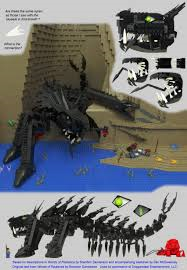
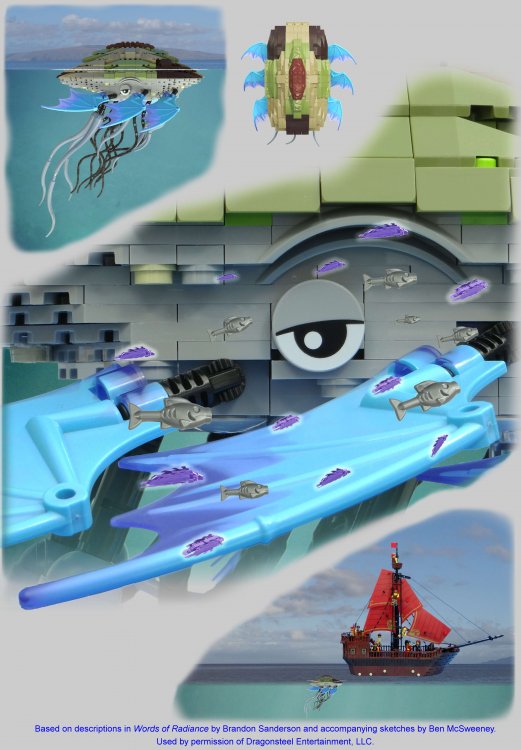
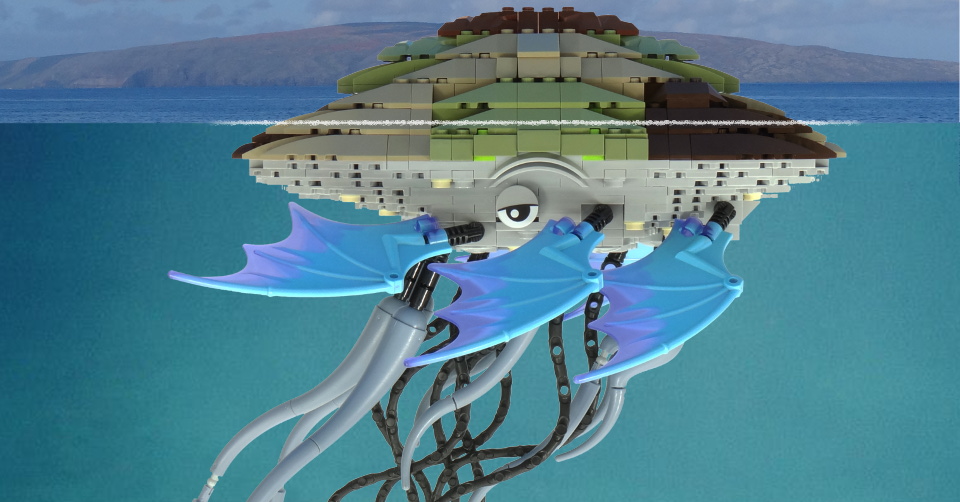
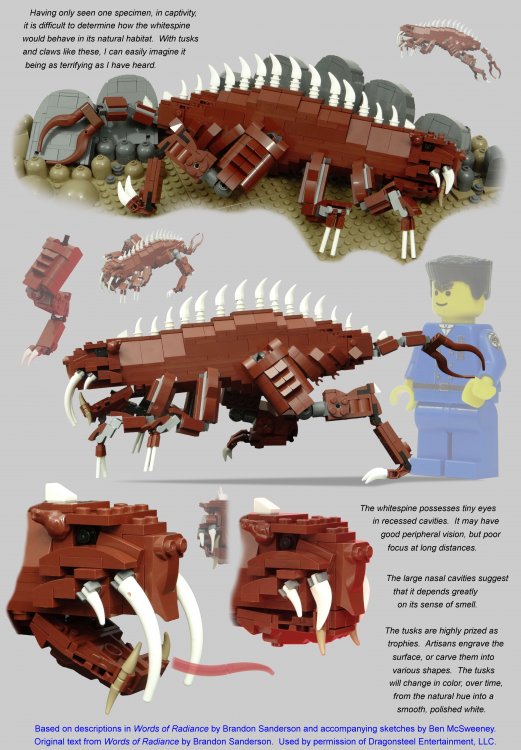
This made me think about how much fun it would be if Stormlight/Roshar were the next installment of LEGO Dimensions. +1 This picture came from a 2014 article on Tor.com https://www.tor.com/2014/03/21/the-way-of-kings-as-interpreted-through-lego/ There are also some cool Lego ideas on Pinterest. I found all kinds of cool things that should probably be on this site with a Google image search for "sadeas lego" & "Stormlight lego." There are probably other searches that will turn up better stuff.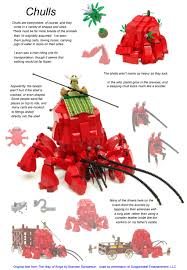
-
Here's everything we have on our new alleged Radiant from Chapter 24: From all this we can see that Malata never introduced herself as a Dustbringer. I imagine that she probably introduced herself as a Releaser, then when Dalinar looked at her funny, she gave an exasperated sigh and explained that her order is commonly known as Dustbringers. Then when recognition dawned on his face, she probably explained that her spren told her that they don't like being called Dustbringers. It's worth noting that Dalinar perceives her as "strange." Also, that she is from Jah Keved, but does not dress like a light-eyed Vorin woman; she is wearing a skirt and slightly open blouse with gloves on both hands. She doesn't behave like a Brightlady, either. She is described as idly leaning and wearing a slight smile when she looks at the de facto king of Alethkar and Urithiru. What I noticed from the end of the chapter is that all of the members of the Karbranthian party expect Dalinar to conquer the holdouts by force (and that this is why they chose to come to Urithiru - to spare Jah Keved from Alethi attack). So, is there any way that Malata's almost smiles at Dalinar reflect an eagerness for battle, or an attempt at a challenge along the lines of "I just dare you to attack my homeland, Blackthorn..." ? Alternatively, if Malata happens to be Chanarach/Chana in disguise (unlikely), then she might simply find Dalinar to be an amusing figure (that is, she finds it almost funny that the Blackthorn is trying to play politician and has gotten so over his head with bonding the Stormfather, finding Urithiru, and painting a target on himself for Ishar). I'm inclined to think that she is not in the know about the Diagram since she is from Jah Keved. However, if she is a Diagram initiate, then that might be why she creeps Dalinar out as she is likely present in order to carry out his assassination. If this proves to be true, I like the speculation that she could be Liss.
-
Unless I missed something, Dalinar isn't confirmed to be forgetting Navani... that was just speculation about what may happen. Personally I hate that theory because it is needlessly distracting. It invalidates so much of the character building we have seen for Navani (who is kind of unscrupulous & selfish, but also good-natured, resourceful, and pleasantly sassy). It will also occupy Dalinar with a lot of navel-gazing exposition that will be annoying to read. The only way in my mind to salvage that sort of thing is for it to propel him to fix the problem by using his Bondsmith abilities to restore his connection to Navani. In just about any other conceivable plotline, I'm just bored reading about his angst over forgetting his wife while he freshly experiences the guilt that he associated with Evi.
-
@treblkickd OK, just to play devil's advocate here, what if the revocation of personal freedom was a side effect instead of the intended result? To be more specific what if Ishar or a Bondsmith of old severed the Connection that the Listener race had with the rhythms (in an effort to break their ability to communicate - like an attack on a communications satellite in modern warfare), and the revocation of personal freedom was an unintended consequence? Does that change your calculus of judging the act to be evil? Perhaps a more interesting moral question is this: Is the life of one of your race or tribe worth more than the life of your enemy's race or tribe? I think in war, human nature dictates that the default answer to the question is yes. So, if breaking your enemy's access to long-distance communication saves countless human lives while rendering the Listeners as automatons, it's one that humans are likely to make every time they are faced with the decision. How you avoid a situation where mindless enemies become shamelessly exploited is a difficult question, though. If you don't make them work, they are a drain on resources. If you do put them to work, you've consigned them to a life of functional slavery. It's a hard call. However, if the humans had already won the war and broke the Listeners' minds just to enslave them, then yes... that is pretty horrible.
-
Yeah, I've always been curious where the spren is in a soulcaster fabrial. It was my understanding that all the fabrials of the modern era involved trapped spren, but there's no mention of spren in the ancient fabrials like soulcasters & oathgates.
-
Well, that's not my understanding (not really anyway). WoBs have confirmed that Adonalsium has had some sort of opposition (pre- and/or post- shattering). Warning: Cosmere spoilers (including some tidbits about Yolen obtained from non-published sources) So, operating from the point of view / assumption that Adonalsium was the "good" god and his opposition is the "evil" god. The shards of Adonalsium (when unified as a whole) ought to be good by default. So, shards are only as evil as their intent is lacking some other shard's intent to be a force for good. Honor and Odium + Devotion to what is good and right would yield an entity who is committed to behave morally and who hates immorality. Throw Endowment in there, and you get an entity that would aim to bless/reward those who behave morally. However, we don't have a single entity with all those harmonized intents; we have separate entities that are hyper-focused on their one (out-of-context) intent. So, they are no longer "good" by nature. They are now individual components embodying the separate aspects of a "good" deity. It turns out that Odium & Autonomy taken alone can lead to some ostensibly bad results (e.g. the Desolations on Roshar, the subterfuge and political strife on Scadrial, and the shattering of at least 3 shards). Now we know that Brandon is quick to qualify Hoid's involvement in the cosmere as dependent on whether you agree with Hoid's point of view, which suggests that his motivations might not be as pure as they appear on the surface (i.e. many - including myself - suspect that Hoid is either attempting to reunify Adonalsium or facilitate the shattering Odium & Autonomy to protect the other shards with whom he is friendly). Regardless, at this point in the story of the Cosmere, Hoid certainly appears to be a force for good (although his 'ends justify the means' philosophy might make him more gray than white). Main point: Honor made his home on Roshar with Cultivation for a reason and he used his power to constrain Odium (a reckless force of violence and destruction); he also valued unity and the honorspren (who named themselves after Honor) have adopted "doing what is right" as their governing philosophy. I would say that Honor/Tanavast must have possessed moral rectitude as a quality. Teaming up with Cultivation could also be read as an attempt to cultivate honor in the sentient species of Roshar, which is a noble and laudable endeavor. It is by those actions that I measure Honor's goodness. Honor may not have defined or exemplified morality, but he's more white than gray in my mind.
-
That's actually a really good way to put it. We hold up the ideal but acknowledge that - while we aspire to the ideals represented - we sometimes fail to realize / act on them. Like I said, I was trying to avoid discussion of whether refusing to stand for the anthem is right or wrong. I understand both sides, and I hate that the political arena is so dysfunctional & adversarial that our leaders can't / won't acknowledge the other side has a point. I just thought it was interesting how various moral philosophies and understandings of honor play out in the real world. I also think it's great that literature inspires us to have these kinds of discussions.
-
Well, I think we both agree that being honorable is distinct from being moral. However, I think that being honorable has some overlap with morality. I don't think one can be fully moral without also being honorable. As you said, honor requires one to keep an oath so long as you are able. This is not the same thing as carefully avoiding oaths that have the potential to compromise your morality (i.e. what is right). So, I would agree with your revision: "honor unchecked has the potential to lead to as much evil as unchecked hatred." Now, being honorable is a requirement of being moral. Aside from a utilitarian ethic (that can excuse just about anything) lying is generally considered to be wrong because deceit would not exist in a perfectly moral world. It is at odds with the ideal of morality. It is only useful in the service of morality when used to manipulate a person stuck in pride and/or error (i.e. a fool). So, doing what one says that he or she will do is always honorable and usually moral. However, I still don't agree that evil is a direct result of honor unchecked. I maintain that foolishness, pride, and selfishness lead to evil. To the extent those things are present in one's motivations in swearing an oath, I think the seeds of evil are planted. The catch is that without the ability to know what the future holds, almost any oath can come into conflict what might be an otherwise morally right choice. ----------------------------------------------------------------------------------- Easy example: • Honoring one's marriage vows = honorable • Honoring one's marriage vows when their spouse demonstrates a persistent pattern of abusive behavior = enabling abuse (honorable in one sense, but foolish and immoral in another sense) In the example above, it is not the desire to honor one's vows that leads to enabling an abuser. It's the violation of the abuser's vows (i.e. "to have and to hold, to love and to cherish") that makes holding to the vows problematic for the victim. Showing honor to that which is dishonorable is dishonorable in and of itself, which is exactly that we see Szeth & Nale struggle with. ----------------------------------------------------------------------------------- I think it's also something that all those NFL players who refuse to stand for the national anthem are struggling with. They see certain elements of our country's history as dishonorable & immoral, so they are withholding the honor and respect typically given to the symbol (the flag) & celebration (the anthem) of our country. Whether that is right or wrong is a moral question that I have mixed feelings about, but it is interesting to see this issue play out in the real world.
-
Chapter 14 | @ Kaladin Chapter 14 | @ Khen (the female voidbringer) to the male: Chapter 14 | @ Kal watching the voidbringers: Chapter 13 Chapter 15 | @ Adolin & Shallan discussing the Urithiru murders: Chapter 15 | Shallan's mental image when Adolin offers to train her: Chapter 15 | @ Shallan Chapters 1 - 15 | All the surgebinders (but especially Kaladin):
-
I don't think so. I think that an oath is only as good as it is wise. So, honoring a foolish oath will lead to foolishness, folly, and ultimately evil. Let's go to our real-life religions for an example: Jephthah is a character from the Bible; his account is recorded in Judges 11:1—12:7. He's a pretty interesting character who is best known for slaying his daughter in order to honor a foolish oath he made to God. Jephthah was asked by the elders of Israel to lead the defense of the country against the invading Ammonites. When he agreed, he made a vow to God, saying, “If you give the Ammonites into my hands, whatever comes out of the door of my house to meet me when I return in triumph from the Ammonites will be the Lord’s, and I will sacrifice it as a burnt offering.” Jephthah then defeated the Ammonites and returned home. When Jephthah arrived at home, his daughter, an only child, was the first to come out of his house. Jephthah evidently expected an animal to exit, but... The moral of the story is that people are not to make rash commitments or promises (e.g. foolish oaths) to God. Also interesting is what Jesus had to say about oaths in his Sermon on the Mount: So, the Judeo-Christian god certainly expects people to honor their oaths. Jesus more or less says that it is better not to swear any oaths at all because God takes them so seriously. In light of that, I wouldn't say that honor unchecked leads to evil so much as the content of one's oath can bind someone to a course of action that is obviously wrong and against the intent of the person making the oath. Simply put, most oaths are foolish because we don't know what the future holds. As a result, oaths bind the future conduct of honorable people to a restrictive code of conduct that may result in acts that are obviously wrong (or prohibit them from doing what is right). TL;DR → A foolish oath can lead an honorable person to commit acts of evil, not the person's sense of honor. Dishonorable people might be willing to forsake a poorly thought-out oath in service to what is right, but a they will also ignore their own convictions about what is right when it's convenient for them.
-
This makes me think of Wan ShaiLu (a.k.a. "Shai") from The Emperor's Soul when she was stuck in her Forger's prison cell with walls crafted from many different kinds of rocks. There is a connection between Forgery & Soulcasting... I wonder how rock strata play into it. Perhaps like Shai, Shallan will be better able to change/soulcast objects if she understanding their origins & history? That doesn't seem to have much relevance to the way the Jasnah soulcasts, though. She turned living people (criminals) into fire. I can't think that such a feat would be possible for Shai on Sel; the likelihood of a person ever having been a tongue of flame is next to impossible. Hmm...
-
So, this theory is basically - as Sazed says - Kelsier's string (to the Physical realm) has been cut and he needs a new string. Furthermore, he could get a new string by cutting someone else's string (tying them to the Physical realm) via Hemalurgy and tying the two cut strings together (spiking a Cognitive entity with a spike storing someone's connection to the Physical realm) which would facilitate a Cognitive entity's manifestation in the Physical realm. Interesting. RAFO, I guess.
-
I think that the interest in the story generated by Tor releasing the Oathbringer chapters (3-at-a-time once each week) has proven that a serialization (i.e. TV show) would be perfectly suited to The Stormlight Archive. People (on this site at least) are talking about a novel the way that half of the internet talks about each new Game of Thrones episode after it airs.
-
Yeah, I often wonder about whether to add new thoughts on a hot topic (e.g. the identity/nature of Trell) to an old thread on the topic or whether to start a new one. On one hand, I don't want to lose the previous conversation on the topic, but on the other I want to restart the conversation with new thoughts or new information (in which case making a new thread seems more desirable). What would you recommend @Chaos?
-
Way of Kings Prime Scene, Two Way of Kings Annotations
KidWayne commented on Chaos's article in Brandon and Book News
Yeah, and if you go back and read the 2016 State of the Sanderson blog post, he has two publishers. Apocalypse Guard seems like a contractual obligation that also serves to keep Brandon refreshed. I believe Brandon is earnestly interested in the material aimed at younger readers. I also have young kids and would love to share my talents with them; so I get where he is coming from. Perhaps we will see less of this stuff as his kids grow up and they get into the Cosmere. -
Maybe that is where Venli gets the spren to bond that allows her to discover stormform.
-
Woah, there. You can only make that argument (i.e. authors in general and Sanderson specifically) if you have a utilitarian ethic. I disagree with your argument and utilitarianism in general (read Huxley's A Brave New World for a rational realization of a utilitarian society). Suffering is a necessary part of personal growth; it is a result of living in a world in which others' free will allows them to choose to act selfishly. Overcoming our own selfishness for the benefit of others.is painful, but it is beautiful too. Some might even consider it foundational to love.
-
[OB] Unite Them... [Mistborn Era 2 spoilers]
KidWayne replied to KidWayne's topic in Stormlight Archive
OK, I had to bring this up after reading this comment: I really like this guess about the Ghostbloods being behind the copycat murder with a motivation to blackmail Shallan. It seems so un-radiant that it really makes me think that the Ghostbloods and Odium are buds.

