



name_here
-
Posts
938 -
Joined
-
Last visited
-
Days Won
2
Content Type
Profiles
News
Forums
Blogs
Gallery
Events
Everything posted by name_here
-
It's not that the crustaceans are aquatic; it's that they have armored shells. Exposed humans die pretty quickly in highstorms, but chulls simply shrug them off. Pretty much everything on Roshar needs to either hide like the plants or be sturdy enough to hunker down in the face of a stormwall and survive.
-
We also have chapter-by-chapter review of WoA on this very site, under blogs.
-
Writing and Spren and magic systems *Mistborn spoilers*
name_here replied to name_here's topic in Cosmere Discussion
Again, the only reason I think there is some long-lost actual Shard-related reason why prayers are invariably written and burned is that writing has been confirmed to interact with Spren. I am perfectly well aware of the significance of burnt offerings in a very large number of religions; one does not take a Latin course on the Aeneid without knowing that. There's a number of differences between how Vorinism does it and how real-world religions do it that would not be terribly significant if it weren't for the interlude with the Spren experiment. Firstly, it seems like only prayers are burned. Most religions primarily burned animal sacrifices. Theologically, this was either because large herd animals were especially significant and symbolized power and/or manhood, thus making them ideal displays of devotion, or because the gods liked eating beef. More practically, not all of the animal was incinerated; generally large portions of the meat were cooked and eaten. Secondly, burnt offerings were more common in polytheistic religions (although at least early Judaism had them) because polytheistic deities were generally ascribed only finite power. So, if the belief was that burning the sacrifice allowed it to rise to the gods in the form of smoke, polytheistic deities would actually require people to sacrifice to them in order to get whatever, while omnipotent monotheistic deities didn't. Insofar as sacrifices exist in monotheistic religions, they seem to be much more about the devotion shown by the sacrifice. Thirdly, at least Greek and Roman mythology is positively filled with instances in which people promise to make an offering if they get to safety/hit their target, and a god hears them and grants their plea. In Vorinism, prayers aren't particularly expensive, not nearly on the order of a young bull or ram, and I don't recall any other forms of burnt offerings. It's also monotheistic and has an omnipotent deity. And it appears to be enshrined in their theology that burning prayers is not simply desirable but necessary; not just a way of showing appropriate reverence but actually mandatory in order for the prayer to be received. In a polytheistic religion with limits to divine power that wouldn't be out of place, but it's distinctly odd in a monotheistic religion. It's quite possible the original reason was entirely different, but the oddities and the behaviour of the Spren makes me think there must have been a specific motivation at one point. The structure of Vorinist theology simply makes it highly unlikely it sprang up without an external motivation. -
I don't really think it's as wrapped up as any of the others that lack sequels except The Way Of Kings. Essentially, it felt like the ending was a natural breakpoint in the story but not actually the end. While most endings throughout media leave unanswered questions, and the characters probably go on to further adventures afterwards, the primary plot thread is largely resolved in series endings that are considered good. Although Sel still had a bunch of things on it that could happen, and Shu-Dereth was still going strong, the main plot was essentially wrapped up. The evil plot was foiled, the Reod was figured out, and things more-or-less stabilized. It doesn't lock out the possibility of a sequel but does stand on its own just fine. Alloy, however, If it were a TV show, the ending would be followed with a To Be Continued... screen. I'm perfectly fine with it now that I know a sequel is planned, but at first I was quite upset when I thought it was a stand-alone. Basically, in Elantris, the story is over and we want to hear the next one, while in Alloy the story hits an act break.
-
Writing and Spren and magic systems *Mistborn spoilers*
name_here replied to name_here's topic in Cosmere Discussion
Good point about how the burning might be related to releasing Spren. While my theory doesn't have a direct connection between the two, that is an alternate possibility for where the practice came from. Maybe originally the prayers were actually used to temporarily lock a Spren into a state so they could help the writer, and were ceremonially burned once the task was completed. That would also explain why it is apparently common practice to wear a prayer for a happy marriage while engaged and burn it at the wedding, even though most lighteyes don't seem to believe they mean anything until burned. If they were originally related to controlling Spren, then at one point it might have been common practice to bind some sort of Spren (Gloryspren? Creationspren? Maybe there are actual Marrigespren?) for the duration of the engagement and burn the paper during the ceremony. Then at some point slips of paper not actually describing Spren obtained ceremonial purpose, and the original use was entirely forgotten and prayers substituted, but with lingering cultural effects like the belief in Glyphwards. I imagine they used to be more elaborate, but because virtually everyone in positions of power is functionally illiterate and can only read relatively simple glyphs, it became common practice to write them in a form Lighteyed men could actually read. Possibly after an incident involving an inaccurate transcription in the manner of the Wicked Bible. -
Writing and Spren and magic systems *Mistborn spoilers*
name_here replied to name_here's topic in Cosmere Discussion
Re: cultural importance of burning, while you'd probably get an answer like that from an Ardent if you pressed, I don't think it's quite an adequate explanation. Numerous religions do place a great deal of import on burnt offerings, but their mythology also includes people who successfully obtained divine aid by promising to make a sacrifice later. The practice of wearing unburnt prayers would be an example of that, except that it appears to not be accepted by the priesthood. So I suspect it's an after the fact justification after the original reason was lost. There's a couple of possibilities regarding the focuses. First, it could be that the focus is simply words, like how the shared focus of the systems of Sel was symbols, and in one case this manifests as writing. Second, it is also possible Cultivation has systems based on writing and Vorinism merged the attributes of the two Shards. While this wouldn't fit with how it worked on Scadrial, Ruin and Preservation had that duality going on, and the powers being all word-based does fit with Sel's systems. It's also possible written words are similar to spoken Commands, which could be omitted by higher Heightenings but were essentially mandatory. Another somewhat unlikely option is that Radiant powers come from some sort of master document that holds a spell in Dawnchant to grant the power to form bonds with Spren to anyone who meets certain requirements. It's quite possible the Shardplate glyphs have magical importance, but they aren't strictly neccesary for Radiant power use and so wouldn't fill the focus requirement. -
It always seemed to me that TLR largely committed atrocities because he was desperately trying to keep humanity alive during the ashfalls and had no idea how to run a government, so he slapped together a ton of bits of various successful ones. Thing is, good government by modern standards is a pretty recent invention. So all the bits of government were horribly oppressive. The Skaa in particular were stated to be based off the slave farming caste of somewhere. The ash makes farming incredibly labor-intensive but not terribly complex, so from a pure productivity standpoint it worked fairly well. Since altering it would have risked mass starvation and Rashek didn't know much about farming, he felt it was necessary to carry out mass executions to keep the system in place.
-
Bear in mind Spren can be invisible or selectively visible. Just because they can't be seen doesn't mean they aren't there. Plus Syl did actually slightly diminish the force of the Highstorm, and there were a lot of regular windspren in it.
-
Writing and Spren and magic systems *Mistborn spoilers*
name_here replied to name_here's topic in Cosmere Discussion
I'd have thought that if it weren't for the Spren experiment. In isolation it's not that noteworthy, but in light of demonstrated interaction between writing and Spren it seems noteworthy. -
It is not actually clear. However, using a normal weapon apparently automatically drops people to the warrior class, so picking up a Shardblade might justify Truthless status all by itself. He could have committed some sort of other major crime, but Shardblades were designed to fight Voidbringers in the first place and so it might be that using them against Voidbringers would not violate Stone Shamanism.
-
I suspect that it is possible to burn Lerasium to produce the effect of any of the base metals with a significant increase in power, just like Vin burning the mists. Though she might be the only person in the entire series who can do it.
-
This first came up in the Spren and Quantum Mechanics thread. To recap, in one of the interludes a pair of Ardents discover that Spren are affected by what is written about them. The relevant discoveries are as follows: 1. Spren vary in a number of attributes under normal conditions, the one in question being size 2. If a measurement is taken and written down, the Spren becomes locked in that size 3. If the measurement is then erased, the Spren begins fluctuating again 4. Taking or saying measurements has no effect, they must be written down. However, they don't have to be written down by the person who takes them 5. They have to be actual measurements, not random numbers 6. This definitely works in chalk on slate, other materials were not tested but are presumed to be the same. The following things are known to be unknown. They are of questionable direct relevance, and I'm mostly listing them so the main conversation in this thread won't be bogged down. If someone wants to theorise about them, please establish a dedicated thread. 1. Effect of taking multiple measurements and writing them all down from memory (not tested) 2. Effect of precision of the measurement (all were taken with the same tool and written down at the highest reliable precision) 3. Effect of inaccurate measurements, i.e. when the measurement is actually taken but the measurer reads it incorrectly. (not tested, though it might just work like an imaginary measurement) 4. Effect of outdated measurements (there was some time delay, but not much) 5. Whether this extends to other traits (according to the viewpoint character, this appears to be the case for Spren luminosity, but it wasn't tested) 6. The extent to which existing Spren are already constrainted by previous writings (inherently untestible, as of course it is impossible to be certain all written material concerning them has been found) Anyways, enough recap. On to... recaping Vorin religious practices. So, one of the central rites of Vorinism is burning prayers. As demonstrated with the huge Shash glyph, there appears to be no constraint on the form beyond that they must be written and lit on fire. The writing system generally used is glyphs, which is also the only system non-Ardent men are allowed to use. This is apparently considered the only way to actually communicate with the Almighty, which is mentioned to be kind of strange since he's supposedly all-knowing. Sometimes, unburned prayers are worn and ascribed supernatural signifigence, but this is apparently regarded as foolish supersition by the Ardentia. So, apparently the Almighty is incapable of recieving prayers until they are burned. And not merely in the sense that burning prayers is the proper way of doing things, as there is never any particular suggestion that alternate methods are acceptable if the Almighty has in his wisdom placed you in a situation where there is no fire. This, then, would imply that he actually cannot see the prayers before they are burned. And we know that the Almighty is actually the Shard Honor. The last bit of recap is the information on Shards from Hero of Ages. Ruin and Preservation were both functionally omniescient, with one exception. They were unable to see metal very clearly, instead seeing a blinding glow surrounding it. This was sufficent to prevent Ruin from being able to read the Lord Ruler's inscriptions. Finally on to the theory. Both of the Scadrial Shards were blinded by the focus of their magic system. It seems unlikely that this is a coincidence. It's unclear how much about them can be generalised to all Shards, since they were paired opposites and so probably had more in common with each other than with the other Shards. However, it isn't too much of a stretch to assume that other Shards also have difficulty percieving the focus of their magic system. So if Honor cannot read unburned prayers, that would imply that they contain the focus of his magic system. It could be specifically ink, except that writing in chalk had noticable effects on Spren. Taken together, those two facts suggest that writing is a magical focus. Of course, the Radiants don't appear to actually depend on writing to use their powers, but we've only seen a small portion of the powers of four orders. So there's easily enough Surges left for at least one of them to be entirely dependent on writing. What it does is an open question, though given Vorin gender roles I wouldn't be too terribly suprised if it were capable of biological alteration or saw heavy use in manufacturing. However, it's been thousands of years since anyone actually used it, and there's really no telling what parts of Alethi culture are actually sourced off the Radiants and what just sprung up over time. The big open question is what precisely constitutes writing as far as this is concerned. I suspect that burning prayers happens because the ink and paper burn at different rates, producing a glyph-shaped outline. The glyphs used in prayers are relatively simplistic, so the outline doesn't need to be too precise. The Alethi writing system is probably also impossible to percieve, since it's what affected the Spren. It's entirely possible that the Surge related to writing runs on rules similar to Awakening Commands, where the langauge doesn't matter so long as you know what you're writing. I doubt the prayers are actually examples of it in use, although I guess it's possible they'd have a specific magical effect if used by a member of the right order and backed by Stormlight. Personally, I figure they were always just prayers; whenever someone set some glyphs on fire Honor would read it and respond in whatever way seemed suitable under the circumstances. Now that Honor has lost its Shardbearer and is possibly Splintered as well, they're just paper.
-
300-400 pages usually strikes me as pretty decent. I mean, an awful lot of books are longer than that, but it's fully possible to tell an entire story in that length. Apparently Alloy is going to get a sequel with the same characters, too. Which is good, because the ending is most definitely not sufficent for a stand-alone.
-
So according to that interview, there was a video. Could we see it? I checked IGN and company but turned up nothing, but I'm not sure if that's because Little Orbit is keeping it under wraps or <insert multipage rant about modern game jornalism>
-
Well, yeah, clearly something is up with Stone Shamanism. I'm dubious that Szeth was punished for saying Voidbringers exist, especially since he doesn't seem terribly certain that they do. It seems likely to me that he did something, potentially killing someone with his Shardblade, that would have been justified by the existance of Voidbringers. Thus, his punishment is a statement that they do not exist. I think he draws Radiant powers from the Oathstone, since Radiant powers seem to come from various sorts of obligation to others.
-
There's a running series of theories about Shardblades being somehow tainted, but no one brought up Shallan not seeing Spren normally in connection with it. Of course, both she and Elhokar have a different kind of Spren from Kaladin. Dalinar doesn't see Spren in mirrors, but he actually does hear a mystery voice that might be a Spren in battle. Szeth apparently isn't actually a Radiant, with one of the prevailing theories being him having Jezerin's Honorblade.
-
While that's posed as an enigma in-universe, I think that Spren actually do cause what they're associated with. Essentially, because Syl fought deathspren and Kaladin survived being essentially flayed for a rather unusually long period even before he got Stormlight smuggled to him, it seems rather plausible that deathspren cause death, and thus so do similar spren.
-
Odium is derived from the Latin verb meaning "to hate." It's probably what the Shard exemplfies by the naming convention. If Preservation and Ruin are any guide, Rayse is probably insufficently human to have any possibility of turning out to not be a villain, unless what he hates is the real villain.
-
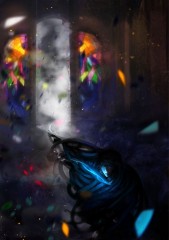 I have a school project where we need to create a splash screen linked to a website. I'd been going to use Inkthinker's Vin, but this is spectacular. Seriously, one of my primary reactions to news about the movie adaption is "eeeee, Vin's awesome crashing through stained-glass windows on the big screen!" Seconding desk-top size requests!
 -
Going by the Glass Pillars fortelling experienced by Avenidha,the Black Tower will remain intact and seperate until it falls in the third generation of the Seachan-everyone war, landing a good chunk in Domination Bands and sending the rest into a guerrilla war. However, it is rather likely that Avenidha will alter the future in some manner to avert the war, with unpredictable effects on the Black Tower.
-
Gavilar killed so Dalinar would succeed?
name_here replied to kari-no-sugata's topic in Stormlight Archive
During the scene where Dalinar puts on his Shardplate, it snaps closed by itself, so I expect it's much faster to put on properly than normal plate armor. The Parshendi do intentionally make their assassination attempts flashy and obvious to give the target warning, according to Szeth's narration. -
Theory: Danlan is more than she appears
name_here replied to lil_literalist's topic in Stormlight Archive
Eye color is all wrong. Otherwise sensible. Now, part of the reason Dalan might be sticking with Adolin is that Navani has been helping him not put his foot in his mouth or repeat the Temple Incident. But you do raise a good point about her having Spanreed access. Interestingly, spying on the Highmarshall that way might have been less than effective- because he's working with the Stormwardens, who have a glyph-based pictographic writing system and therefore do not need to add a female scribe to the loop for high-security communications. -
All the hair colors are mixed-dominance, far as I can tell. In the real world you can see this with cats (especially female cats, because it's linked to the X-chromosome) but is not the case with human hair colors. Now, what makes this interesting is that Baxil's Mistress (new crackpot theory: Shallash&Jezerin's daughter instead of Shallash herself, and has her mother's eyes) has Alethi-colored black hair but not at all the right skin color. If Roshar had more typical genetics, I'd put it down to genetic drift and intermarriage, but the way the genetics work would indicate that the hair color should be most heavily associated with people who look exactly like Shallash assuming she had, say, twenty children over the past four thousand years and each of them had a reasonable number of children and grandchildren. Long-term mutation could concievably explain it, but only over a long timeframe and assuming Shallash stopped having kids a long time ago.
-
Shards, at least by the prior evidence, can effectively see everything on the planet except what they're specifically blind to and things obscured by that. So I don't see any particular reason why the method of destruction would matter, except that it would need to be possible to read the symbols at some point during the destruction. Fire is good for this if the ink used on Roshar is of a kind that would burn either before or after the surface it is written on, producing a glyph-shaped flame. So it's quite possible Honor once told someone that he'd make sure to read any message written in glyphs and set on fire, and alternate methods would theoretically work if Honor happened to be paying attention. This wouldn't really be a proper magic system, as Honor would grant prayers on a case-by-case basis instead of a fixed set of rules.
-
Allomancy in the Zombie Apocalypse
name_here replied to MerryBerry's topic in General Brandon Discussion
Pewterarm, definitely. It's the best for getting out of unpleasant surprises. Although Coinshots can fly, it is generally inadvisable because they can't pull on metal if they misjudge their jump and they're a lot more fragile than Mistborn, who regularly flare pewter as a substitute for safe landing speeds.
