



Inquisitor #5
-
Posts
304 -
Joined
-
Last visited
-
Days Won
2
Content Type
Profiles
News
Forums
Blogs
Gallery
Events
Everything posted by Inquisitor #5
-
Scadrian vs. Rosharan magic post RoW
Inquisitor #5 replied to NameIess's topic in Cosmere Discussion
It's almost like this is solved entirely by assuming that the weapons being used have a supernatural damaging property of some kind. - Words of Radiance, chapter 53 Here we see Plate showing cracks even at minor impact, implying to me that the invested cutting definitely plays a part. -Words of Radiance, chapter 56 Plate still resists, as seen here, Adolin notes no cracks in the helmet, helmets however seem to be rather sturdy. -Words of Radiance, chapter 14 Here we see two poweful overhead strikes, possibly damage from impacting the ground, and then a Plated heel-kick to shatter it. -Words of Radiance, chapter 57 Here we see Kaladin impacting a Blade three times, which, per Adolin's two strikes and a kick, should be enough to shatter the helmet. How, pray, do you make a hole without displacing the material. Could you please tell me the name of any of these weapons? Because the spike found in war hammers, lucernes and the absolute beauty that is the bec de corbin was not a dagger blade, on account of being a spike, not a blade. A billhook, or bill, being a pole weapon, so I don't understand how that has any bearing on how daggers were used against armour. I agree that a bill through the chest will mess you up, in fact it'd be a lousy weapon if it didn't, it just has no bearing on the use of daggers, as it's not even the same category of weapon. If Plate was particularly vulnerable to piercing strikes, would the standard infantry weapon not be a variation on the warhammer or polearm? Would you not want every advantage you could get if you risked facing a Sharbearer? We see Shardbearers warp battles by their presence, they are walking tanks with an effective instant death radious of ~2.5 metres (Blade + reach) for anyone not in Plate. If an effective way of countering these people was accessible, as long as it also allowed soldiers to effectively face normals, would we not see a greater focus on such methods, pushing the usefulness, and thus value, of Shardbearers down? And yet that's not how warfare looks. I think the closest we get to a piercing weapon being used is found in the Way of Kings: -the Way of Kings, chapter 69 I'd say if anything was going to pierce it'd be a Plated kick, assuming impact at the toe, but all we get is cracks. -the Way of Kings, chapter 56 An ordinary guy here played by ~20 warform listeners in a trenchcoat. A note on Plate as well, if it was as fragile as you make it out to be, would we not expect the various kicks and punches to break the Plate as you're attacking? -Words of Radiance, chapter 44 Going by this, punching through a wall is something you reasonably can do Plated, presumably without sustaining catastrophic damage to the Plate. -Words of Radiance, chapter 53 And there we have a comparison we might be able to work with, if anyone wants to have fun with the physics of guns vs different types of rock. Indeed -Words of Radiance, chapter 26 Interesting thing to note: -Words of Radiance, chapter 14 This implies that Plate is lighter than it looks, meaning it should be even thicker/bulkier, though we of course don't know if this means significantly lighter than its bulk suggests or fractionally lighter than steel but will throw you off, a bit like finding a deceptively heavy pebble or light rock. A last thing, in Adolin's full disadvantage duel we see Kaladin stab his spear into a crack in Plate and the tip comes out bloody, showing that at least some of the cracks go all the way through. I'm not digging out the book again to quote this, it should be chapter 57 or thereabouts. This shows that my conception of plate was erroneous, as actual structural damage happens before it explodes and also that Plate doesn't seal up instantly if broken. ¤_¤ -
Scadrian vs. Rosharan magic post RoW
Inquisitor #5 replied to NameIess's topic in Cosmere Discussion
Not my point. I'm saying that you'd sooner move the person wearing the plate than pierce it. Oh for the love of... The rondel dagger was used against people in plate, yes. And it's basically a pin the size of a dagger, yes. And it would put a lot of force in a tiny area, yes. But it was not used to pierce plate. Real life plate armour would be part of a three layer set, first you have your cloth armour, which contrary to what we see in popular culture was sturdy, a gambeson will stop arrows and prevent cuts (giving you blunt trauma instead), to get through this with a sword you'd need to saw or stab. Next you have your maille, metal rings riveted together into a fairly stiff interlocking garment, helping absorb the resultant blunt trauma and also making you harder to stab, breaking the rings is not easy. (Also, maille behaving almost like a liquid, as in movies, is completely inaccurate, as the construction making it move like that would break under its own weight if using authentic materials.) Lastly you have your plate, which makes you even more slash and stab immune, the only realistic way of piercing this with a sword is with what the German school of fencing calls a Mordhau (murder stroke), where you grip your sword by the blade and use it as a makeshift warhammer, using the crossguard to attempt to pierce your opponent's plate. However, plate has a few weak points, joints, because people fight better if they can move, and eye-slits, because people fight better if they can see. That is where the rondel dagger comes in, stabbing through the eye-slit (as Kaladin does to Helaran with a dagger) or into the exposed joint, being thin enough to slip through the rings of maille. Getting stabbed through the eye, armpit or groin is gonna ruin anyone's day. My interpretation is that the investiture is holding it together, regardless of damage, up until the point of structural failiure, not that it immediately seals over. By this interpretation it's impossible to punch through plate without inducing complete structural failiure. Can you please cite anything like this happening or being implied? I can not remember plate breaking without the fireworks show. The Shardplate material is a highly magical fictional metal(-ish), it does not have normal material properties. I'd be more inclined to believe that all the significant damage might have been caused by all the people with plate and blades who he was fighting at the time. ¤_¤ -
Scadrian vs. Rosharan magic post RoW
Inquisitor #5 replied to NameIess's topic in Cosmere Discussion
I lack even such a tangential interest I'm afraid, so a lot of gun related things will go over my head. Heh, my physics is rusty, I've not really practiced it in about ten years and sometimes looking at the formulae makes my head spin. I'd say I have a fairly solid grasp on it, here let down by my massive ignorance of guns. I also don't have it in me to run the more complicated physics calculations and trying to research which formulae and what numbers go where, so if the discussion turns to things like tensile strength and heat capacity I'm perfectly happy for someone who has more of a head for it crunch the numbers. If we take a look at the Shardplate illustration in the books: At the top the combined sabatons and greaves are shown both in a relaxed position (presumably when not worn) and a tense position (plate snapping into shape around the wearer) and we can see that the front (toe to ankle) seems to consist of five plates (toe guard, layers 1-4), with further plates underneath, which seem to be able to glide along eachother, as the tightened illustration shows the edges of the plates closer together, presumably having tightened around the foot. A similar pattern is repeted with the heel. We also have an illustration of a gauntlet, though I don't know if there's much insight to be had there. We also have two people obligingly posing in their plates, and here we get some interesting things; the shoulder joint and pauldrons. The shoulder joint looks to me like it's composed of several C-shapes, cresents or slighty-more-than-semi-circles, overlapping in a C/ɔ pattern, presumably with a slight wedge-shape to each plate, allowing both for limited rotation without creating gaps and compression/expansion moving the arm up and down. The pauldron then seems to be another set of C-shaped plates enclosing the shoulder, with the same kind of plate moving against plate setup. We can also see that the breastplate has several plate hoops, presumably allowing (limited) bending at the waist. I'm unsure how the knee and elbow joints work, but I could see the same kind of ɔ within C pattern as the shoulder joints, but possibly tighter. An interesting additional detail is the plate skirt being composed of a few overlapping big plates at the sides, but each "scale" of the front and back seems to be an individual plate hanging from waist, rather than plates attached to plates attached to the waist. My position is then that each plate is a rigid piece, but that the pieces can move relative to eachother, either because of joints/hinges, being attached to a soft backing, investiture basically magnetising it all in place, or a combination of several of these. I'm leaning investiture myself, as the internal workings of Plate ar really odd compared to real-life plate armour. So I agree that there has to be give, but not in the plate material. And here are a couple images of apparently real plate with a similar joint armour, so it's apparently possible to build: ¤_¤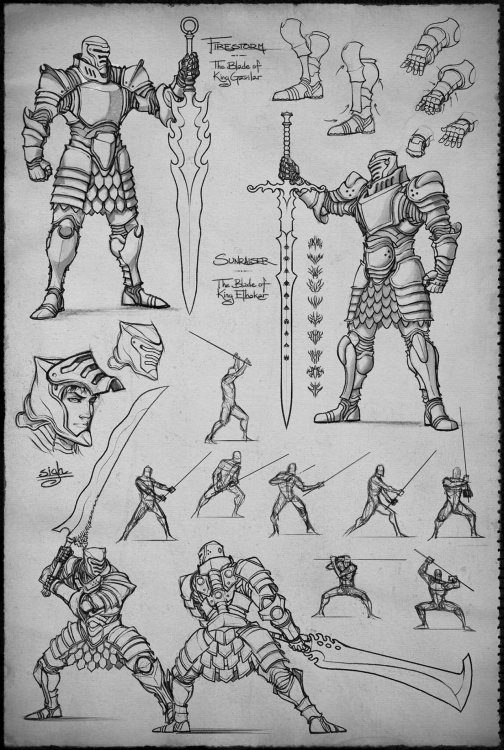
.jpg.dc300553ab721c226209e6a832b2a3c2.jpg)
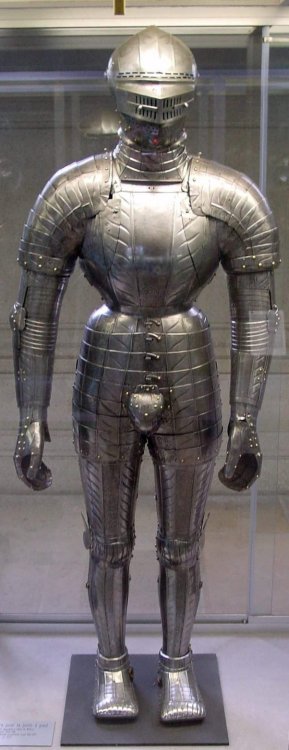
-
I'd personally have made the connection between iron/steel and attractor/repeller. Interesting thought. ¤_¤
-
Scadrian vs. Rosharan magic post RoW
Inquisitor #5 replied to NameIess's topic in Cosmere Discussion
How are they hitting the helmet through the shardshield? The only thing known to damage a shardblade physically, in any way, ever, is Nightblood, as far as we know they are functionally indestructible. Yes, he uses our physics as a base, but due to investiture the materials science of the real world breaks down. Plate seems to act almost like the phenomenon you can get with glass where tension builds up on impact with no visual damage until one day it's pushed over the edge and shatters/explodes. Plate seems to maintain structural integrity up until the point where it fails catastrophically, exploding into molten metal. I've already made my point that I don't think the magics cancel, as that is by far the more realistic option, imo. You mean the helmet being used as a buckler to block shardblades repetedly? These things will functionally not happen in combat, the human in the armour moves too much/too easily for piercing to take place by stabbing. My interpretation os that straight up piercing is impossible, sections of plate always either hold (albeit with possible damage) or shatter, there is no evidence of them sustaining enough damage to break but not shatter. Now, I'm not saying that you couldn't break plate in single attacks, but I'd assume that you'd need to bring out the "fun stuff," anti-materiel rifles, land mines, recoilless rifles and the like. I'd argue that, at least once fitted, each section of plate is perfectly rigid, joints being handled by overlapping plates and/or the same "this is defintitely magical" effect that makes the visor fuse to the helmet once closed, with no seam. @therunner, thanks for the excellent imput re:guns, I'm most definitely not a gun person so all of that would have passed me by. Edit: And regarding the stabbability of plate, if we assume that the magical effects cancel, we're left with the excercise of trying to get through something that, per therunner's calculations, is at least a centimetre thick, when under ideal testing conditions you can barely pierce real-life plate with a thickness in millimetres, making that scenario even less likely. ¤_¤ -
Scadrian vs. Rosharan magic post RoW
Inquisitor #5 replied to NameIess's topic in Cosmere Discussion
Yes, and I've already argued that there might be roughly two people per combination alive at the moment and maybe ~40% aren't figting fit based on age alone, so you'd be able to get some super soldiers, sure, but as I've already said, even if it takes a hundred radiants to capture/kill/neutralise such a person it's a good trade for Roshar. Yes, I know this. Slight nitpick, the windrunner resonance is, per WoB "strength of squires," not the reverse lashing. The reason for me asking was that you mentioned "resonant twinborn" in a way that sounded like a separate category, and I was confused by what you meant by it. I'll not respond to most of this section, as I'm (still ) not great at physics. My understanding of this is that velocity is conserved as the only thing that changes is the direction of the fall, all of you starts falling in the new direction instantly, so no inertia. There would probably be a small loss from clothing and such, but not from your body. This is the Superman-problem, no? Superman catching a falling person would snap their spine/rip their arm off/etc. so in a world (mostly) obeying physics of course he'd need to slow. You'd still need to adjust your aim to account for the speed of the radiant travelling under several gravities and if the radiant came head-on they could lie flat in they air to minimise their profile and put up a shardshield to protect from frontal shots. Again, not touching the physics part. I fail to see what other ways scadrians have to steal surgebinding powers, other than nicking the honorblades. I disagree. I don't think Dalinar'd have anything to say on the matter. Ishar tries to take both his connection to the Stormfather (his bond) and his connection to Odium (Honor's champion) and this is presented as Dalinar having no agency. I do agree that the Stormfather could then choose to end the bond with Ishar (assuming Ishar didn't get up to more connection shenanigans), and Dalinar could forge a new connection to Odium, but I don't think he could have refused to give up the connections, just like you can't refuse to give up an attribute if someone makes a spike from you. On that note, I'd also argue that the spren couldn't (through free will) prevent their bond from being stolen (be it through hemalurgy or bondsmithing,) they could just end the bond after the fact. My take on this is that free will plays a part in maintaining the bond, not stealing it and I think it's gonna apply differently to nahel bonds (connection forged intentionally and voluntarily) and a metalborn's connection to their shard(s) (connection intrinsic to them.) It's possible that Sazed could maybe sever the connection once stolen, but on the other hand he seems to not be very good at connection in general. He can't sense Hoid even though he's got a major connection to Preservation. My read on that is that Wax, could shatter a section of plate, with the right gun, with 2-3 bullets, 1 in the exact right moment. But Wax also has "protagonist power" on his side. Also, shattering a section of plate is not the same as penetrating it, it explodes outward, which I think'd turn away a bullet. Also also, plate in the context of this WoB is deadplate, which, judging by the serious difference in performance between plate generally and the helmet Kaladin steals, is inferior in durability to living plate/plate on a radiant. Yes. I don't agree with this assessment, I'd say that the investiture in the blade overcomes that of the plate, if they canceled out the blade couldn't damage the plate. It is functionally impossible to penetrate plate armour with a bladed weapon, that's the reason why warhammers exist, they're can openers for knights. So I don't think we can perfectly apply real world physics here. On account of how it's described as never denting or bending, I'm gonna go with rigid, but it's also magical, so our physics don't apply perfectly. That's actually a really good question. Again, this can't be working entirely like real physics, as you can not cut through plate. I'd assume that the magical cutting property of the blade is rebuffed, but still causes damage to the plate, effectively acting like a bunch of extra physics. The strength of the blow is barely relevant compared to the investiture imparted. Again leaving the actual physics to people better equipped for it. I do want to note, again, that the magical properties of shards makes the physics go wonky. Also, do the scadrians have guns equivalent to the magnum, m16 or ak47 at this stage? Fair enough, if we were playing entirely with real physics that'd be perfectly true (the decline of plate armour came about because of better firearms, not because people made better swords after all.) But as I said above, it can't just be the physics of the interaction, because then blades could never damage plate, which means magic is in play and that makes comparing the physics harder. Edit: going by your interpretation that magic a and magic b cancel out, you then seem to have ascribed magic a to bullets as well as blades, as it seems you are comparing the physics of nonmagical blade vs nonmagical plate and gun vs nonmagical plate, rather than gun vs magical plate, though please correct me if I got that wrong. ¤_¤ -
Radiant Spren Anticipating Szeth in WoR
Inquisitor #5 replied to Bopushaq's topic in Cosmere Discussion
Hmm, fair. I suppose it coincides but isn't a coincidence. That makes a lot of sense as an explanation of why Odium's attention is there at that point. Not sure Odium had agents in position to be able to intervene. Honestly, the more I look at it, the more Rayse's long game looks rather stupid, Dalinar had too many close calls and Rayse doesn't really seem to have had a backup plan in place for if he lost Dalinar. ¤_¤ -
Radiant Spren Anticipating Szeth in WoR
Inquisitor #5 replied to Bopushaq's topic in Cosmere Discussion
The Honorblade probably isn't "the one who hates" for one, then I'm more inclined to believe that that's Odium and the timing is coincidental. ¤_¤ -
How the Recreance should have happened
Inquisitor #5 replied to MistMage's topic in Cosmere Discussion
Interesting theory, though I don't think it can be true if all the adult honorspren were wiped out. I find it unlikely that none of them had been bonded to radiants who broke oath before, so some should have survived based on that. ¤_¤ -
Scadrian vs. Rosharan magic post RoW
Inquisitor #5 replied to NameIess's topic in Cosmere Discussion
I can't see that being the case, given Sanderson's Laws of Magic, someone being able to become arbitrarily powerful with no drawback flies in the face of what seems to be a cornerstone of the worldbuilding of the cosmere. On the metallic arts being his favourite, is this based on the WoB where he was asked what power he himself would like to have? Because him wanting to be able to "fly" with steel does not mean that steel allomancy is the be all, end all of cosmere magics, it just means that Brandon would like to have that ability. Yes, you can make a compounder of anyone with a medallion, I agree, I was mostly pushing back against the idea of creating a double compounder from a metalborn using a medallion, as three power medallions are, to the best of our knowledge, exceedingly rare. Assuming roughly the same rate of birth for each twinborn combination (which isn't the case, I know, because feruchemy has an uneven distribution, but this is what we have to work with) and an upward population trend, increasing exponentially, which leads to a higher absolute number of metalborn over time and a human lifespan of ~80 years. Wax is the third known crasher, and given how the population mechanics work, it's possible the second is still around or that their lives overlapped to some extent (higher absolute population). Judging from this, we can assume that, at present, there might be two of any given type of twinborn running around. Say we wanted to make a c-steel, c-gold soldier, given a two power medallion, we have four possible starting points: two each c-steel, a-steel/f-gold, a-gold/f-steel and one c-gold (Miles being hecka dead skews this one) for a total of seven candidates. If we assume that there's a fairly equal age distribution, then 25% are 20 or younger, with a large chunk of this age span being unfit to fight, on account of physical and mental maturity and ability, 25% are 61+ and I'd wager that they're not fighting fit either. This leaves us with ~50% of the candidates (21-60 and late teens), let's say 4 people who you can make double compounder super soldiers, 4 people who if captured, killed or put out of commission for some other reason are irreplacable, until a new one is born/grows up. Will these people be very impactful on a battlefield? Undoubtedly. Will they instantly swing the conflict in Scadrial's favour? Probably not. We're talking about people where even a trade 1:100 with surgebinders is ultimately worth it for Roshar. I've already taken the position that, given the dissemination of medallions, Scadrial has the better baseline, the better troop quality, as any soldier can be an allomancer (more helpful than feruchemist unless you have people whose sole job is compounding more attributes for other people) or double allomancer depending on how easy medallions with two powers are to make or any combination of two metalborn abilities. Scadrial might also have the higher peak potential, though limited by birthrates (double compounder practically needs a twinborn) but Roshar has the higher average potential, which is only limited by spren populations and suitability of temprament. I'm not sure what you mean by "resonant twinborn," please explain. If it's a connection to an entity that isn't themselves how is that not manipulable? I could possibly see such an "intrinsic" connection being harder to steal, on account of it probably being a bit more permanent than a nahel bond, but I don't think that precludes messing with it. And pulling Ishar's "the floor is radiant" shenanigans on them should still be applicable. On the other hand, you're not stealing a person's entire connection to a shard, you're stealing the power/conduit, similar to hemalurgy, aren't you. They can detect rhythms of others burning metals, not tones of mist or Well (even regular Bronze mistings did not hear well, and they were stronger in Era 1). Rosharan could intuit those properties of mists based on their pre-existing experience with other gaseous investiture. F-zinc burner has nothing to work off as you yourself say. Yep, this. Scadrians might have better tools to work from than Rosharan humans, but they have no knowledge base to reach the point of trying and seekers are not naturally attuned to detect non-allomancy, we've never seen anyone seek feruchemy even, so they'd probably need training to detect the weird sounds of other shards. Rosharans, on the flipside, have the knowledge base, but possibly less ability to apply it easily, unless singers could attune Scadrial once they got there. (Singer seeker pov when?) I'm sorry, I'm not sure what this is meant to say? Only surgebinders with gravitation have been shown to use gravitation? I don't understand how this is relevant when their shared power is being discussed. Or are you saying that we've not seen this from the shanay-im? In that case we know that their powers manifest differently, just as with all brands of fused (apparently.) Going by these WoBs, you couldn't just steal someone's surges, you'd get the whole bond and, unless you, per the second WoB, had a way to prevent the spren from severing the bond (which is apparently possible, but I'd guess not known how at the moment, based on both the lack of hemalurgy knowledge and it not being applicable within the scope of hemalurgy on Scadrial) you'd stand there with a nice hole in your soul and one of the bondsmith spren might have a grudge angainst you, personally. Also, even if you could prevent the spren from severing the bond, there's nothing saying that not acting in line with the oaths is safe, so you might just end up with a deadeye (or once/if that issue is fixed, you might still break the bond, even if the spren can't) and you might be unable to advance in oath level, either because the spren won't cooperate or because hemalurgy is "static," with you just stapling a power to your soul and getting what was left after the hemalurgic decay, or both. And after all that, you'd be left with worse surgebinding (on account of hemalurgic decay, I assume in this case that it'd weaken the connection, as the spren itself decaying seems weird, let it sit long enough and you might not get a blade no matter if you spiked a fifth oath) and no known way of powering it off Roshar (it should be possible with the metallic arts, the same as it's possible to awaken with stormlight, but seeing as one of the best awakeners ever hasn't figured out that second one, I'll assume it's not simple) and even if you could use metal/feruchemical stores to fuel it you wouldn't get the benefit of that burn/those stores as the power'd go to your surgebinding instead. ¤_¤ -
Scadrian vs. Rosharan magic post RoW
Inquisitor #5 replied to NameIess's topic in Cosmere Discussion
Yeah, I can't see Brandon allowing that, if nothing else because of Sanderson's Second Law: And I don't feel like that allows for such utter roflstompage (technical term, that. ) I wholeheartedly agree, if that's how regular F-nicrosil works then any conflict with Scadrial is won by default, a bit like the typical X vs fullborn. ¤_¤ -
Scadrian vs. Rosharan magic post RoW
Inquisitor #5 replied to NameIess's topic in Cosmere Discussion
That is a fair assesment, if only the characters could take care to use precise language in tense situations. That is to say, to me that reads as multiple stores being depleted quickly (though not at a uniform rate, I imagine that she uses up very little feruchemical strength for instance, on account of how there's no mention of her ending up somewhere between body-builder and Hulk and she obviously uses speed at an incredible rate at first) rather than the level of a single store, why say stores if talking about a singular? I'm fully prepared to conceed that this might just be a point where English is Like That(TM) and that it's a nuance that's passed me by as a second language speaker. In any case, I'd imagine that tapping enough nicrosil to overcome both the invested metal resistance (charged spikes) and the natural investiture barrier (said spikes stuck in people) would end up with a fairly high tap rate, not to mention that she has a "my god, it's full of stars"-moment because she can see that it's all just energy coalesced. Oh, I completely agree, the mechanics of the Bands and the mechanics of the medallions seem to not quite be the same in any case, what with medallions apparently not running out of f-nicrosil. As far as we know the Bands are a one of a kind object that most people don't have the know-how, let alone ability, to replicate, and unlike the medallions the Bands can run dry and if you wish to pull Rashek level shenanigans they'll run dry quickly. I'd say they're a great asset in a hypothetical confrontation, but one that has to be deployed very carefully. ¤_¤ -
Scadrian vs. Rosharan magic post RoW
Inquisitor #5 replied to NameIess's topic in Cosmere Discussion
-Bands of Mourning, ch. 28 So affecting metals inside someone seems to be a distinct possibility with the Bands, though seeing as Marasi notes how quickly the stores are used up a few seconds or so after she starts tapping you probably couldn't sustain that level of power for long. ¤_¤ -
Scadrian vs. Rosharan magic post RoW
Inquisitor #5 replied to NameIess's topic in Cosmere Discussion
Oh, I just meant that Rashek at his base level of super-mistborn is unlikely to be able to sense or affect a blade, I only included the bit on nicrosil to make clear that I wasn't allowing for f-nicrosil shenanigans, as that could potentially affect the outcome (compounded super-mistborn and all.) Do you have a quote on that, I don't recall that being the case, only that he initially mistakes the Bands for aluminium and, IIRC, he finds them allomantically after his confrontayuon with Suit and at that point they're almost completely drained. We know the rough size of Roshar, we know the mass (and thus gravity) of Roshar, we know the length of the day on Roshar, both in Roshar-hours and Earth-hours, the only thing that is unclear is English not having a clear division between a full day (day + night) and day (daytime), my first language for instance has two separate words for these concepts, allowing you to make the distinction far less ambiguously. In any case we can work backwards from known numbers to see how far is reasonable to move under how many lashings in what time. I mean, the Rosharan lights aren't waveforms either, as is explicitly stated when Navani's experimenting with them. Seeing as the pulsing of the Well has been confirmed as a Pure Tone of Scadrial I'd hazard that the mists would also respond to the correct sound. And seeing as it was apparently confirmed that you could stick mist in a gem, it really seems to be the same kind of thing. Yes? I've never claimed that not to be the case. I agree that these are made of the Shards' powers but not that those are stored in those metals. Shardblades are made from (presumably) the Ettmetal equivalent for Honor and Cultivation, the Honorblades are presumably made from "Tanavastium," and Raysium, Odium's godmetal, is something the fused are granted access to, and yet the *lights also exist, just as the beads of lerasium and the mists coexisted. In any case you could theoretically distill lerasium out of the mists, which I'd say is a good indicator that these things are the same stuff, ie Preservation (also, Kelsier literally tells us that these are the same thing in Secret History, if I recall.) The equivalent to anti-light would be anti-mist, we've yet to see evidence of anti-godmetals, though they should theoretocally exists. Ah, yeah, I don't mean to bring that into serious discussion here, as I don't think it likely within the parameters of the argument, I just wished to push back against the idea that fabrials are somehow lacking because they don't know how to make surge-fabrials yet. Sorry, that question is a bit unclear to me, could you please clarify? Brandon still has to work within the rules he's established. Also, I don't think that arguing that something will probably happen in the future is productive when there is no way of knowing what, if anything, will happen, as we can only work with data we have. Have we actually seen what all the magic systems in the cosmere are capable of? The metallic arts are three magic systems and compounding is literally the effect of magic system cross-contamination, in isolation none of the metallic arts allow for infinite loops. I'll grant that they are highly synergistic though. ¤_¤ -
Scadrian vs. Rosharan magic post RoW
Inquisitor #5 replied to NameIess's topic in Cosmere Discussion
I feel like Navani wouldn't be worried if it wasn't a known possiblity, possibly something that happened on a small scale while these were being developed, but not extensive enough to be life-threatening, just a kink to iron out. Ohh, I've not picked up a lot of the information from there yet, many thanks. ¤_¤ -
Scadrian vs. Rosharan magic post RoW
Inquisitor #5 replied to NameIess's topic in Cosmere Discussion
I'm inclined to agree with Frustration here. And this sort of seals the deal, does it not? If the BoM, which, per WoB, don't have enough investiture to be a shardblade can't be affected/sensed by allomancy then it stands to reason that shardblades can't either, so pushing on them, in whole or in part, is essentially out of the question. It might be possible with the Bands and Vin could probably have done it while she was ascending, but I wouldn't be suprised if even Rashek at baseline super-mistborn (no nicrosil shenanigans, just baseline strength) couldn't sense a blade, let alone affect it. I'd rate that a maybe, I could also see an augur becoming indecisive from their understanding that every choice would close off so many paths and I don't know if they'd be that much more self-aware than a particularly introspective person. But you're also left with no more aluminium reserves after burning it. Either it burns incredibly rapidly, it wipes itself when burned, ot both and I see no reason to doubt its given rate of burn. So I'm willing to grant that you could burn away a lashing applied to you, or a single "jolt" from a painrial (though you'd still get hit by every "jolt" except that one if you remain within its influence) as these are foreign investiture imposed on you, but I'm not willing to grant that you could continually burn aluminium to be investiture immune, as I have no reason to believe that it doesn't burn away practically instantly. Ah, then I've misunderstood you, I thought you had interpreted the suppressors to use tones. If I may be very pedantic, by this logic we've actually only seen anti-voidlight and anti-stormlight and we can't infer anti-life-, war- or towerlight. To me it seems clear that any investiture manifesting in the same way (gaseous) could be flipped to anti-x with the right tools and knowledge. Now, we don't know of any way to store, say, Preservation's mist, but that is to me the only hurdle, we know a method that works to flip it once you can do that. I don't see why they need to be able yo do that, we see fabrials all the time that can do things that seem outside the skillset of any radiant and we can easily infer functions that we haven't seen. For instance the battlefield dehumidifier (water attractor) used in WoR, where Navani worries that they might have tuned it wrongly and that it might suck the blood out of their soldiers, we've never seen this happen, but we know it's a real possibility and you could deliberately make a blood attractor to, say, drop on an enemy position like a bomb. I frankly think that a Rosharan industrial revolution is possible on the backs of pairing fabrials and waterwheels and a bit of engineering, heatrials and soulcasting could see them have bona fide steam turbines, with the ability to turn stormlight into mechanical work. Yes, there are far more possible combinations of metalborn, but they are also not reliable powersets, every windrunner gets the same powerset, reliably, but not every metalborn gets a power that's useful in a fight, let alone two, or two that interact in such a way that one of them becomes incredibly useful. I'd also be cautious of claiming five powers for a twinborn, as Allik has only seen one medallion in his life that does three, IIRC, and he talks about the ones that do two as absolutely wonderful devices, though they're obviously common enough to outfit an entire airship crew and they have at least one that does another power combination as well. So personally I'm sticking to two per medallion, as that seems to be, if not common, then at least not rare. This is not to say that having a reliable powerset is inherently better than every possible twinborn + medallion interaction, but the static powersets of the radiants might still beat most ability combinations possible for metalborn and radiants are far more common than any given twinborn, even the known possible number of bondsmiths matches the number of known crashers, ever. Sure, a twin gold, twin steel is incredibly dangerous, but you need one of two very rare combinations to start with, and such a person would still need to eat and sleep and might be vulnerable to adhesion (glued to the floor) and abrasion (sliiiiiiide), as well as more traditional things like caltrops and they'd presumably not be immune to pain, unlike Miles, because they've not been doing the infinite healing for forever. I'm also not sure if you'd get resonances off medallions, but I know there's a rough threashold where you stop getting them because you have too many powers. Ah, I misunderstood then. ¤_¤ -
Scadrian vs. Rosharan magic post RoW
Inquisitor #5 replied to NameIess's topic in Cosmere Discussion
That's not at all what I was saying though, I'm saying that you can be as strong as you like but it won't help you lift a frictionless object. In this case shardplate/blades are "frictionless" unless your allomancy is extremely strong, regardless of how strong your push is, just as you could theoretically have a push powerful enough to affect orbital paths but you still couldn't move a gram of aluminium. A-gold lets you see a vision of who you might have become, had you made different choices, and generally seems rather distracting, I fail to see how it gives insights into other people. We can calculate average speeds from known times and distances, other assumptions should follow from physics, calculate how fast they'd move under X Rosharan gravities. Aluminium burns near enough instantaneously, so they'd need crack timing, assuming that it'd even work, which I personally doubt. Fun fact, even a regular blunted sword swung by a human not in power armour can tear flesh and break bone, so even if the blade just acted like a blunt slab of metal someone hit by it could still be in trouble. A savant is not known to do anything to metal, to my knowledge. I seriously doubt that aluminium feruchemy is the path to safe hemalurgy, in fact I doubt there is such a path. Fair enough. Also fair. Aluminium makes healing not take, fair, it needs to stay in the wound though. I think you'd need a significant mass of lead before it starts messing with lashings, like, fill a windrunner up with so much that there's a significant pull from all this non-magical stuff towards the ground. If a single aluminium bullet would be enough to disrupt a lashing it should be enough to disrupt a metalborn. I read the mechanics as fundamentally similar, investiture in, power out. So if you prevent the investiture from ever translating into power, you don't need to care about blocking the power. I've already said that I think the suppressors work off connection, so I don't think anti-tones are required for any of this. How so, is the planet that mostly runs on earth-analogue science really at a magical integration and tech dev advantage when compared to magi-tech planet? That seems like a fair assesment at the moment, we'll habe to see how fabrial science/engineering develops. Funny thing is, you can be skilled, versatile and cunning with surgebinding too. ¤_¤ -
Oh, I'm not saying that only 16 perpendicularities can exist, or anything like that. Presumably you could open a functionally endless number of perpendicularities per Shard, I'd just make a distinction between [Shard]'s perpendicularity and perpendicularity opened using [Shard]'s investiture. The former I'd contend is the natural point where the Shard's power gathers, which seems to be limited to one per Shard per planet at most. What Dalinar does has been identified as opening Honor's perpendicularity, as opposed to opening a perpendicularity. It behaves the way Honor's perpendicularity presumably behaves, recharging spheres, which is not a known function of what Elsecallers and Willshapers do. I contend that opening a perpendicularity using Honor's investiture would not recharge spheres, opening Honor's perpendicularity would. I guess we need to see if what Ishar does recharges spheres or not, if it doesn't I'm totally on-board with him "just" opening a perpendicularity, if it does everything goes hecka weird. ¤_¤
-
I'd need to re-read that part, but I remember getting the impression that Ishar saw Dalinar doing his thing and at that point realised that he could maybe also do that, though who knows how he has agents in Shadesmar then. The perpendicularity thing is new, as far as we know, Honor no longer lives to enforce his laws and all that, so this shouldn't be a trick from back in the day for Ishar. The Stormfather also says "I didn't feel him" or something like that when Ishar is doing the thing, which either means he thinks it's Honor's perpendicularity and Ishar somehow circumvented him to open it or he thinks it's not Honor's perpendicularity, since he can't feel it. Given that pretty much every Shard we've met (that is, knowingly been to the planet where this Shard resides) seems to have one, Cultivation's in the peaks, Honor's is confirmed as moving, Preservation's was the Well, Ruin's was the Pits, Devotion's is the pool in Elantris, it seems safe to speculate about a singular perpendicularity per Shard*, a place where their pure essence pools. *Autonomy and her avatars mess this up a bit, assuming the pool on Patji to be a perpendicularity. ¤_¤
-
Scadrian vs. Rosharan magic post RoW
Inquisitor #5 replied to NameIess's topic in Cosmere Discussion
I assume that to be identical in function, not design, personally. -Rhythm of War, chapter 9 -Rhythm of War, chapter 19 This would indicate that the field suppressor is an old style fabrial, which makes the spren-in-gem discovery seem irrelevant. ¤_¤ -
Scadrian vs. Rosharan magic post RoW
Inquisitor #5 replied to NameIess's topic in Cosmere Discussion
Oh, I thought this was the old style of fabrial, spren manifesting as devices. If it's a modern fabrial the fact that its design mirrors the Sibling's suppressor is really strange, imo. Then arranging metal into three gem housings should be halfway to a soulcaster. ¤_¤ -
Scadrian vs. Rosharan magic post RoW
Inquisitor #5 replied to NameIess's topic in Cosmere Discussion
Exactly, so I feel like maybe something is up there. I don't think it reasonable that either side in the historical desolations had a significant edge, tech- and knowledge-wise, if the fused had significantly more advanced practical knowledge of realmatics/arcana/magi-science, engineering and technology then the desolations should have been even more devastating, if team Honor had the same advantages then the desolations should have been far less devastating. It's of course possible that the fused being able to aggregate knowledge over time eventually tips the scales, even if the desolations hadn't been getting more frequent. I suppose that I just feel like if they could easily have whipped up a suppressor, the historical radiants would have, because being able to shut down your enemies' magic is a huge advantage and based on the fact that Raboniel apparently reverse engineered it based on getting a look at it once it feels like it can't be too complicated, so the ancients must have had a reason not to replicate them. To be fair, such reason might be along the lines of what's said about the bondsmith spren, the whole "wanting more than three is seditious" and, if it's a bondsmith fabrial, then it might be seen as infringing on something holy, rather than a mundane reason like "we don't know how" or "we've not found the right kind of spren." So maybe it would work just fine? Maybe there may be slight imperfections, but anyways, the idea of soulcasting weapons is still viable, even if said water method doesn't work. Huh, would you look at that. Yeah, soulcasting is weird, it's possible that either mass is retained and we end up with a low density or hollow end product or that extra energy is pulled from or shunted into the spiritual in cases where this would be an issue. Possibly we only run into mass/volume incongruencies if we also try to change the phase of matter? I do agree that it's still generally viable, especially with lower tech firearms, like the cast bronze cannons I've already mentioned, which might also be more suited to use in the Rosharan atmosphere, because they're essentially a bronze urn with a hole here to set fire to the charge and a hole there for projectiles to come out of once you light said charge, so there aren't a lot of parts that can fail. On that note, shardplate also makes for the possibility of making these things man-portable, which I'm sure everyone on the recieving end would think is grand. ¤_¤ -
Scadrian vs. Rosharan magic post RoW
Inquisitor #5 replied to NameIess's topic in Cosmere Discussion
I could have sworn it was in the Mistborn annotations, but the best I can find is this: https://wob.coppermind.net/events/291/#e11199 It'd also help if soulcasting preserved volume instead of mass, but as we see both with Jasnah's stone into smoke in Kharbrant (smoke billows out) and the soulcasting of air into rock, I think, on the Shattered Plains (air rushes in), mass seems to be what's preserved. Air into metal could still work, especially for simpler things, mimicking real life cast bronze cannons, for instance. I'm not sure how much more accuracy they'd need, just make a rock fall at multiple gravities in a straight line towards a known enemy position/the enemy line, a lot of physics will happen to anyone unfortunate/stubborn enough to not relocate. A stone from a sling can kill, so I expect this to be perfectly lethal. ¤_¤ -
Scadrian vs. Rosharan magic post RoW
Inquisitor #5 replied to NameIess's topic in Cosmere Discussion
I don't dispute that iron feruchemy affects the total strength of your push/pull, to do that would be to wilfully ignore the evidence of the books. I have an analogy for you, imagine allomantic strength as your ability to gain purchase or grip and the strength of your push/pull as muscular strength. In this analogy the more invested something is, the slipperier it is, and no matter how strong you are, you can't move something against which you can gain no purchase. So while total strength increases your ability to grip remains the same, and so you have nowhere to apply said massive strength. See also in Alloy of Law when Wax throws a push against some metal, only to discover that it's allomantically inert, he's able to push, but it does no good because he can't gain purchase. I'll leave the momentum + pushes to people better at physics than I. Do you have a source for this? I can't recall ever getting concrete numbers on pushes and pulls. Aluminium inhibits magical healing from any magic system. Though I'm willing to agree that possibly radiant healing has been overstated a little. The surefire way to kill anyone with significant magical healing seems to be to mulch the head/brain entirely, but it's far from the only way (of note is that, according to Brandon, Rashek lied about surviving decapitation, had he been properly decapitated it'd have killed him, presumably making the guillotine an effective method to kill invested individuals), going off what Nale says in Edgedancer, a shardblade through the spine kills a first oath radiant (and possibly second oath, I'm not sure if he thinks Lift is second or third at the time) because he notes that Lift had progressed to the point where he'd need to keep her impaled until she ran out of light to be sure, judging by how Elhokar dies keeping any vital spot wounded until the relevant investiture runs dry will also kill someone who's using invested healing and if the Defeated One wasn't such a huge idiot he could probably have killed Kaladin by just jamming his carapace spike in and keeping the wound open so that Kal's spinal cord couldn't heal. Then again, I think anything that gets a third or above oath radiant gets anyone, even Miles 'the sensible response to being tied up is blowing yourself up' Dagouter, though in his case you might get bored keeping him stabbed after a while. On that note, I think the relevant ways of supernatural healing (pewter not included because it's completely outcompeted when the other ways are known to regrow limbs) end up, from worst to best: bloodmaker, the lowest rung, beaten by radiant healing for burst healing, might win a protracted heal-off but lacks ease of powering; radiant healing, beats a standard bloodmaker for ease of use if nothing else, stormlight just naturally happens every week or so, might be fairly fuel inefficient but fuel is incredibly plentiful; gold compounder, the gold standard (heh) of cosmere healing, incrrdible burst healing, incredible lasting power, power source stays when not in use, unlike stormlight which eventually evaporates. In general I think that guns will have a hard time dealing with invested healing in the same way that guns have a hard time dealing with vampires in popular culture, bullet holes in most of the soft bits won't really slow them down and with the wounds resealing quickly, things like blood loss and internal bleeding won't come into play. Once incendiary ammunition, explosive rounds and flamethrowers enter the equation then we might be talking. Is this from when Kaladin intervened in Adolin's duel? Because the way I remember that is that the helmet was crisscrossed with cracks from being hit by shardblades several times and to people familiar with plate it looked like a miracle that it still held together. From your phrasing it seems you are talking about an instance where Kaladin destroys a helmet however, please remind me of when that happens, I don't recall this from any of the instances when Kaladin fights a shardbearer, but I haven't read WoK/WoR in a while. Could the same not be said of metalborn with combat powers? It's easy to overestimate yourself, especially if you know/think you're better than average. As I've already said, physics is not my strong suit, so I'll leave that to others. A fist sized rock is plenty dangerous at speed, you don't have to be sending boulders flying, also, Szeth using the Honorblade lashes a piece of rock large enough to stand on on his way to Gavilar, so a third/fourth oath radiant could probably act like artillery fairly easily, given the greater efficiency of radiants. I'd say that 9 of the orders are combat focussed, on account of their armour piercing instant death swords and powered armour, even if they are differently suited to different roles in an army. I will agree that at present there seems to be no large scale fabrial manufactoring, it's still an artisanal craft. I'm curious about what you mean by limited range or effect, compared to what? The Urithiru suppressor covers the entirity of the tower and a bit beyond and spanreeds work a continent apart, oh, and Vstim's alerter presumably has range exceeding effective line of sight, otherwise it feels like an unwise investment. If they're above the highstorm they're not much use as air support and might be vulnerable to attack from radiants. Waterproof for Scadrian weather isn't necessarily highstorm proof. I believe the small craft needed the crew to be storing weight, but was fine otherwise, but the large ship required priming with iron feruchemy, implying it needs to be lighter. Ah, I hope I didn't come across as having taken offense then, tone on the internet and all that. I fail to see why this would be the case, as by the same token you'd need three suppressors to block a normal windrunner, one per lashing. I don't doubt that you could make single ability suppressors, though I think that it's simpler to make a blanket counter-Preservation device that making a counter-Preservation-as-filtered-through-gold device. I'm not sure I follow, to me this reads like someone saying that because you turned down the heat on your tap the cold water got more cold, if you follow. Hmm, fair point. I suppose it's hard to say what comes from the suppressor affecting stormlight, what comes from the suppressor affecting the bond and what comes from the suppressor affecting the surgebinding at this stage. Though I do want to raise the point that suppressors do not seem to have been deployed en masse historically, if they were the fused would presumably have reverse engineered them far earlier, implying that they are hard to manufacture, that the ancients just didn't know how or that they felt they had some other reason not to make them. ¤_¤ -
Scadrian vs. Rosharan magic post RoW
Inquisitor #5 replied to NameIess's topic in Cosmere Discussion
The more I think about it, the more I'm inclined to agree actually. I think I've been thinking that you can bypass because of the muddied connection, but I think what I'm arguing boils down to "you can still burn merals" and that you're saying "even so, the power wouldn't do anything." (Please correct me if I'm wrong) And I'm definitely inclined to agree with that, just the same as people could still draw in stormlight, but it'd just sit there, you might be able to burn all the, say, pewter you want, but even if the power gets to you it won't do its thing. I could also believe that someone who's just an allomancer might even be blocked from burning at all. I feel like this is a bit of an unfair point, because as far as I remember Kaladin is the only one we see try it, so it's hard to draw conclusions from that singular data point. My read is that any windrunner could have used the ability were they awake, because the suppressor doesn't affect adhesion (my take on this is that it can't manipulate adhesion because it functions via adhesion, this would incidentally make a hypothetical reverse suppressor, or enhancer, not enhance itself into a feedback loop) and the reverse lashing is a hybrid ability born of both windrunner surges, though it would presumably be harder the lower their oath. Hmm, in the same sense as the reverse lashing I could see feruchemy being diminished in some way under the influence of a Preservation suppressor, possibly something like there being an automatic loss of power on storing/tapping, having to make an effort to store/tap or being limited in how quickly they could store/tap. Fair point on the quality of the store and I really like the idea that the reason why compounding eventually becomes unfeasable is because you get too far from the spiritual aspect. I'm well aware of the WoB, I've been keeping up with the thread on my own time. In fact, I thought that maybe asking about what happens when you burn a metalmind would help resolve the, er, disagreement over said WoB. The way I see it, going back to my example of 50%, 5 hours, is that 500%, 5 hours and 50%, 50 hours are quantitatively equal, but qualitatively unequal. If we assume that the store increases in "volume," that is time, rather than quality, then it makes perfect sense that you introduce a loss when using the store in a short amount of time, in a way that assuming the reverse doesn't imply. Though this also makes sense with your attribute×time model, which I wouldn't be suprised if it were true or close to true. I think the only time feruchemy is actually talked about qualitatively in any official capacity is when Brandon is trying to explain it, and the way he talks about the specific cases might have thrown off our understanding. ¤_¤

.jpg.dc300553ab721c226209e6a832b2a3c2.jpg)
