



Lewis Nethur
-
Posts
1141 -
Joined
-
Last visited
Content Type
Profiles
News
Forums
Blogs
Gallery
Events
Everything posted by Lewis Nethur
-
Too bad Shallan isn't the Elsecaller, I could see her being reckless and curious enough to take a half-day off of radianthood and locating the Origin of Storms...
-
Wait a second, Jasnah could find the Origin in Shadesmar, where, I guess I would assume there aren't highstorms (right...?) and then just pop out into the physical realm. Hopefully her natural scientific curiosity will make her take the journey soon, if she hasn't already. A scientist who can more-or-less teleport should really help us get a lot of these questions answered.
-
Some minor points to consider, though still just my own speculation: I don't believe we've ever seen a highstorm hit Shinovar. Unless I'm mistaken, the Shin believe stormlight is holy, which would be weird if they don't have any exposure to it. I suspect (no evidence) that they would experience the highstorm's light-part without its storm-part. The phenomenon would be like an aurora in the upper atmosphere shooting across the sky at incredible speed followed by light rain. (I'd probably worship it too now that I think about it) In terms of recharging...expended stormlight could just return to the storm naturally, or really, the intangible force that drives the storms. Investiture can't be created or destroyed (WoB) so...it's going somewhere when it shines out of a gem or gets burned through with a soulcaster; why should it have to go to a specific physical location? Urithiru is said in-book to be built "at the place closest to Honor." I'm guessing his shardpool is either close-by or is the one Rock found in the Horneater Peaks. I earlier stated that storms tend to get more violent and pick up speed when crossing over bodies of water. This is how things tend to work on Earth (but...weather is complicated, so not always), so you're right, no really good reason to believe the process would be applicable to highstorms.
-
That would certainly be interesting, and I kinda like the imagery. On a side note to everyone else reading, please don't think my word law on this subject, we've received relatively little information; I was just parroting what I believe (keyword) to be the most widely held baseless speculation.
-

Natural Fabrials: Symbiosis on Roshar
Lewis Nethur replied to Blightsong's topic in Stormlight Archive
LOL. All I can think about now is Eshonai getting stormform spiked away from her and given to The Lopen. Thank you for making my day! -
Calculating When Highstorms Occur
Lewis Nethur replied to Lewis Nethur's topic in Stormlight Archive
You bring up excellent points/questions that ultimately this endeavor should help to answer. If the speed at which highstorms travel across Roshar ends up being shown to be more-or-less constant, or shown to obey one of several discrete values, or shown to change unpredictably, then we should be able to more-or-less establish if there is one continuous storm, several continuously circulating storms, or if storms are created and then dissipate at some point. As a general point, I believe storms tend to get more aggressive as they travel over water, so recharging after passing Shinnovar is a serious possibility in my mind. But like we always say, weather is super complicated. -
We don't know for sure yet, but I think the prevailing idea currently, both between readers and Stormwardens, is that the Origin is more of an "idea" than an actual physical place. IE: the storms don't shoot out of some cavern set in the ocean on the opposite side of the planet (though...who knows, maybe they do?) Could Kaladin fly there? Probably. But I suspect he wouldn't find anything there worthwhile. If it exists as a specific location, it's a tremendous distance away, probably in the middle of the ocean, and could just as easily be in the northern or southern hemisphere. Finding it with the naked eye during a storm would probably be all but impossible. The storms may get worse again after they pass Shinnovar. Think of the mountains around Shinnovar as a rock sticking out of a river, they only break up and slow the flow of water for a narrow cone behind them before the flow recombines and returns to normal. Edit: I like your candor, but I can tell you that a submarine would probably be a very bad idea unless it was highly, highly advanced.
-
Agreed, I wouldn't think that Honor would be nearly as concerned for humanity's long-term survival as he is for preserving and maintaining human dignity. Cultivation could justify sacrificing lives and condemning people to slaughter if it meant the survival of a seed of humanity that could again be cultivated. Faced with the decision between fighting a hopeless battle to the death, or winning by using dishonorable or possibly reprehensible methods, I believe Honor would have to choose fighting to the death, for himself and everyone else. The further they were backed into a corner the more they would disagree about what their strategy should be; I assume Odium capitalized on that in order to kill Tanavast in a way that Cultivation was unable/unwilling to intervene.
-
Calculating When Highstorms Occur
Lewis Nethur replied to Lewis Nethur's topic in Stormlight Archive
Haha, truth be told, I made most of it last night, I pretty much just added some quick formatting and refined a few of the calculations. Afraid I'm not quite that magnificent (but I am close) -
Calculating When Highstorms Occur
Lewis Nethur replied to Lewis Nethur's topic in Stormlight Archive
Here's a graphical representation of this data for reference. Each point is a day, each point on the x-axis is a day with a highstorm. The height of peaks difficult to describe without getting all calculusy. Suffice it to say that it has to do with whether the frequency of storms is increasing or decreasing, which is why leading up to the Weeping the peaks are so large (big slow down in storm frequency compared to previous weeks). EDIT: This is only one of the simplest first order solutions. IE: I have artificially introduced the criteria that none of the peaks occur precisely on the X-Axis. A real general solution to highstorm prediction would need to consider this possibility.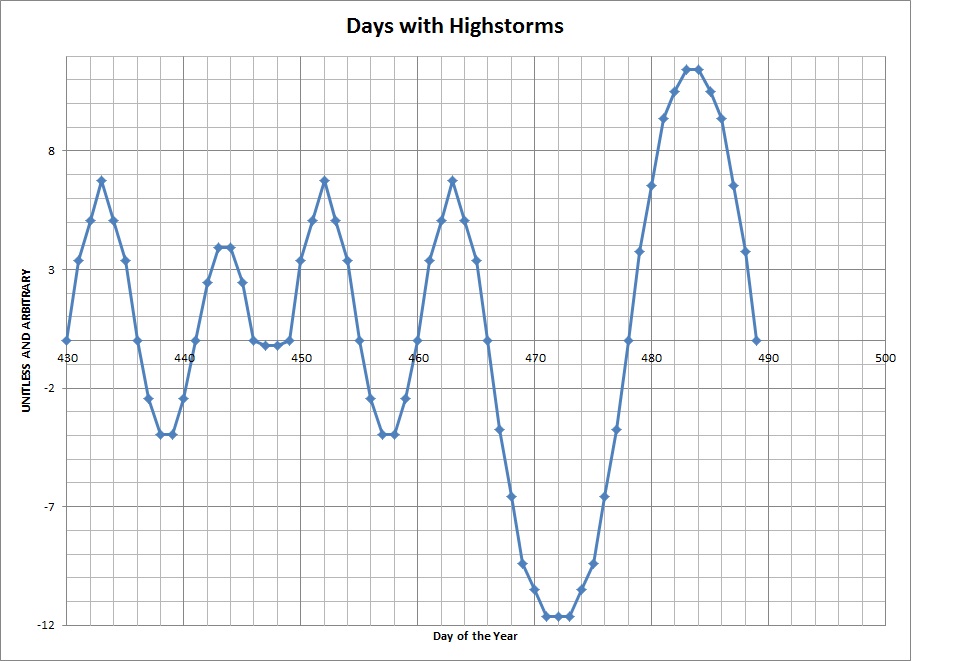
-
Calculating When Highstorms Occur
Lewis Nethur replied to Lewis Nethur's topic in Stormlight Archive
You see deeply indeed! The function would represent only an approximate general solution for any given year. In truth, I'm skeptical that the Weeping actually does occur exactly every 500 days, in my opinion, it would be far more likely that it would shift at least a little, say, half a day to maybe as much as several days. It's important to remember that predicting weather is so hard because so many things affect it; even though Roshar's weather appears to be relatively well controlled by an external force, that force should not be expected to be omnipotent, in other words, it should have some limit on what it can do, which would necessarily introduce some measure of variance in all meteorological phenomena (though how much, only Sanderson can truly say). (IE: it probably can't control the trajectory of every single molecule in the atmosphere, but even if it can, it probably can't control their speed simultaneously, and even if it can, it probably can't control that speed to an infinite number of decimal places, ect. Hence - year-to-year variance; maybe a little, maybe at lot, but always at least some.) What all this means for those still reading is that, in practice, a more iterative approach would need to be used to predict highstorms. Every year a small correction factor would need to be added to account for any change in the length of the year, and coefficients adjusted as predicted highstorms are observed to occur at different times than expected. For example, if you tell your High Prince that a storm won't hit for 12 hours, and it arrives after only 2, you better believe you'll be riding out that storm by adjusting the coefficients of your chosen wave function to agree with the newly observed data and refining your estimates for the arrival of the next few storms. (that is, if you don't want to spend the next storm lashed to a post outside...) I'm not trying to develop weather radar for Roshar, far from it, nor am I trying to troll the series and scour its pages for inconsistencies (not that anyone has suggested as much, but it's always in the back of my mind when I post about continuity). But I think it would be interesting and possibly useful for the community to develop a method of more clearly identifying when a scene takes place in reference to the last storm that passed and the next one to arrive. Granted, a good rule of thumb seems to be about 3-5 days between storms, but I believe there are in-book references suggesting there are occasionally back-to-back days with storms, or stretches almost as long as the weeping without any. We may even be able to figure out the maximum number of highstorms that can occur in a single month. -
Calculating When Highstorms Occur
Lewis Nethur replied to Lewis Nethur's topic in Stormlight Archive
Thanks for the feedback, looking back on it, I think it's fair to say I made a few too many logical leaps without justification. Let's start at the beginning: Some of the weather events on Roshar appear to occur more-or-less at the exact same time each year. This implies that, to a good approximation, their occurrence can be described using a wave function. For example, the first day of each Weeping follows the function: y = sin(pi*x/500 - 10) , where each root (place where y = 0) represents the initiation of another Weeping. (Note: there are many other valid ways to describe this phenomenon) This equation has a 1000 day period, with a root occurring every 500 days. It's a little old-fashioned, but the value of Sine for a given input can be measured by hand by carefully drawing right-triangles with a ruler and protractor and then using long division to take the ratio of the length of each side. Back before computers, people used massive tables of Sine values that had been found experimentally. Rosharans seem to have some basic concepts for finance, debt, credit, and economic theory judging from passing comments made in-book, so I would posit that they definitely have at least basic trigonometry nailed down, as trigonometry predates these concepts in real-life by a significant amount of time and is extremely vital in map-making. The way ancient mathematicians tracked natural phenomenon (IE: the movement of stars and planets past a point in the sky) in real life was to simply write down the date/time it occurred. After they had, over several decades, accumulated enough data points they could plot them out and try to fit a function to them. For more complicated and, for lack of a better term, "wavy" wave functions (see attached) with unevenly spaced roots, determining the underlying function described by your data points analytically can be difficult or impossible without a computer. However, if you know enough of the past roots (IE: the days when highstorms occurred) and you don't care about the wave's behavior between the roots, you can construct an approximation of the wave by adding several simple wave functions together. This process still isn't trivially easy, but is doable using only trial and error in the event that Rosharans haven't discovered calculus and more complicated mathematical concepts, which I admit is entirely possible. I picked the method of combining Sine waves because I suspect it would be the easiest method to accomplish Stormwardens' basic task of approximating when highstorms will occur without having to rely on computers or advanced techniques. My ultimate goal here is to compile a list of in-book references that show when highstorms occur at specific places on Roshar. From this we might be able to derive, 1) how fast storms move across the continent, and 2) a function whose roots describe approximately when highstorms will occur. It should be noted that it's entirely possible that specific data points may have been deliberately omitted to prevent this kind of back calculation from being readily performed, however, we won't know until we try. TLDR; I speculate that Sanderson, in his development for the time-line of events in the Stormlight Archive identified key points when he wanted highstorms to occur. His track record for internal consistency in his novels leads me to suspect that he may have had a real and decipherable pattern (mathematical function) generated to describe when highstorms occur for his own use during writing (with the caveat that it doesn't need to be spot on because weather is complicated and subject to fluctuation) so he can quickly and easily tell if he's in the right continuity-ballpark when adding new events or shuffling things around (so he doesn't inadvertently create a series of scenes no highstorms for 20 days outside the weeping). This isn't as crazy as it might sound, there are plenty of mathematicians in the world that could readily knock out such a task. wavy-wave.bmp -
Natural Fabrials: Symbiosis on Roshar
Lewis Nethur replied to Blightsong's topic in Stormlight Archive
An excellent observation; it would most likely have taken a tremendous amount of time for Greatshells, and indeed all gemhearted creatures, to evolve and create a relatively stable ecosystem. The violent/turbulent conditions on Roshar and the large amount of investiture present could have greatly accelerated the evolutionary process, particularly if it was being specifically guided by Adonalsium, but it would be a bit of a stretch to suggest it occurred within only a few thousand years. Ergo, trapping spren in gems (which is the foundation of fabrial science) as a magic system must predate the Shattering. Well done! -
Calculating When Highstorms Occur
Lewis Nethur replied to Lewis Nethur's topic in Stormlight Archive
@WeiryWriter , @Oversleep You people are Gods. I think I'm gonna settle in, enjoy a drink, and brush up on my Fourier Synthesis. EDIT: @Cheese Ninja is also deserving of praise. -
Calculating When Highstorms Occur
Lewis Nethur replied to Lewis Nethur's topic in Stormlight Archive
Thanks! It's been a while since I looked at those numbers; I was originally trying to use them to determine if Taravangian was able to predict that the Stormfather would send the last storm in WoR early, but I think I ultimately concluded that we needed one or two more dates to be able to tell...go figure...still, a great start! -
Warning! Meaningless Math Jargon Follows. Request: I earned a math-minor but it's been a while since I stepped foot in a math class; if something looks screwy in my logic or word choices, do speak up. So, disclaimer: I'm assuming stormwardens estimate when highstorms will occur by running a summation on a set of linearly independent wave functions, using the day of the year, or possibly the hour of the year, as the common independent variable. We know from numerous in-book references that the highstorms are almost, but not quite, mathematically predictable; ie: stormwardens' estimates are usually pretty good, but are sometimes off by, IIRC, as much as half a day (10 hrs). We also know that the weeping, as well as the highstorm that occurs in the middle of every other weeping, are particularly regular in their occurrence (though I don't recall anyone ever saying they occurred at exactly the same time for each two year cycle, meaning the length of each year could vary a little.) It sounds to me like the stormwardens (or really...Sanderson) literally fit a combination of sine-waves together to mark the days when highstorms start at the Origin, then use the average speed a storm travels across the continent to predict when the storm will hit their location (my guess would be 10 different waves, though that's purely speculation). This would be complicated and mathematically intense for the stormwardens to accomplish, but totally feasible with enough data and free-time. The caveat of course would be that they may need an infinite number of data points (and time) to perfectly reconstruct the wave function that describes the cycle of highstorms; however, they could probably fit the data fairly well with just a handful of functions. Kaladin's father makes a hobby of predicting highstorms and is able to guess the right day ~80% of the time. This tells us that solving for when a highstorm will occur is probably not trivially easy to do by hand, otherwise it'd be weird that he, a reasonably well-educated man, did it recreationally and that people were paid to do it. I'm guessing then that they either use a Taylor Expansion, or large sine-table (which would be easier), to approximate values for sine, then use multiplication and addition to solve the equation, followed by mapping the solutions onto the Rosharan calendar; a little tedious in my opinion, but I'm also a resident of the age of computers. Those who are really dedicated would also probably spend time trying to identify combinations of wave functions to better fit their real-life observed data, as well as correction coefficients for each function. Ultimately, I think the equation they would start off with would look something like this: 0 = A*sin(a*x + B) + C*sin(c*x + D) + E*sin(e*x + F) + ... + N*sin(n*x + M) + K ; I'd start off by guessing K = 0 for simplicity. where x is a day, or possibly hour, when a highstorm will pass through (or be created at) the Origin. Interestingly, though not coincidentally, if plotted out, this function would probably look fairly similar to words written in the Alethi script. So my question to the community is this: Has anyone ever gone through TWoK and WoR and determined the dates when highstorms reached specific locations, and does anyone know how fast a highstorm travels across the continent? If so, can you point me to where to find this information so I don't waste a whole bunch of time trying to recreate it? Any thoughts, opinions, or additions?
-
There are some cosmere works I haven't read yet, are there people who suffer "soul wounds"? I guess I'm just contesting the need for some kind of crazy shenanigans or secret exploit for Szeth to be able to draw nightblood and live in general. As far as I understand, Nale could breathe stormlight in and just be touching Szeth when nightblood is drawn, or, someone could perform a lashing on him, or, he could draw nightblood during a highstorm. The interesting question is will Szeth be able to access surges? I have a feeling he won't be able to, considering that, if he could, realmatic problems and mumbo-jumbo aside, he would probably just be too powerful. Sure, kaladin beat him, but I don't think most of the radiants would stand a chance. Losing his surges greatly decreases his mobility, so he's not a looming threat to every radiant every second of every day. But he's still a highly trained assassin with a sword that is, as Sanderson puts it, "orders of magnitude more powerful than a shardblade." So basically, I'd suggest he'll be a stormlight breathing, surgeless "skybreaker" with a sword that literally kills people on contact, and probably damages, hurts, or drains other spren-swords on contact. I'm assuming his bond with nightblood will let him breathe stormlight, otherwise his tenure as a skybreaker will be extremely short...Also, the surges aren't directly of Honor and Cultivation, they are of the spren, which might give them some more flexibility in their rules...though possibly not...
-
Szeth is adept at drawing in stormlight, why is it inconceivable that Nale will just hand him an emerald broam and tell him to breathe the light in the second he draws nightblood and re-sheath immediately? Probably wouldn't take that much damage, just lose some color in one hand
-
Interesting, I initially thought they were looking for awakened objects, but discarded the idea once I remembered how implausibly difficult awakening inorganic materials is. I eventually settled on the idea that k&n were looking for people with an abnormally strong presence or connection to the cognitive realm; probably to recruit new world hoppers, thoughts?
-
I believe it's mentioned somewhere that the length of the name, as well as its symmetry is taken into consideration for determining how "divine" it is. For example, Hanavanar is a king, so he can get away with having so long and symmetrical a name because the Almighty has obviously blessed him greatly. Ialai, who is high ranking but not royalty, has a name that is significantly shorter, but commented on for being almost blasphemous because it's seen as her parents reaching above their station, or perhaps predicting greatness for her. Basically, a symmetrical name isn't always blasphemous. I could definitely see ardents being displeased with Hashal, Tarah, Laral, and Rillir though. Not sure how Tarah even managed to get away with it, unless she was a foreigner or a lighteyes...
-
Some kind of matriarch seems like a good hypothesis. First off, I know explaining humor is painfully unfunny and laughter-killing, so I'm sorry in advance. Rock jokingly says he'll name Kaladin his kaluk’i’iki if Kaladin can travel a great distance through outrageously hazardous conditions unharmed. The humor could be originating from a variety of angles, including but not limited to: 1. A kaluk'i'iki is the only type of person or thing that could survive such a treacherous journey and all kaluk'i'iki are women/feminine in nature, ergo, Kaladin is a girl (pause for laughs). This would suggest kaluk'i'iki are some type of elite survivalist, guardian spirit (or spren), or otherwise unyielding hero/leader of the community. 2. Rock currently has a kaluk'i'iki who is one tough and/or stubborn lady and probably the only person capable of pulling off such an unbelievable feat; the humor would then come from the absurdity of Kaladin holding the relationship to Rock of a kaluk'i'iki. Rock then goes on to laugh again when Kaladin asks if a kaluk'i'iki is a wife, implying that the idea is scandalous or profoundly silly, suggesting a kaluk'i'iki might be of a familial or ancestral relation, such as a mother, sister, or grandmother. 3. Rock is making a mocking comparison between Kaladin's likelihood for success (which Rock believes to be zero), and his likelihood of becoming a kaluk'i'iki (definitely zero). The joke being that Kaladin has no chance for success combined with the juxtaposition of proposing Kaladin adopt a female role (IE: Kaladin's chance of success is about as good as his chance of growing breasts; pause for laughs). This interpretation would allow kaluk'i'iki to mean pretty much anything, as it would no longer need to be relevant to the context of traveling, survival, or heroism in order to be perceived as funny. However, Rock presumably felt that a kaluk'i'iki was an important or prominent enough figure that Kaladin ought to be able to understand the joke that was being made; combined with Rock's derisive laughter when Kaladin asked if it meant wife, this would imply that a kaluk'i'iki is some type of important matriarchal figure of a community, spirtiual leader, or female relative. TLDR; Based on how the word was used, a kaluk'i'iki is probably one of the following: a type of female relative/ancestor, a prominent matriarchal figure, a spiritual leader, or some kind of spren that Horneater culture treats as female.
-
What form do parshendi start with?
Lewis Nethur replied to cloudjumper's topic in Stormlight Archive
Just to be clear, I definitely don't support the idea of slave labor...That said, the thing that makes slave labor so expensive and unappealing in general is that: 1) slaves tend to harbor resentment for their owners 2) slaves generally don't do very good work unless they're restricted to very unskilled jobs (lack of motivation, not intelligence) 3) slaves revolt and kill their owners occasionally Since 1) and 2) don't apply to Parshmen, they're really quite perfect slaves. "Flooding the market" with Parshmen would drive prices down (supply and demand and what not). This wouldn't ruin the profits of selling Parshmen though, it would just make small-scale breeding operations economically unwise. Instead, sprawling breeding farms, overseen by a small number of large stake-holders would be the most efficient solution, which would work well with Alethkar's top-heavy feudal-esque society. However...the price of a Parshman couldn't fall below a certain limiting value, (IE: ~16 years of food, water, and utilities + a markup determined by market dynamics probably on the order of 25% - 100%). That's where I made my mistake earlier. The minimum cost of a Parshman the market could sustain would probably still be pretty high (on the order of an entry-level car). Considering the frequency of wars and power shifts, I'd imagine sellers would insist on being paid in cash (er...spheres) rather than credit, which would disqualify pretty much all members of the middle class and lower. I still feel like Parshmen shouldn't be more expensive than human slaves...but whatever, they are and that's that. Thanks for the contribution and making me think about it a little harder @Erklitt -
Why do people on Roshar age so well?
Lewis Nethur replied to asterion137's topic in Stormlight Archive
Er...that was a typo, I meant to say "moons." I don't mean to derail this thread...but may I ask if that bit about Roshar's axial tilt is from a WoB, or was it established from in-book references in another thread? (I ask because I've tried searching this forum for that type of information before and want to know if I just gave up too quickly.) -
Why do people on Roshar age so well?
Lewis Nethur replied to asterion137's topic in Stormlight Archive
1.1 times the length of Earth Years? Does that mean that it's been confirmed that Rosharn days are only 20 hours long? I know Taravangian says when he was making the Diagram he described the experience as something like 20 hours of lucid insanity. I've been assuming to myself that their days were shorter than ours since the way they describe the passing of their moon seems to imply that the sun is only down for something like 6 hours. 20/24 * 500/365 = 1.1 (ish) -
What form do parshendi start with?
Lewis Nethur replied to cloudjumper's topic in Stormlight Archive
That's an excellent point. I've thought about that a little myself, but I actually don't recall ever seeing anyone post here about it. Considering how obedient and docile Parshmen are, I'd think that breeding them would be at least as easy as breeding livestock. I'm going to just go ahead and assume that agriculture on Roshar is too complicated to be performed by Parshmen in an economically responsible way, otherwise their whole use of slaves doesn't make much sense to me... But even so, the important questions are: where the heck are all these Parshmen coming from, and why aren't there tremendously more of them? From a capitalist standpoint, as long as you can train a Parshman to do enough work to offset the cost of feeding, housing, and cleaning up after itself it would probably, in the long run, make sense to buy one. Considering they never offer back-sass or revolt, I'd think every family in Roshar would want a Parshman or two to help around the house, weed gardens, churn butter, wash clothes, or whatever. It'd be weird if no Alethi had ever had the idea to try enterprising on this largely untapped market. So like...what gives? Why is the supply of Parshmen low enough to keep their price higher than ordinary slaves?

