



Lewis Nethur
-
Posts
1141 -
Joined
-
Last visited
Content Type
Profiles
News
Forums
Blogs
Gallery
Events
Everything posted by Lewis Nethur
-

Surgebinding While Using Shardplate
Lewis Nethur replied to Sand Master's topic in Stormlight Archive
Theres not a good consensus, but the most popular theory I'm aware of is that shardplate materializes from the essence of a minor spren which is related to, or possibly subservient to, a radiant spren. In Kaladins battle with Szeth, at one point he is surrounded by a swirling mass of windspren, some fans, based on hints and winks by Sanderson that are not conclusive in my opinion, have theorized that Kaladin was extremely close to obtaining shardplate at this point. -
I wasn't aware it had been confirmed that Vasher went to Roshar before making Nightblood, that's pretty wild...Heck, maybe Roshar is where he gathered the massive stockpile of Investiture needed to make Nightblood. It's sorta bugged me how cavalier they were about burning through Breath, which functions at least partially as a person's soul on their planet, during their experiments making Nightblood when they weren't really sure what the result would be. If they didn't have to go through the process of gathering the Breath from people, I could see them being tremendously more casual with how they spent it. Interesting implications...
-
Unfortunately...last I heard (maybe from one of the newsletters or annotations?), sequels for Warbreaker are still in the early planning stages, ie: the specific mechanics for how Awakening functions as a magic system, who will live, who will die, and how the conflict hinted at at the end of Warbreaker will ultimately be resolved are still sort of up in the air. Though it breaks my heart to say it (Vasher is my favorite character in the Cosmere), I think the community should be emotionally prepared for a scenario in which Vasher ultimately ends up with very little time on screen in the next 3 Stormlight Archive novels...His back story hasn't been written yet, the way his Investiture functions hasn't been decided, and explaining how/why he got to Roshar in-book would leave many casual readers and first-time Cosmere readers either bored or hopelessly confused. @Argel is right though, he could still serve as a supporting character/mentor like Hoid, showing up and helping out while deftly avoiding any deeper exploration. Showing off Vasher's awesome zombie-army making abilities, while explaining that he's the only one on Roshar who can make them, and also explaining that hes a space traveling, investiture-vamping, biologically-immortal undead alien from another planet could be a huge turn-off for new fans, and, even if done expertly and in a way that didn't reveal too much or derail the series, would still probably feel like an unexplained and weird loose end. I think of if as similar to if one of the X-men showed up in Game of Thrones and started obliterating White Walkers. It could be cool, it could be a fun read, and, if done absolutely perfectly by a creative genius, it might not leave fans upset, confused, or feeling insulted. But it would still be super weird and make the series less accessible. I believe Sanderson still maintains a friendly agreement with publishers to keep Cosmere references and cross-over material away from main plot lines and arcs. They're concerned with optimizing, cultivating, and assisting with the growth of his fan-base and career in general in the long run; obscurity is the bane of writers, and there are a lot of people who, despite being avid readers and fantasy fans, don't want to make a commitment as big as reading the whole Cosmere epic, and also don't want to feel like they only read part of a story. Trust me, no one wants me to be wrong more than I do. I'd love to see Vasher poke his head outside during a highstorm and go crazy awakening boulders and building a massive arsenal of Nightbloods to take back home with him...
-
Er...I'll bite, when did Brandon imply humans didn't kill Adonalsium? Those quotes don't imply that. All those quotes say is that Adonalsium probably didn't commit suicide. He says it didn't kill itself (referring most likely to the conscious aspect of itself) ~impish smile~ but leaves unsaid what did kill it. Was it killed by humans? Ants? Its own power? Werewolves? I think it's a little too soon to be drawing conclusions about a story that isn't set to be drafted for 10-20 years... To say humans couldn't shatter a Shard strikes me as a little too absolutist in my opinion. I mean, at the very least it's conceivable that they could talk to one, make it feel bad, and ultimately lead it to kill itself, or otherwise stop protecting itself from being killed. Even if you can't directly overpower an enemy, there are other ways to win.
-
Don't be so sure. Humans killed the thing that broke into the 16 shards after all. If there's one constant in the Cosmere, it's that everything has weaknesses, as well as strengths.
-
@Jondesu Well, we don't have a specific WoB that I'm aware of, if that's what you're asking. However, I believe we do have confirmation that the Radiant-spren of Roshar are Splinters of either Honor or Cultivation. I'll admit, I'm injecting a little bit of opinion into the issue here, but I consider Liespren, whose entire live seem dedicated to the study of the identification of patterns, complex mathematics, and human psychology, to be, at most, only distantly related to the intent of Honor and/or Cultivation. It may seem counter-intuitive that what is essentially a piece of a shard would have such a wildly different primary Intent than the thing that created it, but remember, all of the Shards were created by being broken off of a greater being. I would think that all of the Shards contain at least trace amounts of all of each of the others' intents deep down. For example, Honor's intent might really be made up of 99.9% Honor and 0.1% all other intents. In this way, he could, in theory anyway, generate a splinter with virtually any Intent. I would speculate that the less in common a Splinter has with its parent Shard, the less Investiture it is likely to have, but this doesn't really need to be the case since we're dealing with things that are, by their very nature, effectively impossible to quantify, and pretty wide open to interpretation. WoB has it that the Holder of a Shard gets to interpret the meaning of the Intent to at least some degree. If someone truly believed deep down in their soul that the best way to exemplify the Intent of Odium was through passive aggression and isolationism, they could theoretically master the Shard and build up and focus on their own planet without ever going after the other Shards. They'd probably have high walls and an itchy trigger finger, but, if left alone, they'd probably keep to themselves, which is wildly different than the Odium we've all come to know and love.
-
If anyone new picks up Odium's shard...they'd probably just turn into a new, slightly less effective Rayse and then have to be killed. Hatred is a pretty objectively bad Intent, I don't think it could really ever get along with the other Shards, by very definition. That said, it could be splintered and tied up throughout Greater Roshar to keep its effects pretty negligible...Though, if Cultivation picked up Odium's shard (and what the heck, Honor's too for fun), we might get an army of Radiants who can both surgebind, voidbind, and be mind-controlled by their god in a pinch. ("~Inarticulate screams~ CULTIVATION SMASH PUNY SHARDWORLDS!") All I have to say, is, "Look out Scadrial!"
-
Remember, Splinters have their own Intent, a Splinter can have an Intent attached to it that only very distantly and vaguely resembles that of its parent Shard. There's some gray area here, but it's conceivable Sazed Splintered part of Ruin's power away from himself, granting it to someone else. Whether the person who picked up that Splinter would then be a Splinter, or a Sliver, I leave to the Cosmere scholars and philosophers to decide, but the fact remains that they wouldn't necessarily have to be cursed with the Intent of Ruin if it was done correctly.
-
You're thinking of Texas Hold'em, it's a popular version of poker in upscale casinos. By the way, welcome to the forums! I'd definitely like to see a chromium twinborn Mat Cauthon-ing their way across the Cosmere (Wheel of Time reference, sorry). If I was perpetually lucky I don't think I'd commit myself to a single job, I'd just wander around enjoying how everything miraculously worked out for me. You're never going to find a winning lottery ticket while wandering down a dark alley alone after bumping into Ironeyes and Vasher who, for seemingly no reason, decided to share their knowledge of Hemalurgy and Awakening with you after gifting you with a set of spikes and a few hundred Breaths if you're stuck inside all day working.
-
Also, keep in mind that glyphs can be drawn to look like pretty much anything while keeping their meaning. Pretty sure Kaladin remarks at some point that the glyph pairs of great houses can be extremely difficult to decipher if you don't know what to look for in them. Think: Caligraphy on steroids
-
This seems more plausible. I personally think it would be a little more boring an explanation, but it could require many fewer flashbacks and avoid painful in-book explanations of complex Cosmere-related physics and realmatic theory that, let's face it, generally makes the series less accessible by more casual readers and fans. I'll give you even odds on it and an upvote.
-
Dang! You have thoroughly slashed and defeated a tremendous amount of my content on this thread with a single well placed post, and it wasn't even a long one. Good show! Good show indeed!
-
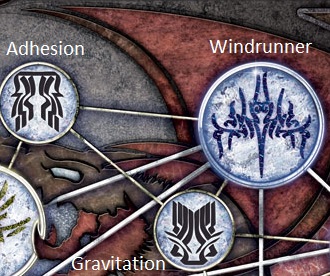
All of the Windrunner glyphs sort of look wing-shaped to me, I'd be surprised if it wasn't one of these (my money is on the big one in the upper right as that seems the most appropriate to the context), but then again...this is Sanderson, so who knows?
-
Human Races on Roshar: A Brief Guide (Ver.1.0)
Lewis Nethur replied to Botanica's topic in Stormlight Archive
WOW! I had never heard those bits about Human-Aimian-Parshendi hybrids before. You've greatly illuminated Roshar and how its people have migrated and evolved in my mind; would that I could give you two upvotes, but I'll have to suffice with one and an expression of enjoyment reading your post! -
That's...possible I guess...But it doesn't seem entirely consistent with Dalinar's vision of the Recreance. Also, Lightweavers don't really have oaths that they can break...as long as they are true to themselves, they get to do pretty much whatever they want. If being a corrupt jerk is their prerogative, I don't see why that would kill their spren. There's been a lot of speculation that when a Radiant dies without breaking their oaths their spren loses its personality, but is ultimately free to bond another person if it can find one. If this wasn't the case, then it would be unreasonable and irrational for the spren to bond Radiants except when a desolation is imminent, since, in the case of Honorspren, if new ones are created at all, it occurs only very infrequently. If Radiant-Spren are essentially a non-renewable resource and can only bond once, why waste them when everything is going well, ie: when the world isn't actively ending? The vast majority of spren capable of bonding Radiants were "killed" during the Recreance in a manner that left them unable to initiate a new bond (technically, Brandon admits they could be revived, but he's also stressed that doing so would be outrageously difficult), meaning that even the orders like Lightweavers, who aren't really bound by any particular ethical code, probably ended up killing their spren. If the Recreance wasn't a deliberate and intentional decision, I would think that many Radiants would have mended their ways before it was too late (just look at the grace period and second chance Kaladin got) which would have left a much larger pool of spren capable of bonding new humans in the present age. We have reason to believe that Radiants are often, if not usually or even always, deeply emotionally attached to their spren. Killing your spren would therefore be like killing your best friend, as well as forfeiting your godlike super powers. I think the Recreance must have been intentional and resulted from the discovery of previously unknown information (information that mr. T believes he has, or is able to find btw); I could see the Radiants losing their way and becoming corrupt, but I can't see them all refusing the change when faced with the fact that if they didn't, they would be killing something dear to them and condemning it to endless torment.
-
@dvoraen Actually, we don't specifically know when the Diagram was written. Recall, the Alethi made first contact with the Parshendi something like a year before Gavilar's assassination IIRC, roughly around the same time Szeth was made Truthless; not sure if we can reasonably say which occurred first at this point. We have the following from the Diagram: There are two ways to interpret this as I see it (at least with what we know so far). The first is, the Diagram was written before Gavilar was assassinated, and Taravangian is the one who manipulated the Parshendi into using Szeth to kill Gavilar in hopes that the Alethi would crush them in an overwhelming counter-strike. This would resolve the dilemma of "how the heck did the Parshendi, who shouldn't have any knowledge of the Shin, know Szeth was a Surgebinder and could be controlled via Oath Stone unless someone leaked the information to them?" In this scenario it would make the most sense if Mr. T had been behind Szeth being named Truthless to begin with, as he was specifically looking for a Truthless he could groom into a kingslayer to use against rival kingdoms, while also trying to instigate a war against the Parshendi. The second way is less fun in my opinion, but equally valid and supports your theory: The Diagram was written after Gavilar's assassination and mr. T is just identifying and commenting on the fact that, since the Alethi are already at war with the Parshendi, the Parshendi need to be wiped out quickly or they might figure out how to adopt Stormform, which he correctly guesses would totally suck for mankind. I don't like offering up counter-arguments to my own theory usually, but I think you're right that we just can't be sure yet. Still fun to speculate though!
-
Purelake Gods' Identity (Short Theory)
Lewis Nethur replied to Lewis Nethur's topic in Stormlight Archive
Yep, specifically, I think that's from one of Dallinar's visions. The fact that an interlude was dedicated to introducing and describing the Purelake, the occasional references to the Purelake made by other characters in-book (usually in passing, ie: Vasher) and the descriptions of the intense battle against some horrible void monster and mysterious black fortress in the middle of the Purelake in ancient times leads me to believe the area will, in the future, prove to be more important than it currently is. Speculating anything about the fortress is probably wickedly premature at this point...but...there's a death rattle that goes something like: 10 Radiants, gathered before a wall of black and red! Foreshadowing? Red herring? Utter coincidence? You decide! -
How does Mr Ts ability really work?
Lewis Nethur replied to Djarskublar's topic in Stormlight Archive
@Djarskublar - I guess I'm just not seeing why a change in his base investiture is needed to affect a change in his compassion and intelligence. We have WoB that his change in compassion is negatively correlated with his gain in intelligence. That implies to me that every day, he has the same total capacity, just balanced differently between different aspects of his humanity. Maybe his presence in the Cognitive Realm increases to increase his intelligence and allow him to tap into the collective conscious of the world on smart days by granting him a portion of humanity's combined knowledge, or maybe his presence in the Spiritual Realm increases to increase his awareness of the collective unconscious of the world, thereby giving him impossible and fantastical intuition and capacity to predict how people will think, feel, and act. Both are plausible and could account for the depletion of his compassion for others. I think it would be odd if his spirit web was changing on a day-to-day basis. He went to the Nightwatcher to have his spirit web changed; for everyone else who has sought the Old Magic, it seems like they got their web changed one time, and that one time change is what gives them their boon and curse. I think there might be a WoB related to whether or not a Boon can be spiked away from a person without spiking away their curse, but I can't remember what the verdict was, will keep looking. More investiture could allow him to see into the spiritual realm I suppose, but, as far as I'm aware that would require an amount of investiture that could very well make him immune to shardblades (like Hoid). That'd be kinda weird and unnecessary. I think the far simpler explanation would be that the way his mind, body, and soul are distributed across the 3 realms is what's shifting on a day-to-day basis. I'm enjoying your theory, and just getting hung up on a single point, it's possible I'm just misunderstanding you. So my questions to you are this: why does he need more investiture on a smart day than a stupid day when, either way, he is already gaining something and proportionately losing something else in a directly related manner? On extremely stupid days he has super-human empathy and compassion for others, and spends the day crying his eyes out in solidarity for the people of the world's pain. Why would super-human intelligence at the cost of compassion require an increase in base investiture and super-human compassion at the cost of intelligence require a decrease in base investiture? -
@dvoraen I think Sanderson divulged some information about the original time-line and pacing he planned for the series a few years ago that would support your theory, IE: Taln was originally supposed to come back before Gavilar's assassination, something like 6 years before it actually occurred in the published novel. I wouldn't be surprised if you just nailed down what the original reason for Szeth's exile was (though he was named something like Jekk in the early drafts I think...) As it stands though, the timeline would be hard to make work for this to still be true.
-
Well...Honor didn't intentionally create the Radiants (I think there's an explicit confirmation of this in a WoB...) and the Heralds were pretty sick of being sent to damnation by the time the Radiants came to be...the theory has holes, no question, but I think it could be plausible in part...though probably not as simple as my off-the-cuff explanation would imply. Guess we'll see
-
During the Recreance, almost all of the Radiants, the sworn protectors of humanity who had sheltered them through the last desolation and adhered to strict codes of conduct, enforced by their spren, that, at least partially, disallowed them from abusing their powers, came together and decided they had had enough and were done playing. Probably the most honorable and dedicated heroes of Roshar, almost unanimously and simultaneously, came to the realization that they really didn't want to be Radiants anymore, even if it meant killing their spren, who, judging by Kaladin and Syl's relationship, were pretty close and intimate friends. I'd say that whatever secret was revealed to instigate this action was, 1) Extremely shocking and unexpected, 2) Completely counter to the basic ideas of having radiant orders, and 3) Indicates (whether correctly or incorrectly we won't know for a long time) in some way that the existence of Radiants probably endangers the entire human race. It seems unlikely to me that the Radiants would have abandoned their oaths just to save their own skins, IE: if the spren are taking something from them, or eating their souls when they die, ect. more of them would probably have chosen to just deal with that in order to avoid killing their spren. This implies to me that the revelation was probably much more horrific than just personal loss. Unless...could Radiants have been getting sent to Damnation to fuel the Oathpact upon dying...? Faced with an eternity in hell (assuming radiants don't get resurrected like heralds) for their human, I could see the spren insisting that the Radiants give up their oaths...
-
How does Mr Ts ability really work?
Lewis Nethur replied to Djarskublar's topic in Stormlight Archive
I believe in an interview a few years ago Sanderson implied that a reader was on the right track when they asked if Taravangian's presence in the cognitive and spiritual realms is what is being manipulated to alter his intelligence and compassion. IE: on a smart day his presence in the spiritual realm is being reduced, thereby reducing his compassion for other living beings, in order to increase his presence in the cognitive realm. I think you've offered a solid extrapolation/addition to this point and I'm inclined to agree that there are some things in the Diagram that just don't seem like they could have been predicted from any amount of knowledge Taravangian could have had; unless of course he was tapping the collective knowledge of all of Roshar directly from the cognitive realm. How could he possibly have known Dalinar would get visions from Honor? Dalinar only turned his life around and became honorable, instead of a marauding warlord because of a cryptic message scrawled in blood next to his brother's corpse. Szeth didn't want to leave that message, he only did so because he wasn't able to get away before Gavilar started giving his last words (which are sacred or something to Shin). I'm not sure his innate investiture is changing; I think it's probably more like, how his innate investiture is distributed throughout the 3 realms is changing. Increased intellectual connection to other people (allowing him to know impossible things by accessing humanity's collective knowledge pool) at the cost of decreased spiritual connection to other people (reducing his ability to empathize or identify with others). There are still some holes in this that need to get patched up, but I have a feeling it'll be built upon in future books. -
From the Diagram: Taravangian, in his super-human moment of genius, appears to be making the connection that the Honorblades are held by the Shin, grant the use of surges to their wielder, and are given to anyone who is declared to be Truthless. The sentence: "Can we make to use a Truthless?" is worded in a very peculiar style. It sounds to me to be simultaneously asking, "can we make a Truthless?" and "Can we use a Truthless?" If I had to guess, I'd say Taravangian found a way to set Szeth up, that he somehow found a way to manipulate Szeth into believing the voidbringers were returning, though whether he did so through deceit or real evidence we can't say yet. After Szeth's exile, Taravangian either lost track of him, or else deliberately allowed him to be passed around from master to master in the Rosharan underground to hone his skills as a surgebinder.
-
So I don't have a whole lot here, but please recall that religions in the Cosmere tend to be, at least loosely, based on significant on-world historical events. With that said... The Purelakers worship a male "god" they refer to as Nu Ralik. They believe that worshiping Nu Ralik outside of a "sacred grotto" is unsafe however, because his younger, spiteful brother Vun Makak will get jealous. Ishikk implies that he believes that upsetting Vun Makak can incur real world consequences in the form of bad luck or some type of curse (there's no telling at the moment whether this is superstition or grounded in truth). This sort of implies that they believe Vun Makak to be more powerful, or at least more present, than Nu Ralik (which sort of sounds like two male Shardholders we know who have warred in that area in the past...one good, though ultimately weaker, one evil and strong) I propose to the community that Ralik, the older brother (or the one who has been on Roshar longer) is in fact Honor, Makak, the spiteful (a synonym for odious ) younger brother is...wait for it...Odium! I'm also guessing that, judging from the Purelake's relative proximity to Jah Keved, that the prefixes, "Nu" and "Vun," are used to specify older/younger siblings, as they strike me as linguistically similar to the titles used by Shallan's brothers (IE: Nan Balat, Asha Jushu, and Tet Wikim) this is pretty speculative though, and not particularly important. Note, I'm not proposing that Tanavast and Rayse are actually brothers. The Purelakers' fear of worshiping Ralik in Makak's hearing may imply that, at some point in the past, people of their kingdom were aware that Honor had been overpowered/beaten by Odium; I sort of doubt they would believe Honor had been killed, even if they had a way of knowing it, which would be why they maintain their worship of him in "secret." So that's it, thoughts? Holes that need to be addressed? Counter arguments? Any ideas how they could have known or been aware of Honor's defeat after Aharietiam and the Recreance?
-
Hoid and Frost speculate that Odium's "goal" is to, first, become the most powerful being in the Cosmere (by killing anyone who might be close in power), and second, make sure no one can ever rise up to challenge him for possession of that title (IE: by splintering the investiture of those he kills). If they're right, then we can guess that Odium ultimately intends to kill and splinter all of the other shards, and probably any particularly powerful/knowledgeable worldhoppers as well. What will be interesting to discover however is how he picks the order in which he attacks his chosen victims...

