



NH2316
-
Posts
29 -
Joined
-
Last visited
NH2316's Achievements
47
Reputation
-
I appreciate this thread. Autonomy's motivation in those books didn't make a ton of sense to me when reading them the first time, and that specifically took a lot of enjoyment away from me. Brandon is pretty good at writing well-characterized villains with clear and interesting motivations (e.g. taravangian, the Lord Ruler, Szeth, Moash, Gavilar, Sadeas), but Trell/Autonomy's motivation felt to me (back when I read MB Era 2) very vague and confusing....which ultimately made them seem like a relatively generic "cosmic bad guy". I'm interested to re-read the Wax & Wayne books now post-WaT, to see if it is clearer now what/why Autonomy moved on Sazed & Scadrial. WaT did clear up for me one of the other issues I had with the W&W books, namely the motivation of the Ghost Bloods on Scadrial vs. on Roshar (I know not everyone may feel this way, but Ialtyl & Mraize's goals & seeming divergence from Kelsier made a lot more sense to me after WaT). Ironically, if I were recommending a cosmere reading order to a new reader, I'd probably now suggest reading W&W after finishing Stormlight Arc 1 for that reason on its own.
-
Could be totally off base here.....but.... On my initial read this passage read to me a bit like someone (Endowment) protecting their friend (Valor) from an ex (Hoid). I have absolutely no proof of this, just vibes. But for what its worth.... My theory is that Valor's Vessel and Hoid were close before the Shattering (probably lovers, but maybe just close friends or siblings), and whatever circumstances/reasons that led one to take up a Shard and one to refuse (Hoid) put them at cross-purposes ending with intense feelings of hurt and betrayal. Maybe Valor in the present time is legitimately conflicted on talking to Hoid again (hence the difference between Endowment's and Harmony's reads of the situation), but Endowment is playing the role of the Best Friend in Every Rom-Com - i.e. obligatory hate for Hoid (the ex) and doing everything in her power to prevent Hoid and Valor from getting together again (to protect Valor from getting further hurt). The amount and quality of disdain Endowment has for Hoid feels so personal and specific in a way that could be read as "You hurt my best friend because you're a selfish jerk and I won't forgive you for that". That has certainly been my initial read of the Endowment-Hoid dynamic, with part of that assessment being that it seems like Hoid doesn't hate Endowment as much as she hates him (unlike, for instance, his mutual and symmetric loathing of Rayse). It feels like Hoid knows the reason Endowment hates him so much is kind of/partly/mostly justified, even if he maybe doesn't;t fully agree with her point of view. That seems like a very Hoid kind of feeling & story - "Even if I don't ultimately regret what I did, and even if I don't really like Endowment personally, I know I acted like a shithead and I hurt Valor, so I kind of understand Endowment for protecting Valor from me". This could even work within the theory that Valor is on Roshar.... maybe Valor immediately fled to Roshar after the Shattering to isolate herself (himself? themselves?) in grief with whatever went down and to move on from those events/Hoid himself.....only to be surprised when another Shard with a good-natured but somewhat bumbling Vessel (Tanavast) showed up too. Valor then found some way to discretely hide herself and just kind of got stuck on Roshar secretly as more Shards started showing up and things started escalating. It would be kind of funny in a tragic-ironic kind of way actually - like for example if immediately after the Shattering all Valor's Vessel wanted was to be left alone to get over their breakup and instead she/he/they ended up stuck in a cosmic house that everyone else moved into, thereafter being trapped living in the walls watching while more and more god-level tenants showed up to stomp around breaking stuff, one of those god-level tenants eventually even being her Ex (Hoid). Again, this is a purely vibes based assessment and almost certainly wrong, but I think one that could square a lot of circles in what we know about the Endowment-Hoid-Valor relationship so far.
-
Kal's terrible soup gives Szeth food poisoning, and Szeth never trusts him again. Having failed as a therapist, Kal doesn't process the anger in a healthy way, and decides to steal Nightblood, kill Taravangian, and Ascend to Odium. With the perspective of a Shard he intends to mine the Spiritual Realm for all the possibilities of how to be a better therapist on Roshar, but instead gets distracted by all the possibilities of soup recipes. He eventually learns that Rock's soup had the exact same recipe as what he served to Szeth, except for one extra ingredient: Love. Kal-odium splinters himself in dramatic irony. The back-half of the Stormlight Archive is all about the surviving Rosharans plotting war to take back their most prized Culinary creation, chouta, from the Scadrians (who they despise because they think Scadrians can't/don't appreciate it, on account of them literally being willing to eat metal).
-
To the heralds it's Midius, though to others (I think Frost, who presumably has known him longer than most anyone) it's Cephandrius (spelling?)....and other things to other people. Hold is not his real name, since (can't remember where) Hoid mentions it's the name of a former mentor he feels like he failed. Quite possible the "true" name is cephandrius, since that's what characters before the Shattering know him as, though again I dont know. With reference to a Hoid as "M-----" reveal, that was mostly a joke though I do kind of like the theory that Hoid is the ultimate villain of the whole cosmere, or at least "not-a-good-guy", and I think we've seen a lot of evidence hoid isn't purely noble....but that's a whole other discussion probably best for a different thread Edit: I'm stupid.....you were pointing out that "Midius" does in fact start with M rather than saying that was his "real name". Nice catch haha....didn't even think of that
-
Wild tinfoil hat theory: Hoid's real (original) name will start with M, when he's revealed as the true villain of the cosmere in the heel-turn to end all heel turns......Just kidding. I think it's this - - along with the phenomena where writers in fantasy/sci-fi often subconsciously (or perhaps consciously) incorporate resonances with the works that influenced them, especially when it comes to aspects of the story that require them to invent something novel (e.g. naming a character or place, or inventing a magic system). It's (maybe***) kind of like the trope where a disproportionate number of Black superheroes have powers related to lightning or electricity. I'm not certain this occurred because there's a racist cabal of superhero writers out there who were all like "what if we all made black characters but gave them similar powersets", if only because it's not clear to me it's actually racism that Storm/Black Lightning/Mile Morales/Electro/Blue Marvel (and literally dozens of others....google it if you dont believe me) all have really cool if nevertheless somewhat thematically-similar superpowers. More likely, it's a kind of subconscious bias for writers who are thinking up a new superhero to incorporate aspects of characters which they found influential. I think the M thing is maybe a bit like that - it's implausible that there's any high-fantasy writer out there who didn't subconsciously consider Morgoth (the biggest villain of the most prototypical and archetypal work of that genre) when thinking "what should I name my villain"? As an aside: Nale leads the Stormbreakers. And while Division is technically modeled after manipulation of the Strong Nuclear Force and not electromagnetism, it's closer than any other surge to a cosmere version of electric "shock and awe" powers (https://tvtropes.org/pmwiki/pmwiki.php/Main/ElectricBlackGuy).....just saying. ***I mean, I haven't ruled OUT that it's racism....I could absolutely be wrong. it's just that there's so many more overtly racist tropes in that genre for BIPOC characters that it seems more like weird coincidence.
-
This seems likely to me, especially without a single mention or (as far as I've noticed) allusion to El and what he's been up to so far in the preview chapters/story through end of day 2. Agree El seems like a villain best rolled out slowly and I hope that's the case. El's introduction in RoW felt enigmatic and (because it was right at the end of the book) important in a way that makes him seem like a special villain of major importance for the longer term. I personally felt some parallels with Taravangian's "unmasking" at the end of WoK. There's obviously some differences: Taravangian was already a minor character in Khabranth scenes scattered throughout the books, though in my opinion these mostly just serve to reinforce the juxtaposition of his public persona against his ultimate "revealing" as a puppet-master/villain right at the end. The actual reveal does two things to establish this is a complex villain of major importance - 1. it shows that he has a LOT going on to influence the broader world (Szeth finds out T has his oathstone, T been behind Szeth's regicide campaign, you glimpse the horrific truth behind the death knell epigraphs that started the book, and you get foreshadowing that Dalinar is his next target), and 2. It does all this right at books' end so you know you aren't getting answers on any of this for a while, and probably some answers won't come until multiple books forward because there's simply so many questions raised in a short time. And that's exactly what happens - Taravangian is in fact the primary overarching villain of the series so far and we get slow well-earned payoffs to the mountain of questions this breif tease at the end of the book raises. You could maybe call this "mystery box" storytelling, though I hate to label it that***.....maybe a better description of the vibe here is that it's akin to something that's often used (sometimes well, and sometimes....not so well) in the comics/graphic novels medium, wherein a classic trope is the heroes beating the villain in the end of a story arc only for an even bigger villain to be "unmasked" as the "real" threat looming on the horizon. El's reveal in RoW felt a bit like this to me - very sudden introduction of a character we're seemingly meant to have 10,000 questions about, and done right at the end amid a whole bunch of other stuff wrapping up. You get a lot of interesting details on El that suggest "not-a-normal-villain" vibes, just like we did way back when with Taravangian. Admittedly, the degree of detail is a bit lesser in degree to taravangian's reveal, but to me this makes sense: T is the clear overarching villain of the series, or at least of the first 5, and you wouldn't want to introduce El in a way that overshadows T because at least through WaT (and maybe all the way to the end of the cosmere) T is THE villain. I also think the likelihood El is a longer-term villain has become much greater with his seemingly complete absence early in WaT (via the previews). Here's to compelling villains - may their mysteries and motives be paid off slowly and ultimately be well-earned. ***I hate to label it that because A. my opinion of "mystery box" storytelling is not great.....JJ abrams is the prototype of the Mystery Box writer and I would argue that his use/overuse of it ruined many of his screen works that started promising and ended as disjointed messes (first Lost, later and even more spectacularly the Star Wars sequel trilogy). That said, I think that's what happens when you use the Mystery Box without a well-developed plan for pay-offs for the mysteries, whereas Brandon excels at consistently at paying off mysteries in a way that feels earned.....and B. The "Mystery Box" in the Abrams sense tends to be a lot of much more disparate mysteries ("There's an invisible monster! Wait it's also a polar bear! There's another monster that is visible and may or may not be related to the polar bear! Also there's mysterious people already on the Island! But some of these people seem like real people and other more like ghosts! Also, Timey-Wimey stuff is in play!"), rather than the sudden introductions of a lot mysteries all surrounding a single character to be explored later. For those reasons, I think it's closer to the comics "wait there's a bigger bad!" trope, although in this case it might just be "there's another big and long-term bad" since I'm not convinced El will or should exceed taravangian (who is a compelling enough villain to be the overall antagonist all the way to cosmere's end-game, if that's where Brandon has decided he's going to go).
-
Wind and Truth: What is the loophole? [Discuss]
NH2316 replied to r0cketm00se's topic in Stormlight Archive
During a contest itself hostilities will have to occur. That is kind of the very point. I don't see the contract saying anything about limiting collateral damage or having to stay alive during the battle. Suicide attacks are definitely allowed. That's fair - "hostilities" are a part of a contest and necessary, and the "hostilities" to be ended which the contract refers to are ostensibly hostile actions instigated by odium and his agents after the contest. It makes me wonder though, with the suicide attack / collateral damage idea, what if odium engineers it so that whatever collateral damage occurs as a result of their champion losing causes hostilities from a third party organically that nevertheless serves odiums ends? The sort of thing I picture is something like odium closes their champion, that champion loses, but either because of who that champion is or collateral damage that occurs during the contest, a powerful third party (someone with nightblood, a bondsmith, a powerful spren, a world-hopper, etc.) decides of their own volition that it's necessary to do something that ultimately serves odium anyway. The extreme example would be someone revenge-kills Cultivation with nightblood, and while narratively I admit I don't know how that works , I'm not a writer and have confidence Brandon could figure it out. Maybe a less extreme version could be something happens in the contest that puts the potential world-ending dangers of surgebinding as a magic system on display (something hinted at through these books, and I think in some WoB) --> this freaks out the radiants themselves, Cultivation, the heralds, or the people of roshar, the people of a different world hopping planet, etc. --> the freaked out party seeks to limit surgebinders or their works in a way that as a by-product is a boon to odium (a mass revolt against the radiants, ending whatever remains of the oathpact, a second recreance which this time takes out the bondsmith spren too, a world hopper group like the ghost bloods radicalizing to target Roshar as a threat, etc.). Again, admittedly I don't know how you get from a-->z with specifics, but I'm not a writer. Anyway, the end result is you have scenario A: Odium's champion wins, odium wins, B. odiums champion loses, but odium still gets a powerful boon out of it that is just fine by odium in the grander timescale. Shards seem pretty strongly bound to the meaning of their oaths and not just the letter based on what Rayse says (although that assumes Rayse was right, and that Taravodium is bound to the same degree), so the maneuvering odium needs to do would have to be so subtle that the actions of the third party here are entirely their choice. However, I don't see that requirement any different from the "child champion" loophole - if Odium choosing an innocent target knowing it will cause dalinar to forfeit is OK, then I can't see how choosing a champion that results in a revenge campaign or populist uprising against the radiants would be more out of bounds. Totally aside, this will not be the loophole because it's so absurd, but I find the idea below (from a 2020 Wolverine comic by Benjamin Percy) as a hilarious loophole in this kind of classic fantasy "contest of champions" / "fight to the death" plot: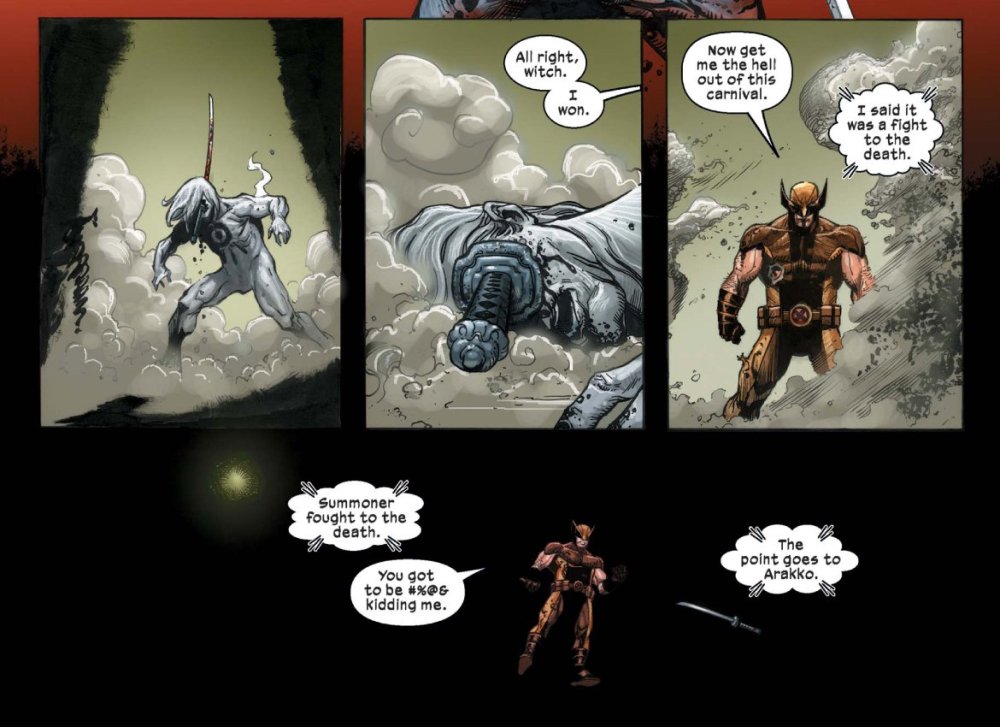
-
The Grand Theory for Wind and Truth: The final battle Predictions
NH2316 replied to Honors_Gun's topic in Stormlight Archive
Agree with a lot of the others here - Dalinar hasn't finished his arc. My own thought is that his broader arc is the charge given to him at the very beginning of his story in WoK - "Unite them". He's spent several books grappling with what it means to be a diplomat and uniter of men rather than a warlord and destroyer, even if he mostly has the innate tools of the latter. He has an internal moral dilemma that I think of as a sort of a macro-level analogue to Kal's continued grappling with what it means to save a person by killing another (and when/whether killing to protect is ever justified or makes sense). For Dalinar, who spent his early years waging war and conquering in the (ostensible) name of uniting a nation, he has to grapple with what it means to be a warlord trying to unite societies and forge a peace. You could argue that he's united the radiants, but even in that it's not really true - he hasn't united the skybreakers, the dustbringers are sketchy parts of the alliance at best, and he's not united the singers and humans (perhaps most importantly). He's not done with his arc as "Uniter" yet, which I think could end with him uniting the peoples of Roshar as a single society (including the singers), setting up a unified planetary civilization and culture for the space age.....and/or dying in the attempt. Alternatively, there's also the theory out there that "Unite them" actually will refer to the splinters of Honor, and somehow he'll bond them and "re-form" Honor, which I don't know if I buy but....we'll see. Either way, Dalinar has more work to fulfill the charge given to him by Tanavast in WoK, in my opinion. Unrelated, did not know about THIS . Wow that kind of blows my mind a bit. Very interesting and excited to see what comes of it. -
I LOVE this. That would be an incredibly cool explanation, and fit into the Roshar-Scadrian conflict in an interesting way
-
You're probably right, this is some artificial vessel holding investiture (for, etc.). I also wonder if a shard-gun needs external ammunition, practically speaking, because a ranged projection of the spren itself as a "bullet" seems like it might not work efficiently. From other examples it takes a lot of concentration to make shard-weapons manifest at range for even limited periods of time, like when adolin has to concentrate really hard to throw Maya and keep her manifested after leaving his hand.... although that's with an unbonded/deadeye spren and not a radiant bond...so...?. Nevertheless, spren can't venture too far from you just generally, which would seem to make any manifestation of the spren-as-projectile more limited than an actual projectile. Also, if bonded spren can manifest as viable/practical projectile weapons all on their own, why haven't we seen that yet? e.g. - A shard crossbow seems like it would be pretty game-changing in SA1-5 (a lot more efficient than a sword or spear) and its kind of implausible to me that zero radiants by SA4 would have realized that and tried it out if it really was so easy. Caveat there is ranged shard-weapon capabilities may just be a 4th/5th ideal thing which would also explain why it hasn't been seen....maybe SA5 is going to be shard-crossbow fights in the sky and stuff haha Anyway, because of ^these things, it's been my general theory that a shard-gun would seem to require or at least be most practical with external ammunition - e.g. the spren-gun launches some bullet-like projectile so the spren themselves doesn't have to extend to range. So I wonder if the "power-pack" as Dusk describes it could have two functions - holding a power source plus holding ammunition. I don't know, maybe I'm overthinking this.
-
Stormlight Archive: Wind and Truth Prediction
NH2316 replied to CtrlAltDepressed's topic in Stormlight Archive
Discussions of mechanistic plausibility aside, I do like the idea of everyone gets revenge on Gavilar for F&*%& so many things up and being such a jerk to everyone who ever loved him. That said, that feels very neat and happy to me in a way I don't personally expect to happen. Not entirely. Yes, he will win against Dalinar but I believe by doing that Taravangian will deadeye the Stormfather, which will cause endless Weeping, causing flooding that will destroy Kharbranth, thus Odium will break the deal with Taravangian and that will either be exploited by the Coalition, or it will force Odium to withdraw for a time being. Future Cosmere spoilers, SotD2: I do expect SA5 ends in tragedy - if not an overt version of "Odium Wins", at least "Odium doesn't lose and therein survives to do everything he wants to in the cosmere once the Space Age rolls around". It's an end to an arc (SA1-5), but also a midpoint in the overall SA.....that just seems like too great a chance to end on tragedy to pass up (for presumably some kind of redemption arc in SA6-10). Who know, though? -
Oh It's MUCH more complicated. First, going halfway through the spinal cord you *obviously* get Radiant Brown-Sequard Syndrome (google it). You lose motor, vibration, proprioception, and your primary surge on the ipsilateral side below the lesion. On the contralateral side, you lose pain and light touch sensation, and your secondary surge. However, it would be difficult to achieve hemi-section of the spinal-cord with a shardblade without *also* disrupting the other part of your neck. Importantly, you would knock out the carotid, vertebral artery, and internal jugular on the affected side. - Losing the IJ is bad, but with radiant healing maybe it's survivable without lasting damage (obviously you'd need surveillance for developing thromboembolic events proximal and distal, but you could probably survive the bleeding long enough to achieve hemostasis). - Losing the common carotid is a much bigger problem. You stroke out essentially the entire ipsilateral hemisphere of your brain. Maybe some of the brainstem is saved....depending on where you cut the vertebral artery you might have enough collateral flow from the contralateral vertebral to supplement the vertebrobasilar syndrome through it....especially with radiant healing. But your ipsilateral middle, anterior, and posterior cerebral artery territories are TOAST (maybe you save some PCA territory, sight, by vertebrobasilar contributions....but that's a stretch.) Now, this is where things become tragic. Since the stroke is above the pyramidal decussation, it *obviously* means you lose motor on the contralateral side. Now, even though the spinal cord hemisection alone would have preserved contralateral motor function, you now lose motor on that side too. So, you've now lost all voluntary motor movement. Also, you lose effective use of your ipsilateral lung, as the phrenic nerve is likely lacerated. The other effects of the MCA/ACA stroke are varied: - If the cut was on the right, you get hemineglect of the left side. This is bad enough for normal people, but for a radiant it's WAY WORSE. If you or your spren accidentally position yourselves so the spren ends up to the left of you, you stop perceiving their existence. This immediately murders the spren. No take backs.* The only silver-lining is if Shallan stands to your left you also aren't aware of her when she's making puns. - If the cut was on the left, you lose speech function. For a normal human, Broca's or Wernicke's aphasia could apply, but for a radiant something special happens - you end up getting "Shallan's aphasia", wherein you can no longer MAKE cheap puns. Lastly, if your were previously suffering from hyperthyroidism the loss of half your thyroid results in partially-treated thyroid disease. You still need to see lirin to get the other half taken out, but maybe it temporizes your symptoms until you get an appointment. "Be thankful for small blessings..." and some-such. --Anyway, hope this very serious explanation helps! *The mechanism here should again be *obvious*, but if not...... it's because once your spren passes to the neglected left side you no longer believe they exist or in fact ever existed. Like a baby lacking object permanence, the object literally does not exist in your mind if you can't see it (or, as in your case, you technically can see it but the object unfortunately stood to the left of you so you neglect the seeing). For regular objects that's fine - once they pass back to your right side they exist in your mind again. Unfortunately for your spren..... if they don't exist in your mind (as their heavily-Connected radiant), they stops existing in the cognitive realm. Again, sadly, no takebacks.
-
I think this above is spot on. There are lots of fantasy stories (and Chronicles of Narnia is a great example) which start from an assumption that there is one capital G god. As Duxredux said - nothing wrong with those stories....but the cosmere doesn't seem be as interested in "who's the real god" as a primary end. Instead, it's a lot of more nuanced and novel questions about god and gods (plural) - - What would necessitate that people decide to kill a god? (adolnasium) - How would people respond to learning their god is long dead? (honor & Vorins) - How does a society respond to learning their god is not the only god? (various rosharan peoples) - What is the connection between monarchs and gods? Is godhood simply increasing degrees of relative power over others? Is it right for any being mortal or immortal to place themselves above others even if they have the power to do so? (Taravangian's paternalistic and Machiavellian philosophy of the role of kings..contrasted vs. the less certain, conflicted, and slightly more progressive views of Dalinar/Jasnah/Nohodon). - What of "god-kings" who present themselves as gods to a people....until that people learns that there's some power higher? (The lord ruler / scadrians) - Can a god be in conflict with itself? (Harmony) - What would a god want? And what would they do to get it? (possibly the Iriali One...whoever the One may actually be) ....and plenty more. The thing all these themes and questions have in common though is that they require degrees of godhood and perhaps the "who is GOD full-caps?" to be left unanswered. Moreover, what is interesting about a story focusing on questions like this is not just finding definitive truths....I'd argue its just as much or more what any truths you do find about god/gods say about the people who believe in them. I can understand how you could feel frustrated with this. My own take is that to ask some of the questions above, like "what happens when you learn god is dead", you have to show many possible responses to create contrasts and conflict narratively. It wouldn't be realistic otherwise. A centuries long religious order won't accept that their god is dead overnight - that's asking people to deal with a truth that contradicts their senses of self, community, and being in an absolutely profound way I don't think most people can imagine. In real life, the loss of a long-held faith is a massive and potentially even crippling challenge for people....imagine then what happens if that came with some form of "hard proof" your god was dead.
-
Love it thanks! I've read The Witcher books, but not The First Law, so I'll try the latter!
-
Cormac McCarthy? It'll be interesting to hear your thoughts when you finish. In my experience, it's polarizing that way. Slight Spoilers "Truer words......" Etc, re: your feelings in the hidden content. I have similar feelings for Love in the Time of Cholera and The Stranger, which I read around the same time as The Road (very different genres...similar feelings). Alternatively, Anyway..... I'm looking for the next thing to read and would love suggestions. In the past 3ish years I've read a lot of sci-fi and fantasy series I've enjoyed - Foundation, The Expanse, Remembrance of Earth's Past, the Cosmere (all so far), Wheel of Time*, His Dark Materials. Also American Gods (as a single book), plus a ton amount of comics/graphic novels (Hickman's Avengers/FF/X-men, Saga, Invincible, Ewing's Immortal Hulk & Defenders, Grant Morrison's Doom Patrol & X-men, Gaiman's Eternals plus Sandman). With the above in mind as touchstones, does anyone have a single "best" next novel or series they'd recommend while I wait for SA5?
