Cash67
-
Posts
2034 -
Joined
-
Last visited
-
Days Won
6
Content Type
Profiles
News
Forums
Blogs
Gallery
Events
Everything posted by Cash67
-
He nods and doesn’t press the subject. Pic helps her up, and soon she is hanging onto his back. Pics attention narrows to the Being once more. His humming increases in volume.
-
He swallowed and nodded.
-
“I hope not,” he replied.
-
“We needed Tal’s help,” Pic hummed. He pulled her into their group. “I am so happy you’re safe,” he said to Lundyn, smiling at her.
-
Pic caught her, still reeling from is own fear. “Yeah, it has,” Pic replied. Pic heard this, and quickly turned around. Seeing Lundyn, he hummed, “Come here, quick.”
-
Pic sees… nothing. Worse, he hears nothing. That sense of nothing pressed in on him from all sides, awakening a panic. Then, as soon as it had started, the silence ended, and he was in front of Tal. “…um, hi,” he hums, composing himself. @Edema Rue @Ancient Elantrian
-
-
Hello there! Welcome to the Shard, it is my favorite place on the internet. If you could have a singular power from the Sanderson novels, what would it be and why?
-
Lundyn continued to slide whenever she sang. It was almost as if the music was trying to lead her somewhere. “Hold on,” Pic hummed to the Being. “Tal will soon send instructions. We will move then.” @Ancient Elantrian
-
Alright putting this here. I’ve grown annoyed with my ability to not draw. The people who can draw on here, where did you start? Want to start learning.
-
YESSS A NEW ART BABY
okay, so i'm mostly self-taught, so idk how helpful this is gonna be
BUT
i do have some good info :3
Spoileri've always loved drawing, and you know how you made those chicken-scratch colored-outside-the-lines masterpieces for your parents when you were 4? yeah, we all did that (right?). however, i never stopped. i found something so beautiful and freeing about being able to create whatever i wanted right there on the page. so as i grew older, i slowly started teaching myself to get better through environment studies and drew objects i saw around me; anything from bananas to chairs to blades of grass or butterflies. if i was on a walk and i saw something cool, i would bring it back home with me so i could draw it.
this is your first set of tools--a pencil, paper, and everyday objects.
at this point, it doesn't really matter what your main focus is going to be as you get better (for reference, I definitely specialize in people lol), it only matters that you're drawing and practicing. some people might disagree with this, but it's really important to get a solid foundation. for the first few weeks, you may want to focus on these few things:
1. how to accept the pencil as an extension of your own arm. some people have trouble with this, because the pencil is a tool, right? it's not part of your body. however, your pencil should almost always be in line with your arm, and most of your movements should come from the elbow or even the shoulder (though some beginners find this hard and it makes them stiff, so doing a few warmups or even stretching before you draw can help loosen you up). also, if you feel yourself growing attached to a certain pencil, you're probably doing this right. i've started to notice growing 'relationships' between me and some of my pencils, and this is why i use mechanical ones. all you have to do is buy new led, and they're harder to break. you can keep them for longer. that might just be me being sentimental, but i do draw better when i'm using a pencil i have a relationship with. it's easy to hold it, easy to use it; basically second nature. it turns the thought process of "i'm using this pencil to draw" into "i'm drawing". the pencil is an extension of you.
2. defeating confidence's worst enemy--chicken scratch. this is a slang term some of us throw around referencing the "sketchy" lines beginners sometimes struggle with. however, there's a difference between actual sketchy lines and chicken scratch.
Spoiler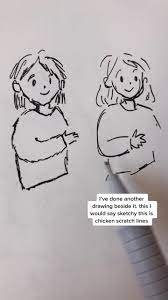
sketchy lines look more like the photo on the right and are used as a foundation to find the best overall line (which we'll talk about a little bit later) and are usually refined later. chicken scratch is more like the one on the left. there's a notable difference in line confidence (which comes with time and practice; you sadly can't really cheat that one), and a lot of the lines seem kind of "wobbly" or unsure. a lot of beginners do this because they feel unconfident in their skills and lines, and their brains naturally try to counter that with drawing more lines to cover it up. there's generally not a clear line of action, and it's made of a lot of small, disconnected lines instead of longer, more fluid ones.
3. finally, to practice these, you're obviously going to have to draw. try to draw things around you--a glass of water, an apple or banana--something simple that can be made of one or two shapes. this will help your eye-hand coordination, which will help your relationship with your pencil, which will help your line confidence. USE REFERENCES!!!!! THIS IS SO SO SO SO SO IMPORTANT, and people who say "you're not an artist if you use a reference" (let's be honest) probably are not good at drawing. yeah, maybe they can draw one thing really well, but they probably don't actually improve that much. now, there are ways to use a reference and ways NOT to use a reference. if you're just looking at your reference (be it an actual object, a photo off of pinterest, etc) and translating it onto the page without any aids like a lightboard or SketchWizard or tracing paper, this is super awesome and actually helps you improve the most. if you're tracing, you're not learning as much. this is generally okay if you're just trying to do a study of an artist's work, to make your lines look a certain way, or etc., that's generally alright if the artist has said you can use their work as references--but you should also credit them if you're tracing, especially if you're copying their character's design. otherwise you might get into some drama.
4. don't rush! drawing is a process, and nobody ever reaches their "peak potential" or anything like that; you're constantly improving, and even the "best" artists have room to grow. it's okay to be frustrated with how a piece turned out, but it's not okay aim that frustration or annoyance at yourself. give yourself grace!
5. and finally, be consistent. whether it's just 5 minutes a day or an hour, make sure you ARE being consistent. drawing for an hour one day a week is not the same as drawing for five minutes a day. i recommend something in between--i try to draw for about 20 minutes a day. sometimes i do more because i'm feeling really awesome, and sometimes i stop right at 20. it really depends on what works for you!
wow, this was a lot. probably not really what you were looking for, but if you have any specific questions, PLEASE feel free to ask! i can give some more examples, tips, or whatever! also, my favorite art youtuber is Sam Yang (SamDoesArts). he's mostly a digital artist, but a lot of his tips can be translated across into traditional art as well.
so... yeah do what you will with this probably unhelpful info dump


-
-
-
"Pic," Pic hums.
-
“That’s usually what Tal does…,” Pic trailed. He turned to the animals. “Can either of you go ask Tal where we get a key?”
-
“Ahh, ancient entity wanting a job,” Pic says, standing up. “As far as I’m aware, the clinic isn’t hiring right now…but still feel free to make yourself at home.” Pic kept his eyes trained on The Being. “I haven’t found d a service that I’ve had to pay for yet!”
-
Taking a walk while listening to The Arcadian Wild.
Today is a good day.
-
Pic listened to the conversation. “You’re not the strangest thing to wander these halls,” he hums. “Welcome to the Clinic,” hesitantly says.
-
Pic pressed in to finish the kiss, then observed the bird that had landed on his head. "Thankfully, we are the opposite," Pic hummed, face flush.
-
He kissed her back on the lips. I don't want this to end either Pic thought.
-
The song eventually came to an end, and Pic smiled at Aventine.
-
Pic listened to them, and guided the song in accordance witht he lyrics. A chord turned major for hope, a continuation of the minor key for pain. The song flipped back and forth, back and forth. Pic never wanted it to end.
-
Pic's smile grew every time the pattern repeated. She has the voice of an angel, he thought. They walk up to the love seat where two people were singing.
-
-
Pic smiled in contentment and shifted his song to support her melody. Once he figured out what she was singing, he reached out to the staff in front of her, and tapped it. Notes began to scroll into existence in front of her. If she sang, a dot appeared that showed where she was singing. Peace and exhaustion settled on Pic and Aventine. It had been a long day. There were many things left unsaid and unspoken, and even more that needed to be spoken. But for now, Pic was content to sit with his girlfriend and enjoy the moment.
-
Show other people and have them laugh instead! Wait those songs in gollums voice?
-
“I’m glad they told you,” he hummed. “I will never be sad that you are here, and will always be sad when you leave.”
-