



CrypticSpren
-
Posts
78 -
Joined
-
Last visited
Content Type
Profiles
News
Forums
Blogs
Gallery
Events
Posts posted by CrypticSpren
-
-
Been working on a mega doc for all things 9-point conic. It covers a number of things and I want to push this out to the wider Rithmatics community.
Sections 1.1-1.3: Making general information about 9-point conics accessible
9-point conics are central to Rithmatics, but it's pretty hard to find good documentation about them. I've literally only been able to find 4 sources yielding any information (besides the 17th shard) about 9-point conics. All of them... kind of suck
Spoiler- Wikipedia: no proof
- Wiki source 1, the original paper: page only has statement of existence, no proofs https://www.jstor.org/stable/1967142?seq=1
- Wiki source 2, a scan of a paper from 1912 that is physically difficult to read because it's not typeset https://babel.hathitrust.org/cgi/pt?id=uc1.b3808276&view=1up&seq=1
- A fine arts thinkpiece that is miserable to read http://mat.msgsu.edu.tr/~dpierce/Mathematics/Geometry/Thales/nine-point-conic-2017-07-25.pdf
- A "proof by computer" that handwaves all 9-point conics as affine transformations of the 9-point circle... which I do not think is true for hyperbolas https://www.researchgate.net/publication/233284234_The_nine-point_conic_A_rediscovery_and_proof_by_computerMost of the doc covers facts hardcore Rithmatic theorists already know from @KalynaAnne (namely what the 9-point conic is and the criterion for determining type of conic (circle, ellipse, or hyperbola) -- but actually has proofs for them.
I'm quite happy with how these turned out overall -- I haven't seen other sources do everything in terms of the centered conic matrix (they just use the raw conic formula), and I think using the matrix helps a lot in making things understandable.
I also have a section on what I'm calling the Conjugate Diameter Property, which I haven't seen anyone mention before. I think any aspiring Rithmatists will find the associated corollary (the Tangent-Direction Property) very useful for drawing defenses
Section 1.4-1.6: Classifications of sub-9 point configurations
Enumeration of the different n-point configurations and their properties, taken from the hardcore rithmatic theory thread. I also have what I think is a satisfying mathematical explanation that explains why the only valid 4-point and 2-point circles are the ones described in the book, despite being able to draw circles through any rectangle and in many ways through 2 points, that generalizes well to ellipses and hyperbolas.
Section 2: Inverse Algorithms
If I and the other suckers at the game thread ever get our act together and really create a game, we need to be able to take a collection of attachments to a Line of Warding and detect whether a corresponding quadrangle that admits the given conic exists. The algorithms here should cover all circle, ellipse, and hyperbola cases
Link to overleaf: https://www.overleaf.com/read/khgdzgrmnjzd#e3571f
If anybody is interested in contributing, please let me know.
- The whole thing is pretty wordy and can probably be trimmed down; it's pretty long
- I'm the only person who has looked at the math. Though I think it looks good, a check for readability and correctness is very welcome
- I got tired of writing and don't have much covering parabolic and degenerate conic configurations -- which probably should be covered, if believers in Line of Forbiddance (and, as @IlstrawberrySeed has suggested on our mostly-dead discord server, the Mark's Cross) as an instance of a segment of a degenerate conic are correct -- is totally lacking in both the classification and inverse algorithm sections of the doc
2 -
I was looking for the BYU Rithmatist game on the internet and can’t find it. I’m guessing it got taken down since it was deployed with Heroku which is no longer free?
Does anybody know how to get in contact with the creators to get access to it again?
0 -
On 6/7/2023 at 0:34 PM, IlstrawberrySeed said:
However, I've been working hard to avoid putting a hole - the sunlight spores melt the wax through a glass/rosite section, not by lighting a fuse.
I'm not using a fuse, just a touch hole. Regular black powder flintlock rifles do this too, and it's fine. When the trigger is pulled, flint is struck down onto metal above a flash pan, sending a spark down to ignite a powder in it. The hot gas from the resultant mini-explosion goes up a touch hole that lights the powder in the barrel. Since the touch hole is small this is OK.
I assumed your design would be very similar. I don't think going through a roseite or glass section would work very well. Heat transfer is not instantaneous, so it's already a slight stretch for enough heat to go from sunlight -> wax to consistently melt the cartridge with a touch hole, and improbable without one.
TLDR, I think we should drop being airtight as a goal entirely.
On 6/7/2023 at 0:34 PM, IlstrawberrySeed said:A dropper would work, and those shouldn't be too hard to get from worldhoppers, but hard to make in world.
Yeah, a pipette type of thing would be really nice here. Really, I think the key to getting a consistent amount of water is releasing it in a pressurized squirt instead of just letting gravity do the work so there's enough forces for surface tension and adhesion not to matter. I can't think of anything more simple than a dropper.
I guess a wet sponged that gets squeezed when the trigger is pulled could also technically work, but that seems really prone to generating misfires.
I will say, it might be worth digging into the book to see how the ignition mechanisms for Crow's gun and the ship cannons work. Brandon may have done some of the work here for us in this domain.
On 6/7/2023 at 0:34 PM, IlstrawberrySeed said:You could use midnight essence or a few breaths, but that is expensive or finiky.
Yeah. Midnight essence is expensive on the user to use, breaths are expensive to get. Not good options.
1 -
16 hours ago, alder24 said:
Not really. I'm using common sense, just like you, with basic science and some help from google. I'm in no way expert. If being good with guns qualifies someone for one, then I failed from the start as I've never held a gun in my life.
Well your insight has been pretty darn good for someone also going off of common sense
 . Nice find on the spore size.
8 hours ago, IlstrawberrySeed said:
. Nice find on the spore size.
8 hours ago, IlstrawberrySeed said:Suposed to be "akin," not "skin." I've used a black poweder rifle once or twice in my life- you have to pour the black poweder into the barrel, then stuff the bullet down with a rod. Similar to a canon, but smaller. Something similar (not rifeling though) should be possible with spore poweder and non-spherical bullets. Is that within their tech level though, or only slightly past it?
Tress's flare gun uses internal spores on a miss, this may drop some, but shouldn't trigger them.
The "trigger" is the targets blood, as the bullet breaks inside. There isn't ignition/isolation inside the bullet. In the casing? Yes, I can see that could be an issue - especially if using a cartridge style. But if we switch it to a Black Powder rifle style, then we use a water cartridge of wax, followed by some spores, and then the wadding & bullet, then it shouldn't be that bad.
Make a metal container, thin as possible; with holes. Coat it in wax; again thin as possible.
- Put water charge in barrel.
- Pour sporepowder (zepehr spores, possibly sunlight) in barrel
- Put wadding on barrel and insert bullet
- Ram rod it to the back of the barrel.
- Pour sunlight spores into over-barrel.
Pulling the trigger applies a drop of water to the sunlight spores.
Oh, this is cool. Definitely much less of a stretch than fancy cartridges! I will say, though I've fired black powder once before, someone else did the prep for me so I had to do some reading up on the mechanisms
 .
.
The one thing that I am worried about with this design is the water cartridge. Firstly, it seems like it would be easy to accidentally break the water charge when using the ram rod. Secondly, wax could gunk up the back of the gun after repeated usages.
The immediately obvious solution is, instead of having sunlight spores light a flame that travels down the touch hole and melts the wax, we just pour water directly down the touch hole.
However, I'm not sure how you'd get a good mechanism for getting a consistent amount of water down the touch hole. Because water is sticky. If the touch hole is small (which it must be, in order for the majority of the gas to expand down the barrel), capillary action is going to make how much a drop of water slides down it be unpredictable. And we actually do need a consistent amount - if there isn't enough water that goes in, the gun won't fire properly, but if there is too much water, then the gun won't be dry for the next shot and activate when spore powder is spilled down the barrel.
I still think that something along these lines is a better approach than a wax cartridge though. Let me know if y'all have any ideas.
Edit: I posted before I responded to everything, whoopsie.
On 6/5/2023 at 7:52 PM, Frustration said:I don't know about that Rosite spores would make imobilizing both of them much easier.
Hmm. I'd think you'd want Verdant spores for immobilization; Roseite is just going to push people. That's what Tress uses them for after all. I suppose after further consideration, other forms of immobilization (i.e. Awakening) are probably more expensive than spore guns. I'll give credit where credit is due: spore guns may have a small niche in the greater Cosmere as a means of immobilizing enemies with something cheaper than breaths.
Also, in reading up on different spore types, I found this WOB. So Zephyr must only have trace amounts of ozone, as it wouldn't be very safe to breath otherwise.
0 -
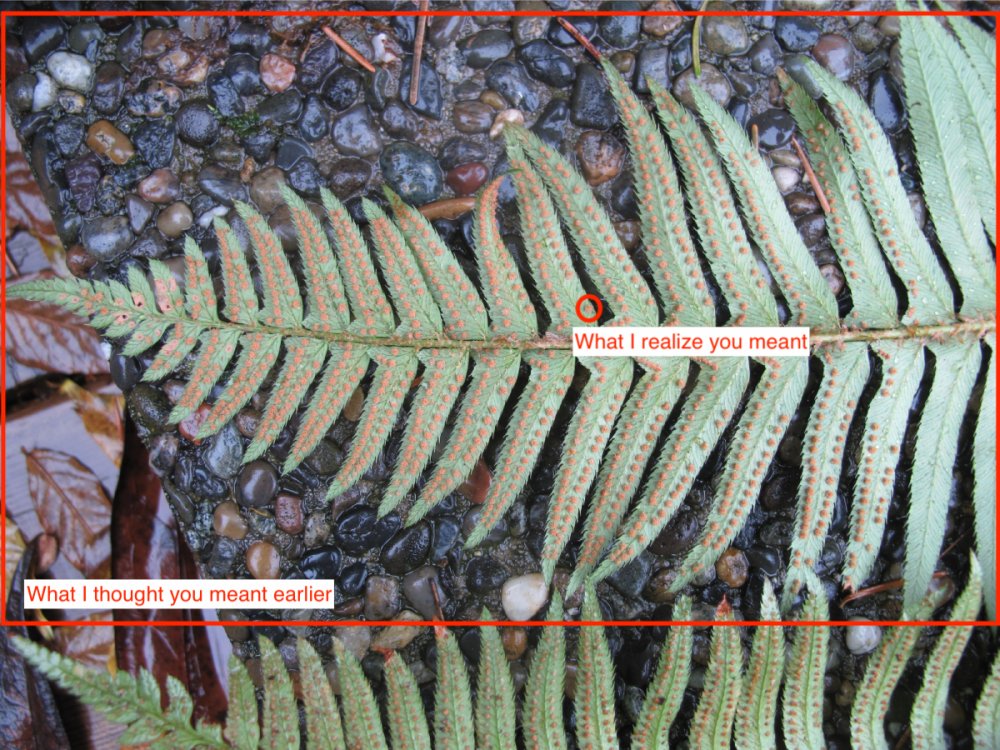
I'm agreement with everything from @alder24's comment. I think I misunderstood the sword fern comment (see picture attached; I'm quite illiterate).
6 hours ago, IlstrawberrySeed said:How big is too big for a slightly larger bullet?
I think two or three times the size is fine? Just a gut feeling.
6 hours ago, IlstrawberrySeed said:How big are aether spores compared to sword fern spores?
Probably much smaller than a sori of spores, likely larger than a single spore. Sand-speck size I would think. It's not really the "there are spores in this bullet" that doesn't work, and more so "there's layers of different metals in the back and trigger mechanism for those spores in this bullet" that makes the design too complicated.
I believe that early bullets are just cast metal; if that's the case then I'd imagine just dropping a couple of spores into the mold while making bullets wouldn't be very difficult. I wouldn't really recommend it though - most of the time, the spores wouldn't do anything since being encased in metal means they won't get wet on impact, and you also run the risk of the bullet blowing up inside your gun on ignition.
6 hours ago, IlstrawberrySeed said:Is a front loader skin to our black powder possible?
I have no idea what this means.
To be honest, I have high school/early undergraduate level physics/chem knowledge but that's about as far I go. I'm just confident enough to shoot down parts of your design that don't pass a common sense check.
My (former) roommate is the Mech E; I'm a computer science kid. I'm also really bad with guns. I'll miss a head-sized paper target at 25 yards with a .22 rifle more than half the time and I'm too weak to even be able to hold a shotgun correctly through a full box of shells. @alder24 seems to have a better handle on things.
Edit:
I realized that I never commented on the use of aluminum on my previous post. The claim:
On 5/30/2023 at 11:07 AM, IlstrawberrySeed said:Bleeding around is different that AOE. Bleeding makes it slightly less effective than line of sight, but still better than no aluminum.
I'm not entirely convinced of this. I haven't worked much with superconductors and stuff that bends fields generally, but I get the impression that oftentimes the behaviors of things that start and end far from the thing that bends the field tends not to be affected very much by the bent field. So putting a layer of aluminum in the design may add complexity to and decrease the durability of gun for no or very little effect. I'd have to look more into the physics to give a definite answer though.
0 -
Oh boy, it's been a while since I checked on 17th Shard... that being said, here's my thoughts overall.
General Comments:
Generally, it looks like y'all (@IlstrawberrySeed and @alder24) are asking for the spore gun to do completely different things. @alder24 is looking for what I think the original topic was about: a spore gun that serves the purpose of a gun for personal use. Something akin to a handgun. Maybe something along the lines of a rifle or shotgun.
Meanwhile, it looks like @IlstrawberrySeed is designing something way bigger:
On 5/30/2023 at 11:07 AM, IlstrawberrySeed said:Also, have you ever seen the bottom of a sword fern? That's how large I was invisioning. Definitly too large for smaller sized modern bullets.
I don't really know about military tech terminology, but I think when people talk about what you're discussing people usually say something along the lines of "anti-personnel heavy artillery rounds" as opposed to "bullets"
.
As a general principle, all of @alder24 's assumptions critiques seem to have been spot on under the assumption that you are making a gun that you can actually hold. But some are non-issues for heavy artillery, and none of @IlstrawberrySeed's replies have addressed that.
Or maybe I just totally misunderstood @IlstrawberrySeed. In that case, let me know.
Specific comments:
Confusion: I still don't understand the ignition mechanism. What's up with the wax? How does pulling the trigger actually make the water in the cartridge trigger the spore powder?
Issue:
On 5/30/2023 at 11:07 AM, IlstrawberrySeed said:Metal cartridges are hard to make. Have you read anything from the Grisha-verse? Manipulating rosite should allow for similar drops in tech level as fabriacators; (though not as widespread;) the hardest part of cartridges is getting them into the right shape and connect to the bullet properly (I assume). Rosite fixes those.
I don't think roseite spores are analogous to metals for fabrikators. Roseite spores can only have their general direction of growth controlled with metals. And it makes crystals, not smooth surfaces. Furthermore, once the roseite is grown, it's kind of locked in place and can't be further machined. You'd need a person who has bonded the actual roseite aether to be like a fabrikator. The appeal of roseite is that you can quickly make hard, durable crystal in roughly the shape you want, as opposed to being able to get really precise shapes. I still think that standard metal bullets are probably the way to go.
Final thoughts -- on the philosophy of spore guns:
I think that we should generally think about one of the things that makes spore guns appealing before making suggestions: they are simple and cheap to use on Lumar. Spores are found in entire oceans and can keep if you just hold some as dry powder in a bucket. Ammunition, even for advanced artillery like cannons, doesn't require a factory. It can be created on a boat with some simple tools, spores, and a small silver spike.
Outside of Lumar, spores are expensive to get. So if you're in a position where you're fighting Allomancers and Radiants (i.e. probably in a more important part of the Cosmere), it probably isn't worth getting a spore gun, much less an Aluminum-loaded one. And if you have breaths, standard awakening techniques are probably your best form of combat.
Even within Lumar, if you need to precision machine cartridges to be able to use your gun, you've lost a little bit of what makes a spore gun cool and special.
2 -
11 hours ago, alder24 said:
A steel handle is below the barrel and its fore vector would be pointing mostly upwards, providing little force in the direction of the muzzle. And what is above the Aether in the barrel? A hole for ignition where a force from a steel handle is pointing towards. It can help but that is where most of the force would be poining.
Yeah. For some reason I thought the spore guns are tube-shaped instead of gun shaped, but now looking back at the text there is nothing to support that at all.
12 hours ago, alder24 said:Iron bullet with steel tip? Hollow? That would provide very little penetration. A simple piece of armor would stop it. Especially a tip made out of aluminum (there is steel and aluminum tip? How many tips does this bullet have?)
I was confused by that too
.
12 hours ago, alder24 said:which is 4x less dense than a steel, from which armor would be made
I think Mistborn Era 2 actually addresses this - aluminum bullets are good for anti-investiture purposes but are considerably worse overall. Don't quote me on that though.
12 hours ago, alder24 said:Crimson would likely shatter on impact with that speed, or maybe even during ignition.
What do we actually know about crimson? What suggests that it will shatter on impact?
0 -
9 hours ago, alder24 said:
Decomposition of ozone into O2 can be explosive on its own
Eh, I guess that means that there are only trace amounts of ozone in Zephyr gas, as otherwise people would know about how volatile it is. Thanks for the Wiki check!
1 hour ago, IlstrawberrySeed said:I meant the initial velocity of the gas isn't 0 because of the iron in the bullet.
Hmm, I was assuming the model that the initial velocity of the gas is 0 no matter what the surroundings are, and that iron/steel applies a force on the gas. But seeing that iron and steel seem to affect the direction that rosite grows without affecting rosite that's been sitting around for a while, it might be the case that there is a very small time interval after being wet for which the zephyr spores become investure, which is affected by iron/steel, which promptly turns into gas that maintains the velocity of that investirue (ozone + other stuff), which is not affected by iron and steel.
If that is the case, then yes the initial velocity of the gas would not be 0 because of the iron in the bullet. But also, because the time frame which the zephyr is in investiture form is near instantaneous (which we know because the air blast seems to happen as soon as the spore is wet), that means that iron and steel have very little effect at all.
1 hour ago, IlstrawberrySeed said:You want a steel handle. More steel behind the initial position than after it.
Probably. Never have done any calcs with gases that aren't exerting equal pressure in all directions, so I have no idea whether the improvements from this would be significant or not.
1 hour ago, IlstrawberrySeed said:For the most part, but during the first segment the bullet cannot be pulled back but the gas is pulled forward.
I can't figure out what you mean by this. Do you mean that the normal force from the cartridge will cancel out with the backwards force from the pull of the gas on the bullet? I don't think this will help in any significant capacity, as the gas already starts immediately behind the bullet. I assume that the gas is always evenly distributed across the area of the barrel behind the bullet in my model anyway so it wouldn't even factor into the calculations I would do
.
1 hour ago, IlstrawberrySeed said:The Iron has effects on the bullet beyond speed.
Like what? As an aside: in case it wasn't clear: @Frustration's argument for a iron bullet is flawed, as stated by @alder24 in his response about Newton's 3rd Law.
1 hour ago, IlstrawberrySeed said:Also, I'm pretty sure the steel overrided the iron completely despite being only slightly in front of the shield, so directional pieces should be possible without aluminum.
Honestly I kind of brushed over your design last time with a "very cool" because I had to go to sleep, but now that I have some time to take a decent look I've realized that I have no idea what is going on. This is all very hard to understand without an actual schematic. What do you mean by override? What is this shield? What are directional pieces?
2 hours ago, IlstrawberrySeed said:Steel gun with Iron at the end of the barrel and aluminum & steel coating on the front, using front loaded bullets with rosite cartridges with pewter and zink being the base the rosite grows on and the "SprePoweder" sits on.
I get that you want iron in front for the same reason that you want steel in the back, but I can't figure out the rest of the gun design.
- Why aluminum and steel coating in front? I don't see why you'd want to safeguard against silver, and as far as we know, that is all aluminum does with regards to spores. Also, wouldn't steel in front cancel out the effects of iron in front?
- Why pewter and zinc? We do not know how they interact with the spores AFAIK.
- What is "SprePoweder"?
2 hours ago, IlstrawberrySeed said:The bullet is iron with steel tip and nail shaped, with the body made of rosite and crimson spines. The front is hollow tipped, preferably aluminum or hollowed out crimson. In the space between the back of the bottom of the hollow and the steel, put crimson and sunlight spores. When the bullet splits, the spores will be released into the targets body.
This kind of makes sense, but honestly is a bit confusing. A drawing for clarity would be much appreciated.
1 -
14 hours ago, alder24 said:
If there is a 30 cm long barrel, a few millimeters thick, that's a lot of steel, more than Tress used when patching a hole. Just a few spores might not create sufficient force during ignition to escape that force of steel barrel pushing Aethers into the back of the barrel. And there is a little hole in the back of the barrel for the ignition mechanism, a hole through which all that air would want to escape. And that might explode your gun.
Oh, I did not read your earlier post carefully enough earlier. Yeah, this is definitely a big problem. No steel barrel.
8 hours ago, Duxredux said:As for Zephyr and Sunlight used in the propellant, I suspect that Zephyr specifically creates oxygen atoms in both O2 and ozone. Ann comments on the smell of lightning when there's a puff of Zephyr, which sounds like ozone to me. I haven't run into a class that gives me the formulae for figuring out optimal ballistic performance so someone else would have to tell me if that would change the propellant side, but with instant ignition and a potent oxidizer, that sounds like a dangerous impact charge.
Totally forgot about the lightning smell; that is a very cool observation. I have to wonder - would mixing zephyr spores with traditional hydrocarbon-based gunpowder be any good? That is, since the ozone provides oxygen to combust normal gunpowder.
0 -
Ok, my gut tells me that I have a feeling that if a bullet is traveling sufficiently fast to be a good bullet, the barrel material isn't gonna matter that much if it isn't silver. But micro-optimizations are fun, so I'm gonna put out my opinions here.
14 hours ago, alder24 said:... Even a steel backplate would add something, but not as much to overcome the force of the whole steel barrel pushing it back, you would need a very big backplate to counteract that.
I could be missing something obvious, but shouldn't the overall steelpush effect being outwards once the bullet is halfway through the barrel make this a non-issue? By symmetry, the "allomantic potential" (that is, integral of the steelpush vector field over arbitrary path from the bullet origin) should be zero. Of course, if the expanding gas is too weak to push the bullet halfway through the barrel then the gun isn't going to work at all, but assuming that it does I think the gun should work fine.
14 hours ago, alder24 said:That's a messy explanation, I can't word it in a better way.
Nah what you said totally makes sense. I just hope that what I say also makes sense
14 hours ago, alder24 said:What I mean is the force of an iron bullet being pulled towards expanding gas will negate the additional force of expanding gas being pulled towards the iron bullet. Just imagine 2 magnets stuck together at opposite poles, by pushing the one magnet you push also the other magnet with the same force - that push is the pressure of expanding gas, but the magnets don't gain any more speed due to them being attracted to each other. Basically you gain nothing from it, an iron bullet will behave just like a lead bullet in this configuration. The force of aether gas pulled towards an iron bullet is nullified by the force of iron bullet being pulled back towards aether gas.
Physics I logic makes me think that the iron bullet actually should be a little bit worse. Assuming that your logic regarding the extra forces cancelling out (which I'm inclined to believe is correct) the total amount of energy that the bullet has exiting the barrel should be the same. However, an iron bullet will also pull zephyr gas along with it, effectively giving it more inertia than a lead bullet of the same mass without the potential to do more damage. Some of the iron bullet's energy will go into propelling this gas instead of speed, so it will overall be slower and deal less damage.
That being said, this effect is likely insignificant since air is light. I would guess that turbulence effects more relevant. However, I can't speak to what those would be since I know literally nothing about fluid mechanics; there's a reason why I've been assuming IDEAL GAS LAW GO BRRRR in all my posts thus far.
0 -
1 hour ago, IlstrawberrySeed said:
I highly doubt that zepher spores simply convert their mass, I expect it to be more like Allomancy.
Totally agreed. Really, in order to do any real calculations, we need a "zephyr constant" for mols of gas created per spore. We just thought that 1 kg/m^3 so the "zephyr mass -> air mass" yields that wetting a zephyr spore creates a localized zone of about 1000 times the density of the air around it, which seems more or less right - enough pressure to be dangerous if it gets into your eyes and to launch something, but not blow everything up.
1 hour ago, IlstrawberrySeed said:Also, considering that the air is already pushing in the right direction, I don't know that an increase in temperature would really help, as your less worried about the pressure as the initial movement.
Not sure what you mean by "the air is already pushing in the right direction". I think it's a reasonable assumption that, without the influence of Intent, gas from converted zephyr spores is stationary at the time of creation, as there isn't anything special about any arbitrary direction.
Just to make sure we're on the same page: the way that actual guns work is that pressurized gas is created (via combustion of gunpowder), which pushes a bullet out the barrel. The instantaneous force on the bullet is the gas pressure (that is, difference between pressure of the hot air in the back of the barrel and atmospheric pressure, at the front of the barrel) times the cross-sectional surface area of the barrel. The amount of energy that the bullet has at the time of leaving the gun - which is presumably the value we want to maximize - is that force integrated over the length of the barrel.
As far as I can tell, spore guns work the same way, only the pressurized gas is created via zephyr gas instead of gunpowder combustion.
I know we don't specifically want to maximize pressure (at time of spore activation), as you need to consider how the pressure changes over the length of the barrel. However, assuming that the chamber and barrel dimensions are roughly the same order of magnitude, the volume of the expanding gas that pushes the bullet should only change within that order of magnitude while all other values in the ideal gas law remain constant, so the pressure should only change within that (small-ish) order of magnitude. So maximizing pressure serves as a good heuristic.
2 hours ago, IlstrawberrySeed said:The metals aren't to be consumed though (other than the iron).
You take a steel tube with steel backplate. The cartridge has zink, pewter, and steel (and possibly bendalloy, durilium, necrosil, or shardmetal/shardalloy) on the bakplate with the rest being rosite. The bullet is an iron nail-ish shape with shaped rosite on the front, (with a possible aluminum coating or spore fillings) with the very tip being a crimson spike (if not coated in aluminum). Rosite is slightly translucent, so you could actually go the rout of evaporated water condesnsing to fire rather than injecting the water by breaking rosite with valuable silver, but that has the potential to go off early.
I assume a water molecule is smaller than spores. If so, then water could come through the micro-perforated backplate of the cartrage, allowing you to use a rosite wall on the back of the container.
Right, only silver actually gets consumed; I am a certified buffoon. This design concept is very cool and I hope if we ever see Tress's world again we'll get stuff like this. I love it.
0 -
Doesn't the baton pass ban set a precedent for the shed tail ban? "Move that gets a sweeper on the board pre-stacked" has been deemed OP already.
I don't really play singles though so not sure if that's how stuff works.
0 -
I don't think duralumin and bendalloy will actually make a difference, since spores react basically instantaneously. Furthermore, a big appeal of spore guns is that they're extremely cheap (using resources for which one finds entire oceans) so it's kind of against the spirit of the thing to consume metals in spore gunpowder.
As for adding sunlight spores, some math is required. However, I asked my roommate (mechanical engineer) to do some calculations and the answer is ... maybe.
If y'all feel inclined to do some calcs yourself we used the following model.
- Spores are about the density of sand
- Sunlight spores release the same heat as gasoline per mass
- Zephyr spore mass converts directly into air at room temperature of the same mass
Using ideal gas law and assuming a gun/cannon of reasonable dimensions (1 meter barrel 1 kg fuel I think??) it's about half and half, but if dimensions change slightly and/or air is actually treated adiabaticaly instead of an ideal gas we can also get 100% zephyr as optimal.
We could definitely get more precise. Zephyr spore mass -> air mass is probably actually calculable if we can find some good estimates for some of the measures in the book, but I have no idea how we can get a good estimate for enthalpy of the sunlight spore reaction.
However, I think the general conclusion is that sunlight spores could be useful for spore guns; at the very least if you're trying to stretch your zephyr while sailing the sunlight seas it won't crap out your spore gunpowder. But it's quite unclear as to whether or not it's optimal.
5 -
I had a friend who would play a terribly imbalanced variation that she made and dubbed "Setters of Katana", in which the robber had a katana and would kill settlements. So I say kuh·taan
0 -
Alright, nobody seems to be using the server but I'm posting a link to join it here for anyone who wants to dev
0 -
You're listed as not accepting Friend Requests so you'll have to send one to me
0 -
Ok, I set up a discord server. I'll add @IlstrawberrySeed once he/she sends a friend request too.
Anyhow, what Godot version are we using? I know there's some cross compatibility problems across Godot 3 and Godot 4 so let's make sure we're on the same page.
0 -
The main reason I fear GDScript is the dynamic typing. I just feel like it takes unnecessary extra cognitive load to keep track of types when you can just let the compiler handle it in a statically typed language. Plus, when your IDE knows types autocomplete is a lot more powerful (ReSharper is really good). Very much a personal preference.
Also, doing linear algebra beyond the in-built geometric transformation methods was a hassle. I really don’t want to calc splines perform regression without proper matrix support.
But the last time I took a serious look at it was 2 years ago so I’m also biased.
It’s pretty easy to access C# classes that extend Godot nodes from GDScript, so something that we can (and probably should) do is use a mix. For example, we could use GDScript for small scripts and UI, but handle crunchier things like line detection and bind point calcs in C#.
Anyhow, C# is basically just Java with some extra nice features sprinkled on top, so if you know the latter you’ll be fine (properties, yield syntax, ND-arrays, and LINQ in particular are big upgrades from Java). I don’t have much experience with C# either but just from programming in Java I feel like I can wield C# somewhat proficiently.
Also even if people don’t get the Principia Rithmatica reference I still think it sounds pretty cool.
0 -
Ok cool let’s use Godot
. I don't remember how Godot works that well but I'm sure it can't be that hard (let's use Mono though because GDScript drives me insane). Glad to hear that you have experience - it's easy to make architecture that completely falls apart when nobody totally knows what they're doing.
I have a bunch of boilerplate classes for making OpenGL stuff lying around but I still agree that OpenGL is pain.
I will say that it's not the math and graphics that scares me for Godot: we can just convert stuff into Math.NET Numerics whenever we need to do real math, and the SurfaceTool/Mesh classes are pretty robust.
It's more the physics. Lines of Warding and Lines of Forbiddance are approximately circles and lines, but not quite. Thus, might be optimal to do preliminary checks for collisions with the simple geometry (circle for Warding, bounding box for Forbiddance) before checking collisions with the actual true geometry. Without access to Box2D directly, a Line of Warding's geometry might have to be a many-faced convex polygon or line segment collection and the engine might end up doing dozens of checks for a line of vigor that doesn't even get close to impact.
On a screen with tons of Rithmatic lines this could cause significant lag.
To be fair, this problem wouldn't be worth addressing until we're way down the line and maybe there is an intelligent way to get such behavior from Godot. There's a very high chance I'm worrying about nothing.
As for a name: how do you feel about Principia Rithmatica?
Finally, how do we feel about a Discord server? 17th shard is really annoying for back and forth communication and I think it would be nice for there to be a bunch of channels just for us devs to discuss.
Anyhow, I'm traveling back to school today so there's a good chance I'll disappear until tomorrow. Adios until then.
0 -
Somehow didn't find this thread 'til now. I think y'all would appreciate this one
1 -
I have a personal theory on how the three main Rithmatic lines (Warding, Forbiddance, and Vigor) work, based on electromagnetism. My physics knowledge is pretty elementary so please let me know if this makes any sense.
I believe we can characterize our 3 OG Rithmatic lines by what they do in terms of E&M analogues.
- Lines of Vigor, as we have heard over and over again, are the equivalent of waves. They carry energy along the line that they travel, and the chalk is just a visualization of the magnitude of the electric field at a given point in a transverse plane wave.
- Lines of Forbiddance are just conductors. A flat sheet of conductor is able to reflect an electromagnetic wave, just as a line of Forbiddance reflects a line of vigor. It is, however, not a superconductor, and therefore some energy is lost when a line of vigor bounces, which goes into breaking the line of Forbiddance
- A line of Warding, at the moment of drawing, is a conductor in which free-flowing charged particles are dumped in. The charged particles distributes across the conductor, which then "cools down" and becomes insulating, locking the charge in place. The charged particles are what actually give the Line of Warding strength, which is why the Line of Warding is stronger along curved areas.
I think that seeing as Rithmatics functions in 2 dimensions, the laws that Rithmatic charge would follow would also be in 2 dimensions. From a quick Google there seems to be a mathematical analogue for electrodynamics in 2 dimensions: https://www.reed.edu/physics/faculty/wheeler/documents/Electrodynamics/Miscellaneous Essays/E&M in 2 Dimensions.pdf. My E&M/calc skills are too scrubby for me to understand basically anything of what's going on here, but I hopefully the theory doesn't break down.
0 -
All good; I also screwed up my computer and just got it maintenanced
I’m Cryptic#9849 on discord
0 -
I don't remember exactly where I began to have suspicions, but I wasn't completely convinced until chapter 14:
Quote“I met a deaf human once,” Huck said. “She was a dancer, and one of the best under the moons—best I’d seen, anyway. I was enjoying the time with her, but it ended up getting interrupted in a rather abrupt way. Which is a shame, but things happen. I also couldn’t afford to talk to her, since—you know, things relating to who and what I am. Didn’t want to reveal myself.”
Remember in Chapter 5, Flik tells Tress
QuoteI thought they had ’im at the fifth kingdom, as that princess was deaf, but the young master went and threw up on her at dinner.”
So the deaf human dancer was the princess, the abrupt interruption was Charlie vomiting on her, and the "things relating to who and what I am" was the fact that Charlie was fighting for Tress.
5 -
All good @IlstrawberrySeed! I'm also not that experienced; all the projects I've worked on so far have had a lot of scaffolding so the level of self-direction this project will have is definitely new for me too.
One thing I really haven't been able to figure out is how to determine the strength of bind points of a drawn 9-point circle, and you seem to hint that you have some ideas there.
I am aware of the simpler construction for the 9 points than using the triangle properties (pick 3 points to become the triangle midpoints, then bisect each possible arc across 2 of those points) but I'm still not sure how to check how well a particular set of 9 points fits that construction intelligently.
Math ideas for the detection of various Rithmatic lines would also be appreciated. There are implementations, but they're all questionable.
They calculate using a set of points as the representation of a drawn curve, under the (possibly incorrect) assumption that the points are evenly distributed and without any regard to the order of points. And the detection of lines of vigor is really finicky and bad, being based on a peak and trough detection strategy that totally fails if there's any jitter in the drawn line.
The code for all curve fitting is all here if you want to take a look, but feel free to pitch suggestions without looking at it or to ask for a text explanation if you're confused (justifiably considering that my code here is kinda bad).
Apologies for the long ramble. Anyhow, your help would be much appreciated.
0
 . Nice find on the spore size.
 .
.

The Ultimate 9-point conic document
in The Rithmatist
Posted · Edited by CrypticSpren
Rewrite to be relevant to current document status
Originally, unaware of the recent rule changes to the site, I had used a lot of AI assistance in generating the document.
Now I have completely rewritten it, without AI usage!
In terms of differences from the old document
Improvements
- Fixed arithmetic error in proof of 9-point conic
- Clean up of conjugate-diameter property symbol manipulation parts
- Complete overhaul of admissibility proof for 4-point conic (the previous one was handwavy at some parts and unnecessarily convoluted in others)
Dropped Portions
- Proof of "9-point conic is a circle if and only if one of the quadrangle points is at the orthocenter of the triangle)". I feel like I've seen a purely geometric proof that is satisfying for this out there somewhere. If I can't find it though I will add this section back.
- Handing of input error from algorithms section. I worry they may have obstructed clarity initially. For the most part readers can figure out the sensible thing to do by just replacing every instance of "A = B" with "A - B < epsilon" throughout the algorithms. The only notable difference besides this is that doing so flag some diagonals as midpoints incorrectly if someone draws a 9-pointer that is very close to a degenerate configuration -- but the best way to handle such cases is probably worth discussing in playtesting.
- Proofs of soundness from algorithms section. Hopefully it should be obvious without spelling it out explicitly
- Diagrams for all 9-point configurations. Tikz is pretty onerous to use and I just don't want to go through the hassle of writing scripts to generate it. Hopefully @KalynaAnne's tumblr posts and @Carbonationspren's wonderful Desmos graph should let you all figure out what the configurations look like yourself easily enough. If any readers care enough for better visualizations though, I'm not opposed to making some Desmos graphs or manim plots myself.