



Channelknight Fadran
-
Posts
21457 -
Joined
-
Last visited
-
Days Won
95






.thumb.png.cb7a70d87f63173188cda1ec6cb69ef0.png)
Channelknight Fadran's Achievements
8.7k
Reputation
Single Status Update
See all updates by Channelknight Fadran
-
Some problems:
- We don't know what shape the universe is
- We don't know the one-way speed of light
- Time is only symmetrical if you don't have a lot of stuff
Some ramifications of those problems:
- We don't know if our universe is symmetrical
- Light could be faster in one direction than another direction
- Time travel could be possible but not really?
SpoilerI'm going to take you down a flipped-up acid trip of geometry and topology like nothing you've ever experienced. This stuff gets wild and makes absolutely no sense despite the fact that it's all completely logical in every conceivable fashion.
It all started way back when Pythagoras invented the triangle. He was looking at lines and such a bunch I guess, and eventually decided what it means to be parallel and what it means to be not parallel. A parallel line will never intersect another parallel line, and any two lines that are not parallel will inevitably intersect at some point or another.
Now this was so simple and so arbitrary that literally every mathematician for centuries to come did everything they could to disprove it for... some reason. None of them could ever get anywhere because they kept inventing new rules for geometry that basically just rephrased exactly what Pythagoras had already decided.
Now before I get into the weird stuff, allow me to jump forwards a bit on our chronology and explain to you the basics of time travel as a little starter trivia. There was this guy called Ole Roemer who calculated the speed of light using some crazy eclipse shenaniganery, and then another fella you might've heard of called Albert Einstein.
By this time people had already pretty much figured out that light was the fastest possible thing in the universe. As a form of pure energy (zero mass) it could always and would always travel at the cosmological speed limit, being ~300,000,000 meters per second. Anything with any amount of mass could approach this limit but never quite reach it (such as lil' protons and neutrons in the Large Hadron Collider, which can go higher than 99.99999% the speed of light).
Einstein had won a Nobel Prize for his work on the photoelectric effect (quantum mechanics, standing waves, emission spectra... that's all an SU for another day), but because he was a scientist he decided to start thinking about other things. Apparently he was real into this whole "cosmological speed limit" thing, and eventually settled on the difference between gravity and acceleration.
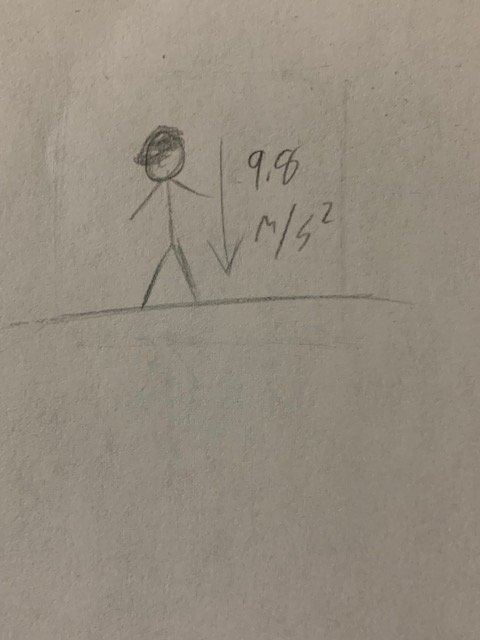
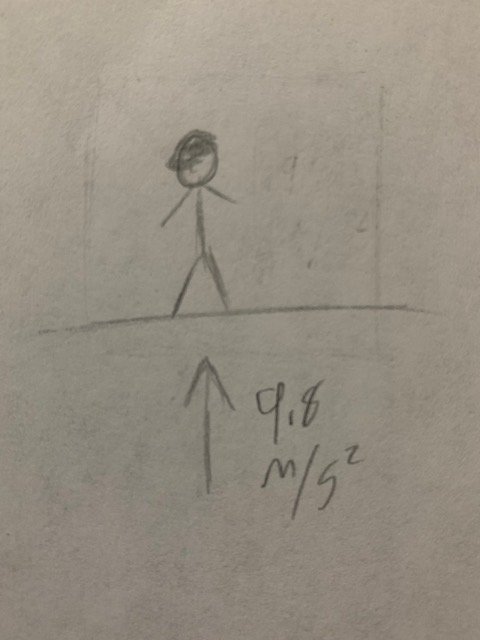
Here we have a couple little Fadrans (Fadrinos, if you will) standing in an isolated area. The first one is under the influence of gravity, which pulls downwards at a rate of 9.8 m/s^2. He feels a constant force because he isn't moving at all, and doesn't accelerate because he's on the floor. You might recognize this sensation: it's called Existing On Earth.
The second Fadrino, however, is being accelerated upwards at 9.8 m/s^2. His little spaceship is in a frictionless, gravityless vacuum - so the acceleration is the only force he experiences. If his spaceship had constant momentum (say, just 9.8 m/s instead 9.8 m/s^2), then eventually he would come to equal speed with the platform and start floating - however, because it's accelerating, it constantly "catches up" to his "getting used to" the speed... meaning that he feels the exact same constant force as Fadrino 1 does on Earth, meaning that it is impossible to differentiate between gravity and acceleration.
So Einstein was thinking about this and realized some funky things.
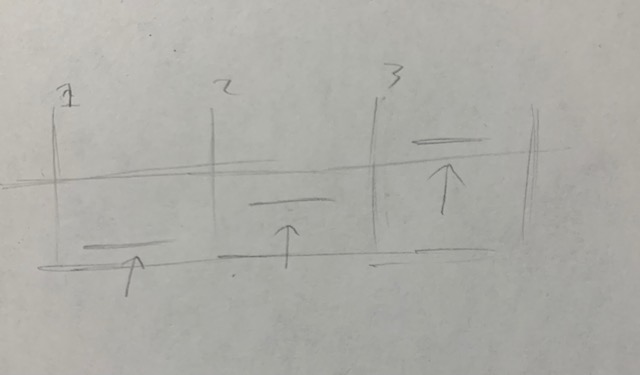
That middle line (pretend it's straight plz my hands are bad) is a beam of light, and the platform is acceleration upwards. Throughout the platform's movement the light's path remains stable, but the platform observes it at different heights based on where it is.
.jpg.49da35b46b9f2cd3db60460647ebe379.jpg)
This means that to Fadrino 2, light appears to curve downwards over time as he accelerates upwards. And what's more, because Acceleration and Gravity are now effectively indistinguishable...
.thumb.jpg.46c521622e0e8d16af36cc7791d85228.jpg)
Fadrino 1 will experience the same thing.
A bunch of scientists decided to team up and figure this out. To first prove that this bending of light in gravity was true, they pointed a bunch of telescopes at the sun and waited for an eclipse: lo and behold, the stars were in the wrong spots. Einstein subsequently became world-famous, which is funny because this wasn't even the thing that won him a Nobel Prize.
Light, of course, always follows a straight line. There's no way to actually bend it. This meant that gravity wasn't a force: gravity was the bending of space. The light was bending to our point of view, because to its point of view the path it's following is still perfectly straight. It's still a straight line, but to us it appears to be bent out of shape.
This began to baffle people, as you might expect, so smart folks like Carl Sagan decided to stop thinking about this kind of thing in three dimensions and downgraded to just two.
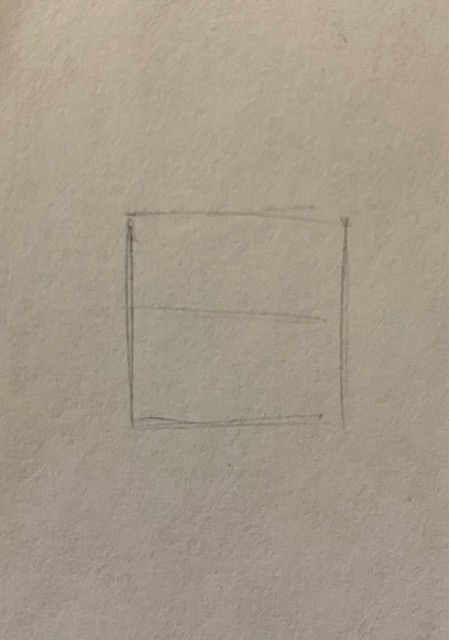
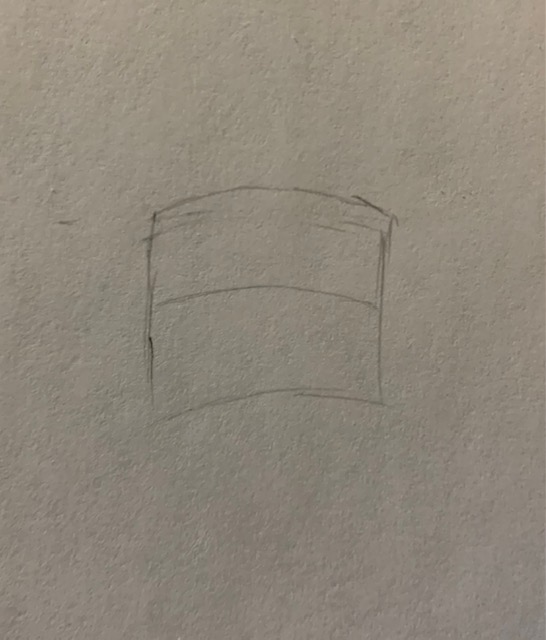
Imagine the line in the middle of both these "squares" is a beam of light. To the light, both of these "squares" are just that - perfect squares. But obviously one is very square-like and the other... isn't. Right?
WRONG.
With the regular square, the light is moving straight along with its edges. The square is straight, and therefore so is the path of light.
With the bendy square, the light is moving in a curve along with the curve of its edges. To the light it is still moving in a straight line, and therefore to the light the square still appears... well, square.
Now you might be thinking "Fadran, you absolute buffoon. Couldn't the light just move in a straight line and cut across anyways? You pixie-coated swine. You swivel-headed pasnip."
The problem is that I had to draw both those guys on a flat piece of paper instead of modeling them in a 3D space. Imagine both those squares are completely flat surfaces - 100% two-dimensional. In a 3D space, the first would take up the X and Y axis, but none of the Z; but the second would take up room in the Z-axis, because it's curved up and down.
I hope this makes sense. Honestly, there's so much stuff that I still have to explain... I'm just going to move on. If you got stuck here then you probably aren't ready for the rest of this stuff.
So hop on back to Pythagoras and his triangles. What you must understand is that all his geometry rules were written given a regular, Euclidean space: that is, where flat things are flat and curvy things are curved. Our universe as we experience it is Euclidean. That's an important word to remember, so I recommend you jot it down on the inside of your eyelid or someplace else you won't forget it.
But then there was this guy who was doing the rounds of trying to disprove Pythagoras' dumb axiom, and decided that instead of finding a different route to the same conclusion he would fabricate a different conclusion and figure out what kind of rules he'd need in order for that conclusion to work.
Bolyai was his name, and weird ideas was his game. He theorized an axiom where a specified point (x) isn't on a specified line (r) - in Euclidean geometry, only one line can exist through x that doesn't eventually intersect r, that being a parallel line. But Bolyai started with assuming some sort of magical anti-geometry where multiple lines of different angles could intersect x without intersecting r.
What was weird was that all his maths worked out just fine here... but he couldn't draw it. He couldn't even really visualize it that well.
But we can nowadays because this hypothetical plane is PRINGLE-SHAPED
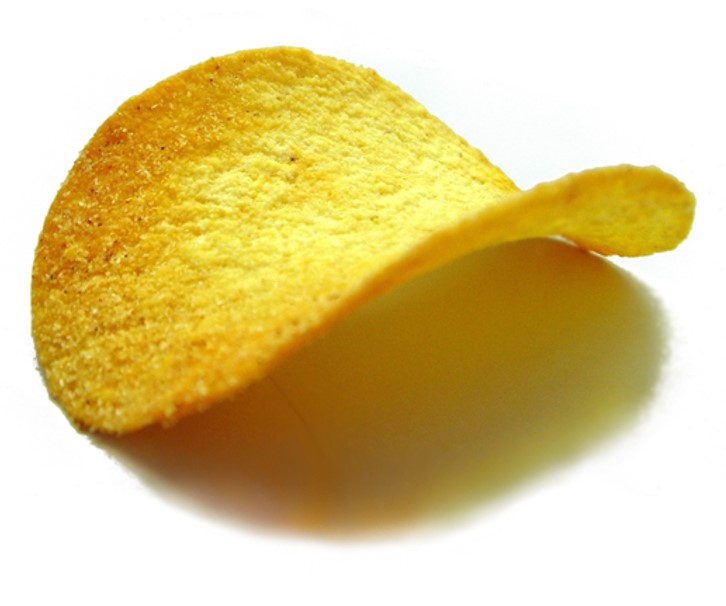
Why is this the case? Because there's negative curvature on the inside of this puppy. If you made a flat surface with the properties of a pringle, then the shortest distance between two points would actually be a curve.
This type of geometry is now known as Hyperbolic, which is another word that you should get imprinted on the inside of your other eyelid for safekeeping. Now of course this type of geometry makes no sense to any of us foolish Euclidean beanbags, but we can still appreciate some of the whacky hijinks that happen inside of a Hyperbolic space, such as...
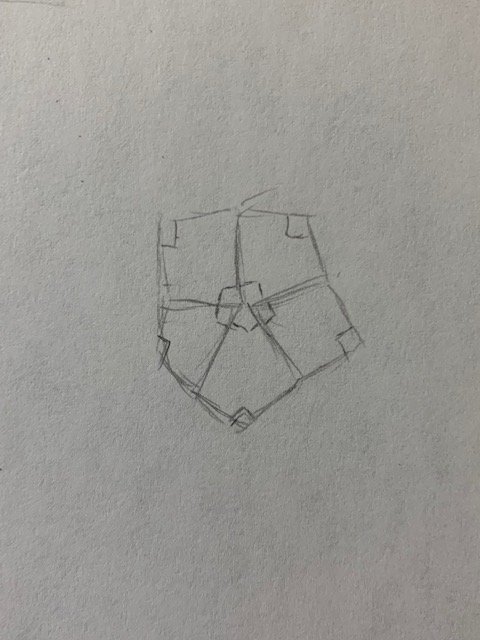
Squares! Obviously these guys are drawn on paper, but imagine them being set on a plane with negative curvature (that is, a Hyperbolic or Pringular plane). What's whacky is that each of these "squares" still have four right angles (360 degrees), but five of them intersect at a single point instead of four, making an absolutely horrendous fractal shape that we can kinda sorta "imagine" to look like this:

That is a flat surface you're looking at, but in order to image it in our regular Hyperbolic world he have to make it all bendy and curvy. If we instead lived in a Hyperbolic world this kind of thing would look perfectly normal to us, and by walking around on a Euclidean plane we'd get vertigo and have to sit down after a few minutes.
Now you might be thinking - hey Fadran, if this is a plane that's flat with negative curvature, then couldn't there be a sort of... opposite Hyperbolic plane? With positive curvature?
And you'd be... CORRECT. For once.
It's called Spherical geometry. Luckily that word is much easier to remember because you're all out of eyelids, and basically it follows a flat plane that exists with the properties of a sphere. Y'know... kind of like how we observe our own planet.
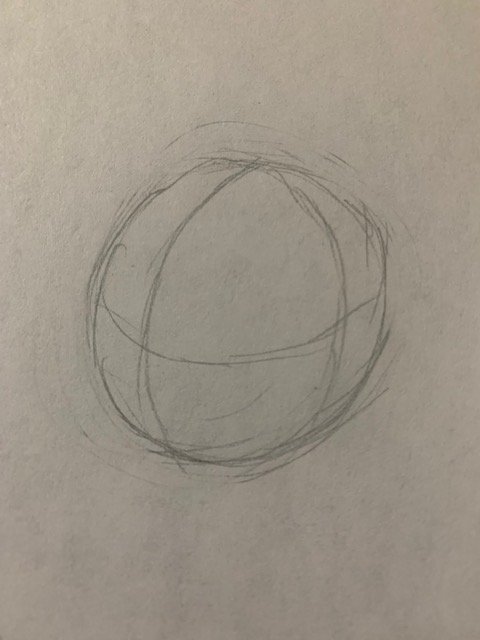
Here is an objectively terrible drawing of a sphere. I have three lines, each effectively running across the three different "middles" of this sphere. Already this should be ringing some "NANI" bells in your brain, because remember that this sphere is representing a flat surface: a flat surface with three middles.
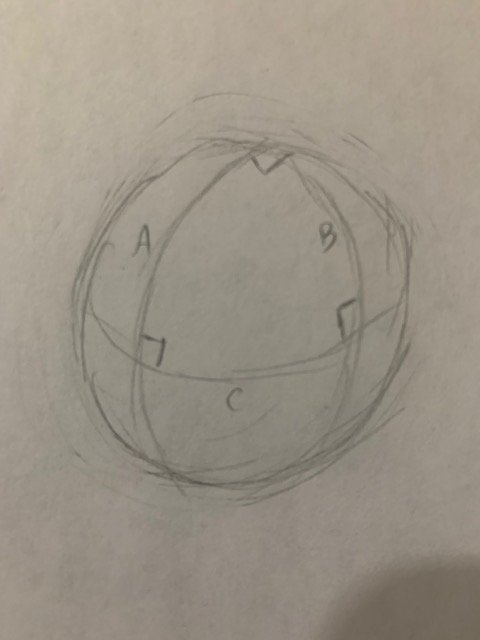
Something absolutely fascinating about this surface is the fact that it has a very unique property: every line is perpendicular at their intersections, but parallel at the midpoint between each one. Because Line A is perpendicular to Line C, and Line C is perpendicular to line B, then that means Line A and Line B are parallel; however, if you view this top down, then you realize that Line A is perpendicular to Line B, and because Line C is also perpendicular to Line B, then Line C is parallel to Line A. So now triangles have 270 degrees instead of 180, squares are also ovals for some reason, and basically nothing makes any sense.
So you might be beginning to see the problem here. I mean, we live on a sphere (the planet Earth), but when we walk from one place to another it sure feels like we're walking in a straight line. That's because we're really small, and so the curvature of the Earth from our point of view feels inconsequential. You have to get really far away to even start to notice it, because the Earth is so big.
You want to know what else is big?
The universe.
The universe is big.
The universe is really big.
The universe, in fact, is so big that maybe it's also not a perfectly Euclidean place at all.
But surely that's something we could measure? Even if it would appear as a flat plane to us; after all, we can still measure the properties of regular Euclidean surfaces down here, meaning we should be able to measure the properties of a Hyperbolic or Spherical plane.
We did this by looking at the CMBR, or Cosmic Microwave Background Radiation. This is the leftover radiation from roughly 370,000 years after the big bang when stuff was finally beginning to cool the heck down and things were finally becoming stuff like atoms and scud. All this stuff cooled in patches, which would follow uniform shapes in a very rough and highly scientific fashion that I'm not the least big qualified to talk about here. If we measure these patche in the CMBR, then we should be able to find the average curvature of spacetime and determine whether or not our universe is Euclidean.
So we did that.
The average curvature of these patches was measured to be about 0.0007
with a margin of error
of 0.0019
As far as we were concerned, the universe was Euclidean.
BUT WHAT IF
WHAT IF
WHAT IF
what if...
instead of having positive or negative curvature...
...our universe had both.
Allow me to introduce you to another principle: Nowhere is Special. When you zoom out wayyy far across our universe - farther than even the likes of light could possibly comprehend - the universe basically becomes a uniform soup. Space is pretty much the same... everywhere. At smaller scales you can observe things like trees and apples and the words "Euclidean" and "Hyperbolic" inscribed on the insides of your eyelids, but when you zoom out so far that even SuperMcDuperMegaClusters of galaxies become nothing more than singular points, then you stop paying much attention to the little stuff like that and more attention to the bigger picture.
At this scale, the average density of the universe is pretty uniform. So is the average temperature, the average energy, and - most notably, in our case - the average curvature. In order to observe the universe with this level of uniformity and at this scale, you wouldn't be able to use any other references for your position, momentum, or anything else - just like you can't have anything to show you whether you're accelerating upwards or being pulled down by gravity in that thought experiment we did with the Fadrinos earlier.
One such ramification of this assumption is that you can't have an edge to the universe, as then all positions would be fixed on an arbitrary plane and therefore (in a sense) observable. This might imply that a Euclidean universe is simply infinite, but allow me to draw your attention to another possibility:
The universe is shaped like a donut.
First of all, this theory works with the potentiality of our universe having both positive and negative curvature (the outer ring has positive, the inner ring has negative). Secondly, the universe has no edge, as no matter which way you go you'll always loop back in on yourself.
What this means is that light, traveling in a "straight" line, would eventually come back to where it started (assuming it traveled along a uniform set of the circle and not in a fancy elliptical mess), meaning that in a theoretical tiny donut universe you could see the back of your own head - similar to how you would if you were hanging out at the event horizon of a Black Hole (which is, by the way, not a good idea).
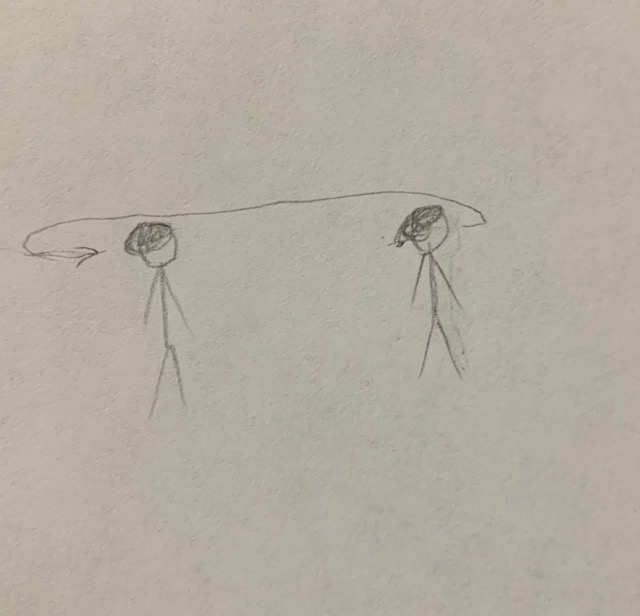
However, we have absolutely no way to prove this. We couldn't even begin to try. Obviously looking for ourselves in the night sky is pointless, because we wouldn't be seeing ourselves. It would take light so long to make the round that we would be seeing space since long before the Earth even existed - but even beyond that, we can't observe this behavior.
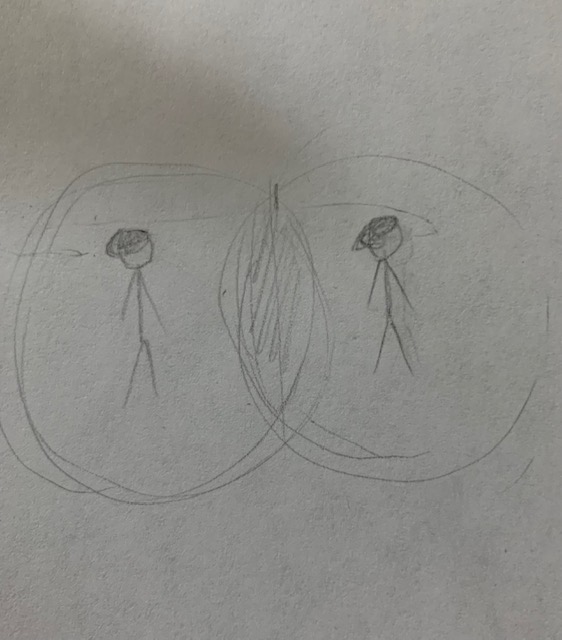
Assume that the circle there represents the observable universe - this is, the amount of space that you can see based on how far light could have come since the dawn of time. If the universe wrapped in on itself, then presumably so would your spheres of observation, and potentially they could overlap. Then by just looking back at the CMBR you could try to find identical patches on either end and prove that the universe is donut-shaped.
But there's a massive problem with this: the CMBR is younger than the universe. It was only created as soon as atoms started to form and began to emit photons (via the photoelectric effect - if you recall, the thing that Einstein did win a Nobel Prize for), which was 370,000 years AFTER the Big Bang. Basically, in order to see yourself in a donut universe, the Universe would have to be smaller than the Observable Universe.
(Kind of reminds me of that Naked Singularity stuff...)
So basically we're back at a stalemate. We can't prove that the universe is a cake pop or a pringle or a donut. Best we can do is think up weird stuff that would happen if the universe was one of those shapes...
Like - hey hang on a minute, a donut universe BREAKS RELATIVITY.
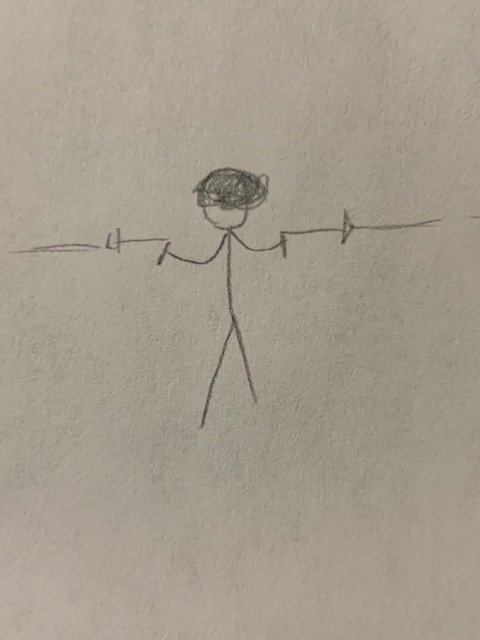
Let's say this Fadrino is firing his laser guns out in two different directions. In a Euclidean universe the lasers are going to propagate out to infinity, but in a Donut universe they'll eventually wrap back around and blast him in the face.
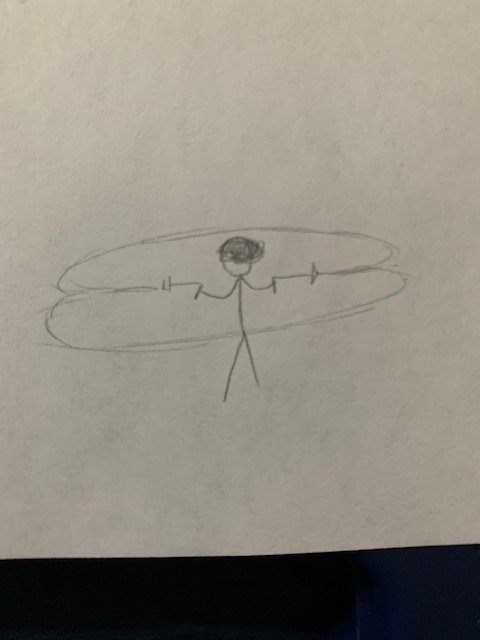
This makes sense, right? Even if this is in our hypothetical micro-sized Donut universe, the principle would technically hold for a regular-sized Donut universe
Now recall that cosmological principle: Nowhere is Special. You cannot tell where you are or where you're going without any point of reference in the vast universe. Basically, this Fadrino has no way of telling whether he's standing still or moving around.
But there's a problem: if he's moving in one direction, then some weird stuff happens...
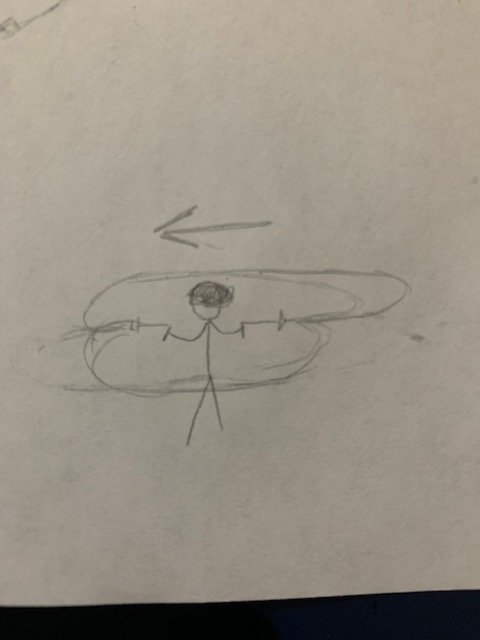
One of the lasers has to travel farther to catch up to him - meaning he would get shot by it after he got shot by the first. This can mean one of two things:
- Relativity was completely wrong and our understanding of reality is so massively flawed that we'd all be better off forgetting about the concept of science altogether.
- There is a singular, ultimate reference frame.
Let's consider the second one, because existential crises are generally debilitating towards one's mental state. If the Fadrino is moving, then he cannot know he is moving - and yet he gets smacked by one laser before the next. To his reference frame, the speed of light is not constant: this is what Albert Einstein would call "not good."
However, there is a way in which this situation functions: if there is a point of reference. Everywhere in the universe is special. There is someway or someplace or something that acts as the ultimate POV, whether that's some hole in reality or God or the squirrel of legend: in a Donut Universe, there is a preferred reference frame outside of all other reference frames.
This reminded me of something I learned in a Veritasium video: that we have never measured the one-way speed of light. The speed of light, the most important constant in all of our universal understanding, has never been measured.
You might think that's stupid. Of course it's been measured, you dummy. You buffoon. You sweatstained pillowcase. We know how fast it is, right? It's 2.99E8 meters per second.
Correct, but we've never... like, really measured that. Light travels in a vacuum at a constant speed and in a constant direction: a straight line, at the speed of (c). But the way we measure it is by sending it one way and then bouncing it back at us, timing how long it takes to reach us and dividing by the distance to get the two-way speed. Divide that by two and you get (c).
But it's impossible to measure it in one direction. Every single experiment we've ever done has required us to send the light there and back again. If you send your laser beam in one direction for a determined distance (say, one kilometer), then you set a clock the moment you shine the laser and stop it as soon as it hits the other side. How do you know when the laser hits the other side? You'd need to receive some kind of indication that it had done so, which cannot go faster than the speed of light.
The only way to receive this indication is to have a mirror at the other side and have the light bounce back at you, then when it hits you again you stop the timer and divide the result by two. Thus, we can only ever calculate the two-way speed of light (check the video to debunk any other stupid ideas you have to measure the light in one direction).
Now this might seem superficial to you, but it could mean any kind of chaos in reality. Say we send a message to someone on Mars, which is roughly 13 light-minutes away.
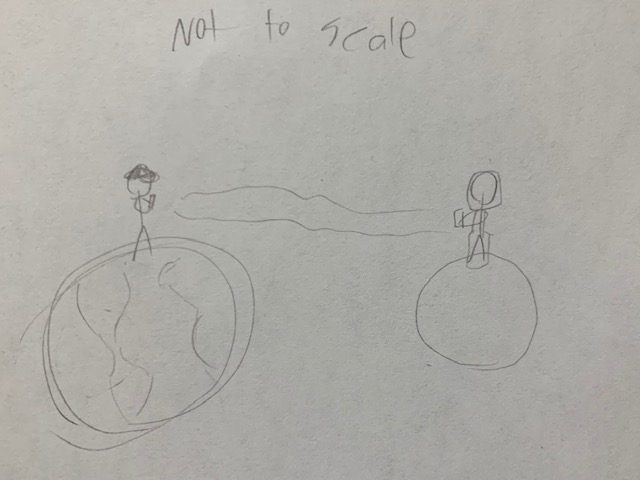
We tell them we sent the message at 12:00 on Earth, and because they want to stay synced with us they set their watch to 12:13 (because it took the message 13 minutes to arrive). Then they send back a reply at 12:13 saying that they're all synced up, which arrives at 12:26 on Earth.
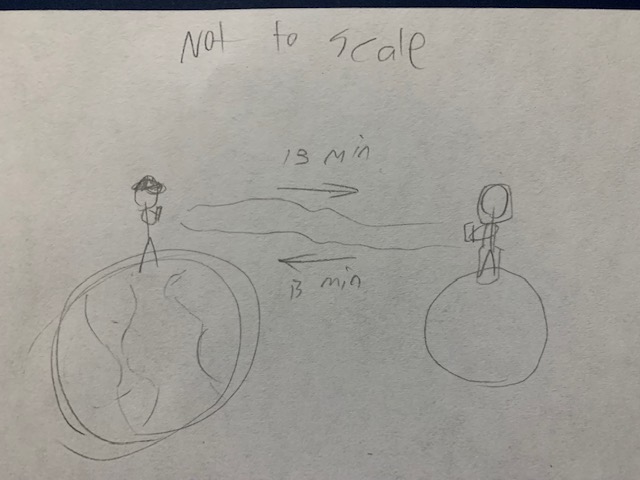
However, because we haven't measured the one-way speed of light, imagine that the light takes 26 minutes to travel to Mars and 0 minutes to travel back to Earth.
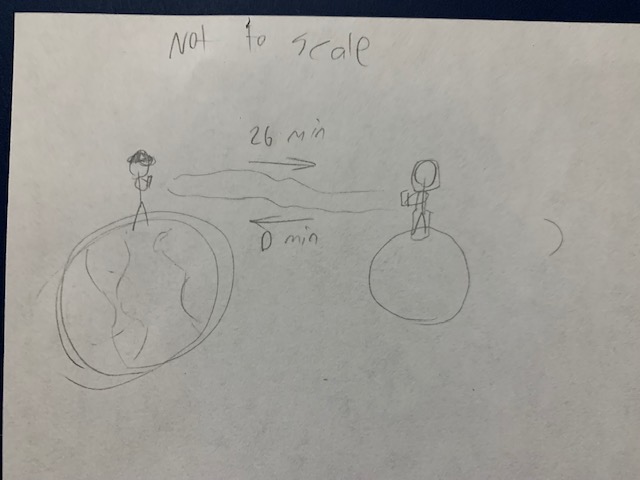
Because we know the two-way trip is 26 light-minutes, when the astronaut receives their message they assume 13 minutes has passed and sets their watch to 12:13 anyways. Then when they send back their message it takes 0 minutes to arrive, but for the same reason the message arrives at 12:26 - so now both the clocks are successfully synced, and there's no way for either one of them to tell the difference between two 13-minute transfers and one 26-minute transfer.
Now you might be thinking "Fadran, you utter dumbulscork. How in the squirrel of legend's name would that make any sense?"
And you're right - it does make more sense to just assume that the speed of light works in every direction. But we can't prove that, no matter how hard we try. And perhaps that the fact that we can't prove the one-way speed of light also supports the fact that we can't prove that our universe is Euclidean because of the weird inconsistencies.
Hell, it could even get worse than that. Consider this scenario:
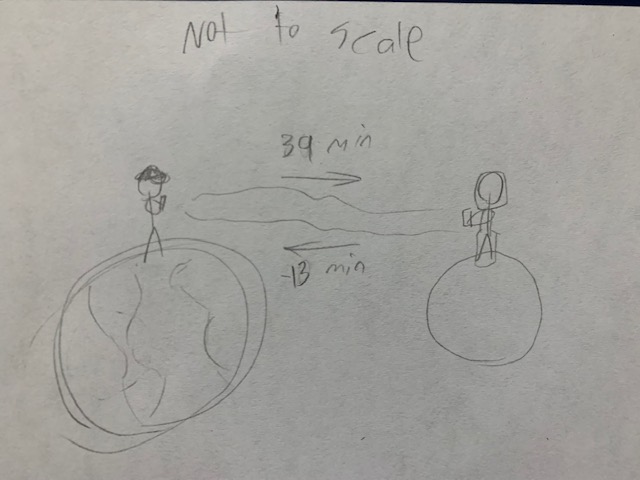
It's still a 26-minute two-way light trip, but now one of the messages is going back in time to account for light being significantly slower the other way. Suddenly time itself is breaking down before our very eyes, all because we can't prove A N Y T H I N G
And what's more, we can't even prove time is a thing at this point, because it isn't even symmetrical! If you take a video of a single particle doing its thing and show it to somebody, they'd have no way of telling whether you played the video backwards or forwards - but if you take a video of an egg splattering on the floor, they'd be pretty darn aware. Because time isn't symmetrical in terms of the laws of thermodynamics: everything tends towards entropy, so you can be pretty sure that the disorder caused by an egg dropping onto the floor is what's going on instead of a bunch of atoms spontaneously combining and working together to turn a bunch of yolk and shell bits into a whole egg and hover it back into the air - but again, you can't technically prove it. Even if it makes so much sense for the egg to have fallen and broken, you can't with a one hundred percent certainty know that that's what happened.
So space might be a donut
Light might prefer one direction to another
And time doesn't make A N Y S E N S E
...
...it is 2 AM
.jpg.49da35b46b9f2cd3db60460647ebe379.jpg)
.jpg.54c79021b69f3596e812a6fca3d05ee4.jpg)
