



Lightspine
-
Posts
311 -
Joined
-
Last visited
-
Days Won
2
5 Followers


Lightspine's Achievements
733
Reputation
-
I saw somebody in the r/Cosmere reddit thread make this observation but there wasn't much discussion about it, which is a shame: There's a few specific parallels between December's "first life" and the "Dog and the Dragon" story. (Here's the reddit comment, also here's a link to a transcript of the "Dog and the Dragon" story for easier reference if you want to compare these points) December is raised sleeping in a corner with the innkeeper's dog December's parting warning to the innkeeper will save their youngest child from falling into a well The family in the Dog and the Dragon have 3 children, and the Dog learns to read alongside the youngest child. This mirrors how December learns to read in the Reeve's family. Now, the parallels aren't perfect (for example, the "youngest child" in the Dragon and the Dog story is paralleled by both the innkeeper's youngest grandchild and the Reeve's youngest, and December doesn't learn how to plant seeds or "fly") but I think they're still quite notable. The reddit comment used these as part of their theory that December is a dragon. I'm not entirely on board with that but I still think that this is a cool observation worthy of more discussion. Let me know any parallels I missed!
-
To add to what others have already said, Aux even mentions that some windspren have joined the Iriali caravan: So it seems pretty likely that those are Sigzil’s platespren following him!
-
The situation with Ba Ado Mishram being a better candidate to hold Odium than Rayse got me thinking about the whole business Autonomy has with avatars, and makes me wonder how willing of a participant Bavadin is in it. Bavadin is still the current holder of Autonomy, and seems to have Invested Taldain's sun. However, her avatars are spread elsewhere throughout the star systems of the Cosmere. But what is the difference between the shardholder and her avatars? Are they truly unified in their purpose, and are their power imbalances at play? "The sun could love the stars. But never as an equal." Gavilar's quote reminded me of Trell and Nalt. As a refresher, Trell is an avatar of Autonomy (or is meant to represent one) with "a thousand eyes" represented by the stars. Nalt is an opposing god whose single, glaringly bright eye is the sun. It's always tickled me a little that this seems to pit the avatars of Autonomy (the stars) against Autonomy herself (Taldain's sun?). But what if there is indeed a contest going on between Bavadin and the avatars? My theory is this: even if Bavadin is a fitting vessel, the power of Autonomy seeks independence and "survival of the fittest." It thus aligns with its Intent to create avatars, irregardless of Bavadin's will. Bavadin may then be under constant pressure to appease Autonomy lest she become an Avatar and one of her avatars ascends to Vesselhood. Likewise, the avatars (like Telsin) seek to prove themselves and take Bavadin's place. This could have been the fuel for the invasion of Scadrial. I don't have much direct evidence of this, but there's this WoB that made me think this was possible: (Mind, it does imply that Patiji was created intentionally)
-
There's been a lot of theorization going around about Valor being a fourth shard hiding in Roshar. The following theory emerged as I considered the possibility, and though it might be a crackpot idea, I think it has a lot of circumstantial evidence. Let me take you through the thought process. Part I: Why is Valor Hiding? As I mentioned in the introduction, there are hints to a fourth shard inhabiting Roshar. Specifically, something is certainly hidden underneath the Shattered Plains, among the fallen fragments of what was once a fourth moon. At the same time, there's a lot of emphasis placed on the mystery of Valor's whereabouts. Todium, Tanavast, and Wit are all unable to locate them. And yet, hiding seems specifically antithetical to their Intent. How does remaining hidden could align with Valor? I could think of one answer: Hiding behind enemy lines, putting themselves in immediate danger in order to undermine and influence Odium. First of all, this reconciles hiding in the same location as Odium's shardpool. When Venli discovered the shardpool, I thought that it wouldn't be Odium's, and would instead belong to the fourth shard. However, it is clearly proven to be Odium's at the end of the book, when it fills with Warlight. El's interlude chapter also heavily implies that Odium knows about this Shardpool, so it certainly does not belong to Valor. My theory is that Valor is hiding by essentially surrounding themselves in Odium's power, and therefore only act upon the world by reaching through Odium. In doing this, they risk being destroyed by Odium upon discovery. I understand that there is no precedent for a Shard doing this. But whatever Valor is doing, it's unprecedented anyways. Part II: What is Valor Doing? The Intent of Valor wouldn't allow them to simply hide and observe, but would urge them to act. We know from Endowment's letters in this book that they and Valor have "dealings" but otherwise know next to nothing about what they might be up to. But we do know some things that Endowment has been doing. Despite refusing to intervene on Roshar at Hoid's request, her actions have certainly influenced the planet. Most notably, she had a direct hand in turning Vasher into a Returned and the creation of Nightblood, thereby allowing Taravangian to kill Rayse and become Odium. Cultivation's plan would have been impossible without the actions of Endowment. Their plans are certainly intertwined (consider that Lift, the third individual to receive Cultivation's direct touch, is now being trained to realize her full potential by Vasher). A lot of people have also identified the moment that Taravangian kills Rayse as evidence of Valor's meddling, since he feels an incredible surge of bravery during that pivotal moment. I agree. But I also think there's more going on here. First of all, this occurs while Taravangian is in what is essentially a vision being granted by Odium. Valor being able to influence him under those conditions is one of the reasons I believe Valor must be hiding from within Odium's power. How else to explain direct but unnoticed intervention by another shard within Odium's vision? Secondly, there are other key players to Cultivation's plan for Taravangian: Sja-Anat and Moelach. Sja-Anat's role is rather direct: she supplies the corrupted windspren that bring Odium's attention upon Taravangian. Moelach's influence is more subtle, but I also think it is more compelling; because while Cultivation's future sight should allow her to foresee the actions of a being like Sja-Anat, Moelach touching the Spiritual Realm should shield them from such foresight much like Renarin's future is hidden from Odium. And yet, it is a Death Rattle that makes Taravangian believe Gavilar and leads him to Cultivation's touch at the Valley. Taravangian's dying mother specifically sees the moment where Gavilar names the Night of Sorrows as they look upon a map of Roshar. How could Cultivation have foreseen what someone else would observe in the Spiritual Realm? This plan should have been impossible. This is my thesis; Cultivation, Endowment, and Valor are working in concert. Cultivation acts through Dalinar, Taravangian, and Lift. Endowment uses Vasher and Nightblood. And Valor's chess pieces are the Unmade. Part III: The Unmade Kinda Suck While analyzing the actions of the Unmade, I've come to notice how frequently Odium's plans for them fail or they act against his interests. Only when he commands them directly do they seem to do anything productive to his cause. Obviously, Sja-Anat and Ba-Ado-Mishram both seek to undermine their god. But what of the others? Nergaoul's greatest contribution to Odium's war is probably turning Sadeas' army at the Battle of Thaylen Field, but they are ultimately defeated and captured. While Rayse hoped to use him to shape Dalinar into his champion, Nergaoul's influence ultimately leads Dalinar to fulfill Cultivation's desires. Re-Shephir doesn't really accomplish much beyond murdering a few people in Urithiru. In fact, her encounter with Shallan is what teaches the Coalition that the Unmade can be captured, which wins them the Battle of Thaylen Field. She also incorrectly reports to the Fused that the Sibling is dead. Moelach's Death Rattles only directly influence the actions of characters twice, as far as I can tell (please let me know if I've forgotten an instance, there are a LOT of death rattles). The first time I've already mentioned—Taravangian heeds Gavilar's warning because of a Death Rattle. The second takes place within Winds and Truth, leading Sigzil to renounce his oaths in order to save his spren. What's more, despite the climax of this book being the single most common subject of Death Rattles ("Night of sorrows", never-ending storm, homeland crumbling to dusk, suckling child etc...) it clearly catches Todium off guard. Whatever information Moelach is gleaning about the future isn't being effectively utilized by either Rayse nor Todium. Yelig-nar is scary, but hasn't won any critical battles. Aesudan didn't really do much. Arguably the greatest fallout of Amaram utilizing his power is that it leads Rock to pick up a weapon, and therefore return to the Horneater Peaks. Their presence at the Shattered Plains in this book was pretty inconsequential. Ashertmarn does successfully incapacitate Kholinar's leadership, but doesn't prevent the Radiants from reaching the Oathgate and doesn't harm them in Shadesmar. Kholinar's fall can mostly be pinned on Sja-Anat taking control of the Oathgate, but we already know she isn't entirely loyal. Dai-Gonarthis successfully delivers Todium's army to the Shattered Plains. In net, however, this doesn't really benefit Todium. They lose the Plains to the Listener treaty, and the forces that the Coalition expends on the Plains couldn't have been diverted elsewhere anyways—its not like using Dai-Gonarthis here made any of the other warfronts more winnable. And in return for that, she'll demand a price from Todium—now Retribution—that we have yet to see. (You might argue that Dai-Gonarthis would have won Todium the battle if not for the unforeseen intervention of the Listeners. But if Valor really is the fourth Shard hidden in the Shattered Plains, then she almost certainly had an active hand in guiding the Listeners to seek Narak.) Chemoarish has been completely MIA so far, and might not even be the name of the ninth Unmade. So yeah, that's all of the Unmade and how much they've helped Odium so far. After doing the math, only Ashertmarn, Yelig-nar, and maybe Nergaoul have helped Odium, and they've had very little say in the matter. The other Unmade arguably all detract from him. To me this seems suspiciously incompetent. Unless they're double agents—in which case they've actually done a very good job. As we see in Sja-Anat's RoW interlude, they will be re-Unmade if they are discovered acting against him. They are Valor's brave soldiers, submitting themselves to this risk in order to expose Odium's weaknesses to his enemies at critical times. Part IV: I Know I'm Probably Wrong This theory has been built entirely on wild speculation and thumbtacking-string-on-corkboard-type thinking. There's no direct evidence for any of this. I know there's probably holes in this theory that I haven't seen (and invite everyone to point them out). This doesn't address Tanavast noticing people ("new ones, watchers, who had been hidden from me") among the Fourth Moon shards. This doesn't tie in the Unoathed, who I've seen people rightfully speculate are the products of Valor. But darn it, there's just enough circumstance here for me to want to believe in it. I rest my case.
-
Speaking of Shallan's illusion tactic, I doubt Iyatil was simply getting lucky: Could she have some sort of ability that lets her identify illusions? It feels like something Allomantic bronze might be able to accomplish, or maybe Allomantic tin can make it easier to see through a lightweaving? On the other hand, if she did have such an ability wouldn't that make the white sand illusion detection method pointless?
-
I'm betting that this is either a larkin or chasmfiend egg! Chasmfiend carapace is described as "dark violet" (and they also have violet blood) and Chiri-Chiri's is normally "brown-violet" which could line up with the egg's color. Rosharan wildlife is also the only type we've seen that's capable of incorporating minerals into their biology, which would explain the egg being rock/crystal. In addition we know that chulls, which have a similar pupation life cycle to chasmfiends, hatch from eggs (although we don't know what those look like). The silver in the egg is the main thing that doesn't necessarily fit this idea. Chiri-Chiri's eyes are silver colored though, if that counts for anything.
-
The Unkalaki founding myth talks about gods of the waters and trees, so I agree with you here. There's also "spren" from the Eila Stele. It's possible some of these are the same (could Night be the same as "spren" or "tree"? Mostly bringing it up because of the Nightwatcher's vibe, I don't think it's particularly likely) but there's definitely something to do with water that we haven't seen yet. On that note, anyone else think that Chemoarish being mistaken with the Nightwatcher might be because of Chemoarish stemming from the original Night, or perhaps even their unmaking being why the original Night vanished? As for them being in Shinovar, I don't think there's enough evidence to conclude Chemoarish has anything to do with stone, but I still agree that she's probably there primarily because she's one of the few Unmade whose whereabouts we haven't seen. Only her and Dai-gonarthis are unaccounted for.
-
The truth behind vorinism and the future of the knights Radiant
Lightspine replied to bmcclure7's topic in Cosmere Discussion
I actually think the modern version of vorinism is "tainted" and in many ways describes the situation from the perspective of the Dawnsingers, with Odium as the "Almighty" better than it does the humans. The Dawnsingers were pushed out of Roshar (the "Tranquiline Halls") by the voidbringers (humans) who came from Ashyn ("Damnation"). The original Dawnsingers now fight on in their afterlife to reclaim the "Tranquiline Halls". This fits much more neatly than the narrative that humans are somehow fighting to reclaim Ashyn in the afterlife after being kicked out by voidbringers coming from Braize, which is the face-value interpretation given to us by the books. But I also think it could totally be foreshadowing for Odium using Roshar as a training grounds for his war on the rest of the Cosmere. -
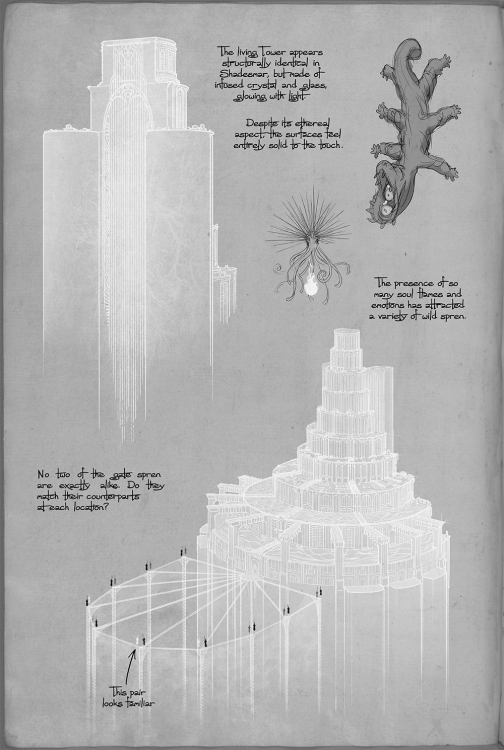
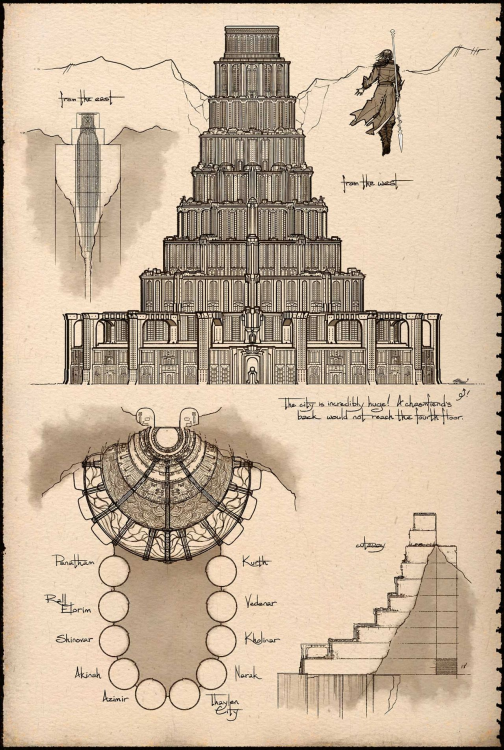
I think the central takeaway from the sketch at the end is that the Oathgate spren match the corresponding spren at each location—including their state of corruption (or "Enlightenment")—just as the person who made the sketch (probably Nazh) speculates. We've known since Oathbringer that the Kholinar Oathgate spren is corrupted, but this is our first time seeing that the same is true for the spren at the Kholinar Oathgate at Urithiru, as far as I know. We can tell by matching the newest sketch to the map of Urithiru from Oathbringer that the Kurth, Vedenar, Kholinar, Panatham, Rall Elorim and Shinovar Oathgate spren have been corrupted, and the Azimir one is in the process of corruption. The "this pair looks familiar" is referring to the Thaylen city spren, and I believe this is because they are the feature of this sketch in Oathbringer, which depicts Shallan petitioning the Thaylen city Oathgate spren to let them through to the Physical realm (it can't be a sketch of the Kholinar Oathgate since one of those spren should be red).
-
TL;DR: I think that the Wind isn't the only Old Magic spren of wind and that the Eila Stele still refers to the Stormfather. During my recent reread of Rhythm of War I noticed this quote from the Stormfather, which really got me thinking: I think it's fairly well accepted that the Stormfather is a remnant of the Old Magic that has been invested by Honor (even though the Nightwatcher is the only spren that's explicitly stated to come from the Old Magic). From this point of view, the Stormfather's quote above is in reference to his original state as an Old Magic spren. Therefore, the wording has some implications: not just that he calls himself "wind" but also "a wind" implying that he wasn't necessarily unique. The more I thought about it, the more signs I saw indicating that the Old Magic spren were not singular: For example, the story of the Unkalaki references them receiving aid from the gods of the waters, the gods of the mountains, and the gods of the trees. Not from one "god" of each, but "gods." As an add-on to this, the Sibling is almost certainly descended from a "god of the mountains" (specifically the mountain Ur, which Urithiru was crafted from—as indicated in RoW chapter 83) and it would not make sense for their influence to extend to the Horneater Peaks where the Unkalaki received blessings from the gods of the mountains. The Sibling must be a separate entity; there is more than one god of mountains. Likewise, Stone Shamanism references plural "spirits of stones and mountains." Following these preview chapters lots of people here have been reexamining the Eila Stele, and for good reason. The original interpretation of this was that these correspond to the three Bondsmith spren, with "wind" referencing the Stormfather. Following the recent chapters I've seen the general consensus change to "wind" being "the Wind" that speaks to Kaladin. But what if our original interpretation was actually correct? There is no indication that this new Wind that we hear from in the previews ever betrayed the Dawnsingers. On the other hand, the Stormfather certainly did when he chose to bond with humans. In fact, we have direct confirmation of this: This makes me think that the original Eila Stele interpretation is accurate: the Stormfather was a god of winds who betrayed the Dawnsingers. He just wasn't the only god of winds. I think it might be really important if the Wind that speaks to Kaladin isn't considered to have betrayed the Dawnsingers. Finally, I have some more nebulous evidence. Among the Rhythms of Roshar (listed here: https://coppermind.net/wiki/Rhythm#Normal_Rhythms) the Rhythm of Winds seems pretty unique: almost all of the others correspond to an emotional state. The Rhythm of Winds is instead used to predict highstorms and is attuned by both Venli and Eshonai when they enter a highstorm (Chapters 57 and 88 of RoW). However, it is also attuned by Shumin when experiencing vertigo/being at a great height from Leshwi's tower in Kholinar (RoW Chapter 11) so it's purpose isn't always storm-related. This indicates to me that there's a connection between the Stormfather and winds of all kinds. Probably the most glaring evidence against this theory is that we don't really see these spren around. If every mountain has a spren like the Sibling inhabiting it, surely somebody would have noticed. I think that this is easily explained though; Wit tells us that the Wind is "weaker than it once was" and it only recently was able to make contact with people again. Most of the Old Magic spren probably faded away with time and are now weak or slumbering, with the surviving ones likely doing so due to additional Investiture from one of the Shards—the three Bondsmith spren and likely the Unmade (Yelig-nar is also called the Bleakwind—could it possibly be a corrupted spren of wind?).
-
I really like this take! When it comes the Wind coming back, I'm now beginning to think it's likely a confluence of factors. The Wind herself accredits Odium changing hands, while our mystery author is speculating along other lines. Maybe it's the additive effects from those and stuff like the return of Windrunners and less worship of Honor. You also make some great points about the Everstorm, I'd forgotten exactly how strange and unprecedented it is compared to what was going on in previous Desolations. I don't actually think an "original" Fleet mythos exists before the one we read. Hoid seems to suggest that this is the first time he's heard it—it's certainly the first time he's told it. His language around that actually makes me even more convinced that Fleet's story is Kaladin's:
-
Thanks for bringing that Death Rattle to my attention! It actually reminds me of yet another "storm" candidate. I saw somebody on a thread here reference that Death Rattle while bringing up the Weeping—a long period of mostly wind-free rainstorms—as a potential reason why a "new storm" would lead to people appreciating the wind more. I agree that this is probably the most straightforward interpretation, but it feels like something is missing. I agree that capital-S Storm is almost certainly highstorms/Stormfather/Honor, which seems to imply the Wind is a separate entity. So it doesn't quite make sense to me that the Everstorm making people see highstorms in a separate light would be what restored the Wind's voice. This seems especially strange when you consider that "fear of the Wind" somehow coincided with "worship of the Storm." But the Everstorm is certainly a top candidate for "new storm", alongside whatever "storm" the Wind is warning Kaladin of during these previews. While we're on this topic, I'm not sure how much faith we're supposed to put into the Knigths of Wind and Truth author's musings here. In their own words, they're making an educated guess, and they might even be proposing two completely separate theories—the second passage I quoted could be implying that it was never fear of the Wind at all that lead to the loss of her voice, but rather worship of the Storm. Maybe people are worshipping the Storm less now is restoring the Wind's voice? Dalinar's publication of Oathbringer and his declaration of Honor being dead could be shifting public perception of Vorinism and worship of the Almighty.
-
The idea that Fleet's song is an act of foreshadowing for Kaladin's arc in book 5 has been looming large in my mind ever since we learned that he's headed to Shinovar, and I've seen some discussion of it around here. With the release of these preview chapters, however, some additional details have popped up that have given this idea even more weight to me. The first and most obvious one is that Kaladin's plan is to literally ride the highstorm to Shinovar. I mean, could the connection get any more heavy-handed than that? But I also think there's some more subtle details that are important to examine, especially pertaining to the Wind's whisperings to Kaladin. For example, we've learned that Hoid's rendition of the Wandersail was told to the beat of one of the Rhythms of Roshar. What's more, the reason Kaladin could hear the music even as Wit spoke was because the Wind was echoing this Rhythm back. Let's re-examine some of the passages surrounding Fleet's song with this knowledge: Compare this to how Hoid's music is described during his telling of the Wandersail: With our new knowledge in mind, it seems entirely plausible to me that the Wind is acting as a "third hand" during Hoid's performance of Fleet's song, much like it acted as a duet partner for the Wandersail. I personally think that this is only possible because Fleet's song is also set to a Rhythm, because of the way both of these melodies seem to grip Kaladin. Another new and interesting detail is that Kaladin's journey is going to start from the Azimir oathgate. At first, this seems to make it dissimilar to Fleet's race. However, I think the way that the race is described lines up quite nicely with the grander arc of Kaladin's journey throughout these books: Kaladin has been mentally put through the ringer in the past few books, but at the start of WaT he's in the best place he's been in for a very long time. Figuratively speaking, he's escaped the storm and found the sun. Right in time for him to start a journey from Azimir. Unfortunately, the rest of Fleet's journey doesn't paint a particularly happy picture for Kaladin. (By the way, the previous two quoted sections are back to back. I just wanted to point out because it was striking to me how similar they are to what Kaladin's about to do) As we all know, Fleet dies at the end of this story. Kaladin has been assembling enough death flags to stock an embassy during these preview chapters, but there are also other more interesting interpretations of Fleet's—and by proxy Kaladin's—fate. I've seen a lot of discussion on here and elsewhere about Kaladin potentially picking up Honor, and this could definitely line up with the above passages. I'm not completely sold on it, but it seems highly plausible. Additionally, there's a lot of mentions of the wind here which might be the capital-W Wind. The other highly theorized fate for Kaladin is reforging the Oathpact and becoming a Herald, but I'm not sure if the above passage supports that. It could maybe be spun that way though. And now for some slightly more crackpot ideas: The Wind has whispered warnings about an incoming storm to Kaladin. It seems to me that Kaladin won't just be riding a highstorm to Shinovar, but that he'll have to accomplish his mission before this "storm" arrives. You could even say that he's racing this storm, metaphorically. Fleet's story ends with the storm physically stopping at Shinovar upon his death: The optimistic interpretation of this is that Kaladin averts this "storm" that the Wind describes. What makes me especially suspicious about this is that the storm Fleet races is never referred to as a highstorm. Seriously. I read the whole the like three times before I noticed this, so I've decided to compile every instance of the word "storm" being used during the song below as proof of this. That's 17 instances of the word "storm" and zero uses of "highstorm," plus one mention of a "stormwall." I'm not going to interpret too much from this since I think it's heavily implied to be a highstorm—what with having a stormwall and sweeping from East to West—so much so that before today I would have sworn on my life that the word "highstorm" was used at some point. But if this word choice is intentional, I think it's meant to imply that the storm Kaladin's stopping won't be the highstorms. Whatever is going on, it may have to do with the "new storm" or the capital-S Storm mentioned in the Knights of Winds and Truth excerpts from chapters 3 and 4: I don't really have any concrete theories to propose about what this storm or the Storm are—the highstorms, the Everstorm, and some third unknown storm (which may or may not be a literal storm) all seem like strong possibilities. There's one final passage from this song that might be worth mulling over: There's been a lot of suspicion surrounding Chanarach's identity lately. Now, I don't think there's any textual evidence of Kaladin outrunning Shallan's mum or anything like that, but could this passage have a hint of truth? Has Kaladin interacted with Chanarach at some point? Anyway that's a wrap on the long-winded thoughts I had about how Fleet's story ties in with Kaladin's. Looking forward to the discussion and any other connections you all can find!
-
why the machine works on humans?
Lightspine replied to king of nowhere's topic in Cosmere Discussion
Actually, I don't think the Nightmare was touching Nikaro in that scene. What you're remembering is when Liyun is feeding from Yumi. Here's the full passage: However, the Nightmare certainly did need to get closer to Nikaro in order to start feeding on him, and couldn't do it from a significant distance, so I understand your consternation at the machine being able to perform this over a range of (probably) thousands of miles. My tentative thought here is that the Festival itself probably made it easier. A significant chunk of the Torish population may have been gathered in the capital city at that time, and a crowd of them gathered right up at the machine when it was being activated (Yumi finds the machine in what was once a "grand exhibit hall"). Maybe the large number of nearby souls was able to give the machine the power boost it needed to reach out and gather the more distant ones? -
why the machine works on humans?
Lightspine replied to king of nowhere's topic in Cosmere Discussion
I don't have much to say here in terms of theory that hasn't already been said, but I haven't seen this particular passage brought up yet so I thought I would do it: Whatever the Father machine did is not unique to it. (And remember the smaller "child" machine also extracted hion from the scholar and Yumi when it was being primed). Another instance of souls having hion characteristics is during the carnival ride: Since hion seems to be just what Virtuosity's investiture looks like, there's two options here: 1). the people's souls are being converted into Virtuosity investiture when machines/Nightmares feed on them. 2). the people's souls are already Invested by Virtuosity on this particular planet. I don't know if there's evidence either way about this.


