



Harakeke
-
Posts
260 -
Joined
-
Last visited
-
Days Won
2
Content Type
Profiles
News
Forums
Blogs
Gallery
Events
Everything posted by Harakeke
-
-
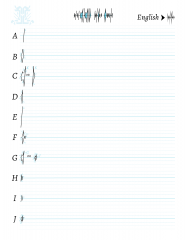
I don't think the Alethi letters aren't really waveforms -- they're just phonetically-organized graphemes with shapes inspired by waveforms. For example, the words "gravity" /gravitē/, "joy",/joi/, and "type" /tīp/ all use the same letter for Y, even though it's pronounced differently in each word. edit: Made some English > Alethi practice pages.
-
What about the English letter Q -- would it be written as K in Alethi?
-
Heh. You should see my original hand-drawn chickenscratch notes... Yeah -- I filled the letters in on purpose to make it easier to tell them apart at a glance. I may play around some more with various colors and fill. Good idea with the transliteration key. Have there been any new tidbits of information other than what's on the wiki page?
-

Vectors and Wallpapers - Surge/Voidbinding charts and more
Harakeke replied to Shadow Guardian's topic in Creator's Corner
Very cool! Dotting for later. -
Since I'm hoping Words of Radiance will have more illustrations with Alethi script, I started working on a bookmark-sized translation key. I've attached the draft version -- I'm aiming for sort of a "child's phonics book" feel. Any suggestions? edit: updated first post with most recent versions:
-
Very cool! Though... I'm wondering if maybe you're taking the transliterating a little too far? I haven't actually run your code, but from looking over the spoiler blocks, it seems like you might be doing a lot of unnecessary replacements, particularly when it comes to vowels. There was a quote from Peter Ahlstrom on the old forum: "The person who translated these books into English treated certain art pages different ways in order to tailor it to the English-speaking audience. The Navani pages are meant to give a flavor for what the writing looks like, yet still be something readers can figure out and understand." Unless there is other information outside of the books that I've missed (which is entirely possible -- I haven't kept up with the forums much), I don't think it's really possible to transliterate English into *actual Alethi*, only the pseudo-Alethi that's used in the WOK artwork. So, if your goal is to produce Alethi script consistent with what we have in WOK, I don't really think you need to convert English into full phonetic notation before applying the Alethi script font. Apart from the trickyness with c > s/k, I think all you really need to do are some basic character-level replacements. The examples we have of pseudo-Alethi (the excerpts from Navani's Notebook on p. 762 & 856)follow English orthography pretty straightforwardly, as I recall -- apart from a few specific exceptions at the character level: Th > /θ/ CH > /tʃ/ C > /k/ or /s/ W > /ʌ/ X > /ks/ I forget if there's anything canon regarding Qu, but I think it should realize as either /k/ or /kʌ/ For example, the device on p. 762 is labelled just as it would be spelled in English ("Pain Knife"), not as it would be pronounced (/pān nīf/). Furthermore, the English word "Joy" (/dʒoi/) is written using distinct Alethi characters for "J" and "Y" even though that combination of letters would pronounced in modern Alethi the same as "Yoy" (/joi/). But regardless, I'm impressed with what you folks have done!
-
