



sprocket
-
Posts
32 -
Joined
-
Last visited
Content Type
Profiles
News
Forums
Blogs
Gallery
Events
Everything posted by sprocket
-
People keep pointing to Dalinar's reference to the God Beyond as evidence that he's becoming more cosmere aware, but I really don't think that's it. Wayne refers to the God Beyond and I don't think he's been talking to the Heralds. Same goes for the character who mentions it in Shadows for Silence (I can't remember who it was but I remember it happened). It's also worth noting that any extra connection to the Spiritual Realm would give no extra information about the God Beyond, as the "beyond" part means beyond the three realms, to the place where the dead go, where not even Shards can see. The God Beyond seems to be something that people on many different shardworlds developed independently, probably for the exact same reasons as Dalinar. Dalinar came to believe that Honor wasn't god because he was mortal and fallible, but that a god did exist beyond Honor.
-
There it is, I figured there'd be something I missed somewhere. It's been a while since I've read Oathbringer and I also read it really quickly, so I've forgotten a lot of details. Good catch! There does seem to be something weird with Felt tho.
-
I was reading through WoBs and this one stood out to me: Generally, our biggest clue for spotting worldhoppers on Roshar is when characters have trouble identifying their ethnicity. It's notable that this never happened with Felt. Scadrians would likely look Shin to Alethi, but it's never brought up that Felt is a foreigner in an Alethi army. Like Brandon said, he should stand out more. If Felt is a Kandra, it wouldn't be hard to change their body to look more Alethi. Why not pick a more Vorin name? I'm not sure, maybe that was Brandon just making sure we'd notice him. If Felt was just a normal person it'd be in his interest to pick a Vorin sounding name anyway. Similarly, there's this interesting WoB: This seems to imply that we'd have above average difficulty spotting Felt. This would make sense if he was a Kandra, since he could look entirely different from appearance to appearance. Regardless, there is definitely something going on with Felt that Brandon hasn't disclosed yet. The bit about Felt's dialogue is interesting, I just reread Mistborn 1 and 2 and don't remember anything weird there, but I also wasn't looking for it. I wish I had a digital copy so finding that stuff was easier. I suspect there might be a clue implying that Felt had been replaced. Since Brandon has explicitly said that the Felt we see in Stormlight Archive is the same Felt as in Mistborn, meaning that a Kandra took his place some time during the events of the original trilogy. I'm also half convinced that Felt is that pesky Kandra worldhopper that we haven't been able to pin down. Consider this WoB: So we've seen the Kandra worldhopper, well, we've seen Felt. He also didn't reveal the planet, which is interesting. There's also: It doesn't sound like much, but it basically confirms that the Kandra worldhopper has at least taken the form of a male. Whether she has appeared on screen in that form is another matter, but it hasn't been strictly disproved. Note that the above quote comes from 2014, so this was before Felt got a bunch of lines in the Dalinar flashbacks in OB. Honestly even I can't remember if Felt said anything in Words of Radiance. As a final tidbit there's also this WoB: This response would make sense considering Felt doesn't really show up in Way of Kings but is presumably still kicking around in Dalinar's army.
-

[OB] Voidbinding, and what we can learn from Scadrial
sprocket replied to Naerin's topic in Stormlight Archive
I feel like it's worth pointing out that Preservation and Ruin being so diametrically opposed is something fairly unique in the Cosmere. I'm sure their nature as opposites had an effect on how Alomancy, Feruchemy, and Hemalugy came about. Honor, Cultivation, and Odium are not nearly so neat in their interaction. There's no reason to think that there should necessarily be one magic system for each shard plus one for the blend (as we see on Scadrial). One blended system (surgebinding), plus one shard specific system(voidbinding), seems to be the case on Roshar. That said, I think your parallel still holds. The basic effects of most magic systems are similar, but vary slightly in application and method of access (the actual system, as you very accurately put it, I think). You can actually do a lot of the same stuff with Allomancy that you can with Feruchemy. And what do you know, that's a shard specific system achieving similar effects as a blended system, the very same situation we seem to be seeing on Roshar. Also, Listener forms already seem to be a kind of fusing of spren and listener, as opposed to a bond as we've seen before. It doesn't look like the spren actually sticks around after the transformation nahel bond style. I assume that's what is happening here, just to voidspren with minds instead of the mindless spren that Listeners normally bond to. The listener fuses to the voidspren and they become a kind of composite entity and grants them access to the surges. -
Right, I remember what I was thinking of now, in WoR Nale says: Which, yeah, doesn't explicitly mention drinking, but it definitely seems to disqualify him from being Tukar's God Priest
-
In regards to the theory that Tezim is Jezrien, haven't we heard that Jezrien is basically just a gibbering drunk nowadays? And we know Ishar is effectively leading the other Heralds right now. Ishar was the one who told Nale to start hunting radiants, and this Tezim guy really doesn't seem to want new radiants around either. This plus Mraize saying that Tezim might not be human at all, along with the hints that the heralds aren't really human either, seals the deal for me.
-
Except not really. A shardblade will cut like a shardblade with or without stormight or a gemstone. The fact that the gemstones were added later does kinda punch a hole in the fabrial theory though. Still, they don't seem like the same thing as shardblades to me. I don't think they're entirely made up of spren or investiture either. I feel like an Honorblade would be closer to that, and shardplate is too different.
-
Well the surge of transportation is a thing. Currently we know less about plate then we do blades, I'm sure there's a reason ancient plate behaves differently that we're going to learn soon. The thing is, if plate wasn't a fabrial, why does it behave so similarly to one? If it was a bunch of spren in solid form why does it need gems and stormlight to work? You end up with questions either way, but with what we have I think the fabrial angle is more likely partly due to occams razor.
-
Technically that might be the case. We really don't know enough about that time period to say. Brandon even called attention to that when Dalinar uses his to build a latrine, so finding out that builders and other non radiants made use of plate too would be a nice call back. Also, presumably shardplate was created around the same time as Uruthiru and the Oathgates (since they seem to be a comparable level of advanced and are also closely associated with the KR). There does seem to be some difference between modern plate and ancient plate. The plate worn by the KR in the past didn't interfere with surgebinding, and could be dispelled almost like a shardblade. So back then it was probably seen as something only the KR could make proper use of, or maybe the KR were literally the only people who could use it at that time (like there was some other bond like the Nahel bond that enabled this). There's definitely something more involved. Maybe the gemstones that power it have the "children" of the Nahel bonded spren inside, providing the resonance required to surgebind while wearing it. I have a gut feeling we'll probably have a better idea once Oathbringer is out.
-
I know this theory isn't very popular, but I'm still pretty much certain that shardplate isn't anything more than a very advanced fabrial. This doesn't mean that there aren't spren involved (we know that there are spren inside fabrials), and these spren could form half of the "lesser bond" between the armor and its bearer. So that would mean that shardplate is made out of some kind of mundane metal (i.e., not solid investiture like atium), but augmented by the affects of various surges. If you think about it, everything shardplate does can be attributed to a surge, and in stark contrast to shardblades, they require gemstones with a supply of stormlight in order to work. I don't know about you guys but that sounds like a fabrial to me. We've even seen contemporary fabrials that behave similarly to plate in the form of the Veden half-shard shields (metal augmented by a surge that can block a shardblade but shatters after too much stress is put on it).
-
I'm almost certain at this point that the author is Dalinar. The plot thread with the ardent is setting up a conflict between Dalinar and the Vorin Church. Dalinar is still firmly Vorin, but the church is going to brand him as a heretic in an attempt to undermine him. Hence why the author talks about people claiming he's a heretic. Like others have mentioned, Jasnah is a well known and self professed atheist, this would not be something that would bother her. As for the "I know that many women who read this" part, I think this is just a Vorin thing, as men can't read. Even if they're reading it to a man, it's still the woman reading it. I do acknowledge the fact that it really sounds like Jasnah. The parts about seeing Shadesmar, and the bit about appearing to die and having some who saw farther ahead thinking they did (Taravangian and the Diagram), all sound like Jasnah. I think this a red herring though, something to mislead us. I think it's describing things that have yet to happen. Which means at some point Dalinar is going to see Shadesmar and appear to die.
-
So I've been reading everyone's replies and all the feedback has been really appreciated, I'm gonna keep adding images to the main post as I work so stay tuned! I see there's been a lot of talk about spike counts. I think I'm going to go with a balance between canon and aesthetically pleasing. The default ten spikes seem a bit low for me so I'll probably add some. I will at least add one through the heart, and maybe more in the back even though none are mentioned (it looks more like a spine that way). I'm hesitant to add too many to the rib cage for fear of things getting crowded, but I'll withhold judgement until I test that. Thanks again everybody!
-
I completely forgot about that cover, and the text does refer to them wearing dark robes. However I think I'm going to forego traditional robes for two reasons: 1. It's a little boring as a design not bad necessarily but I've seen a lot more imaginative stuff in fan art, and 2. If I do end up animating this for a game engine I want to cut down on cloth simulation. Yeah... I forgot to bring up the tattoos. Even though I had definitely been thinking about how to do them. One thing in particular is the red streak that marks obligators who are members of the canton of inquisition. I've seen that depicted as going down across the eyeball, or running down the center of the forehead. Personally I like the latter more, but I don't know if there's evidence that confirms it one way or another. I also know (from the wiki I think) that the type of allomancer the inquisitor was before is indicated by the tattoos. How isn't mentioned but the most straight forward way would probably be the allomantic symbol somewhere. If they were a mistborn that might get crowded but eh, it's doable.
-
http://imgur.com/lII3YDt this was what I was going off of for spike placement. It would make sense not to have any in the arms or legs though, especially in this illustration it looks impractical. You're right. On page forty five it goes through every spike. The inquisitor they fight has ten. "Two through the eyes and one through the shoulders: all steel. Six through the ribs: two steel, four bronze" plus an apparently non standard pewter spike through the heart. From the coppermind wiki that last one steals feruchemical physical powers, which makes sense since he was using feruchemical steel. I will be sure to adjust that accordingly.
-
So I accidentally put this up without finishing the post, I'm just gonna keep adding to it until it's actually done, sorry about that!
-
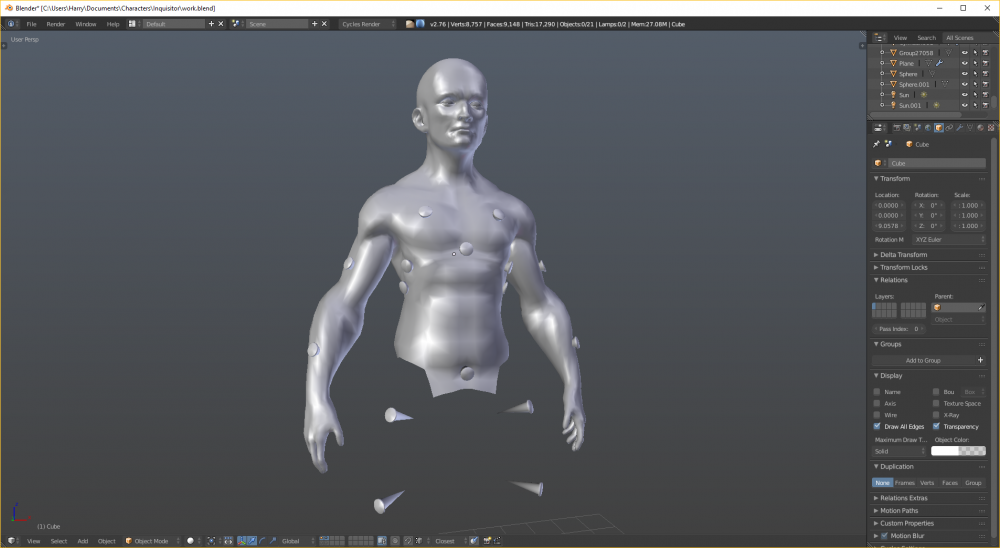
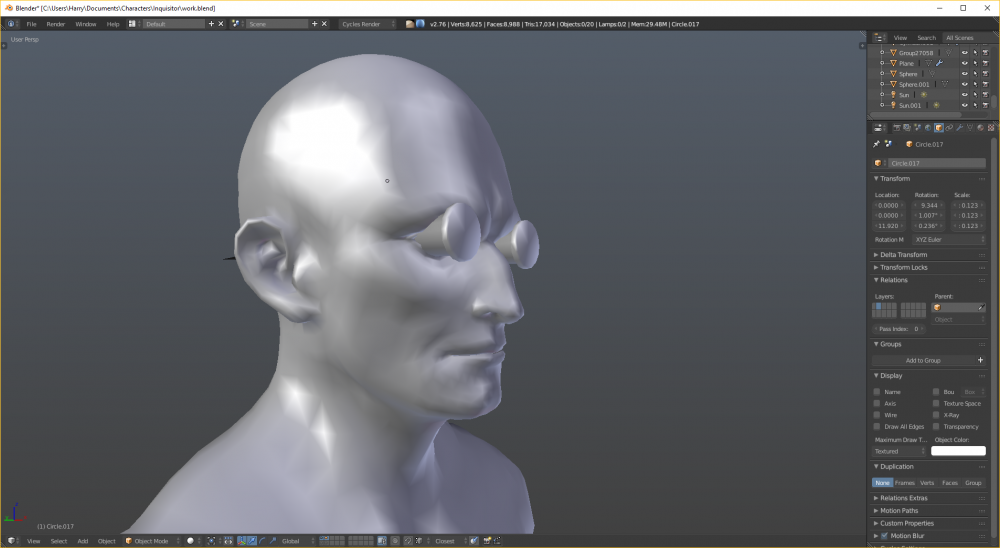
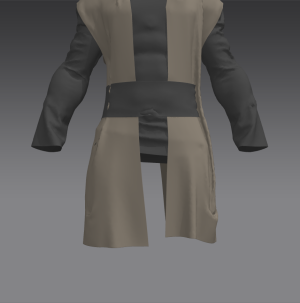
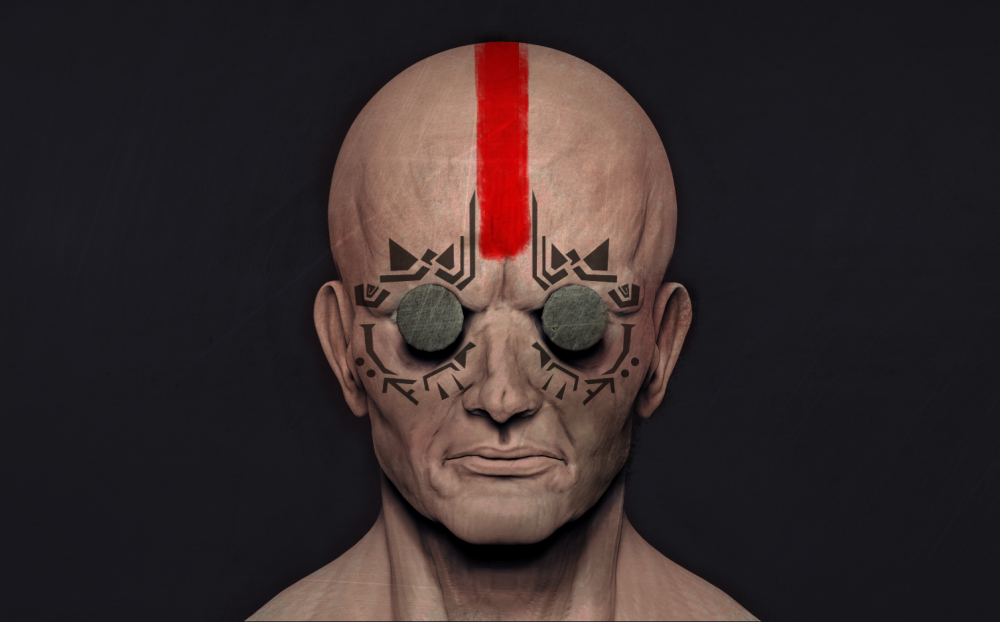
Hey everyone! I need your help to figure out some things about Inquisitors. I've come up against a bit of a wall trying to decide how to represent a few key things, namely: What exactly do the spikes look like? And what clothes do inquisitors wear? To break this down further, I have a few questions about the spikes. As traditionally depicted, the spikes are so thick that when trying to fit them into the eye socket, most of the surrounding flesh would basically have to be destroyed, which seems like it would wreck havoc on the structure of the face. This made me think that maybe the spikes are thinner than we normally think of them. It would certainly make it easier to drive them through the body quickly and keep freedom of movement. That brings me into the next thing: Do the spikes come in varying shapes? If all the spikes are the same length (and we know that the eye spikes span the length of the head and then some as they stick out the back) then spikes in the arms would stick out so far that the bearer might easily impale himself again. Some spikes might also rub against each other inside the body if they are too long (assuming they are placed symmetrically). Lastly, is the type of metal each spike is made out of apparent? Does a pewter spike look different than a bronze spike? Is the Allomantic symbol stamped onto the front? Are these spikes purely utilitarian or are they more like ceremonial objects, carefully crafted? Do the inquisitors polish their spikes? There are a lot of details that don't come up in bare bones descriptions that I feel should be taken into consideration. Next is clothing. I've seen depictions of inquisitors wearing concealing robes and revealing clothes. It seems like no one knew about any spikes besides the eye spikes outside of the inquisitors themselves, so canonically they probably covered up. But design wise showing the spikes and the musculature would be much more imposing. Moreover, what style of clothing do they wear? They were fighters but also figures in a religious institution so both elements should come to bear. This is the base mesh as it stands right now. I don't know how much of the upper body will be shown so I've basically modeled all of it. Spike placements were taken from Ben McSweeney's (Inkthinker) illustration. This is what I mean with the spike thickness thing. I've seen illustrations that show the eyelids stretched around it, but that might look strange in 3D. And here's a quick moc up of some clothes I made. It looks more jedi ish than I'd like. Quick note/edit: I'm not just looking for textual evidence. WoB, or even straight up speculation or just cool ideas would be awesome. Oh also, feedback on the model in general is appreciated too. Update: Alright It's been a little while and I haven't had too much time to work on it, but here's something I threw together for fun just to get an idea of what the finished product will be like. The detailed sculpt is underway, and this is a quick test render with some textures and added color thrown in. The eye tattoos are pretty bad, so that tells me I need to figure out a better look for those.
-
Has it really? Darn, probably should have checked first. Thank you though! I appreciate the feedback.
-
Oh man I hadn't considered polarization. I like that idea though, perhaps it relates to which magic system the investiture manifests as. Like one polarization gives you Allomancy, another gives Awakening etc. This is assuming the wavelength-amplitude model I described though.
-
So I was rereading The Final Empire and something occurred to me during the scene when Marsh teaches Vin tips on bronze. Full disclaimer, I haven't spent nearly enough time thinking this over so it might be shaky; I just thought it was interesting. Firstly, some things that we know: Using Allomancy produces waves that can be sensed by those burning bronze These waves have varying "pulse lengths" and an experienced Seeker can differentiate the metal being burned based on this These waves can vary in strength as well (this seems to be implied when Vin describes pewter as "a bold beat, and quick"). Copper makes these these pulses essentially undetectable within a given radius The enhancement metals can nullify or enhance the affects of Allomancy The first three facts make Allomancy seem suspiciously similar to electromagnetic radiation. There appears to be an Allomantic "spectrum" which Seekers can detect, and the nature of these Allomantic waves is defined by pulse length (wave length) and strength (amplitude of the wave). So my guess is that these waves are not simply a byproduct of Allomancy, but the actual investiture itself propagating through some realmatic field. Viewed in this way, some things begin to make sense. For example, we know that metals themselves do not fuel Allomancy directly, but act as a "catalyst". The mists (raw gaseous investiture, the body of Preservation) fuel Allomancy externally. This can be viewed like white light (investiture) being filtered into one specific wavelength or color (the Allomantic effect). This also gives some insight into how the enhancement metals may work on a realmatic level. Waves can interfere with each other constructively (peaks meet peaks and troughs meet troughs) when two waves are in phase, creating a stronger resultant wave. Or alternatively they can interfere destructively and cancel out (peaks meet toughs and vice versa). So Duralumin for example, may simply be producing a wave that constructively interferes with another Allomantic wave, making a wave with greater amplitude and consequently greater strength. On a similar note, this explains how copper clouds can be pierced. If copper is exploiting destructive interference to cancel out bronze waves, then it is to be expected that any bronze wave with a great enough amplitude will not be canceled out entirely (specifically any amplitude greater than that of the copper wave). *Takes long breath* So, I'm sure this has to be at least somewhat intentional, Brandon does like to make his magic grounded in physics (maybe not to this point but such is the role of a sharder). If I'm right this means investiture is a kind of fundamental force in the Cosmere along with gravity, electromagnetism, and the strong and weak forces. It seems to interact with them all in some way as well (similar to the electro-weak interaction). Take surgebinding, you have the surge of gravitation (force of gravity, duh), the surge of illumination (electromagnetism), the surge of division (possibly the weak force). Additionally investiture does seem to act like radiation in how it reacts with spiritual DNA. Too much of it can damage or mutate your sDNA as seen with savants, and invested objects can alter your spritweb. That's about all I have, I hope it wasn't too technical or I didn't explain it well enough. I'd love to hear your thoughts
-
Hey that's a cool idea! Sorry I missed that
-
You know, you've got a point here. I could potentially see this being the case. Although wouldn't it mean if you left it uninfused for too long it would melt into a shardpuddle?
-
A bond like that also makes sense given that Shardplate has to move along with the body of the wearer. Perhaps, once on, the plate links to your cognitive aspect somehow. This could explain why it automatically conforms to your body shape, and why it falls off once you die. That and the soulcaster thing makes me think all fabrials have a bigger cognitive effect than we realize.
-
Hahaha, this would actually make me quite happy
-
This, I'd forgotten to bring this up. It's always struck me as a little odd, my best guess right now is that the plate is just really good at absorbing the kinetic energy of whatever strikes it, but that doesn't really seem like enough to cause it to melt... You know, maybe it's heating up because all the work (in the energy sense) being done by the stormlight is suddenly changing to heat energy when the stormlight gets cut off, I don't know if that makes sense. But now I'm thinking about investiture in a whole new way. As for the grip of the boots thing, that's something I had completely forgotten about, but that screams surge of abrasion.
-
So recently I finished my re reading of SA, and somewhere into WoK I got into a discussion with some friends about shardplate, and it got me thinking. At this point probably stop reading if you haven't finished Words of Radiance. I'd like to see what people think about shardplate, since it seems it doesn't get as much attention as the other various shards. I had been thinking about the workings of plate, it started with realizing that if shardplate was really made out of metal, it should dent, except it doesn't, it shatters. When I brought this up to my freinds they seemed to think treating plate like a fabrial was silly since doing that in the past turned out to be false (i.e shardblades being spren). They believed that construction of plate was in some way related to the Nahel Bond, as shardblades are. Despite this, I'm pretty sure they are just fabrials. We know the gemstone in a shardblade isn't actually related to its function, but shardplate requires them AND a steady supply of stormlight. If the gemstones aren't infused then the armor is anything but light. And, probably most importantly, everything shardplate does can be related to the surges. Shardplate is metal, yet it shatters instead of deforming, I imagine that is is related to the surge of either tenstion or cohesion, but I can't say for certain since we don't yet know much about those surges. Progression or transformation would allow the plate to regrow from a single piece. The misting of the visor due to illumination. Obviously there's some pretty advanced fabrial science that is beyond our current understanding but as we've seen, the ancients had some pretty wicked knowledge in that department. This brings me to my second topic. History. Recent and not so recent. The vision where dalinar meets Nohadon seems to imply that Bond granted surgebinding was present long before the founding of the Knights Radiant. This is important because I believe shardplate was the hallmark of the Knights and came into existence around the same time. In fact I think this time was one of the few where it's construction was possible given the level of technology at the time. That they managed to construct something as sophisticated as the oathgates makes me think they could manage shardplate. As for recent history, both Kaladin and Renarin seemed to have no problem touching shardplate, which doesn't help the assertion that shardplate is of the spren. Something both my friends were eager to prove. tl;dr: Shardplate is just a very advanced fabrial that was made at the same period as the founding of the KR and the construction of Urithiru.


