CrypticSpren
-
Posts
78 -
Joined
-
Last visited
Content Type
Profiles
News
Forums
Blogs
Gallery
Events
Everything posted by CrypticSpren
-
Orlionra I pray for your sanity. I haven't read All the Pretty Horses but Blood Meridian has traumatized me greatly.
-
Just joined Shard today but have been lurking for a while; may we someday see another poster as prolific as thee.
-
Very sad.
-
I still have everything Selish and Taldanian (??) to get through (except for Emporer's Soul, which I have read), so it's probably going to be a little while before I even consider going back to Keepers of the Lost City. Assuming I can manage to get my hands on Elantris and White Sand that is.
-
I can't stand KOTLC. I made it up to Lodestar before giving up. I felt that There really wasn't anything that the plot was building towards. Sophie is an insufferable Mary Sue Dex, who started off as my favorite character, became a total simp But to each their own I suppose
-
I like this theory a lot: after all, Rithmatics was originally supposed to mirror other Cosmere magic systems. I assume that by "categorization of awakened objects" you mean biochromatic entities. However, I'm hesitant to believe in this theory since Nalizar doesn't really seem to be a Forgotten. I know Coppermind suggests that he is, but Nalizar's chalk entity isn't totally destroyed by acid and is a lot more intelligent than Harding's Forgotten. However, Nalizar's body is also kept and his consciousness is removed, like a forgotten.
-
Is this still a thing? I myself have been trying to make a Rithmatist game using C# in Godot and would be interested to see if we could share. I also suck at coding but it's fun so I still try to do it anyway. Also, I don't think that copyright law should be a problem here since Mr. Sanderson himself said that he's fine with fan games.
-

Easton Defense reverse engineer
CrypticSpren replied to FeruchemicalAbhorsen's topic in The Rithmatist
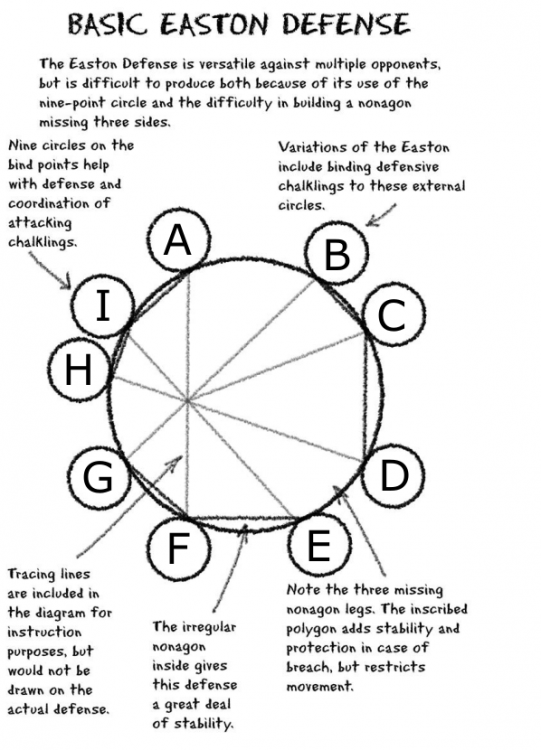
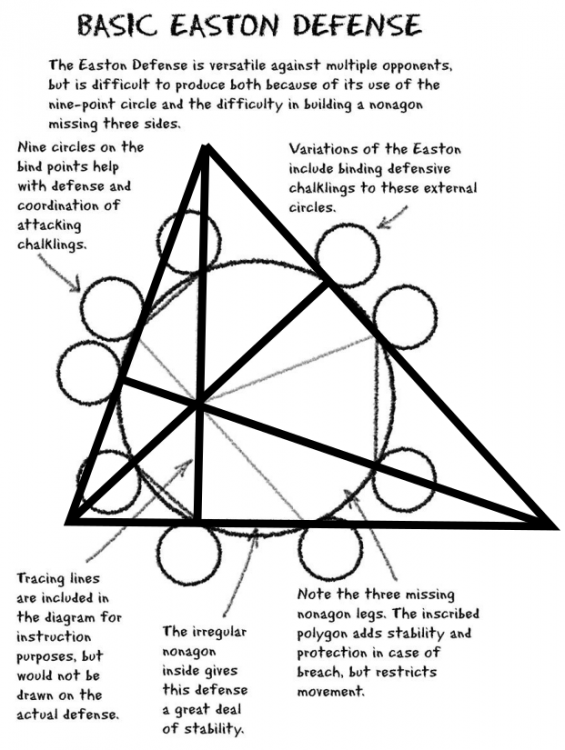
Everyone here is saying that it's not necessary to figure out the exact triangle in the book, and for purely dueling purposes that's true. But it's still worth questioning whether that diagram is any good from a standpoint of plain curiosity. I'm a couple of years late, but I think I've figured it out (attached image) I know Lightning kind of already said this, but the points on a nine-point circle are: The feet of the altitudes (type I points) The midpoints of the segments connecting the orthocenter to the corners of the triangles (type II points) The midpoints of the sides of the triangle (type III points) These types aren't actual geometric terms, but I'm going to use them to explain my methodology. It turns out, there's actually a much easier way to construct a nine-point circle without the triangle. Place three points randomly along a circle. These are the type I points. Bisect the minor arc between each pair of type I points. These are the type II points. Find the points diametrically opposed to each type II point. These are the type III points. With this newfound knowledge, we can jump into our investigation. Let's consider the attached labeling schema. We can pretty much assume that the point towards which all the grey segments are drawn is the orthocenter of the triangle. The chances that four different pairs of points - AF, BG, DH, and EI - are all colinear with a point chosen inside the circle seems far too unlikely to be purely coincidental. However, if that chosen point is the orthocenter, three pairs of points necessarily have this property, as each type I point must have a corresponding type III point along the same altitude. Consequently, we can assume that three of AF, BG, DH, and EI must be altitudes, and one is a fake altitude. Meanwhile, C doesn't have an opposing point, so it must not be along an altitude. Therefore, it is a type III point. Since C is a type III point, the point diametrically opposed to it - G - is a type II point. Thus, the point altitudinally opposed to G - B - must be a type I point. Also since G is a type II point, we know that it is at the center of a minor arc between two type I points. Arcs HF and IE appear to be the only viable candidates. Therefore, either HFB or IEB are the sets of type I points. Out of the two, I thought HFB looked more likely.